1966 · Chevrolet · United States
1966 Chevrolet Impala Super Sport: the 427 arrives
Impala SS falls to 119,314 as the 427 arrives; 3,247 full-size Chevrolets got the 390-hp L36.
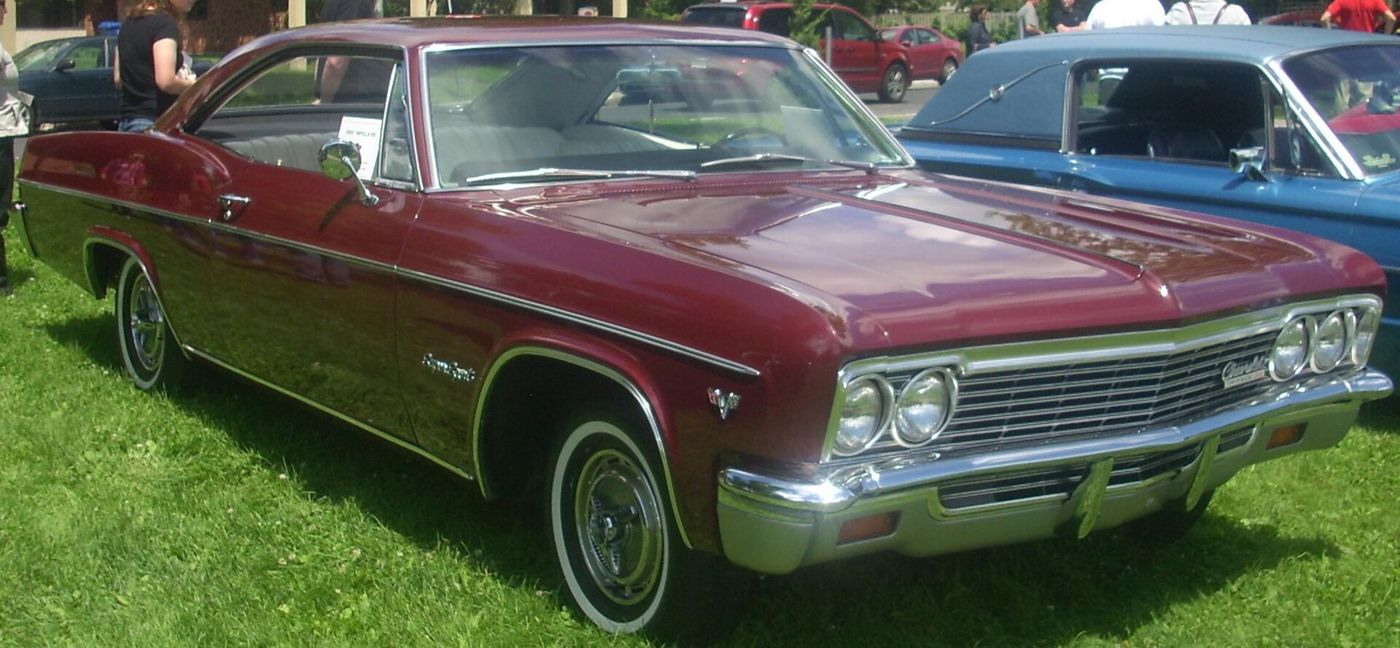

The 427 reached the full-size Chevrolet for 1966, and it arrived in a Super Sport line that was still selling in six figures. The Impala SS Registry lists the year's Super Sports by VIN prefix: 102,619 V8 and 823 six-cylinder sport coupes, and 15,783 V8 and 89 six-cylinder convertibles. Chevrolet's own production records show 3,247 full-size Chevrolets with the L36 427 rated at 390 hp, a count that takes in every full-size car with the engine, Super Sport or not. The 427 was an engine for a few thousand buyers in a year when the Super Sport alone ran past a hundred thousand.1,2,3
The registry calls its figures cars sold, and its four rows add up to 119,314. The Classic Industries production chart rounds the year to 119,300, and Wikipedia's fourth-generation Impala article gives "around 117,000." By any of those counts the hardtop was the Super Sport most buyers wanted: V8 sport coupes outnumbered V8 convertibles by more than six to one, and a six-cylinder SS was a rarity in either body. Around the Super Sport, the Classic Industries chart counts 654,900 non-SS Impalas of all bodies and 181,000 Caprices, the top trim newly introduced for 1966.1,2,4,3
Factory suggested prices covered all four Super Sport combinations: $2,842 for the six-cylinder sport coupe, $2,947 for the V8 sport coupe, $3,093 for the six-cylinder convertible, and $3,199 for the V8 convertible. Every one of those prices sat exactly $158 above the matching plain-Impala price for the same body style and engine, so the Super Sport trim carried the same premium whichever car it was put on. Choosing the V8 added $105 to a sport coupe and $106 to a convertible, and the V8 convertible cost $252 more than the V8 sport coupe. The cheapest Super Sport, the six-cylinder sport coupe, and the dearest, the V8 convertible, were $357 apart.5
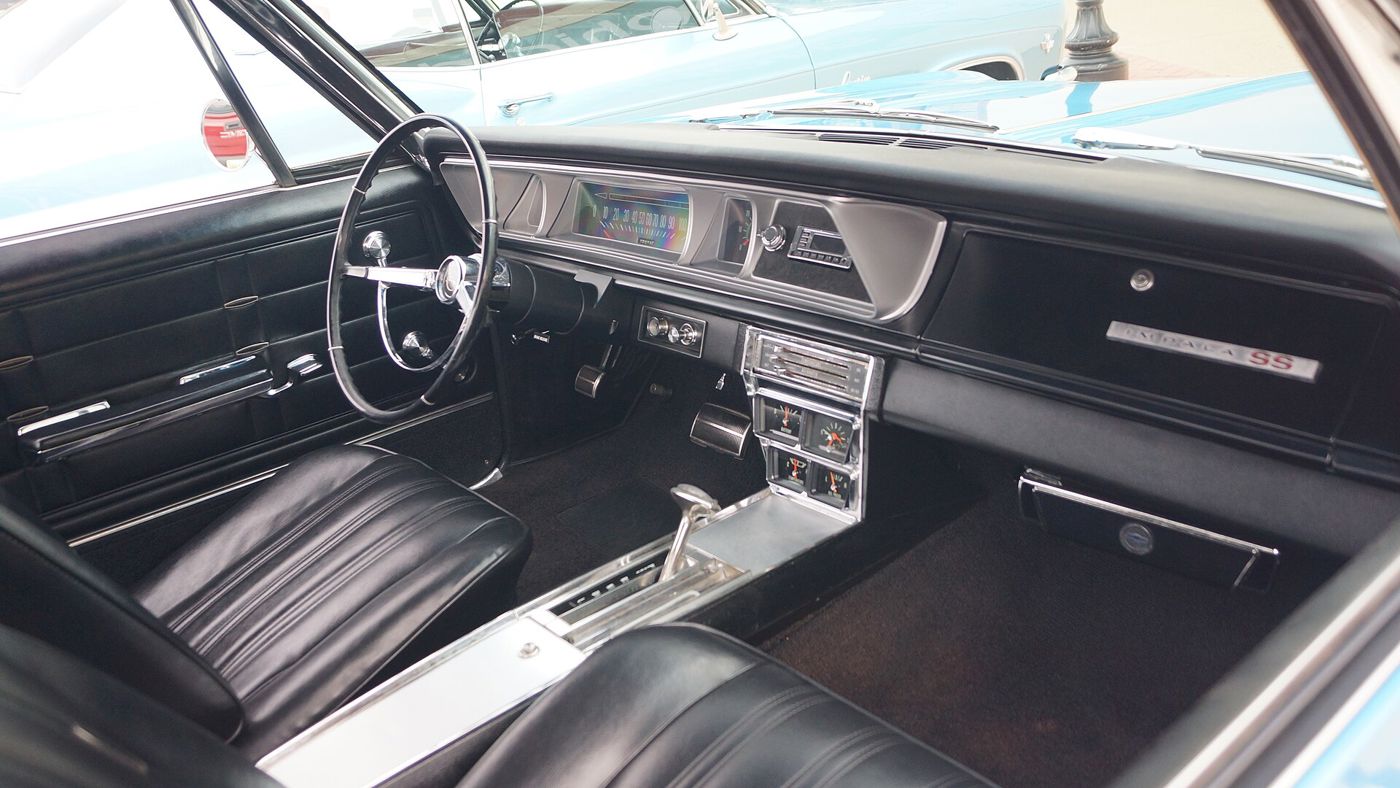

Chevrolet's own regular-production-options list sets out the V8 ladder for the series that included the Impala SS: the L77 283-cu-in V8 at 220 hp, the L30 327 at 275 hp, the L35 396 at 325 hp, the L36 427 at 390 hp, and the L72 427 at 425 hp, alongside K66 full transistor ignition and K30 speed and cruise control. Old Cars Weekly also ties the L36's 390 hp to Chevrolet's production records, while Wikipedia gives 385 hp. The L72 came only with a manual transmission. On Chevrolet's own figures the L36 sat 65 hp above the L35 396 and 35 hp below the L72, so the 427 arrived in two distinct states of tune.3,6
The model numbers tell a 1966 Super Sport apart. Chevrolet's model identification placed the Impala Super Sport in series 167-16800, a four-passenger two-door in both body styles, with 167 marking six-cylinder cars and 168 marking V8s. The VIN prefixes followed the same scheme: 16737 and 16837 for the six-cylinder and V8 sport coupe, and 16767 and 16867 for the six-cylinder and V8 convertible. A 16837 prefix marks the V8 sport coupe, the largest single group at 102,619 cars, and a 16767 prefix the six-cylinder convertible, the smallest at 89.1
Fact sheet · 1966 · United States
The numbers
1966 Chevrolet Impala Super Sport: Impala SS falls to 119,314 as the 427 arrives; 3,247 full-size Chevrolets got the 390-hp L36.
Figures may describe different groups of cars. Add rows together only when the note says they make up a total.
Key facts
Production
| What was counted | Count | Counted as |
|---|---|---|
| Impala SS sport coupe, V8 (16837)1 Super Sport · sport coupe · V8 | 102,619 | sold |
| Impala SS sport coupe, six (16737)1 Super Sport · sport coupe · L6 | 823 | sold |
| Impala SS convertible, V8 (16867)1 Super Sport · convertible · V8 | 15,783 | sold |
| Impala SS convertible, six (16767)1 Super Sport · convertible · L6 | 89 | sold |
| What was counted | Built |
|---|---|
| Impala Super Sport total (rounded)2 Super Sport Rounded; the chart also gives 900 six-cylinder and 118,400 V8. | 119,300 |
| What was counted | Built |
|---|---|
| RPO L36 427/390 hp, all full-size Chevrolets3 all full-size · L36 427 | 3,247 |
| What was counted | Built |
|---|---|
| Impala series (non-SS), all bodies2 all full-size | 654,900 |
| Caprice2 all full-size | 181,000 |
Prices when new
| Model | Price | Price type |
|---|---|---|
| Impala SS Sport Coupe, six-cylinder (16737), factory price5 | $2,842 | factory suggested price, 1966 |
| Impala SS Sport Coupe, V-8 (16837), factory price5 | $2,947 | factory suggested price, 1966 |
| Impala SS Convertible, six-cylinder (16767), factory price5 | $3,093 | factory suggested price, 1966 |
| Impala SS Convertible, V-8 (16867), factory price5 | $3,199 | factory suggested price, 1966 |
Prices are the nominal dollars of the day, not adjusted for inflation.
Engines
| Engine | Factory rating | Availability |
|---|---|---|
| L36 · 427 V83 427 cu in · 4-barrel | 390 hp (SAE gross) | optional |
| L72 · 427 V86 427 cu in · 4-barrel | 425 hp (SAE gross) | optional, manual transmission only per Wikipedia |
Ratings are published figures, not dyno results. Gross and net ratings aren't directly comparable.
Options and packages
| Code | Option |
|---|---|
L77RPO |
283 cu in V8, 220 hp (V8 series incl. Impala SS 16800) |
L30RPO |
327 cu in V8, 275 hp (V8 series incl. 16800) |
L35RPO |
396 cu in V8, 325 hp (V8 series incl. 16800) |
L36RPO |
427 cu in V8, 390 hp (V8 series incl. 16800) |
L72RPO |
427 cu in V8, 425 hp (V8 series incl. 16800) |
K66RPO |
Full transistor ignition (V8 series) |
K30RPO |
Speed and cruise control |
Identification
- VIN prefixes
- 16737/16837 sport coupe (six/V8); 16767/16867 convertible (six/V8).1
- Impala Super Sport model numbers
- Series 167-16800 Impala Super Sport: 16737/16837 two-door sport coupe and 16767/16867 two-door convertible, 4-passenger (167 = six-cylinder, 168 = V8).
Where the sources disagree
Identification
Read a 1966 Chevrolet VIN
The VIN decoder runs in your browser and never sends the VIN anywhere. How the factory numbered this year's cars:
Same model year
Also in 1966
- Buick Riviera A longer, heavier new body on the same X-frame; 5,718 of 45,348 carried the GS option, and the dual-quad Super Wildcat went from dealer add-on to factory MZ engine in March 1966.
- Buick Skylark Gran Sport, GS and GSX The Gran Sport became its own Skylark series (44600) on the restyled body, still with the 401 at 325 hp; 13,816 are tabulated.
- Buick Wildcat The one-year Wildcat Gran Sport: 1,244 built, 242 convertibles, 22 Super Wildcats.
- Chevrolet Chevelle and Malibu SS The first full year of the SS 396 as its own series, with a 396 V8 in every car: 66,843 sport coupes and 5,429 convertibles.
- Chevrolet Chevy II and Nova The source engine table lists the 327 L79 at 350 gross hp. Enthusiast-compiled production: 172,485 cars; Super Sport 20,986.
- Chevrolet El Camino SS The 396 reaches the Chevelle pickup at 325 and 360 hp, still without an SS badge; 35,119 El Caminos built.
- Dodge Charger Dodge's first Charger, a fastback on the Coronet platform introduced on 1 January 1966, built 37,344 times, 468 of them with the new Street Hemi.
- Dodge Coronet R/T and Super Bee The first year the 426 Hemi was sold as a street engine; in the Coronet it was an option on ordinary sedans, hardtops and convertibles, before any R/T package existed.
- Ford Fairlane A new, wider Fairlane could take the 390 big-block for the first time, bringing the Fairlane 500 GT and GTA, and a small run of R-code 427 hardtops was built for Super Stock racing.
- Ford Galaxie The 428 became the big-car performance engine and gave its name to the Galaxie 500 7-Litre hardtop and convertible, with the 427 still available.
- Ford Thunderbird A 345-hp 428 became a $64.77 option, and the Town Landau outsold every other body combined.
- Mercury Comet and Cyclone The Comet moved to the larger Fairlane-based body, and the Cyclone GT brought the 335-hp 390 with twin hood scoops, bucket seats and a heavy-duty suspension.
- Mercury Marauder and S-55 The S-55 returned as its own line, a hardtop and convertible with the 345 hp 428 'Super Marauder' V8.
- Oldsmobile Cutlass, 4-4-2 and Hurst/Olds The 4-4-2 package gained the L69 three-two-barrel 'Tri-Carb' option at 360 hp, and a handful of factory W-30 forced-air cars were built for drag racing.
- Oldsmobile Starfire The last Starfire of the 1960s: coupe only, moved downmarket, 13,019 sold.
- Plymouth Barracuda and 'Cuda The last glassback-era year: one fastback body, the 273 Commando as the top engine, and production that fell to 38,029.
- Plymouth GTX, Belvedere and Satellite The 426 Street Hemi reached showrooms in the Belvedere and Satellite, and 1,546 were built into Plymouth intermediates.
- Pontiac Catalina 2+2 and Super Duty The 2+2 was listed as its own model for the only time, and production fell to 6,383.
- Pontiac GTO The GTO becomes its own Pontiac series and has its biggest year: 96,946 built.
- Pontiac Grand Prix Production fell to 36,757 as the GTO and 2+2 drew performance buyers.
- Pontiac Tempest and LeMans Pontiac's overhead-cam six and the Sprint package arrive beside the 326 HO.
- Rambler and AMC Marlin The Marlin's second year: production fell to 4,547, less than half the 1965 figure.