1966 · Pontiac · United States
1966 Pontiac GTO: The Option Becomes a Series, and the Best Year It Ever Had
The GTO becomes its own Pontiac series and has its biggest year: 96,946 built.
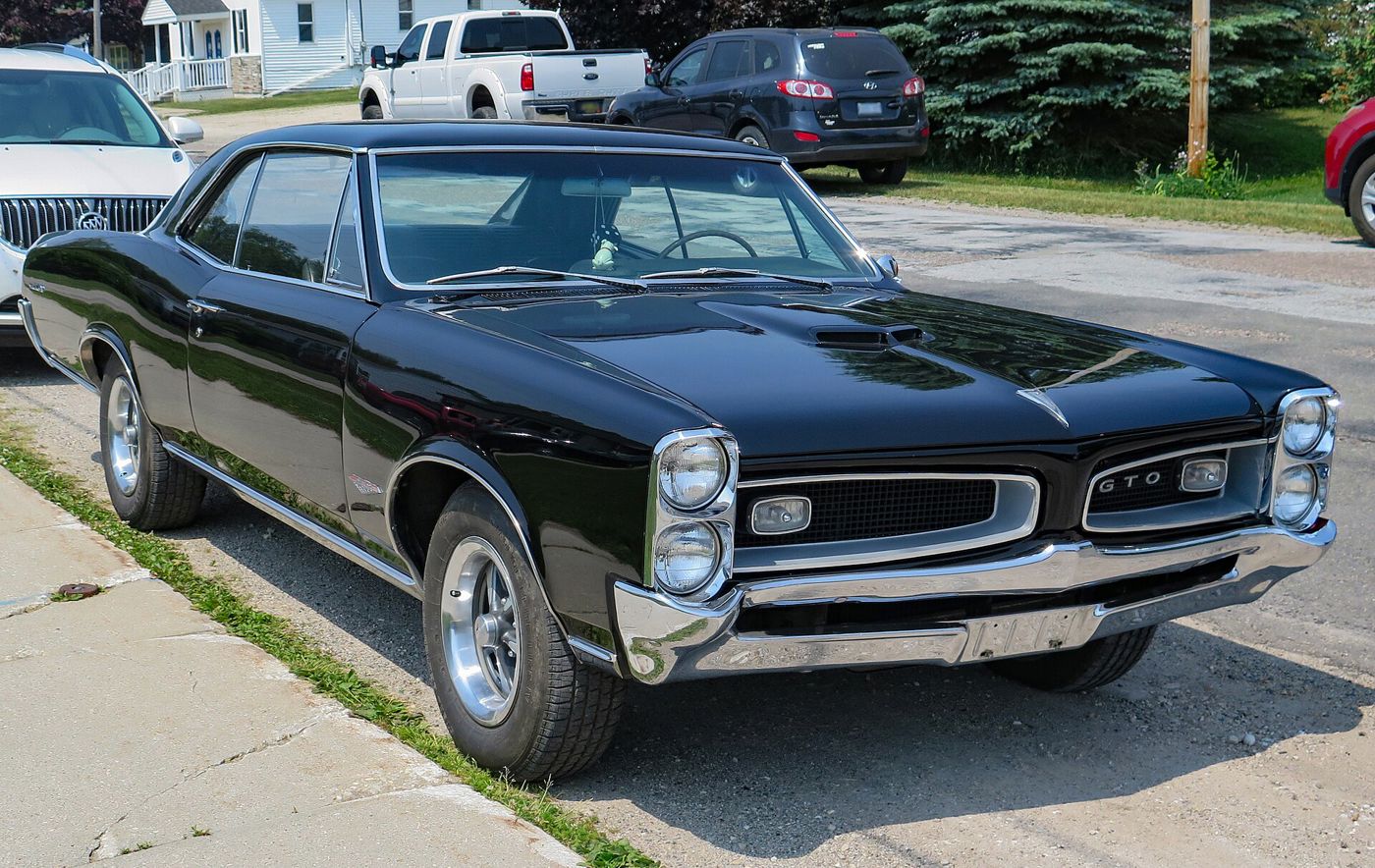

Pontiac introduced its 1966 GTO models to the public on September 27, 1965, and for the first time the three letters did not hang off another car's name. The GTO had its own series number, 242; in 1964 and 1965 it had sat inside the Tempest LeMans series. The division had a new man at the top as well. In 1965 John DeLorean, one of the Pontiac engineers credited with the original GTO, was promoted to head all of Pontiac. At 40 he was the youngest division head General Motors had ever had.1,2,3,4
The promotion from option to series was earned in the showroom. Sales of the facelifted 1965 GTO had jumped to more than 75,000, while Pontiac's total sales topped 801,000; production of the 1965 GTO came to 75,352. The corporation had already bent once to accommodate the car. After the 1964 GTO broke the corporate displacement limit for intermediate A-bodies, general manager Pete Estes was, in Ate Up With Motor's phrase, slapped on the wrist, and the A-body displacement limit was raised to 400 cubic inches. A rule broken by a best-seller had been rewritten around it.5,4
The car that carried the new series number was new metal. The 1966 A-body was more curvaceous, with kicked-up rear fender lines for the Coke-bottle look, a slightly recessed rear window, and a louvered taillight cover used only on the GTO. Width grew to 74.4 inches, and length was 206.4 inches on the unchanged 115-inch wheelbase. There was also a full-length rocker molding, and the interior came in six colors of Morrokide. New Strato bucket seats had higher, thinner backs, and for anyone who wanted the engine bay to shout, option code 522 lined the inner fenders in red plastic.6,7,1
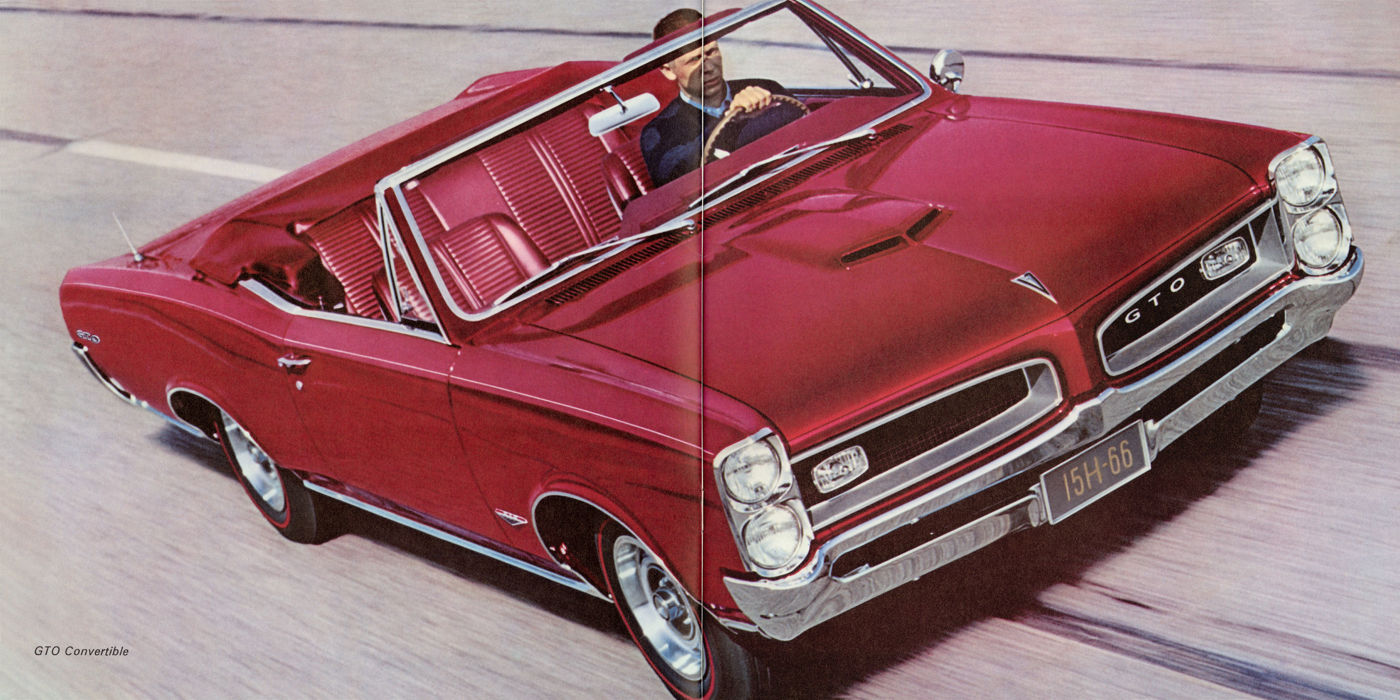
Under the hood Pontiac left the formula alone. The standard 389 with one four-barrel carburetor was rated at 335 hp at 5,000 rpm and 431 lb-ft; the Tri-Power 389, with three two-barrel carburetors on progressive linkage, was rated at 360 hp at 5,200 rpm and 424 lb-ft. Both ran 10.75:1 compression, and both ratings are advertised SAE gross. Tri-Power cost $112.51 on the price list. The triple-carburetor engine had been rated at 348 hp in 1964 before new cylinder heads brought it to 360 for 1965 and 1966. Nothing about the engine choice was new; what was new was how many people now made it.7,6,5
The sharpest tool arrived in January 1966. The XS Ram Air package took the Tri-Power 389, swapped its cam for the long-duration 744 grind, with 301 degrees intake and 313 exhaust, and added stronger valve springs. Pontiac shipped the Ram Air pan separately for the dealer to fit, and the package could be installed at the factory or assembled later from parts. It moved the power peak to 5,600 rpm without any change in the 360 hp rating.6,4,7
A buyer could start at $2,783 for the sport coupe, $2,847 for the hardtop, or $3,082 for the convertible, the factory prices in the compiled table. Motor Trend printed different list prices, $2,826 and $3,059, on its own basis. From there the magazine's price list read like a menu: $182.98 for the all-synchromesh four-speed, $193.44 for the two-speed automatic, $36.60 for a limited-slip axle, $3.71 for heavy-duty suspension, $83.65 for the Rally Cluster with tachometer, and $340.60 for air conditioning. The three-speed manual stayed standard. Tri-Power and the four-speed together, the combination in the quicker of Motor Trend's two test cars, added $295.49.2,7,6
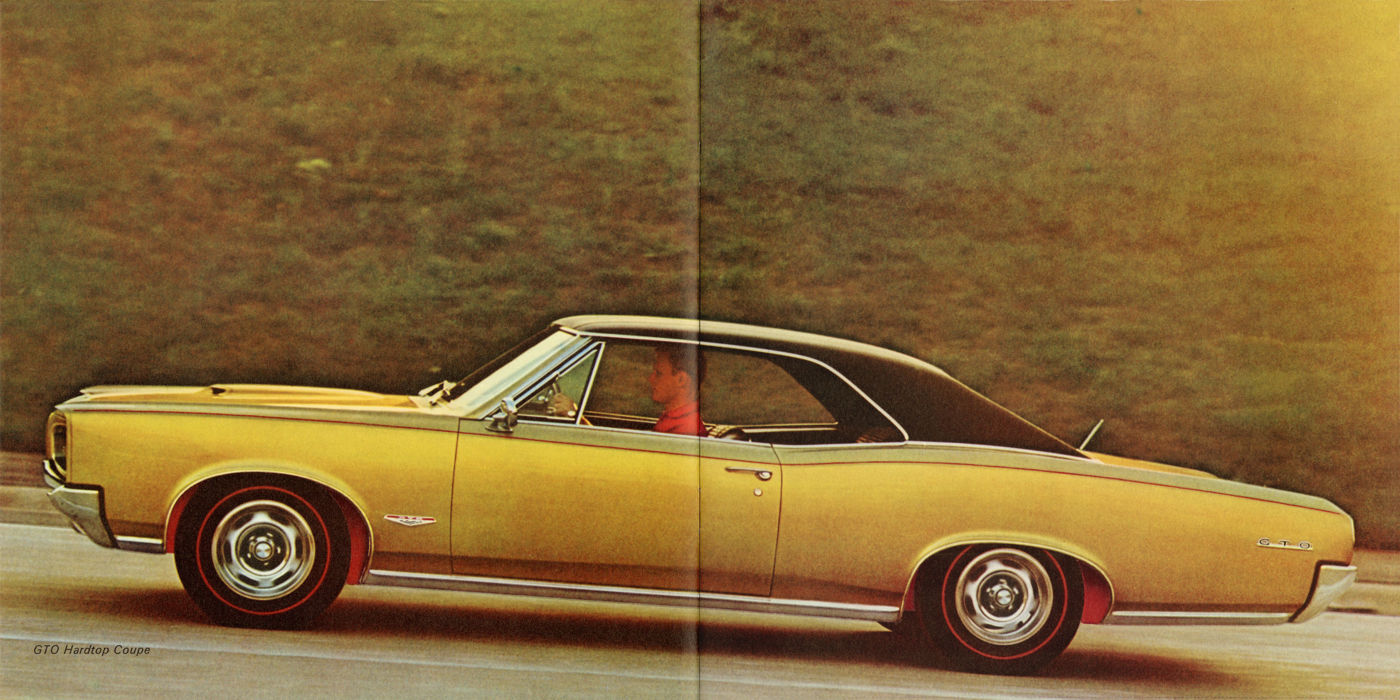
Buyers ordered 96,946 of them, the highest total of any GTO year and about 29 percent more than 1965. The hardtop was the car of the year: 73,785 hardtops, roughly 76 percent of the total. The convertible, $235 dearer than the hardtop, found 12,798 buyers, about 13 percent, and the pillared sport coupe, the least expensive way to get a GTO, accounted for 10,363, about 11 percent.2,4
The rivals had arrived in force. Chevrolet made the Chevelle SS 396 its own series for 1966, with a 396 in every car, and built 66,843 sport coupes and 5,429 convertibles. Oldsmobile answered Tri-Power directly with the L69 4-4-2, three two-barrels and 360 hp; 2,129 L69 cars were built among 24,180 4-4-2s. In March 1966 Car and Driver ran six of these cars, the GTO, SS 396, 4-4-2, Skylark Gran Sport, Fairlane GT/A and Comet Cyclone GT, at the Westhampton drag strip and the Bridgehampton circuit with Masten Gregory driving. Its GTO was a Royal Bobcat car, and the magazine noted that the three most stock entries gave the least trouble.8,9,10
Motor Trend's May 1966 test, 'A Tale of the Tiger, Told Twice,' put two press GTOs side by side and showed how much the order form mattered. A 335 hp hardtop with the two-speed automatic and 3.23 gears ran 0-60 mph in 7.5 seconds and the quarter mile in 15.6 seconds at 90 mph. A 360 hp Tri-Power convertible with the close-ratio four-speed and 3.55 gears, heavier at a 3,720-pound curb weight, did 0-60 in 6.8 seconds and ran 15.50 seconds at 93.16 mph at Carlsbad Raceway. On the standard 9.5-inch drums it stopped from 60 mph in 136 feet. Those figures belong to those two cars, which listed at $3,677.43 and $3,917 as tested.7
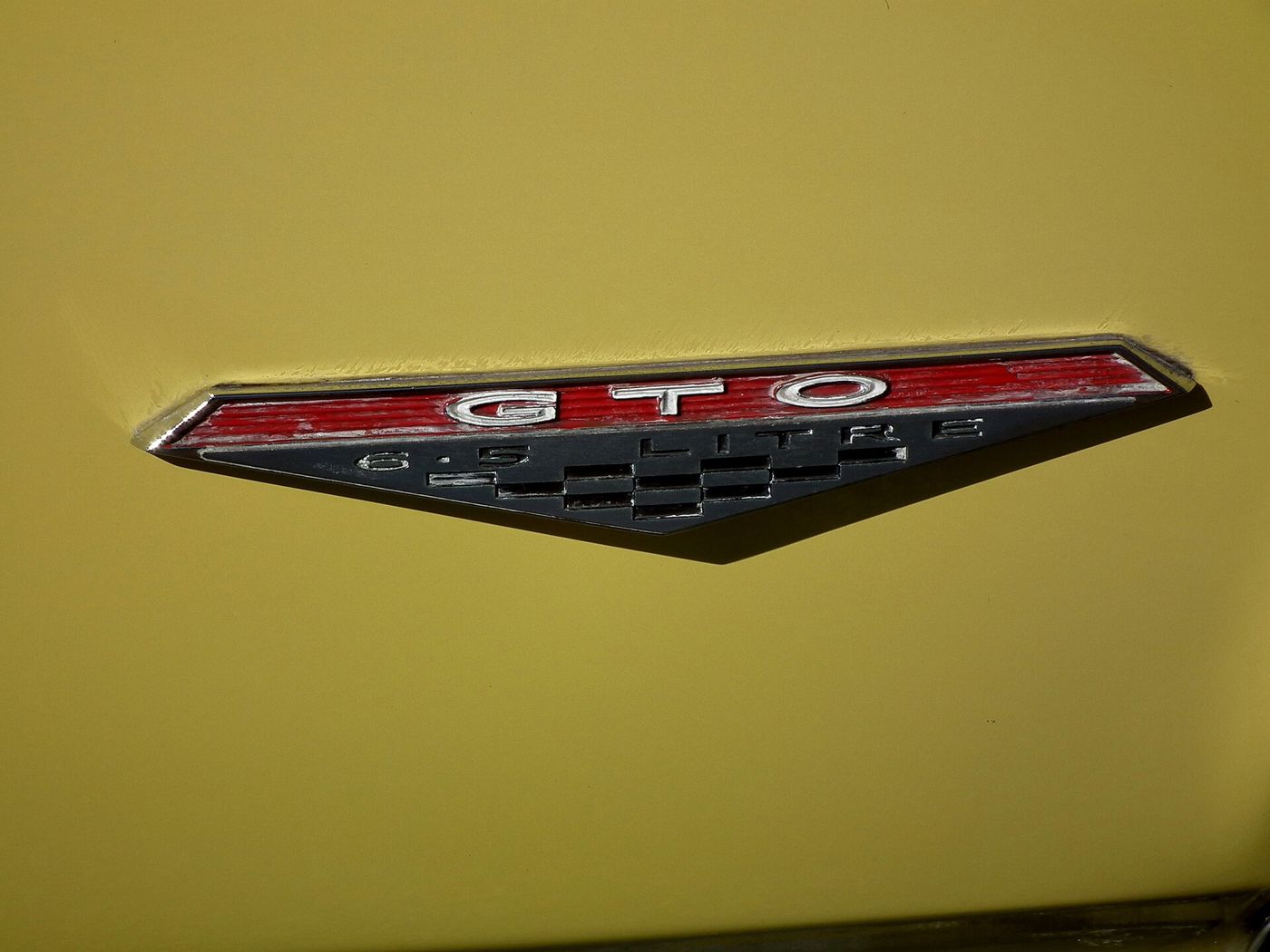

Pontiac sold the car as much as it built it. When tire supplier U.S. Royal branded its new red-line tire the Tiger Paw, it approached Pontiac about a cross-promotion, and Jim Wangers followed with GTO cologne and aftershave from Max Factor, GTO driving shoes from Thom McAn, and a GTO on the new Monkees television series. The slogans 'Speak softly and carry a GTO' and 'The Great One' ran in Car Craft, Car and Driver and Hot Rod. Not everyone at General Motors was charmed. GM president James Roche told DeLorean to tone down the tiger advertising.5,1
The 1966 car also turned out to be the last of a line. General Motors issued a ban on multiple carburetors for every car except, in Ate Up With Motor's account, Chevrolet's Corvair and Corvette, and the ban put an end to Pontiac's popular Tri-Power. The 1967 GTO arrived with the engine bored to 400 cubic inches and no triple two-barrels on the list, and production fell to 81,722. No later GTO year matched the 1966 total. For one year the option that had broken a corporate rule was Pontiac's own series, its three carburetors still legal, and nearly 97,000 buyers took one home.5,4
Fact sheet · 1966 · United States
The numbers
1966 Pontiac GTO: The GTO becomes its own Pontiac series and has its biggest year: 96,946 built.
Figures may describe different groups of cars. Add rows together only when the note says they make up a total.
Key facts
Production
| What was counted | Built |
|---|---|
| GTO total, all bodies2,4 GTO | 96,946 |
| What was counted | Built |
|---|---|
| GTO two-door sport coupe2 GTO · 2-door sport coupe | 10,363 |
| GTO two-door hardtop2 GTO · 2-door hardtop | 73,785 |
| GTO convertible2 GTO · convertible | 12,798 |
Prices when new
| Model | Price | Price type |
|---|---|---|
| GTO sport coupe2 | $2,783 | factory price, 1966 model year |
| GTO hardtop2 | $2,847 | factory price, 1966 model year |
| GTO convertible2 | $3,082 | factory price, 1966 model year |
| GTO hardtop, manufacturer's suggested list price by Motor Trend7 | $2,826 | MSRP including taxes, 1966-05 |
| GTO convertible, manufacturer's suggested list price by Motor Trend7 | $3,059 | MSRP including taxes, 1966-05 |
| Price as tested, Motor Trend 335 hp automatic hardtop7 | $3,677.43 | as tested incl. excise tax, 1966-05 |
| Price as tested, Motor Trend 360 hp four-speed convertible7 | $3,917 | as tested incl. excise tax, 1966-05 |
Prices are the nominal dollars of the day, not adjusted for inflation.
Engines
| Engine | Factory rating | Availability |
|---|---|---|
| 389 4-bbl (standard)7,6 389 cu in · Carter AFB four-barrel | 335 hp @ 5,000, 431 lb-ft @ 3,200 (SAE gross) | standard |
| 389 Tri-Power7,6 389 cu in · three Rochester two-barrel carburetors, progressive linkage | 360 hp @ 5,200, 424 lb-ft @ 3,600 (SAE gross) | optional |
| XS · 389 Tri-Power with Ram Air package6,7 389 cu in · three two-barrel carburetors, functional scoop | 360 hp @ 5,200, 424 lb-ft @ 3,600 (SAE gross) | optional, late in the year; factory-installed or as parts |
Ratings are published figures, not dyno results. Gross and net ratings aren't directly comparable.
Transmissions
| Transmission | Availability |
|---|---|
| Three-speed manual6 | standard |
| Four-speed manual, all-synchromesh (close-ratio with Hurst linkage on the Motor Trend convertible)7 | optional, $182.98 as listed by Motor Trend |
| Two-speed automatic7 | optional, $193.44 as listed by Motor Trend |
Options and packages
| Code | Option | Price |
|---|---|---|
| 360 hp Tri-Power engine7 | $112.51 | |
| Limited-slip differential7 | $36.60 | |
| Heavy-duty suspension7 | $3.71 | |
| Power brakes7 | $41.30 | |
| Power steering7 | $94.10 | |
| Air conditioning7 | $340.60 | |
| AM/FM radio7 | $132.79 | |
| Tachometer (in Rally Cluster)7 | $83.65 | |
| Vinyl roof cover7 | $83.65 | |
| Head rests7 | $52.28 | |
522order code |
Red plastic inner fender liners6 |
Paint
| Code | Color |
|---|---|
A |
Starlight Black6 |
B |
Blue Charcoal6 |
C |
Cameo Ivory6 |
D |
Fontaine Blue6 |
E |
Nightwatch Blue6 |
H |
Palmetto Green6 |
K |
Reef Turquoise6 |
L |
Marina Turquoise6 |
N |
Burgundy6 |
O |
Coronado Gold6 |
P |
Barrier Blue6 |
R |
Montero Red6 |
T |
Martinique Bronze6 |
V |
Mission Beige6 |
W |
Platinum6 |
Y |
Candlelight Cream6 |
Color names are the factory's. We don't show color swatches, because a screen color is no guide for a restoration.
Interiors
| Code | Trim |
|---|---|
219,232 |
Blue (vinyl, per the page's key) [GTO & Tempest LeMans trim list]11 |
220 |
Turquoise (vinyl, per the page's key) [GTO & Tempest LeMans trim list]11 |
221,233 |
Fawn (vinyl, per the page's key) [GTO & Tempest LeMans trim list]11 |
222 |
Red (vinyl, per the page's key) [GTO & Tempest LeMans trim list]11 |
223,231 |
Black (vinyl, per the page's key) [GTO & Tempest LeMans trim list]11 |
224 |
Parchment (vinyl, per the page's key) [GTO & Tempest LeMans trim list]11 |
228 |
Black (cloth, vinyl, per the page's key) [GTO & Tempest LeMans trim list]11 |
Specifications
| Measure | Value | Applies to |
|---|---|---|
| Wheelbase2,7 | 115 in | all GTO bodies |
| Overall length7 | 206.4 in | hardtop and convertible by Motor Trend |
| Shipping weight, sport coupe2 | 3,445 lb | sport coupe |
| Shipping weight, hardtop2 | 3,465 lb | hardtop |
| Shipping weight, convertible2 | 3,555 lb | convertible |
| Compression ratio7 | 10.75:1 | both 389 engines |
| Brake drum diameter, front and rear7 | 9.5 in | standard brakes |
Period road tests
| Test | Car tested | Result |
|---|---|---|
| Motor Trend, 1966-0570-60 mph | GTO hardtop, 389 4-bbl (335 hp gross), two-speed automatic, 3.23 axle, 7.75x142 aboard; curb weight 3,620 lb | 7.5 s |
| Motor Trend, 1966-057standing quarter mile | GTO hardtop, 389 4-bbl (335 hp gross), two-speed automatic, 3.23 axle, 7.75x1490 mph trap speed; street tires | 15.6 s |
| Motor Trend, 1966-0570-60 mph | GTO convertible, 389 Tri-Power (360 hp gross), close-ratio four-speed, 3.55 axle, 7.75x142 aboard; curb weight 3,720 lb | 6.8 s |
| Motor Trend, 1966-057standing quarter mile | GTO convertible, 389 Tri-Power (360 hp gross), close-ratio four-speed, 3.55 axle, 7.75x1493.16 mph trap speed; Carlsbad Raceway; street tires | 15.5 s |
| Motor Trend, 1966-057stopping distance from 60 mph | GTO convertible, 389 Tri-Power, four-speed, 3.55 axlestandard 9.5 in drum brakes | 136 ft |
A road test result belongs to the one car that was tested, with its engine, gearing, tires, and conditions. It is not a figure for every car of the year.
Identification
- Body (cowl) plate
- Body (cowl) plate riveted to the top left cowl under the hood. It carries the build date (month 01-12 and week A-E), the style number (year, series and body style), the body number (assembly-plant prefix and production sequence), the trim code, the lower and upper paint codes, and factory accessory codes. The page's example plate reads: Build Date 04B; Style 66-24217; Body PON21XXX; Trim 223-B; Paint N-2; ACC. WXS 2KWG.11
- Body-plate assembly-plant codes
- BA = Doraville, GA; BT = Arlington, TX; BC = Southgate, CA; BW = Wilmington, DE; BK = Kansas City, KS; EUC = Euclid, OH; BL = Linden, NJ; PON = Pontiac, MI.11
Identification
Read a 1966 Pontiac VIN
The VIN decoder runs in your browser and never sends the VIN anywhere. How the factory numbered this year's cars:
Same model year
Also in 1966
- Buick Riviera A longer, heavier new body on the same X-frame; 5,718 of 45,348 carried the GS option, and the dual-quad Super Wildcat went from dealer add-on to factory MZ engine in March 1966.
- Buick Skylark Gran Sport, GS and GSX The Gran Sport became its own Skylark series (44600) on the restyled body, still with the 401 at 325 hp; 13,816 are tabulated.
- Buick Wildcat The one-year Wildcat Gran Sport: 1,244 built, 242 convertibles, 22 Super Wildcats.
- Chevrolet Chevelle and Malibu SS The first full year of the SS 396 as its own series, with a 396 V8 in every car: 66,843 sport coupes and 5,429 convertibles.
- Chevrolet Chevy II and Nova The source engine table lists the 327 L79 at 350 gross hp. Enthusiast-compiled production: 172,485 cars; Super Sport 20,986.
- Chevrolet El Camino SS The 396 reaches the Chevelle pickup at 325 and 360 hp, still without an SS badge; 35,119 El Caminos built.
- Chevrolet Impala SS Impala SS falls to 119,314 as the 427 arrives; 3,247 full-size Chevrolets got the 390-hp L36.
- Dodge Charger Dodge's first Charger, a fastback on the Coronet platform introduced on 1 January 1966, built 37,344 times, 468 of them with the new Street Hemi.
- Dodge Coronet R/T and Super Bee The first year the 426 Hemi was sold as a street engine; in the Coronet it was an option on ordinary sedans, hardtops and convertibles, before any R/T package existed.
- Ford Fairlane A new, wider Fairlane could take the 390 big-block for the first time, bringing the Fairlane 500 GT and GTA, and a small run of R-code 427 hardtops was built for Super Stock racing.
- Ford Galaxie The 428 became the big-car performance engine and gave its name to the Galaxie 500 7-Litre hardtop and convertible, with the 427 still available.
- Ford Thunderbird A 345-hp 428 became a $64.77 option, and the Town Landau outsold every other body combined.
- Mercury Comet and Cyclone The Comet moved to the larger Fairlane-based body, and the Cyclone GT brought the 335-hp 390 with twin hood scoops, bucket seats and a heavy-duty suspension.
- Mercury Marauder and S-55 The S-55 returned as its own line, a hardtop and convertible with the 345 hp 428 'Super Marauder' V8.
- Oldsmobile Cutlass, 4-4-2 and Hurst/Olds The 4-4-2 package gained the L69 three-two-barrel 'Tri-Carb' option at 360 hp, and a handful of factory W-30 forced-air cars were built for drag racing.
- Oldsmobile Starfire The last Starfire of the 1960s: coupe only, moved downmarket, 13,019 sold.
- Plymouth Barracuda and 'Cuda The last glassback-era year: one fastback body, the 273 Commando as the top engine, and production that fell to 38,029.
- Plymouth GTX, Belvedere and Satellite The 426 Street Hemi reached showrooms in the Belvedere and Satellite, and 1,546 were built into Plymouth intermediates.
- Pontiac Catalina 2+2 and Super Duty The 2+2 was listed as its own model for the only time, and production fell to 6,383.
- Pontiac Grand Prix Production fell to 36,757 as the GTO and 2+2 drew performance buyers.
- Pontiac Tempest and LeMans Pontiac's overhead-cam six and the Sprint package arrive beside the 326 HO.
- Rambler and AMC Marlin The Marlin's second year: production fell to 4,547, less than half the 1965 figure.