1966 · Dodge · United States
1966 Dodge Charger: The Fastback That Brought the Street Hemi Home
Dodge's first Charger, a fastback on the Coronet platform introduced on 1 January 1966, built 37,344 times, 468 of them with the new Street Hemi.
United States · researched through 2026-09-23
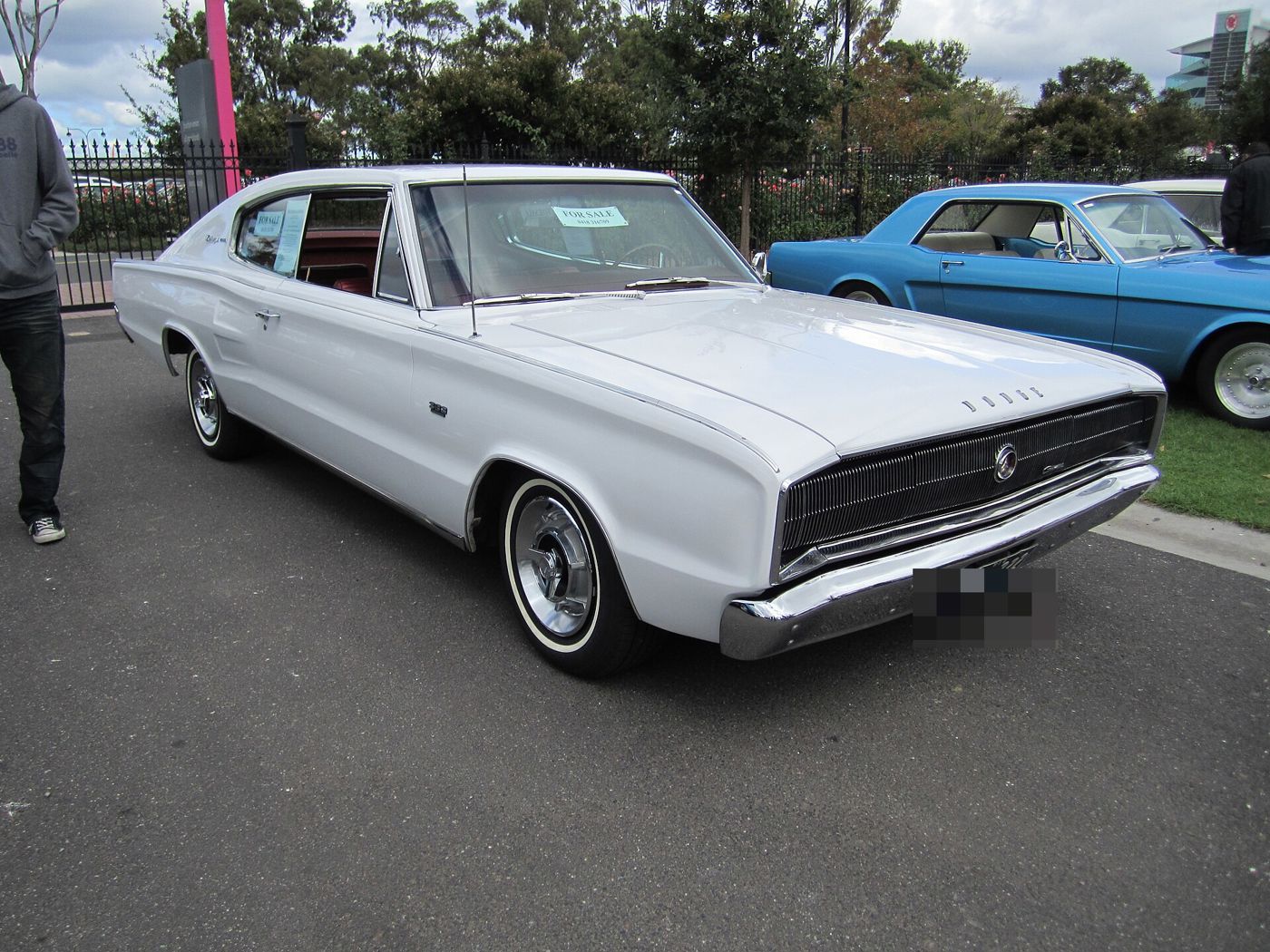
The first Charger was born beside a boycott. Dodge's heritage history records that in 1965 NASCAR banned the Hemi because it did not meet new rules requiring engines to be available for series production, and that Chrysler sat out the racing season in protest. Until then the 426 Hemi had been a competition engine: Newhardt and Holmstrom count 101 strictly-for-racing Hemi Coronets for 1965. The way back to the racetrack ran through the showroom. For 1966 Chrysler put a street version of the Hemi on the regular option list, and on January 1, 1966, Dodge introduced a new car that offered it at the top of its engine list: the Charger, a fastback with its own body on the Coronet chassis.1,2
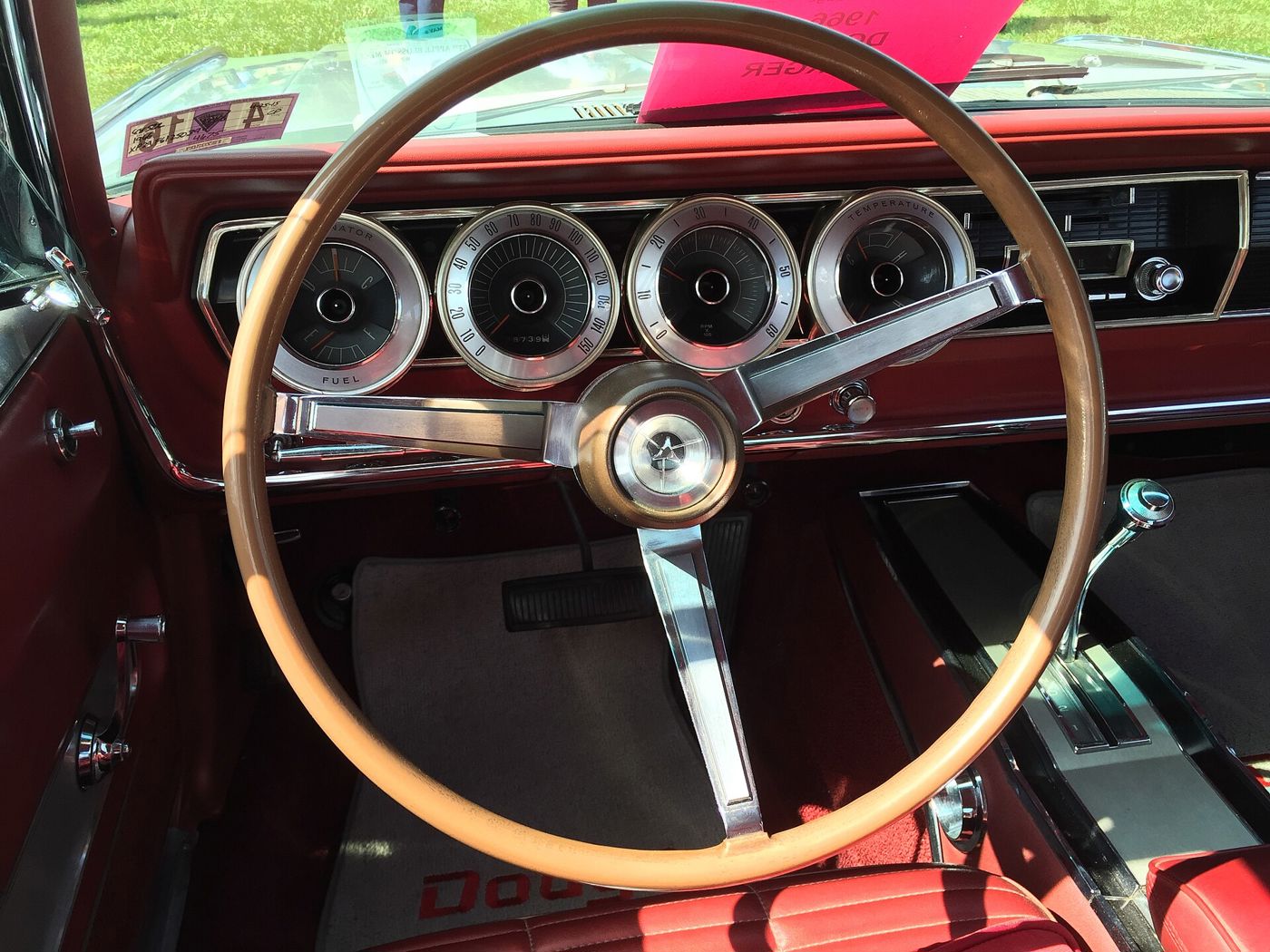
The shape had been waiting for some time. Ate Up With Motor traces it to a styling study by designer Carl Cameron in the summer of 1963, and says the car was rushed into production to compete with the Ford Mustang. What reached showrooms was what Ate Up calls a specialty car. Dodge's heritage history calls it the brand's first production fastback and describes an interior with four bucket seats and a full-length centre console; Ate Up adds full instrumentation and folding rear seats. The factory brochure built the car's identity around the fastback and that four-seat interior.3,1
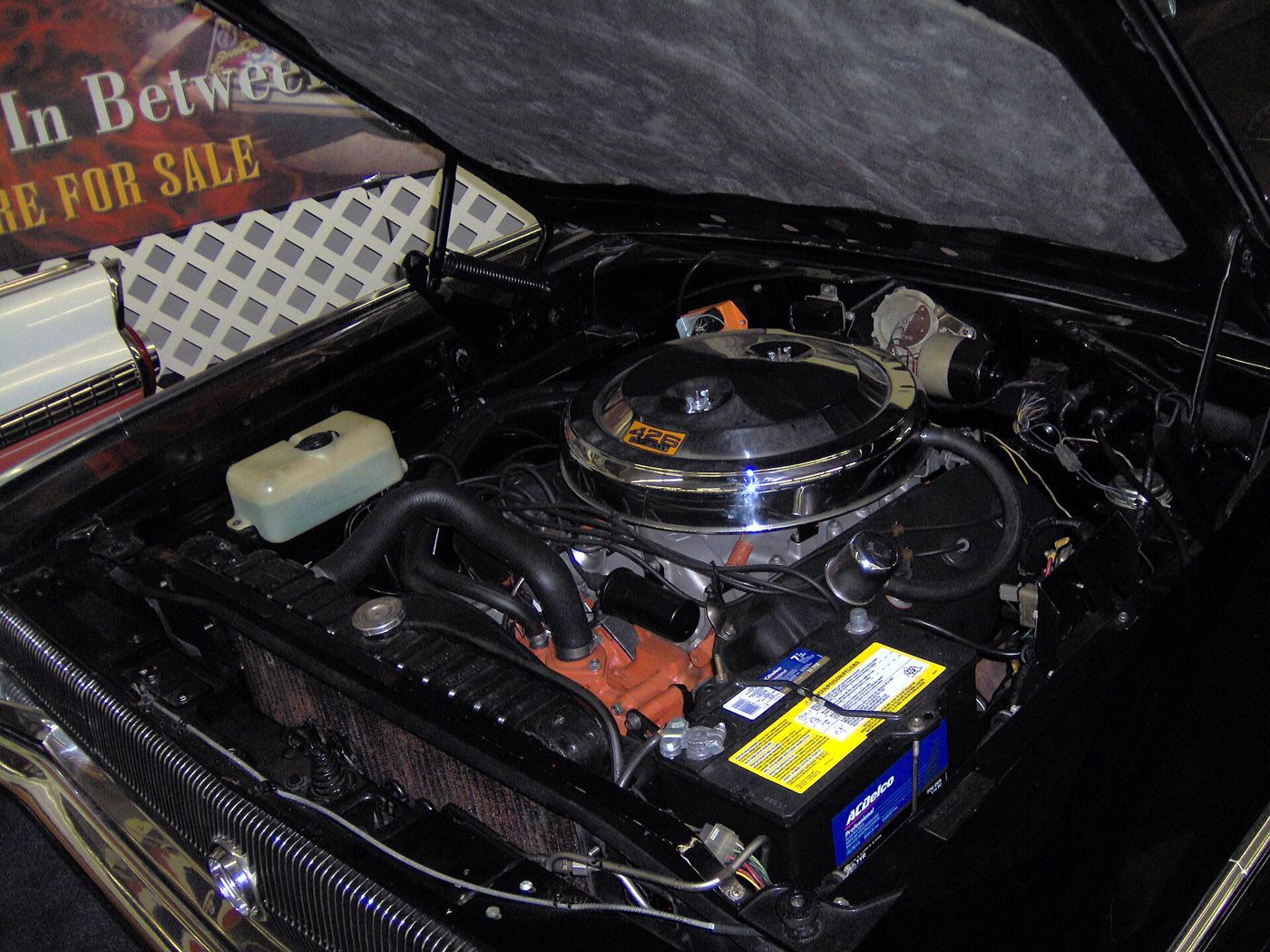
The engine list ran from sensible to spectacular. Dodge's heritage account gives a 230 hp 318 V-8 as standard, with a 265 hp 361 and a 325 hp 383 above it, and at the top the 426 Street Hemi, rated at 425 hp and 490 lb-ft. Those are period gross ratings as Dodge now reports them, not chassis measurements. The Hemi was not a casual choice: Ate Up With Motor puts its price at $877. The Charger's own base price is not settled, since two books print different figures without a basis, so it remains an open question rather than a guess.1,3
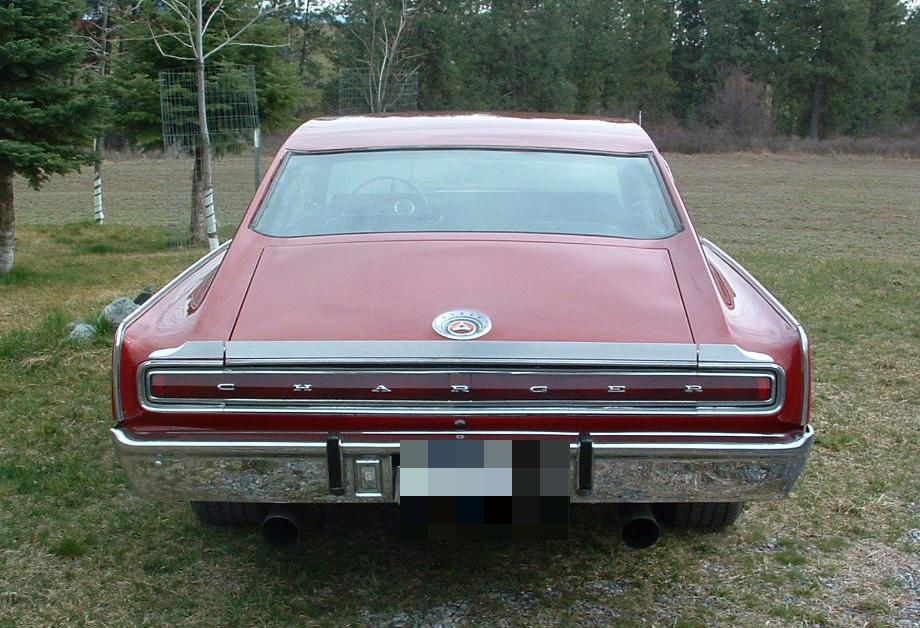
The first model year was short, and it was the Charger's best until the redesign. Automotive Industries, Mueller and Langworth all give 37,344 Chargers for 1966, every one a fastback. The Hemi was a rarity inside that total. Newhardt and Holmstrom count 468 Hemi Chargers, 1.2 percent of the year's buyers, and Mueller splits them into 250 four-speeds and 218 TorqueFlite automatics. Mueller and Glatch's later book repeats the 468. For the other engines no documented count exists: nobody has yet published a sourced split of 318, 361 and 383 cars for 1966, so the story of the other 98.8 percent of Chargers has to be told without numbers.4,5,6,2,7,8
Not every history agrees on the Hemi cars. Ate Up With Motor prints 438 Hemi Chargers for 1966 and describes the four-speed as mandatory with the engine. Both claims run against the production tables, which count 468 cars and 218 of them with an automatic. The automatic split matters more than the 30-car difference in the total. If Mueller's figures are right, almost half of the first Street Hemi Chargers, 47 percent, were ordered with TorqueFlite, evidence that Chrysler's racing engine was being ordered as a road car. NASCAR's series-production rule required ordinary customers to be able to buy the engine; the automatic Hemi Chargers show that some of them did.3,7,1
On the track the fastback proved a mixed blessing. Ate Up With Motor reports that the Charger suffered from excessive lift at speed and that a rear-deck spoiler was added at the last minute to steady it. The result still counted. According to the same history, David Pearson drove a Charger to the 1966 NASCAR Grand National championship, although Ford took the manufacturers' title. The pattern would repeat itself for years: a Charger shape chosen for the showroom that had to be corrected for the superspeedway, and a correction that then became part of the car's identity. The 1969 Charger 500 and Daytona were, in that sense, later chapters of a story that began with the 1966 spoiler.3
In the showroom the Charger never became the Mustang fighter its rushed launch suggested. Ate Up With Motor counts 53,132 Chargers across 1966 and 1967, a little under 5 percent of Dodge's volume, against nearly 180,000 GTOs and more than a million Mustangs in the same two years. The production tables tell the same story in sharper form. Mueller gives 15,788 Chargers for 1967, and with the 37,344 of 1966 that makes exactly the site's two-year total. The fall from the first year to the second was 58 percent. Whatever its merits, the first Charger was a minor seller by the standards of the cars it was measured against.3,7,5
The second year made the first one look better. For 1967 Dodge carried the fastback over with small front-fender turn indicators, a new vinyl-roof option and newly mandated safety equipment, including a collapsible steering column and a dual-circuit master cylinder. Production fell to 15,788, of which Mueller and Glatch count 14,666 as domestic. The Hemi fell harder still, from 468 cars to 117 by Mueller and Glatch's count, or 118 by Gunnell's. Meanwhile a new engine found more buyers than the Hemi ever had in the Charger: Mueller and Glatch record 660 Chargers with the 440 Magnum in its first year. That shift, from the exotic racing engine to the big, simple wedge, pointed directly at the car Dodge would build next.1,8,9
What the first Charger did establish was a place in the lineup for a Dodge that led with style and backed it with the biggest engine Chrysler would sell. That combination outlived the fastback. Dodge replaced it for 1968 with the double-diamond body and an R/T built around the 440, and Ate Up With Motor reports 96,108 sold that year, nearly double the first generation's two-year total. The Street Hemi stayed on the Charger's option list through 1971, which Dodge's heritage history describes as the last year a buyer could order a factory Hemi Charger. The 468 Hemi cars of 1966 were the first of that line: the kind of showroom production NASCAR had demanded before it would let the engine race.3,1,2
Fact sheet · 1966 · United States
The numbers
1966 Dodge Charger — Dodge's first Charger, a fastback on the Coronet platform introduced on 1 January 1966, built 37,344 times, 468 of them with the new Street Hemi.
Coverage: Partial — researched sections are shown; missing ones are not yet sourced. Researched through 2026-09-23.
Every figure is labeled with how sure we are. Reported means a manufacturer, registry, or reference figure we cite but have not reconciled against factory records ourselves. Disputed means credible sources disagree and both are shown. Rows are separately scoped; don't add them together unless the note says they make up a total.
Key facts
- 1966 Charger production: 37,344, all fastbacks.4,5,6
- 426 Hemi Chargers: 468 (250 four-speed, 218 automatic).7,8
- Introduced 1 January 1966.1
- The factory catalogue lists 16 acrylic-enamel colours and six Cologne-grain vinyl interior colours (blue, saddle tan, red, white, citron-gold, black) for the 1966 Charger.
Production
| What was counted | Count | Basis | Status |
|---|---|---|---|
| Charger fastback, all engines4,5,6 Charger · 2-door fastback hardtop · US production statistics Several books round to 37,300. The sources may share Ward's/industry lineage. | 37,344 | built, model-year | Reported |
| Charger (Over-Drive production table, rounded)10 2-door fastback hardtop · not stated Rounded to the hundred; Over-Drive's table notes use 'calendar year 1966' wording and do not state the accounting basis. Consistent with the 37,344 row; its lineage is not stated. | 37,300 | built, model-year | Reported |
| What was counted | Count | Basis | Status |
|---|---|---|---|
| Charger, 426 Hemi7,2 Charger · 2-door fastback hardtop · 426 Hemi 2x4-bbl · not stated | 468 | built, model-year | Reported |
| What was counted | Count | Basis | Status |
|---|---|---|---|
| Charger, 426 Hemi, 4-speed7 Charger · 2-door fastback hardtop · 426 Hemi 2x4-bbl · 4-speed manual · not stated | 250 | built, model-year | Reported |
| Charger, 426 Hemi, TorqueFlite7 Charger · 2-door fastback hardtop · 426 Hemi 2x4-bbl · 3-speed automatic · not stated | 218 | built, model-year | Reported |
Rows are separately scoped; do not add them.
No sourced 1966 counts were found for the 318, 361 or 383 engines.
Over-Drive's 1966 mid-size table gives the whole mid-size line (Coronet series plus Charger) as 260,500, rounded; it is not a Charger figure.
Prices when new
| Model | Price | Basis |
|---|---|---|
| Base price, Charger 2-door fastback hardtop (V-8)10 | $3,122 | base price as tabulated by Over-Drive (manufacturer's suggested retail), 1966 model year |
Prices are the nominal dollars of the day, not adjusted for inflation.
Engines
| Engine | Factory rating | Availability | Built |
|---|---|---|---|
| 318 V-81,11 318 cu in · 2-barrel | 230 hp (as stated by Stellantis retrospective (period gross)); 230 hp @ 4,400, 340 lb-ft @ 2,400 (SAE gross (AMA 'publishing max bhp', corrected to 60 F and 29.92 in Hg)) | standard | Not yet sourced |
| 361 V-81,11 361 cu in · 2-barrel | 265 hp (as stated by Stellantis retrospective (period gross)); 265 hp @ 4,400, 380 lb-ft @ 2,400 (SAE gross (AMA 'publishing max bhp')) | optional | Not yet sourced |
| 383 V-81,11 383 cu in · 4-barrel | 325 hp (as stated by Stellantis retrospective (period gross)); 325 hp @ 4,800, 425 lb-ft @ 2,800 (SAE gross (AMA 'publishing max bhp')) | optional | Not yet sourced |
| 426 Street Hemi V-81,11 426 cu in · two 4-barrel | 425 hp, 490 lb-ft (as stated by Stellantis retrospective (period gross)); 425 hp @ 5,000, 490 lb-ft @ 4,000 (SAE gross (AMA 'publishing max bhp')) | optional | 4687 Reported |
Ratings are the manufacturer's advertised figures under the standard shown (SAE gross before 1972, SAE net after). They are not dyno results, and gross and net ratings can't be compared directly.
Transmissions
| Transmission | Availability | Built |
|---|---|---|
| 3-speed manual, column shift | standard with the 318 V-8 only; not available with the 361, 383 or 426 Hemi | Not yet sourced |
| 4-speed manual, console floor shift11 | optional with the 361, 383 and 426 Hemi; not available with the 318 | Not yet sourced |
| TorqueFlite 3-speed automatic, console selector | optional with all Charger engines | Not yet sourced |
Options and packages
| Code | Option | Price | Installed |
|---|---|---|---|
|
361 cu in 265 hp 2-bbl V-810 | $88 | Not yet sourced |
|
383 cu in 325 hp 4-bbl V-810 | $150 | Not yet sourced |
|
426 Street Hemi 425 hp dual 4-bbl V-810 | — | Not yet sourced |
|
4-speed manual floor shift (with 361 and 383 V-8s)10 | $188 | Not yet sourced |
|
TorqueFlite automatic, with V-8s other than the 27310 | $211 | Not yet sourced |
|
Sure-Grip positive traction rear axle10 | $39 | Not yet sourced |
|
Air conditioning (Coronet and Charger)10 | $274 | Not yet sourced |
|
AM radio (Coronet and Charger)10 | $44 | Not yet sourced |
|
Auto Pilot cruise control10 | $64 | Not yet sourced |
|
Power steering10 | $73 | Not yet sourced |
|
Power front disc brakes10 | $54 | Not yet sourced |
|
Power brakes10 | $16 | Not yet sourced |
|
Tinted glass, all windows10 | $40 | Not yet sourced |
|
Road wheels10 | — | Not yet sourced |
|
Heavy-duty suspension package10 | $22 | Not yet sourced |
Paint
| Code | Color | Built |
|---|---|---|
4 |
Sandstone10 | Not yet sourced |
6 |
Mauve10 | Not yet sourced |
7 |
Maroon10 | Not yet sourced |
8 |
Deep Plum10 | Not yet sourced |
A |
Silver10 | Not yet sourced |
B |
Black10 | Not yet sourced |
C |
Light Blue10 | Not yet sourced |
D |
Medium Blue10 | Not yet sourced |
E |
Dark Blue10 | Not yet sourced |
F |
Light Green10 | Not yet sourced |
G |
Dark Green10 | Not yet sourced |
K |
Medium Turquoise10 | Not yet sourced |
L |
Dark Turquoise10 | Not yet sourced |
P |
Bright Red10 | Not yet sourced |
Q |
Red10 | Not yet sourced |
R |
Yellow10 | Not yet sourced |
S |
Cream10 | Not yet sourced |
W |
White10 | Not yet sourced |
X |
Beige10 | Not yet sourced |
Y |
Saddle Bronze10 | Not yet sourced |
Z |
Gold10 | Not yet sourced |
Color names are the factory's. We don't show color swatches, because a screen color is no guide for a restoration.
Interiors
| Code | Trim | Built |
|---|---|---|
|
Cologne-grain vinyl, bucket seats front and rear: blue | Not yet sourced |
|
Cologne-grain vinyl, bucket seats front and rear: saddle tan | Not yet sourced |
|
Cologne-grain vinyl, bucket seats front and rear: red | Not yet sourced |
|
Cologne-grain vinyl, bucket seats front and rear: white | Not yet sourced |
|
Cologne-grain vinyl, bucket seats front and rear: citron-gold | Not yet sourced |
|
Cologne-grain vinyl, bucket seats front and rear: black | Not yet sourced |
Specifications
| Measure | Value | Applies to |
|---|---|---|
| Wheelbase11 | 117 in | Charger BW2-P-29 |
| Overall length11 | 203.6 in | Charger BW2-P-29 |
| Overall width11 | 75.3 in | Charger BW2-P-29 |
| Overall height11 | 53.1 in | Charger BW2-P-29 |
| Track, front11 | 59.5 in | all Coronet and Charger models |
| Track, rear11 | 58.5 in | all Coronet and Charger models |
| Curb weight (estimated), 318 V-811 | 3,755 lb | Charger special 2-door hardtop, standard equipment |
| Curb-weight addition, 426 Hemi versus 31811 | 303 lb | Charger: Hemi differential (+366) less the 318 correction factor (+63), per note (a) |
| Shipping weight10 | 3,499 lb | Charger BWP-29 as tabulated by Over-Drive |
| Standard tyres11 | 7.35 x 14 | Charger with 318, 361 or 383; 7.75 x 14 Blue Streak with the 426 Hemi |
| Standard axle ratio, 3-speed manual and TorqueFlite11 | 2.94 :1 | Charger with standard 318 |
Identification
- Style code
- The AMA specification lists the 1966 Charger as style BW2-P-29 (V-8 models only; the 273 V-8 is marked 'not available on Charger'). Over-Drive's table prints it as BWP-29.11,10
Identification
Read a 1966 Dodge VIN
The VIN decoder runs in your browser and never sends the VIN anywhere. How the factory numbered this year's cars:
Same model year
Also in 1966
- Buick Riviera A longer, heavier new body on the same X-frame; 5,718 of 45,348 carried the GS option, and the dual-quad Super Wildcat went from dealer add-on to factory MZ engine in March 1966.
- Buick Skylark Gran Sport, GS and GSX The Gran Sport became its own Skylark series (44600) on the restyled body, still with the 401 at 325 hp; 13,816 are tabulated.
- Buick Wildcat The one-year Wildcat Gran Sport: 1,244 built, 242 convertibles, 22 Super Wildcats.
- Chevrolet Chevelle and Malibu SS The first full year of the SS 396 as its own series, with a 396 V8 in every car: 66,843 sport coupes and 5,429 convertibles.
- Chevrolet Chevy II and Nova The source engine table lists the 327 L79 at 350 gross hp. Enthusiast-compiled production: 172,485 cars; Super Sport 20,986.
- Chevrolet El Camino SS No factory Super Sport El Camino is documented for this year; the record carries the host El Camino production as context.
- Chevrolet Impala SS Impala SS falls to 119,314 as the 427 arrives; 3,247 full-size Chevrolets got the 390-hp L36.
- Dodge Coronet R/T and Super Bee The first year the 426 Hemi was sold as a street engine; in the Coronet it was an option on ordinary sedans, hardtops and convertibles, before any R/T package existed.
- Ford Fairlane A new, wider Fairlane could take the 390 big-block for the first time, bringing the Fairlane 500 GT and GTA, and a small run of R-code 427 hardtops was built for Super Stock racing.
- Ford Galaxie The 428 became the big-car performance engine and gave its name to the Galaxie 500 7-Litre hardtop and convertible, with the 427 still available.
- Ford Thunderbird A 345-hp 428 became a $64.77 option, and the Town Landau outsold every other body combined.
- Mercury Comet and Cyclone The Comet moved to the larger Fairlane-based body, and the Cyclone GT brought the 335-hp 390 with twin hood scoops, bucket seats and a heavy-duty suspension.
- Mercury Marauder and S-55 The S-55 returned as its own line, a hardtop and convertible with the 345 hp 428 'Super Marauder' V8.
- Oldsmobile Cutlass, 4-4-2 and Hurst/Olds The 4-4-2 package gained the L69 three-two-barrel 'Tri-Carb' option at 360 hp, and a handful of factory W-30 forced-air cars were built for drag racing.
- Oldsmobile Starfire The last Starfire of the 1960s: coupe only, moved downmarket, 13,019 sold.
- Plymouth Barracuda and 'Cuda The last glassback-era year: one fastback body, the 273 Commando as the top engine, and production that fell to 38,029.
- Plymouth GTX, Belvedere and Satellite The 426 Street Hemi reached showrooms in the Belvedere and Satellite, and 1,546 were built into Plymouth intermediates.
- Pontiac Catalina 2+2 and Super Duty The 2+2 was listed as its own model for the only time, and production fell to 6,383.
- Pontiac GTO The GTO becomes its own Pontiac series and has its biggest year: 96,946 built.
- Pontiac Grand Prix Production fell to 36,757 as the GTO and 2+2 drew performance buyers.
- Pontiac Tempest and LeMans Pontiac's overhead-cam six and the Sprint package arrive beside the 326 HO.
- Rambler and AMC Marlin The Marlin's second year: production fell to 4,547, less than half the 1965 figure.