1966 · Buick · United States
1966 Buick Gran Sport: a showroom car among prepared rivals
The Gran Sport became its own Skylark series (44600) on the restyled body, still with the 401 at 325 hp; 13,816 are tabulated.
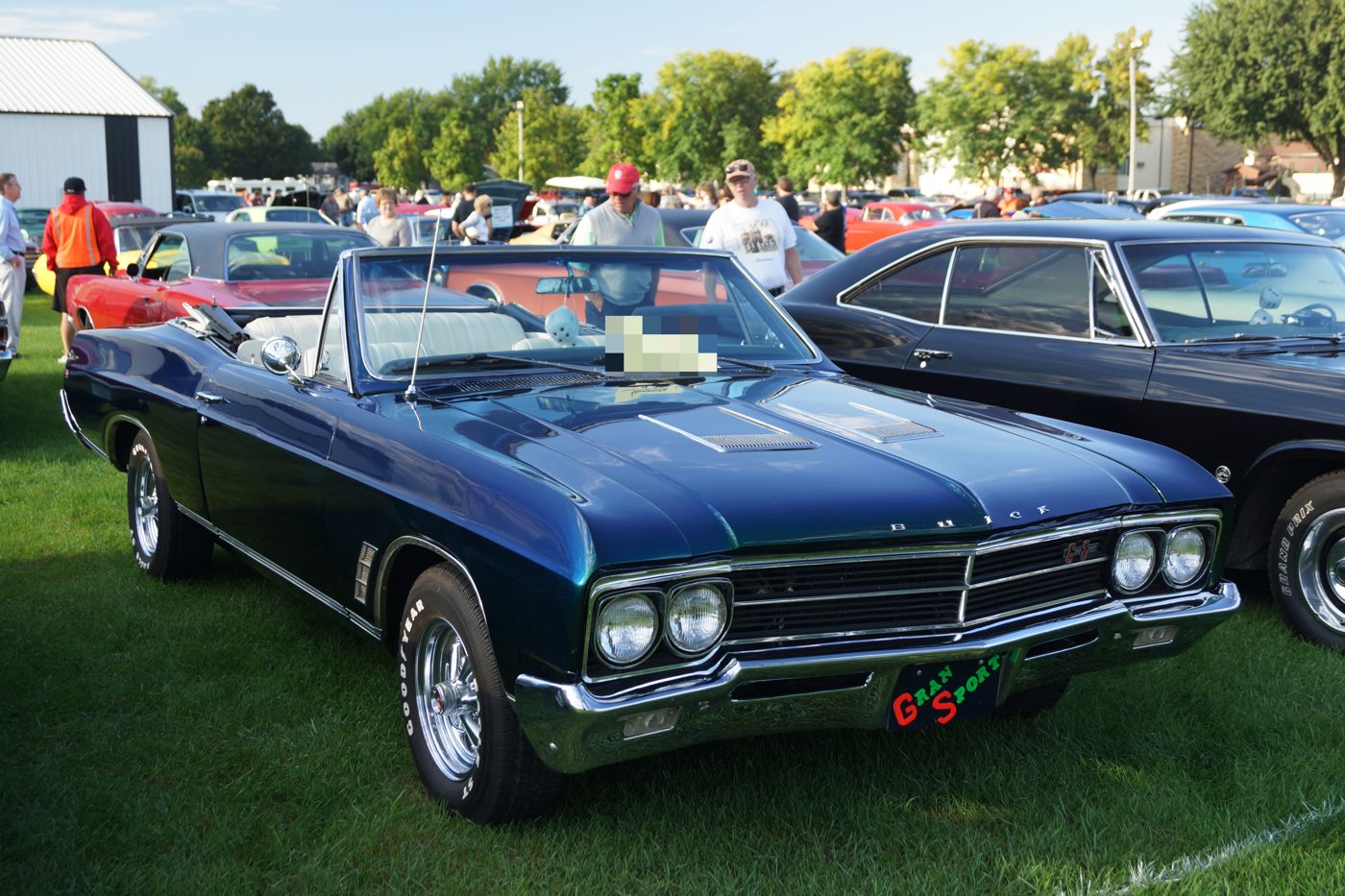

At Westhampton, Long Island, Car and Driver’s Buick Skylark Gran Sport ran the quarter mile in 14.92 seconds at 95.13 mph. That was a competitive result for a car the magazine considered relatively unprepared, carrying a two-speed automatic into a six-car comparison whose entrants had received sharply different amounts of attention. Published in March 1966, the test followed the cars from the drag strip to Bridgehampton’s road circuit and ordinary roads. It asked how usable these performance sedans were, rather than simply finding the fastest specially prepared machine. The Buick’s time belonged to one equipped car, and its transmission, axle, tires and preparation were part of that time.1
The magazine had originally sought eight cars, reduced to six after the Chrysler entries withdrew. It wanted showroom equipment and available options, with no tire or rear-axle changes between the drag-strip and circuit phases. Its preparations nevertheless changed the comparison cars: Firestone supplied 7.75 × 14 Super Sports 500 passenger tires, and Hurst wheels replaced the original wheels. Hurst-Campbell arranged technical inspection, while Masten Gregory was selected to drive the road-course laps. Those common arrangements did not erase the differences in individual preparation. Some competitors had been specially attended, while the Buick's participation letter said it would conform to the rules. Not every entrant was untouched stock, and the magazine said so.1
Two Buick engineers accompanied the Gran Sport, and its tire pressures became a point of disagreement at Bridgehampton. Buick initially insisted on the stock 28 psi while others were using roughly 45 psi at the recommendation of Firestone and Gregory. The pressure was later increased, though the article does not give the final setting. Gregory thought the car improved as he became accustomed to it and after the tire change in pressure, while still finding it too soft. That was his impression from the driver's seat, not a measured spring-rate comparison. It also means the lap time came from a GS on raised pressures, not one running showroom tires and pressures on an ordinary road.1
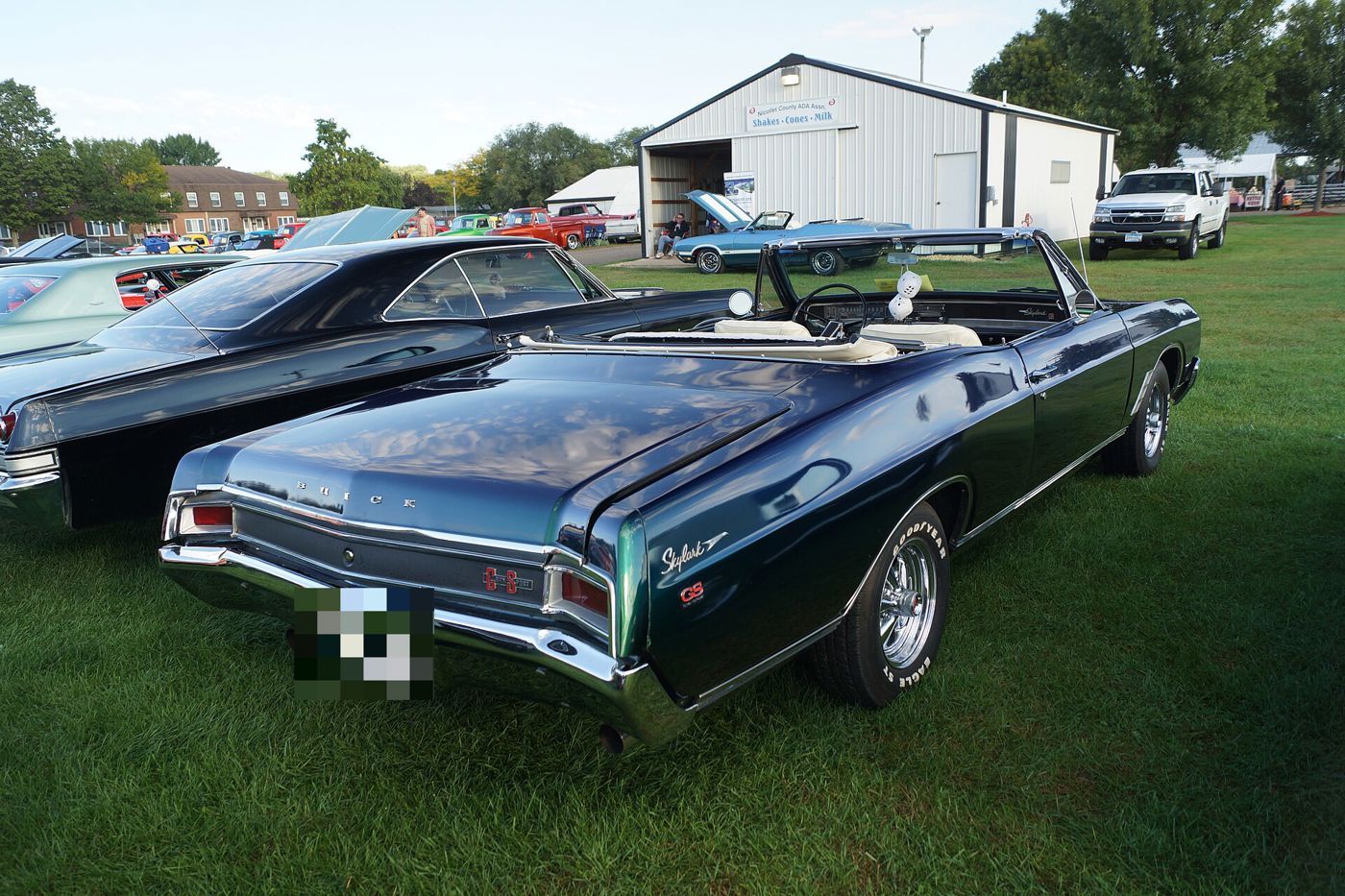

The road-course and street portions drew out a different character from the standing quarter mile. The Buick’s listed Bridgehampton lap was 2:08.5, and its timed 80–0-mph panic stop was 5.0 seconds. Gregory criticized the two-speed automatic as inadequate for this type of car and wanted firmer springing, but came to appreciate its balance and regular-driving potential. The staff reported frequent bottoming with one person in the rear seat, alongside good controllability during extended wet-road driving. Taken together, the test was neither a simple endorsement nor a single acceleration ranking. Its judgments describe how that one Buick behaved in the comparison; they say nothing about Buick's management decisions and give no universal verdict on every Gran Sport.1
The test car did not match the standard factory rating in every detail. Car and Driver lists a 401-cu-in V-8, 340 hp at 4,600 rpm and 445 lb-ft at 3,200 rpm, with 10.25:1 compression. It gives the automatic car a 3.36 axle and a 3,550-lb test weight, and quotes $3,978.04 as the price as tested. Those are the magazine’s figures for its own car, not a base price or a build sheet. The article's text rounds the trap speed to 95.3 mph, while its data panel prints the more precise 95.13 mph.1
Buick’s own AMA specifications describe the standard car. Issued October 14, 1965, with the cover and general-specification page revised January 24, 1966, the Gran Sport form names three bodies: 44607 thin-pillar coupe, 44617 hardtop coupe and 44667 convertible. It describes each as a two-door, six-passenger Skylark Gran Sport. All share a 115.0-inch wheelbase, with 58.0-inch front and 59.0-inch rear tracks. The general sheet gives 204.0 inches of length and 75.5 inches of width. These are nominal factory dimensions, rather than measurements taken from the magazine car. They fix the three GS body choices; they do not say which engine, equipment or production total any surviving car had.2
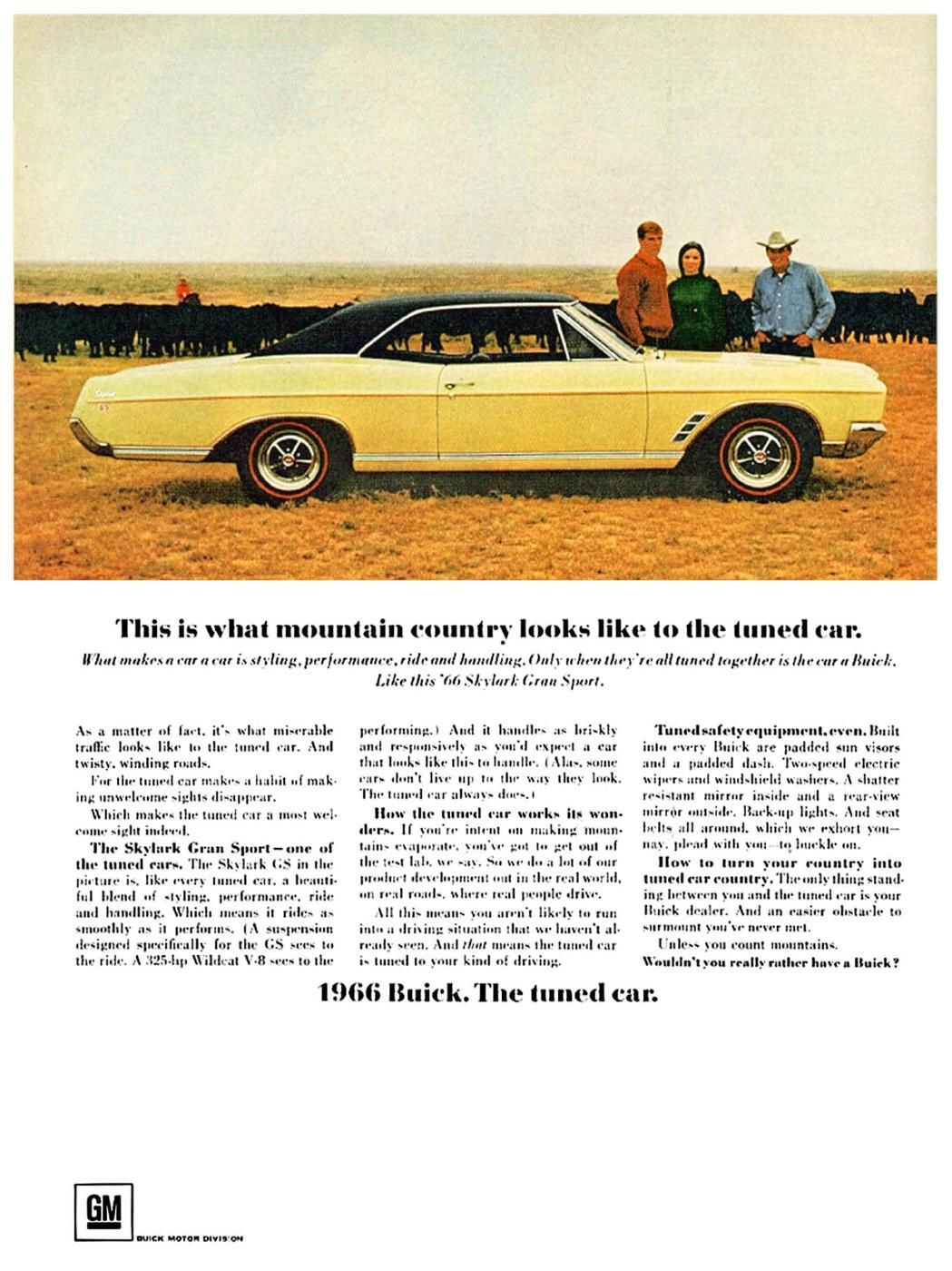
The factory engine page prints displacement as 400 cu in, with a 4.1875 × 3.640-inch bore and stroke. Its published maximum is 325 bhp at 4,400 rpm and 445 lb-ft at 2,800 rpm, with 10.25 compression and premium fuel recommended. The footnote corrects horsepower and torque to 60°F and 29.92 in Hg. Those nominal values are separate from road-test acceleration and from the magazine’s 340-hp panel. Car and Driver and the later Over-Drive compilation use the familiar 401 displacement label; the factory page says 400. That difference in label alone does not mean Buick installed a different engine in the magazine car, and it does not explain the separate difference in power rating.2,1,3
The showroom gearbox and axle choices were not the test car's. The revised general sheet lists a three-speed manual as standard, a four-speed manual as optional, and the Super Turbine automatic as optional; overdrive is unavailable. Its listed axle ratio is 3.36 with either manual and 2.93 with the automatic. Car and Driver’s automatic instead has a 3.36 axle in its panel. The two numbers describe different things, the standard listing and one test car, and neither says what every automatic GS carried. The factory sheet does not say that no other axle could be fitted. Likewise, the magazine’s criticism of a two-speed transmission tells nothing about the manual car, which it did not test in this comparison.2,1
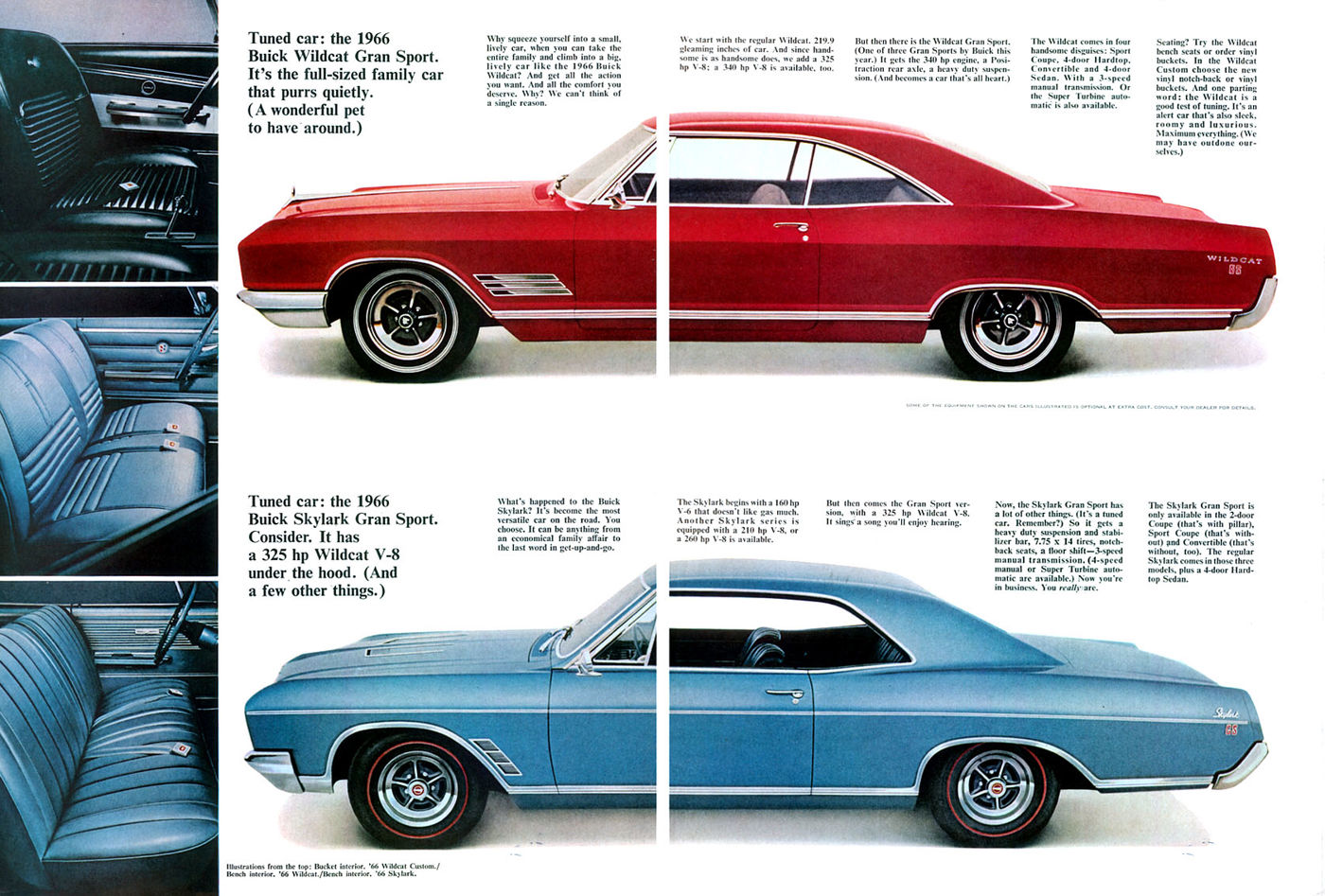
The GS sat in series 44600, and Buick built 13,816 of them: 1,835 thin-pillar coupes, 9,934 hardtops and 2,047 convertibles. Factory prices were $2,956, $3,019 and $3,167 respectively, without a stated accounting basis. Those nominal amounts are base prices, a different thing from the magazine’s equipped-car price. A late-year L76 version had a Quadrajet and Wildcat cam, rated at 340 hp and available only with an automatic. No reliable engine or transmission production split is known to go with the body totals, so the total cannot support a more exact rarity claim for a particular powertrain.3,2,1
Color, trim and engine codes complete the picture. The paint chart ran to fifteen entries, and GS interiors came in five color groups: aqua, black, blue, light fawn and red. Engine code MR identified the 401, 325-hp, 10.25:1 Carter four-barrel combination. Buyers could add air conditioning for $430, bucket seats for $141, power steering for $87 and a Positive Traction rear axle for $49. The 1966 Gran Sport was three factory bodies, a nominal 325-hp standard rating, a late-year 340-hp Quadrajet 401, and a contemporary test whose prepared equipment and driver judgments belong to one Buick.3,4,2,1
Fact sheet · 1966 · United States
The numbers
1966 Buick Skylark Gran Sport: The Gran Sport became its own Skylark series (44600) on the restyled body, still with the 401 at 325 hp; 13,816 are tabulated.
Figures may describe different groups of cars. Add rows together only when the note says they make up a total.
Key facts
- Gran Sport production 13,816: 1,835 coupes, 9,934 sport coupes, 2,047 convertibles.3
Production
| What was counted | Built |
|---|---|
| Skylark Gran Sport V-8 series3 Skylark Gran Sport · 401 | 13,816 |
| All Buick Special, Special Deluxe, Skylark and Gran Sport3 all intermediate series | 208,580 |
| What was counted | Built |
|---|---|
| Gran Sport 2-door coupe (44607)3 Skylark Gran Sport · 2-door coupe · 401 | 1,835 |
| Gran Sport sport coupe (44617)3 Skylark Gran Sport · 2-door hardtop sport coupe · 401 | 9,934 |
| Gran Sport convertible (44667)3 Skylark Gran Sport · 2-door convertible · 401 | 2,047 |
Prices when new
| Model | Price | Price type |
|---|---|---|
| Gran Sport coupe (44607)3 | $2,956 | factory price, 1966 |
| Gran Sport sport coupe (44617)3 | $3,019 | factory price, 1966 |
| Gran Sport convertible (44667)3 | $3,167 | factory price, 1966 |
Prices are the nominal dollars of the day, not adjusted for inflation.
Engines
| Engine | Factory rating | Availability |
|---|---|---|
| 401 V-8, Gran Sport3 401 cu in · Carter 4-barrel | 325 hp @ 4,400, 445 lb-ft @ 2,800 (SAE gross (as listed by secondary source)) | standard, Gran Sport |
| L76 · 401 V-8, late-year Quadrajet version3 401 cu in · Rochester Quadrajet 4-barrel | 340 hp @ 4,600, 445 lb-ft @ 3,200 (SAE gross (as listed by secondary source)) | late-year option, automatic only per source |
Ratings are published figures, not dyno results. Gross and net ratings aren't directly comparable.
Transmissions
| Transmission | Availability |
|---|---|
| 3-speed manual3 | standard |
| 4-speed manual (401: 2.20 first)3 | optional |
| 2-speed automatic3 | optional |
Options and packages
| Option | Price |
|---|---|
| Automatic transmission3 | $245 |
| Three-speed manual transmission with floor shift3 | $48 |
| Four-speed manual transmission with floor shift3 | $199 |
| 340 cu in 260 hp V-8 (Skylark, not GS)3 | $64 |
| Gran Sport package option3 | $236 |
| Positive traction rear axle3 | $49 |
| Air conditioning3 | $430 |
| Bucket seats3 | $141 |
| Clock3 | $16 |
| Convenience lamps3 | $8 |
| Outside mirror3 | $4 |
| Padded dash3 | $16 |
| Power antenna3 | $26 |
| Power brakes3 | $43 |
| Power convertible top3 | $64 |
| Power seats3 | $71 |
| Power steering3 | $87 |
| Radio, AM/FM3 | $150 |
| Radio, deluxe push-button3 | $88 |
| Radio, super deluxe signal-seeking3 | $124 |
| Rear speaker3 | $16 |
| Tinted glass3 | $43 |
| Trunk release3 | $10 |
| Two-speed wipers and washer3 | $19 |
| Two-tone paint3 | $17 |
Paint
| Code | Color |
|---|---|
A |
Regal Black3 |
C |
Arctic White3 |
D |
Astro Blue3 |
E |
Midnight Blue3 |
F |
Blue Mist3 |
H |
Seafoam Green3 |
J |
Verde Green3 |
K |
Turquoise Mist3 |
L |
Shadow Turquoise3 |
N |
Burgundy Mist3 |
R |
Flame Red3 |
T |
Saddle Mist3 |
V |
Shell Beige3 |
W |
Silver Mist3 |
Y |
Cream3 |
Color names are the factory's. We don't show color swatches, because a screen color is no guide for a restoration.
Interiors
| Code | Trim |
|---|---|
166 |
Skylark GS: Aqua, vinyl4 |
168, 198 |
Skylark GS: Black, vinyl4 |
161, 191 |
Skylark GS: Blue, vinyl4 |
163, 193 |
Skylark GS: Light Fawn, vinyl4 |
167, 197 |
Skylark GS: Red, vinyl4 |
Specifications
| Measure | Value | Applies to |
|---|---|---|
| Wheelbase3 | 115 in | all intermediates |
Identification
- Series number
- Gran Sport V-8 series 44600: 44607 coupe, 44617 sport coupe, 44667 convertible.3
- VIN
- E.g. 444076H101555 (a Skylark example): 4 = Buick; 2-3 = series (46 = Skylark Gran Sport); 4-5 = body (07 coupe, 17 sport coupe hardtop, 67 convertible); 6 = year (6); 7 = plant (H, C, Z, X, Y, D, B, K, V, I); last six = production number.4
- Body number plate
- Style 66-4607 coupe, 66-4617 sport coupe, 66-4667 convertible (Skylark Gran Sport); plate also carries trim code and two-letter paint code.4
- Engine code (Skylark Gran Sport)
- MR: 401 cu in (listed as "400"), 325 hp, 10.25:1, 4-barrel.4
Where the sources disagree
Identification
Read a 1966 Buick VIN
The VIN decoder runs in your browser and never sends the VIN anywhere. How the factory numbered this year's cars:
Same model year
Also in 1966
- Buick Riviera A longer, heavier new body on the same X-frame; 5,718 of 45,348 carried the GS option, and the dual-quad Super Wildcat went from dealer add-on to factory MZ engine in March 1966.
- Buick Wildcat The one-year Wildcat Gran Sport: 1,244 built, 242 convertibles, 22 Super Wildcats.
- Chevrolet Chevelle and Malibu SS The first full year of the SS 396 as its own series, with a 396 V8 in every car: 66,843 sport coupes and 5,429 convertibles.
- Chevrolet Chevy II and Nova The source engine table lists the 327 L79 at 350 gross hp. Enthusiast-compiled production: 172,485 cars; Super Sport 20,986.
- Chevrolet El Camino SS The 396 reaches the Chevelle pickup at 325 and 360 hp, still without an SS badge; 35,119 El Caminos built.
- Chevrolet Impala SS Impala SS falls to 119,314 as the 427 arrives; 3,247 full-size Chevrolets got the 390-hp L36.
- Dodge Charger Dodge's first Charger, a fastback on the Coronet platform introduced on 1 January 1966, built 37,344 times, 468 of them with the new Street Hemi.
- Dodge Coronet R/T and Super Bee The first year the 426 Hemi was sold as a street engine; in the Coronet it was an option on ordinary sedans, hardtops and convertibles, before any R/T package existed.
- Ford Fairlane A new, wider Fairlane could take the 390 big-block for the first time, bringing the Fairlane 500 GT and GTA, and a small run of R-code 427 hardtops was built for Super Stock racing.
- Ford Galaxie The 428 became the big-car performance engine and gave its name to the Galaxie 500 7-Litre hardtop and convertible, with the 427 still available.
- Ford Thunderbird A 345-hp 428 became a $64.77 option, and the Town Landau outsold every other body combined.
- Mercury Comet and Cyclone The Comet moved to the larger Fairlane-based body, and the Cyclone GT brought the 335-hp 390 with twin hood scoops, bucket seats and a heavy-duty suspension.
- Mercury Marauder and S-55 The S-55 returned as its own line, a hardtop and convertible with the 345 hp 428 'Super Marauder' V8.
- Oldsmobile Cutlass, 4-4-2 and Hurst/Olds The 4-4-2 package gained the L69 three-two-barrel 'Tri-Carb' option at 360 hp, and a handful of factory W-30 forced-air cars were built for drag racing.
- Oldsmobile Starfire The last Starfire of the 1960s: coupe only, moved downmarket, 13,019 sold.
- Plymouth Barracuda and 'Cuda The last glassback-era year: one fastback body, the 273 Commando as the top engine, and production that fell to 38,029.
- Plymouth GTX, Belvedere and Satellite The 426 Street Hemi reached showrooms in the Belvedere and Satellite, and 1,546 were built into Plymouth intermediates.
- Pontiac Catalina 2+2 and Super Duty The 2+2 was listed as its own model for the only time, and production fell to 6,383.
- Pontiac GTO The GTO becomes its own Pontiac series and has its biggest year: 96,946 built.
- Pontiac Grand Prix Production fell to 36,757 as the GTO and 2+2 drew performance buyers.
- Pontiac Tempest and LeMans Pontiac's overhead-cam six and the Sprint package arrive beside the 326 HO.
- Rambler and AMC Marlin The Marlin's second year: production fell to 4,547, less than half the 1965 figure.