1966 · Rambler/AMC · United States
1966 Marlin: Production Falls Below Half of Launch Year, and the Price Comes Down
The Marlin's second year: production fell to 4,547, less than half the 1965 figure.
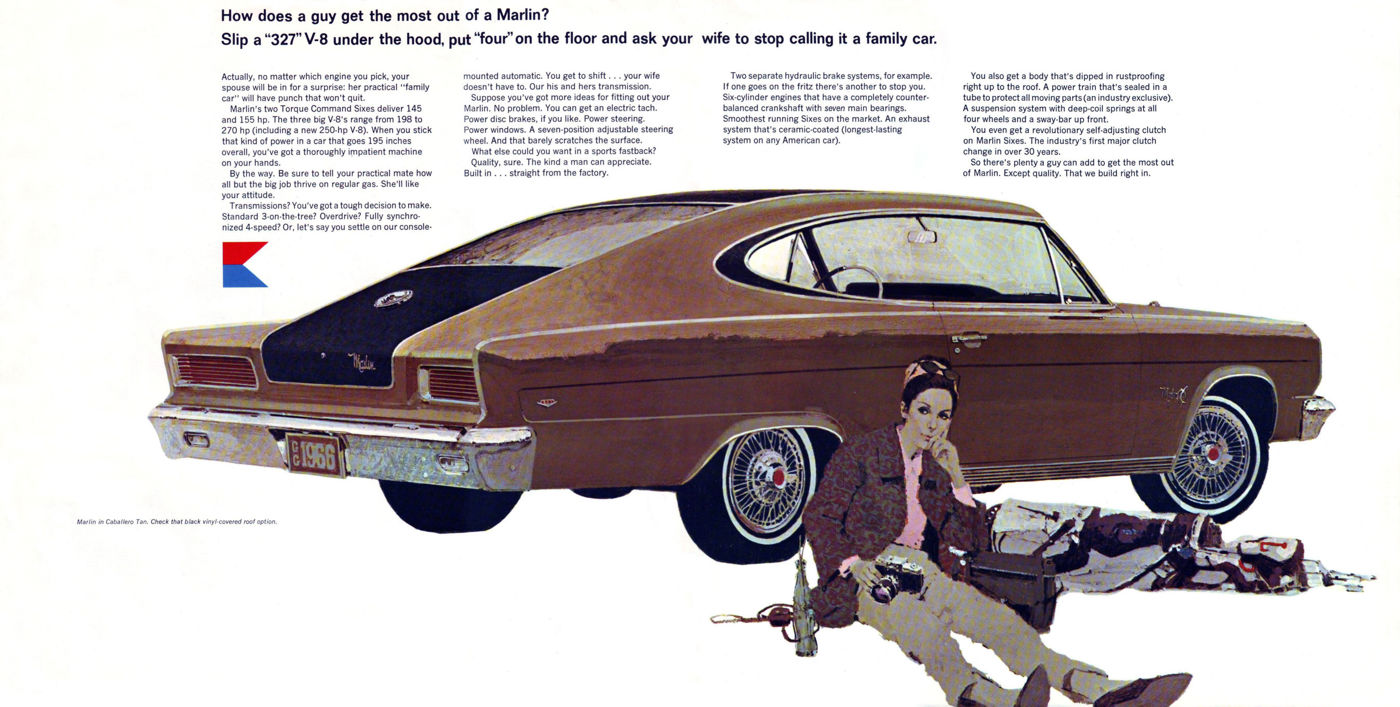
The Marlin's second year saw production fall to 4,547, less than half the 10,327 built in its 1965 launch year. AMC responded by lowering the base price to $2,601, an attempt, per the period record, to broaden the car's market appeal after its steep first-year sales drop. The car kept its 112-inch wheelbase for 1966, the same span it had carried at launch; it would not grow to 118 inches until the following year's redesign.1,2
The 1966 Marlin's engine lineup ran five deep. The standard engine was a 232-cubic-inch six with a single-barrel carburetor rated at 145 horsepower, with a two-barrel version of the same six offered at 155 horsepower. Above the sixes sat a 287-cubic-inch two-barrel V8 at 198 horsepower, and two versions of the 327-cubic-inch V8: a two-barrel rated 250 horsepower and a four-barrel rated 270, the strongest engine offered that year. All five ratings come from the same factory brochure's Performance Selector chart, giving a single consistent source for the full spread from base six to top V8, a range wide enough that a buyer could nearly double the standard engine's horsepower simply by checking the right box on the order form.
Five transmissions were available to pair with those engines: a standard three-speed column-shift manual, an optional column-shift overdrive for the six and the 287, a column-shift automatic, a floor-mounted four-speed synchromesh manual for the 287 and 327, and a floor-mounted automatic for the V8s, each with its own matched axle ratio spelled out in the brochure down to specific gear numbers. Paint choice was broader still: nine solid colors were available on the Marlin out of AMC's full thirteen-color 1966 palette, the other four reserved for other models, plus fifteen extra-cost two-tone combinations built from those same nine solids.3
The brochure's technical specifications round out the picture of a full-size fastback rather than a small car: 195 inches long overall, 74.5 inches wide, standing 54.2 inches tall when loaded, on a track of 58.2 inches front and 57.4 inches rear. Brakes measured 10 inches in diameter with 167.5 square inches of lining area, standard tires were 7.35x14 with a 7.75x14 size optional on V8-equipped cars, and the fuel tank held an approximate 19 US gallons, specifications that place the Marlin squarely among AMC's larger 1966 offerings despite its sporting fastback roofline.
Set against the 1965 launch-year total, the 4,547 Marlins built in 1966 represent a decline of just under 56 percent, meaning fewer than half as many buyers chose a Marlin in its second year as had in its first. The price cut to $2,601 did not reverse that decline within the 1966 model year, though whether it slowed the fall further or came too late to matter is not something the two production figures alone can answer. The two-tone paint codes themselves followed a fixed reading order, top color listed first, a convention worth noting for anyone matching a restoration to the period color folder, since it says which shade belongs where on the body.1,2,3
Fact sheet · 1966 · United States
The numbers
1966 Marlin: The Marlin's second year: production fell to 4,547, less than half the 1965 figure.
Figures may describe different groups of cars. Add rows together only when the note says they make up a total.
Key facts
- 1966 Marlin production 4,547.1
Production
| What was counted | Built |
|---|---|
| Marlin fastback, all engines1 Marlin · 2-door fastback hardtop · US | 4,547 |
Paint: the nine solid colours are the 1966 colour folder's thirteen less the four marked Not Available on Marlin (15 Brisbane Blue, 16 Britannia Blue, 17 Crescent Green, 18 Granada Green). The folder's two-tone codes read top colour first.
Prices when new
| Model | Price | Price type |
|---|---|---|
| Marlin base price2 | $2,601 | base price, 1966 |
Prices are the nominal dollars of the day, not adjusted for inflation.
Engines
| Engine | Factory rating | Availability |
|---|---|---|
| 232 six 1-bbl 232 cu in · 1-barrel | 145 hp @ 4,300, 215 lb-ft @ 1,600 (period factory advertised (gross)) | standard |
| 232 six 2-bbl 232 cu in · 2-barrel | 155 hp @ 4,400, 222 lb-ft @ 1,600 (period factory advertised (gross)) | optional |
| 287 V8 2-bbl 287 cu in · 2-barrel | 198 hp @ 4,700, 280 lb-ft @ 2,600 (period factory advertised (gross)) | optional |
| 327 V8 2-bbl 327 cu in · 2-barrel | 250 hp @ 4,700, 340 lb-ft @ 2,600 (period factory advertised (gross)) | optional |
| 327 V8 4-bbl 327 cu in · 4-barrel | 270 hp @ 4,700, 360 lb-ft @ 2,600 (period factory advertised (gross)) | optional |
Ratings are published figures, not dyno results. Gross and net ratings aren't directly comparable.
Transmissions
| Transmission | Availability |
|---|---|
| Three-speed manual, column (axle 3.15 six, 3.54 V-8s) | standard |
| Overdrive, column (six and 287; axle 3.54) | optional |
| Automatic, column (axle 3.15 six; 3.15, 2.87 no-cost, V-8s) | optional |
| Four-speed synchromesh, floor (287: 3.54; 327: 3.15, 3.54 no-cost) | optional |
| Automatic, floor (V-8s; 3.15, 2.87 no-cost) | optional |
Paint
| Code | Color |
|---|---|
1 |
Classic Black3 |
3 |
Antigua Red3 |
19 |
Balboa Aqua3 |
20 |
Cortez Aqua3 |
23 |
Samoa Gold3 |
24 |
Caballero Tan3 |
72 |
Frost White3 |
25 |
Apollo Yellow3 |
21 |
Marquesa Mauve3 |
1-72 |
Two-tone 1-72 (extra cost)3 |
3-72 |
Two-tone 3-72 (extra cost)3 |
19-20 |
Two-tone 19-20 (extra cost)3 |
23-24 |
Two-tone 23-24 (extra cost)3 |
72-1 |
Two-tone 72-1 (extra cost)3 |
72-3 |
Two-tone 72-3 (extra cost)3 |
20-19 |
Two-tone 20-19 (extra cost)3 |
24-23 |
Two-tone 24-23 (extra cost)3 |
3-1 |
Two-tone 3-1 (extra cost)3 |
19-72 |
Two-tone 19-72 (extra cost)3 |
20-72 |
Two-tone 20-72 (extra cost)3 |
23-72 |
Two-tone 23-72 (extra cost)3 |
24-72 |
Two-tone 24-72 (extra cost)3 |
25-1 |
Two-tone 25-1 (extra cost)3 |
21-72 |
Two-tone 21-72 (extra cost)3 |
Color names are the factory's. We don't show color swatches, because a screen color is no guide for a restoration.
Specifications
| Measure | Value | Applies to |
|---|---|---|
| Wheelbase | 112 in | 1966 Marlin |
| Overall length | 195 in | 1966 Marlin |
| Loaded height | 54.2 in | 1966 Marlin |
| Width | 74.5 in | 1966 Marlin |
| Tread, front / rear | 58.2 / 57.4 in | 1966 Marlin |
| Brake diameter / lining area | 10 / 167.5 in / sq in | 1966 Marlin |
| Tires | 7.35 x 14 (7.75 x 14 optional for V-8s) | 1966 Marlin |
| Fuel tank capacity (approx.) | 19 US gal | 1966 Marlin |
Same model year
Also in 1966
- Buick Riviera A longer, heavier new body on the same X-frame; 5,718 of 45,348 carried the GS option, and the dual-quad Super Wildcat went from dealer add-on to factory MZ engine in March 1966.
- Buick Skylark Gran Sport, GS and GSX The Gran Sport became its own Skylark series (44600) on the restyled body, still with the 401 at 325 hp; 13,816 are tabulated.
- Buick Wildcat The one-year Wildcat Gran Sport: 1,244 built, 242 convertibles, 22 Super Wildcats.
- Chevrolet Chevelle and Malibu SS The first full year of the SS 396 as its own series, with a 396 V8 in every car: 66,843 sport coupes and 5,429 convertibles.
- Chevrolet Chevy II and Nova The source engine table lists the 327 L79 at 350 gross hp. Enthusiast-compiled production: 172,485 cars; Super Sport 20,986.
- Chevrolet El Camino SS The 396 reaches the Chevelle pickup at 325 and 360 hp, still without an SS badge; 35,119 El Caminos built.
- Chevrolet Impala SS Impala SS falls to 119,314 as the 427 arrives; 3,247 full-size Chevrolets got the 390-hp L36.
- Dodge Charger Dodge's first Charger, a fastback on the Coronet platform introduced on 1 January 1966, built 37,344 times, 468 of them with the new Street Hemi.
- Dodge Coronet R/T and Super Bee The first year the 426 Hemi was sold as a street engine; in the Coronet it was an option on ordinary sedans, hardtops and convertibles, before any R/T package existed.
- Ford Fairlane A new, wider Fairlane could take the 390 big-block for the first time, bringing the Fairlane 500 GT and GTA, and a small run of R-code 427 hardtops was built for Super Stock racing.
- Ford Galaxie The 428 became the big-car performance engine and gave its name to the Galaxie 500 7-Litre hardtop and convertible, with the 427 still available.
- Ford Thunderbird A 345-hp 428 became a $64.77 option, and the Town Landau outsold every other body combined.
- Mercury Comet and Cyclone The Comet moved to the larger Fairlane-based body, and the Cyclone GT brought the 335-hp 390 with twin hood scoops, bucket seats and a heavy-duty suspension.
- Mercury Marauder and S-55 The S-55 returned as its own line, a hardtop and convertible with the 345 hp 428 'Super Marauder' V8.
- Oldsmobile Cutlass, 4-4-2 and Hurst/Olds The 4-4-2 package gained the L69 three-two-barrel 'Tri-Carb' option at 360 hp, and a handful of factory W-30 forced-air cars were built for drag racing.
- Oldsmobile Starfire The last Starfire of the 1960s: coupe only, moved downmarket, 13,019 sold.
- Plymouth Barracuda and 'Cuda The last glassback-era year: one fastback body, the 273 Commando as the top engine, and production that fell to 38,029.
- Plymouth GTX, Belvedere and Satellite The 426 Street Hemi reached showrooms in the Belvedere and Satellite, and 1,546 were built into Plymouth intermediates.
- Pontiac Catalina 2+2 and Super Duty The 2+2 was listed as its own model for the only time, and production fell to 6,383.
- Pontiac GTO The GTO becomes its own Pontiac series and has its biggest year: 96,946 built.
- Pontiac Grand Prix Production fell to 36,757 as the GTO and 2+2 drew performance buyers.
- Pontiac Tempest and LeMans Pontiac's overhead-cam six and the Sprint package arrive beside the 326 HO.