1966 · Pontiac · United States
1966 Pontiac Grand Prix: Production Falls as the GTO and 2+2 Take Performance Buyers
Production fell to 36,757 as the GTO and 2+2 drew performance buyers.
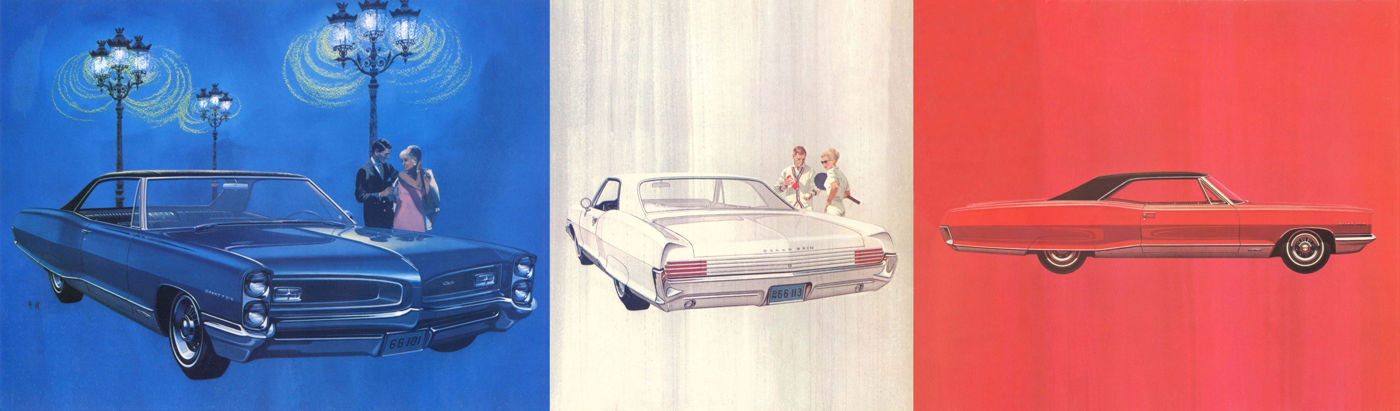
The Grand Prix lost ground in 1966, when production fell to 36,757 cars at a listed price of $3,492. Pontiac's performance lineup had expanded elsewhere, including the GTO and 2+2, but the Grand Prix kept its own full-size formula. A four-barrel 389 remained standard, rated at 333 hp at 5,000 rpm with manual transmission or 325 hp at 4,800 rpm with automatic, each with 429 lb-ft. Buyers could order a 421 or the 421 HO.1,2
Pontiac offered five engine combinations. Alongside the two transmission-dependent 389 ratings were a 338-hp 421 four-barrel, a 356-hp 421 Tri-Power and a 376-hp 421 HO Tri-Power. Torque figures listed for those three engines were 459, 459 and 461 lb-ft, respectively, peaking at 2,800, 3,200 and 3,600 rpm. Transmission choices included a three-speed manual, two four-speed gearsets, and the three-speed Turbo Hydra-Matic 400. The three-speed, synchromesh on all forward gears, ran 2.42/1.61/1.00; the standard four-speed 2.52/1.88/1.46/1.00 and the close-ratio box 2.20/1.64/1.28/1.00; the Turbo Hydra-Matic 2.48/1.48/1.00. The four-barrel engines ran 10.5:1 compression, the Tri-Power 421s 10.75:1.1
Pontiac's full-size option list put comfort and convenience alongside performance equipment. It priced air conditioning at $430, power steering at $95, power brakes at $43, power windows at $106, a six-way power seat at $97 and power door locks at $46. A tachometer cost $54 and Electro-Cruise with a fuel warning $96. The Cordova top added $97, aluminum hubs and brake drums $120, and Super-Lift shock absorbers $40. Radios ran $89 for the push-button AM and $151 for the push-button AM/FM. Tinted glass cost $43 all around or $29 for the windshield alone, a remote deck-lid release $11, and a glare-proof tilt mirror $4.1
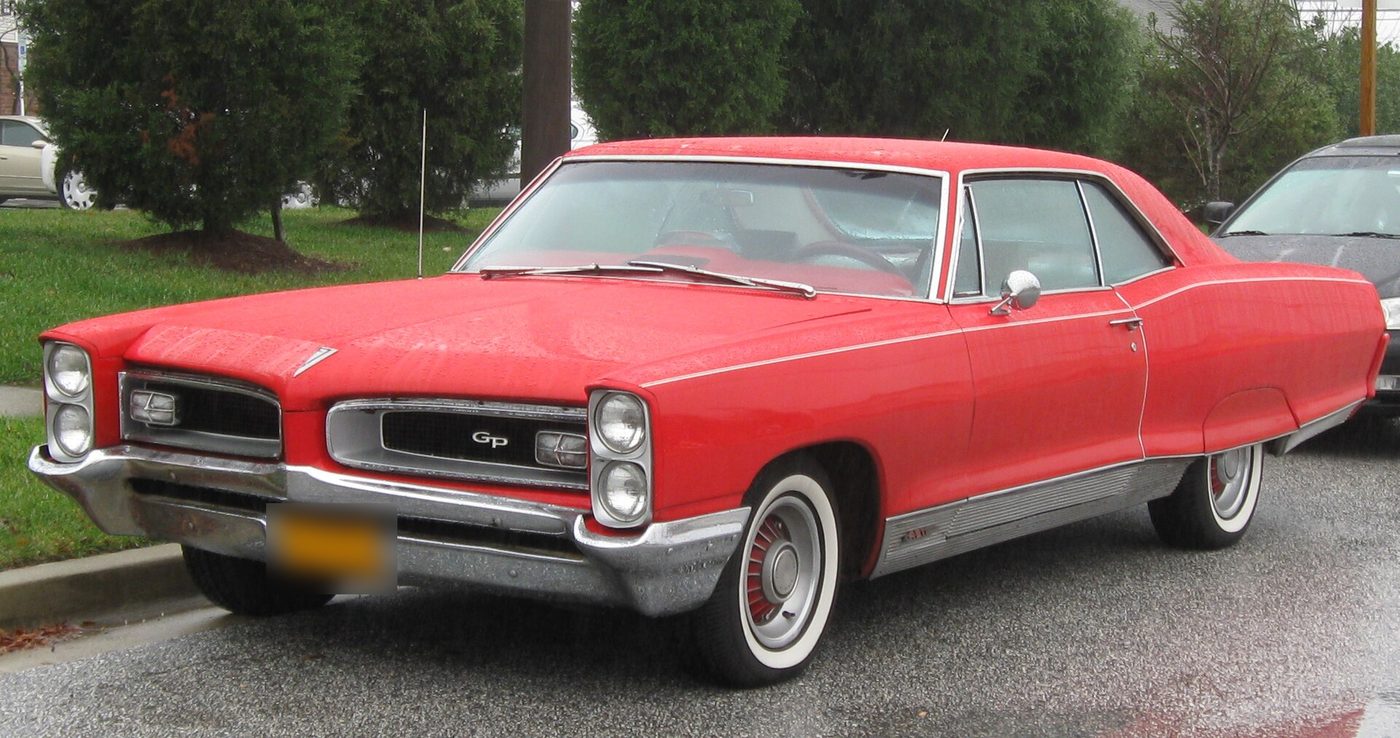

The cabin centered on Strato bucket seats and a console, with Morrokide or cloth upholstery. Pontiac also offered a no-cost notchback bench seat with a center armrest. The factory description calls the bucket cushions more contoured and their backs higher than the standard seats. A monochromatic, deeply piped Morrokide interior, glove-box lamp and revised square-gauge instrument panel rounded out the equipment. The choice between buckets and bench gave the Grand Prix a more personal cabin than the usual full-size layout, while the seats and console remained part of Pontiac's model-specific description.1
The Grand Prix rode on a 121-inch wheelbase and measured 214.8 inches long and 53.9 inches high. Its shipping weight came to 4,015 pounds. The width, track and tire figures applied to Pontiac's full-size line as a whole rather than to the Grand Prix alone: 79.7 inches wide, 63-inch front and 64-inch rear tracks, with 8.25-by-14 tires standard and 8.55-by-14 specified with air conditioning.1,2
Pontiac identified the car as Series 266, body 26657, and the production figures agree that it built 36,757 of them, at a listed price of $3,492. Pontiac's engine table ran from the 325-hp automatic 389 at 4,800 rpm, through the 333-hp manual version at 5,000 rpm and the 338-hp 421 four-barrel at 4,600, to the 356-hp 421 Tri-Power at 4,800 and the 376-hp 421 HO at 5,000 rpm. Every one of them made at least 429 lb-ft.2,3,1
Fact sheet · 1966 · United States
The numbers
1966 Pontiac Grand Prix: Production fell to 36,757 as the GTO and 2+2 drew performance buyers.
Figures may describe different groups of cars. Add rows together only when the note says they make up a total.
Key facts
Production
| What was counted | Built |
|---|---|
| Grand Prix 2-door sport coupe2,1,3 Grand Prix · 2-door sport coupe | 36,757 |
Prices when new
| Model | Price | Price type |
|---|---|---|
| Grand Prix 2-door sport coupe2 | $3,492 | factory price, 1966 model year |
Prices are the nominal dollars of the day, not adjusted for inflation.
Engines
| Engine | Factory rating | Availability |
|---|---|---|
| 389 4-bbl1 389 cu in · 4-barrel, 10.5:1 | 325 hp @ 4,800, 429 lb-ft @ 2,800 (SAE gross (period advertised rating)) | Grand Prix standard, automatic |
| 389 4-bbl1 389 cu in · 4-barrel, 10.5:1 | 333 hp @ 5,000, 429 lb-ft @ 3,200 (SAE gross (period advertised rating)) | Grand Prix standard, manual |
| 421 4-bbl1 421 cu in · 4-barrel, 10.5:1 | 338 hp @ 4,600, 459 lb-ft @ 2,800 (SAE gross (period advertised rating)) | optional |
| 421 Tri-Power1 421 cu in · three 2-barrels, 10.75:1 | 356 hp @ 4,800, 459 lb-ft @ 3,200 (SAE gross (period advertised rating)) | optional all lines |
| 421 HO Tri-Power1 421 cu in · three 2-barrels, 10.75:1 | 376 hp @ 5,000, 461 lb-ft @ 3,600 (SAE gross (period advertised rating)) | optional all lines |
Ratings are published figures, not dyno results. Gross and net ratings aren't directly comparable.
Transmissions
| Transmission | Availability |
|---|---|
| Three-speed manual (2.42/1.61/1.00), synchromesh on all forward gears1 | standard |
| Four-speed manual, floor shift (standard 2.52/1.88/1.46/1.00; optional close ratio 2.20/1.64/1.28/1.00)1 | optional |
| Three-speed Turbo Hydra-Matic 400 (2.48/1.48/1.00)1 | optional |
Options and packages
| Option | Price |
|---|---|
| Air conditioning1 | $430 |
| Aluminum hubs and brake drums, 2-door models1 | $120 |
| Cordova top, coupes1 | $97 |
| Electro-Cruise and fuel warning1 | $96 |
| Instrument gauge cluster1 | $21 |
| Mirror, rear view glare-proof tilt1 | $4 |
| Mirror, remote control outside rear view1 | $12 |
| Power brakes1 | $43 |
| Power door locks1 | $46 |
| Power seat, six-way1 | $97 |
| Power tilt bucket seat, left-hand1 | $71 |
| Power windows1 | $106 |
| Radio, push-button AM/FM1 | $151 |
| Radio, push-button AM1 | $89 |
| Remote control deck lid1 | $11 |
| Super-Lift shock absorbers1 | $40 |
| Tachometer1 | $54 |
| Tinted glass1 | $43 |
| Tinted windshield1 | $29 |
Paint
| Code | Color |
|---|---|
A |
Starlight Black1 |
B |
Blue Charcoal1 |
C |
Cameo Ivory1 |
D |
Fontaine Blue1 |
E |
Nightwatch Blue1 |
H |
Palmetto Green1 |
K |
Reef Turquoise1 |
L |
Marina Turquoise1 |
N |
Burgundy1 |
O |
Coronado Gold1 |
P |
Barrier Blue1 |
R |
Montero Red1 |
T |
Martinique Bronze1 |
V |
Mission Beige1 |
W |
Platinum1 |
Y |
Candlelight Cream1 |
Color names are the factory's. We don't show color swatches, because a screen color is no guide for a restoration.
Interiors
| Trim |
|---|
| Strato bucket seats with console, in Morrokide or cloth upholstery, with higher backs and more contoured cushions; notchback bench seat with center armrest a no-cost option. Monochromatic, deeply piped Morrokide interior; glove box lamp; revised square-gauge instrument panel.1 |
Specifications
| Measure | Value | Applies to |
|---|---|---|
| Wheelbase1 | 121 in | Grand Prix |
| Overall length1 | 214.8 in | Grand Prix |
| Overall height1 | 53.9 in | Grand Prix |
| Shipping weight2 | 4,015 lb | Grand Prix |
| Overall width1 | 79.7 in | 1966 full-size Pontiac |
| Front track1 | 63 in | 1966 full-size Pontiac |
| Rear track1 | 64 in | 1966 full-size Pontiac |
| Standard tires1 | 8.25 x 14 (8.55 x 14 with air conditioning) | 1966 full-size Pontiac |
Identification
- Series and body
- Series 266, body 26657.2
Identification
Read a 1966 Pontiac VIN
The VIN decoder runs in your browser and never sends the VIN anywhere. How the factory numbered this year's cars:
Same model year
Also in 1966
- Buick Riviera A longer, heavier new body on the same X-frame; 5,718 of 45,348 carried the GS option, and the dual-quad Super Wildcat went from dealer add-on to factory MZ engine in March 1966.
- Buick Skylark Gran Sport, GS and GSX The Gran Sport became its own Skylark series (44600) on the restyled body, still with the 401 at 325 hp; 13,816 are tabulated.
- Buick Wildcat The one-year Wildcat Gran Sport: 1,244 built, 242 convertibles, 22 Super Wildcats.
- Chevrolet Chevelle and Malibu SS The first full year of the SS 396 as its own series, with a 396 V8 in every car: 66,843 sport coupes and 5,429 convertibles.
- Chevrolet Chevy II and Nova The source engine table lists the 327 L79 at 350 gross hp. Enthusiast-compiled production: 172,485 cars; Super Sport 20,986.
- Chevrolet El Camino SS The 396 reaches the Chevelle pickup at 325 and 360 hp, still without an SS badge; 35,119 El Caminos built.
- Chevrolet Impala SS Impala SS falls to 119,314 as the 427 arrives; 3,247 full-size Chevrolets got the 390-hp L36.
- Dodge Charger Dodge's first Charger, a fastback on the Coronet platform introduced on 1 January 1966, built 37,344 times, 468 of them with the new Street Hemi.
- Dodge Coronet R/T and Super Bee The first year the 426 Hemi was sold as a street engine; in the Coronet it was an option on ordinary sedans, hardtops and convertibles, before any R/T package existed.
- Ford Fairlane A new, wider Fairlane could take the 390 big-block for the first time, bringing the Fairlane 500 GT and GTA, and a small run of R-code 427 hardtops was built for Super Stock racing.
- Ford Galaxie The 428 became the big-car performance engine and gave its name to the Galaxie 500 7-Litre hardtop and convertible, with the 427 still available.
- Ford Thunderbird A 345-hp 428 became a $64.77 option, and the Town Landau outsold every other body combined.
- Mercury Comet and Cyclone The Comet moved to the larger Fairlane-based body, and the Cyclone GT brought the 335-hp 390 with twin hood scoops, bucket seats and a heavy-duty suspension.
- Mercury Marauder and S-55 The S-55 returned as its own line, a hardtop and convertible with the 345 hp 428 'Super Marauder' V8.
- Oldsmobile Cutlass, 4-4-2 and Hurst/Olds The 4-4-2 package gained the L69 three-two-barrel 'Tri-Carb' option at 360 hp, and a handful of factory W-30 forced-air cars were built for drag racing.
- Oldsmobile Starfire The last Starfire of the 1960s: coupe only, moved downmarket, 13,019 sold.
- Plymouth Barracuda and 'Cuda The last glassback-era year: one fastback body, the 273 Commando as the top engine, and production that fell to 38,029.
- Plymouth GTX, Belvedere and Satellite The 426 Street Hemi reached showrooms in the Belvedere and Satellite, and 1,546 were built into Plymouth intermediates.
- Pontiac Catalina 2+2 and Super Duty The 2+2 was listed as its own model for the only time, and production fell to 6,383.
- Pontiac GTO The GTO becomes its own Pontiac series and has its biggest year: 96,946 built.
- Pontiac Tempest and LeMans Pontiac's overhead-cam six and the Sprint package arrive beside the 326 HO.
- Rambler and AMC Marlin The Marlin's second year: production fell to 4,547, less than half the 1965 figure.