1963 · Ford · United States
1963 Ford Falcon Sprint: The Compact That Went to Monte Carlo With a V8
The mid-year 1963 1/2 Sprint put the Fairlane's 164 hp 260 V8 into the compact Falcon for the first time, as a hardtop and a convertible.
United States · researched through 2026-09-23
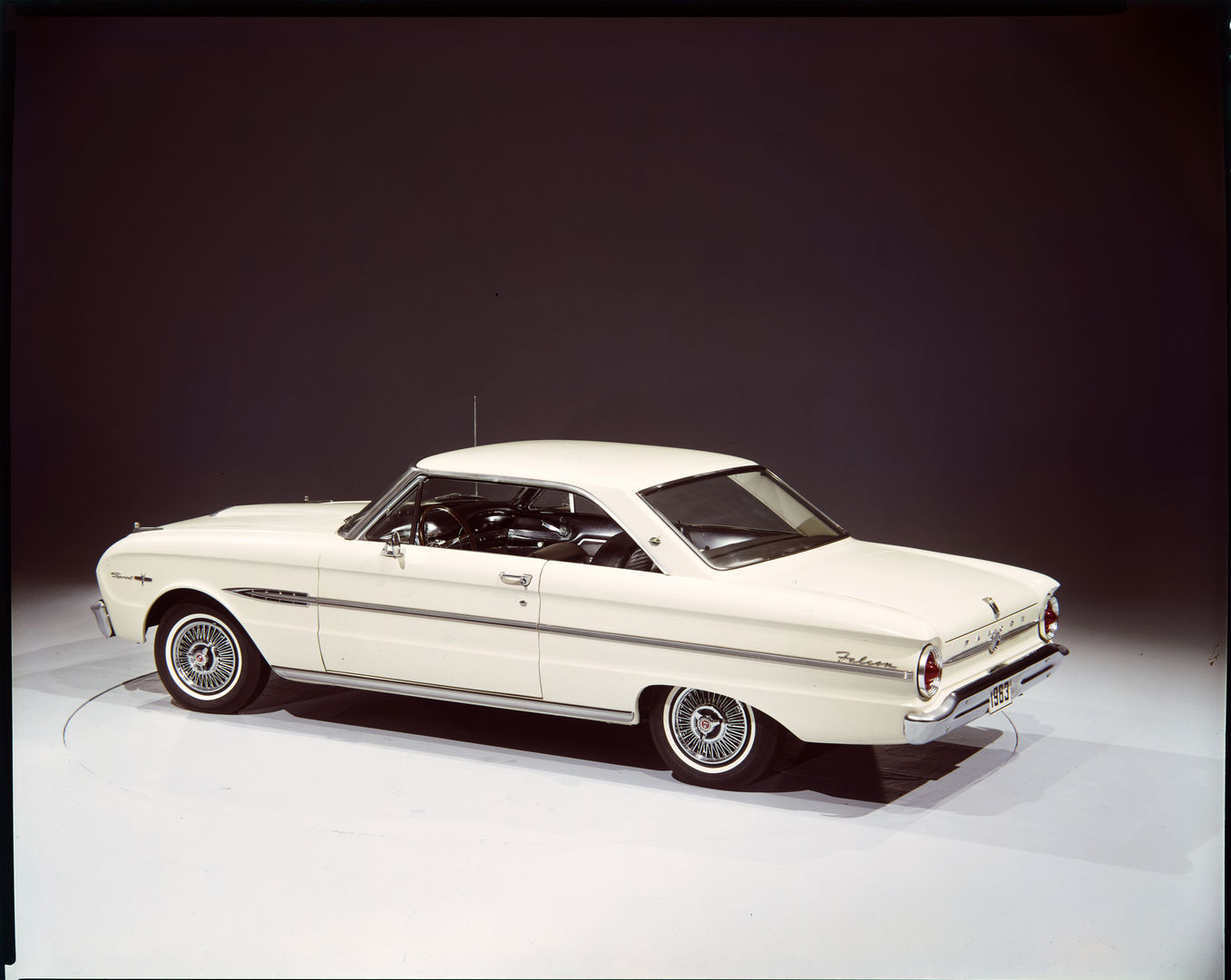
In January 1963 three Ford Falcons with V8 engines took on the Monte Carlo Rally. RallySport Magazine records that Ford's Detroit factory entered them as a full works effort, with Anne Hall, Peter Jopp and Bo Ljungfeldt driving two-door Futura Sprints. MotorCities, the Detroit-area heritage organization, gives the full crews: Ljungfeldt with Gunnar Haggbom in car 223, Jopp with Trent Jarman in car 221, and Hall with Margaret MacKenzie in car 222. The rally put a compact Ford with a Fairlane V8 in front of a European audience just as Ford was introducing that combination at home.1,2
MotorCities' A. Wayne Ferens names the people behind the entry. George Merwin was Ford's competition manager, and Jeff Uren, chosen for his experience with British rally teams, managed the team. The three cars were prepared by Holman & Moody in Charlotte, North Carolina. Bonhams, selling Ljungfeldt's car in 2012, placed Ford's early-1960s rallying within its Total Performance marketing strategy and noted that the car's surviving paperwork referred to the Alan Mann Racing Team. The sources do not fully agree on who handled which stage of the preparation.2,3
The rally engines were not showroom engines. Over-Drive Magazine's 1963 fact sheet says the Monte Carlo Sprints used a 260 Cobra V8 modified by Holman Moody that likely produced more than 300 horsepower. MotorCities describes the base as the 164-horsepower 260 with a four-speed. The difference matters for anyone drawing a line from the rally to a buyer's car: the result showed what the Falcon structure and the small V8 family could be made to do, not what a customer's Sprint would do with its factory 164 horsepower.4,2
The results were strong on the stages and modest in the standings. MotorCities reports that car 221 finished 34th overall and car 223 42nd, out of 307 entrants, and Bonhams also gives Ljungfeldt 42nd of 307. MotorCities says the Falcons beat every car, regardless of class, on the Chambery-Monte Carlo final leg and set the best time among all finishers in all six special test sections. RallySport reports that Anne Hall lost 31 minutes in severe weather. RallySport notes that the Monte decided its overall results with an engine-capacity formula, which explains how the fastest cars on the stages could finish in the thirties and forties overall.2,3,1
Ljungfeldt's biggest Monte result came a year later. Bonhams writes that in 1964 he won every special stage and his class, but the handicap favoring smaller cars left him second overall behind a Mini Cooper, and that he remains the only driver to have won all the Monte Carlo stages in a single event. RallySport's retrospective also describes fastest stage times and a second place behind a smaller-engined car without separating the two years as clearly; Bonhams dates the second-overall result specifically to 1964. For 1963, MotorCities and Bonhams agree on Ljungfeldt's 42nd place.3,1,2
At home the V8 Falcon arrived at mid-year. Wikipedia dates it to February 1963, halfway through the model year, when the Fairlane's 164-horsepower Challenger 260 was offered in the Falcon for the first time. Over-Drive Magazine dates the introduction to late January and notes that the V8 was available across the line, including station wagons, at $158 in cars and $196 in wagons. Wikipedia adds that 1963 1/2 was the only time a first-generation Falcon offered a V8. The Sprint hardtop and convertible were introduced with it as the V8 Falcons with performance equipment.5,4
The Falcon Club of America's reference page lists what made a Sprint. The 164-horsepower Challenger V8 was standard, with a special muffler and a “power hum” air cleaner. Bucket front seats, a tachometer, chromed engine dress-up, simulated wire wheel covers, bright rocker moldings and a simulated wood-grain steering wheel were all included. Over-Drive Magazine adds heavy-duty suspension and a dash-mounted tachometer. The four-speed manual was standard, with ratios of 2.73, 2.04, 1.51 and 1.00 behind the V8.6,4
The Sprint hardtop listed at $2,603 and the convertible at $2,837, according to the Falcon Club, which also gives an approximate curb weight of 2,875 pounds. Over-Drive Magazine lists air conditioning at $360 and an AM radio at $58 as Falcon options, and gives the 109.5-inch wheelbase and a 3.25 axle behind the V8. With 164 horsepower in a car of that weight, the Sprint's standard equipment leaned more on the look and feel of a sports car, the tachometer and bucket seats, than on outright power.6,4
The production figures are consistent across the sources. The Falcon Club, Over-Drive Magazine and Wikipedia all give 10,479 Sprint hardtops and 4,602 Sprint convertibles, 15,081 in all. None names its underlying record, so the agreement may reflect one lineage. Over-Drive Magazine also lists the Futura hardtop, 10,972 with buckets and 17,524 with a bench, and the Futura convertible, 12,250 and 18,942. Against those Futura figures, the Sprint made up about 27 percent of the hardtops and about 13 percent of the convertibles.6,4,5
Those proportions show where the buyers were. More people chose a Futura hardtop with a bench seat than a Sprint hardtop, and bucket-seat Futura hardtops slightly outnumbered Sprints as well. In convertibles the gap was wider, with the Sprint trailing both bench- and bucket-seat Futuras. Roughly one in four Falcon hardtop buyers and one in eight convertible buyers chose them, if the Futura figures cover the rest of those body styles.4,6
The Sprint's larger importance came a year later. Wikipedia states that the first-generation Falcon Sprint cars were the basis for the 1964 1/2 Mustang, and that the 1963 1/2 Sprint was nearly mechanically identical to the Mustang while looking different. The Falcon's floorpan, the small V8 and the four-speed, sold together in a sporty compact with bucket seats and a tachometer, reappeared under a new body. The Sprint sold 15,081 copies in half a model year, and its combination of parts was about to be sold again under a different name.5,6
The 1963 Sprint therefore has two roles. In Europe, three rally cars prepared by Holman & Moody and managed by Jeff Uren set the fastest times on the Monte Carlo stages and finished 34th and 42nd overall under a formula that favored small engines. In American showrooms, a 164-horsepower compact with a four-speed and a tachometer sold 15,081 copies from a mid-year start. The rally showed what the engine family could do once developed; the showroom car was the version a buyer could actually order.2,1,6
Fact sheet · 1963 · United States
The numbers
1963 Ford Falcon Sprint — The mid-year 1963 1/2 Sprint put the Fairlane's 164 hp 260 V8 into the compact Falcon for the first time, as a hardtop and a convertible.
Coverage: Partial — researched sections are shown; missing ones are not yet sourced. Researched through 2026-09-23.
Every figure is labeled with how sure we are. Reported means a manufacturer, registry, or reference figure we cite but have not reconciled against factory records ourselves. Disputed means credible sources disagree and both are shown. Rows are separately scoped; don't add them together unless the note says they make up a total.
Key facts
Production
| What was counted | Count | Basis | Status |
|---|---|---|---|
| Sprint 2-door hardtop6,4,5,7 Sprint · 2-door hardtop · 260 V8 · as published The sources agree but none names its underlying record; they are not shown to be independent. | 10,479 | built, model-year | Reported |
| Sprint convertible6,4,5,7 Sprint · convertible · 260 V8 · as published | 4,602 | built, model-year | Reported |
| Futura hardtop with bucket seats (context)4,7 Futura · 2-door hardtop, bucket seats · as published Not Sprints; recorded as context for the hardtop's bucket-seat mix. | 10,972 | built, model-year | Reported |
| What was counted | Count | Basis | Status |
|---|---|---|---|
| All 1963 Sprints (hardtop and convertible)7 Sprint · 260 V8 · as published The table's two Sprint rows (10,479 and 4,602) add to this model total. | 15,081 | built, model-year | Reported |
| All 1963 Falcons in the table (Falcon, Futura, Sprint; wagons included in sedan rows)7 as published Per the table's note, Ford did not track wagons separately; they are included in the sedan figures. | 266,518 | built, model-year | Reported |
| What was counted | Count | Basis | Status |
|---|---|---|---|
| Falcon Futura series total (context)7 Futura · as published Not Sprints. | 118,442 | built, model-year | Reported |
Rows are separately scoped; do not add them unless a note says they partition a total.
No count of all 1963 V8 Falcons was found.
The Over-Drive production table lists the Sprint as its own model line with body/style shown as 'RPO', and seats the Sprint convertible at four. Its Sprint figures match the Falcon Club of America and Wikipedia, so all three are treated as one lineage.
Prices when new
| Model | Price | Basis |
|---|---|---|
| Sprint 2-door hardtop6 | $2,603 | as published by the club (list price; basis not stated), 1963 model year |
| Sprint convertible6 | $2,837 | as published by the club (list price; basis not stated), 1963 model year |
| Sprint 2-door hardtop coupe (model 18)7 | $2,603 | factory price as compiled ('from various sources' per the table note), 1963 model year |
| Sprint convertible (model 15)7 | $2,837 | factory price as compiled ('from various sources' per the table note), 1963 model year |
Prices are the nominal dollars of the day, not adjusted for inflation.
Engines
| Engine | Factory rating | Availability | Built |
|---|---|---|---|
| 260 'Challenger' V8 2-bbl4,6 260 cu in · 2-barrel | 164 hp @ 4,400, 258 lb-ft @ 2,200 (SAE gross) | standard in the Sprint; optional in other Falcons ($158 cars, $196 wagons) | Not yet sourced |
Ratings are the manufacturer's advertised figures under the standard shown (SAE gross before 1972, SAE net after). They are not dyno results, and gross and net ratings can't be compared directly.
Transmissions
| Transmission | Availability | Built |
|---|---|---|
| 4-speed manual4 | standard in the Sprint; ratios 2.73, 2.04, 1.51, 1.00 with the V8 | Not yet sourced |
| 3-speed manual4 | V8 ratios 2.79, 1.70, 1.00 | Not yet sourced |
| 2-speed automatic4 | optional, $163; ratios 1.82, 1.00 | Not yet sourced |
Options and packages
| Code | Option | Price | Installed |
|---|---|---|---|
|
260 V8 (non-Sprint cars)4 | $158 | Not yet sourced |
|
Air conditioning4 | $360 | Not yet sourced |
|
AM radio4 | $58 | Not yet sourced |
Paint
| Code | Color | Built |
|---|---|---|
|
Black (Raven Black, M1724)4,6 | Not yet sourced |
|
Corinthian White (M1238)4,6 | Not yet sourced |
|
Rangoon Red (M1515)4,6 | Not yet sourced |
|
Castilian Gold6 | Not yet sourced |
|
Glacier Blue (M1553)4,6 | Not yet sourced |
|
Viking Blue (M1448)4,6 | Not yet sourced |
|
Oxford Blue (M1447)4,6 | Not yet sourced |
|
Ming Green (M1451)4,6 | Not yet sourced |
|
Silver Moss (M1454)4,6 | Not yet sourced |
|
Sandshell Beige (M1543)4,6 | Not yet sourced |
|
Rose Beige (M1555)4,6 | Not yet sourced |
|
Heritage Burgundy (M1444)4,6 | Not yet sourced |
Color names are the factory's. We don't show color swatches, because a screen color is no guide for a restoration.
Specifications
| Measure | Value | Applies to |
|---|---|---|
| Wheelbase4 | 109.5 in | sedans and hardtops |
| Overall length4 | 181.1 in | sedans |
| Curb weight, Sprint (approx.)6 | 2,875 lb | Sprint |
| Rear axle, 260 V84 | 3.25 ratio | 3.50 and 3.80 special order |
| Shipping weight, Sprint hardtop7 | 2,875 lb | Sprint hardtop |
| Shipping weight, Sprint convertible7 | 2,998 lb | Sprint convertible |
Identification
- Body codes (as read from the club page)
- Sprint hardtop 63C; Sprint convertible 76B.6
Identification
Read a 1963 Ford VIN
The VIN decoder runs in your browser and never sends the VIN anywhere. How the factory numbered this year's cars:
Same model year
Also in 1963
- Buick Riviera Buick's first Riviera, a four-seat personal-luxury hardtop limited to 40,000 cars, with a 401 Nailhead standard and a 340-hp 425 added in December 1962.
- Buick Wildcat The Wildcat became its own series, adding a convertible and four-door hardtop; 35,725 built.
- Chevrolet Chevy II and Nova First Nova Super Sport year in the source production table. Enthusiast-compiled production: 372,626 cars; Super Sport 42,432.
- Chevrolet Impala SS Super Sport (RPO Z03) peaks toward the 1960s high: 153,271 built, plus the Z11 427 drag package.
- Chrysler 300 letter series Hardtop-only and trimmed exclusively in Claret Red leather, the 300J carried a 390 hp short-ram 413 as its only engine; 400 were built, the smallest letter-car run.
- Dodge Dart 330/440, Polara and Max Wedge The Max Wedge grew to 426 cu in, rated at 415 or 425 hp, and a Ramchargers Dodge driven by Herman Moser won Stock at the 1963 NHRA Nationals; Ramcharger production remains unsourced.
- Ford Fairlane Hardtops and wagons joined the Fairlane line; reference-site counts give 28,268 bucket-seat Fairlane 500 Sport Coupes, beside 97,444 Fairlanes and 246,443 Fairlane 500s.
- Ford Galaxie The 406 opened the year and was replaced mid-year by the 427, in Q-code (410 hp, one four-barrel) and R-code (425 hp, two four-barrels) form, while a fastback Sports Hardtop was offered in the Galaxie 500 and 500 XL series.
- Ford Thunderbird The Sports Roadster's second and last year: only 455 were built.
- Mercury Marauder and S-55 The S-55 line grew to four bodies, and the mid-year fastback Marauder hardtop arrived with 390, 406 and 427 V8s available.
- Oldsmobile Starfire A squared-off roof with a concave rear window; production fell 38 percent to 25,890.
- Plymouth Savoy, Fury and Max Wedge The Super Stock engine grew to 426 cu in at 415 or 425 hp, a Stage II revision followed, and Chrysler's own four-speed arrived in May 1963; Super Stock production remains unsourced.
- Pontiac Catalina 2+2 and Super Duty Three Super Duty 421 ratings up to 410 hp, then GM's racing withdrawal ended them early in the model year.
- Pontiac Grand Prix Production more than doubled to 72,959 at an unchanged price.
- Pontiac Tempest and LeMans A V8 for the Tempest, and about a dozen Super Duty Tempests built for racing before Pontiac's January 1963 withdrawal.
- Studebaker Avanti Studebaker's fiberglass four-seat coupe went on sale with a 289 V8 and an optional $210 Paxton supercharger. It was billed on the strength of a 1962 run of Bonneville records, and 3,834 were built as 1963 models.
- Studebaker Hawk The GT Hawk could now be ordered with the Avanti's R1 and supercharged R2 engines, and a spring 1963 package created the Super Hawk. Old Cars Weekly counts 396 R1 cars among 4,009 domestic GT Hawks.
- Studebaker Lark and Super Lark Studebaker offered the Avanti's R1 and supercharged R2 engines in the compact Lark and added a Super Lark package in April. No source read gives an R2 Lark count; the estimates run from about 200 to a few hundred.