1963 · Chevrolet · United States
1963 Chevrolet Impala SS: Fifty Aluminum-Nosed Z11s and a Racing Door About to Close
Super Sport (RPO Z03) peaks toward the 1960s high: 153,271 built, plus the Z11 427 drag package.
United States · researched through 2026-09-22
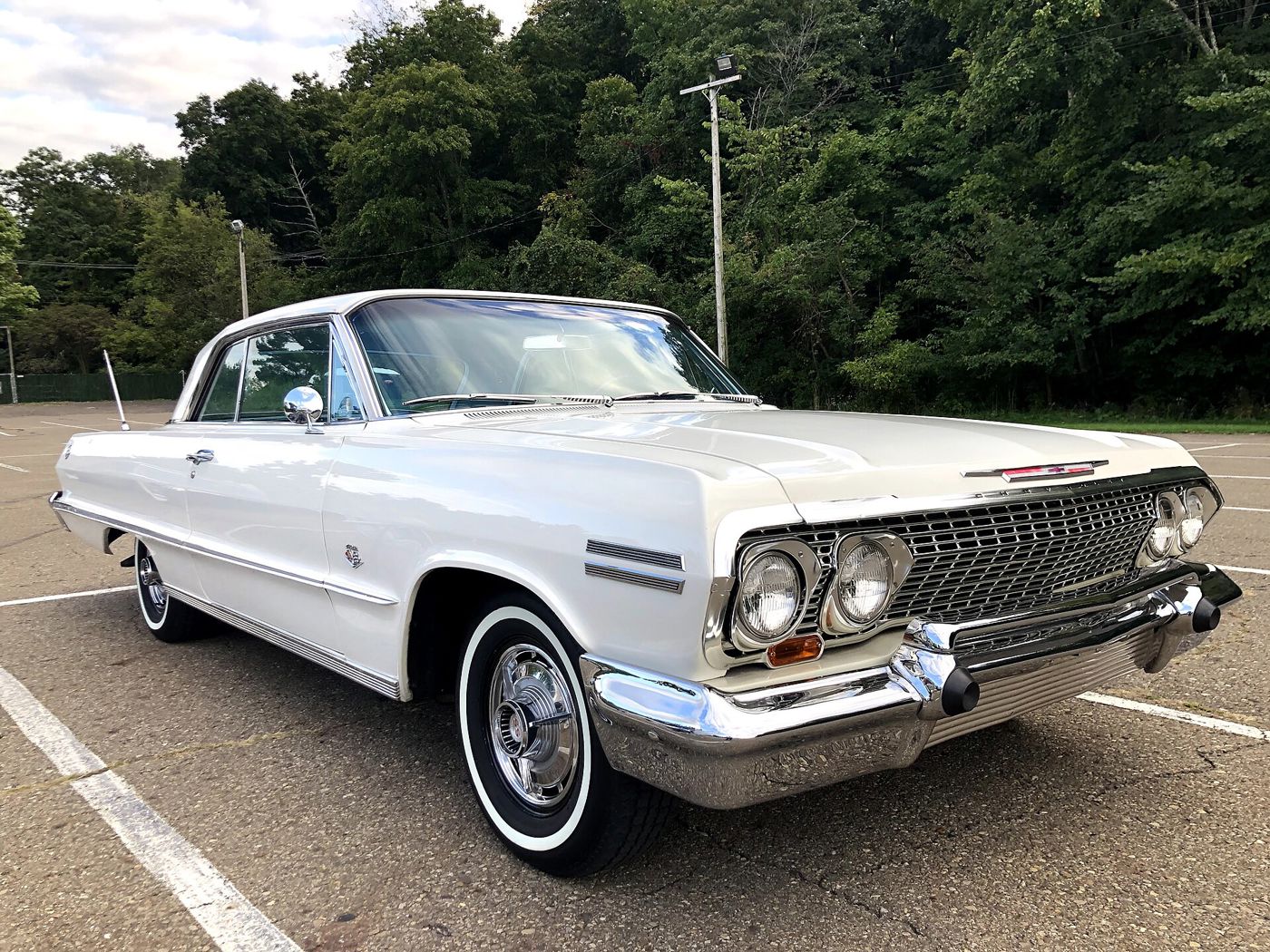
On August 21, 1962, Vince Piggins, head of Chevrolet's Economy, Safety and Performance department, sent a memo to eight colleagues, among them H. F. Barr, E. J. Premo and Zora Arkus-Duntov. As NHRA reproduces it, the memo called for two things. Ten Mark II 427-cubic-inch engines were to be prepared for Daytona Beach in February 1963. And 50 special 1963 Impala SS sport coupes were to be built with aluminum front-end sheet metal, hood, fenders, bumper and the rest, to carry Mark I 427s under a light-weight vehicle option coded RPO Z-11. Read today, it describes a Chevrolet planning to race harder in 1963, not less.1
The two engines had different jobs. NHRA explains that when NASCAR confirmed it would allow 427-cubic-inch engines for 1963, both programs got a stroked crankshaft, 3.650 inches. The Mark I was the drag-strip engine, built from the existing W-series 409 and badged in Chevrolet's paperwork as the 430 hp Turbo-Fire 427. The Mark II, the 427 hp Turbo-Fire 427, was the engine meant for Daytona. The memo also records that Duntov would keep developing a hood that fed cold air to the carburetors. The Z11 was the drag-strip half of a two-engine program.1
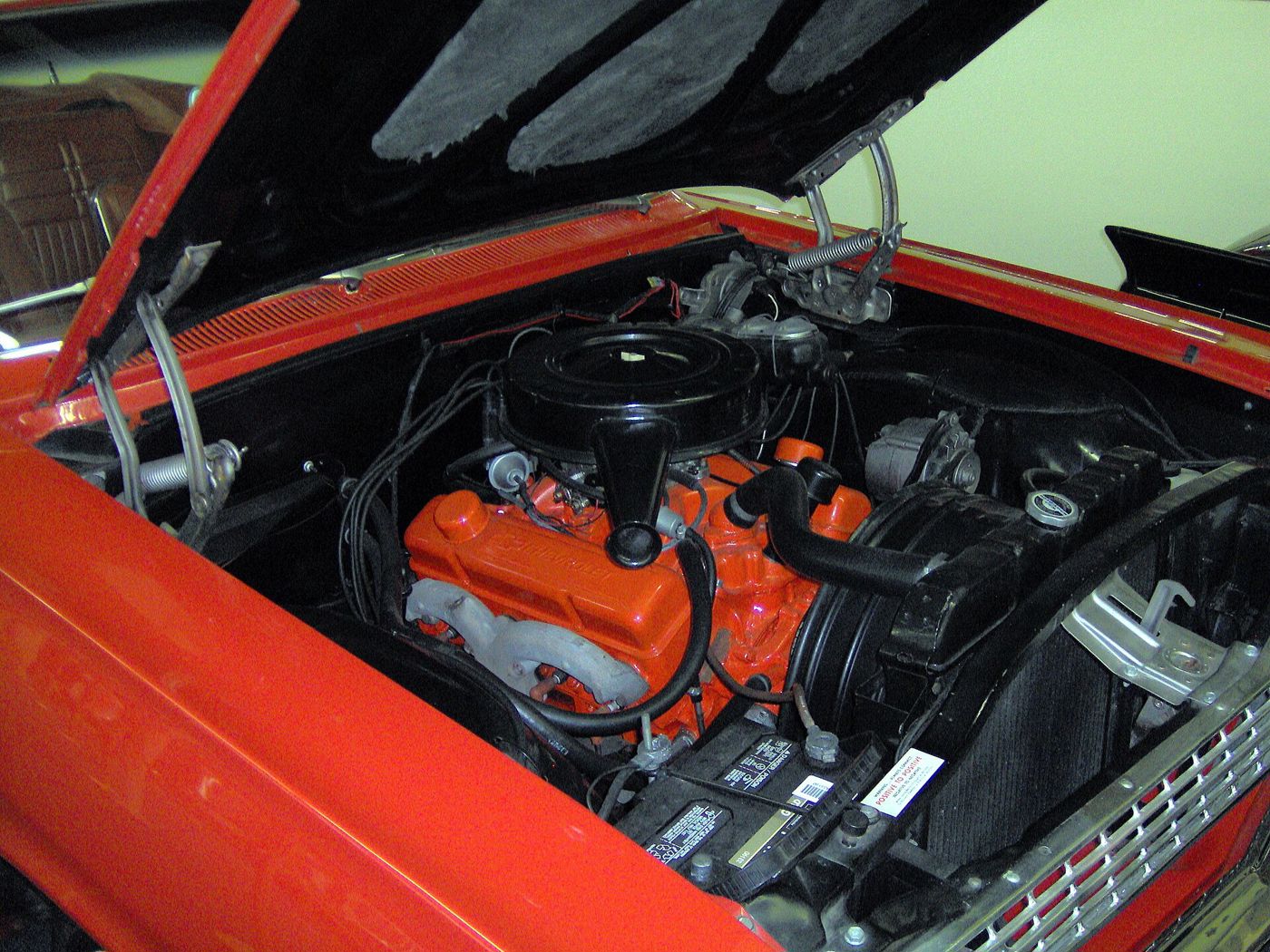
The package that reached the drag strip matched the plan. NHRA's history of the 409 lists the Z-11 as a $1,237 option and says the cars appeared at the 1963 Winternationals with aluminum front ends and 430 hp ratings. Chevy Hardcore's feature on a surviving car adds the details: dual Carter AFB four-barrels on an aluminum intake, 13.5:1 compression, cowl induction, and more than twenty weight-saving aluminum pieces including the hood, fenders and bumpers. Wikipedia's third-generation Impala article places the option on the Impala sport coupe. The 430 hp figure is an advertised SAE gross rating.2,3,4
How many were built is not settled. The Piggins memo planned 50. Wikipedia says 50 Z11 cars were produced at the Flint plant. The Classic Industries chart lists 57, and Chevy Hardcore says many sources put production at 57, with fewer than 60 built. The memo's 50 is a plan, not a count; the chart says its figures have not been verified by the factory; and Wikipedia does not show the record behind its 50. Both figures stand until a Chevrolet build record settles the question. Either way, set against 153,271 Super Sports, the Z11 was roughly one car in every 2,700 to 3,100.1,4,5,3
The ordinary Super Sport, meanwhile, was having its best year yet. The Classic Industries chart counts 153,271 Impala SSs for 1963, now under RPO Z03, against 99,311 in 1962. Measured against the chart's 832,600 Impalas, nearly one Impala in five was a Super Sport. Wikipedia describes the year's rectilinear styling with an engine-turned aluminum rear panel, and the Impala SS Registry lists the SS's own engine-turned exterior trim, SS badging and wheel covers, with 7.00 x 14 tires on the sport coupe and 7.50 x 14 on the convertible. V-8s dominated: the chart gives 735,900 V-8 Impalas against 96,700 sixes.5,6,4
The street 409 was still the engine most buyers meant when they said 409. NHRA's history says it came in three versions for 1963, rated from 340 to 425 hp, all SAE gross. The chart counts 16,920 409 engines across the full-size line, up from 15,019. That row covers every full-size Chevrolet, not only Super Sports. Even if every one of those 409s had gone into a Super Sport, it would have been in no more than about 11 percent of the cars wearing the badge; by 1963 most SS buyers were choosing trim and comfort, not the big engine.2,5
Then the door began to close. At 3:45 p.m. on January 24, 1963, a Pontiac bulletin told zone distributors that new orders for 389 and 421 Super Duty engines were cancelled that day. That bulletin is a Pontiac document, not a Chevrolet one, and it does not state the corporate reasoning. General Motors' broader position is on the record in chairman Frederic Donner's 1965 congressional testimony: the Automobile Manufacturers Association had adopted a June 1957 resolution against racing participation and speed advertising, and GM said it had made those provisions its own policy and continued to follow their spirit. Chevy Hardcore's feature says the ban effectively ended the Z11's competition career.7,8,3
What the policy stopped, and what it left alone, is visible on Pontiac's side of the corporation. Over-Drive's 1963 Pontiac fact sheet lists three Super Duty 421 ratings, 390, 405 and 410 hp, marked available only until February 1, 1963, while the January bulletin kept the 421 HO on sale. For ordinary buyers Pontiac still catalogued the 421 in 353 hp four-barrel and 370 hp Tri-Power form. Chevrolet's catalogue kept its street 409s in the same way. The factory-built drag and stock-car specials ended; the big engines a buyer could order from a dealer stayed.9,7,2
The cars that had been built went racing anyway, in private hands. Chevy Hardcore reports that Frank Sanders, the original owner of the car it profiles, won 19 of 20 races with it in 1963 and took a class title at the NHRA Winternationals; those claims come from the car's history and have not been checked against NHRA's own results. Pontiac's cars kept winning briefly too: on February 16, 1963, according to the Motorsports Hall of Fame of America, Paul Goldsmith won the American Challenge Cup in a Ray Nichels Super Duty Tempest. The Hall's display car is a recreation; the original, it reports, is believed to have been scrapped.3,10
What followed shows how far the Super Sport had drifted from the drag strip. For 1964 the Classic Industries chart counts 185,325 Super Sports, now a series of their own, while 409 engines across the full-size line fell to 8,684, about half the 1963 figure. The 1963 Impala SS therefore sits at a crossing point. It was the biggest Super Sport year yet at 153,271 cars, and it carried the most extreme factory drag package Chevrolet had offered, a $1,237 option on 50 or 57 cars, planned in a memo in August 1962 and overtaken by corporate policy within months.5,2,1,4
Fact sheet · 1963 · United States
The numbers
1963 Chevrolet Impala Super Sport — Super Sport (RPO Z03) peaks toward the 1960s high: 153,271 built, plus the Z11 427 drag package.
Coverage: Partial — researched sections are shown; missing ones are not yet sourced. Researched through 2026-09-22.
Every figure is labeled with how sure we are. Reported means a manufacturer, registry, or reference figure we cite but have not reconciled against factory records ourselves. Disputed means credible sources disagree and both are shown. Rows are separately scoped; don't add them together unless the note says they make up a total.
Key facts
- Super Sport production 1963: 153,271.5
- Chevrolet's 1963 specifications list Super-sport RPO Z03 for the Impala sport coupe and convertible (17-1847, 67) with all-vinyl bucket seats, a floor shift for Powerglide and the four-speed, and a centre console, and offer the 409 at 340 hp (L33), 400 hp (L31) and 425 hp (L80).
Production
| What was counted | Count | Basis | Status |
|---|---|---|---|
| Impala Super Sport5 Super Sport · sport coupe and convertible · not stated | 153,271 | built, model-year | Reported |
| RPO Z11 427 special package5 Impala sport coupe (Z11) · 427 (Z11) · not stated Wikipedia gives 50; see conflicts. | 57 | built, model-year | Disputed |
| What was counted | Count | Basis | Status |
|---|---|---|---|
| Impala Super Sport total production5 Super Sport · sport coupe and convertible · not stated The Classic Industries chart carries a single unpartitioned Super Sport figure for 1963 (no body or engine split), so it already is the year's whole total; same value and source as the 'ss' row above, added as its own row per the site's total-row convention. | 153,271 | built, model-year | Reported |
| What was counted | Count | Basis | Status |
|---|---|---|---|
| 409 V8 engines, full-size line5 all full-size (source row "409") · 409 V8 · not stated Row is labelled only "409" in a chart of all full-size Chevrolets; not an SS-only count. | 16,920 | built, model-year | Reported |
| What was counted | Count | Basis | Status |
|---|---|---|---|
| Impala series, all bodies5 all full-size · not stated | 832,600 | built, model-year | Reported |
| Convertible, all full-size5 all full-size · not stated | 82,659 | built, model-year | Reported |
| Sport coupe, all full-size5 all full-size · not stated | 399,224 | built, model-year | Reported |
| Impala series, V85 all full-size · not stated | 735,900 | built, model-year | Reported |
| Impala series, six-cylinder5 all full-size · not stated | 96,700 | built, model-year | Reported |
Classic Industries says its chart is believed correct but has not been verified by the factory. Chart rows mix series, body and engine scopes and are not additive.
Best missing primary source: the GM Heritage vehicle information kit for this year (gm.com returned 403).
Prices when new
| Model | Price | Basis |
|---|---|---|
| Impala SS 2-door hardtop, list price (Car Life test car, before extra-cost options)11 | $2,828 | manufacturer list price, base 2-door hardtop configuration per Car Life's specifications panel, 1963-03 |
| Impala SS 2-door hardtop, price as tested (409/340, Powerglide and options)11 | $3,708 | list price plus extra-cost options on Car Life's test car, 1963-03 |
| Impala Super Sport equipment package (RPO Z03)12 | $161 | retail option price, 1963 |
Prices are the nominal dollars of the day, not adjusted for inflation.
Engines
| Engine | Factory rating | Availability | Built |
|---|---|---|---|
| Z11 · 427 (Z11)13 427 cu in | 430 hp (SAE gross) | special package | Not yet sourced |
Ratings are the manufacturer's advertised figures under the standard shown (SAE gross before 1972, SAE net after). They are not dyno results, and gross and net ratings can't be compared directly.
Options and packages
| Code | Option | Price | Installed |
|---|---|---|---|
Z03RPO |
Super Sport6,5 | — | 153,2716,5 Reported |
Z11RPO |
427 special package13 | — | Not yet sourced |
L30RPO |
327 cu in V8, 250 hp (12-16-1800) | — | Not yet sourced |
L74RPO |
327 cu in V8 high performance, 300 hp | — | Not yet sourced |
L33RPO |
409 cu in V8, 340 hp | — | Not yet sourced |
L31RPO |
409 cu in V8, 400 hp | — | Not yet sourced |
L80RPO |
409 cu in V8, 425 hp | — | Not yet sourced |
M20RPO |
Four-speed (close-ratio version M21) (12-16-1800) | — | Not yet sourced |
G80RPO |
Limited-slip axle (3.08, 3.36, 3.55, 3.70, 4.11, 4.56:1) | — | Not yet sourced |
U16RPO |
Tachometer (12-16-1800) | — | Not yet sourced |
Interiors
| Code | Trim | Built |
|---|---|---|
812/815 |
Black SS bucket-seat trim (sport coupe/convertible codes where two are given)6 | Not yet sourced |
827/821 |
Green SS bucket-seat trim (sport coupe/convertible codes where two are given)6 | Not yet sourced |
843/831 |
Blue SS bucket-seat trim (sport coupe/convertible codes where two are given)6 | Not yet sourced |
854/845 |
Aqua SS bucket-seat trim (sport coupe/convertible codes where two are given)6 | Not yet sourced |
867/856 |
Fawn SS bucket-seat trim (sport coupe/convertible codes where two are given)6 | Not yet sourced |
858/862 |
Saddle SS bucket-seat trim (sport coupe/convertible codes where two are given)6 | Not yet sourced |
875/879 |
Red SS bucket-seat trim (sport coupe/convertible codes where two are given)6 | Not yet sourced |
Identification
- SS equipment
- Registry: SS added engine-turned exterior trim, SS badging and SS wheel covers; sport coupes on 7.00 x 14 and convertibles on 7.50 x 14 tires.6
Where the sources disagree
Identification
Read a 1963 Chevrolet VIN
The VIN decoder runs in your browser and never sends the VIN anywhere. How the factory numbered this year's cars:
Same model year
Also in 1963
- Buick Riviera Buick's first Riviera, a four-seat personal-luxury hardtop limited to 40,000 cars, with a 401 Nailhead standard and a 340-hp 425 added in December 1962.
- Buick Wildcat The Wildcat became its own series, adding a convertible and four-door hardtop; 35,725 built.
- Chevrolet Chevy II and Nova First Nova Super Sport year in the source production table. Enthusiast-compiled production: 372,626 cars; Super Sport 42,432.
- Chrysler 300 letter series Hardtop-only and trimmed exclusively in Claret Red leather, the 300J carried a 390 hp short-ram 413 as its only engine; 400 were built, the smallest letter-car run.
- Dodge Dart 330/440, Polara and Max Wedge The Max Wedge grew to 426 cu in, rated at 415 or 425 hp, and a Ramchargers Dodge driven by Herman Moser won Stock at the 1963 NHRA Nationals; Ramcharger production remains unsourced.
- Ford Fairlane Hardtops and wagons joined the Fairlane line; reference-site counts give 28,268 bucket-seat Fairlane 500 Sport Coupes, beside 97,444 Fairlanes and 246,443 Fairlane 500s.
- Ford Falcon Sprint The mid-year 1963 1/2 Sprint put the Fairlane's 164 hp 260 V8 into the compact Falcon for the first time, as a hardtop and a convertible.
- Ford Galaxie The 406 opened the year and was replaced mid-year by the 427, in Q-code (410 hp, one four-barrel) and R-code (425 hp, two four-barrels) form, while a fastback Sports Hardtop was offered in the Galaxie 500 and 500 XL series.
- Ford Thunderbird The Sports Roadster's second and last year: only 455 were built.
- Mercury Marauder and S-55 The S-55 line grew to four bodies, and the mid-year fastback Marauder hardtop arrived with 390, 406 and 427 V8s available.
- Oldsmobile Starfire A squared-off roof with a concave rear window; production fell 38 percent to 25,890.
- Plymouth Savoy, Fury and Max Wedge The Super Stock engine grew to 426 cu in at 415 or 425 hp, a Stage II revision followed, and Chrysler's own four-speed arrived in May 1963; Super Stock production remains unsourced.
- Pontiac Catalina 2+2 and Super Duty Three Super Duty 421 ratings up to 410 hp, then GM's racing withdrawal ended them early in the model year.
- Pontiac Grand Prix Production more than doubled to 72,959 at an unchanged price.
- Pontiac Tempest and LeMans A V8 for the Tempest, and about a dozen Super Duty Tempests built for racing before Pontiac's January 1963 withdrawal.
- Studebaker Avanti Studebaker's fiberglass four-seat coupe went on sale with a 289 V8 and an optional $210 Paxton supercharger. It was billed on the strength of a 1962 run of Bonneville records, and 3,834 were built as 1963 models.
- Studebaker Hawk The GT Hawk could now be ordered with the Avanti's R1 and supercharged R2 engines, and a spring 1963 package created the Super Hawk. Old Cars Weekly counts 396 R1 cars among 4,009 domestic GT Hawks.
- Studebaker Lark and Super Lark Studebaker offered the Avanti's R1 and supercharged R2 engines in the compact Lark and added a Super Lark package in April. No source read gives an R2 Lark count; the estimates run from about 200 to a few hundred.