1963 · Ford · United States
1963 Ford Galaxie: Daytona's Top Five, the 427 and a Roof in Dispute
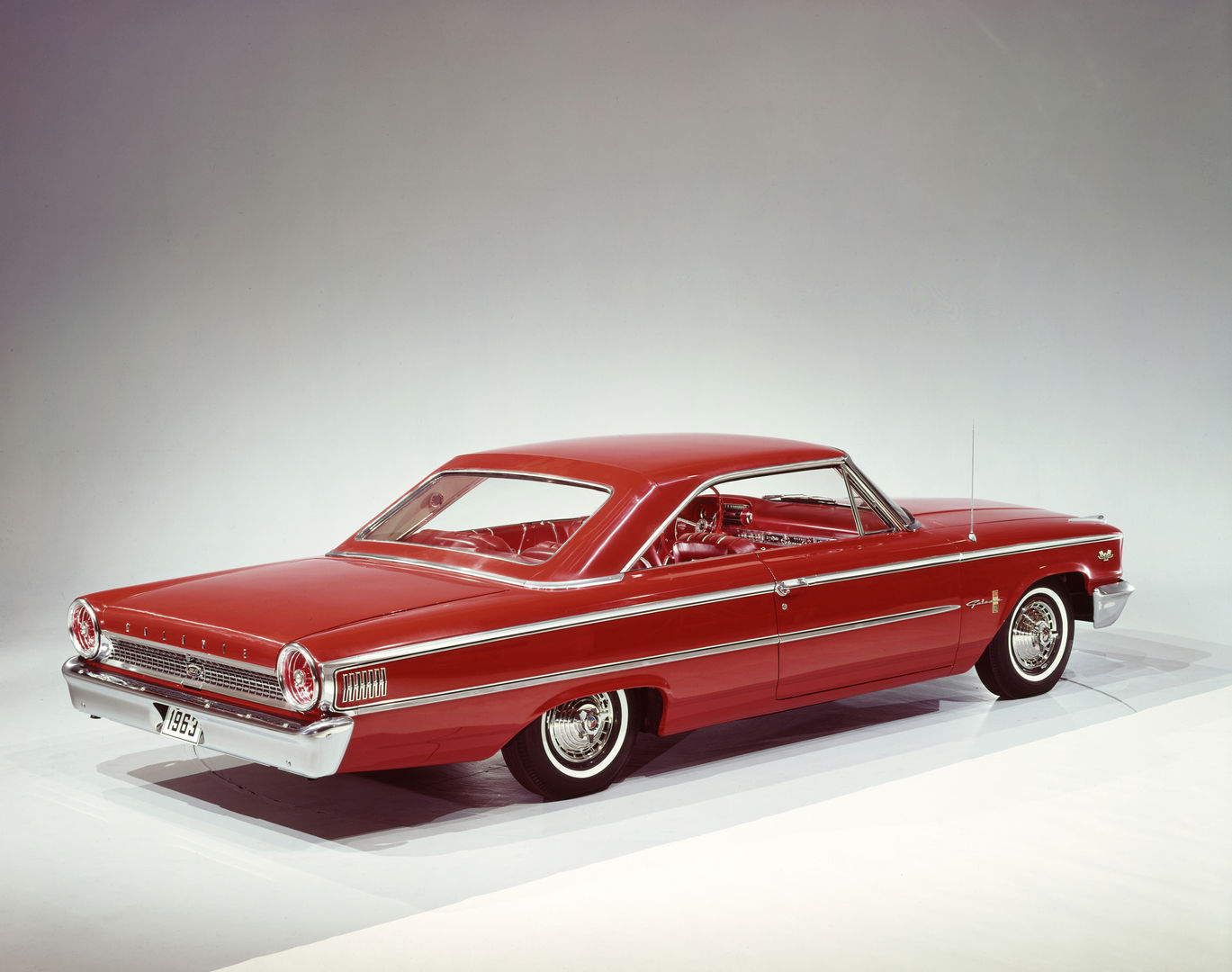
The 406 opened the year and was replaced mid-year by the 427, in Q-code (410 hp, one four-barrel) and R-code (425 hp, two four-barrels) form, while a fastback Sports Hardtop was offered in the Galaxie 500 and 500 XL series.
Tiny Lund came to Daytona in February 1963 without a ride. Marvin Panch had flipped a Maserati sports car in practice for a preliminary race, and Lund, then an unemployed driver looking for work as a mechanic, helped get him out of the burning car. From his hospital bed, Panch asked for Lund to take his place in the Wood Brothers' No. 21 Ford. On February 24 Lund ran the Daytona 500 on a single set of tires, made one fewer pit stop than his rivals, ran out of fuel in Turn 4 on the last lap, and coasted home about half a lap ahead of Fred Lorenzen.1,2
The car was a Ford Galaxie 500, and it did not win alone. Fords took the first five places: Lund, Lorenzen, Ned Jarrett, Nelson Stacy and Dan Gurney. The Wood Brothers went on to the 1963 owner's championship, the only title in the team's history, yet that year's drivers' title went to Joe Weatherly in a Pontiac with three wins. Ford's big car was fast enough to fill the top five at Daytona but had not yet turned speed into a championship, and the rest of the 1963 model year was about adding more of it.1,2,3
Ford's answer was more engine. The 406 began the year in two forms, code B with one four-barrel at 385 horsepower and code G with three two-barrels at 405 horsepower, and each was replaced mid-year by a 427: code Q with one four-barrel at 410 horsepower and 476 lb-ft, and code R with two four-barrels at 425 horsepower and 480 lb-ft, all SAE gross ratings. The standard axle with either big engine was 3.50:1 with the three- or four-speed and 4.11 with overdrive.4
Car Life put the change in plain arithmetic in its June 1963 road test. A Galaxie with the standard 260 V-8, the magazine calculated, carried 23.2 pounds per horsepower at a 3,800-pound curb weight, while a 427 Galaxie could run as low as 8.7 pounds per horsepower at 3,700 pounds and 425 horsepower. Its own test car was neither: a 289 XL Sports Hardtop that averaged 15.8 mpg over nearly 1,000 miles, against the 9 to 12 mpg the staff had been seeing from cars with more than 400 cubic inches. The big engines bought their performance with fuel, and Car Life measured the bill.5
Car Life's larger point was that the Galaxie's weight problem ran through the whole range, racing cars included. The magazine wrote that in the Galaxie, a car larger in box volume than a Lincoln, there was simply too much weight for the standard 260 V-8, particularly against Chevrolet's 195-horsepower 283. Ford's fix for ordinary buyers was one more pass of the boring bar, taking the 260 out to 289 cubic inches, rated at 195 horsepower at 4,400 rpm and 282 lb-ft at 2,400. At the top of the range the 406 and the 427 were the same answer on a far larger scale, and the racers building lightweight Galaxies were busy taking weight back out.5,6
The other mid-year change was the roof. Ford added a Sports Hardtop fastback to the Galaxie 500 and 500 XL series, and the sources disagree about why. Over-Drive Magazine says it was primarily developed to help Fords on NASCAR's high-speed ovals after a distinct disadvantage in 1962. Mac's Motor City Garage quotes Ford studio chief Joe Oros saying the design was not influenced by racing and was meant to give the hardtop a youthful, sporty verve, while acknowledging that Ford's racers had struggled with the 1962-63 boxtop. Car Life, for its part, noted that the new slantback roof was not a true fastback at all.4,7,5
Buyers voted for the new roof. The Galaxie 500 Sports Hardtop reached 100,500 against 49,733 notchback hardtops, almost exactly two to one, even though the fastback arrived halfway through the year; the production figures mix 'sold,' 'delivered' and 'built' wording from row to row. In the 500 XL series the margin was far narrower: 33,870 fastbacks to 29,713 notchbacks. For scale, the Galaxie 500 four-door sedan alone reached 205,722.4,7
The 427's most visible customers were often at dealerships. Martyn L. Schorr's October 1963 Cars feature followed Bill Kolb Jr., a salesman at Larsen Ford in White Plains, New York, who raced a lightweight 427 Galaxie after hours and had run 116 mph in 12.7 seconds while winning Super Stock trophies at the Dover strip both times out. Schorr wrote that the lightweight was offered only as a Galaxie hardtop, with fiberglass hood, front fenders, doors and deck lid, lightweight aluminum bumpers and no sound deadening, and a caption put the finished car just under 3,600 pounds. Bob Tasca's 'Go Getter II,' he added, had run 12.0 seconds at a Rhode Island strip.6
The same article is candid about what Ford had not yet solved. The lightweight used a T-10 four-speed with a 2.36:1 first gear and a 1.66 second, its own clutch and an explosion-proof scattershield bellhousing, but Ford still offered only a non-locking differential on its high-performance cars, so dealers or owners had to fit a Detroit Automotive locker, a hundred-dollar-plus job. Schorr also noted that although the car was set up at the factory for drag racing, it could not be raced successfully straight off the showroom floor, and he called that one serious drawback of the Ford.6
Those limits pointed to the next step. The full-size Galaxie was simply too heavy against lighter Chevrolet, Dodge and Plymouth competition, and Ford's 1964 answer was to put the 427 into the midsize Fairlane and call it the Thunderbolt. 1963 was the year Ford got its biggest engine and its fastback roof into the showroom, filled the top five at Daytona with the big car, and found that the car wrapped around the engine had become the problem.8,4,2
Fact sheet · 1963 · United States
The numbers
1963 Ford Galaxie (406 and 427): The 406 opened the year and was replaced mid-year by the 427, in Q-code (410 hp, one four-barrel) and R-code (425 hp, two four-barrels) form, while a fastback Sports Hardtop was offered in the Galaxie 500 and 500 XL series.
Figures may describe different groups of cars. Add rows together only when the note says they make up a total.
Key facts
- 427 mid-year: Q-code 410 hp at 5,600 rpm, 476 lb-ft; R-code 425 hp at 6,000 rpm, 480 lb-ft.4
Production
| What was counted | Count | Counted as |
|---|---|---|
| Galaxie 500 XL Sports Hardtop (fastback)4,9 Galaxie 500 XL · 2-door fastback hardtop · as published | 33,870 | sold |
| Galaxie 500 XL 2-door hardtop (notchback)4 Galaxie 500 XL · 2-door hardtop · as published The figure appears in two paragraphs of the page. | 29,713 | sold |
| Galaxie 500 XL convertible4 Galaxie 500 XL · convertible · as published | 18,551 | sold |
| Galaxie 500 Sports Hardtop (fastback)4,9 Galaxie 500 · 2-door fastback hardtop · as published | 100,500 | sold |
| Galaxie 500 2-door hardtop (notchback)4 Galaxie 500 · 2-door hardtop · as published | 49,733 | delivered |
| Galaxie 500 convertible4 Galaxie 500 · convertible · as published | 36,876 | built |
| Galaxie 500 4-door hardtop4 Galaxie 500 · 4-door hardtop · as published | 26,558 | delivered |
| Galaxie 500 XL 4-door hardtop4 Galaxie 500 XL · 4-door hardtop · as published | 12,596 | sold |
| Galaxie 500 4-door sedan4 Galaxie 500 · 4-door sedan · as published | 205,722 | built |
| Galaxie 4-door sedan (52)9 Galaxie · 4-door sedan, 52 · as published | 82,419 | built |
| Galaxie 2-door sedan (51)9 Galaxie · 2-door sedan, 51 · as published | 30,335 | built |
| Galaxie 500 Club Sedan 2-door (61)9 Galaxie 500 · 2-door sedan, 61 · as published | 21,137 | built |
| What was counted | Built |
|---|---|
| Galaxie series total9 Galaxie · as published | 112,754 |
| Galaxie 500 series total9 Galaxie 500 · as published | 440,526 |
| Galaxie 500 XL series total (V8 only)9 Galaxie 500 XL · as published 4-door hardtop 12,596, 2-door hardtop 29,713, fastback 33,870, convertible 18,551. | 94,730 |
| Ford 300 series total (context)9 300 · as published | 70,152 |
| Station wagons total (context)9 Country Sedan, Country Squire · station wagons · as published | 126,372 |
| What was counted | Built |
|---|---|
| All 1963 full-size Fords9 all full-size · as published | 844,534 |
Prices when new
| Model | Price | Price type |
|---|---|---|
| Galaxie 4-door sedan (52), six9 | $2,507 | factory price, 1963 model year |
| Galaxie 4-door sedan (52), V89 | $2,616 | factory price, 1963 model year |
| Galaxie 2-door sedan (51), six9 | $2,453 | factory price, 1963 model year |
| Galaxie 2-door sedan (51), V89 | $2,562 | factory price, 1963 model year |
| Galaxie 500 Town Sedan (62), six9 | $2,667 | factory price, 1963 model year |
| Galaxie 500 Town Sedan (62), V89 | $2,776 | factory price, 1963 model year |
| Galaxie 500 Club Sedan (61), six9 | $2,613 | factory price, 1963 model year |
| Galaxie 500 Club Sedan (61), V89 | $2,722 | factory price, 1963 model year |
| Galaxie 500 Town Victoria 4-door hardtop (64), six9 | $2,739 | factory price, 1963 model year |
| Galaxie 500 Town Victoria 4-door hardtop (64), V89 | $2,848 | factory price, 1963 model year |
| Galaxie 500 Club Victoria 2-door hardtop (63), six9 | $2,674 | factory price, 1963 model year |
| Galaxie 500 Club Victoria 2-door hardtop (63), V89 | $2,783 | factory price, 1963 model year |
| Galaxie 500 Fastback Coupe (66), six9 | $2,674 | factory price, 1963 model year |
| Galaxie 500 Fastback Coupe (66), V89 | $2,783 | factory price, 1963 model year |
| Galaxie 500 Sunliner convertible (65), six9 | $2,924 | factory price, 1963 model year |
| Galaxie 500 Sunliner convertible (65), V89 | $3,033 | factory price, 1963 model year |
| Galaxie 500 XL Town Victoria 4-door hardtop, V89 | $3,333 | factory price, 1963 model year |
| Galaxie 500 XL Club Victoria 2-door hardtop (67), V89 | $3,328 | factory price, 1963 model year |
| Galaxie 500 XL Fastback Coupe (68), V89 | $3,268 | factory price, 1963 model year |
| Galaxie 500 XL Sunliner convertible (76C), V89 | $3,518 | factory price, 1963 model year |
Prices are the nominal dollars of the day, not adjusted for inflation.
Engines
| Engine | Factory rating | Availability |
|---|---|---|
| Z · 390 V8 4-bbl4 390 cu in · 4-barrel | 300 hp @ 4,600, 427 lb-ft @ 2,800 (SAE gross) | optional |
| B · 406 V8 4-bbl4 406 cu in · 4-barrel | 385 hp @ 5,800, 444 lb-ft @ 3,400 (SAE gross) | early 1963; replaced mid-year by the 427 Q |
| G · 406 V8 3 x 2-bbl4 406 cu in · 3 x 2-barrel | 405 hp @ 5,800, 448 lb-ft @ 3,500 (SAE gross) | early 1963; replaced mid-year by the 427 R |
| Q · 427 V8 4-bbl4 427 cu in · 4-barrel | 410 hp @ 5,600, 476 lb-ft @ 3,400 (SAE gross) | from mid-year |
| R · 427 V8 2 x 4-bbl4 427 cu in · 2 x 4-barrel | 425 hp @ 6,000, 480 lb-ft @ 3,700 (SAE gross) | from mid-year |
Ratings are published figures, not dyno results. Gross and net ratings aren't directly comparable.
Transmissions
| Transmission | Availability |
|---|---|
| 4-speed manual4 | optional; ratios 2.36, 1.78, 1.41, 1.00 |
| 3-speed manual4 | standard; 2.37/1.51/1.00 with 390 and 406 High Performance; all-synchromesh on other engines |
| 3-speed manual with overdrive4 | optional, including 390, 406 and 427 High Performance |
| Cruise-O-Matic 3-speed automatic4 | optional |
| Fordomatic 2-speed automatic4 | optional |
Options and packages
| Option | Price |
|---|---|
| Transmission, four-speed manual4 | $188 |
| Transmission, three-speed manual with overdrive4 | $108 |
| Transmission, Cruise-O-Matic4 | $212 |
| Transmission, Fordomatic with V84 | $190 |
| Equa-Lock differential4 | $39 |
| Battery, heavy-duty 70-amp4 | $8 |
| Air conditioning, Select Aire (V8)4 | $361 |
| Power brakes4 | $43 |
| Power steering4 | $82 |
| Power windows, front and rear4 | $102 |
| Radio, push-button, with antenna4 | $59 |
| Tinted glass4 | $40 |
| Two-tone paint4 | $22 |
| Vinyl trim, Galaxie 500 except convertible4 | $26 |
| Wheel covers, deluxe4 | $26 |
Paint
| Code | Color |
|---|---|
A |
Black (M1724)4 |
J |
Rangoon Red (M1515)4 |
M |
Corinthian White (M1238)4 |
B |
Peacock Blue (M1613)4 |
E |
Viking Blue (M1448)4 |
X |
Heritage Burgundy (M1444)4 |
Y |
Glacier Blue (M1553)4 |
D |
Ming Green4 |
H |
Oxford Blue4 |
I |
Castilian Gold4 |
I |
Champagne4 |
P |
Silver Moss4 |
T |
Sandshell Beige4 |
V |
Chestnut4 |
W |
Rose Beige4 |
Color names are the factory's. We don't show color swatches, because a screen color is no guide for a restoration.
Specifications
| Measure | Value | Applies to |
|---|---|---|
| Wheelbase4 | 119 in | all |
| Overall length4 | 209.9 in | all |
| Overall width4 | 79.9 in | all |
| Rear axle ratio, 406/427 with 4-speed4 | 3.5 ratio | 406 and 427 |
| Shipping weight, Galaxie 500 XL fastback (68)9 | 3,670 lb | 68, V8 |
| Shipping weight, Galaxie 500 XL convertible (76C)9 | 3,820 lb | 76C, V8 |
| Shipping weight, Galaxie 500 fastback (66) V89 | 3,615 lb | 66, V8 |
| Shipping weight, Galaxie 2-door sedan (51) V89 | 3,650 lb | 51, V8 |
| Overall height, Sports Roof fastback4 | 54.5 in | 2-door fastback |
| Overall height, convertible4 | 54.6 in | convertible |
| Front track4 | 61 in | all |
| Rear track4 | 60 in | all |
| Rear axle, 406 and 4274 | 3.50 (3-speed and 4-speed), 4.11 (overdrive) | 406/427 High Performance |
| Dealer-installed axle ratios4 | 2.89 to 4.56 | all |
Identification
Read a 1963 Ford VIN
The VIN decoder runs in your browser and never sends the VIN anywhere. How the factory numbered this year's cars:
Same model year
Also in 1963
- Buick Riviera Buick's first Riviera, a four-seat personal-luxury hardtop limited to 40,000 cars, with a 401 Nailhead standard and a 340-hp 425 added in December 1962.
- Buick Wildcat The Wildcat became its own series, adding a convertible and four-door hardtop; 35,725 built.
- Chevrolet Chevy II and Nova First Nova Super Sport year in the source production table. Enthusiast-compiled production: 372,626 cars; Super Sport 42,432.
- Chevrolet Impala SS Super Sport (RPO Z03) peaks toward the 1960s high: 153,271 built, plus the Z11 427 drag package.
- Chrysler 300 letter series Hardtop-only and trimmed exclusively in Claret Red leather, the 300J carried a 390 hp short-ram 413 as its only engine; 400 were built, the smallest letter-car run.
- Dodge Dart 330/440, Polara and Max Wedge The Max Wedge grew to 426 cu in, rated at 415 or 425 hp, and a Ramchargers Dodge driven by Herman Moser won Stock at the 1963 NHRA Nationals; Ramcharger production remains unsourced.
- Ford Fairlane Hardtops and wagons joined the Fairlane line; reference-site counts give 28,268 bucket-seat Fairlane 500 Sport Coupes, beside 97,444 Fairlanes and 246,443 Fairlane 500s.
- Ford Falcon Sprint The mid-year 1963 1/2 Sprint put the Fairlane's 164 hp 260 V8 into the compact Falcon for the first time, as a hardtop and a convertible.
- Ford Thunderbird The Sports Roadster's second and last year: only 455 were built.
- Mercury Marauder and S-55 The S-55 line grew to four bodies, and the mid-year fastback Marauder hardtop arrived with 390, 406 and 427 V8s available.
- Oldsmobile Starfire A squared-off roof with a concave rear window; production fell 38 percent to 25,890.
- Plymouth Savoy, Fury and Max Wedge The Super Stock engine grew to 426 cu in at 415 or 425 hp, a Stage II revision followed, and Chrysler's four-speed arrived in May 1963.
- Pontiac Catalina 2+2 and Super Duty Three Super Duty 421 ratings up to 410 hp, then GM's racing withdrawal ended them early in the model year.
- Pontiac Grand Prix Production more than doubled to 72,959 at an unchanged price.
- Pontiac Tempest and LeMans A V8 for the Tempest, and about a dozen Super Duty Tempests built for racing before Pontiac's January 1963 withdrawal.
- Studebaker Avanti Studebaker's fiberglass four-seat coupe went on sale with a 289 V8 and an optional $210 Paxton supercharger. It was billed on the strength of a 1962 run of Bonneville records, and 3,834 were built as 1963 models.
- Studebaker Hawk The GT Hawk could now be ordered with the Avanti's R1 and supercharged R2 engines, and a spring 1963 package created the Super Hawk. Old Cars Weekly counts 396 R1 cars among 4,009 domestic GT Hawks.
- Studebaker Lark and Super Lark Studebaker offered the Avanti's R1 and supercharged R2 engines in the compact Lark and added a Super Lark package in April. No source read gives an R2 Lark count; the estimates run from about 200 to a few hundred.