1963 · Plymouth · United States
1963 Plymouth Super Stock 426: Built to a 427-Inch Rule, Raced by the Men Who Built It
The Super Stock engine grew to 426 cu in at 415 or 425 hp, a Stage II revision followed, and Chrysler's own four-speed arrived in May 1963; Super Stock production remains unsourced.
United States · researched through 2026-09-23
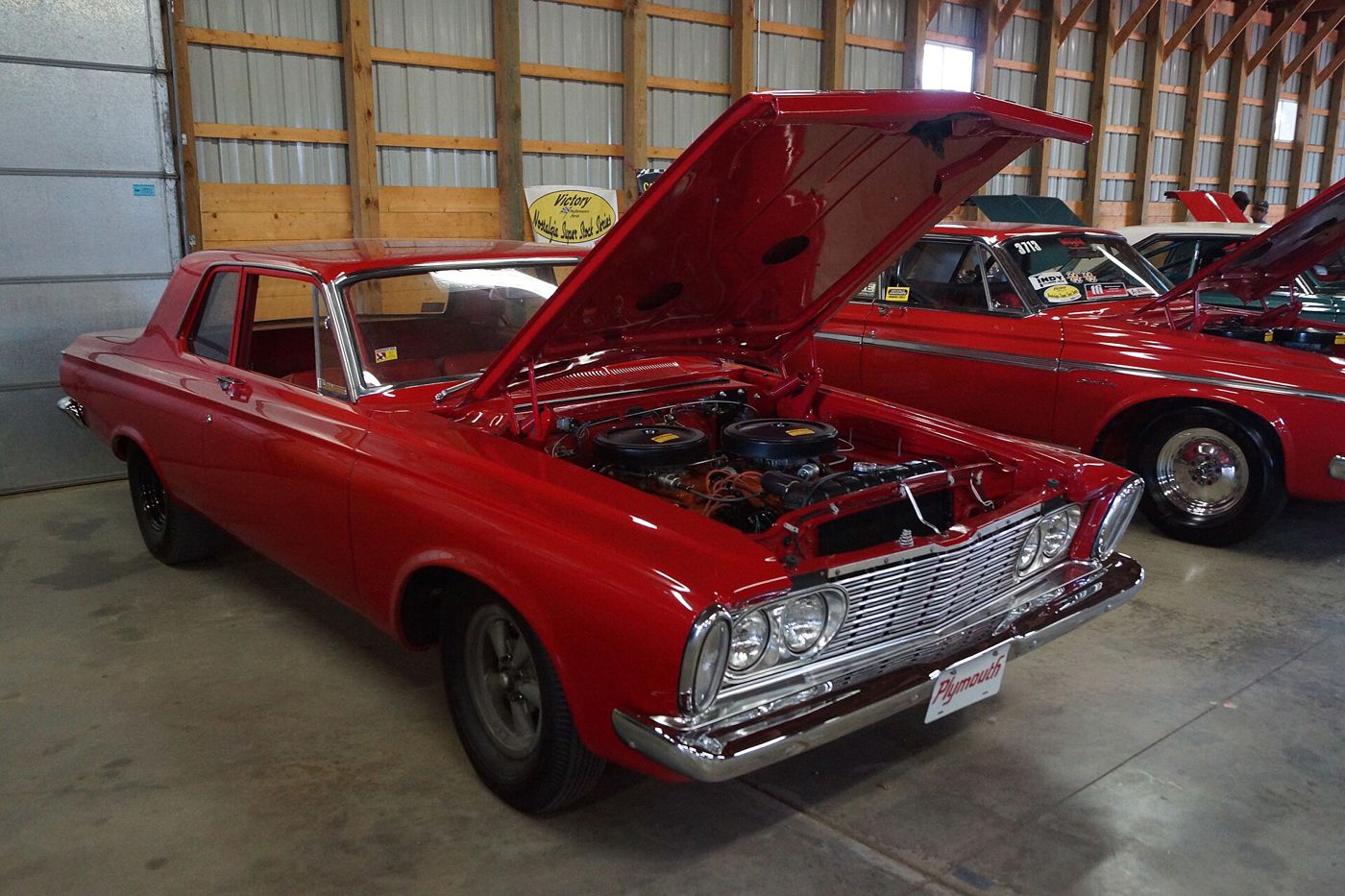
Plymouth's factory drag racers arrived at the NHRA Winternationals in February 1963 with a new engine. Mac's Motor City Garage describes the Golden Commandos as the factory Plymouth team, set up as a counterpart to Dodge's Ramchargers, led by engineer Ray Kobe and made up mainly of Chrysler engineering mechanics and technicians. The article says they came out of nowhere to finish runner-up at that meet. In the same season, Dragzine reports, Tom Grove's Melrose Missile, a 426-powered 1963 Savoy named for Melrose Motors of Oakland, California, won the Super Stock class at the Winternationals with a three-speed manual. The two results belong to different entries and are kept apart.1,2
The engine's size was set by a rule. Engine Labs reports that for 1963 NHRA limited factory Super Stock displacement to 427.2 cubic inches, which is why Chrysler's maximum-performance wedge grew from 413 to 426 rather than to anything larger. Chrysler's technical bulletin dated June 13, 1963 presents the 426 as the successor to the 1962 413-cubic-inch Plymouth Super Stock and Dodge Ramcharger programs, keeping the two marque names separate even while describing one engineering development. On the Plymouth side, the option carried the name Super Stock 426 in Over-Drive's compilation of the year's engines.3,4,5
Plymouth needed the attention. Mac's records that the corporation's volume division had fallen from third to eighth in U.S. sales after the 1961 and 1962 models, cars Virgil Exner himself had called plucked chickens. Exner began the 1963 overhaul, and Elwood Engel, arriving as design vice president, changed little: a wider stance, a deck three inches longer and a shoulder line running front to rear. Over-Drive keeps the 116-inch wheelbase and describes a flat roof, a flatter rear deck and a square front. Mac's credits a performance program under Chrysler engineer Tom Hoover with moving Plymouth and Dodge from mid-field toward the front in NASCAR and drag racing.1,5
The Super Stock 426 itself was a short-ram engine. Over-Drive lists two Carter four-barrels on an integral 15-inch ram intake, mechanical lifters and a camshaft with 300 degrees of duration, 75 degrees of overlap and 0.509-inch lift. On 11.0:1 compression it was rated at 415 horsepower at 5,600 rpm and 470 lb-ft at 4,400 rpm; on 13.5:1 it was rated at 425 horsepower at 5,600 rpm and 480 lb-ft at 4,400. These are manufacturer-published ratings whose basis the fact sheet does not state, and at 425 horsepower from 426 cubic inches the high-compression engine sat just under one horsepower per cubic inch on paper.5
The engine also changed during the year, and the sources describe the change differently. Over-Drive says Stage II versions arrived with improved cylinder heads, exhaust duration raised to 308 degrees and lift to 0.520 inch, and the same horsepower ratings. It adds that in June 1963 Plymouth announced a Super Stock wedge-head 426-II for supervised drag racing and stock-car racing, and that cars with it finished first and second in USAC competition. Engine Labs, writing about the 1963 engines, says both compression versions were called Stage II and that there was no Stage I. Neither source prints the factory release that would settle the naming.5,3
A buyer could put the engine in almost any full-size Plymouth. MaxWedge.com says the 1963 package was available in every intermediate B-body Plymouth, Savoy, Belvedere, Fury and Sport Fury alike, and Over-Drive singles out the lighter Belvedere two-door hardtop. The racers chose the plainest car and lightened it further. Engine Labs describes a Plymouth Savoy with lightweight aluminum front bodywork, a hood scoop and a minimal interior, and Dragzine lists an aluminum front bumper and hood and factory hood scoops on the Melrose Missile. None of the sources states how much weight the aluminum parts saved.6,5,3,2
The gearboxes tell the calendar of the year. Over-Drive lists the 426 with a three-speed manual and a 3.91 standard axle, or the TorqueFlite automatic, and says Chrysler's own four-speed, geared 2.66, 1.91, 1.39 and 1.00 with a 3.55 standard axle, arrived only in May 1963. Grove's Winternationals class win came with the three-speed, months before a four-speed could be ordered. Dragzine says the Melrose team also ran a push-button TorqueFlite car in Super Stock Automatic that season, driven by Charlie Di Bari, so the same dealer campaigned both transmissions while the corporation was still finishing its manual gearbox.5,2
How many Plymouths got the engine has not been found in any published source. Over-Drive gives 244,395 Plymouths for 1963, 158,612 of them with V8s, or about 65 percent, and prints body counts for the host series: 56,313 Savoy four-door sedans, 54,929 Belvedere four-door sedans, 31,891 Fury four-door sedans, 11,483 Sport Fury hardtops and 3,836 Sport Fury convertibles. Every one of those counts covers all engines. Two-door sedan counts for the Savoy and Belvedere were not captured, and Darrell L. Davis's Max Wedge serial-number work, which may hold totals by body, has not been inspected. The denominator is known; the numerator is not.5
The racing season did not end with a Plymouth on top at the biggest meet. Mac's says the Golden Commandos set low elapsed time at the U.S. Nationals in September and claimed the track record at Detroit Dragway, the Ramchargers' home track. But NHRA's Ramchargers retrospective identifies Herman Moser as the Stock winner at the 1963 Nationals in a Max Wedge Dodge, and a participant there recalls officials repeatedly inspecting and sealing the engine. Low elapsed time and the eliminator title were separate honors, and in 1963 the corporation's two factory-connected teams divided them. Dragzine credits the Melrose cars with 26 track records over their two seasons.1,7,2
The team rivalry had a social edge that the cars did not. Mac's describes the Golden Commandos as mainly mechanics and technicians and calls the contest with the engineer-heavy Ramchargers a light-hearted blue-collar versus white-collar rivalry. NHRA's history of the Ramchargers stresses that the club remained financially and operationally independent of Chrysler even though several members held engineering jobs connected to the corporation's race program. Both groups drove the same corporate engine family, and both show how a factory program could run through people whose day jobs and weekend racing overlapped without becoming one organization.1,7
The 426 wedge's replacement was already under way before the 1963 season began. NHRA's history of the Race Hemi says that in December 1962 Bill Weertman and a small engineering group were assigned to prepare a new 426-cubic-inch engine for the 1964 Winternationals and Daytona 500, and it places Hoover on that work after his Max Wedge and Ramchargers experience. The shared displacement makes the two easy to confuse, but the Race Hemi was a different engine with a different combustion chamber. The Melrose Missile raced on into 1964, and Dragzine says Grove retired it in 1965 when he moved to Ford.8,2
Fact sheet · 1963 · United States
The numbers
1963 Plymouth Savoy, Belvedere and Fury with the Super Stock 426 — The Super Stock engine grew to 426 cu in at 415 or 425 hp, a Stage II revision followed, and Chrysler's own four-speed arrived in May 1963; Super Stock production remains unsourced.
Coverage: Partial — researched sections are shown; missing ones are not yet sourced. Researched through 2026-09-23.
Every figure is labeled with how sure we are. Reported means a manufacturer, registry, or reference figure we cite but have not reconciled against factory records ourselves. Disputed means credible sources disagree and both are shown. Rows are separately scoped; don't add them together unless the note says they make up a total.
Key facts
Production
| What was counted | Count | Basis | Status |
|---|---|---|---|
| 1963 Plymouth standard line, all models (all engines)5 not stated Scope (whether Valiant is excluded) as the fact sheet frames its mid-size line. | 244,395 | built, model-year | Reported |
| 1963 Plymouth standard line with V8 engines5 V8 (all) · not stated | 158,612 | built, model-year | Reported |
| Savoy four-door sedan (all engines)5 Savoy · 4-door sedan · not stated | 56,313 | built, model-year | Reported |
| Belvedere four-door sedan (all engines)5 Belvedere · 4-door sedan · not stated | 54,929 | built, model-year | Reported |
| Fury four-door sedan (all engines)5 Fury · 4-door sedan · not stated | 31,891 | built, model-year | Reported |
| Sport Fury two-door hardtop (all engines)5 Sport Fury · 2-door hardtop · not stated | 11,483 | built, model-year | Reported |
| Sport Fury convertible (all engines)5 Sport Fury · convertible · not stated | 3,836 | built, model-year | Reported |
| What was counted | Count | Basis | Status |
|---|---|---|---|
| Savoy two-door sedan (all engines, incl. fleet)9 Savoy · 2-door sedan · not stated | 20,281 | built, model-year | Reported |
| Belvedere two-door sedan (all engines)9 Belvedere · 2-door sedan · not stated Identical to the 1962 Belvedere 2-door figure in Over-Drive's 1962 table; possibly carried over in error. | 3,128 | built, model-year | Reported |
| Belvedere two-door hardtop (all engines)9 Belvedere · 2-door hardtop · not stated | 9,204 | built, model-year | Reported |
| Fury two-door hardtop (all engines)9 Fury · 2-door hardtop · not stated | 13,832 | built, model-year | Reported |
| Fury four-door hardtop (all engines)9 Fury · 4-door hardtop · not stated | 11,877 | built, model-year | Reported |
| Fury convertible (all engines)9 Fury · convertible · not stated | 5,221 | built, model-year | Reported |
| What was counted | Count | Basis | Status |
|---|---|---|---|
| 1963 Plymouth standard line (Over-Drive table total)9 not stated Disagrees with the 244,395 total printed in Over-Drive's own 1963 fact sheet. The table repeats several 1962 prices and its Fury wagon rows match the 1962 Sport Suburban rows exactly, so it may carry 1962 data. | 258,283 | built, model-year | Disputed |
Host-series rows count every engine and are context only. Savoy and Belvedere two-door sedan counts (the usual Super Stock bodies) were not captured.
Prices when new
| Model | Price | Basis |
|---|---|---|
| Savoy 2-door sedan, V8 (TP2-L 311)9 | $2,313 | factory / base price as tabulated by Over-Drive (host car; Super Stock engine extra), 1963 model year |
| Belvedere 2-door sedan, V8 (TP2-M 321)9 | $2,450 | factory / base price as tabulated by Over-Drive (host car; Super Stock engine extra), 1963 model year |
| Belvedere 2-door hardtop, V8 (TP2-M 322)9 | $2,538 | factory / base price as tabulated by Over-Drive (host car; Super Stock engine extra), 1963 model year |
| Fury 2-door hardtop, V8 (TP2-H 332)9 | $2,693 | factory / base price as tabulated by Over-Drive (host car; Super Stock engine extra), 1963 model year |
| Fury convertible, V8 (TP2-H 335)9 | $2,924 | factory / base price as tabulated by Over-Drive (host car; Super Stock engine extra), 1963 model year |
| Sport Fury 2-door hardtop (TP2-P 342)9 | $2,851 | factory / base price as tabulated by Over-Drive (host car; Super Stock engine extra), 1963 model year |
| Sport Fury convertible (TP2-P 345)9 | $3,082 | factory / base price as tabulated by Over-Drive (host car; Super Stock engine extra), 1963 model year |
Prices are the nominal dollars of the day, not adjusted for inflation.
Engines
| Engine | Factory rating | Availability | Built |
|---|---|---|---|
| Super Stock 426, dual 4-bbl short ram, 415 hp5 426 cu in · 2 x 4-barrel Carter on integral 15 in short-ram intake | 415 hp @ 5,600, 470 lb-ft @ 4,400 (manufacturer published (basis not stated)) | optional | Not yet sourced |
| Super Stock 426, dual 4-bbl short ram, 425 hp5 426 cu in · 2 x 4-barrel Carter on integral 15 in short-ram intake | 425 hp @ 5,600, 480 lb-ft @ 4,400 (manufacturer published (basis not stated)) | optional | Not yet sourced |
| 426 wedge, single 4-bbl, 370 hp (11.0:1)10 426 cu in · 4-barrel | 370 hp @ 4,600, 460 lb-ft @ 2,800 (AMA published max. bhp and torque (SAE gross)) | high-performance option, all Savoy, Belvedere, Fury and Sport Fury models; 3.91 standard axle (3.55 with 4-speed) | Not yet sourced |
| 426 wedge, single 4-bbl, 385 hp (12.5:1)10 426 cu in · 4-barrel | 385 hp @ 5,200, 465 lb-ft @ 3,600 (AMA published max. bhp and torque (SAE gross)) | high-performance option (added in the 4-22-63 revision) | Not yet sourced |
Ratings are the manufacturer's advertised figures under the standard shown (SAE gross before 1972, SAE net after). They are not dyno results, and gross and net ratings can't be compared directly.
Transmissions
| Transmission | Availability | Built |
|---|---|---|
| Chrysler four-speed manual (2.66 / 1.91 / 1.39 / 1.00)5 | from May 1963 | Not yet sourced |
Options and packages
| Code | Option | Price | Installed |
|---|---|---|---|
|
Air conditioning (as part of accessory group, $375)5 | $446 | Not yet sourced |
|
Backup lights (standard on Fury)5 | $11 | Not yet sourced |
|
Basic Group, Fury (others $114)5 | $104 | Not yet sourced |
|
Basic Radio Group, Fury (others $173)5 | $162 | Not yet sourced |
|
Electric clock (Savoy and Belvedere)5 | $16 | Not yet sourced |
|
Front bumper bar5 | $14 | Not yet sourced |
|
All-vinyl hardtop trim for Fury (standard Sport Fury)5 | $25 | Not yet sourced |
|
Heater and defroster (without air conditioning)5 | $74 | Not yet sourced |
|
Left-hand outside mirror5 | $6 | Not yet sourced |
|
Padded dash (Savoy and Belvedere)5 | $14 | Not yet sourced |
|
Power brakes5 | $43 | Not yet sourced |
|
Six-way power seat (Fury only)5 | $95 | Not yet sourced |
|
Power steering5 | $77 | Not yet sourced |
|
Power windows (Fury only)5 | $102 | Not yet sourced |
|
DeLuxe push-button radio5 | $84 | Not yet sourced |
|
Push-button radio5 | $59 | Not yet sourced |
|
Rear bumper guards5 | $14 | Not yet sourced |
|
Safety Group, Fury (others $107)5 | $94 | Not yet sourced |
|
DeLuxe steering wheel (standard Sport Fury)5 | $11 | Not yet sourced |
|
Tinted glass, all5 | $40 | Not yet sourced |
|
Tinted windshield only5 | $22 | Not yet sourced |
|
Undercoating with hood pad5 | $14 | Not yet sourced |
|
Wheel covers (standard Sport Fury)5 | $19 | Not yet sourced |
|
Windshield washer5 | $12 | Not yet sourced |
|
Variable-speed wipers5 | $6 | Not yet sourced |
|
Four-speed manual floor shift (all V8s; from May 1963)5 | — | Not yet sourced |
|
Sure-Grip positive-traction rear axle5 | — | Not yet sourced |
Paint
| Code | Color | Built |
|---|---|---|
B |
Ebony Black5 | Not yet sourced |
C |
Light Blue5 | Not yet sourced |
D |
Medium Metallic Blue5 | Not yet sourced |
E |
Dark Metallic Blue5 | Not yet sourced |
F |
Light Green5 | Not yet sourced |
G |
Metallic Green5 | Not yet sourced |
M |
Light Beige5 | Not yet sourced |
P |
Red5 | Not yet sourced |
R |
Coppertone5 | Not yet sourced |
W |
Ermine5 | Not yet sourced |
X |
Medium Beige5 | Not yet sourced |
Y |
Metallic Brown5 | Not yet sourced |
Color names are the factory's. We don't show color swatches, because a screen color is no guide for a restoration.
Specifications
| Measure | Value | Applies to |
|---|---|---|
| Standard axle ratio, 426 Ram engines10 | 3.91 with 3-speed manual and automatic; 3.55 with 4-speed | 426 2x4-bbl Ram, all models |
| Dealer-installed optional axle ratios, Super Stock 426 | 4.10, 4.30, 4.56, 4.89 | Super Stock 426 |
| Super Stock 426 standard equipment (per brochure) | Sure-Grip 3.91 axle, heavy-duty rear springs, 59-amp battery, 7.50 x 14 rayon tires on 5 1/2 K wheels; with manual transmission a 10 1/2-in clutch and heavy-duty T-85 3-speed with Hurst shifter | Super Stock 426 |
| Wheelbase9 | 116 in | all models |
Identification
- Serial number car line
- In 1963 Chrysler serial numbers, car-line digit 3 is Plymouth V8.11
Where the sources disagree
Super Stock 426 torque ratings
- 470 lb-ft (415 hp, 11.0:1) and 480 lb-ft (425 hp, 13.5:1) at 4,400 rpm10
- 465 lb-ft and 475 lb-ft at 4,400 rpm
Lead with the AMA specification (technical document, revised 4-22-63); show the brochure figures as advertised.
Identification
Read a 1963 Plymouth VIN
The VIN decoder runs in your browser and never sends the VIN anywhere. How the factory numbered this year's cars:
Same model year
Also in 1963
- Buick Riviera Buick's first Riviera, a four-seat personal-luxury hardtop limited to 40,000 cars, with a 401 Nailhead standard and a 340-hp 425 added in December 1962.
- Buick Wildcat The Wildcat became its own series, adding a convertible and four-door hardtop; 35,725 built.
- Chevrolet Chevy II and Nova First Nova Super Sport year in the source production table. Enthusiast-compiled production: 372,626 cars; Super Sport 42,432.
- Chevrolet Impala SS Super Sport (RPO Z03) peaks toward the 1960s high: 153,271 built, plus the Z11 427 drag package.
- Chrysler 300 letter series Hardtop-only and trimmed exclusively in Claret Red leather, the 300J carried a 390 hp short-ram 413 as its only engine; 400 were built, the smallest letter-car run.
- Dodge Dart 330/440, Polara and Max Wedge The Max Wedge grew to 426 cu in, rated at 415 or 425 hp, and a Ramchargers Dodge driven by Herman Moser won Stock at the 1963 NHRA Nationals; Ramcharger production remains unsourced.
- Ford Fairlane Hardtops and wagons joined the Fairlane line; reference-site counts give 28,268 bucket-seat Fairlane 500 Sport Coupes, beside 97,444 Fairlanes and 246,443 Fairlane 500s.
- Ford Falcon Sprint The mid-year 1963 1/2 Sprint put the Fairlane's 164 hp 260 V8 into the compact Falcon for the first time, as a hardtop and a convertible.
- Ford Galaxie The 406 opened the year and was replaced mid-year by the 427, in Q-code (410 hp, one four-barrel) and R-code (425 hp, two four-barrels) form, while a fastback Sports Hardtop was offered in the Galaxie 500 and 500 XL series.
- Ford Thunderbird The Sports Roadster's second and last year: only 455 were built.
- Mercury Marauder and S-55 The S-55 line grew to four bodies, and the mid-year fastback Marauder hardtop arrived with 390, 406 and 427 V8s available.
- Oldsmobile Starfire A squared-off roof with a concave rear window; production fell 38 percent to 25,890.
- Pontiac Catalina 2+2 and Super Duty Three Super Duty 421 ratings up to 410 hp, then GM's racing withdrawal ended them early in the model year.
- Pontiac Grand Prix Production more than doubled to 72,959 at an unchanged price.
- Pontiac Tempest and LeMans A V8 for the Tempest, and about a dozen Super Duty Tempests built for racing before Pontiac's January 1963 withdrawal.
- Studebaker Avanti Studebaker's fiberglass four-seat coupe went on sale with a 289 V8 and an optional $210 Paxton supercharger. It was billed on the strength of a 1962 run of Bonneville records, and 3,834 were built as 1963 models.
- Studebaker Hawk The GT Hawk could now be ordered with the Avanti's R1 and supercharged R2 engines, and a spring 1963 package created the Super Hawk. Old Cars Weekly counts 396 R1 cars among 4,009 domestic GT Hawks.
- Studebaker Lark and Super Lark Studebaker offered the Avanti's R1 and supercharged R2 engines in the compact Lark and added a Super Lark package in April. No source read gives an R2 Lark count; the estimates run from about 200 to a few hundred.