1963 · Pontiac · United States
1963 Pontiac Grand Prix: Production Doubles, and Four Ratings Get a Second Source
Production more than doubled to 72,959 at an unchanged price.
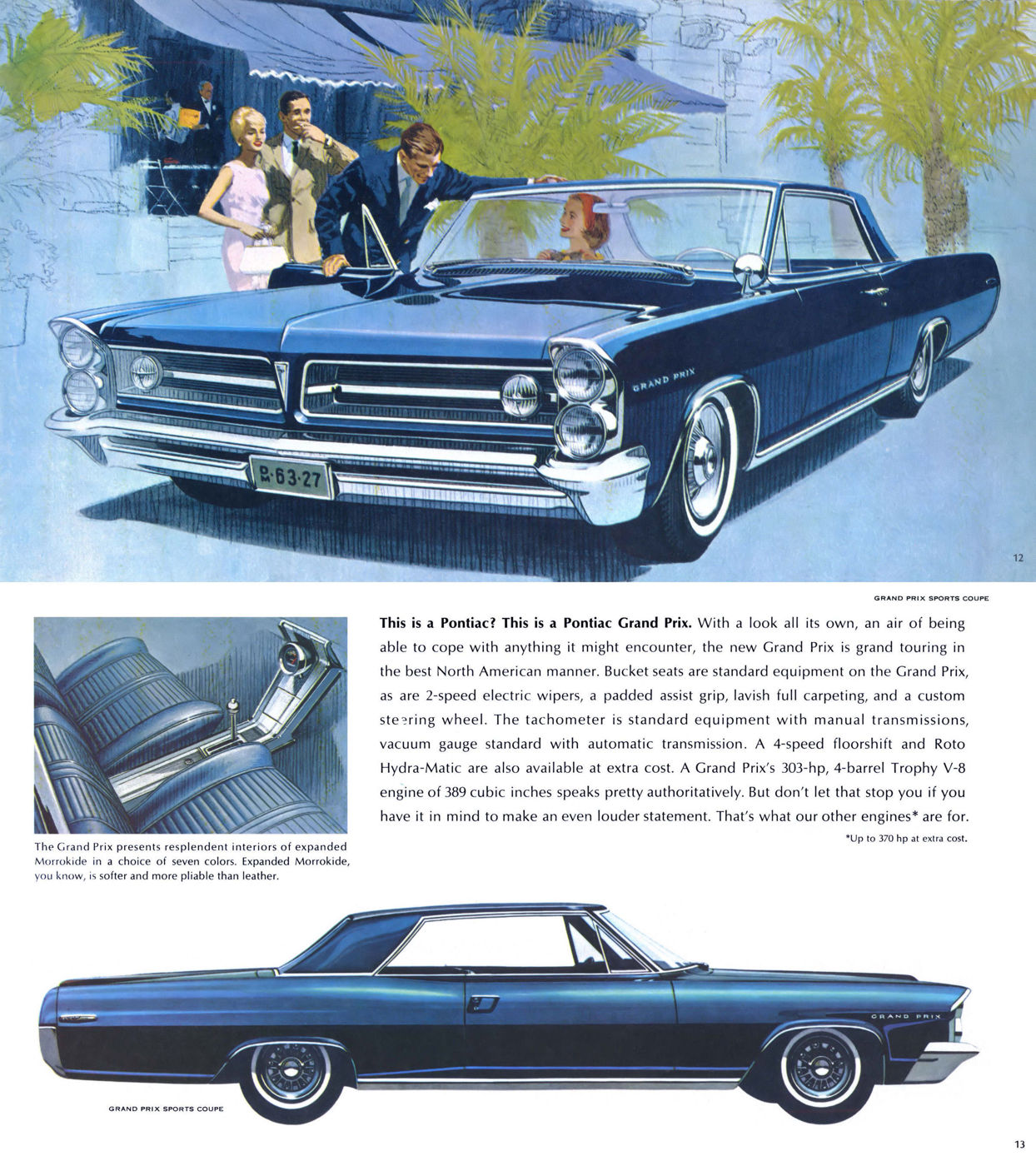
The Grand Prix's second year brought a sharp rise in sales: Pontiac's total was 72,959, more than twice the prior year, at the same $3,490 price. Bonneville-level equipment included monochromatic Morrokide, bucket seats, a console with vacuum gauge and a woodgrain steering wheel and dash trim. A four-barrel 389 rated at 303 hp remained standard. Pontiac also offered a wider engine range, including a two-barrel economy 389 for cars with Economy Hydra-Matic and a 2.56:1 axle.1,2,3
The 1963 engine list included a 318-hp 389 Tri-Power, a 353-hp 421 four-barrel and a 370-hp 421 Tri-Power, in addition to the standard 389 and economy engine. Ratings do not line up perfectly across sources. The AMA factory sheet and Motor Trend give the 421 HO 460 lb-ft at 3,800 rpm; Over-Drive lists 455 lb-ft at 3,400. Over-Drive rates the 389 Tri-Power at 318 hp, while the AMA sheet says 313. The standard 389 torque is 425 lb-ft in Over-Drive and 430 in the AMA sheet. Over-Drive's own text also mentions a 338-hp 421 four-barrel, an engine its engine tables leave out.1,4,3
A four-speed Synchromesh and Super Hydra-Matic were each listed as $231.34 options. Across the full-size line Pontiac also offered aluminum hubs and drums, Safe-T-Track, air conditioning, a Cordova top, tachometer, power brakes and seats, a tilt bucket seat, remote mirror, sports wheel covers and Tri-Power induction. Pontiac marked only some of those options specifically for Grand Prix fitment.1
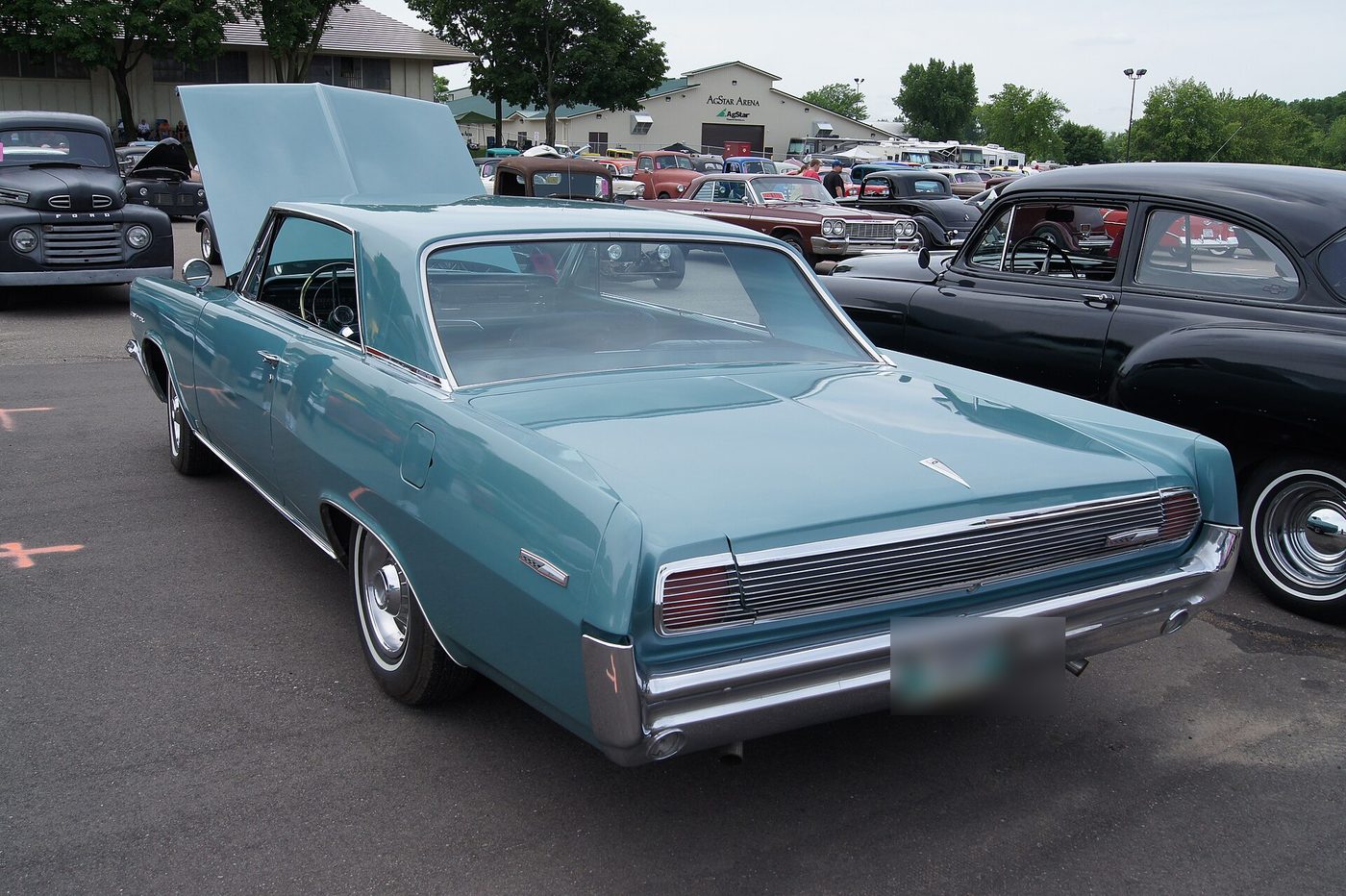

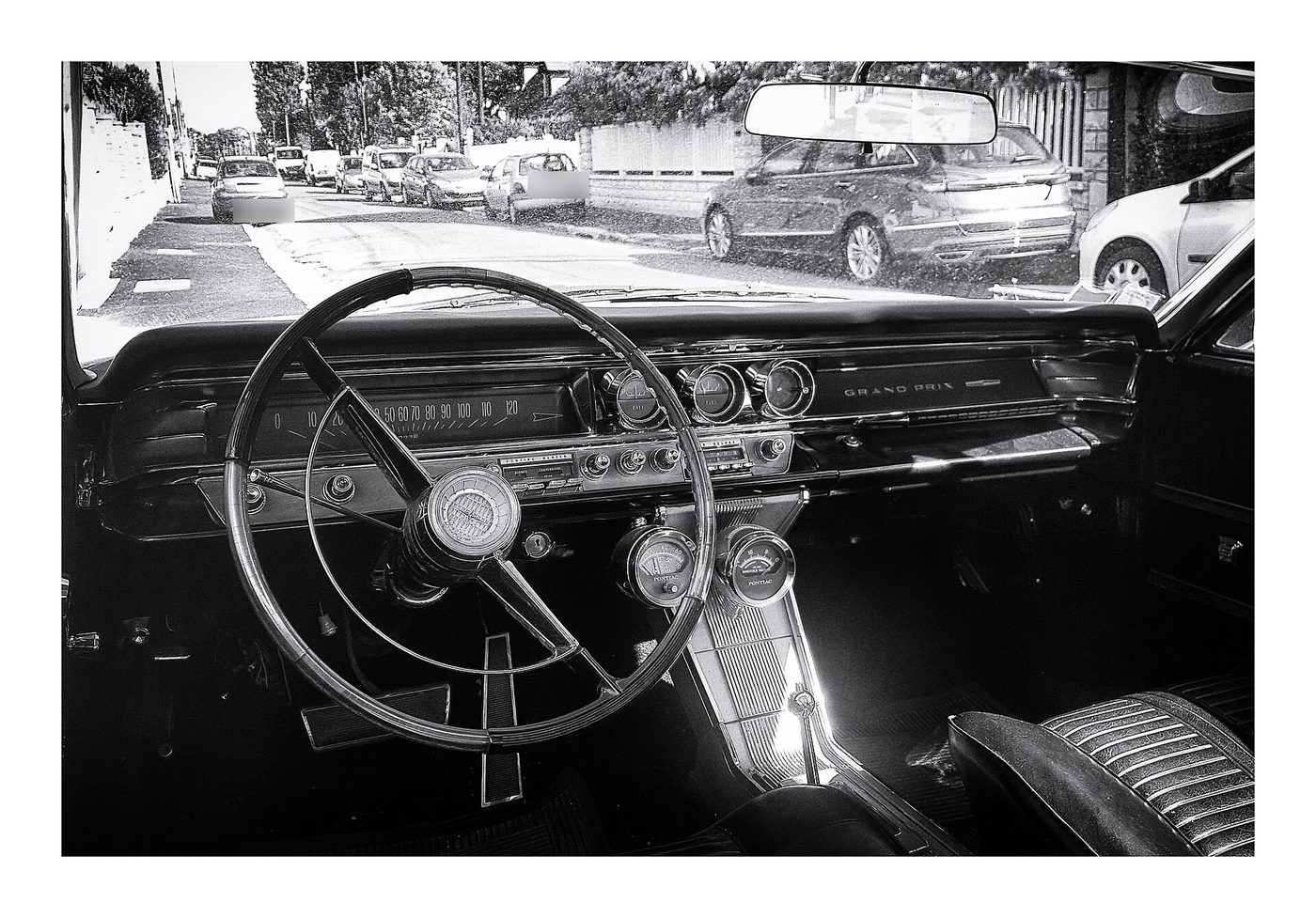
The cabin carried monochromatic Morrokide, a woodgrain steering wheel and dash, bucket seats and a center console with vacuum gauge, all standard. The full-size paint chart offered 14 colors from Starlight Black and Cameo Ivory to Nocturne Blue, one chart for every full-size Pontiac, the Grand Prix included. For a buyer, the combination of restrained exterior trim and a detailed, console-centered interior helped distinguish the Grand Prix within Pontiac's full-size lineup.1
The 1963 Grand Prix retained a 120-inch wheelbase, with a 211.9-inch overall length and 54.1-inch height. Sources give different weights: the compiled shipping figure is 3,915 pounds, while the factory AMA sheet lists 3,930. The AMA sheet separately estimates 4,123 pounds curb weight for a standard-equipment coupe; Motor Trend's 421 HO test car carried a manufacturer-stated 4,190-pound curb weight. Pontiac paired the standard 389 and three-speed with a 3.42 axle, while Hydra-Matic cars used a 3.23 axle as standard. The 421 HO used 3.42 across its transmissions. Factory details also specify seven axle ratios and a concave, one-piece rear window.1,2,3,4

Motor Trend tested a 421 HO Grand Prix with four-speed, Saf-T-Track and a 3.42 axle. It recorded 6.6 seconds from 0 to 60 mph, a 15.1-second quarter mile at 94 mph and a 147-foot stop from 60. The same report gives the car a $3,489 base price and $4,675.19 price including tax and license. These are figures for that test car, not every Grand Prix built that year.3
Pontiac identified the car as Series 29, body 2957, a five-passenger two-door hardtop coupe. The serial number sits on the left front body pillar and the engine number on the front of the right cylinder bank.2,4
Fact sheet · 1963 · United States
The numbers
1963 Pontiac Grand Prix: Production more than doubled to 72,959 at an unchanged price.
Figures may describe different groups of cars. Add rows together only when the note says they make up a total.
Key facts
Production
| What was counted | Built |
|---|---|
| Grand Prix 2-door hardtop coupe2,1,5 Grand Prix · 2-door hardtop coupe | 72,959 |
Prices when new
| Model | Price | Price type |
|---|---|---|
| Grand Prix 2-door hardtop2 | $3,490 | factory price, 1963 model year |
| Motor Trend test car, basic price3 | $3,489 | basic price, 1963-03 |
| Motor Trend test car, as tested3 | $4,675.19 | price, 1963-03 |
Prices are the nominal dollars of the day, not adjusted for inflation.
Engines
| Engine | Factory rating | Availability |
|---|---|---|
| 389 4-bbl1 389 cu in · 4-barrel, 10.25:1 | 303 hp @ 4,600, 425 lb-ft @ 2,800 (SAE gross (period advertised rating)) | Grand Prix standard |
| 389 Tri-Power1 389 cu in · three 2-barrels, 10.75:1 | 318 hp @ 4,600, 430 lb-ft @ 3,200 (SAE gross (period advertised rating)) | optional all lines |
| 421 4-bbl1 421 cu in · 4-barrel, 10.75:1 | 353 hp @ 5,000, 455 lb-ft @ 3,400 (SAE gross (period advertised rating)) | optional all lines |
| 421 Tri-Power1 421 cu in · three 2-barrels, 10.75:1 | 370 hp @ 5,200, 455 lb-ft @ 3,400 (SAE gross (period advertised rating)) | optional all lines |
| 389 2-bbl economy (Hydra-Matic only)4 389 cu in · 2-barrel, 8.6:1 | 230 hp @ 4,000, 386 lb-ft @ 2,000 (SAE gross (AMA published maximum bhp)) | Grand Prix (series 29) with Economy Hydra-Matic; 2.56:1 axle |
Ratings are published figures, not dyno results. Gross and net ratings aren't directly comparable.
Transmissions
| Transmission | Availability |
|---|---|
| Four-speed Synchromesh, floor shift1 | optional, $231.34 |
| Super Hydra-Matic1 | optional, $231.34 |
Options and packages
| Option | Price |
|---|---|
| Aluminum hubs and drums (price range)1 | $122 |
| Tachometer1 | $54 |
| Safe-T-Track differential1 | $42 |
| Air conditioning1 | $430 |
| Cordova top1 | $86 |
| Instrument gauge cluster1 | $21 |
| Power brakes1 | $57 |
| Power seat1 | $96 |
| Power tilt bucket seat, left-hand1 | $71 |
| Remote control mirror1 | $12 |
| Sports wheel covers1 | $30 |
| Tri-Power induction (389)1 | $116 |
Paint
| Code | Color |
|---|---|
A |
Starlight Black1 |
C |
Cameo Ivory1 |
D |
Silvermist Gray1 |
F |
Yorktown Blue1 |
H |
Kimberley Blue1 |
J |
Silverleaf Green1 |
L |
Marimba Red1 |
P |
Aquamarine1 |
Q |
Marlin Aqua1 |
R |
Yuma Beige1 |
S |
Saddle Bronze1 |
T |
Caravan Gold1 |
V |
Grenadier Red1 |
W |
Nocturne Blue1 |
Color names are the factory's. We don't show color swatches, because a screen color is no guide for a restoration.
Interiors
| Trim |
|---|
| Monochromatic Morrokide, woodgrain steering wheel and dash trim, bucket seats, center console with vacuum gauge1 |
Specifications
| Measure | Value | Applies to |
|---|---|---|
| Wheelbase1 | 120 in | Grand Prix |
| Overall length1 | 211.9 in | Grand Prix |
| Overall height1 | 54.1 in | Grand Prix |
| Shipping weight2 | 3,915 lb | Grand Prix |
| Curb weight3 | 4,190 lb | Motor Trend test car (manufacturer specification) |
| Overall width1 | 78.7 in | 1963 full-size Pontiac (all series) |
| Front tread1 | 64 in | 1963 full-size Pontiac |
| Rear tread1 | 64 in | 1963 full-size Pontiac |
| Standard tires1 | 8.00 x 14 | passenger cars; 8.50 x 14 optional |
| Four-speed ratios (421 CID)1 | 2.20 / 1.64 / 1.30 / 1.00, reverse 2.26 :1 | 421 four-speed; 389 four-speed 2.54 / 1.92 / 1.50 / 1.00 (close ratio special order for 389) |
| Rear axle ratios offered1 | seven ratios; 3.64 and 3.90 special order only | 1963 full-size Pontiac |
| Curb weight (AMA)4 | 4,123 lb | Grand Prix 2957, standard equipment |
| Shipping weight (AMA, licensing weight)4 | 3,930 lb | Grand Prix 2957 |
| Standard power team4 | 389 4-bbl 303 hp with heavy-duty 3-speed synchromesh, axle 3.42 (3.64 optional); four-speed optional | Grand Prix series 29 |
| Axle ratios with Hydra-Matic 3754 | 3.23 (standard), 3.42 :1 | Grand Prix 389 4-bbl 303 hp with Hydra-Matic 375 |
| Axle ratio with 421 HO engines4 | 3.42 :1 | 421 HO four-barrel and 3-2 barrel, all transmissions |
| Paint finish4 | Acrylic lacquer | 1963 Pontiac, including Grand Prix |
| Rear window4 | Concave, one piece | Grand Prix 2957 |
Period road tests
| Test | Car tested | Result |
|---|---|---|
| Motor Trend, 1963-0330-30 mph | Grand Prix 2-door hardtop, 421 HO (370 hp), four-speed, Saf-T-Track 3.42:1, aluminum wheelsas reported by the magazine | 3 s |
| Motor Trend, 1963-0330-45 mph | Grand Prix 2-door hardtop, 421 HO (370 hp), four-speed, Saf-T-Track 3.42:1, aluminum wheelsas reported by the magazine | 4.6 s |
| Motor Trend, 1963-0330-60 mph | Grand Prix 2-door hardtop, 421 HO (370 hp), four-speed, Saf-T-Track 3.42:1, aluminum wheelsas reported by the magazine | 6.6 s |
| Motor Trend, 1963-033standing quarter mile, elapsed time | Grand Prix 2-door hardtop, 421 HO (370 hp), four-speed, Saf-T-Track 3.42:1, aluminum wheelsas reported by the magazine | 15.1 s |
| Motor Trend, 1963-033standing quarter mile, speed | Grand Prix 2-door hardtop, 421 HO (370 hp), four-speed, Saf-T-Track 3.42:1, aluminum wheelsas reported by the magazine | 94 mph |
| Motor Trend, 1963-033stopping distance from 60 mph | Grand Prix 2-door hardtop, 421 HO (370 hp), four-speed, Saf-T-Track 3.42:1, aluminum wheelsas reported by the magazine | 147 ft |
A road test result belongs to the one car that was tested, with its engine, gearing, tires, and conditions. It is not a figure for every car of the year.
Identification
- Series and body
- Series 29, body 2957, 2-door hardtop coupe, 5-passenger.2
- Serial and engine number locations
- Vehicle serial number on the left front body pillar; engine number on the front of the right-hand cylinder bank.4
- Body style and seating
- Grand Prix body 2957, 2-door hardtop coupe; passenger capacity 5 because bucket front seats are standard.4
Where the sources disagree
1963 421 370 hp torque rating
1963 421 four-barrel rating within the Over-Drive fact sheet
- 421 four-barrel 338 hp; 353 hp with Tri-Power; 370 hp HO with Tri-Power1
- 421 four-barrel HO 353 hp at 5,000 rpm; 421 Tri-Power HO 370 hp at 5,200 rpm (no 338 hp engine listed)1
- 421 HO 4-barrel 353 hp at 5,000 rpm, 455 lb-ft at 3,400; 421 HO 3-2 barrel 370 hp at 5,200 rpm, 460 lb-ft at 3,800 (factory sheet)4
1963 389 Tri-Power rating
Identification
Read a 1963 Pontiac VIN
The VIN decoder runs in your browser and never sends the VIN anywhere. How the factory numbered this year's cars:
Same model year
Also in 1963
- Buick Riviera Buick's first Riviera, a four-seat personal-luxury hardtop limited to 40,000 cars, with a 401 Nailhead standard and a 340-hp 425 added in December 1962.
- Buick Wildcat The Wildcat became its own series, adding a convertible and four-door hardtop; 35,725 built.
- Chevrolet Chevy II and Nova First Nova Super Sport year in the source production table. Enthusiast-compiled production: 372,626 cars; Super Sport 42,432.
- Chevrolet Impala SS Super Sport (RPO Z03) peaks toward the 1960s high: 153,271 built, plus the Z11 427 drag package.
- Chrysler 300 letter series Hardtop-only and trimmed exclusively in Claret Red leather, the 300J carried a 390 hp short-ram 413 as its only engine; 400 were built, the smallest letter-car run.
- Dodge Dart 330/440, Polara and Max Wedge The Max Wedge grew to 426 cu in, rated at 415 or 425 hp, and a Ramchargers Dodge driven by Herman Moser won Stock at the 1963 NHRA Nationals; Ramcharger production remains unsourced.
- Ford Fairlane Hardtops and wagons joined the Fairlane line; reference-site counts give 28,268 bucket-seat Fairlane 500 Sport Coupes, beside 97,444 Fairlanes and 246,443 Fairlane 500s.
- Ford Falcon Sprint The mid-year 1963 1/2 Sprint put the Fairlane's 164 hp 260 V8 into the compact Falcon for the first time, as a hardtop and a convertible.
- Ford Galaxie The 406 opened the year and was replaced mid-year by the 427, in Q-code (410 hp, one four-barrel) and R-code (425 hp, two four-barrels) form, while a fastback Sports Hardtop was offered in the Galaxie 500 and 500 XL series.
- Ford Thunderbird The Sports Roadster's second and last year: only 455 were built.
- Mercury Marauder and S-55 The S-55 line grew to four bodies, and the mid-year fastback Marauder hardtop arrived with 390, 406 and 427 V8s available.
- Oldsmobile Starfire A squared-off roof with a concave rear window; production fell 38 percent to 25,890.
- Plymouth Savoy, Fury and Max Wedge The Super Stock engine grew to 426 cu in at 415 or 425 hp, a Stage II revision followed, and Chrysler's four-speed arrived in May 1963.
- Pontiac Catalina 2+2 and Super Duty Three Super Duty 421 ratings up to 410 hp, then GM's racing withdrawal ended them early in the model year.
- Pontiac Tempest and LeMans A V8 for the Tempest, and about a dozen Super Duty Tempests built for racing before Pontiac's January 1963 withdrawal.
- Studebaker Avanti Studebaker's fiberglass four-seat coupe went on sale with a 289 V8 and an optional $210 Paxton supercharger. It was billed on the strength of a 1962 run of Bonneville records, and 3,834 were built as 1963 models.
- Studebaker Hawk The GT Hawk could now be ordered with the Avanti's R1 and supercharged R2 engines, and a spring 1963 package created the Super Hawk. Old Cars Weekly counts 396 R1 cars among 4,009 domestic GT Hawks.
- Studebaker Lark and Super Lark Studebaker offered the Avanti's R1 and supercharged R2 engines in the compact Lark and added a Super Lark package in April. No source read gives an R2 Lark count; the estimates run from about 200 to a few hundred.