1963 · Studebaker · United States
1963 Studebaker Lark and Super Lark: The Avanti's Supercharged V8 in a Compact Sedan
Studebaker offered the Avanti's R1 and supercharged R2 engines in the compact Lark and added a Super Lark package in April. No source read gives an R2 Lark count; the estimates run from about 200 to a few hundred.
United States · researched through 2026-09-23
In March 1963 Andy Granatelli took a group of R2-engined Studebakers to the Bonneville Salt Flats. Ate Up With Motor records that the group included a couple of Larks alongside Gran Turismo Hawks and Avantis, and that a supercharged Lark with a 3.31 axle reached 132 mph. The Avanti's records had drawn attention the year before. This time the car setting speeds was Studebaker's everyday compact, fitted with the same supercharged 289 that Studebaker had introduced in its new sports coupe.1,2
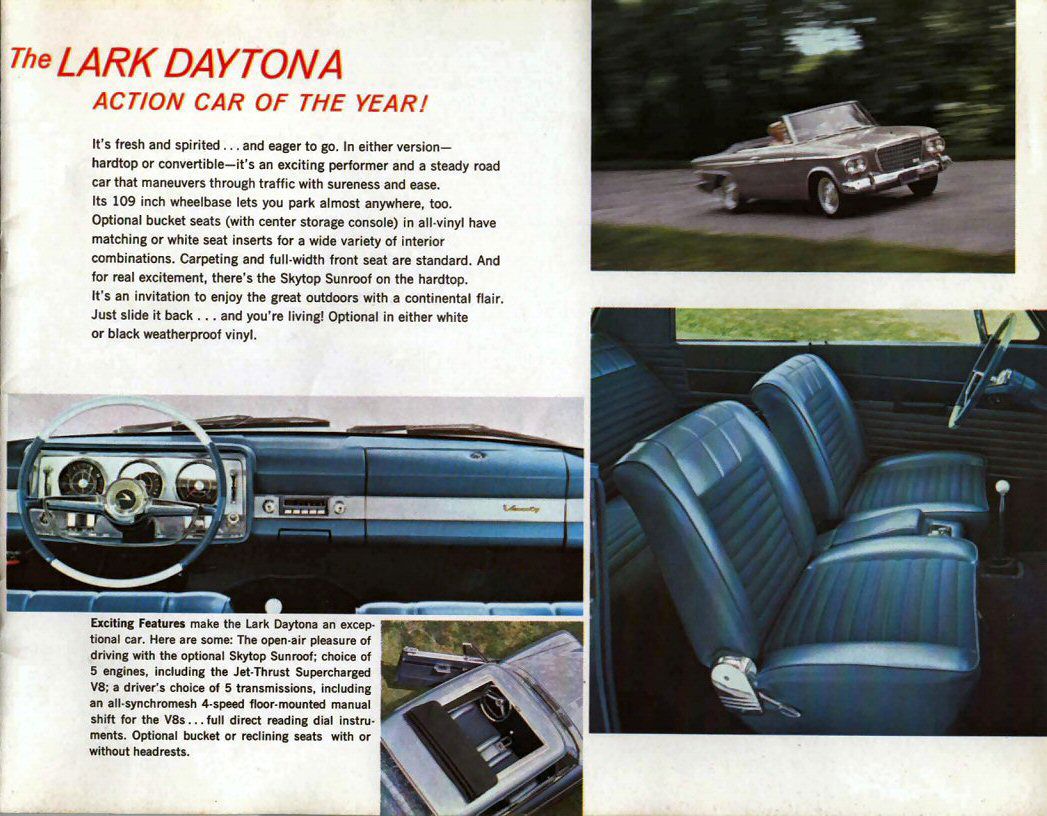
The Lark was the car that had kept Studebaker going. Ate Up With Motor writes that it was developed in only seven months and went on sale in November 1958 as a 1959 model, with about 30,000 orders before the Big Three's compacts arrived. By 1963 it had been restyled by Brooks Stevens on a small budget, with dual headlights and a grille the article describes as Mercedes-inspired. Four-door sedans moved to a 113-inch wheelbase while two-doors kept 109 inches, and the line now included the sporty Daytona and the plush Cruiser.1
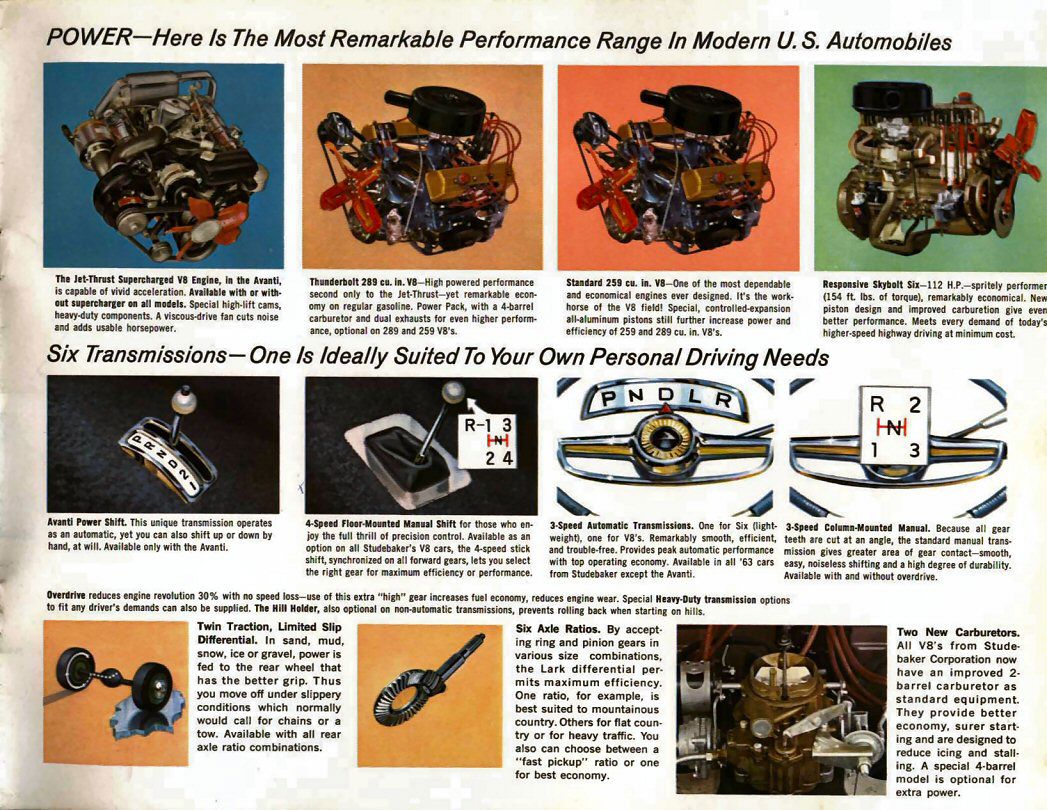
For 1963 Studebaker made its Jet Thrust R-series engines available in the Lark. The R1 was a 289 rated at 240 horsepower; the R2 added a Paxton supercharger and was rated at 289. Ate Up With Motor lists them at $210 and $372 as Lark options. Below them the regular Lark V8s ran from a two-barrel 259 at 180 horsepower to a four-barrel 289 at 225, according to Over-Drive Magazine's fact sheet, and the base six was the 170 at 112 horsepower. Air conditioning could not be ordered with the supercharged engine.2,1,3
In April Studebaker added the Super Lark, which Ate Up With Motor describes as a belated performance package. It was an option package, not a separate model. Old Cars Weekly and Ate Up With Motor describe it as the R1 or R2 engine combined with a Dana 44 limited-slip axle, front disc brakes, a gauge cluster with tachometer and the heavy-duty suspension. It could be ordered on any Lark, though most went on the Daytona hardtop. Super Red paint was reserved for Super Larks and Super Hawks.1,2,3,4
The package was not cheap for a compact. Ate Up With Motor prices the R2 Super Lark package at $680.02 on a Custom sedan, plus $188.30 for the four-speed manual. Over-Drive Magazine lists the base two-door Lark at $1,935. An R2 four-speed Super Lark therefore added close to $870 to the car's price, before any other options. The parts that made up the package were also available separately: the fact sheet lists front disc brakes at $97.95 and a tachometer at $54.1,3
Car Life measured what the package could do. Ate Up With Motor reports that the magazine tested an R2 Super Lark Daytona with the Power Shift automatic and recorded 0 to 60 mph in 7.8 seconds and a standing quarter-mile in 16.2 seconds at 87 mph. That result belongs to one automatic R2 car. For comparison, Old Cars Weekly reports Avanti tests of 7.3 seconds with a four-speed and 8.0 with the automatic, engines unstated. The Super Lark package added $680.02 to a Lark; the Avanti started at $4,445.1,2,1
How many buyers ordered it is not known. Ate Up With Motor says it found no production figures for R2 Larks and has heard estimates from as low as 200 to no more than a few hundred. The Jet Thrust News, the newsletter of the R-engine registry, describes nearly 2,000 R-engine Larks and Hawks built across 1963 and 1964, all engines and both models together. Ate Up With Motor adds that only one R3 Lark and one R4 Lark were ever built.1,5
One body style has a count. Over-Drive Magazine gives 1,015 Lark convertibles for 1963, and autoevolution reports that records show only 52 of them had R-series engines, 31 of those the supercharged R2. On those figures about 5 percent of 1963 Lark convertibles had an R engine and about 3 percent an R2. The same fact sheet lists 3,763 Daytona hardtops, the body most Super Larks used, but no R-engine split for the hardtops was found.3,6
The rest of the Lark line shows what most buyers chose. Over-Drive Magazine lists 40,113 four-door sedans, 17,401 two-door sedans, 11,915 Wagonaires, 5,717 V8 Cruisers and 593 six-cylinder Cruisers. The line's total differs by source and by basis: Ate Up With Motor gives 74,201 sales, Over-Drive Magazine gives production just above 75,000, and Wikipedia gives sales of around 77,000. Whichever figure is used, even the registry's nearly 2,000 R-engine Larks and Hawks for two model years together would be under 3 percent of a single year's Larks.3,1,7
Ate Up With Motor describes 1963 Lark sales as a decline, down to 74,201. The Super Lark arrived in April, late in the 1963 model year. Sherwood Egbert, the president who had pushed the Avanti from sketch to showroom and whose R-series engines now powered the Super Lark, left the company because of stomach cancer, the article records, and that in December 1963 Studebaker shut down production in South Bend, while its Canadian operations continued.1,1
The Super Lark was a sensible idea on paper. It took an engine Studebaker had already developed for the Avanti, fitted it to the compact with the brakes and axle to match, and sold it as a package any Lark buyer could order. Its measured performance was strong, and it could be ordered in any body from a sedan to a convertible. What it lacked was time. Its known production is 52 convertibles with R engines and an unknown number of other Larks.1,2,6
The 1963 Lark therefore has two stories. The larger one is a compact line of about 75,000 cars in a year of falling sales at a company about to leave South Bend. The smaller one is a supercharged Lark reaching 132 mph at Bonneville and a Car Life test car running 16.2 seconds in the quarter-mile. The few hundred R2 Larks that may have been built are now tracked through registries and club records, because no Studebaker production figure for them has been found.3,1,5
Fact sheet · 1963 · United States
The numbers
1963 Studebaker Lark and Super Lark — Studebaker offered the Avanti's R1 and supercharged R2 engines in the compact Lark and added a Super Lark package in April. No source read gives an R2 Lark count; the estimates run from about 200 to a few hundred.
Coverage: Partial — researched sections are shown; missing ones are not yet sourced. Researched through 2026-09-23.
Every figure is labeled with how sure we are. Reported means a manufacturer, registry, or reference figure we cite but have not reconciled against factory records ourselves. Disputed means credible sources disagree and both are shown. Rows are separately scoped; don't add them together unless the note says they make up a total.
Key facts
- 1,015 Lark convertibles were built for 1963. autoevolution reports that 52 of them had R-series engines, 31 of those the supercharged R2.6,3
- Only one R3 Lark and one R4 Lark were ever built, according to Ate Up With Motor. The club engine compilation places the only R4 in a 1964 Lark-type.1,8
- Super Red paint was exclusive to Super Hawks and Super Larks.4
Production
| What was counted | Count | Basis | Status |
|---|---|---|---|
| Lark line, 19631 all Lark-type · not stated Over-Drive gives 'just above 75,000' for production. See conflicts. | 74,201 | sold, model-year | Disputed |
| What was counted | Count | Basis | Status |
|---|---|---|---|
| Four-door sedans, all lines3 all Lark-type · 4-door sedan · not stated | 40,113 | built, model-year | Reported |
| Two-door sedans, all lines3 all Lark-type · 2-door sedan · not stated | 17,401 | built, model-year | Reported |
| Wagonaire, all trims3 Wagonaire station wagon · not stated | 11,915 | built, model-year | Reported |
| Daytona two-door hardtops, combined3 Daytona · 2-door hardtop · not stated | 3,763 | built, model-year | Reported |
| Convertibles, combined3,6 convertible · not stated | 1,015 | built, model-year | Reported |
| What was counted | Count | Basis | Status |
|---|---|---|---|
| Cruiser V83 Cruiser · 4-door sedan · V8 · not stated | 5,717 | built, model-year | Reported |
| Cruiser six3 Cruiser · 4-door sedan · six · not stated | 593 | built, model-year | Reported |
| What was counted | Count | Basis | Status |
|---|---|---|---|
| Convertibles with R-series engines6 Lark · convertible · R1 or R2 · not stated Single secondary source; the underlying records are not named. | 52 | built, model-year | Reported |
| Convertibles with R2 supercharged engine6 Lark · convertible · R2 289 supercharged · not stated | 31 | built, model-year | Reported |
| R2 Larks, all bodies1 Lark · R2 289 supercharged · not stated Estimates run from 200 to a few hundred; an auction catalogue says 'believed' 327. Neither is a count. | Unknown | built, model-year | Unknown |
The body rows are separately scoped. The fact sheet does not say whether they overlap (for example, Daytona hardtops within two-door counts), so they are not added.
The Jet Thrust News 1963 Production Listing, not online, would give R-engine counts.
Prices when new
| Model | Price | Basis |
|---|---|---|
| Standard two-door sedan (base Lark)3 | $1,935 | base price as compiled, 1963 model year |
| Super Lark R2 package on a Custom sedan1 | $680.02 | package price as reported, 1963 (April onward) |
| Four-speed manual with Super Lark1 | $188.30 | option price as reported, 1963 |
| R1 engine option1 | $210 | option price as reported, 1963 |
| R2 engine option1 | $372 | option price as reported, 1963 |
Prices are the nominal dollars of the day, not adjusted for inflation.
Engines
| Engine | Factory rating | Availability | Built |
|---|---|---|---|
| R2 · Jet Thrust 289 V8, Paxton SN-60 supercharger3,1 289 cu in · 4-barrel, centrifugal supercharger (up to about 6 psi) | 289 hp @ 4,800, 330 lb-ft @ 3,000 (SAE gross (as compiled)) | optional; Super Lark package | Not yet sourced |
| R1 · Jet Thrust 289 V83,1 289 cu in · 4-barrel | 240 hp @ 5,000, 305 lb-ft @ 3,000 (SAE gross (as compiled)) | optional; Super Lark package | Not yet sourced |
| 289 V8, four-barrel3 289 cu in · 4-barrel | 225 hp @ 4,500, 305 lb-ft (SAE gross (as compiled)) | optional | Not yet sourced |
| 289 V8, two-barrel3 289 cu in · 2-barrel | 210 hp @ 4,500, 300 lb-ft @ 2,800 (SAE gross (as compiled)) | optional | Not yet sourced |
| 259 V8, four-barrel3 259 cu in · 4-barrel | 195 hp @ 4,500, 265 lb-ft @ 3,000 (SAE gross (as compiled)) | optional | Not yet sourced |
| 259 V8, two-barrel3 259 cu in · 2-barrel | 180 hp @ 4,500, 260 lb-ft @ 2,800 (SAE gross (as compiled)) | V8 models | Not yet sourced |
| 170 six3 170 cu in · not stated | 112 hp @ 4,500, 154 lb-ft @ 2,000 (SAE gross (as compiled)) | six-cylinder models | Not yet sourced |
Ratings are the manufacturer's advertised figures under the standard shown (SAE gross before 1972, SAE net after). They are not dyno results, and gross and net ratings can't be compared directly.
Transmissions
| Transmission | Availability | Built |
|---|---|---|
| Four-speed manual1 | optional | Not yet sourced |
| Borg-Warner 'Power Shift' automatic1 | optional | Not yet sourced |
Options and packages
| Code | Option | Price | Installed |
|---|---|---|---|
|
Super Lark (introduced April 1963): R1 or R2 engine, Dana 44 limited-slip axle, front disc brakes, gauge cluster with tachometer, heavy-duty suspension1,2 | $680.02 | Not yet sourced |
|
Front disc brakes3 | $97.95 | Not yet sourced |
|
Skytop sliding sunroof3 | $185 | Not yet sourced |
|
Tachometer3 | $54 | Not yet sourced |
|
Power brakes3 | $45 | Not yet sourced |
|
Tinted glass3 | $32 | Not yet sourced |
|
White sidewall tires3 | $32.49 | Not yet sourced |
|
Air conditioning (not available with R2/R3)3 | — | Not yet sourced |
Paint
| Code | Color | Built |
|---|---|---|
|
Super Red (Super Lark and Super Hawk only)4,3 | Not yet sourced |
P6310 |
Velvet Black3,9 | Not yet sourced |
P6311 |
Ermine White3,9 | Not yet sourced |
P6312 |
Blue Mist3,9 | Not yet sourced |
P6313 |
Green Mist3,9 | Not yet sourced |
P6314 |
Silver Mist3,9 | Not yet sourced |
P6315 |
Champagne Gold3,9 | Not yet sourced |
P6316 |
Regal Red3,9 | Not yet sourced |
P6317 |
Rose Mist3,9 | Not yet sourced |
P-6327 |
Seabeach Sand3,9 | Not yet sourced |
P-6326 |
Seaspray Green3,9 | Not yet sourced |
P-6325 |
Red Iridescent (decoder: Red Metallic; R-M 63S54R; 1963 spring color only)9 | Not yet sourced |
6418 |
Red Bordeaux (listed as a 1963 spring color)9 | Not yet sourced |
6419 |
Bermuda Brown Metallic (listed as a 1963 spring color)9 | Not yet sourced |
Color names are the factory's. We don't show color swatches, because a screen color is no guide for a restoration.
Interiors
| Code | Trim | Built |
|---|---|---|
829 |
Daytona hardtop trim: blue, cloth9 | Not yet sourced |
839 |
Daytona hardtop trim: green, cloth9 | Not yet sourced |
849 |
Daytona hardtop trim: chestnut, cloth9 | Not yet sourced |
859 |
Daytona hardtop trim: red, cloth9 | Not yet sourced |
919 / 9191 |
Daytona hardtop trim: black, vinyl9 | Not yet sourced |
929 / 9291 |
Daytona hardtop trim: blue, vinyl9 | Not yet sourced |
939 / 9391 |
Daytona hardtop trim: green, vinyl9 | Not yet sourced |
949 / 9491 |
Daytona hardtop trim: chestnut, vinyl9 | Not yet sourced |
959 / 9591 |
Daytona hardtop trim: red, vinyl9 | Not yet sourced |
969 / 9691 |
Daytona hardtop trim: tan, vinyl9 | Not yet sourced |
918 / 9181 |
Daytona convertible trim: black, vinyl9 | Not yet sourced |
928 / 9281 |
Daytona convertible trim: blue, vinyl9 | Not yet sourced |
938 / 9381 |
Daytona convertible trim: green, vinyl9 | Not yet sourced |
948 / 9481 |
Daytona convertible trim: chestnut, vinyl9 | Not yet sourced |
958 / 9581 |
Daytona convertible trim: red, vinyl9 | Not yet sourced |
968 / 9681 |
Daytona convertible trim: tan, vinyl9 | Not yet sourced |
917 / 9171 |
Daytona wagon trim: black, vinyl9 | Not yet sourced |
927 / 9271 |
Daytona wagon trim: blue, vinyl9 | Not yet sourced |
937 / 9371 |
Daytona wagon trim: green, vinyl9 | Not yet sourced |
947 / 9471 |
Daytona wagon trim: chestnut, vinyl9 | Not yet sourced |
957 / 9571 |
Daytona wagon trim: red, vinyl9 | Not yet sourced |
967 / 9671 |
Daytona wagon trim: tan, vinyl9 | Not yet sourced |
Specifications
| Measure | Value | Applies to |
|---|---|---|
| Wheelbase3 | 109 in | two-door bodies |
| Wheelbase3 | 113 in | four-door sedans and wagons |
| Overall width3 | 71.25 in | all |
| Standard tires3 | 6.50 x 15 (6.70 x 15 on convertibles) | all |
Period road tests
| Test | Car tested | Result |
|---|---|---|
| Car Life, 196310-60 mph | Lark Daytona, R2 supercharged 289, Power Shift automaticas reported by Ate Up With Motor; issue month not identified in the passage read | 7.8 s |
| Car Life, 19631quarter-mile | Lark Daytona, R2 supercharged 289, Power Shift automatictrap speed 87 mph; as reported by Ate Up With Motor | 16.2 s |
| Studebaker Bonneville speed trials (as reported by Ate Up With Motor), 1963-031top speed | Lark, R2 supercharged 289, 3.31 axleBonneville Salt Flats; sanction not stated | 132 mph |
A road test result belongs to the one car that was tested, with its engine, gearing, tires, and conditions. It is not a figure for every car of the year.
Identification
- Engine numbers
- 1963 Lark R1 engines start at JT-1,001 and R2 engines at JTS-1,001 (JTC/JTSC in Canada). Standard 289s start at P-93,601 and 259s at V-566,601.8
- Factory build record
- The Studebaker National Museum holds factory Production Orders for most 1936-1966 Studebakers; these are the check for an R-engine or Super Lark claim.10
- Body codes
- Lark bodies carry year-engine-body codes on a cowl plate: e.g. 63V-J8 Daytona hardtop, 63V-L8 Daytona convertible, 63V-P8 Daytona wagon, 63V-P6 Custom Wagonaire, 63V-Y8 Cruiser sedan, 63V-F2/F4/F6 two-door sedans (Standard/Regal/Custom); S replaces V for six-cylinder cars. The plate also carries a trim code (5 = cloth, 6 = vinyl in the decoder's scheme).11,9
Where the sources disagree
Same model year
Also in 1963
- Buick Riviera Buick's first Riviera, a four-seat personal-luxury hardtop limited to 40,000 cars, with a 401 Nailhead standard and a 340-hp 425 added in December 1962.
- Buick Wildcat The Wildcat became its own series, adding a convertible and four-door hardtop; 35,725 built.
- Chevrolet Chevy II and Nova First Nova Super Sport year in the source production table. Enthusiast-compiled production: 372,626 cars; Super Sport 42,432.
- Chevrolet Impala SS Super Sport (RPO Z03) peaks toward the 1960s high: 153,271 built, plus the Z11 427 drag package.
- Chrysler 300 letter series Hardtop-only and trimmed exclusively in Claret Red leather, the 300J carried a 390 hp short-ram 413 as its only engine; 400 were built, the smallest letter-car run.
- Dodge Dart 330/440, Polara and Max Wedge The Max Wedge grew to 426 cu in, rated at 415 or 425 hp, and a Ramchargers Dodge driven by Herman Moser won Stock at the 1963 NHRA Nationals; Ramcharger production remains unsourced.
- Ford Fairlane Hardtops and wagons joined the Fairlane line; reference-site counts give 28,268 bucket-seat Fairlane 500 Sport Coupes, beside 97,444 Fairlanes and 246,443 Fairlane 500s.
- Ford Falcon Sprint The mid-year 1963 1/2 Sprint put the Fairlane's 164 hp 260 V8 into the compact Falcon for the first time, as a hardtop and a convertible.
- Ford Galaxie The 406 opened the year and was replaced mid-year by the 427, in Q-code (410 hp, one four-barrel) and R-code (425 hp, two four-barrels) form, while a fastback Sports Hardtop was offered in the Galaxie 500 and 500 XL series.
- Ford Thunderbird The Sports Roadster's second and last year: only 455 were built.
- Mercury Marauder and S-55 The S-55 line grew to four bodies, and the mid-year fastback Marauder hardtop arrived with 390, 406 and 427 V8s available.
- Oldsmobile Starfire A squared-off roof with a concave rear window; production fell 38 percent to 25,890.
- Plymouth Savoy, Fury and Max Wedge The Super Stock engine grew to 426 cu in at 415 or 425 hp, a Stage II revision followed, and Chrysler's own four-speed arrived in May 1963; Super Stock production remains unsourced.
- Pontiac Catalina 2+2 and Super Duty Three Super Duty 421 ratings up to 410 hp, then GM's racing withdrawal ended them early in the model year.
- Pontiac Grand Prix Production more than doubled to 72,959 at an unchanged price.
- Pontiac Tempest and LeMans A V8 for the Tempest, and about a dozen Super Duty Tempests built for racing before Pontiac's January 1963 withdrawal.
- Studebaker Avanti Studebaker's fiberglass four-seat coupe went on sale with a 289 V8 and an optional $210 Paxton supercharger. It was billed on the strength of a 1962 run of Bonneville records, and 3,834 were built as 1963 models.
- Studebaker Hawk The GT Hawk could now be ordered with the Avanti's R1 and supercharged R2 engines, and a spring 1963 package created the Super Hawk. Old Cars Weekly counts 396 R1 cars among 4,009 domestic GT Hawks.