1989 · Ford · United States
1989 Ford Taurus SHO: The Family Sedan With a Yamaha Heart and Only Three Pedals
The first SHO: a Taurus sedan with a Yamaha-built 3.0-liter 24-valve V6 and a five-speed manual as the only transmission.
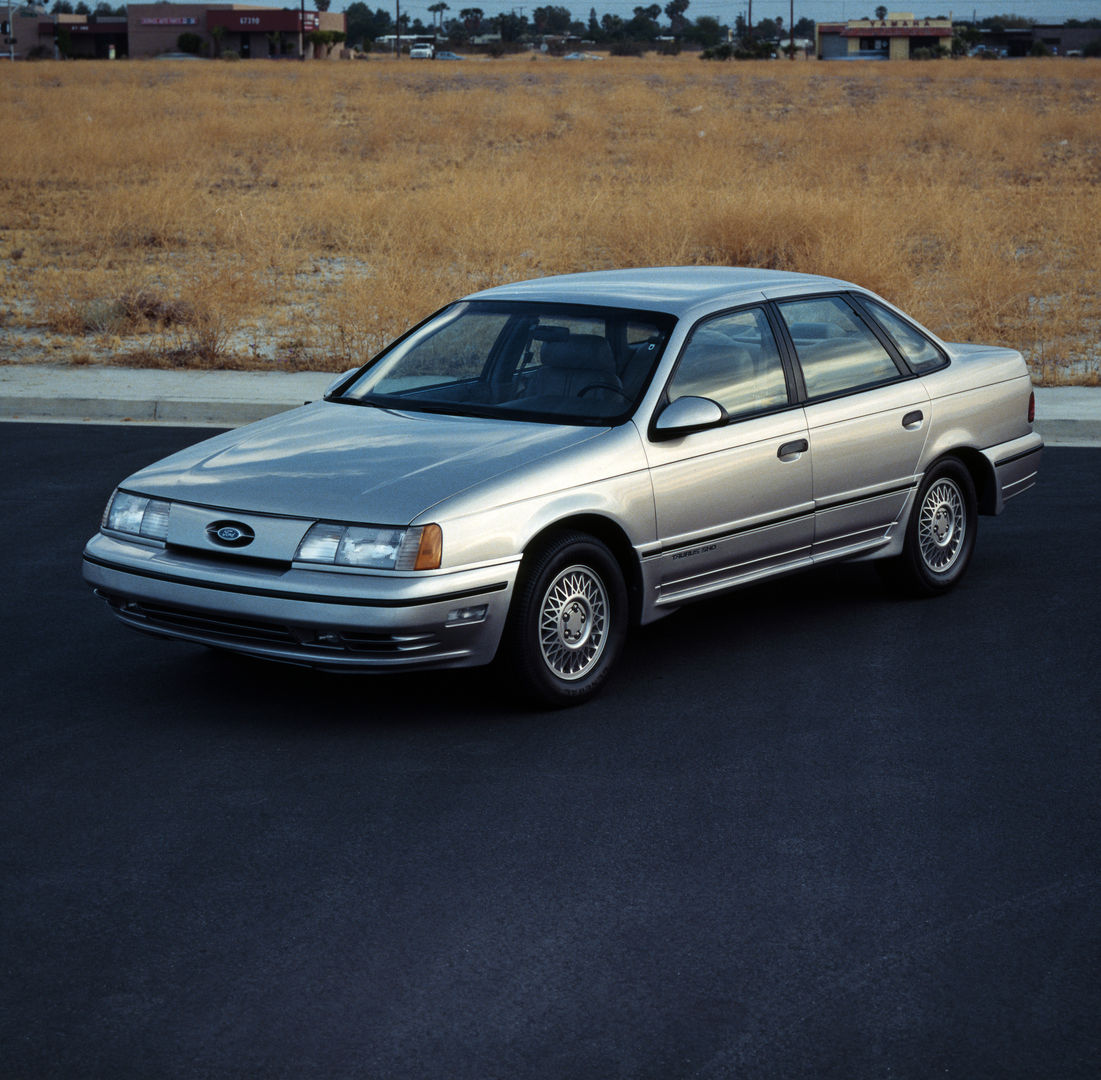
The engine came first, and the car to put it in came later. In 1984, Yamaha Motor Corporation executives signed a contract with Ford to develop, produce and supply a compact 60-degree V-6 with double overhead camshafts. What Ford originally wanted it for is less certain. The engine is thought to have been intended for a mid-engine sports car, a program known internally as GN34 that was cancelled, and Motor Authority later described that project as a Fiero rival. Whatever its first destination, the engine ended up in the least likely place imaginable for a 7,000-rpm V-6: a Ford Taurus.1,2
The result was the 1989 Taurus SHO, for Super High Output, and it was a single, fixed recipe. Every car was a four-door Taurus sedan, body code P54, with the Yamaha-built 3.0-liter 24-valve V-6 and sequential multiport fuel injection, rated at 220 hp. The only transmission was a five-speed manual transaxle, designed and built by Mazda. There was no automatic at any price. The eighth character of the VIN, Y, marks the SHO engine, and first-generation cars were assembled at Atlanta Assembly in Hapeville, Georgia.3,4,1,5
How high the engine revved is itself a small dispute. Wikipedia gives a 7,000-rpm redline, while Motor Authority's 2019 retrospective says the V-6 revved to 7,300 rpm. Neither is a factory document, and the difference may be the gap between a redline and a rev limiter, but neither source explains it. Either way, this was not the 12-valve V-6 of an ordinary Taurus, which Ford had asked Yamaha to rework. The outward signs of the SHO's intent were racier styling, 15-inch wheels, bolstered sport seats and dual exhaust outlets.1,2
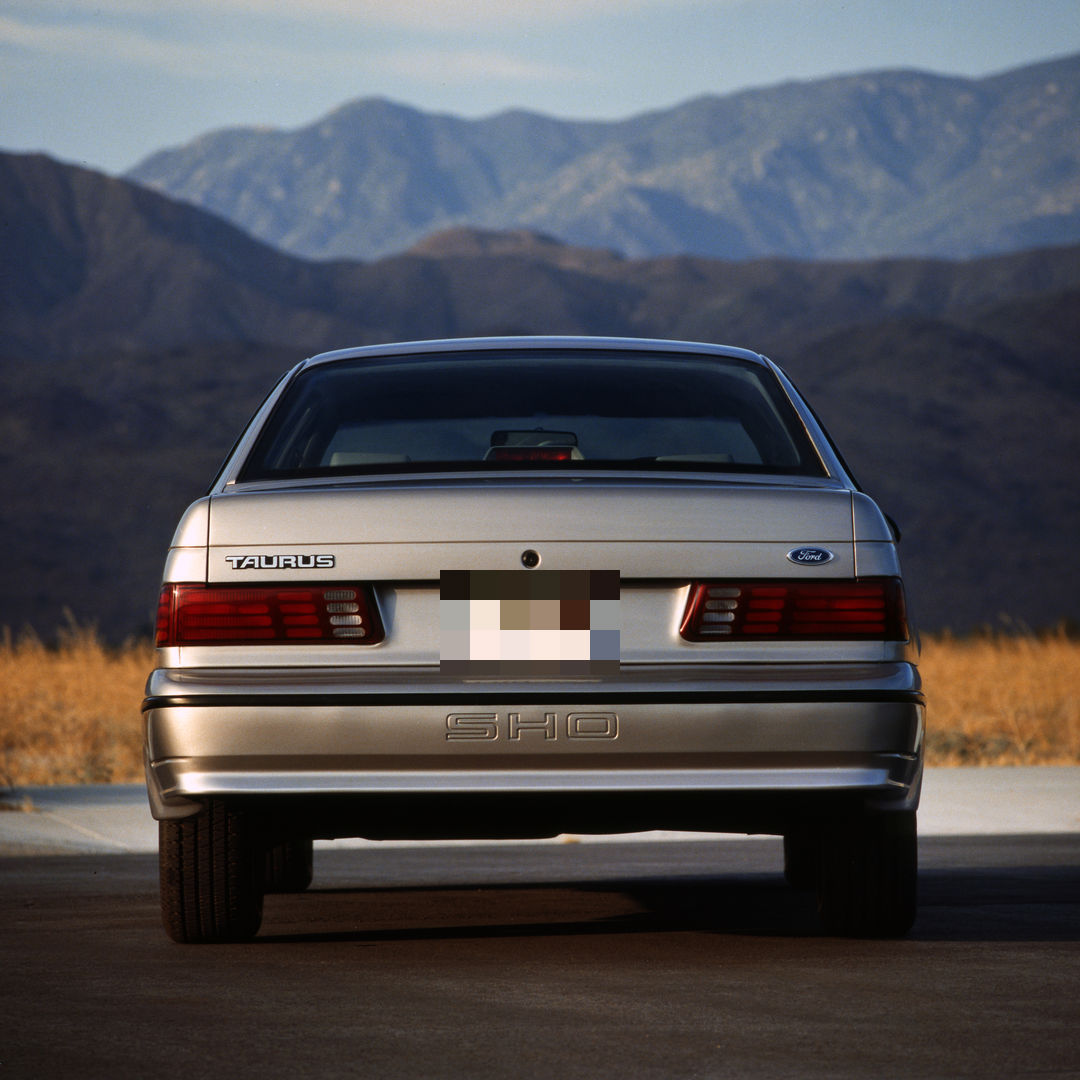
The price made the car's argument for it. The base SHO is reported at $19,739, with options priced separately: the Preferred Equipment Package 211A at $533, a power moonroof at $741, leather seats at $489, automatic climate control at $183, a passenger power seat at $261, keyless entry at $137 and a rear-window defroster at $150. A buyer who took every one of those options added more than two thousand dollars to the base price. Those are reported prices from an enthusiast reference, not figures from a Ford price list. EPA ratings of the day were 18 mpg city and 26 highway, from an 18.6-gallon tank.4
The magazines were impressed. Car and Driver, in December 1988, called the 1989 SHO a "breakthrough car," and Road & Track called it "one of the great surprises for 1989," with good reason. Car and Driver's tested car ran 0-60 mph in 6.7 seconds and reached a top speed of 143 mph, and Road & Track's ran 0-60 in 6.6 seconds. Those figures are reported second-hand, and Wikipedia dates the 143-mph figure to a December 1989 issue instead. Neither prints a page number, so the issue date stays unsettled. Motor Authority later called the SHO America's first BMW M5 rival, one that could keep pace with the Germans for tens of thousands of dollars less.4,1,2
Two totals survive for 1989. The V6SHO wiki's overview table, credited to a 1997 SHO Registry FAQ that drew on Ford Performance Group statistics, gives 15,519, a figure Motor Authority's 2019 retrospective repeats. The wiki's option-code detail table gives 15,504, and its paint and trim rows each add up exactly to that total, as does its single engine-and-transmission row, since every car had the same power team. Either way, the first SHO year ran to more than 15,000 cars.3,2
The detail table's option counts bring the 1989 buyer into focus. Light Titanium Clearcoat was the most common color, on 6,011 of the 15,504 cars, followed by Black on 4,925 and Currant Red on 4,250; Oxford White, on 318 cars, was the rare one, about one SHO in 49, while Currant Red, a little more than one car in four, was far easier to find. Leather buckets, trim SA, went into 7,808 cars and cloth buckets, trim GA, into 7,696, a near even split. The overview table's color figures differ slightly, with 5,975 Titanium, 4,951 Black and 325 Oxford White among its 15,519, and those differences travel with the two totals.3
The option codes show a car bought for comfort as often as for speed. Of the detail table's 15,504 cars, 15,419 had the high-level audio system, 8,206 automatic temperature control against 7,298 with manual air conditioning, 8,191 a six-way power driver's seat and 7,313 dual power seats. The power moonroof went on 7,221 cars, a little under half, and the JBL luxury sound system on 2,962. Regulation left marks too: 2,230 cars carried California emissions equipment and 536 a high-altitude package. Every one of those sedans still had a clutch pedal.3
The next few years put that fact in context. In the overview table's figures, the SHO fell to 8,315 cars in 1990, 8,916 in 1991 and 7,801 in 1992, every one a manual. For 1993 Ford finally offered an automatic, and the overview total jumped to 21,550, of which 17,455 were automatics and only 4,095 manuals, more than four automatics for every manual. The manual-only first year was also the SHO's biggest until the automatic arrived.3
The 1989 SHO is the purest version of an odd idea: a mainstream front-drive family sedan given a high-revving Yamaha engine and a manual gearbox, sold without an automatic and without apology. At a reported base price of $19,739, it was a performance car priced like a well-equipped family sedan, which is what it also was. Between 15,504 and 15,519 buyers took it on those terms, depending on the table, and they split almost evenly between leather and cloth. The engine had found a home in a Taurus, and the Taurus had found a following that bought more SHOs in 1989 than in any of the next three years.3,1,4
Fact sheet · 1989 · United States
The numbers
1989 Ford Taurus SHO: The first SHO: a Taurus sedan with a Yamaha-built 3.0-liter 24-valve V6 and a five-speed manual as the only transmission.
Figures may describe different groups of cars. Add rows together only when the note says they make up a total.
Key facts
- 15,519 built according to the 1997 SHO Registry FAQ; 15,504 according to the option-code detail table. All were five-speed manuals.3
- In the detail table the most common colour was Light Titanium Clearcoat (6,011) and the rarest Oxford White (318). Leather buckets (7,808) slightly outnumbered cloth (7,696).3
- Base price is reported as $19,739.4
Production
| What was counted | Built |
|---|---|
| Taurus SHO, all (SHO Registry 1997 count)3 SHO · 4-door sedan · 3.0 DOHC V6 · 5-speed manual | 15,519 |
| Taurus SHO sedan, body code P54 (count by option code)3 SHO · 4-door sedan · 3.0 DOHC V6 · 5-speed manual | 15,504 |
| What was counted | Built |
|---|---|
| Light Titanium Clearcoat3 SHO · 4-door sedan | 6,011 |
| Black3 SHO · 4-door sedan | 4,925 |
| Currant Red3 SHO · 4-door sedan | 4,250 |
| Oxford White3 SHO · 4-door sedan | 318 |
| What was counted | Built |
|---|---|
| Trim GA, cloth buckets3 SHO · 4-door sedan | 7,696 |
| Trim SA, leather buckets3 SHO · 4-door sedan | 7,808 |
Prices when new
| Model | Price | Price type |
|---|---|---|
| Taurus SHO sedan, base4 | $19,739 | base price, 1989 model year |
| Preferred Equipment Package 211A4 | $533 | option price, 1989 model year |
Prices are the nominal dollars of the day, not adjusted for inflation.
Engines
| Engine | Factory rating | Availability | Built |
|---|---|---|---|
| Y · 3.0-liter DOHC 24-valve V6 (Yamaha-built SHO)4,5 3 L · sequential multiport electronic fuel injection | 220 hp (manufacturer rating as reported) | standard (only engine) | 15,5043 |
Ratings are published figures, not dyno results. Gross and net ratings aren't directly comparable.
Transmissions
| Transmission | Availability | Built |
|---|---|---|
| 445 · Five-speed manual transaxle3,4 | standard (only transmission) | 15,5043 |
Options and packages
| Code | Option | Price | Installed |
|---|---|---|---|
21Bsales code |
Power moonroof3,4 | $741 | 7,2213 |
145sales code |
Diagnostic module and keyless entry3 | 7,6823 | |
142sales code |
Instrument cluster, diagnostic3 | 7,8223 | |
53Asales code |
Six-way power driver seat3 | 8,1913 | |
53Jsales code |
Six-way power seats, dual control3,4 | $261 | 7,3133 |
57Lsales code |
Air conditioning, automatic temperature control3,4 | $183 | 8,2063 |
57Ksales code |
Air conditioning, manual3 | 7,2983 | |
586sales code |
Audio system, high level3 | 15,4193 | |
91Fsales code |
Luxury sound system, JBL3 | 2,9623 | |
916sales code |
Ford JBL audio system3 | 7063 | |
91Hsales code |
Power radio antenna3 | 6,8673 | |
13Hsales code |
Engine block immersion heater3 | 5633 | |
422sales code |
California emission system3 | 2,2303 | |
428sales code |
High-altitude principal use3 | 5363 | |
| Leather seats4 | $489 | ||
| Rear-window defroster4 | $150 |
Paint
| Code | Color | Built |
|---|---|---|
(printed as 11) |
Light Titanium Clearcoat3 | 6,0113 |
(printed as 1C) |
Black3 | 4,9253 |
(printed as 2F) |
Currant Red3 | 4,2503 |
(printed as 9L) |
Oxford White3 | 3183 |
Color names are the factory's. We don't show color swatches, because a screen color is no guide for a restoration.
Interiors
| Code | Trim | Built |
|---|---|---|
GA |
Cloth bucket seats3 | 7,6963 |
SA |
Leather bucket seats3 | 7,8083 |
Specifications
| Measure | Value | Applies to |
|---|---|---|
| EPA fuel economy, city4 | 18 mpg | five-speed manual, period rating as reported |
| EPA fuel economy, highway4 | 26 mpg | five-speed manual, period rating as reported |
| Fuel tank4 | 18.6 gal | SHO sedan |
| Redline1 | 7,000 rpm | first-generation SHO V6 |
Period road tests
| Test | Car tested | Result |
|---|---|---|
| Car and Driver, 1988–1989 (issue not identified)40-60 mph | 1989 Taurus SHO, 3.0 V6, five-speed manual (the only configuration)relayed by Eighties Cars; original issue not read | 6.7 s |
| Car and Driver, 1988–1989 (issue not identified)4top speed | 1989 Taurus SHO, 3.0 V6, five-speed manualrelayed by Eighties Cars; original issue not read | 143 mph |
| Road & Track, 1989 (issue not identified)40-60 mph | 1989 Taurus SHO, 3.0 V6, five-speed manualrelayed by Eighties Cars; original issue not read | 6.6 s |
A road test result belongs to the one car that was tested, with its engine, gearing, tires, and conditions. It is not a figure for every car of the year.
Identification
- VIN
- Body/series 54 identifies the SHO and engine code Y in the eighth VIN position the 3.0 SHO V6 (example pattern 1FACP54Y2MA100001, a 1991 car). Plant letters A (Atlanta) and G (Chicago) appear in the wiki's decoding.5
Where the sources disagree
1989 total production
Identification
Read a 1989 Ford VIN
The VIN decoder runs in your browser and never sends the VIN anywhere. How the factory numbered this year's cars:
Same model year
Also in 1989
- Buick Riviera A longer restyle more than doubled sales to 21,189.
- Ford Thunderbird The new MN12 Thunderbird launched the supercharged, intercooled 3.8 V-6 Super Coupe, Motor Trend's Car of the Year.
- Lincoln Mark VII LSC A carry-over year for the 225-hp LSC, with a revised steering ratio.
- Mercury Cougar The MN12 Cougar, built only at Lorain, with a 210-hp supercharged V-6: 97,246 in two sources, 92,702 in Conceptcarz.
- Oldsmobile Cutlass, 4-4-2 and Hurst/Olds No 4-4-2 or Hurst/Olds was offered this year per the available accounts.
- Pontiac Firebird and Trans Am The 20th Anniversary Turbo Trans Am: a Buick V-6 pace car, 1,555 built inside a 9,631-car GTA run.
- Pontiac Grand Prix The 3.1 V6 arrives, and midyear the ASC/McLaren Turbo Grand Prix.