Racing · Bud Moore Engineering · Ford · 1969–1970
Bud Moore’s Boss 302 Campaign: The Spin That Did Not End the Season
A three-win season that cost Ford the title, then six wins from eleven rounds with Parnelli Jones and George Follmer — and a Riverside finale decided after a lap-six spin.
Story reviewed July 27, 2026
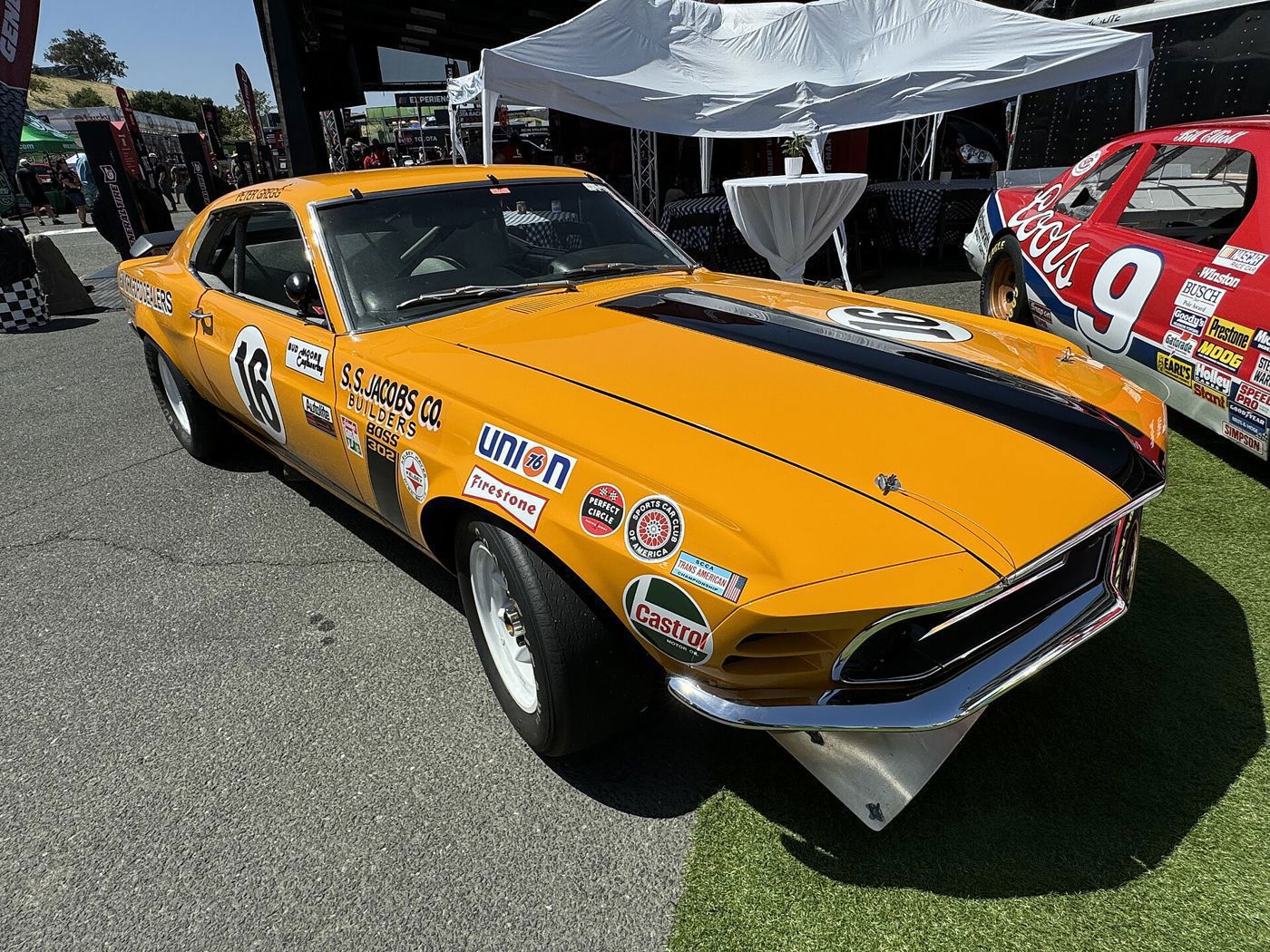
Six laps into the 79-lap Riverside finale, Parnelli Jones spun the Bud Moore Mustang in Turn 9. The car was damaged, vibrating, and behind the field when it rejoined. A season summary could jump directly from that trouble to Ford’s championship, but the distance between those moments is the story. Jones had to recover through traffic, catch teammate George Follmer, and make the decisive pass with eight laps remaining. The contemporary result and SCCA’s later event account supply enough action without invented radio calls, thoughts, or crowd reaction.
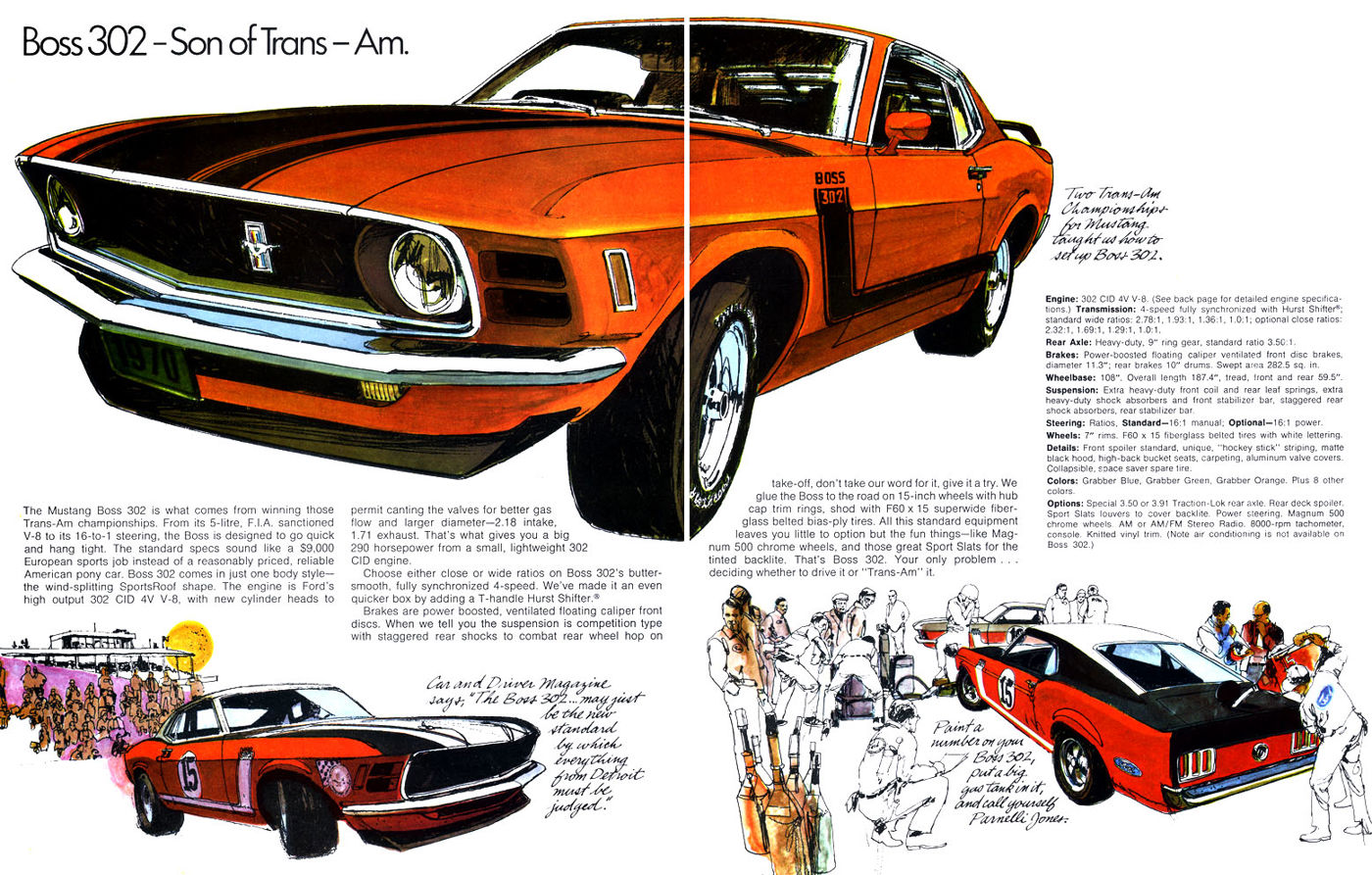
Ford’s public foundation was the Boss 302, a showroom SportsRoof with a 302 four-barrel, mandatory four-speed, 3.50 axle, power front discs, and competition-oriented chassis equipment. FIA form 1589 identified the 1970 Boss 302 Mustang in Group 2 effective April 1, 1970. The Bud Moore race cars were competition machines prepared within a rule system, not stock versions of the selector card. Coolers, tanks, brakes, engine preparation, weight, and tires belong to event and race-car records. Homologation connected the identities; it did not make them mechanically identical. The form also does not supply a final production total or explain how SCCA applied every permitted change.
The campaign had begun a year earlier with enough success to make the failure consequential. Bud Moore Engineering Mustangs won three of twelve 1969 rounds—Parnelli Jones at Michigan and Donnybrooke, George Follmer at Bridgehampton—but Ford lost the contemporary over-two-liter manufacturers’ championship to Chevrolet, 78–64. That record supports a setback without reducing it to one cause. Individual classifications record engine, suspension, accident, and tire-related retirements, but no inspected team log or period contract proves that one tire decision alone cost Ford the title.
The 1970 season gathered the major United States manufacturers then active in the series around a changed set of teams. Bud Moore carried Ford with Jones and Follmer. Jim Hall took Chevrolet’s new effort after Penske parked the dominant 1969 Camaros and moved Mark Donohue to AMC Javelin. Dodge and Plymouth appeared through Autodynamics and All American Racers, while Pontiac’s program suffered the death of Jerry Titus. The grid was not a permanent Camaro-versus-Mustang duel with different paint added around it. CamaroFacts’ racing history follows the Chevrolet side of that changing field.
Moore’s Mustangs won the opening four rounds: Jones at Laguna Seca and Lime Rock, Follmer at Bryar, and Jones again at Mid-Ohio. Donohue then won for AMC, demonstrating that Penske’s change of marque was more than a footnote. Milt Minter won at Donnybrooke in an ex-Penske Camaro entered by Roy Woods, a detail that prevents the car’s history from being assigned to Penske’s 1970 program. Vic Elford later won for Hall’s Chevrolet effort at Watkins Glen. Jones returned to win at Seattle/Kent, his fourth victory of the season and the fifth for Moore’s team.
That Seattle victory settled the award the competitors were actually chasing. The SCCA sheet says Ford had already clinched the manufacturers’ championship before the final round, and Ford’s September 22 release announced the same result with Riverside still to run. The release even stated that Trans-Am then had no driver championship, only a manufacturers’ title. Its unadjusted interim points differ from SCCA’s best-nine-finish total, so the story uses the sanctioning record for scoring and Ford’s document for the contemporary announcement. Riverside would complete the season, not decide Ford’s title.
Follmer’s contribution keeps the campaign from becoming a lone-driver legend. He supplied the Bryar victory and a sequence of points finishes, then led at Riverside while Jones recovered. Moore was the team owner and race-car builder whose organization prepared and fielded the Mustangs; Jones and Follmer were distinct drivers and development participants; Ford supplied the factory program and production identity. Mechanics, engineers, and suppliers made the cars function even though the inspected sources do not yet support a complete crew roster. Giving Moore the organizing role does not turn collective work into solitary authorship.
Jones closed the gap despite the damaged car. SCCA’s account says he caught Follmer and passed with eight laps remaining, then carried the vibration to the finish. The page does not invent what either driver thought as the team cars met. The documented facts already create tension: one Mustang had survived a spin, the other represented valuable manufacturer points, and the recovering car reached the front late enough that another mistake would have erased the work.
The official packet places Jones first and Follmer second at Riverside, 9.4 seconds apart, with Donohue’s AMC Javelin third. The finale made Jones a five-time winner and gave Moore’s team six of eleven rounds—five for Jones, one for Follmer. The manufacturers’ table ended Ford 72, AMC 59, Chevrolet 40, Dodge 18, and Plymouth 15. Those numbers define the contemporary championship and show why AMC’s first season with Penske mattered even without taking the title.
Later SCCA reconstruction gives Jones a one-point driver championship. That framing must retain its date and method because the period series awarded manufacturers. Calling Jones “the 1970 Trans-Am champion” without qualification collapses two different records: his decisive driving and later calculated driver points on one side, the contemporary Ford manufacturers’ award on the other. Both can be told. Neither needs to be erased to make the finish dramatic.
The displacement story needs equal caution. Chevrolet’s showroom Z28 used a 350-cubic-inch engine in 1970, but that did not simply mean the Trans-Am ceiling became 350. The acquired institutional material describes a no-more-than-five-liter sporting class, while the exact 1970 General Competition Rules and Production Car Specifications remain an acquisition target. Street engine growth and race eligibility cannot be merged from coincidence or repeated shorthand.
Riverside closes the season with a better image than an uncomplicated victory lap: a damaged Mustang rejoining, a teammate ahead, a team’s season embodied in two cars, and a late pass that completed Ford’s title. The story preserves Jones’s recovery without making Follmer invisible, credits Moore’s organization without turning a race car into brochure stock, and keeps a retrospective driver title beside the contemporary award. That layered finish is what a results table alone cannot tell.
Contextual links can now carry readers to the exact Mustang records without becoming family navigation. Mustang Car Facts’ Boss 302 racing section owns the detailed Mustang lineage, while this page owns the cross-manufacturer season and the period-versus-retrospective title distinction. Its Jones, Follmer, Moore, and Boss passages are appropriate reciprocal locations after American Muscle Car Facts is deployed at a stable public route; no sibling backlink should be published early and broken.
The final archive priorities are the 1970 SCCA rules, Bud Moore team records, period event reporting, and tire contracts or team logs. Those sources can define permitted preparation, name crew members, document brand and compound by event, and sharpen the recovery lap by lap. They are not needed to invent certainty now. The official finish, season standings, Ford’s period announcement, and SCCA scene account already support the page’s central sequence and careful championship language. A later recollection about threatening a Goodyear switch cannot establish that the team raced the 1970 season on Goodyears.
That careful language honors the competitors. Jones receives the victory and recovery his driving earned. Follmer receives his result and season contribution. Moore’s organization receives its engineering and preparation role. AMC and Chevrolet remain real opponents rather than background scenery. Ford receives the award the period table actually made. The distinctions do not dilute the drama; they explain how one late pass mattered inside an entire year.