1970 · AMC · United States
1970 AMC Javelin: Penske Arrives, and Two Cars Nobody Can Prove They Own
Penske and Donohue brought the Javelin to Trans-Am, and the showroom answered with 2,501 Mark Donohue Javelins and 100 red-white-blue Trans Am Javelins, while total production fell to 28,210.
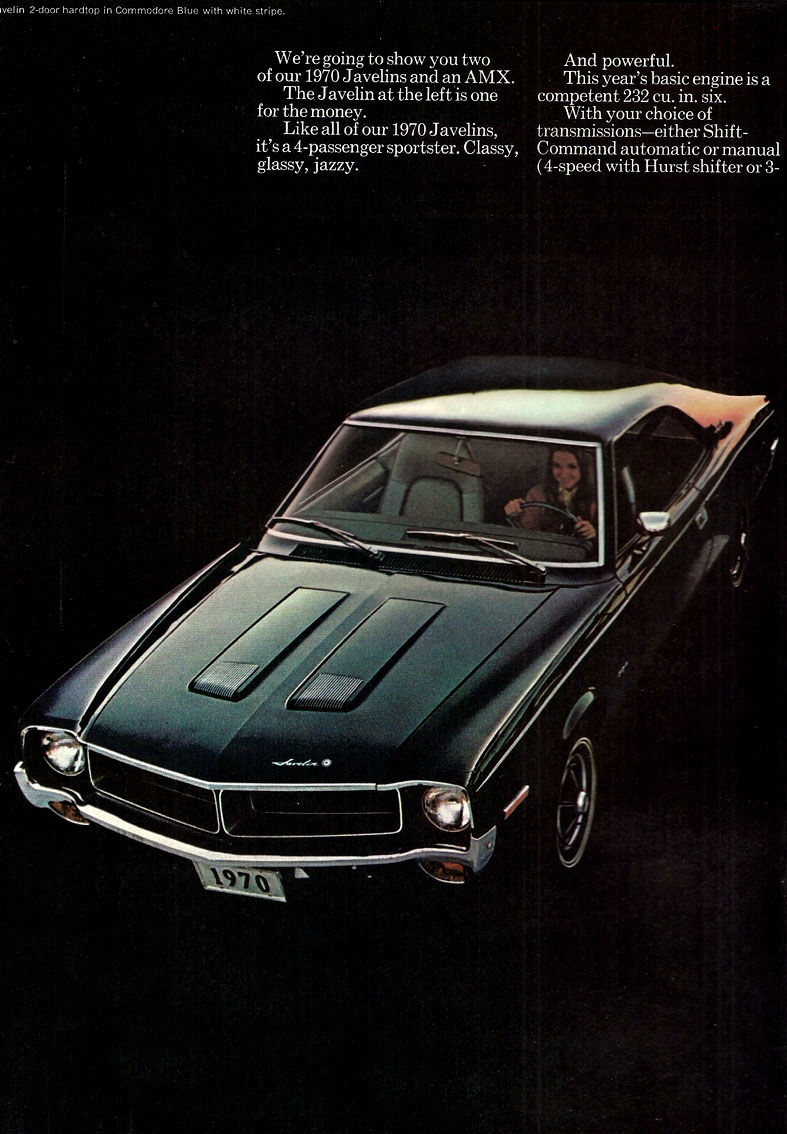
AMC gave the 1970 Javelin a new grille, hood and taillights, and split production between a base car and the better-equipped SST much as it had in 1969, though the totals shrank: 8,496 base Javelins against 19,714 SSTs, a reported 28,210 in all. The SST could be ordered with four-speed power teams for both the newly available 360 and a 325-horsepower 390, the two biggest engines the Javelin had yet offered.1
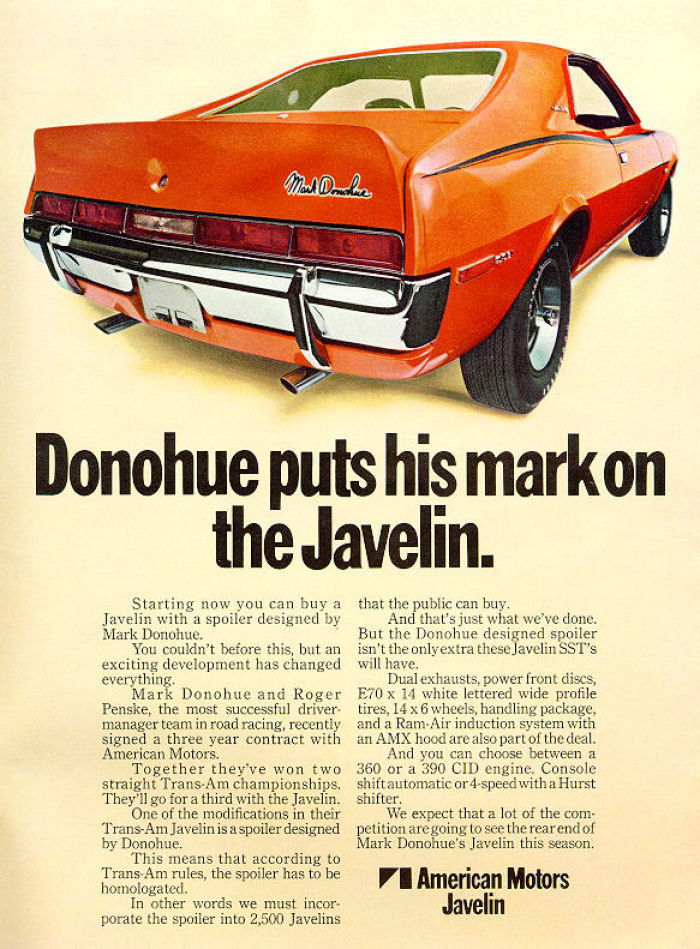
The bigger change that year had nothing to do with sheet metal. Penske Racing joined AMC's factory Trans-Am program for 1970, and Don Cox, who arrived in November 1969 as the team's first dedicated engineer, later recalled AMC's proposal as financially attractive. That racing relationship reached the showroom in two forms: the Mark Donohue Javelin, identified by a rear spoiler carrying Donohue's own signature, and a limited Trans Am Javelin finished in red, white and blue.2,3
Both editions are counted inside the 19,714 SST total, not on top of it: 2,501 Donohue Javelins and 100 Trans Am Javelins, leaving 17,113 other SSTs. Old Cars Weekly gives 2,500 Donohue cars, a figure that reads as a rounded or variant count of the same cars rather than a genuine disagreement about how many cars actually exist.1,3,4
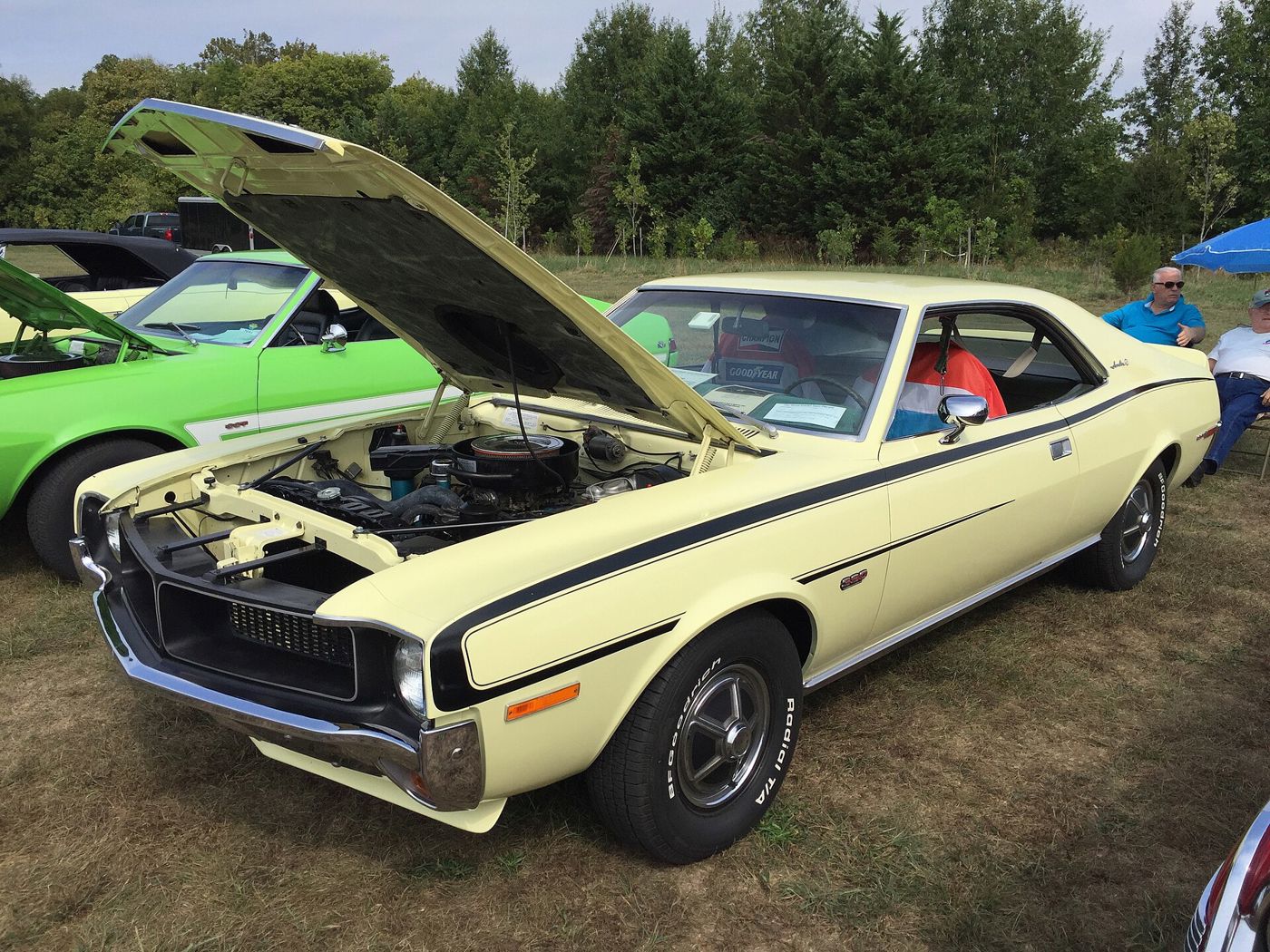

Both special editions share an unusual problem for a factory car: nothing on the car proves it is one. The VIN, door tag and build sheet do not identify a 1970 Donohue or Trans Am Javelin, and memos attributed to AMC advertising director E. B. Brogan allowed dealers to build either package to order. Planet Houston AMX calls the pair among the easiest AMC muscle cars to clone convincingly, since no factory paperwork exists to confirm or deny a given car's originality.1
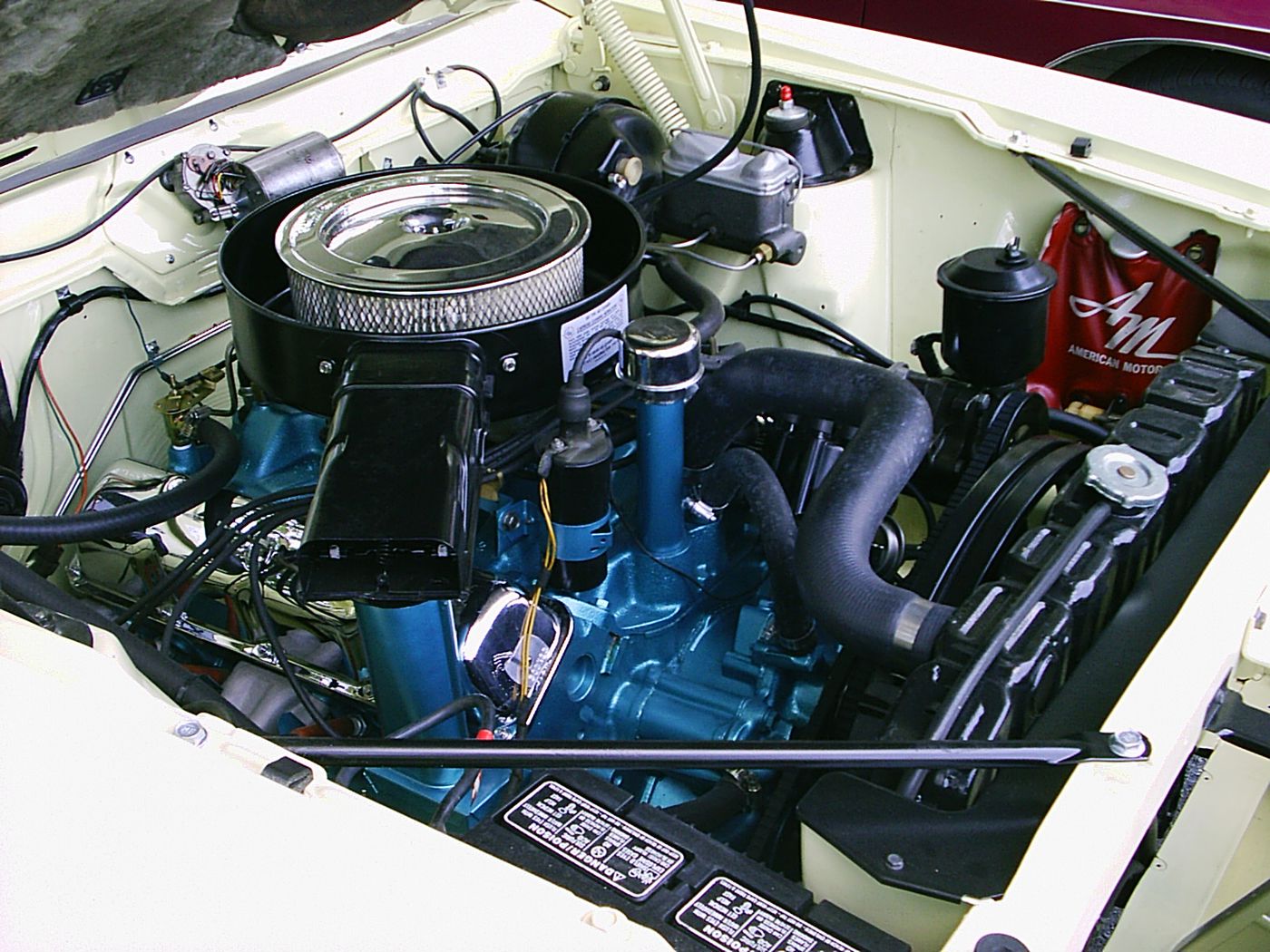
Engine choices for 1970 ran from the 145-horsepower 232 six up through the 390 four-barrel at 325 horsepower and 420 lb-ft, with a 210-horsepower two-barrel 304 and two versions of the new 360 in between: 245 horsepower with a two-barrel carburetor, 290 with a four-barrel. The 360 four-barrel was rated at 395 lb-ft at 3,200 rpm alongside 290 horsepower at 4,800 rpm.
The engine split between the two trims followed the pattern of 1969: the base Javelin still leaned toward its six and small V8, with 4,147 232 sixes and 3,593 304s against only 633 360s and 123 390s, while the SST (whose count includes the Donohue and Trans Am cars, since neither can be separated out) put far more buyers into the two largest engines, 6,798 360s and 2,730 390s, against 9,331 304s and just 855 sixes.5
Prices climbed from 1969's levels: $2,720 for the base Javelin and $2,848 for the SST, both effective from the September 1969 introduction, against Old Cars Weekly's separately reported $2,863 for the SST. The Trans Am Javelin carried its own flat price of $3,995, and the Go Package added $321 with the 360 or $409 with the 390.1,4,6
The Go Package itself grew more serious for 1970. Beyond the four-barrel 360 or 390, power front disc brakes, E70x14 white-letter tires and a handling package, it now added Ram Air induction paired with the AMX's power-blister hood, a functional-looking scoop shared with AMC's two-seat flagship. AMC's own literature describes the same package with dual exhaust and six-inch wheel rims added to its contents.6
Big Bad paint, the story of the 1969 model year, nearly vanished from the 1970 order book. Only 60 Big Bad Orange Javelins are counted for 1970, with Big Bad Blue and Green dropped from the order book that year. Against 1969's 2,282 cars across three colors, 1970's count reads like a program AMC was already easing away from, even as the racing program built around the same cars was just getting started.3

Interior choices widened for 1970 to five colors on both trims, black, blue, green, red or brown, with the base car's Rattan-weave vinyl set against the SST's choice of Ventilaire vinyl, corduroy cloth, or genuine leather, though leather was not offered in the blue or green interior codes. Shipping weight moved from 2,845 pounds for the base car and 2,863 for the SST up to 3,340 for the Trans Am Javelin, a nearly 500-pound jump the red-white-blue paint and trim alone do not fully explain.1
The same base-versus-SST divide ran all the way down to the rubber: a six-cylinder Javelin rode on C78x14s, a V8 SST stepped up to D78x14s, and the performance options climbed further still, to E70x14 red-line tires or F70x14s in white letters. Wheel choices ran from plain discs, standard on the SST, up through Turbo-Cast or wire wheel covers and mag-styled wheels offered with a space-saver spare, while a sports steering wheel with a rim-blow horn was likewise standard SST equipment rather than a separate purchase.
Beyond performance and appearance, AMC's 1970 options covered the ordinary business of living with the car: air conditioning, tinted glass, an Adjust-O-Tilt steering wheel, a trunk-lid luggage rack and a bundled convenience group alongside a separate light group, plus a cold-start package, an engine-block heater and, for California cars specifically, fuel-vapor emission control.
Fact sheet · 1970 · United States
The numbers
1970 AMC Javelin: Penske and Donohue brought the Javelin to Trans-Am, and the showroom answered with 2,501 Mark Donohue Javelins and 100 red-white-blue Trans Am Javelins, while total production fell to 28,210.
Figures may describe different groups of cars. Add rows together only when the note says they make up a total.
Key facts
- Base Javelin 8,496; Javelin SST 19,714 (including 2,501 Mark Donohue and 100 Trans Am cars).1
- Trans Am Javelin: factory price $3,995, shipping weight 3,340 lb; most carry paint code 00.1,7
- Big Bad Orange Javelins: 60 (JavelinAMX.com; blue and green not available).3
- 1970 Javelin Go Package: $321 with the 360 or $409 with the 390, now with Ram Air and the AMX power-blister hood.6
Production
| What was counted | Built |
|---|---|
| Javelin (base), body 7079-51,3 Javelin · 2-door hardtop · US production | 8,496 |
| Javelin SST, body 7079-7 (incl. Donohue and Trans Am)1,4 Javelin SST · 2-door hardtop · US production | 19,714 |
| Javelin SST excluding Donohue and Trans Am editions3 Javelin SST · 2-door hardtop · US | 17,113 |
| What was counted | Built |
|---|---|
| Mark Donohue Javelin1,3 Javelin SST 'Mark Donohue' · 2-door hardtop · US (Kenosha) Planet Houston AMX notes that not all have the 7079-7 door tag and that the edition could be ordered in any color, including the Big Bad colors. | 2,501 |
| Trans Am Javelin (red-white-blue)1,3,4 Javelin SST 'Trans Am' · 2-door hardtop · US (Kenosha) | 100 |
| What was counted | Built |
|---|---|
| Javelin, all trims1 2-door hardtop · US Equals base plus SST (8,496 + 19,714). | 28,210 |
| What was counted | Built |
|---|---|
| Big Bad Orange3 Javelin · 2-door hardtop · US | 60 |
| What was counted | Built |
|---|---|
| Base, 232 six5 Javelin (base) · 2-door hardtop (7079-5) · 232 six · US, Canada and export market; built at Kenosha | 4,147 |
| Base, 304 V85 Javelin (base) · 2-door hardtop (7079-5) · 304 V8 · US, Canada and export market; built at Kenosha | 3,593 |
| Base, 360 V85 Javelin (base) · 2-door hardtop (7079-5) · 360 V8 · US, Canada and export market; built at Kenosha | 633 |
| Base, 390 V85 Javelin (base) · 2-door hardtop (7079-5) · 390 V8 · US, Canada and export market; built at Kenosha | 123 |
| SST, 232 six5 Javelin SST (incl. Donohue and Trans Am) · 2-door hardtop (7079-7) · 232 six · US, Canada and export market; built at Kenosha | 855 |
| SST, 304 V85 Javelin SST (incl. Donohue and Trans Am) · 2-door hardtop (7079-7) · 304 V8 · US, Canada and export market; built at Kenosha | 9,331 |
| SST, 360 V85 Javelin SST (incl. Donohue and Trans Am) · 2-door hardtop (7079-7) · 360 V8 · US, Canada and export market; built at Kenosha | 6,798 |
| SST, 390 V85 Javelin SST (incl. Donohue and Trans Am) · 2-door hardtop (7079-7) · 390 V8 · US, Canada and export market; built at Kenosha | 2,730 |
Prices when new
| Model | Price | Price type |
|---|---|---|
| Javelin (base)1 | $2,720 | factory price, 1969-09 |
| Javelin SST1 | $2,848 | factory price, 1969-09 |
| Trans Am Javelin1 | $3,995 | factory price, 1970 |
| Go Package with 3606 | $321 | option price, 1970 model year |
| Go Package with 3906 | $409 | option price, 1970 model year |
Prices are the nominal dollars of the day, not adjusted for inflation.
Engines
| Engine | Factory rating | Availability | Built |
|---|---|---|---|
| 360 V8 4-bbl 360 cu in · 4-barrel | 290 hp @ 4,800, 395 lb-ft @ 3,200 (period factory advertised) | optional | |
| 390 V8 4-bbl4 390 cu in · 4-barrel | 325 hp @ 5,000, 420 lb-ft @ 3,200 (period factory advertised) | optional | 2,8535 |
| 232 six 1-bbl 232 cu in · 1-barrel | 145 hp @ 4,300, 215 lb-ft @ 1,600 (period factory advertised (gross)) | standard (basic and SST) | 5,0025 |
| 304 V8 2-bbl 304 cu in · 2-barrel | 210 hp @ 4,400, 305 lb-ft @ 2,800 (period factory advertised (gross)) | optional | 12,9245 |
| 360 V8 2-bbl 360 cu in · 2-barrel | 245 hp @ 4,400, 365 lb-ft @ 2,400 (period factory advertised (gross)) | optional |
Ratings are published figures, not dyno results. Gross and net ratings aren't directly comparable.
Transmissions
| Transmission | Availability |
|---|---|
| Four-speed manual (360 and 390 SST) | optional |
| Three-speed manual, floor (standard with 232 and 304) | standard |
| Shift-Command automatic, column or console (all engines) | optional |
Options and packages
| Option | Price | Installed |
|---|---|---|
| Go Package: 360 (290 hp) or 390 (325 hp) four-barrel, power disc brakes, E70x14 white-letter tires, handling package, heavy-duty cooling, space-saver spare, Ram Air with AMX power-blister hood6 | $321 | |
| Mark Donohue Javelin (rear spoiler with Donohue signature)3 | 2,5011 | |
| Heated rear glass (new for 1970)1 | ||
| Javelin 360 or 390 Go Package (footnote 2: 4-bbl V-8, dual exhaust, power front disc brakes, E70x14 red-line tires, 6-in rims, handling package, ram-air carburetion with AMX hood) | ||
| Vinyl-covered roof: black, white or blue | ||
| Bucket seats, fabric (SST); bucket seats, genuine leather (SST); vinyl buckets standard | ||
| Dual exhaust for 360 4-bbl (standard on 390); tachometer and 140-mph speedometer (V-8); Twin-Grip; quick-ratio manual steering | ||
| Power steering; power brakes; power front disc brakes (V-8) | ||
| AM radio; AM/FM radio; rear speaker; 8-track stereo with manual AM radio and 2 rear speakers | ||
| Console (with column-shift transmission); armrest and center cushion (standard SST); air conditioning; Command-Air ventilation; tinted glass; trunk-lid luggage rack; Adjust-O-Tilt wheel | ||
| Convenience group (6); electric wipers and washers; visibility group; light group (7); space-saver spare | ||
| Bumper guards (rear for Javelin); insulation group; anti-scuff side molding | ||
| Sports steering wheel with rim-blow (standard SST); wheel discs (standard SST); Turbo-Cast or wire wheel covers; mag-styled wheels with space-saver; simulated-exhaust rocker panel molding; roof spoiler (not with vinyl roof); rally/racing stripes (black, white or red) | ||
| Handling package (6-cyl. or V-8); heavy-duty cooling; 70-amp battery; cold-start package; engine-block heater; fuel-vapor emission control (California) | ||
| Tires: C78x14 (standard six), D78x14 (standard V-8 SST), E70x14 red line, F70x14 white-lettered |
Paint
| Code | Color | Built |
|---|---|---|
00 |
Trans Am red-white-blue scheme (most Trans Am Javelins)1 | 1001 |
|
Big Bad Orange3 | 603 |
Color names are the factory's. We don't show color swatches, because a screen color is no guide for a restoration.
Interiors
| Code | Trim |
|---|---|
061 / 063 / 064 / 065 / 066 (J) |
Base: black, blue, green, red, brown; Rattan weave vinyl1 |
061–066 (F, L or E) |
SST: same colors; F Ventilaire vinyl, L leather (not in blue 063 or green 064), E corduroy1 |
Specifications
| Measure | Value | Applies to |
|---|---|---|
| Shipping weight, base1 | 2,845 lb | 7079-5 |
| Shipping weight, SST1 | 2,863 lb | 7079-7 |
| Shipping weight, Trans Am Javelin1 | 3,340 lb | Trans Am edition |
| Axle ratios, four-speed (360 4-bbl and 390) | 3.54 (3.15 and 3.91); with Go Package and automatic 3.15 standard (2.87 and 3.54 optional) :1 | Javelin 360 4-bbl / 390 |
Identification
- Donohue and Trans Am editions
- The VIN, door tag and build sheet do not identify a 1970 Donohue Javelin. These editions are among the easiest AMC muscle cars to clone. Most Trans Am Javelins carry paint code 00.1
Where the sources disagree
1970 360 four-barrel torque
- 390 lb-ft (an earlier reading of the same chart)
- 395 lb-ft @ 3,200 rpm (290 hp @ 4,800)
Identification
Read a 1970 AMC VIN
The VIN decoder runs in your browser and never sends the VIN anywhere. How the factory numbered this year's cars:
Read next
The people and races behind the 1970 AMC Javelin
- 1970 Trans-Am at Watkins Glen Racing program
- Bud Moore’s Boss 302 Campaign Racing program
- 1970 Showroom Argument Cross-marque story
- Every AMC Javelin year 1968–1974
Same model year
Also in 1970
- AMC AMX The last two-seat AMX: a restyled nose, a 360 base V8 and a 325-hp 390. At 4,116 cars it was the rarest of the three two-seat years.
- AMC Rebel and Rebel Machine AMC's intermediate supercar: a 340-hp 390, four-speed and Hurst shifter in the Rebel hardtop, first in white with red-white-blue stripes. Totals reported for the one-year run range from about 1,200 to 2,326.
- Buick Riviera The 455 (370 hp gross) arrived with a restyle; production fell to about 37,300 with some 3,505 GS cars.
- Buick Skylark Gran Sport, GS and GSX Buick's GS went to a 455 rated at 510 lb-ft, the Stage 1 option added 10 advertised hp, and a mid-year GSX package was built 678 times in two colors.
- Buick Wildcat The final Wildcat, Custom trim only, with the 370-hp 455; 23,645 built.
- Chevrolet Chevelle and Malibu SS The year the Chevelle Super Sport split into RPO Z25 SS 396 and RPO Z15 SS 454, with the LS6 454 rated at 450 gross horsepower.
- Chevrolet Chevy II and Nova Last year the source engine table lists the big-block (as 402) in the Nova. Enthusiast-compiled production: 307,280 cars; Super Sport 19,558.
- Chevrolet El Camino SS The Malibu/Custom El Camino could carry RPO Z25 SS 396 or RPO Z15 SS 454, including the 450 hp LS6; 8,773 Z15s across Malibu models.
- Chevrolet Monte Carlo SS The first Monte Carlo, with the SS 454 as RPO Z20: 3,823 of 145,976 Monte Carlos per Chevrolet-report-derived tables.
- Dodge Challenger Dodge's first pony car arrived as a 1970 model with nine advertised engines, base, SE, R/T, and R/T SE hardtops, two convertibles, and a one-year Trans-Am homologation special, the T/A.
- Dodge Charger The last year of the second-generation body: a new full-width grille, three series (Charger, 500, R/T), the 440 Six Pack added to the R/T, and production roughly half of 1969's.
- Dodge Coronet R/T and Super Bee The final Coronet-based R/T and Super Bee: the R/T fell to 2,615 cars, while the Super Bee added a 3-speed manual and kept its Six Pack and Hemi options.
- Dodge Dart GTS, Swinger and Demon With the GTS gone, the Swinger 340 was the only performance Dart; it kept front discs, Rallye suspension and a twin-scoop hood and sold about 13,800 beside the new Challenger.
- Ford Fairlane The last Fairlane year: the name survived only on the Fairlane 500 beneath the new Torino, with a mid-year Falcon sharing the body at the bottom of the range.
- Ford Maverick Grabber The $179 Grabber package of stripes, a spoiler and a blacked-out grille arrived mid-1970 on the new two-door Maverick.
- Ford Ranchero GT The Torino-based Ranchero GT could take the 429 Cobra Jet and Super Cobra Jet; reference counts give 3,905 GTs, while Barn Finds rounds the GT figure to about 3,600 of 21,640 Rancheros.
- Ford Thunderbird The 429 at 360 hp was the standard and only engine listed in the 1970 catalog.
- Ford Torino A new, longer body on a 117-inch wheelbase; the Torino Cobra became its own model with the 429, offered in 360, 370 (Cobra Jet) and 375 (Super Cobra Jet) horsepower forms.
- Mercury Comet and Cyclone A new, longer Montego-based Cyclone in three versions: the 429 Cyclone, the small-block Cyclone GT that outsold both others, and the Ram Air 429 Cobra Jet Cyclone Spoiler.
- Mercury Cougar The last first-generation Cougar moved to the 351 Cleveland, kept the Boss 302 as an Eliminator-only engine, and built 2,268 Eliminators.
- Mercury Marauder and S-55 The second and last year of the 1969-70 Marauder: production fell to about a third of 1969's, with the X-100 near half of it.
- Oldsmobile Cutlass, 4-4-2 and Hurst/Olds The 4-4-2 got a standard 455 rated at 365 hp, the W-30 went to 370 hp, and the small-block W-31 moved to the Cutlass and F-85 coupes.
- Plymouth Barracuda and 'Cuda The E-body redesign split the line into Barracuda, Gran Coupe, and 'Cuda hardtops and convertibles, put every Chrysler performance engine through the 426 Hemi on the order form, and added the one-year AAR 'Cuda for Trans-Am homologation.
- Plymouth Duster 340 and 360 Plymouth's new Valiant-based fastback coupe arrived with a 275 hp 340 performance model at $2,547; 24,817 Duster 340s among 217,192 Dusters.
- Plymouth GTX, Belvedere and Satellite Now hardtop-only, the GTX fell to 7,748 cars while its 440 Six Barrel option cost just $119.
- Plymouth Road Runner Production halved from 1969, the 440 Six Barrel became a regular option, and the winged Superbird was built as a Road Runner hardtop to put Plymouth back on NASCAR superspeedways.
- Pontiac Firebird and Trans Am A late-arriving, coupe-only second generation: 48,739 Firebirds, 3,196 of them Trans Ams, and 88 Ram Air IVs.
- Pontiac GTO A new Endura nose, a 455 added beside the three 400s, and GTO production falling to 40,149.
- Pontiac Grand Prix The SJ took a 370 hp 455, Hurst built the SSJ, and production fell to 65,750.
- Pontiac Tempest and LeMans The T-37 and GT-37 bring budget performance to the Tempest.