Racing · Factory-supported Hudson teams · 1951–1955
The Fabulous Hudson Hornet: A Program, Not One Magic Car
A first Daytona win, a network of drivers and mechanics behind one famous name, and a legend that grew larger once it stopped belonging to a single car.
Story reviewed July 27, 2026
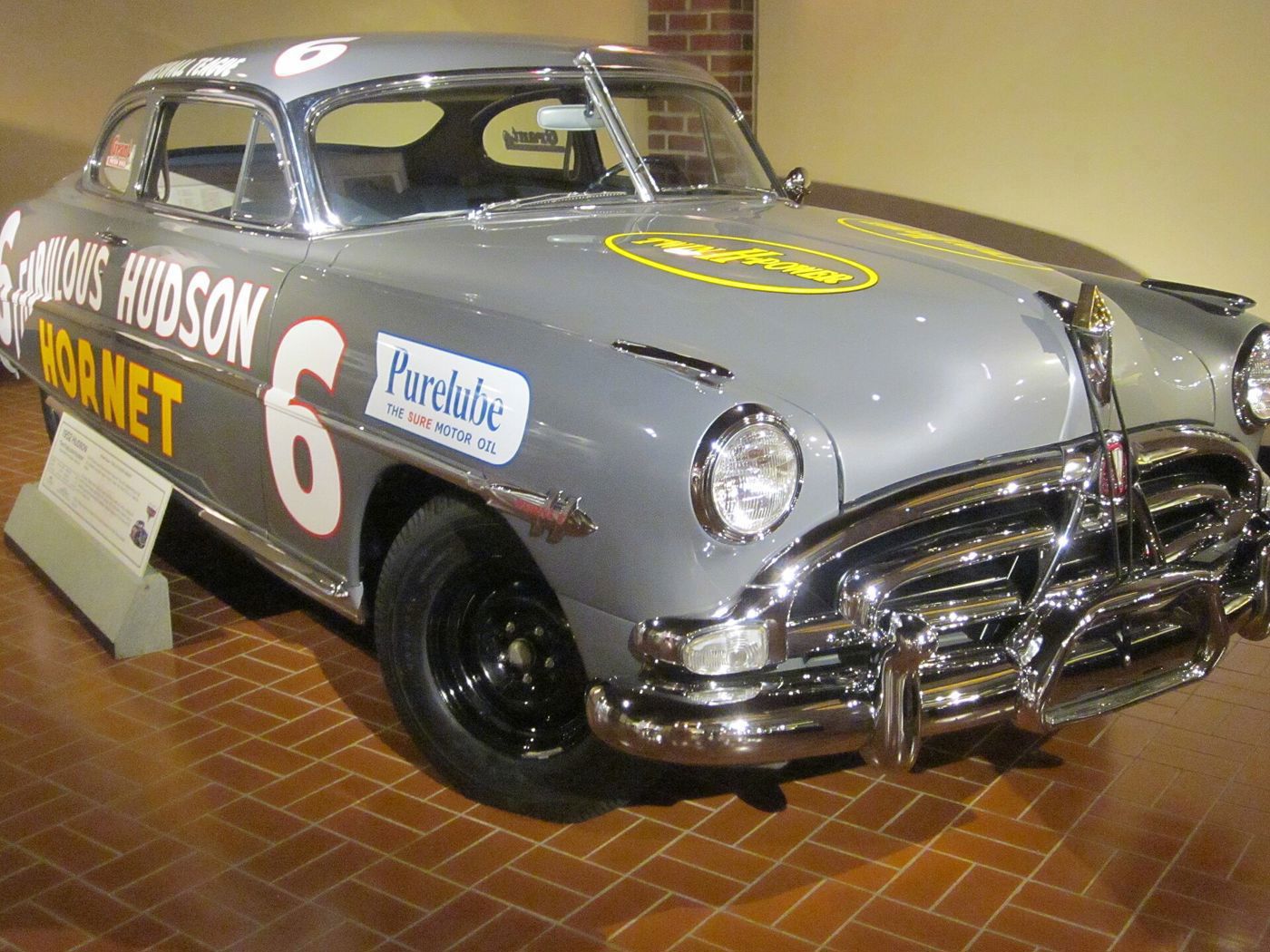
On Daytona’s beach-road course in 1951, Marshall Teague won against fifty-four other starters in what NASCAR identifies as a Fabulous Hudson Hornet. It was the make’s first NASCAR victory. That result is the opening scene because it catches the legend before the name became shorthand for an entire era. The sand, pavement, field size, driver, and first victory are documented. No invented radio call or private thought is necessary. The significance comes from a new stock-car combination proving itself where the public could see it.
Teague then won four of his next nine starts, and NASCAR credits him with seven premier-series victories in the No. 6 Hornet. He also repeated at the Daytona beach-road race in 1952. Those facts establish his program without turning every Hudson win into his. His involvement at NASCAR’s founding meetings and service as the first treasurer place him inside the sport’s institutional formation as well. He was both participant in the organization and one of the drivers making its manufacturer competition consequential.
Herb Thomas expanded the story in a different car. NASCAR describes his No. 92 Fabulous Hudson Hornet, engines built by Smokey Yunick, and five Hudson wins on the way to the 1951 championship. The International Motorsports Hall of Fame connects Yunick through Teague to preparation for Thomas’s Southern 500 winner. The chain matters: Teague helped initiate the effort, Yunick prepared machinery, and Thomas delivered championship results. Combining them into one heroic driver would erase the program that made repeated success possible.
Tim Flock provides another branch. NASCAR says he won the 1952 championship in a Hudson, then later moved to Carl Kiekhaefer’s Chrysler team for his 1955 title. The same driver therefore links the Hornet’s peak to the next performance ancestor in this batch. His move is evidence of how racing knowledge travels. When factory priorities and companies change, drivers and mechanics do not forget what they learned; they carry practices, expectations, and competitive judgment into the next organization.
The production Hornet’s long-stroke 308 and Twin H-Power supplied a recognizable technical foundation, but a race car was not simply a brochure car with numbers. Hudson service literature documents the L-head six and twin-carburetor rating, while racing histories describe torque and low center of gravity as advantages in the earlier cars. Exact race preparation varied by car and event. The street configuration remains in its own comparison record so that competition results do not become implied acceleration data for a 1955 Custom Hollywood.
“Fabulous Hudson Hornet” consequently names a network of cars and people more accurately than a single chassis. Teague’s No. 6, Thomas’s No. 92, Flock’s championship entry, Yunick-prepared engines, mechanics, and factory support all contributed. A page can celebrate the shared identity while attaching each result to the right participant. This is especially important when restored cars appear in museums and events, because famous paint schemes can encourage several histories to be visually merged.
The documented Thomas survivor demonstrates the issue. The National Historic Vehicle Register identifies VIN 7B-185596 as a Hudson provided to Thomas, prepared by Yunick, and the only known surviving NASCAR-campaigned Hudson. It also records restoration, repainting, and a present era-correct replacement 7X engine. The car is an extraordinary material witness, but its current condition is a preservation state. It does not prove how every Fabulous Hornet was built or how this chassis appeared at every race.
The championships need sanctioning labels. Thomas won NASCAR’s 1951 championship and Flock its 1952 championship in Hudsons. Teague won AAA National Stock Car division titles in 1952 and 1954. Calling all of them NASCAR champions would create a smoother sentence and a false record. The correct distinction reveals a broader influence: Hudson success crossed more than one stock-car sanctioning context while different drivers earned different honors.
Year-specific institutional totals show the scale. The NASCAR Hall of Fame reports twenty-seven wins in thirty-four races for Hudson in 1952 and twenty-two wins in 1953. These figures are published with NASCAR Hall attribution rather than treated as a reconstructed database. They give the narrative shape without requiring a disputed lifetime number. They also show that the Fabulous identity became a manufacturer-wide competition force after Teague’s first Daytona breakthrough.
Lifetime totals do not align. NASCAR Hall materials give 79 and 80, while the National Historic Vehicle Register dossier gives 81. The discrepancy could reflect make versus model, series boundaries, race-status changes, or another counting rule. This publication keeps all three in the research record and asks NASCAR Research & Archives for a defined count. It does not choose the middle number or repeat the largest. The disagreement itself teaches readers that racing statistics require entities and scope just as vehicle specifications do.
By 1955, NASCAR says Hudson’s factory presence was gone. The showroom brochure still offered the Hornet name, 308 six, and Twin H-Power under American Motors, but the organized racing effort that built the legend had dispersed. Herb Thomas drove other makes, and Flock joined Kiekhaefer’s Chrysler program. That split between product continuity and competition withdrawal is the closing turn. A badge and engine can survive even as the people and institutional support that made them famous move elsewhere.
The Fabulous Hudson Hornet story is therefore not diminished by refusing the one-car myth. It becomes larger and more human. Teague supplied the first NASCAR win and an organizing presence. Thomas, Yunick, Flock, mechanics, and factory support converted promise into championships and dozens of victories. A surviving car carries part of that history through restoration. Then merger and withdrawal scattered the program’s knowledge into the next era. The legend was fabulous because it was a coordinated achievement, not because one automobile performed magic.