1955 · Hudson · United States
1955 Hudson Hornet: The Name Survived While the Company Changed
The Twin H-Power Hornet that American Motors sold in 1955 shared its name with the most successful stock cars in early NASCAR — and almost nothing else about its situation.
United States · researched through July 26, 2026
Power-team selector
Choose the exact Hornet
The cover of Hudson’s 1955 foldout makes the corporate change impossible to miss: Hudson and American Motors present the new Hornets and Wasps together. A year earlier Nash and Hudson had joined to form American Motors, and the Hudson assembly operation in Detroit was being closed as production shifted to Wisconsin. Yet the Hornet name and its 308-cubic-inch six remained in the catalog. That coexistence—new corporation, familiar badge, proven engine—is the heart of the 1955 story. Continuity existed, but it must be identified component by component rather than assumed for the entire car.
The selected configuration is a Hornet Custom Hollywood hardtop with Twin H-Power and the standard three-speed synchromesh transmission. The brochure lists the Custom Hollywood among the Hornet Six body styles and says Twin H-Power was standard on Custom models, optional on Supers. It also states that the three-speed was standard except on V8 models and gives a 4.1 axle for that transmission. Those statements establish a factory-valid combination rather than a generic Hornet assembled from disconnected specifications.
American Motors’ service manual supplies the engine detail. The L-head inline six displaced 308 cubic inches through a 3-13/16-inch bore and a long 4-1/2-inch stroke, with 7.5:1 compression. The table gives 170 horsepower at 4,000 rpm with the twin-carburetor arrangement. It does not label the rating gross or net and does not publish torque in the located row. The comparison therefore carries 170 as a manufacturer rating of unidentified basis and leaves torque empty. The Hornet’s reputation for torque is important history, but reputation cannot fill a numerical field.
The car’s dimensions emphasize how different the three ancestor routes were. The Hornet rode a 121-1/4-inch wheelbase, measured 209-1/4 inches long, and was 78 inches wide. It sat between the Chevrolet and Chrysler in length while relying on an older engine architecture than either V8 competitor. A simple horsepower ranking would miss the long-stroke six, transmission choice, axle, body, and market context. The comparison is useful precisely because it does not pretend these cars were conceived for one modern class.
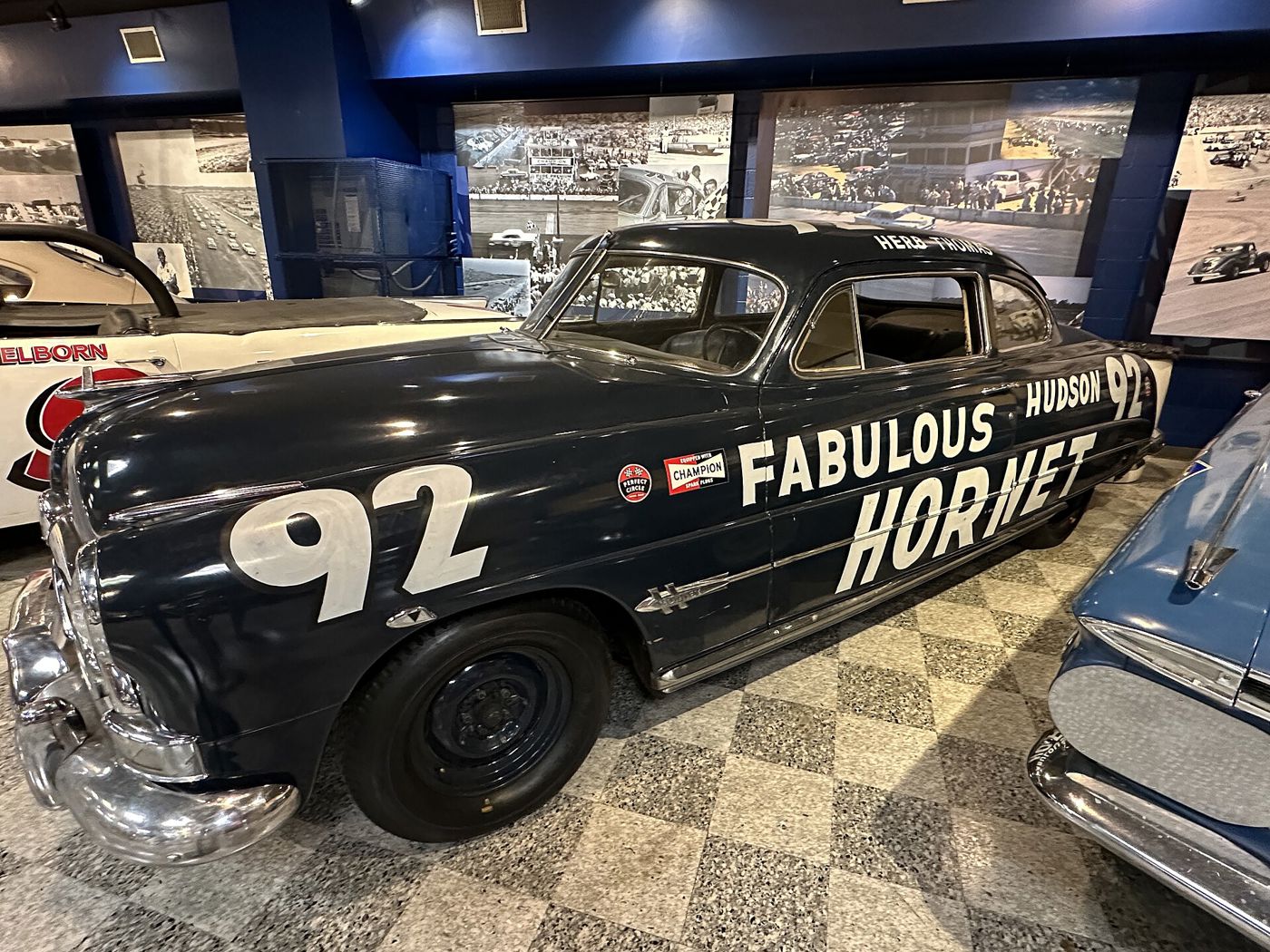
Hornet performance credibility had been built before the merger. NASCAR records Marshall Teague winning the 1951 Daytona beach-road race in a Fabulous Hudson Hornet, the make’s first NASCAR victory, then winning four of his next nine starts. Herb Thomas won five Hudson races on the way to the 1951 championship, and Tim Flock won the 1952 championship in a Hudson. Those achievements belong to multiple drivers, cars, mechanics, and seasons. “The Fabulous Hudson Hornet” was a program and legend, not one magic chassis endlessly changing numbers.
Smokey Yunick’s role adds another person without collapsing the team. NASCAR and the International Motorsports Hall of Fame connect Yunick to engines for Herb Thomas and to preparing a Hornet that won the Southern 500. Teague, Thomas, Flock, Yunick, and Hudson’s factory support each occupy distinct places in the account. Teague’s 1952 and 1954 AAA stock-car titles remain AAA titles; they are not rewritten as NASCAR championships. Thomas and Flock carry the identified NASCAR championship results.
By 1955 the factory-racing situation had changed. NASCAR’s Herb Thomas history says Hudson’s factory presence was gone, and Thomas was racing Chevrolets and Buicks. Flock encountered Carl Kiekhaefer’s Chrysler 300 at Daytona and moved into the team that would win the 1955 title. That makes Flock the human bridge between two ancestor programs: champion in a Hudson, then champion in a Chrysler. The transition is more revealing than a claim that one car simply replaced another. Expertise, drivers, and preparation practices moved as manufacturers reorganized.
The 1955 body creates a major evidence boundary. The brochure and manual prove continued use of the Hornet name and 308/Twin H powertrain. They do not prove that the new Wisconsin-built car retained the earlier 1951–1954 step-down platform unchanged. Later enthusiasts often call merger-era Hudsons “Hashes,” but a nickname is not body engineering. Until an American Motors body manual or launch record establishes the Nash/Hudson platform relationship precisely, this page describes powertrain and name continuity without transferring the early car’s low-floor chassis claims.
Even institutional sources require comparison. A Library of Congress plant report documents the announced production move using period newspaper footnotes, but later says Hudson automobiles ceased after 1955. Period 1957 advertising and institutional histories show the name continued through 1957. The facility-relocation passage remains useful; the end-date sentence does not. A strong source can contain a local error, and publication should preserve the supported claim while calling out the contradiction instead of accepting or discarding the entire document.
Lifetime win totals are similarly unsettled. NASCAR Hall accounts give 79 and 80 Hudson wins, while the National Historic Vehicle Register documentation gives 81. The counts may differ by series, race status, make-versus-model scope, or another definition not stated in the summaries. This page uses year-specific results with attribution and withholds a lifetime total pending reconciliation by NASCAR Research & Archives. Averaging the numbers would solve nothing; telling readers why they differ turns uncertainty into useful history.
The surviving Herb Thomas Hornet is powerful evidence with material changes attached. The National Historic Vehicle Register identifies it as the only known surviving NASCAR-campaigned Hudson, provided to Thomas and prepared by Yunick. It also records restoration, repainting, and an era-correct replacement engine block. The vehicle can tell a preservation story and show how a race car has survived, but its present configuration is not automatically proof of every race-day state. Authenticity is a chain, not a visual impression.
What survived into 1955 was already enough to matter: the Hornet name, the 308, Twin H-Power, a manual configuration, and the memory of extraordinary stock-car success. What changed was equally important: corporate ownership, production location, body context, and factory competition presence. The Hornet belongs among the ancestors because it shows that American performance history is not a straight line of ever-larger V8s. It is also a story of a long-stroke six, racing knowledge, and a famous identity carried through a merger with some continuities proven and others still open.
Same model year
Also in 1955
- Chrysler 300 letter series Chrysler's February 1955 limited-production hardtop put a dual-four-barrel 331 Hemi rated at 300 hp into a leather-trimmed New Yorker-based coupe; club and fact-sheet lineages agree on 1,725 cars.
- Ford Thunderbird Ford planned 10,000 two-seat Thunderbirds and built 16,155, each with a 292 V-8 rated 193 hp with the manual gearbox and 198 hp with Ford-O-Matic.