1965 · Rambler/AMC · United States
1965 Rambler Marlin: How AMC's Compact Fastback Grew Into a Six-Passenger Coupe
AMC's six-passenger fastback, introduced in February 1965. Its best year was 10,327 cars.
United States · researched through 2026-09-22
The Marlin began as a smaller car. In January 1964 American Motors showed the Rambler Tarpon to engineers at the Society of Automotive Engineers convention, and a few weeks later to the public at the Chicago Auto Show, according to Mac's Motor City Garage. Richard A. Teague and his design staff had built it in the summer of 1963 on a production Rambler American convertible with a 106-inch wheelbase. It was a compact fastback, shown to the public months before Ford's Mustang went on sale in April 1964.1,2
That timing matters to the Marlin's origin story, because the story has several versions. Steve Salmi of Indie Auto has compared them. A 1996 club publication said Teague developed the Tarpon in response to the Mustang's sales success, which the dates contradict. Designer Vince Geraci recalled that Teague wanted a fighter for the Mustang. Jim Alexander said the trigger was news of Plymouth's coming Barracuda, while Geraci could not recall the Barracuda being mentioned. Bob Nixon said the Tarpon was developed before anyone knew about the Mustang.2
The decision that turned the Tarpon into the Marlin is better documented. Mac's Motor City Garage places it within AMC's rebranding under chief executive Roy Abernethy, who wanted to move the company from economy cars toward more profitable intermediate and full-size models. The Tarpon's fastback theme was moved from the compact American to the intermediate Classic, which had been fully redesigned for 1965. Teague later recalled Abernethy's view bluntly: “Roy Abernethy didn't like little cars.” In Teague's account, Abernethy suggested the Classic wheelbase for V8 availability and more room inside.1,2
There was also an engineering reason, though it is disputed. Guy Hadsall Jr., as quoted by Indie Auto, reported that AMC's V8 would not fit the compact platform and that a more compact V8 was a year to a year and a half away, so Abernethy wanted a V8 from the start of production. Salmi questions that reasoning, noting that the 287 V8 was rated only two horsepower below the Mustang's base 289 and that dealers later fitted V8s into Americans. Accounts also differ over whether Teague supported the larger car or opposed it.2
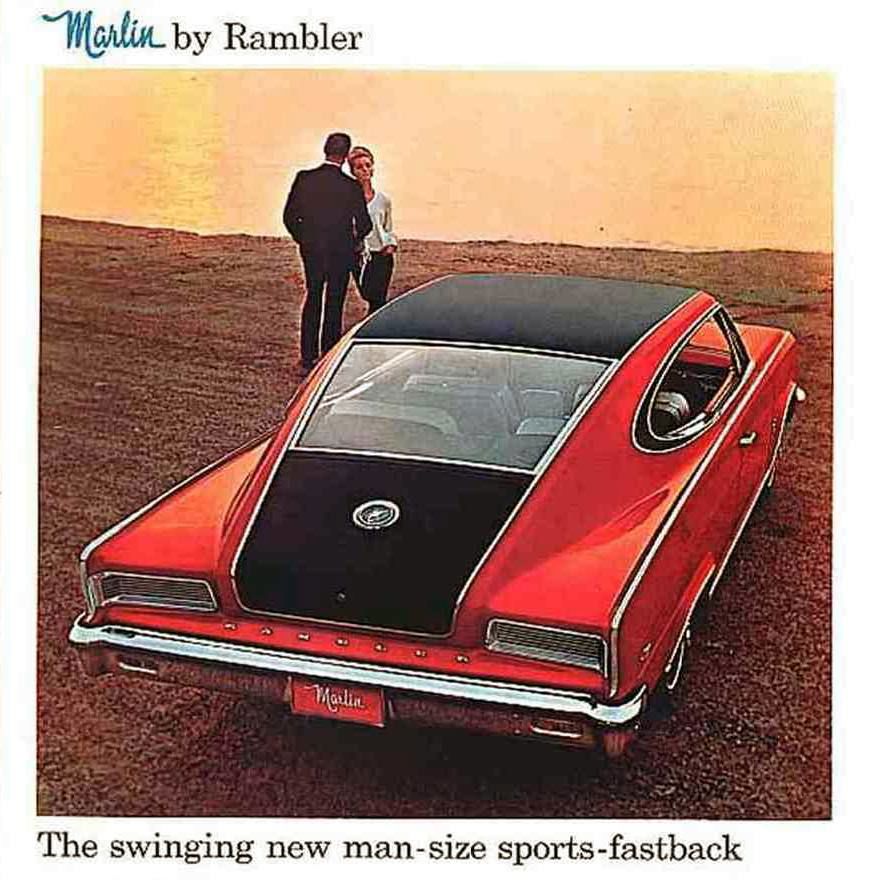
Even the roof has competing versions. Wikipedia says the roof was raised over the rear seat because Abernethy, about six feet four, insisted on being able to sit there. Indie Auto collects the variants: Patrick Foster has written of one inch in 1993 and three inches in 2013; Teague recalled that Abernethy added an inch while he was in Europe and that he never got over it; and Geraci, as reported by Strohl, remembered raising the rear roof slope by an inch and a half. Whether the change was to height or slope is unclear.3,2
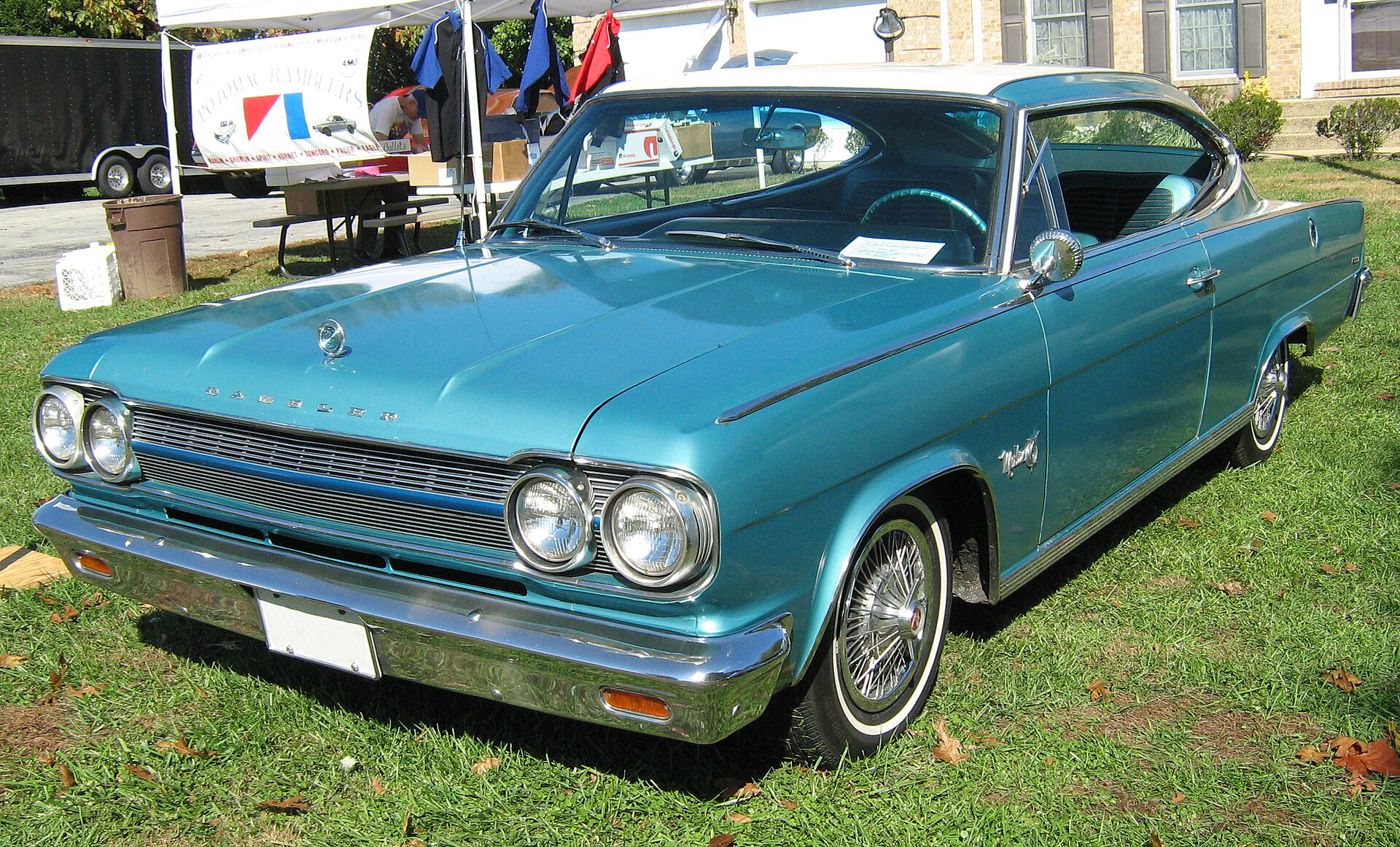
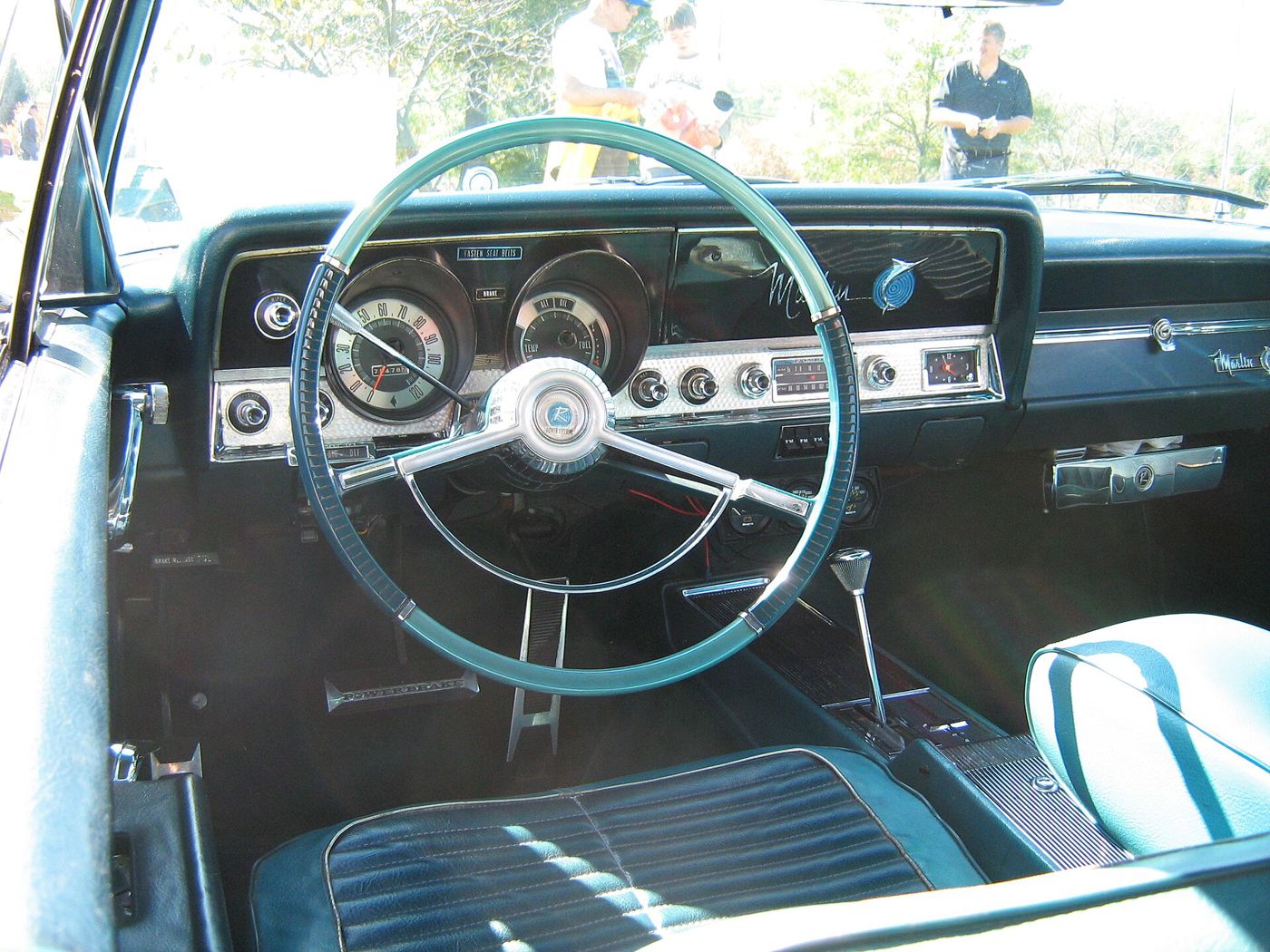
The production car arrived in the middle of the model year. Wikipedia dates the official announcement to February 10, 1965, and its arrival in Rambler showrooms to March 19. Old Cars Weekly describes a six-passenger fastback on the Classic's 112-inch wheelbase, with power front disc brakes standard and an Ambassador instrument panel. Wikipedia specifies Bendix four-piston front disc brakes, individual reclining front seats, front and rear armrests and engine-turned aluminum trim on the dash. The base price was $3,100, according to both sources.3,4
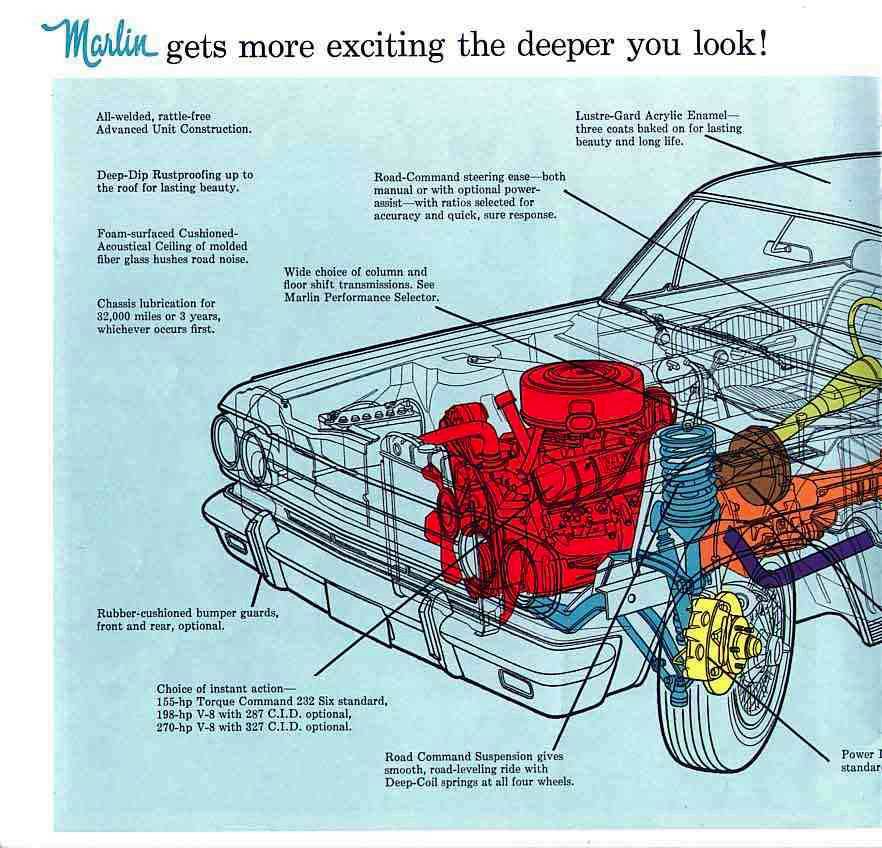
The engine list ran from a six to a 327. Old Cars Weekly gives the standard 232 six at 155 horsepower, a 287 V8 at 198 and a 327 at 270. Wikipedia lists the 287 at 189 horsepower and two 327s, at 250 and 270. Those are factory gross-era ratings as published, and the two sources disagree on the 287. Transmissions ran from a three-speed manual through overdrive to Flash-O-Matic automatics, and Old Cars Weekly singles out the Twin-Stick overdrive, which gave five forward speeds.4,3
AMC pitched the Marlin on comfort. Old Cars Weekly writes that the Tarpon had seemed aimed at the Barracuda and the Mustang, but that the Marlin emphasized comfort and roominess for six passengers instead of performance. Indie Auto says it was marketed as a luxurious sporty coupe, not a high-performance car like the GTO, and that its advertising stressed roominess. Wikipedia calls it a personal luxury car intended to fill a gap between the smaller fastbacks and the luxury cars.4,2,3
The tests matched that pitch. Tom McCahill's Mechanix Illustrated test of a 327 automatic, reported by Old Cars Weekly, gave 0 to 60 mph in 9.7 seconds. Wikipedia cites a Popular Mechanics test at 10.8 seconds, without naming the tested configuration. Both are period measurements tied to the cars tested. The styling drew criticism: Wikipedia records that Automobile Quarterly called the car “very ugly.” The Marlin was quick enough for a six-passenger coupe, and neither test presented it as a performance car.4,3
For its abbreviated first season, the Marlin sold well by its own standards. Old Cars Weekly and Wikipedia both give 10,327 for 1965, from a March start. That was the high point. Production fell to 4,547 for 1966 and 2,545 for 1967, according to both sources, for 17,419 in all. The 1965 cars therefore make up about 59 percent of every Marlin built. Old Cars Weekly also counts only 33 four-speed Marlins across the three years, a tiny share of a car that was sold on comfort.4,3
Within AMC's own showroom the Marlin was outsold by its siblings. Indie Auto notes that the top-end Rebel SST and Ambassador DPL two-door hardtops vastly outsold it, even after the Marlin was restyled for 1967. The Rambler name was dropped from the car for 1966. The Marlin had been moved onto the Classic to give it V8 availability and more room, in line with Abernethy's push toward bigger cars, yet it was AMC's conventional top-line hardtops that sold in volume.2,1
Salmi ends his survey with a caution that fits the Marlin well. Oral histories from designers are valuable, he writes, but participants may misremember or put their own spin on events. The documented facts are narrower: a compact show car in January 1964, a decision to build it on the intermediate Classic, a February 1965 announcement, a $3,100 price and 10,327 first-year cars. The reasons behind the decision and the roof, which the participants remember differently, remain matters of testimony.2,1,3,4
Fact sheet · 1965 · United States
The numbers
1965 Rambler Marlin — AMC's six-passenger fastback, introduced in February 1965. Its best year was 10,327 cars.
Coverage: Partial — researched sections are shown; missing ones are not yet sourced. Researched through 2026-09-22.
Every figure is labeled with how sure we are. Reported means a manufacturer, registry, or reference figure we cite but have not reconciled against factory records ourselves. Disputed means credible sources disagree and both are shown. Rows are separately scoped; don't add them together unless the note says they make up a total.
Key facts
Production
| What was counted | Count | Basis | Status |
|---|---|---|---|
| Marlin fastback, all engines4 Marlin · 2-door fastback hardtop · US | 10,327 | built, model-year | Reported |
| What was counted | Count | Basis | Status |
|---|---|---|---|
| Marlin, all three model years (1965–67)4 Marlin · 2-door fastback hardtop · US Equals 10,327 + 4,547 + 2,545 as given by the same publication. | 17,419 | built, model-year | Reported |
An owner anecdote in the Old Cars Weekly article mentions about 2,000 cars with the 232. That is not a sourced split, so no row is shown.
Prices when new
| Model | Price | Basis |
|---|---|---|
| Marlin base price4 | $3,100 | base price as reported by Old Cars Weekly (basis not stated), 1965-02 |
Prices are the nominal dollars of the day, not adjusted for inflation.
Engines
| Engine | Factory rating | Availability | Built |
|---|---|---|---|
| 232 Torque Command six4 232 cu in | 155 hp @ 4,400, 222 lb-ft @ 1,600 (period factory rating (gross era), as reported) | standard | Not yet sourced |
| 287 V84 287 cu in | 198 hp @ 4,700, 280 lb-ft @ 2,600 (period factory rating (gross era), as reported) | optional | Not yet sourced |
| 327 V84 327 cu in | 270 hp @ 4,700, 360 lb-ft @ 2,600 (period factory rating (gross era), as reported) | optional | Not yet sourced |
Ratings are the manufacturer's advertised figures under the standard shown (SAE gross before 1972, SAE net after). They are not dyno results, and gross and net ratings can't be compared directly.
Transmissions
| Transmission | Availability | Built |
|---|---|---|
| Three-speed manual4 | standard | Not yet sourced |
| Twin-Stick overdrive (with console and buckets)4 | optional | Not yet sourced |
| Flash-O-Matic automatic; Shift-Command Flash-O-Matic4 | optional | Not yet sourced |
Options and packages
| Code | Option | Price | Installed |
|---|---|---|---|
|
Two-tone paint (26 optional combinations); silver or black teardrop side-window insert | — | Not yet sourced |
|
All-vinyl upholstery for standard reclining seats; reclining bucket seats (fabric or vinyl) with center console or center cushion, front and rear fold-down armrests | — | Not yet sourced |
|
Headrests (left and/or right) | — | Not yet sourced |
|
AM or AM/FM all-transistor radios; Duo-Coustic or Vibra-Tone rear speakers | — | Not yet sourced |
|
All-Season air conditioning | — | Not yet sourced |
|
Power steering; Adjust-O-Tilt steering wheel; power-lift windows | — | Not yet sourced |
|
Twin-Grip differential | — | Not yet sourced |
|
Electric windshield wipers; Solex glass (all or windshield only; sunshade Solex front and rear) | — | Not yet sourced |
|
Whitewall tires; 7.75 x 14 tires for V-8s | — | Not yet sourced |
|
Wheel discs with spinners; wire-wheel covers with spinners | — | Not yet sourced |
|
Light Group (trunk, glove-box and courtesy lights, parking-brake warning light, backup lights) | — | Not yet sourced |
|
Visibility Group A (windshield washer, left outside mirror, inside tilt mirror, visor vanity mirror); Visibility Group B (as A with remote-control left mirror) | — | Not yet sourced |
|
Powr-Saver V-8 fan; 40-amp alternator; 70-amp battery; heavy-duty cooling; heavy-duty shocks and springs; Dowgard coolant; retractable front seat belts | — | Not yet sourced |
|
Bumper guards; undercoating; padded sun visors | — | Not yet sourced |
|
Standard: front disc brakes, power brakes, Double-Safety brake system, wheel discs, electric clock, individually adjustable reclining seats, floor carpeting | — | Not yet sourced |
Paint
| Code | Color | Built |
|---|---|---|
P-1A |
Classic Black5 | Not yet sourced |
P-3A |
Antigua Red5 | Not yet sourced |
P-7A |
Seaside (Light) Aqua5 | Not yet sourced |
P-72A |
Frost White5 | Not yet sourced |
P-8A |
Marina (Medium) Aqua Metallic5 | Not yet sourced |
P-9A |
Atlantis (Dark) Aqua Metallic5 | Not yet sourced |
P-14A |
Marlin Silver Metallic5 | Not yet sourced |
Color names are the factory's. We don't show color swatches, because a screen color is no guide for a restoration.
Specifications
| Measure | Value | Applies to |
|---|---|---|
| Wheelbase4 | 112 in | 1965 Marlin (Classic platform) |
| Overall length | 195 in | all 1965 Marlins |
| Loaded height | 54.2 in | all 1965 Marlins |
| Width | 74.5 in | all 1965 Marlins |
| Tread, front / rear | 58.6 / 57.6 in | all 1965 Marlins |
| Brakes | 11.2-in front discs, 10-in rear flanged drums, power assisted (standard) | all 1965 Marlins |
| Tires | 7.35 x 14 (7.75 x 14 optional for V-8s) | all 1965 Marlins |
| Fuel tank capacity | 19 US gal | all 1965 Marlins |
| Axle ratios | 232: 3-speed 3.15, overdrive 3.54, Flash-O-Matic 3.15; 287: 3-speed 3.54, overdrive 3.54, Flash-O-Matic 2.87 (3.15 no-cost); 327: 3-speed 3.54, overdrive 3.54, Flash-O-Matic 3.15 (2.87 no-cost); floor Twin-Stick 3.54; floor Shift-Command 3.15 (V-8 2.87 no-cost) :1 | all 1965 Marlins |
Period road tests
| Test | Car tested | Result |
|---|---|---|
| Mechanix Illustrated, 196540-60 mph | Marlin 327 V8, automaticas reported by Old Cars Weekly; original issue not read | 9.7 s |
A road test result belongs to the one car that was tested, with its engine, gearing, tires, and conditions. It is not a figure for every car of the year.
Same model year
Also in 1965
- Buick Riviera The Gran Sport arrived with the dual-quad Super Wildcat 425 and a 3.42 axle; 3,354 of 34,586 Rivieras had it.
- Buick Skylark Gran Sport, GS and GSX Buick's first Gran Sport was a Skylark option with the 401 'Wildcat' V-8 rated at 325 hp; a production tabulation counts 15,780.
- Buick Wildcat Second-generation B-body Wildcat on a 126-inch wheelbase in standard, Deluxe and Custom series; the 1965 total is disputed between published lineages.
- Chevrolet Chevelle and Malibu SS The Malibu SS continued with 327 options, and late in the year RPO Z16 put a 375 hp 396 into 201 Chevelles.
- Chevrolet Chevy II and Nova The 327 V8 appears in the source engine table; several body-style counts are unavailable. Enthusiast-compiled production: 122,800 cars; Super Sport 9,100.
- Chevrolet El Camino SS No factory Super Sport El Camino is documented for this year; the record carries the host El Camino production as context.
- Chevrolet Impala SS The record Super Sport year: 243,114 built, as the 409 gave way to the 396 mid-year.
- Chrysler 300 letter series The last letter car: a slab-sided restyle on a 124-inch wheelbase, one 360 hp 413, no cross-ram, and an illuminated grille medallion; 2,405 hardtops and 440 convertibles.
- Dodge Coronet R/T and Super Bee The 1965 performance Coronets were competition-only Race Hemi lightweights, not showroom muscle cars, and even their number is published two ways.
- Ford Fairlane A restyled small-block Fairlane whose performance ceiling was the 271-hp K-code 289 High Performance V8, offered with the Sports Coupe.
- Ford Falcon Sprint The last Sprint moved to the 289 V8 and a new V8 front suspension; the club records 2,806 hardtops and 300 convertibles.
- Ford Galaxie A new full-size body with the LTD added above the Galaxie 500 XL; the 427 continued in Q-code (410 hp) and R-code (425 hp) form.
- Ford Thunderbird A mild update of the 1964 body kept the 300-hp 390 as the standard engine; production fell to 74,972.
- Mercury Comet and Cyclone The Cyclone was the performance Comet hardtop: vinyl roof, chrome wheels, bucket seats and console, tachometer and a 225-hp 289 as standard.
- Mercury Marauder and S-55 The last year of the first Marauder generation: 74,590 Marauder-roof cars across Monterey, Montclair and Park Lane, per mercurystuff.com.
- Oldsmobile Cutlass, 4-4-2 and Hurst/Olds The 4-4-2 package moved to a 400 cu in V-8 rated at 345 hp, the name was reread as 400 cubes, 4-barrel, 2 exhausts, and production rose to 25,003.
- Oldsmobile Starfire A 425 V-8, Turbo Hydra-Matic and a rarely ordered four-speed; 15,260 built.
- Plymouth Barracuda and 'Cuda The first full-year Barracuda introduced the Formula S package and the 235-hp 273 Commando, and production reached 64,596.
- Plymouth GTX, Belvedere and Satellite The Belvedere became Plymouth's intermediate line, with the bucket-seat, V-8-only Satellite hardtop and convertible at the top and the 426 Street wedge as its hottest regular-production engine.
- Pontiac Catalina 2+2 and Super Duty The 2+2 gained a standard 338 hp 421 and reached 11,521 cars, its best year.
- Pontiac GTO Ratings up to 335 and 360 hp, and GTO production more than doubling to 75,352.
- Pontiac Grand Prix New 121-inch body and a 333 hp standard 389; 57,881 built.
- Pontiac Tempest and LeMans The LeMans adds a four-door sedan and the four-barrel 326 is rated at 285 hp.