1967 · Buick · United States
1967 Buick GS: two gearboxes, one quarter-mile time
A new 400 cu in V-8 made the Gran Sport the GS 400, joined by a 340 cu in GS 340 and a California GS coupe.
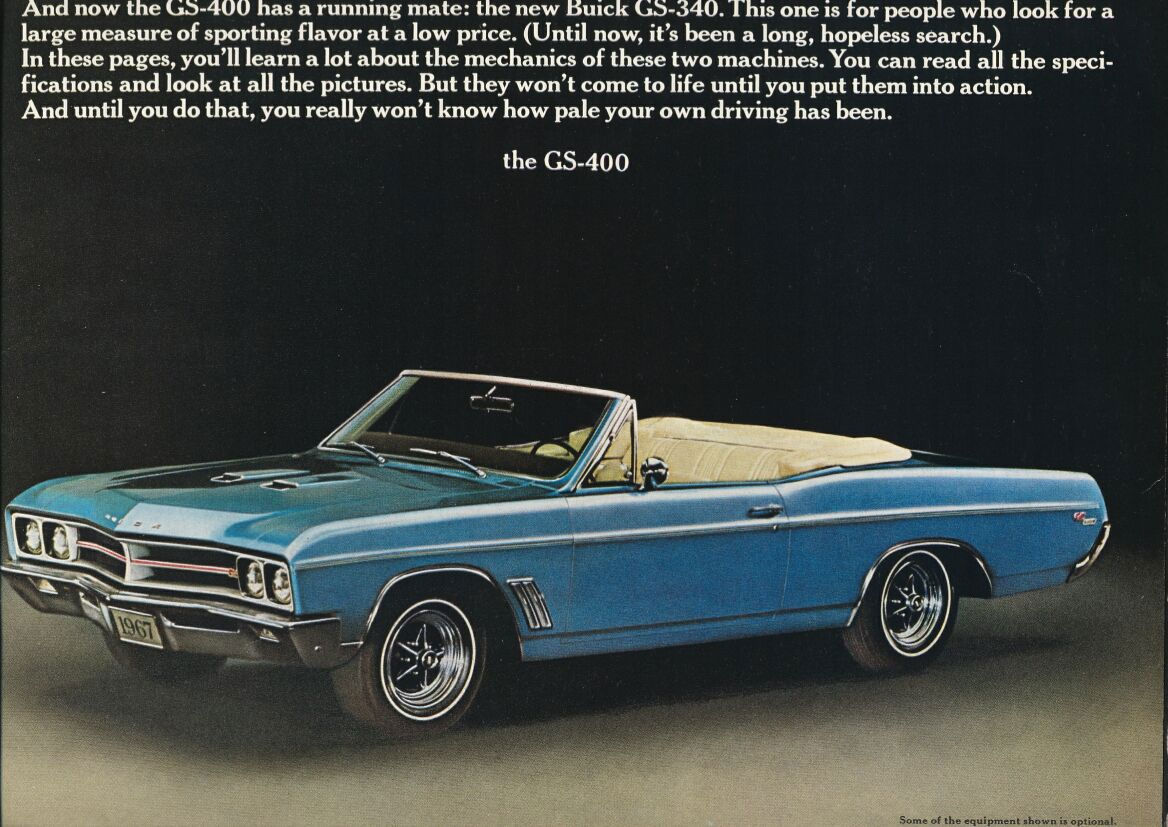
Motor Trend’s April 1967 test ended with an apparent tie: its automatic GS 400 and its four-speed GS 400 both ran the standing quarter mile in 15.2 seconds. The speed at the finish was different, 93 mph for the automatic and 95 mph for the manual. Their 0–60 mph times differed too, at 6.9 and 6.6 seconds. The pair says more about the year than a single quickest number would. Buick had a new 400-cu-in engine and the GS 400 name to go with it, but two cars wearing that name could still arrive at the same elapsed time through different combinations of transmission, axle and equipment.1
The engine’s dimensions made the new name specific. The 400 had a 4.040-inch bore and 3.900-inch stroke, a Rochester four-barrel carburetor and 10.25:1 compression. Its published rating was 340 hp at 5,000 rpm, with 440 lb-ft at 3,200 rpm. These were the manufacturer’s nominal figures, quoted by the magazine, and separate from the acceleration it measured on the road. They were not a rear-wheel power test, and they do not describe some other Buick merely because it wears a Gran Sport badge. The 1967 GS 400 was an engine-and-series choice, and the magazine’s two test cars show how much was still left to choose after a buyer had made it.1
The test cars were not a controlled experiment in changing only the gearbox. The automatic’s 3.90 axle and the manual’s 3.36 axle were different ratios, and the manual’s, the lower number, was the taller gearing, not the shorter. Motor Trend also listed curb weights of 3,817 lb for the automatic and 3,747 lb for the four-speed car. The latter had drum brakes and manual steering. The automatic configuration was listed with F70-14 tires, and the acceleration entries recorded two people aboard. With that many differences between the cars, a small difference in 0–60 time is no universal verdict on manual versus automatic GS 400s. Each result belongs to the car and conditions in its own column.1
The showroom put a price on the alternatives. Motor Trend’s GS 400 hardtop MSRP was $3,019; its options panel listed the three-speed Super Turbine automatic at $236.82 and the floor-shift four-speed manual at $184.31. A limited-slip differential appeared at $42.13 and power front disc brakes at $147.00. These are nominal period amounts, not current values and not an invoice for either test car. A base-model price alone could not describe an equipped Buick. The same hardtop could be ordered around very different priorities, and the magazine’s two cars, with their different weights and equipment, were two such orders, each with its own performance.1
There were three GS 400 bodies. Buick built 1,014 coupes, 10,659 sport coupes and 2,140 convertibles, adding to a model total of 13,813. The body-model numbers are 44607, 44617 and 44667 within the 44600 series. A sport coupe was therefore one of the listed bodies, not a name for the entire total. The coupe was priced at $2,956, the hardtop at $3,019 and the convertible at $3,167. The hardtop in a photograph may or may not be the same specification as the car a magazine tested, and the convertible, at 2,140 cars, was a much smaller share of the GS 400s than the hardtop.2,1
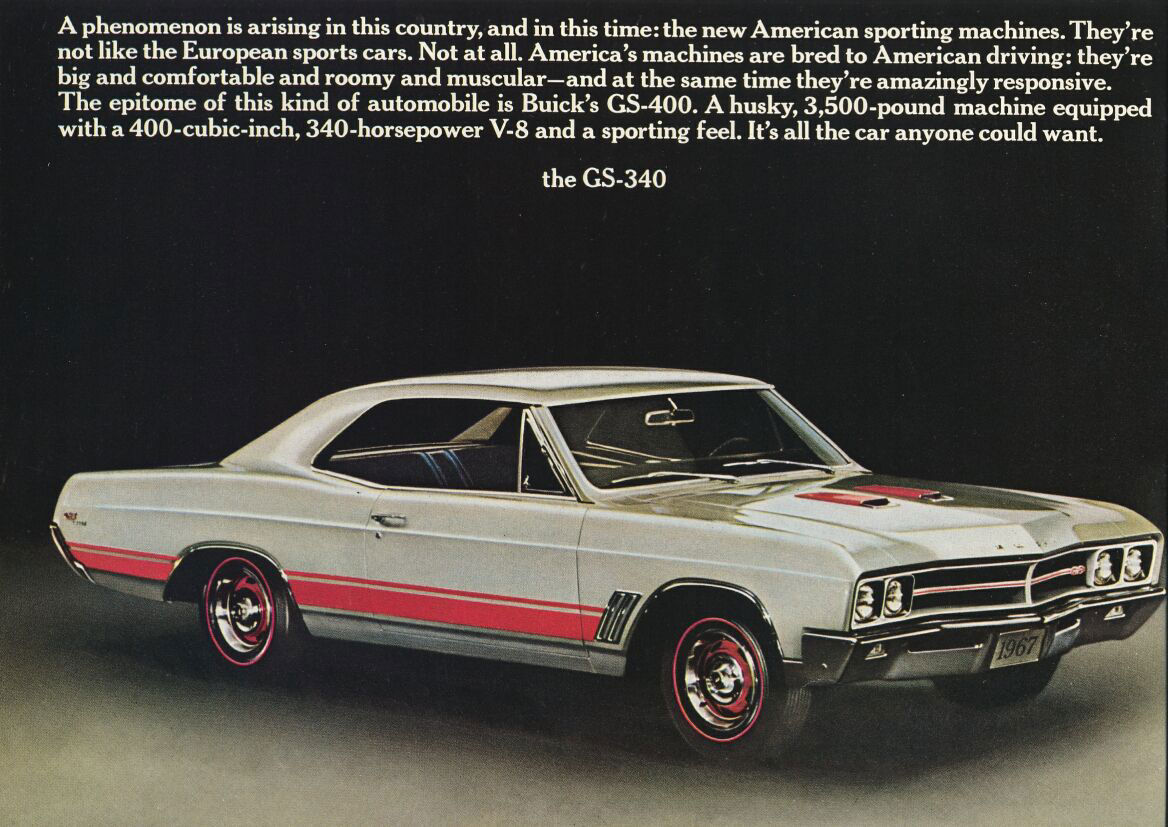
A smaller-engine GS branch sat alongside the 400. The GS 340 sport coupe and California GS coupe used the 340-cu-in four-barrel V-8, listed at 260 hp and 365 lb-ft at 2,800 rpm. Motor Trend’s specification placed peak horsepower at 4,200 rpm; Over-Drive’s engine listing instead puts it at 4,000 rpm. These nominal ratings do not come from the two GS 400 acceleration tests, and the smaller car was a different engine in a different series. The GS 340 was a real part of the same year’s performance lineup, but it was not a substitute for a 400 in a road-test comparison.1,2
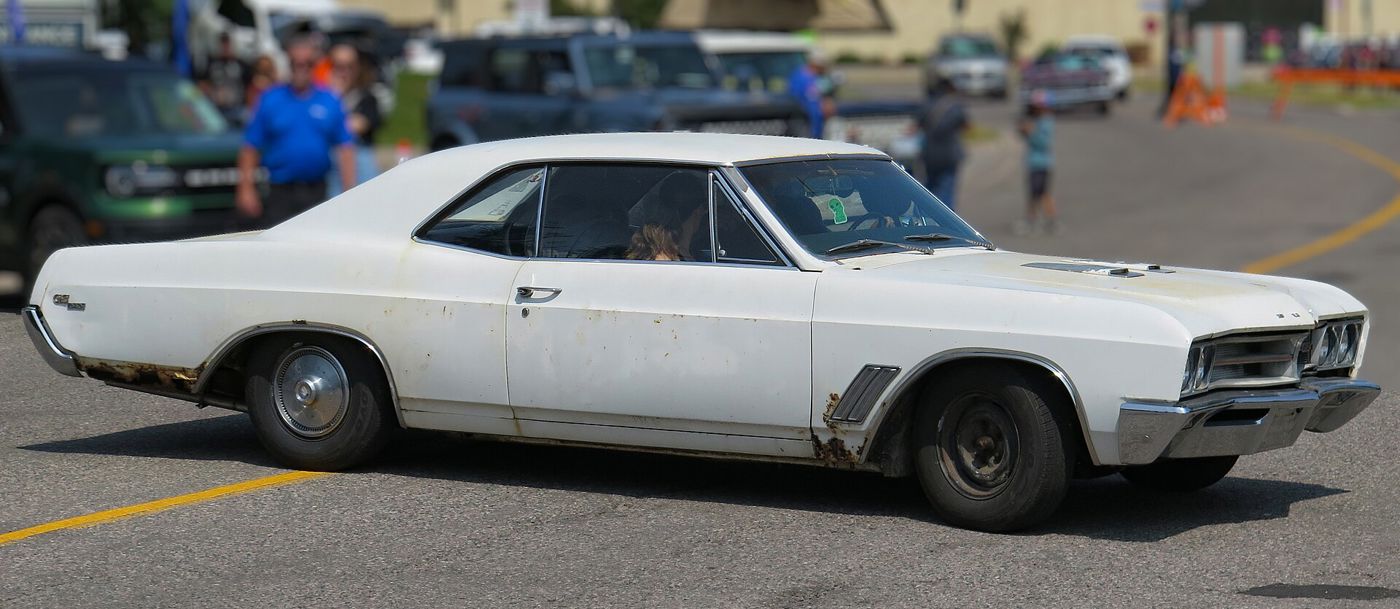

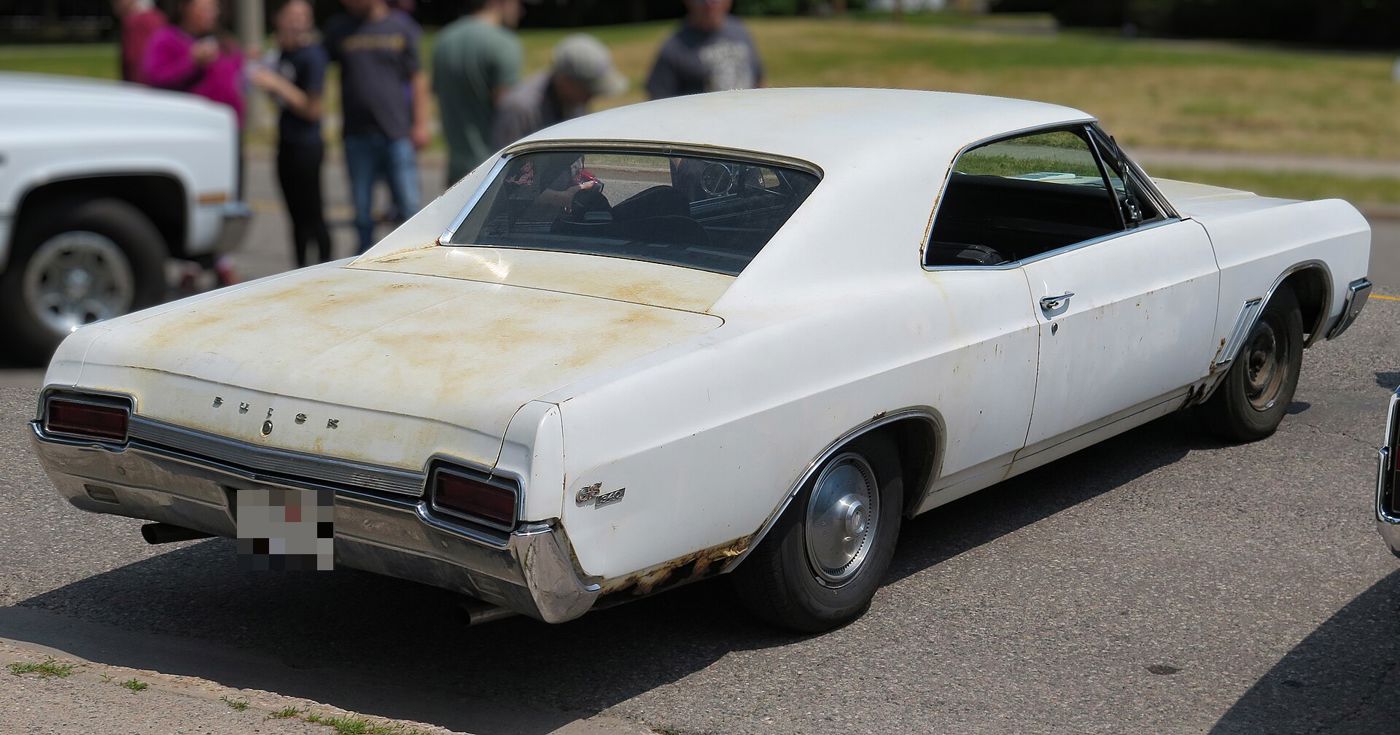
The smaller GS bodies also had their own accounting. Buick built 3,692 GS 340 sport coupes as model 43417 and 1,577 California GS coupes as 43407, both within the Special V-8’s 43400 series rather than the GS 400’s 44600 series. The GS 340 sport coupe was priced at $2,845. That placement matters to someone reading a body number: a GS did not require every variant to share the larger car’s series digits. Buick built 174,777 intermediates in all the listed series and bodies that year, not just Gran Sports. A figure for the whole intermediate line says nothing about the rarity of one GS version; the smaller GS cars are measured by their own rows, 3,692 and 1,577.2
Inside the GS 400, an option’s fitment could matter as much as its price. Buick’s factory sales sheet restricts the B4 operating console to the B2 transmission and bucket seats, while the B7 consolette requires a three- or four-speed floor shift and bucket seats. The listed prices were $57.93 and $36.86. Power steering, C6, appeared at $94.79, and power brakes, C7, at $41.60. Console, seat and transmission choices therefore had to be made together, and an attractive interior does not show the whole order. The separate power-brake and power-disc entries were also two different charges, not a single universal charge for the same equipment.1

Paint and trim made another layer of choices. The exterior paint chart ran to nineteen paint codes, including Regal Black, Turquoise and Gold. The GS 400 interior came in six entries covering aqua, black, blue, light fawn, yellow and red vinyl. The trim codes distinguished 190-series deluxe bucket-seat codes from 180 for a deluxe front bench without an armrest and 160 for a deluxe front bench with one. That numbering ties the trim to the seat-dependent console choices, though a code alone cannot prove that a car's present interior is untouched. These were listed choices and a way to identify a car, not a basis for an exact color-combination rarity claim.2,3
The engine codes complete the basic buyer’s trail: NR identifies the listed 400-cu-in, 340-hp GS 400 engine, and NB the 340-cu-in, 260-hp GS 340 engine, both shown with 10.25:1 compression. The GS 400 rode a 115-inch wheelbase and measured 205.0 inches overall. Body and engine codes can help identify a surviving car, but they do not certify its present mechanical condition or recreate the magazine’s test configuration. Two equal quarter-mile times are an interesting result; the different finish speeds, ratios and equipment are what make the comparison useful beyond the headline.3,1
Fact sheet · 1967 · United States
The numbers
1967 Buick GS 400, GS 340 and California GS: A new 400 cu in V-8 made the Gran Sport the GS 400, joined by a 340 cu in GS 340 and a California GS coupe.
Figures may describe different groups of cars. Add rows together only when the note says they make up a total.
Key facts
- GS 400 production 13,813: 1,014 coupes, 10,659 sport coupes, 2,140 convertibles.2
- GS 340 sport coupe 3,692; California GS coupe 1,577.2
- Motor Trend's GS 400s ran the quarter mile in 15.2 s: 93 mph with the automatic and 95 mph with the four-speed.1
- The factory price sheet lists the GS 400 coupe (4607) at $2,956, sport coupe (4617) $3,019 and convertible (4667) $3,167, matching the tabulated prices.
Production
| What was counted | Built |
|---|---|
| GS 400 (Skylark Gran Sport V-8 series)2 GS 400 · 400 | 13,813 |
| All Buick intermediates2 all series | 174,777 |
| What was counted | Built |
|---|---|
| GS 400 coupe (44607)2 GS 400 · 2-door coupe · 400 | 1,014 |
| GS 400 sport coupe (44617)2 GS 400 · 2-door hardtop sport coupe · 400 | 10,659 |
| GS 400 convertible (44667)2 GS 400 · 2-door convertible · 400 | 2,140 |
| GS 340 sport coupe (43417)2 GS 340 · 2-door sport coupe · 340 4-barrel 260 hp Numbered in the Special V-8 series. | 3,692 |
| California GS coupe (43407)2 California GS-340 · 2-door coupe · 340 4-barrel 260 hp · California (per source) | 1,577 |
Prices when new
| Model | Price | Price type |
|---|---|---|
| GS 400 2-door hardtop, MSRP1,2 | $3,019 | manufacturer's suggested retail incl. federal excise tax, 1967-04 |
| GS 400 coupe (44607)2 | $2,956 | factory price, 1967 |
| GS 400 convertible (44667)2 | $3,167 | factory price, 1967 |
| GS 340 sport coupe (43417)2 | $2,845 | factory price, 1967 |
Prices are the nominal dollars of the day, not adjusted for inflation.
Engines
| Engine | Factory rating | Availability | Built |
|---|---|---|---|
| 400 V-8, GS 4001 400 cu in · Rochester 4-barrel | 340 hp @ 5,000, 440 lb-ft @ 3,200 (SAE gross (manufacturer specification quoted by Motor Trend)) | standard, GS 400 | 13,8132 |
| 340 V-8 4-barrel, GS 340 and California GS1,2 340 cu in · one 4-barrel | 260 hp @ 4,200, 365 lb-ft @ 2,800 (SAE gross (manufacturer specification quoted by Motor Trend for the Skylark option)) | standard, GS 340 and California GS |
Ratings are published figures, not dyno results. Gross and net ratings aren't directly comparable.
Transmissions
| Transmission | Availability |
|---|---|
| Super Turbine 3-speed automatic (Turbo Hydra-Matic type)1 | optional, GS 400 |
| 4-speed manual, floor lever1 | optional, GS 400 |
Options and packages
| Code | Option | Price |
|---|---|---|
| Super Turbine transmission (GS 400)1 | $236.82 | |
| 4-speed manual transmission (GS 400)1 | $184.31 | |
| Limited-slip differential1 | $42.13 | |
| Power front disc brakes1 | $147 | |
B4order code |
Operating console (with B2 and bucket seats only) | $57.93 |
B7order code |
Consolette (with 3- or 4-speed floor shift; bucket seats only) | $36.86 |
C6order code |
Power steering | $94.79 |
C7order code |
Power brakes | $41.60 |
D1order code |
Sonomatic radio with manual antenna | $64.25 |
D5order code |
AM-FM radio with manual antenna | $133.76 |
D6order code |
Rear seat speaker (not on convertible) | $16.64 |
E2order code |
Air Injection Reactor (California cars only) | $50 |
G1order code |
Performance axle with Positive Traction differential | $42.13 |
H1order code |
Trailer towing option | $3.69 |
I6order code |
Air conditioner | $343.20 |
I7order code |
Heavy-duty cooling | $31.60 |
J1order code |
Custom seat belts (2 retractable front, 2 rear) | $6.32 |
J3order code |
Custom shoulder belts (2 front, includes J1) | $32.65 |
J4order code |
Shoulder belts, front seat | $23.17 |
J5order code |
Third seat belt, rear (not with J1 or J3) | $6.32 |
J6order code |
Third custom seat belt, rear (with J1 or J3 only) | $7.90 |
K3order code |
Speed alert | $8.43 |
L1order code |
Soft-Ray tinted glass | $30.54 |
L2order code |
Soft-Ray tinted windshield | $21.06 |
M7order code |
Rear window defroster (not on convertible) | $21.06 |
O4order code |
Door guards, 2-door | $4.74 |
O5order code |
Remote-control outside rear-view mirror | $7.10 |
P1order code |
Carpet savers and handy mats | $12.19 |
P2order code |
Carpet savers | $6.77 |
Q5order code |
Power seat, 4-way tilt adjuster | $69.51 |
R1order code |
Power windows | $100.05 |
S7order code |
Tilt steering wheel (not with 3-speed manual) | $42.13 |
U3order code |
Convenience group | $17.90 |
U5order code |
Tachometer (with B7 or B4) | $47.39 |
V1order code |
Deluxe wheel covers (not with C1) | $16.85 |
V2order code |
Chrome-plated wheels (not with C1) | $90.58 |
V3order code |
Wire wheel covers (not with C1) | $80.05 |
W5order code |
Custom bright exterior moldings, belt reveal | $14.74 |
X3order code |
Floor console, non-operating (bucket seats only) | $31.60 |
1Border code |
Reclining passenger seat with headrests, driver and passenger (bucket seats only) | $83.10 |
1Corder code |
Headrests, driver and passenger (bench seats) | $41.60 |
1Dorder code |
Headrests, driver and passenger (Strato-type seat) | $51.93 |
I8order code |
Delete heater and defroster | $-71.50 |
O4order code |
Door guards, 4-door (as listed on the GS 400 sheet) | $8.16 |
F1order code |
Whitewall tires | |
F8order code |
Wide Oval red-line tires | $0 |
| Custom vinyl top | $84.26 | |
| Custom vinyl Strato-bucket seats | $68.46 |
Paint
| Code | Color |
|---|---|
A |
Regal Black2 |
B |
Turquoise2 |
C |
Arctic White2 |
D |
Sapphire Blue2 |
E |
Midnight Blue2 |
G |
Gold Mist2 |
H |
Green Mist2 |
J |
Verde Green2 |
K |
Aquamarine2 |
L |
Shadow Turquoise2 |
N |
Burgundy Mist2 |
P |
Platinum Mist2 |
R |
Apple Red2 |
S |
Champagne Mist2 |
T |
Ivory2 |
U |
Plum2 |
V |
Charcoal2 |
W |
Fawn2 |
X |
Red2 |
Z |
Gold2 |
Color names are the factory's. We don't show color swatches, because a screen color is no guide for a restoration.
Interiors
| Code | Trim |
|---|---|
196 |
GS 400: Aqua, vinyl3 |
185, 198 |
GS 400: Black, vinyl3 |
191 |
GS 400: Blue, vinyl3 |
184, 194 |
GS 400: Light Fawn, vinyl3 |
193 |
GS 400: Yellow, vinyl3 |
197 |
GS 400: Red, vinyl3 |
Specifications
| Measure | Value | Applies to |
|---|---|---|
| Wheelbase1 | 115 in | GS 400 |
| Overall length1 | 205 in | GS 400 |
| Curb weight, GS 400 automatic1 | 3,817 lb | as listed by Motor Trend; 4-speed 3,747 lb |
Period road tests
| Test | Car tested | Result |
|---|---|---|
| Motor Trend, 1967-0410-60 mph | GS 400 2-door hardtop, 400/340, Super Turbine 3-speed automatic, 3.90 axle, F70-142 aboard | 6.9 s |
| Motor Trend, 1967-041standing quarter mile | GS 400, automatic, 3.90 axle93 mph | 15.2 s |
| Motor Trend, 1967-0410-60 mph | GS 400, 4-speed manual, 3.36 axle, drum brakes, manual steering2 aboard | 6.6 s |
| Motor Trend, 1967-041standing quarter mile | GS 400, 4-speed manual, 3.36 axle95 mph | 15.2 s |
A road test result belongs to the one car that was tested, with its engine, gearing, tires, and conditions. It is not a figure for every car of the year.
Identification
- Series and body numbers
- GS 400 series 44600 (44607 coupe, 44617 sport coupe, 44667 convertible); GS 340 43417 and California GS 43407 in the Special V-8 series 43400.2
- VIN
- E.g. 444077H101555: 4 = Buick; 2-3 = series (46 = GS 400, 34 = GS 340); 4-5 = body (07 coupe, 17 sport coupe, 67 convertible); 6 = year (7); 7 = plant; last six = production number.3
- Engine codes
- NR: 400 cu in, 340 hp, 10.25:1, 4-barrel (GS 400); NB: 340 cu in, 260 hp, 10.25:1, 4-barrel (GS 340).3
Where the sources disagree
Identification
Read a 1967 Buick VIN
The VIN decoder runs in your browser and never sends the VIN anywhere. How the factory numbered this year's cars:
Same model year
Also in 1967
- AMC Rebel and Rebel Machine The Rebel name returned on AMC's new intermediate, offered with a 280-hp 343 four-barrel V8. This is host-car context for the later Machine.
- Buick Riviera A new 430 V-8 (360 hp, 475 lb-ft) replaced the Nailhead; 4,837 cars had the GS handling option.
- Buick Wildcat The new 430 V-8 (360 hp, 475 lb-ft) replaced the Nailhead.
- Chevrolet Chevelle and Malibu SS Second year of the SS 396 series: 59,685 sport coupes and 3,321 convertibles, front disc brakes newly listed, and a late, barely documented L78.
- Chevrolet Chevy II and Nova Super Sport production fell to 10,069 in the source table. Enthusiast-compiled production: 106,430 cars; Super Sport 10,069.
- Chevrolet El Camino SS The Chevelle pickup with 396s at 325 and 350 hp on its option list; 34,830 built, 25,382 of them Malibu V8s.
- Chevrolet Impala SS The SS427 (RPO Z24) arrives: 2,124 of about 76,000 Impala Super Sports.
- Dodge Charger The first-generation fastback's second and last year: the 440 Magnum joined the options, and production fell to 15,788.
- Dodge Coronet R/T and Super Bee Dodge's first R/T: a Coronet hardtop or convertible with the 440 Magnum standard and the 426 Hemi as a special-order option; its production total is published two ways.
- Dodge Dart GTS, Swinger and Demon The restyled 1967 Dart GT offered a 235 hp 273 four-barrel and, for the first time, a 280 hp 383; Over-Drive counts 437 383-engined cars within 38,200 GT hardtops and convertibles.
- Ford Fairlane A facelifted second year for the big-block Fairlane: GT and GTA continued as Fairlane 500 hardtops and convertibles, and a 427 was offered in small numbers for drag racing.
- Ford Galaxie The last year of the approved Galaxie performance range: the 7-Litre quietly disappeared, while the 428 and a 425-hp 427 remained on the order form.
- Ford Thunderbird A new, larger fifth-generation Thunderbird added a four-door Landau; the 428 was the performance option.
- Mercury Comet and Cyclone The Cyclone and Cyclone GT continued as hardtop and convertible, and a handful of Comets were built with the 427 side-oiler.
- Mercury Cougar Mercury's first pony car arrived as a single hardtop body, added the XR-7 at mid-year, and built 150,893 in its first season.
- Mercury Marauder and S-55 The S-55's last year: 570 hardtops and 145 convertibles with the 428 four-barrel, per Wikipedia's table.
- Oldsmobile Cutlass, 4-4-2 and Hurst/Olds Multiple carburetors were gone, the 4-4-2 was trimmed as a Cutlass Supreme, and the W-30 cold-air package became a regular factory option on about 500 cars.
- Plymouth Barracuda and 'Cuda The redesigned second-generation Barracuda added a notchback hardtop and a convertible to the fastback, and the Formula S could now carry a 383.
- Plymouth GTX, Belvedere and Satellite Plymouth's first GTX put a 375-hp 440 Super Commando in a dressed-up Belvedere hardtop and convertible, with the 426 Hemi as the only engine option.
- Pontiac Catalina 2+2 and Super Duty The 2+2 returned to option status with a standard 360 hp 428, and only 1,768 were built.
- Pontiac Firebird and Trans Am Pontiac's late entry into the pony-car field: a Camaro body with a Pontiac nose, five engine-defined models, and 82,560 built in a short first season.
- Pontiac GTO Tri-Power gone, the 389 grown to 400, and a Ram Air option that Car Life ran to a 14.5-second quarter mile.
- Pontiac Grand Prix Concealed headlamps, a standard 350 hp 400, and the only Grand Prix convertible: 5,856 built.
- Pontiac Tempest and LeMans The Sprint six grows to 215 hp and the 326 HO continues; 109,413 LeMans built.
- Rambler and AMC Marlin The last Marlin moved to a 118-inch wheelbase with 290 and 343 V8s listed, the top one a 280-hp 343. Only 2,545 were built.