1964 · Ford · United States
1964 Ford Galaxie 500/XL: Total Performance at Full Size
Two advertised 427s, 410 and 425 horsepower, in a full-size body — Ford's answer was size and cubic inches while Pontiac was busy redefining the question.
United States · researched through July 26, 2026
Power-team selector
Choose the exact Galaxie
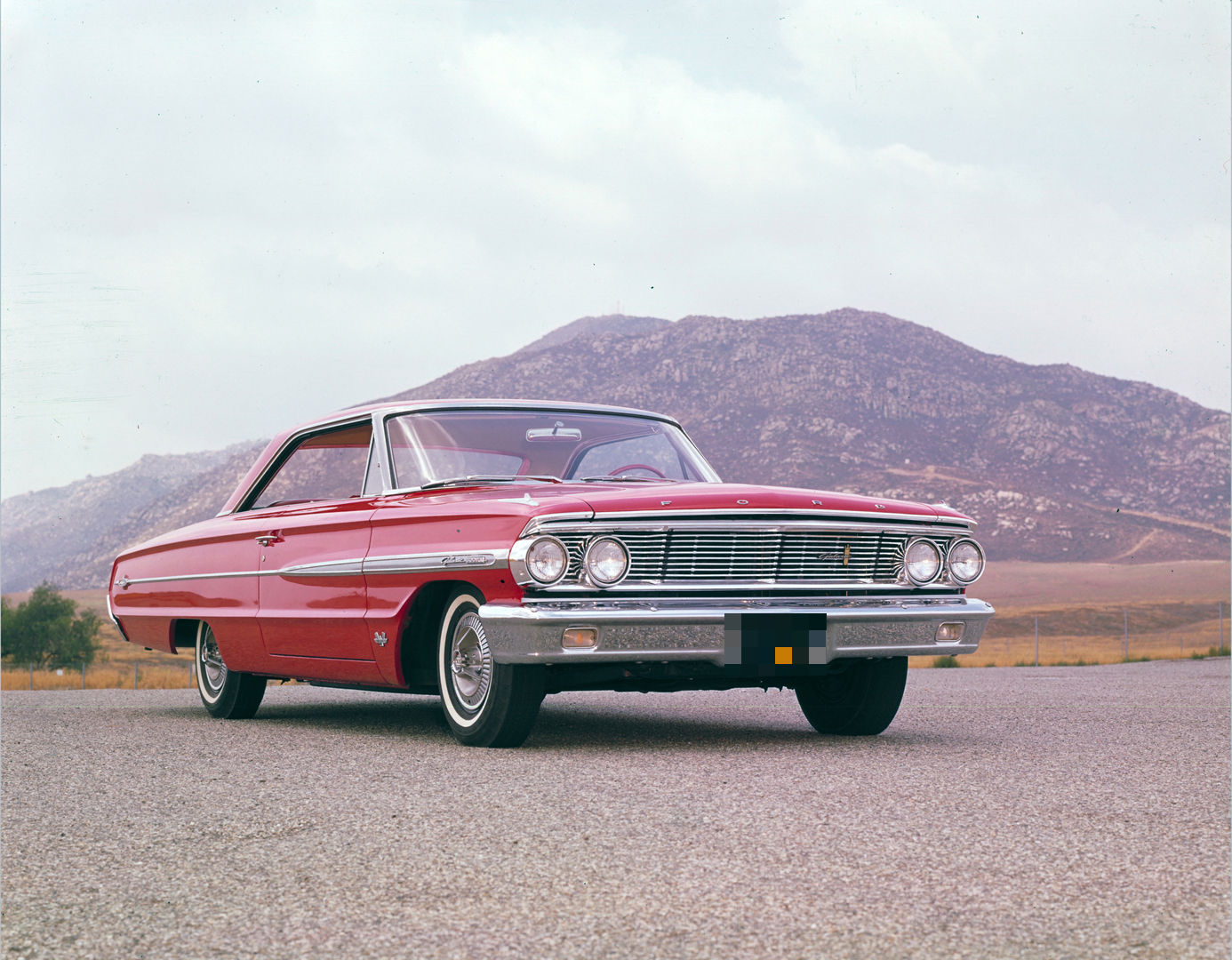
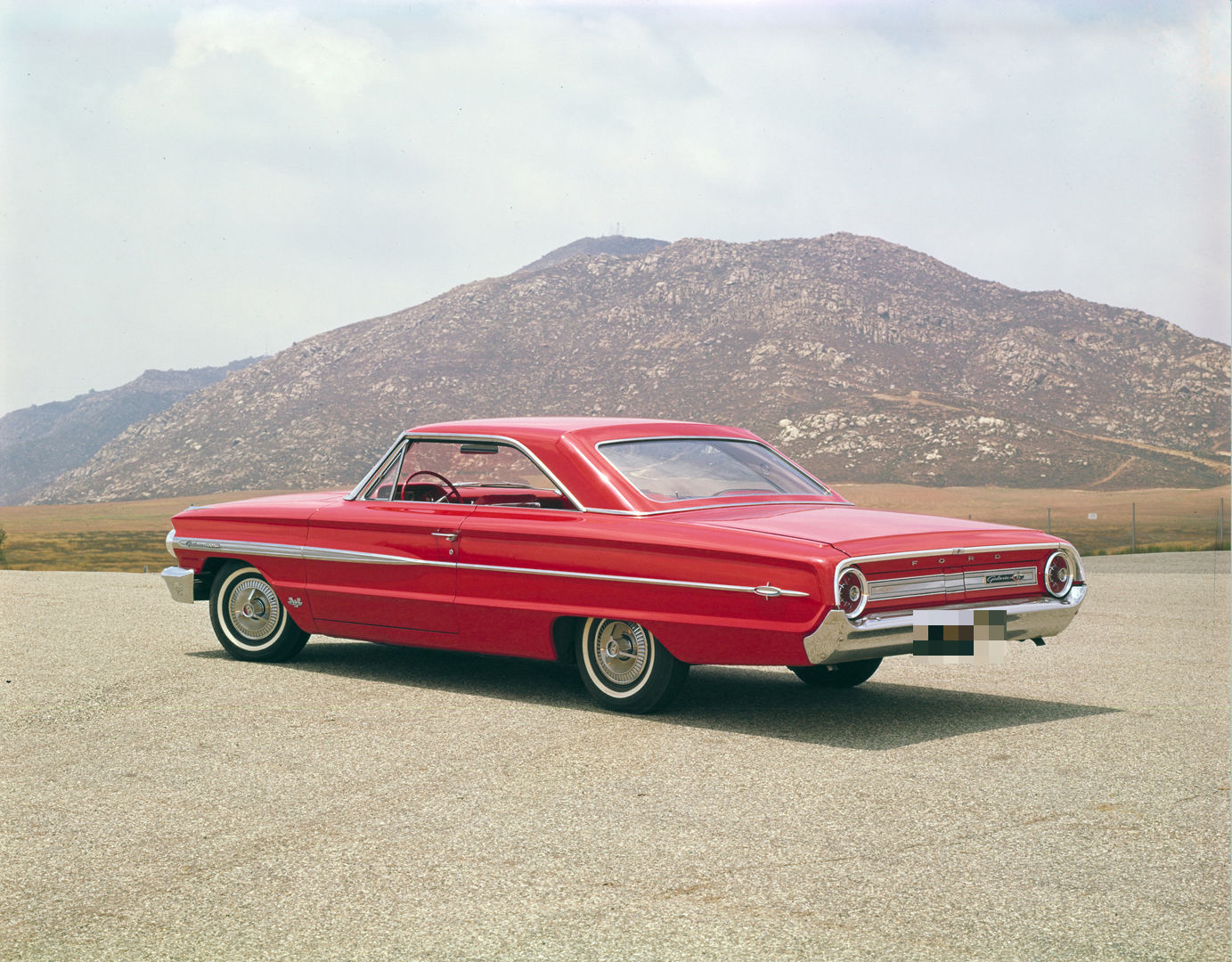
Ford’s 1964 performance language was deliberately broad. “Total Performance” connected renewed racetrack activity to cars across the company’s range, from full-size Galaxies to the new Mustang image arriving in April. The Galaxie 500/XL two-door hardtop stood at the street-going center of that message. It combined bucket-seat personal-luxury presentation with two advertised versions of Ford’s 427 High Performance V8. This was not an intermediate GTO answer and not a lightweight Thunderbolt. It was Ford selling serious engine choices in its full-size flagship.
The first selector branch uses the single-four-barrel 427, advertised at 410 horsepower. The second uses dual four-barrels and 425 horsepower. Ford’s full-size brochure presents both 427s as available across non-wagon models and separately describes a four-speed manual. The selected configurations pair each 427 with that four-speed in a 500/XL hardtop, while preserving an evidence note that the dealer power-team chart remains an acquisition priority. Advertised availability is strong; engine-code-level ordering closure awaits the more exact artifact.
That distinction prevents a brochure from doing more work than it can. Sales literature proves Ford wanted buyers to understand that the engines and transmission existed in the range. It does not authenticate a surviving R-code or Q-code car, establish how many were built, or replace a build record. A modern Galaxie with dual carburetors and four-speed hardware needs vehicle-specific provenance. The selector answers what Ford advertised, not whether one particular car left the assembly line in that form.
Compression provides a smaller but revealing conflict. The visual period brochure appears to give 11.5:1 for the 427 entries. A specialist table gives 11.2:1 for the dual-four-barrel engine. This page preserves 11.5:1 as Ford’s advertised brochure figure and does not silently merge the two. A Ford facts book, shop manual, or engine specification release can later resolve engine-code detail. The specialist value remains a research lead rather than an invisible correction to a primary artifact.
Exact production totals are held for the same reason. Enthusiast histories circulate Q-code and R-code counts, but no Ford production ledger or clearly scoped institutional count was inspected in this pass. A number can be popular and still lack a recoverable source chain. The page is not weakened by leaving the count open. It instead separates the well-supported offering from the still-unverified quantity and prevents rarity claims from outrunning evidence.
The Galaxie’s scale changes the comparison. Pontiac and Chevrolet used 115-inch-wheelbase intermediates, while Ford’s full-size car represented a different packaging decision. Plymouth Sport Fury and Dodge Polara 500 are more natural size peers, each offering 383 and 426 street engines. A default winner would ignore body, weight definition, gearing, induction, and purpose. The useful selector lets a reader compare full-size performance together or deliberately cross categories with the differences visible.
The 500/XL identity adds another layer beyond size. Bucket-seat and personal-luxury presentation made the hardtop a different proposition from a stripped competition shell, even when a 427 and four-speed gave it serious performance intent. That blend matters to muscle history: manufacturers learned that speed could be sold with comfort and status rather than only through austerity. The page treats those qualities as product context, not as evidence of measured pace.
Ford’s race special belongs nearby but not inside the same list. The Fairlane Thunderbolt placed a 427 into a lighter midsize body for drag-racing classes, with construction and distribution shaped by competition requirements. NHRA documents Gas Ronda’s 1964 success and describes more than one hundred cars in a class-threshold context. None of that turns the Thunderbolt into a Galaxie configuration. It occupies a separate factory-competition branch whose result fields and streetability labels are explicit.
That separation makes Ford’s strategy more interesting. The company could advertise high-output full-size street choices, build a class-directed lightweight Fairlane, campaign a spectacular Mercury Comet, and launch Mustang inside one Total Performance identity. It did not need one car to perform every role. Galaxie communicated attainable full-size prestige and power; Thunderbolt communicated sanctioned drag-racing intent; Mustang offered a new personal-car proposition. The marketing umbrella joined them while their configuration records remain distinct.
MustangCarFacts’ 1965 model-year page owns the detailed first Mustang story. Enthusiasts often call early cars “1964½,” but their VIN and model-year identity is 1965, so this corpus does not invent a 1964 Mustang configuration. The contextual link explains how Mustang entered Ford’s performance culture without using a generic family footer and without bending model-year data to match a nickname.
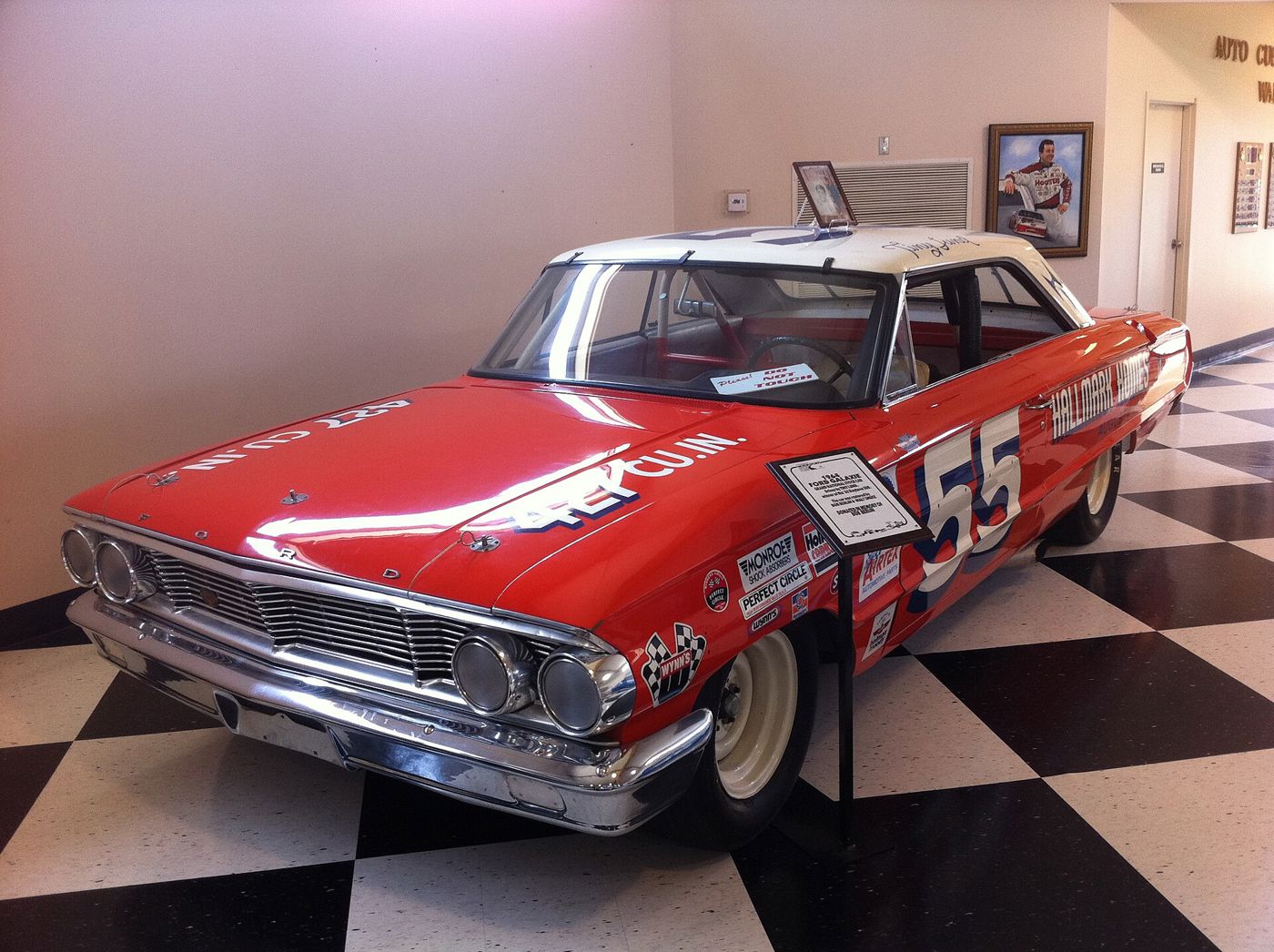
Racing results also remain outside the Galaxie street specification. A Thunderbolt elapsed time cannot become evidence for a 500/XL, and a NASCAR result cannot authenticate showroom gearing or weight. Future period tests of the exact Galaxie configurations can be attached as measured observations with their test-car details. Until those arrive, advertised power, induction, transmission, dimensions, and source limitations provide the comparison. The absence of a stopwatch cell is preferable to a dramatic result from the wrong car.
The two 427 choices still tell a meaningful same-family story. A buyer considering one four-barrel versus two was choosing induction and advertised output while retaining the same full-size body and manual-shift identity. That decision is more precise than comparing “a 1964 Ford” with “a 1964 Pontiac.” It also lets later evidence enter cleanly: axle choices, prices, build counts, and exact tests can attach to the configuration they actually describe.
Until Ford’s dealer facts book or power-team chart is inspected, the page keeps an acquisition note beside both pairings. This is not a suggestion that the cars were imaginary; it is a statement about documentary resolution. The brochure advertises the relevant pieces and market relationship, while the missing chart would close application, codes, and restrictions at the order-system level.
The 1964 Galaxie 500/XL matters because it shows how wide the early muscle landscape was. Ford offered immense street power without shrinking its flagship, while running more specialized machines in public competition. The brochure establishes the promise; the missing power-team chart and ledger define the current boundary. By keeping the Galaxie, Thunderbolt, Comet, and Mustang in their proper roles, the story makes Total Performance legible without turning a marketing idea into one imaginary universal car.
Fact sheet · 1964 · United States
The numbers
1964 Ford Galaxie 500/XL (427) — Ford sold its 427 in the restyled full-size range in two advertised versions, 410 hp with one four-barrel and 425 hp with two, and the Galaxie 500 XL hardtop was the bucket-seat flagship.
Coverage: Partial — researched sections are shown; missing ones are not yet sourced. Researched through 2026-09-23.
Every figure is labeled with how sure we are. Reported means a manufacturer, registry, or reference figure we cite but have not reconciled against factory records ourselves. Disputed means credible sources disagree and both are shown. Rows are separately scoped; don't add them together unless the note says they make up a total.
Key facts
Production
| What was counted | Count | Basis | Status |
|---|---|---|---|
| Galaxie 500 XL 2-door hardtop1,2 Galaxie 500 XL · 2-door hardtop · as published | 58,306 | sold, model-year | Reported |
| Galaxie 500 2-door hardtop1,2 Galaxie 500 · 2-door hardtop · as published | 206,998 | sold, model-year | Reported |
| Galaxie 500 XL convertible1 Galaxie 500 XL · convertible · as published | 15,169 | sold, model-year | Reported |
| Galaxie 500 convertible1 Galaxie 500 · convertible · as published | 37,311 | sold, model-year | Reported |
| Galaxie 500 4-door hardtop1 Galaxie 500 · 4-door hardtop · as published | 49,242 | built, model-year | Reported |
| Galaxie 500 4-door hardtop with bucket-seat trim1 Galaxie 500 XL · 4-door hardtop · as published | 14,661 | delivered, model-year | Reported |
| Galaxie 500 4-door sedan1 Galaxie 500 · 4-door sedan · as published | 198,805 | delivered, model-year | Reported |
| Galaxie 500 Club Sedan 2-door (62A)2 Galaxie 500 · 2-door sedan, 62A · as published | 13,041 | built, model-year | Reported |
| What was counted | Count | Basis | Status |
|---|---|---|---|
| Cars with the XL interior, all bodies1,2 Galaxie 500 XL · 2-door, convertible, 4-door · as published | 88,136 | built, model-year | Reported |
| Galaxie 500 series total2 Galaxie 500 · as published | 505,397 | built, model-year | Reported |
| Galaxie 500 XL series total (V8 only)2 Galaxie 500 XL · as published 57C 4-door hardtop 14,661, 63C fastback hardtop 58,306, 76C convertible 15,169; matches the XL-interior row above. | 88,136 | built, model-year | Reported |
| Custom series total (context)2 Custom · as published | 99,323 | built, model-year | Reported |
| Custom 500 series total (context)2 Custom 500 · as published | 89,447 | built, model-year | Reported |
| Station wagons total (context)2 Country Sedan, Country Squire · station wagons · as published | 140,929 | built, model-year | Reported |
| What was counted | Count | Basis | Status |
|---|---|---|---|
| All 1964 full-size Fords2 all full-size · as published | 923,232 | built, model-year | Reported |
Rows are separately scoped; do not add them unless a note says they partition a total.
The page labels the XL 2-door as a Sportsroof; the 58,306 and 206,998 figures are recorded as 2-door hardtops as stated. No count of Q- or R-code 427 installations was found; enthusiast counts circulate without a recoverable source chain.
Prices when new
| Model | Price | Basis |
|---|---|---|
| Galaxie 500 Town Sedan (54A), six2 | $2,667 | factory price as compiled (base list, by engine), 1964 model year |
| Galaxie 500 Town Sedan (54A), V82 | $2,776 | factory price as compiled (base list, by engine), 1964 model year |
| Galaxie 500 Club Sedan (62A), six2 | $2,613 | factory price as compiled (base list, by engine), 1964 model year |
| Galaxie 500 Club Sedan (62A), V82 | $2,722 | factory price as compiled (base list, by engine), 1964 model year |
| Galaxie 500 Town Victoria 4-door hardtop (57B), six2 | $2,739 | factory price as compiled (base list, by engine), 1964 model year |
| Galaxie 500 Town Victoria 4-door hardtop (57B), V82 | $2,848 | factory price as compiled (base list, by engine), 1964 model year |
| Galaxie 500 fastback hardtop coupe (63B), six2 | $2,674 | factory price as compiled (base list, by engine), 1964 model year |
| Galaxie 500 fastback hardtop coupe (63B), V82 | $2,783 | factory price as compiled (base list, by engine), 1964 model year |
| Galaxie 500 convertible (76A), six2 | $2,936 | factory price as compiled (base list, by engine), 1964 model year |
| Galaxie 500 convertible (76A), V82 | $3,045 | factory price as compiled (base list, by engine), 1964 model year |
| Galaxie 500 XL Town Victoria 4-door hardtop (57C), V82 | $3,287 | factory price as compiled (base list, by engine), 1964 model year |
| Galaxie 500 XL fastback hardtop coupe (63C), V82 | $3,222 | factory price as compiled (base list, by engine), 1964 model year |
| Galaxie 500 XL convertible (76C), V82 | $3,484 | factory price as compiled (base list, by engine), 1964 model year |
Prices are the nominal dollars of the day, not adjusted for inflation.
Engines
| Engine | Factory rating | Availability | Built |
|---|---|---|---|
| Z · 390 V8 4-bbl1 390 cu in · 4-barrel | 300 hp @ 4,600, 427 lb-ft @ 2,800 (SAE gross) | optional | Not yet sourced |
| Q · 427 V8 4-bbl1 427 cu in · 4-barrel | 410 hp @ 5,600, 476 lb-ft @ 3,400 (SAE gross) | optional, non-wagon models | Not yet sourced |
| R · 427 V8 2 x 4-bbl1 427 cu in · 2 x 4-barrel | 425 hp @ 6,000, 480 lb-ft @ 3,700 (SAE gross) | optional, non-wagon models | Not yet sourced |
Ratings are the manufacturer's advertised figures under the standard shown (SAE gross before 1972, SAE net after). They are not dyno results, and gross and net ratings can't be compared directly.
Transmissions
| Transmission | Availability | Built |
|---|---|---|
| 4-speed manual1 | offered; ratios 2.36, 1.78, 1.41, 1.00 as compiled | Not yet sourced |
| 3-speed manual1 | standard; 2.37/1.51/1.00 with 390 and 427 High Performance | Not yet sourced |
| 3-speed manual with overdrive1 | optional, $108 as compiled | Not yet sourced |
| Cruise-O-Matic 3-speed automatic1 | optional, $212 as compiled | Not yet sourced |
Options and packages
| Code | Option | Price | Installed |
|---|---|---|---|
|
Transmission, four-speed manual (required with 410 or 425 hp V8)1 | $188 | Not yet sourced |
|
Transmission, three-speed manual with overdrive1 | $108 | Not yet sourced |
|
Transmission, Cruise-O-Matic1 | $212 | Not yet sourced |
|
Transmission, Fordomatic with V81 | $190 | Not yet sourced |
|
Equa-Lock differential1 | $42 | Not yet sourced |
|
Battery, heavy-duty 70-amp1 | $9 | Not yet sourced |
|
Air conditioning, Polar Aire (V8)1 | $276 | Not yet sourced |
|
Air conditioning, Select Aire (V8)1 | $365 | Not yet sourced |
|
Power brakes1 | $43 | Not yet sourced |
|
Power steering1 | $86 | Not yet sourced |
|
Power seat1 | $64 | Not yet sourced |
|
Power windows, front and rear1 | $102 | Not yet sourced |
|
Radio, push-button, with antenna1 | $58 | Not yet sourced |
|
Padded dash and visors1 | $25 | Not yet sourced |
|
Seat belts, front1 | $21 | Not yet sourced |
|
Tinted glass1 | $40 | Not yet sourced |
|
Tinted windshield1 | $22 | Not yet sourced |
|
Two-tone paint1 | $22 | Not yet sourced |
|
Vinyl trim, except convertible1 | $26 | Not yet sourced |
|
Wheel covers1 | $19 | Not yet sourced |
|
Wheel covers, deluxe1 | $26 | Not yet sourced |
|
Windshield washer and 2-speed wipers1 | $20 | Not yet sourced |
|
Electric clock (Custom and Galaxie 500)1 | $15 | Not yet sourced |
|
Four-way manual seat1 | $18 | Not yet sourced |
|
Heater and defroster (deduct option)1 | — | Not yet sourced |
Paint
| Code | Color | Built |
|---|---|---|
A |
Raven Black1 | Not yet sourced |
B |
Pagoda Green1 | Not yet sourced |
D |
Dynasty Green1 | Not yet sourced |
F |
Guardsman Blue1 | Not yet sourced |
G |
Prairie Tan1 | Not yet sourced |
H |
Caspian Blue1 | Not yet sourced |
J |
Rangoon Red1 | Not yet sourced |
K |
Silversmoke Gray1 | Not yet sourced |
L |
Samoan Coral1 | Not yet sourced |
M |
Wimbledon White1 | Not yet sourced |
P |
Prairie Bronze1 | Not yet sourced |
R |
Phoenician Yellow1 | Not yet sourced |
S |
Cascade Green1 | Not yet sourced |
T |
Navaho Beige1 | Not yet sourced |
V |
Sunlight Yellow1 | Not yet sourced |
W |
Rose Beige1 | Not yet sourced |
X |
Vintage Burgundy1 | Not yet sourced |
Y |
Skylight Blue1 | Not yet sourced |
Z |
Chantilly Beige1 | Not yet sourced |
Color names are the factory's. We don't show color swatches, because a screen color is no guide for a restoration.
Specifications
| Measure | Value | Applies to |
|---|---|---|
| Wheelbase1 | 119 in | all |
| Overall length1 | 209.8 in | all |
| Overall width1 | 80 in | all |
| Shipping weight, Galaxie 500 XL fastback hardtop (63C)2 | 3,622 lb | 63C, V8 |
| Shipping weight, Galaxie 500 XL convertible (76C)2 | 3,787 lb | 76C, V8 |
| Shipping weight, Galaxie 500 fastback hardtop (63B) V82 | 3,582 lb | 63B, V8 |
| Overall height, 2-door Sports Roof and hardtops1 | 55.5 in | 2- and 4-door hardtops |
| Overall height, convertible1 | 55.5 in | convertible |
| Front track1 | 61 in | all |
| Rear track1 | 60 in | all |
| Tires, Police Interceptor1 | 6.70 x 15 | police |
| Rear axle, 427 High Performance1 | 3.50 (3-speed, 4-speed), 4.11 (overdrive) | 427 V8 |
Identification
Read a 1964 Ford VIN
The VIN decoder runs in your browser and never sends the VIN anywhere. How the factory numbered this year's cars:
Same model year
Also in 1964
- Buick Riviera The 425 became standard, the dual-quad Super Wildcat 360 arrived as an option, and the Super Turbine 400 replaced the twin-turbine automatic.
- Buick Wildcat The best Wildcat year at 84,245, with a 425 in 340- or 360-hp form and an available four-speed.
- Chevrolet Chevelle and Malibu SS The first Chevelle; the Malibu SS was a series, and its strongest released engine was the midyear 300 hp L74 327.
- Chevrolet Chevy II and Nova First V8 (283) year in the source engine table. Enthusiast-compiled production: 191,691 cars; Super Sport 10,576.
- Chevrolet El Camino SS No factory Super Sport El Camino is documented for this year; the record carries the host El Camino production as context.
- Chevrolet Impala SS Super Sport becomes its own series: 185,325 built.
- Chrysler 300 letter series Cheaper by about $1,000, with a single-four-barrel 360 hp 413 standard, leather made optional and the convertible restored, the 300K became the best-selling letter car: 3,022 hardtops and 625 convertibles.
- Dodge Dart 330/440, Polara and Max Wedge The Max Wedge's last year brought the Ramcharger 426-III, a 365 hp street 426 for Polara buyers, and in midyear a competition-only 426 Hemi in lightened 330/440 bodies; Roger Lindamood's Dodge won Top Stock at the Nationals.
- Ford Fairlane The year of the Thunderbolt: a midsize Fairlane with a 427 installed for NHRA Super Stock, which carried Gas Ronda to the national Stock title.
- Ford Falcon Sprint The restyled Falcon kept the Sprint hardtop and convertible with the 164 hp 260 V8 standard; the club counts 18,108 built, many with a bench seat.
- Ford Thunderbird The redesigned fourth-generation car offered one drivetrain, a 300-hp 390 with Cruise-O-Matic, and output rose to 92,465.
- Mercury Comet and Cyclone The Cyclone name first appeared on a 1964 Comet hardtop; the only production figure found is a single secondary total.
- Mercury Marauder and S-55 Marauder now meant the fastback roof on any full-size Mercury series, two-door or four-door, with the 390 standard and the 427 optional.
- Oldsmobile Cutlass, 4-4-2 and Hurst/Olds Oldsmobile's first 4-4-2 was a mid-year option package, B09 Police Apprehender Pursuit, with a 310 hp 330, a four-speed and dual exhausts; 2,999 are tabulated.
- Oldsmobile Starfire Production fell to 16,163 as the cheaper Jetstar I took the same body; Motor Trend timed a convertible at 9.7 s to 60.
- Plymouth Barracuda and 'Cuda Plymouth's glassback Valiant-based fastback launched in a short first season and sold 23,443 cars.
- Plymouth Savoy, Fury and Max Wedge Plymouth's last Max Wedge year offered the Super Stock 426-III beside a 365 hp street 426 Commando, while a competition-only 426 Hemi went into lightened Savoy/Belvedere drag cars and swept the Daytona 500.
- Pontiac Catalina 2+2 and Super Duty The 2+2 arrived as a $291 Catalina option and the 370 hp 421 HO replaced the Super Duty at the top.
- Pontiac GTO A $295 option on the Tempest LeMans that put Pontiac's 389 in the intermediate body; 32,450 were built.
- Pontiac Grand Prix A carryover year: 63,810 built, with the 370 hp 421 HO at the top of the option list.
- Pontiac Tempest and LeMans The Tempest becomes a 115-inch intermediate with a 326 V8, and the LeMans carries the new GTO option.
- Studebaker Avanti The last Studebaker Avanti, cut short when South Bend stopped building cars on 20 December 1963. It got rectangular headlamp bezels and a level stance, and 809 were built, including the nine production R3s.
- Studebaker Hawk The final Hawk, with a new deck lid and an optional vinyl 'Sports Roof', ended when South Bend closed on 20 December 1963. 1,767 were built, 1,484 of them domestic.
- Studebaker Lark and Super Lark Brooks Stevens restyled the Lark-type line and the Daytona became its top series. Of the V8 Daytonas, 111 got the R1 and 48 the supercharged R2, and one got the only production R4, before South Bend closed in December 1963.