1964 · Chevrolet · United States
1964 Chevrolet Impala Super Sport: its own series
Super Sport becomes its own series: 185,325 built.
United States · researched through 2026-09-22
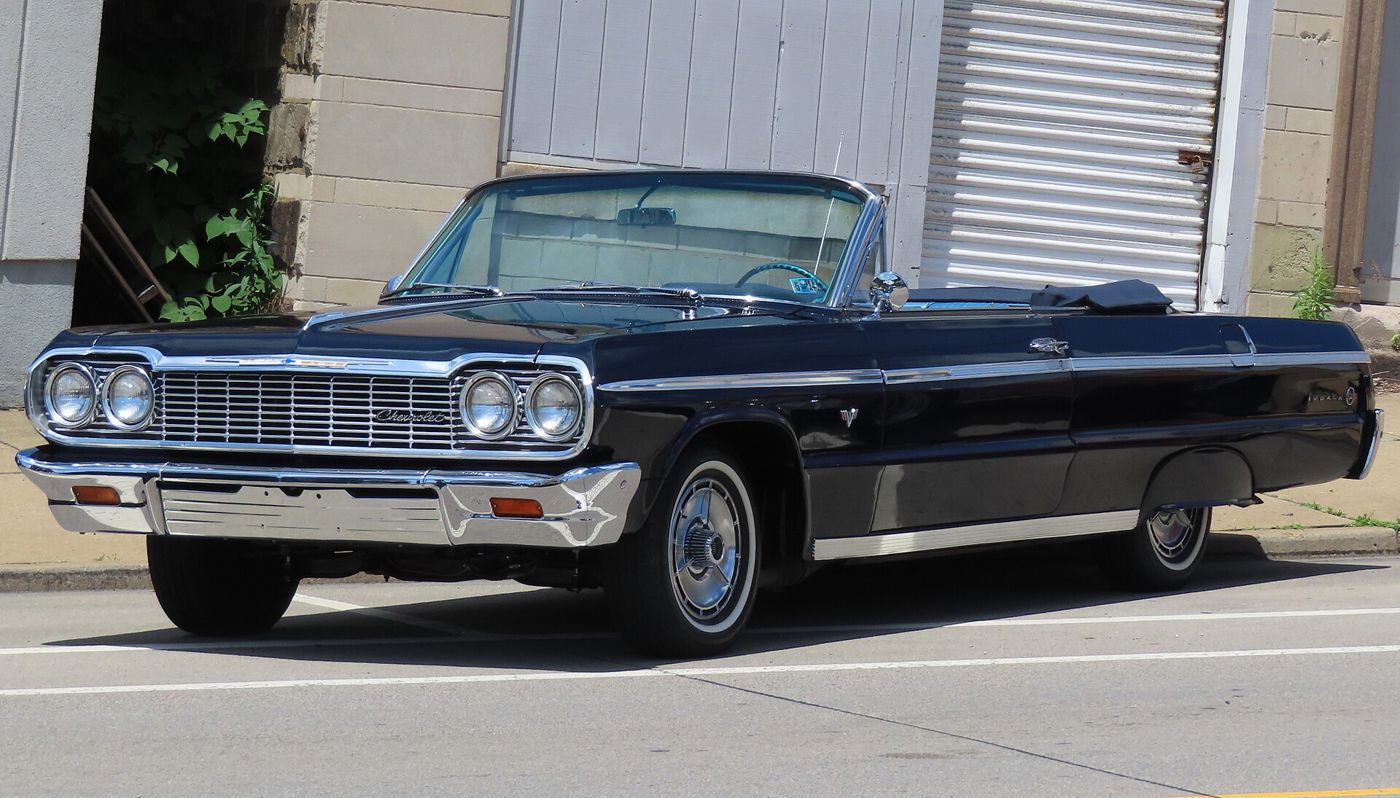
For 1964 the Impala Super Sport became its own series rather than a trim on the Impala, and Chevrolet's own vehicle information kit lists it as series 1300-1400, made up of the two-door sport coupe (model 13-1447 or 14-1447) and two-door convertible (13-1467 or 14-1467), the leading digit distinguishing six-cylinder from V8 cars. A production chart from Classic Industries lists 185,325 Impala Super Sports built for 1964, alongside 8,684 409 engines fitted across the full-size Chevrolet line as a whole.1
The 185,325 figure is presented as a single, unpartitioned total in the source, with no split by body style or engine given anywhere in the chart, so that one number already represents the whole year's Super Sport count rather than a component of some larger figure. A separate Over-Drive Magazine road test offers rough, self-described "approximately" and "estimated" body-style figures, around 165,000 sport coupes and about 18,000 of the 81,897 full-size convertibles built, which sum to roughly 183,000, close to but not exactly matching the Classic Industries total; this record's own production note is explicit that those rough figures are not precise enough to cite as a table value in their own right. The 8,684 409-engine count is itself labeled only "409" in a chart covering all full-size Chevrolets, not the Super Sport specifically, so this record does not treat it as an SS-only figure. Broader context figures from the same chart include 889,600 Impalas of all bodies, 442,292 full-size sport coupes, 81,897 full-size convertibles, 816,000 V8 Impalas, and 73,600 six-cylinder Impalas; this record's own production note cautions that the chart's rows mix series, body, and engine scopes and are not additive, and separately flags that the best missing primary source, the GM Heritage vehicle information kit's own production data, could not be retrieved because gm.com returned an access error.1
The 409-cu-in V8 with dual four-barrel Carter carburetors is rated 425 hp at 6,000 rpm and 425 lb-ft at 4,200 rpm. A full slate of regular-production options is documented from Chevrolet's own information kit: the L30 327-cu-in V8 at 250 hp, available across the V8 series including the Impala SS; the L74 high-performance 327 at 300 hp; three 409 options, the L33 at 340 hp, L31 at 400 hp, and L80 at 425 hp; the M20 four-speed and M21 close-ratio four-speed manuals; the K66 transistorized voltage regulator and ignition; and the G80 limited-slip axle, offered across six different ratios from 3.08 to 4.56:1.2
Eight Super Sport bucket-seat interior trim codes are documented: silver with a black panel and dark gray carpet, black, blue, white with a black panel and dark gray carpet, fawn, saddle, white with a red panel and carpet, and red, with this record's own interior note explaining that the sport coupe and convertible share the same trim code where the source gives only one code for both bodies. Identification detail includes the second and third VIN digits, given as 14 for the 1964 Impala SS, and the information kit's own model breakdown confirming the Super Sport as a distinct 1300-1400 series with five-passenger seating in both the sport coupe and convertible, a formal series designation rather than merely an appearance or performance option checked on an ordinary Impala.3
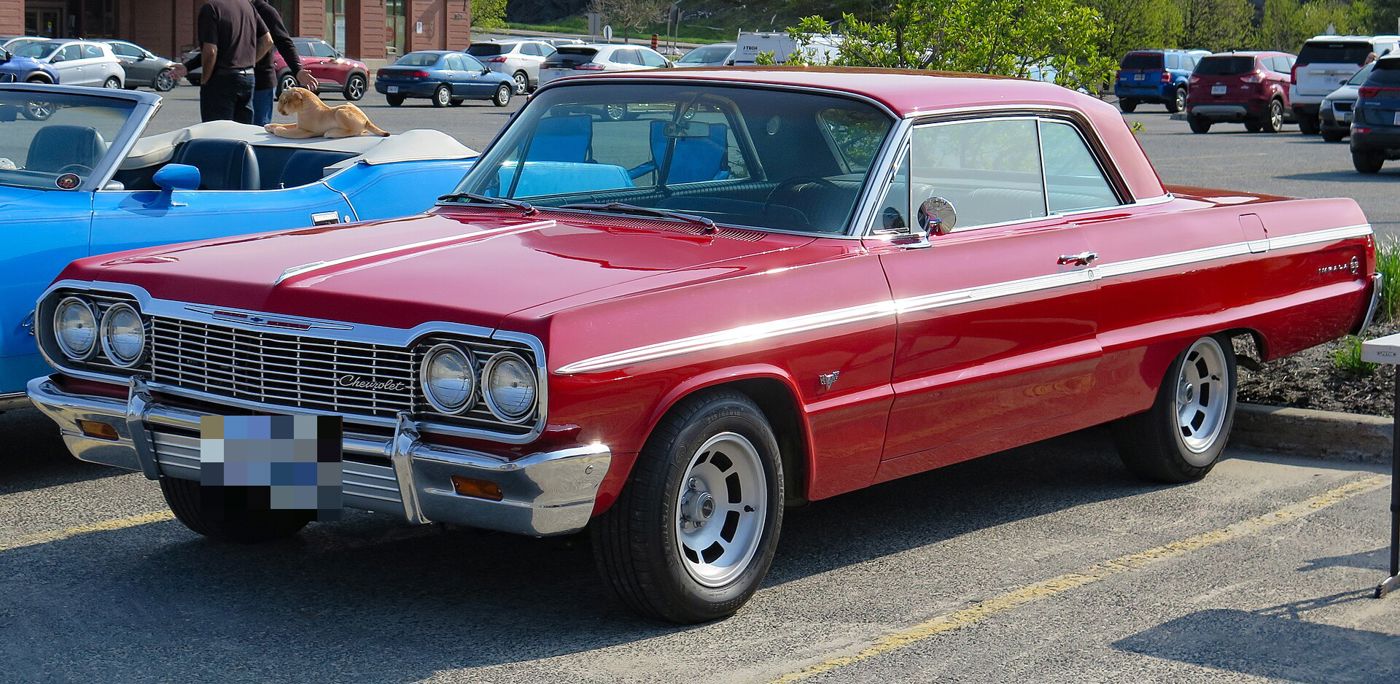
Fact sheet · 1964 · United States
The numbers
1964 Chevrolet Impala Super Sport — Super Sport becomes its own series: 185,325 built.
Coverage: Partial — researched sections are shown; missing ones are not yet sourced. Researched through 2026-09-22.
Every figure is labeled with how sure we are. Reported means a manufacturer, registry, or reference figure we cite but have not reconciled against factory records ourselves. Disputed means credible sources disagree and both are shown. Rows are separately scoped; don't add them together unless the note says they make up a total.
Key facts
- Super Sport production 1964: 185,325.1
Production
| What was counted | Count | Basis | Status |
|---|---|---|---|
| Impala Super Sport1 Super Sport · sport coupe and convertible · not stated | 185,325 | built, model-year | Reported |
| What was counted | Count | Basis | Status |
|---|---|---|---|
| Impala Super Sport total production1 Super Sport · sport coupe and convertible · not stated The Classic Industries chart carries a single unpartitioned Super Sport figure for 1964 (no body or engine split), so it already is the year's whole total; same value and source as the 'ss' row above, added as its own row per the site's total-row convention. A separate Over-Drive Magazine road test gives rough, self-described 'approximately'/'estimated' Sport Coupe (~165,000) and convertible (~18,000 of 81,897) SS figures that sum close to this total (~183,000) but are not precise enough to cite as a table value; see report. | 185,325 | built, model-year | Reported |
| What was counted | Count | Basis | Status |
|---|---|---|---|
| 409 V8 engines, full-size line1 all full-size (source row "409") · 409 V8 · not stated Row is labelled only "409" in a chart of all full-size Chevrolets; not an SS-only count. | 8,684 | built, model-year | Reported |
| What was counted | Count | Basis | Status |
|---|---|---|---|
| Impala series, all bodies1 all full-size · not stated | 889,600 | built, model-year | Reported |
| Convertible, all full-size1 all full-size · not stated | 81,897 | built, model-year | Reported |
| Sport coupe, all full-size1 all full-size · not stated | 442,292 | built, model-year | Reported |
| Impala series, V81 all full-size · not stated | 816,000 | built, model-year | Reported |
| Impala series, six-cylinder1 all full-size · not stated | 73,600 | built, model-year | Reported |
Classic Industries says its chart is believed correct but has not been verified by the factory. Chart rows mix series, body and engine scopes and are not additive.
Best missing primary source: the GM Heritage vehicle information kit for this year (gm.com returned 403).
Engines
| Engine | Factory rating | Availability | Built |
|---|---|---|---|
| 409 V8 (dual 4-bbl)2 409 cu in · two 4-barrel Carter AFB | 425 hp @ 6,000, 425 lb-ft @ 4,200 (SAE gross) | optional | Not yet sourced |
Ratings are the manufacturer's advertised figures under the standard shown (SAE gross before 1972, SAE net after). They are not dyno results, and gross and net ratings can't be compared directly.
Options and packages
| Code | Option | Price | Installed |
|---|---|---|---|
L30RPO |
327 cu in V8, 250 hp (V8 series 12-14-16-1800, incl. Impala SS 1400) | — | Not yet sourced |
L74RPO |
327 cu in V8 high performance, 300 hp | — | Not yet sourced |
L33RPO |
409 cu in V8, 340 hp | — | Not yet sourced |
L31RPO |
409 cu in V8, 400 hp | — | Not yet sourced |
L80RPO |
409 cu in V8, 425 hp | — | Not yet sourced |
M20RPO |
Four-speed (V8 series) | — | Not yet sourced |
M21RPO |
Four-speed close ratio (V8 series) | — | Not yet sourced |
K66RPO |
Transistor regulator and ignition (V8 series) | — | Not yet sourced |
G80RPO |
Limited-slip axle (3.08, 3.36, 3.55, 3.70, 4.11, 4.56:1) | — | Not yet sourced |
Interiors
| Code | Trim | Built |
|---|---|---|
805 |
Silver (black panel, dark gray carpet) SS bucket-seat trim (sport coupe/convertible codes where two are given)3 | Not yet sourced |
815 |
Black SS bucket-seat trim (sport coupe/convertible codes where two are given)3 | Not yet sourced |
831 |
Blue SS bucket-seat trim (sport coupe/convertible codes where two are given)3 | Not yet sourced |
845 |
White (black panel, dark gray carpet) SS bucket-seat trim (sport coupe/convertible codes where two are given)3 | Not yet sourced |
856 |
Fawn SS bucket-seat trim (sport coupe/convertible codes where two are given)3 | Not yet sourced |
862 |
Saddle SS bucket-seat trim (sport coupe/convertible codes where two are given)3 | Not yet sourced |
878 |
White (red panel and carpet) SS bucket-seat trim (sport coupe/convertible codes where two are given)3 | Not yet sourced |
879 |
Red SS bucket-seat trim (sport coupe/convertible codes where two are given)3 | Not yet sourced |
Identification
- VIN
- Registry: 1964 Impala SS VIN second and third digits are 14; sport coupe and convertible share the bucket-seat trim code.3
- Impala Super Sport series (kit)
- For 1964 Chevrolet lists the Impala Super Sport as its own series, 1300-1400: models 13-1447 two-door sport coupe and 13-1467 two-door convertible, 5-passenger (13 = six, 14 = V8).
Identification
Read a 1964 Chevrolet VIN
The VIN decoder runs in your browser and never sends the VIN anywhere. How the factory numbered this year's cars:
Same model year
Also in 1964
- Buick Riviera The 425 became standard, the dual-quad Super Wildcat 360 arrived as an option, and the Super Turbine 400 replaced the twin-turbine automatic.
- Buick Wildcat The best Wildcat year at 84,245, with a 425 in 340- or 360-hp form and an available four-speed.
- Chevrolet Chevelle and Malibu SS The first Chevelle; the Malibu SS was a series, and its strongest released engine was the midyear 300 hp L74 327.
- Chevrolet Chevy II and Nova First V8 (283) year in the source engine table. Enthusiast-compiled production: 191,691 cars; Super Sport 10,576.
- Chevrolet El Camino SS No factory Super Sport El Camino is documented for this year; the record carries the host El Camino production as context.
- Chrysler 300 letter series Cheaper by about $1,000, with a single-four-barrel 360 hp 413 standard, leather made optional and the convertible restored, the 300K became the best-selling letter car: 3,022 hardtops and 625 convertibles.
- Dodge Dart 330/440, Polara and Max Wedge The Max Wedge's last year brought the Ramcharger 426-III, a 365 hp street 426 for Polara buyers, and in midyear a competition-only 426 Hemi in lightened 330/440 bodies; Roger Lindamood's Dodge won Top Stock at the Nationals.
- Ford Fairlane The year of the Thunderbolt: a midsize Fairlane with a 427 installed for NHRA Super Stock, which carried Gas Ronda to the national Stock title.
- Ford Falcon Sprint The restyled Falcon kept the Sprint hardtop and convertible with the 164 hp 260 V8 standard; the club counts 18,108 built, many with a bench seat.
- Ford Galaxie Ford sold its 427 in the restyled full-size range in two advertised versions, 410 hp with one four-barrel and 425 hp with two, and the Galaxie 500 XL hardtop was the bucket-seat flagship.
- Ford Thunderbird The redesigned fourth-generation car offered one drivetrain, a 300-hp 390 with Cruise-O-Matic, and output rose to 92,465.
- Mercury Comet and Cyclone The Cyclone name first appeared on a 1964 Comet hardtop; the only production figure found is a single secondary total.
- Mercury Marauder and S-55 Marauder now meant the fastback roof on any full-size Mercury series, two-door or four-door, with the 390 standard and the 427 optional.
- Oldsmobile Cutlass, 4-4-2 and Hurst/Olds Oldsmobile's first 4-4-2 was a mid-year option package, B09 Police Apprehender Pursuit, with a 310 hp 330, a four-speed and dual exhausts; 2,999 are tabulated.
- Oldsmobile Starfire Production fell to 16,163 as the cheaper Jetstar I took the same body; Motor Trend timed a convertible at 9.7 s to 60.
- Plymouth Barracuda and 'Cuda Plymouth's glassback Valiant-based fastback launched in a short first season and sold 23,443 cars.
- Plymouth Savoy, Fury and Max Wedge Plymouth's last Max Wedge year offered the Super Stock 426-III beside a 365 hp street 426 Commando, while a competition-only 426 Hemi went into lightened Savoy/Belvedere drag cars and swept the Daytona 500.
- Pontiac Catalina 2+2 and Super Duty The 2+2 arrived as a $291 Catalina option and the 370 hp 421 HO replaced the Super Duty at the top.
- Pontiac GTO A $295 option on the Tempest LeMans that put Pontiac's 389 in the intermediate body; 32,450 were built.
- Pontiac Grand Prix A carryover year: 63,810 built, with the 370 hp 421 HO at the top of the option list.
- Pontiac Tempest and LeMans The Tempest becomes a 115-inch intermediate with a 326 V8, and the LeMans carries the new GTO option.
- Studebaker Avanti The last Studebaker Avanti, cut short when South Bend stopped building cars on 20 December 1963. It got rectangular headlamp bezels and a level stance, and 809 were built, including the nine production R3s.
- Studebaker Hawk The final Hawk, with a new deck lid and an optional vinyl 'Sports Roof', ended when South Bend closed on 20 December 1963. 1,767 were built, 1,484 of them domestic.
- Studebaker Lark and Super Lark Brooks Stevens restyled the Lark-type line and the Daytona became its top series. Of the V8 Daytonas, 111 got the R1 and 48 the supercharged R2, and one got the only production R4, before South Bend closed in December 1963.