1969 · Dodge · United States
1969 Dodge Charger: The Aero War, the Charger 500 and a Daytona Nobody Can Count
The second-generation Charger's peak-sales year added the SE package and the aero-bodied Charger 500 and Charger Daytona homologation cars, whose production totals are still disputed.
United States · researched through 2026-09-23
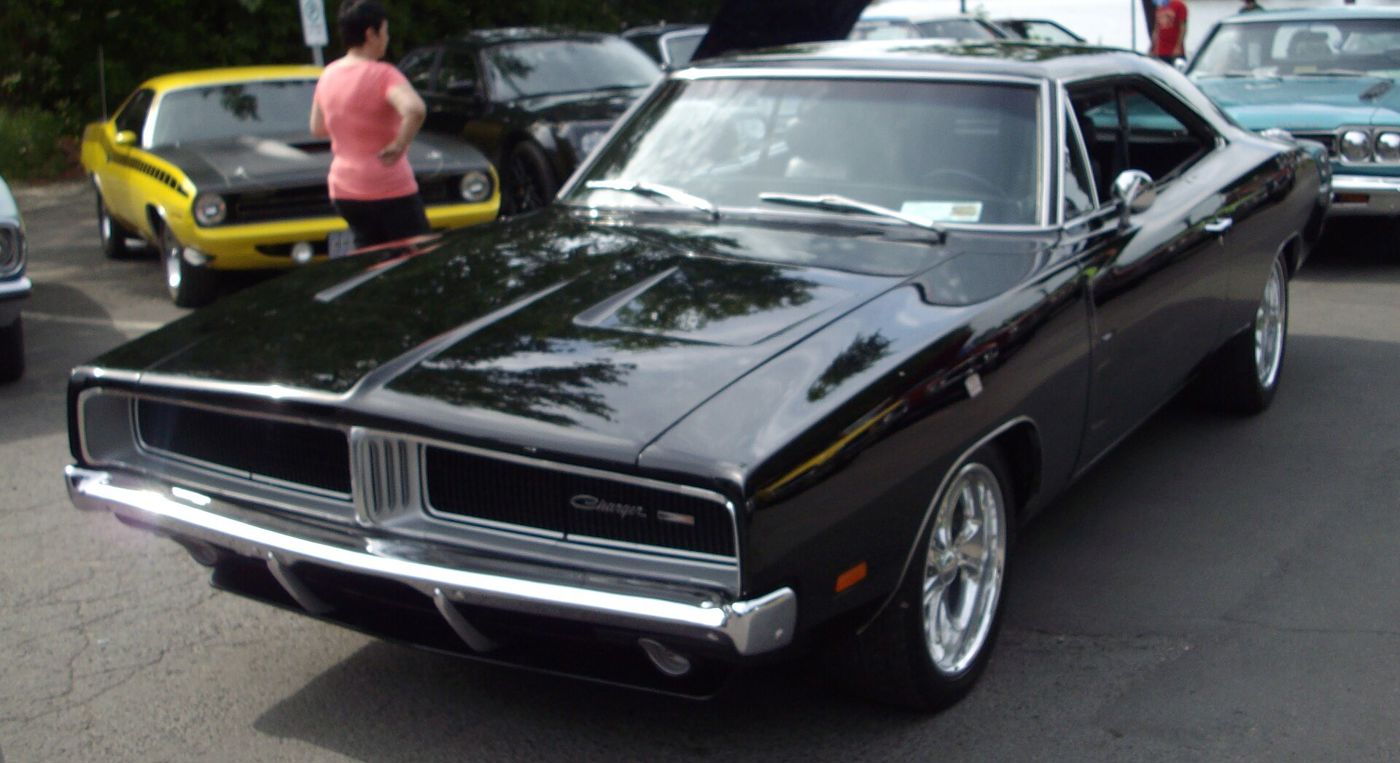
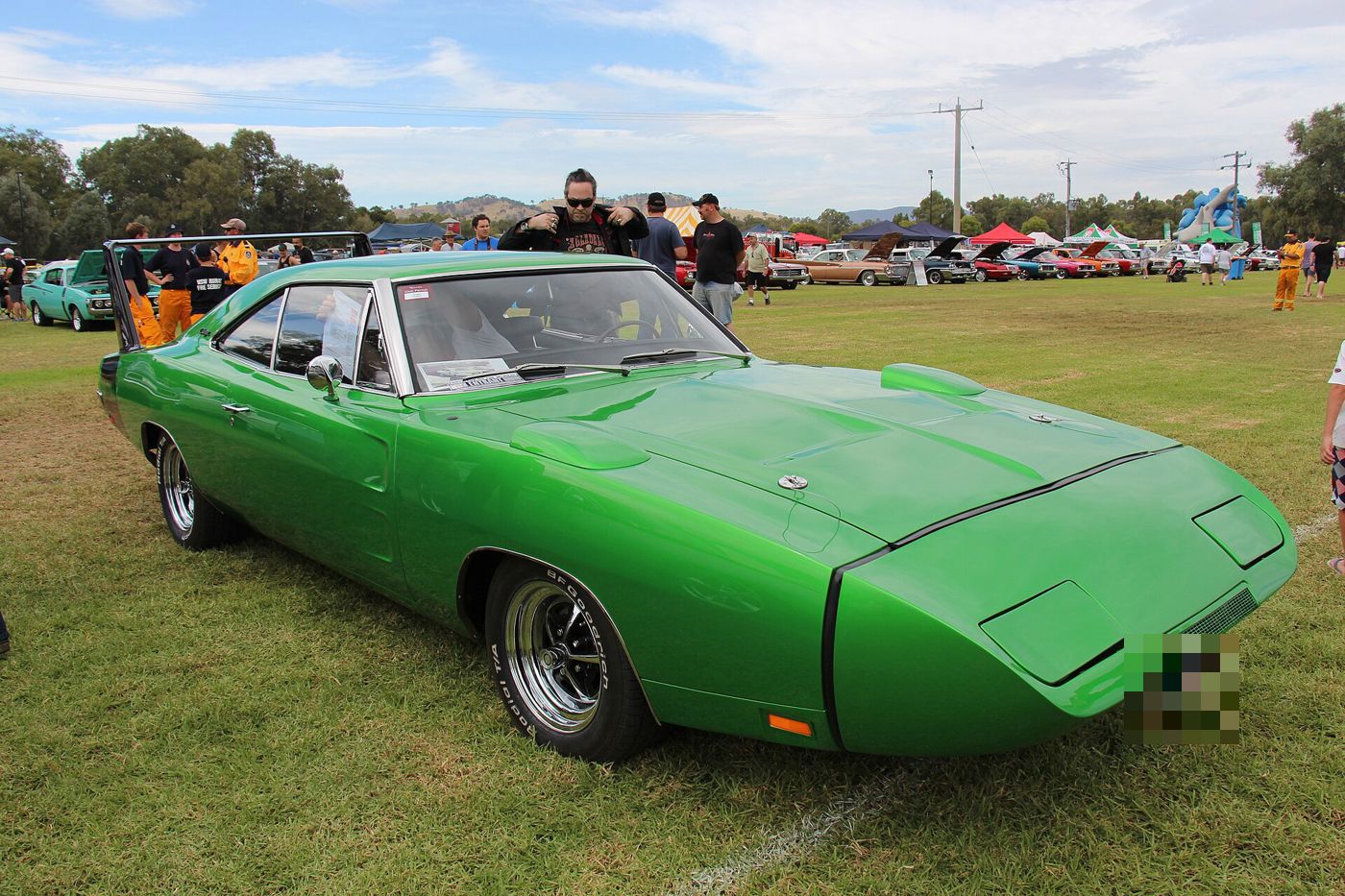
The first race at Alabama's new Talladega superspeedway, on September 14, 1969, went ahead without most of the drivers who were supposed to make it famous. NASCAR's own history records that leading drivers withdrew because they did not trust the tires at the speeds the track produced, and that Bill France ran the race anyway. Ate Up With Motor counts about 30 top drivers in the boycott. Richard Brickhouse won, and Bobby Isaac finished fourth, a lap down. The shape that made its debut that day was a Charger with a pointed nose and a rear wing standing 58 inches above the base of the trunk. It was an awkward coronation for the most extreme car Dodge had ever offered a retail customer, and a fitting one, because very little about the 1969 aero Chargers is as tidy as the legend.1,2,3
The trouble began with a beautiful car. The 1968 Charger's recessed grille and tunnelled rear window between flying-buttress sail panels looked superb on a showroom floor and worked against it at superspeedway pace. Ate Up With Motor reports alarming front-end lift at 180 mph and counts only five Dodge victories from 49 starts in the 1968 Grand National season. Dodge's own heritage account says wind-tunnel testing and research gave its engineers a leg up in NASCAR. The first product of that work reached showrooms as the Charger 500, which Stellantis describes as a model introduced solely for NASCAR, with a flush rear window to reduce drag. It was an admission, written in sheet metal and glass, that the most admired shape of 1968 was also a slow one.2,3
The Charger 500 was a conversion, not a new body. Ate Up With Motor says the flush grille came from the Coronet and that the conversions were done by Creative Industries, a local contractor that had handled special projects for Chrysler since the mid-1950s; it also credits Bill France with a 500-car homologation minimum. Flory's model table lists the Charger 500 at $3,993 and 3,710 lb against $3,592 and 3,646 lb for the R/T, a $401 premium, while Ate Up puts the premium at $268. The race car first appeared at Riverside in February 1969. How many street 500s were built is unsettled. Mueller's production table prints 392, but Mueller and Glatch's later book calls 392 an estimate and says as many as 450 may have been built. Either way, a car built to satisfy a 500-car minimum may not have reached 500.2,4,5,6
Ford did not wait. Its Torino Talladega, a fastback with an extended, lowered nose, was built at Atlanta for homologation between January 21 and February 28, 1969, by Wikipedia's account of the run; the Talladega and Spoiler Registry now believes 738 production cars were built. Ford also had Richard Petty. The Talladega and Spoiler Registry notes that 1969 was the only year Petty raced a Ford, and that he won ten races in it. Ate Up With Motor describes the Ford and Mercury aero cars and the Charger 500 as very closely matched in power and aerodynamics. Dodge's next answer, ready by the autumn, went much further than a flush grille.7,8,9,2
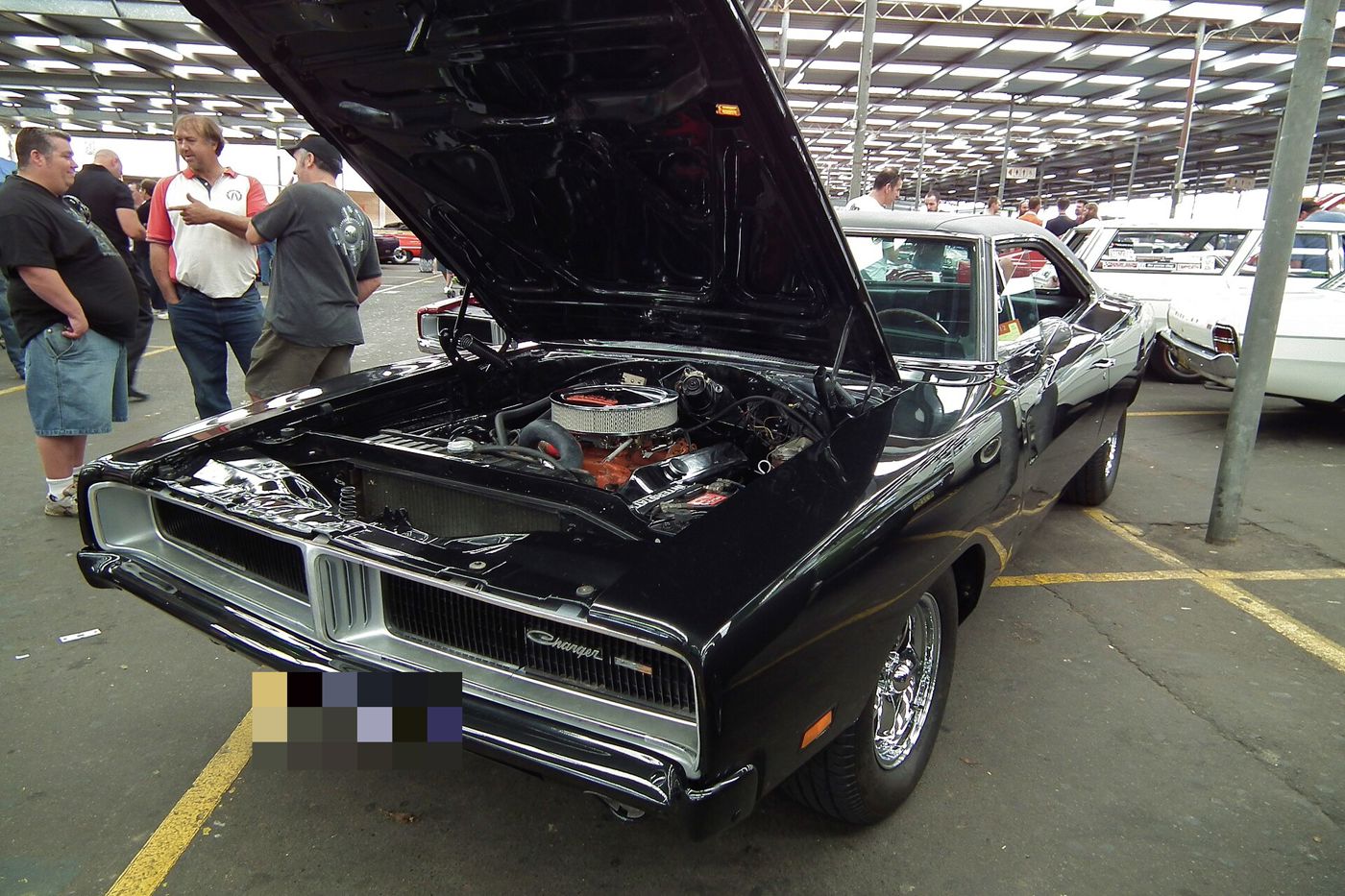
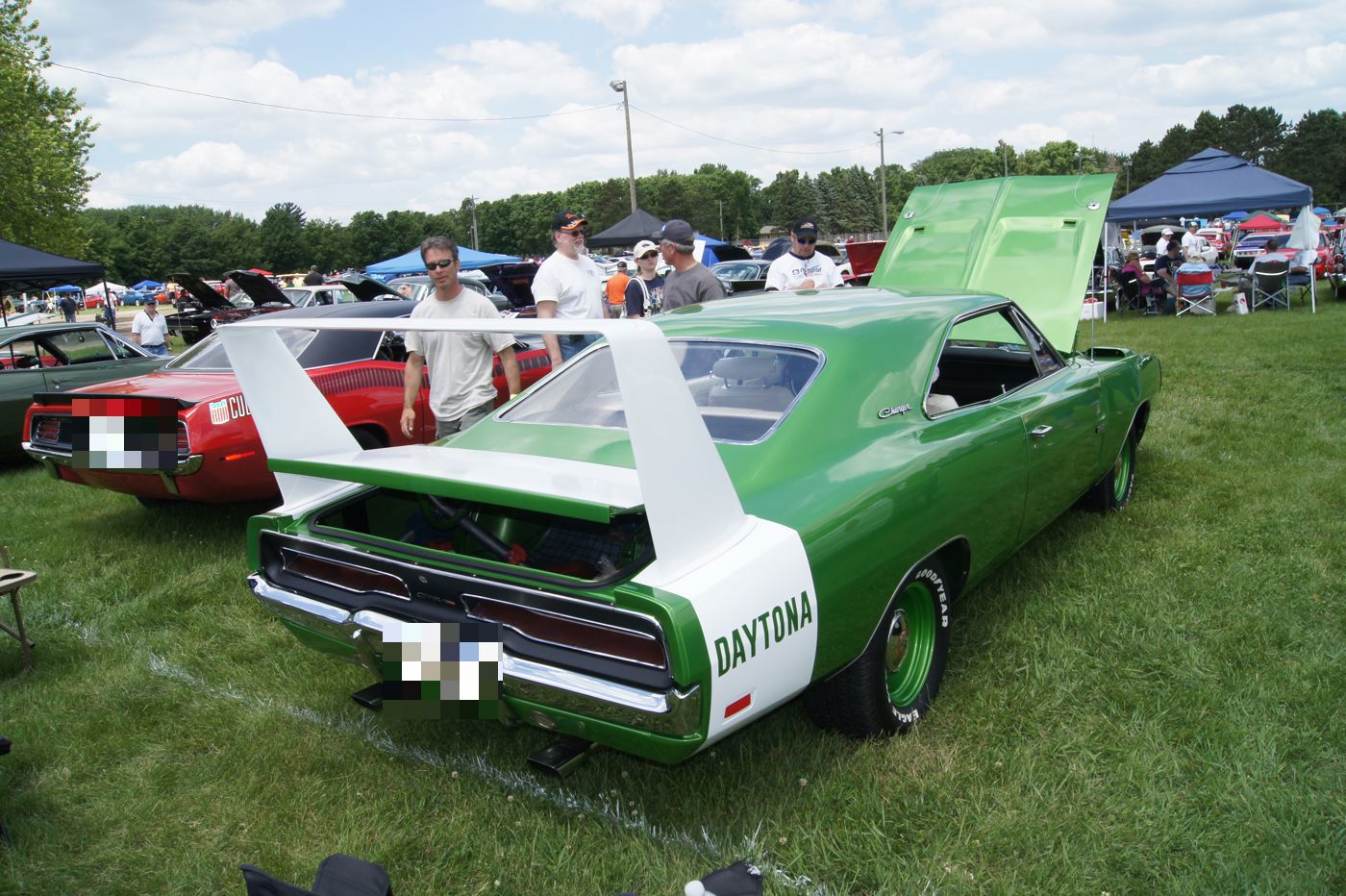
Ate Up With Motor places project engineer Larry Rathgeb and driver Charlie Glotzbach at the centre of the Daytona's testing. Dodge sold the result to dealers under the headline ‘Announcing Dodge's Latest Entry into the Performance Car Market—Charger Daytona!’ The dealer sheet describes aircraft-type fresh-air intakes, longer and lower front fenders and hood, flush windshield mouldings following the Charger 500 design, and larger wheel openings. It lists the 440 Magnum as standard, at 375 hp at 4,600 rpm and 480 lb-ft at 3,200 rpm, and the 426 Hemi as the option, at 425 hp at 5,000 rpm and 490 lb-ft at 4,000 rpm. Those are advertised gross ratings for the street car, not race-engine figures, and the sheet prints no production total at all.2
Counting the Daytonas is the argument that never ends. The figure most books and magazines repeat is 503, which Street Muscle splits into 433 cars with the 440 (139 of them four-speeds) and 70 with the Hemi (22 four-speed, 48 automatic). Stellantis's own 2016 blog says Dodge built 501. Diego Rosenberg, writing in 2025, reports that research built on a shipping list points to 499 cars plus the test mule, with perhaps more prototypes making up 503, and only about 35 US Hemi cars plus five for Canada. Flory's table prints 1,000 and says its totals are estimated. Ate Up With Motor says production stopped in September 1969 once the homologation minimum was reached. Until a Chrysler shipping record or Creative Industries ledger is produced, the true total remains unknown.10,11,12,4,2
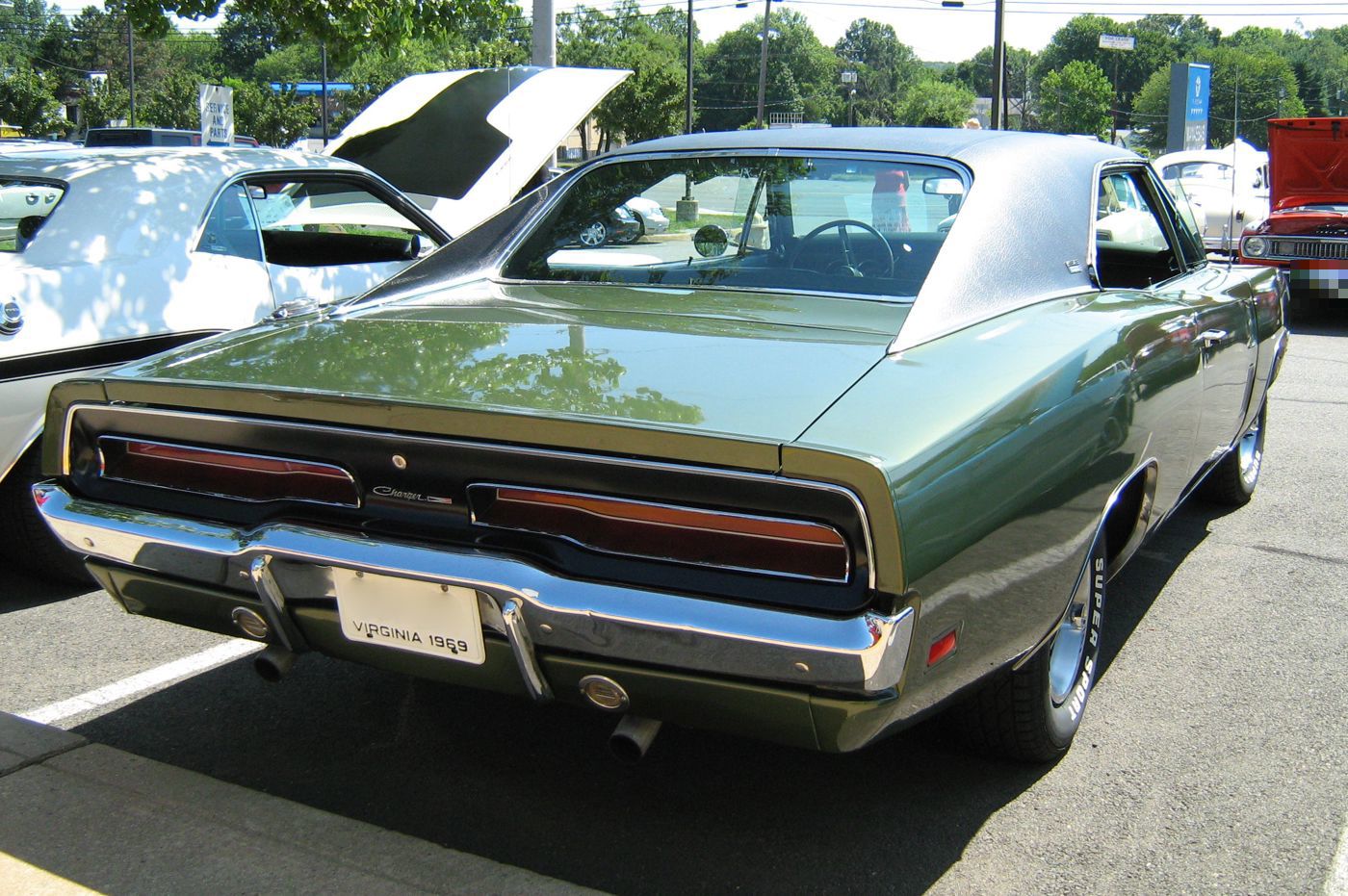
Away from the wings, the ordinary Charger kept selling in volume. Industry statistics put production at 89,199. Dodge added a centre divider to the grille, rectangular tail lamps, an SE package with leather and vinyl seating and wood-grain trim, and a 145 hp 225 slant six as the new base engine. The R/T was the performance model, 20,057 built including cars delivered outside the United States and 18,776 domestic, according to Mueller. Of those domestic R/Ts, 18,344 had the 440 Magnum, 3,605 of them with the four-speed and 14,739 with TorqueFlite. Just 432 had the Hemi, 207 four-speeds and 225 automatics, about 2.3 percent of domestic R/Ts. Stellantis says fewer than 2 percent of all 1969 Chargers carried the Hemi.13,3,5,6
On the track, speed arrived before consistency. NASCAR's biography of Bobby Isaac, driving the K&K Insurance Dodge owned by Nord Krauskopf with Harry Hyde as crew chief, credits him with 17 wins and 19 poles in 1969, yet 19 failures to finish left him sixth in points. NASCAR's Hall of Fame account says Isaac won only once in the winged Daytona, at Texas World Speedway late in 1969. Ate Up With Motor counts 22 Dodge victories that year, with Ford still taking the manufacturers' title on points. Dodge's heritage history makes a larger claim: that from September 1969 into the following year, Charger 500 and Daytona race cars together won 45 of the next 59 NASCAR races. That is the manufacturer's own count, not an independent tally.14,15,2,3
The street cars had a harder time than the race cars. Ate Up With Motor reports that the Daytona and its Plymouth Superbird cousin were not easy to sell when new, and that leftovers sat on dealer lots for months despite substantial discounts. The idea itself travelled further. Plymouth built the Superbird for 1970, and NASCAR's catalogue of Richard Petty's wins records his first Superbird victory, back in a Plymouth, at the Carolina 500 on March 8, 1970. The Charger 500 also left a strange heir: the NASCAR Hall of Fame traces Chrysler development car DC-93 to a 1969 Charger 500 magazine test car that was stolen, stripped, recovered and rebuilt by Nichels Engineering with Daytona aero pieces. On March 24, 1970, Buddy Baker lapped Talladega in it at 200.447 mph.2,16,17
The aero war ended by rule rather than by result. Ate Up With Motor reports that Bill France ruled for 1971 that winged cars would be limited to engines of no more than 305 cu in. What 1969 left behind is a car whose significance is clearer than its numbers. The Charger 500 and Daytona show a factory changing a production body because a racing rule demanded it, then selling the result to the public in quantities nobody has yet reconciled: 392 or up to 450 Charger 500s, and 499, 501 or 503 Daytonas depending on whom you trust. The ordinary R/T numbers are precise to the car. The two most famous 1969 Chargers are not, and an honest history has to say so.2,6,10,11,12
Fact sheet · 1969 · United States
The numbers
1969 Dodge Charger — The second-generation Charger's peak-sales year added the SE package and the aero-bodied Charger 500 and Charger Daytona homologation cars, whose production totals are still disputed.
Coverage: Partial — researched sections are shown; missing ones are not yet sourced. Researched through 2026-09-23.
Every figure is labeled with how sure we are. Reported means a manufacturer, registry, or reference figure we cite but have not reconciled against factory records ourselves. Disputed means credible sources disagree and both are shown. Rows are separately scoped; don't add them together unless the note says they make up a total.
Key facts
- 1969 model-year Charger production: 89,199 (1.06 % of the US model-year total).13
- Charger R/T: 20,057 including deliveries outside the US; 18,776 domestic.6,5
- Of 18,776 domestic R/Ts, 432 had the 426 Hemi: 207 with the four-speed and 225 with the automatic.5
- Stellantis says fewer than 2 percent of all 1969 Chargers had the 426 Hemi.3
- Charger Daytona production is disputed: 503 (common figure), 501 (Stellantis 2016) and 499 plus a test mule (Rosenberg 2025). See conflicts.10,11,12
- The 1969 Charger catalogue shows 17 exterior colour chips: Medium Blue, Bright Blue, Light Blue, Bright Turquoise, Dark Green, Light Green, Gold, Light Bronze, Dark Bronze and Copper (all metallic), Yellow, Red, Silver Metallic, White or Black, Cream, Bright Red and Medium Green Metallic.
Production
| What was counted | Count | Basis | Status |
|---|---|---|---|
| Charger, all series13 2-door hardtop · US production statistics Whether this includes the Charger 500 and Daytona, and Canadian or export cars, is not stated in the snippet. A 104,978 figure circulates online without a stated lineage; see unpublishedLeads. | 89,199 | built, model-year | Reported |
| What was counted | Count | Basis | Status |
|---|---|---|---|
| Charger R/T, including deliveries outside the US5,6,18 R/T · 2-door hardtop · all markets Flory's 1969 Dodge table prints 20,100 for the R/T and states its totals are estimated; see conflicts. | 20,057 | built, model-year | Reported |
| Charger R/T, domestic6,5 R/T · 2-door hardtop · US Mueller's 440 and Hemi rows below sum to this figure; the source presents them as the domestic breakdown. | 18,776 | built, model-year | Reported |
| Charger 5005,6 Charger 500 · 2-door hardtop (flush grille, flush backlight) · not stated Mueller and Glatch call 392 an estimate and say as many as 450 may have been built; project research also logs specialist claims of 548 and 559 without an accounting basis. See conflicts. | 392 | built, model-year | Disputed |
| Charger Daytona10 Charger Daytona · 2-door hardtop (aero nose and rear wing) · US Shown as the commonly repeated figure only. Competing claims: 501 (Stellantis 2016), 499 plus a test mule (Rosenberg 2025), 1,000 estimated (Flory). See conflicts. | 503 | built, model-year | Disputed |
| Charger and Charger SE/500 combined (Over-Drive, rounded)19 Charger + Charger 500/SE · 2-door hardtop · not stated Rounded; scope (whether Daytonas are included) not stated. | 69,100 | built, model-year | Reported |
| Charger R/T (Over-Drive, rounded)19 R/T · 2-door hardtop · not stated Rounded; close to Mueller's 20,057 including deliveries outside the US. | 20,100 | built, model-year | Reported |
| What was counted | Count | Basis | Status |
|---|---|---|---|
| Charger R/T, 440 Magnum5 R/T · 2-door hardtop · 440 4-bbl · US | 18,344 | built, model-year | Reported |
| Charger R/T, 426 Hemi5 R/T · 2-door hardtop · 426 Hemi 2x4-bbl · US | 432 | built, model-year | Reported |
| Charger Daytona, 440 Magnum10 Charger Daytona · 2-door hardtop · 440 4-bbl · US | 433 | built, model-year | Disputed |
| Charger Daytona, 426 Hemi10 Charger Daytona · 2-door hardtop · 426 Hemi 2x4-bbl · US Rosenberg (2025) reports shipping-list research indicating about 35 US Hemi Daytonas plus five for Canada. | 70 | built, model-year | Disputed |
| What was counted | Count | Basis | Status |
|---|---|---|---|
| Charger R/T, 440 Magnum, four-speed5 R/T · 2-door hardtop · 440 4-bbl · 4-speed manual · US | 3,605 | built, model-year | Reported |
| Charger R/T, 440 Magnum, TorqueFlite5 R/T · 2-door hardtop · 440 4-bbl · 3-speed automatic · US | 14,739 | built, model-year | Reported |
| Charger R/T, 426 Hemi, four-speed5 R/T · 2-door hardtop · 426 Hemi 2x4-bbl · 4-speed manual · US An auction listing attributes the same 207 figure to the National Hemi Owners Association; web pages also circulate 224 four-speed / 208 automatic without attribution (see unpublishedLeads). | 207 | built, model-year | Reported |
| Charger R/T, 426 Hemi, TorqueFlite5 R/T · 2-door hardtop · 426 Hemi 2x4-bbl · 3-speed automatic · US | 225 | built, model-year | Reported |
| Charger Daytona, 440 Magnum, four-speed10 Charger Daytona · 2-door hardtop · 440 4-bbl · 4-speed manual · US Part of the 503 lineage; the same source gives 433 440 cars in total, the remainder with TorqueFlite. | 139 | built, model-year | Disputed |
| Charger Daytona, 426 Hemi, four-speed10 Charger Daytona · 2-door hardtop · 426 Hemi 2x4-bbl · 4-speed manual · US | 22 | built, model-year | Disputed |
| Charger Daytona, 426 Hemi, automatic10 Charger Daytona · 2-door hardtop · 426 Hemi 2x4-bbl · 3-speed automatic · US | 48 | built, model-year | Disputed |
Rows are separately scoped and come from different lineages; do not add them. Only the R/T engine and transmission rows are presented by their source as partitions of the 18,776 domestic R/T figure.
No source consulted gives 1969 production for the base Charger, the SE package, or 383-engined cars with a documented lineage.
Charger 500 and Daytona counts are disputed and are shown only with that status.
Prices when new
| Model | Price | Basis |
|---|---|---|
| Base MSRP, Charger R/T 2-door hardtop (XS29)4 | $3,592 | base manufacturer's suggested retail price as tabulated by Flory, 1969 model year |
| Base MSRP, Charger 500 2-door hardtop (XX29)4 | $3,993 | base manufacturer's suggested retail price as tabulated by Flory, 1969 model year |
| Base price, Charger XP29 V-8 (Over-Drive table)19 | $3,125 | base price as tabulated by Over-Drive, 1969 model year |
| Base price, Charger XP29 six (Over-Drive table)19 | $3,020 | base price as tabulated by Over-Drive, 1969 model year |
| Base price, Charger R/T XS29 (Over-Drive table)19 | $3,592 | base price as tabulated by Over-Drive, 1969 model year |
Prices are the nominal dollars of the day, not adjusted for inflation.
Engines
| Engine | Factory rating | Availability | Built |
|---|---|---|---|
| 440 Magnum 4-bbl V-8 440 cu in · 4-barrel | 375 hp, 480 lb-ft (period factory advertised (gross)) | standard on R/T and Charger Daytona | 18,3445 Reported |
| 426 Hemi 2x4-bbl V-8 426 cu in · two 4-barrel | 425 hp, 490 lb-ft (period factory advertised (gross)) | optional on R/T, Charger 500 and Charger Daytona | 4325 Reported |
| 225 Slant Six3 225 cu in · 1-barrel | 145 hp (as stated by Stellantis retrospective (period gross)) | standard (new base engine for 1969) | Not yet sourced |
| 318 2-bbl V-819 318 cu in · 2-barrel | 230 hp @ 4,400, 320 lb-ft @ 2,000 (gross, as Over-Drive transcribes the factory rating); 230 hp @ 4,400, 340 lb-ft @ 2,400 (gross, factory catalogue engine table) | Charger V-8 | Not yet sourced |
| 383 2-bbl V-819 383 cu in · 2-barrel | 290 hp @ 4,400, 390 lb-ft @ 2,800 (gross, as Over-Drive transcribes it); 290 hp @ 4,400, 390 lb-ft @ 2,800 (gross, factory catalogue engine table) | optional | Not yet sourced |
| 383 4-bbl V-819 383 cu in · 4-barrel | 330 hp @ 5,200, 425 lb-ft @ 3,400 (gross, as Over-Drive transcribes it); 330 hp @ 5,000, 425 lb-ft @ 3,200 (gross, factory catalogue engine table) | optional | Not yet sourced |
Ratings are the manufacturer's advertised figures under the standard shown (SAE gross before 1972, SAE net after). They are not dyno results, and gross and net ratings can't be compared directly.
Transmissions
| Transmission | Availability | Built |
|---|---|---|
| TorqueFlite 3-speed automatic | standard with 440 on R/T | 14,7395 Reported |
| 4-speed manual, Hurst shifter | optional | 3,6055 Reported |
| 3-speed manual, column shift | standard with the 318 V-8 or 225 Six only | Not yet sourced |
Options and packages
| Code | Option | Price | Installed |
|---|---|---|---|
|
SE (Special Edition): leather/vinyl seating, wood-grain trim, hood-mounted turn indicators3 | — | Not yet sourced |
|
Performance Hood paint treatment with '426 HEMI' or '440 Six-pack' graphics (as described by Stellantis)3 | — | Not yet sourced |
|
426 Street Hemi V-8, in Charger R/T19 | $648 | Not yet sourced |
|
383 cu in 290 hp 2-bbl V-819 | $70 | Not yet sourced |
|
Air conditioning19 | $361 | Not yet sourced |
|
Power brakes19 | $43 | Not yet sourced |
|
Power steering19 | $85 | Not yet sourced |
|
AM/FM radio19 | $135 | Not yet sourced |
|
AM radio with 8-track tape19 | $196 | Not yet sourced |
|
Music Master AM radio19 | $62 | Not yet sourced |
|
Sport steering wheel19 | $32 | Not yet sourced |
|
Tinted windshield and windows19 | $33 | Not yet sourced |
|
Two-tone paint19 | $23 | Not yet sourced |
|
4-speed manual with Hurst shifter (383 4-bbl, 440 and Hemi only)19 | — | Not yet sourced |
|
Vinyl roof covering (black, white, green, antique or tan) | — | Not yet sourced |
|
Charger Light Group (standard in Charger SE) | — | Not yet sourced |
|
Charger Radio Group (Music Master AM radio, power steering, power brakes, three-speed wipers, deep-dish wheel covers, left remote mirror) | — | Not yet sourced |
|
Trailer-Towing Package (not available with the 225 Six or 426 Hemi) | — | Not yet sourced |
|
F70 x 15 Red Line tyres (standard with 426 Hemi) | — | Not yet sourced |
|
Cast aluminum road wheels (15 in wheels only) | — | Not yet sourced |
Paint
| Code | Color | Built |
|---|---|---|
A4 |
Silver19 | Not yet sourced |
B3 |
Light Blue19 | Not yet sourced |
B5 |
Bright Blue19 | Not yet sourced |
B7 |
Medium Blue19 | Not yet sourced |
B9 |
Dark Blue19 | Not yet sourced |
E7 |
Cordovan19 | Not yet sourced |
F3 |
Light Green19 | Not yet sourced |
F5 |
Medium Green19 | Not yet sourced |
F6 |
Bright Green19 | Not yet sourced |
F8 |
Dark Green19 | Not yet sourced |
L1 |
Beige19 | Not yet sourced |
Q4 |
Light Turquoise19 | Not yet sourced |
Q5 |
Bright Turquoise19 | Not yet sourced |
R4 |
Charger Red19 | Not yet sourced |
R6 |
Red19 | Not yet sourced |
T3 |
Light Bronze19 | Not yet sourced |
T5 |
Copper19 | Not yet sourced |
T7 |
Dark Bronze19 | Not yet sourced |
W1 |
White19 | Not yet sourced |
X9 |
Black19 | Not yet sourced |
Y2 |
Yellow19 | Not yet sourced |
Y3 |
Cream19 | Not yet sourced |
Y4 |
Gold19 | Not yet sourced |
Y6 |
Citron Gold19 | Not yet sourced |
999 |
Bahama Yellow (special order)19 | Not yet sourced |
999 |
Orange (special order)19 | Not yet sourced |
999 |
Rallye Green (special order)19 | Not yet sourced |
Color names are the factory's. We don't show color swatches, because a screen color is no guide for a restoration.
Specifications
| Measure | Value | Applies to |
|---|---|---|
| Shipping weight, Charger R/T XS294 | 3,646 lb | R/T 2-door hardtop |
| Shipping weight, Charger 500 XX294 | 3,710 lb | Charger 500 |
| Daytona rear wing height above the base of the trunk3 | 58 in | Charger Daytona |
| Shipping weight, Charger XP29 V-8 (Over-Drive table)19 | 3,256 lb | base Charger V-8 |
| Shipping weight, Charger XP29 six (Over-Drive table)19 | 3,103 lb | base Charger six |
| Overall length19 | 207 in | Charger (Over-Drive chassis features) |
| Overall height19 | 53.5 (318) / 53.0 (others) in | Charger |
| Wheelbase19 | 117 in | all mid-size |
| Overall length / width / height (catalogue) | 208.0 / 76.6 / 53.2 in | Charger |
| Track, front / rear (catalogue) | 59.5 / 59.2 in | Charger |
| Standard tyres (catalogue) | 7.35 x 14 (six); 7.75 x 14 (318); F70 x 14 Red Line (R/T) | Charger and Charger R/T |
Identification
- Style numbers
- Flory lists the Charger R/T as XS29 and the Charger 500 as XX29 for 1969.4
- 1969 styling identifiers
- Centre-divided grille (two rectangular openings) and rectangular tail lamps replacing 1968's round units.3
Where the sources disagree
Charger Daytona production total
- 503 (433 with 440, 70 with Hemi)10
- 50111
- 499 plus the test mule, possibly more prototypes to reach 503; about 35 US Hemi cars plus 5 for Canada12
- 1,000 (explicitly estimated)4
Present 503 as the commonly repeated figure, with 501 and the shipping-list reassessment beside it. No Chrysler shipping or Creative Industries record has been examined; the canonical total is unknown.
Charger 500 production total
Show 392 as disputed with the authors' own caveat. Specialist claims of 548 and 559 logged in docs/research/batches/charger-aero-racing-people-claim-closure.md remain unregistered.
Charger R/T total
Lead with Mueller's exact figures and note Flory's rounded estimate.
1969 318 and 383 4-bbl rating points
- 318: 230 hp @ 4400, 340 lb-ft @ 2400; 383 4-bbl: 330 hp @ 5000, 425 lb-ft @ 3200
- 318: 230 hp @ 4400, 320 lb-ft @ 2000; 383 4-bbl: 330 hp @ 5200, 425 lb-ft @ 340019
The factory catalogue is primary for what was advertised; Over-Drive's transcription is shown beside it. Peak horsepower agrees; the torque and rpm points differ.
Identification
Read a 1969 Dodge VIN
The VIN decoder runs in your browser and never sends the VIN anywhere. How the factory numbered this year's cars:
Same model year
Also in 1969
- AMC AMX The two-seat AMX's biggest year: 8,293 cars by the enthusiast production table, with a mid-year run of Big Bad colors and 52 Hurst-built Super Stock AMXs for NHRA drag racing.
- AMC Javelin Production fell to 40,675, but the 1969 Javelin added the Big Bad colors, with 2,282 cars painted blue, green or orange, plus the Mod package.
- AMC Rebel and Rebel Machine A base and SST Rebel with no convertible. The Big Bad colors were test-marketed through the New York–New Jersey 'Raider' hardtop. This is host-car context for the 1970 Machine.
- Buick Riviera Another record at 52,872 Rivieras; 5,272 had the GS handling option.
- Buick Skylark Gran Sport, GS and GSX GS production fell to 12,465, and the GS 400's Stage 1 package became a factory option while Stage 2 stayed a dealer item.
- Buick Wildcat 67,453 Wildcats; the last year of the 430.
- Chevrolet Chevelle and Malibu SS Super Sport became RPO Z25 option equipment, available for 1969 only on the 300 Deluxe coupes as well as Malibu sport coupe, convertible and El Camino.
- Chevrolet Chevy II and Nova SS is RPO Z26 per the source, with L48, L34 and L78 engines. Enthusiast-compiled production: 251,849 cars; Super Sport 17,564.
- Chevrolet El Camino SS SS 396 became RPO Z25 option equipment, orderable on the V8 Malibu El Camino (13680); the El Camino share of the 86,307 Z25s is not separately published.
- Chevrolet Impala SS Only the SS427 (RPO Z24) remains; the reported count ranges from 2,425 to about 2,455.
- Dodge Coronet R/T and Super Bee The Super Bee added a hardtop body and the 440 Six Pack, while the 440-powered Coronet R/T continued as the upscale hardtop and convertible.
- Dodge Dart GTS, Swinger and Demon The low-priced Swinger 340 arrived and outsold the GTS by more than two to one (16,637 against about 6,700), while a 375 hp 440 joined the GTS options.
- Ford Fairlane The Fairlane hardtop was the intermediate line's volume leader, while the Fairlane 500 SportsRoof shared its body with the Torino GT, Cobra and Talladega.
- Ford Ranchero GT The Ranchero GT carried Torino GT trim; 1,658 GTs were built, per reference-site counts in the Standard Catalog lineage.
- Ford Thunderbird Fifth-generation Thunderbird; only the whole-line production total was found.
- Ford Torino The Torino GT carried most of the line's volume, the 428 Cobra Jet was in its first full year, and the Talladega aero fastback was built in a short run at Atlanta to homologate a NASCAR nose.
- Mercury Comet and Cyclone The Cyclone fastback came as Cyclone and Cyclone CJ, mid-year Spoilers carried Dan Gurney and Cale Yarborough graphics, and the extended-nose Cyclone Spoiler II was built at Lorain for NASCAR homologation.
- Mercury Cougar A longer, restyled Cougar added a convertible, the Boss 302 arrived in April, and the Eliminator replaced the GT as the performance Cougar.
- Mercury Marauder and S-55 The Marauder name returned on a full-size hardtop, and the X-100 carried the 360 hp 429 four-barrel as its only engine.
- Oldsmobile Cutlass, 4-4-2 and Hurst/Olds The 4-4-2 kept its 400 while the second Hurst/Olds, in white and gold with a 380 hp 455, went into production at about 900 cars.
- Plymouth Barracuda and 'Cuda The last A-body Barracuda introduced the 'Cuda name as a stripped performance package with a standard 340, alongside Formula S and a midyear 440.
- Plymouth GTX, Belvedere and Satellite The GTX shared the Road Runner's new Air Grabber scoop and Super Track Pack but sold 15,602 cars, fewer than a fifth of the cheaper Road Runner.
- Plymouth Road Runner A convertible joined the coupe and hardtop, the 440 Six Barrel arrived at mid-year, and the Road Runner reached its production peak of 84,420.
- Pontiac Firebird and Trans Am The last first-generation Firebird, and the mid-year debut of the Trans Am package: 697 cars by the commonly published count, eight of them convertibles.
- Pontiac GTO Three four-barrel 400s under one nameplate, and the first year of the Judge package built around Ram Air power.
- Pontiac Grand Prix A new 118-inch Grand Prix with the SJ and a 390 hp 428 HO: production more than tripled to 112,486.
- Pontiac Tempest and LeMans The last year of the OHC Sprint six and the 350 HO.
- Rambler American and SC/Rambler AMC and Hurst put the 315-hp 390 V8 and a close-ratio four-speed into the compact Rambler hardtop for NHRA F/Stock. 1,512 were built, and the split between the two paint schemes is disputed.