1967 · Dodge · United States
1967 Dodge Charger: The Fastback Dodge Had Already Decided to Replace
The first-generation fastback's second and last year: the 440 Magnum joined the options, and production fell to 15,788.
United States · researched through 2026-09-23
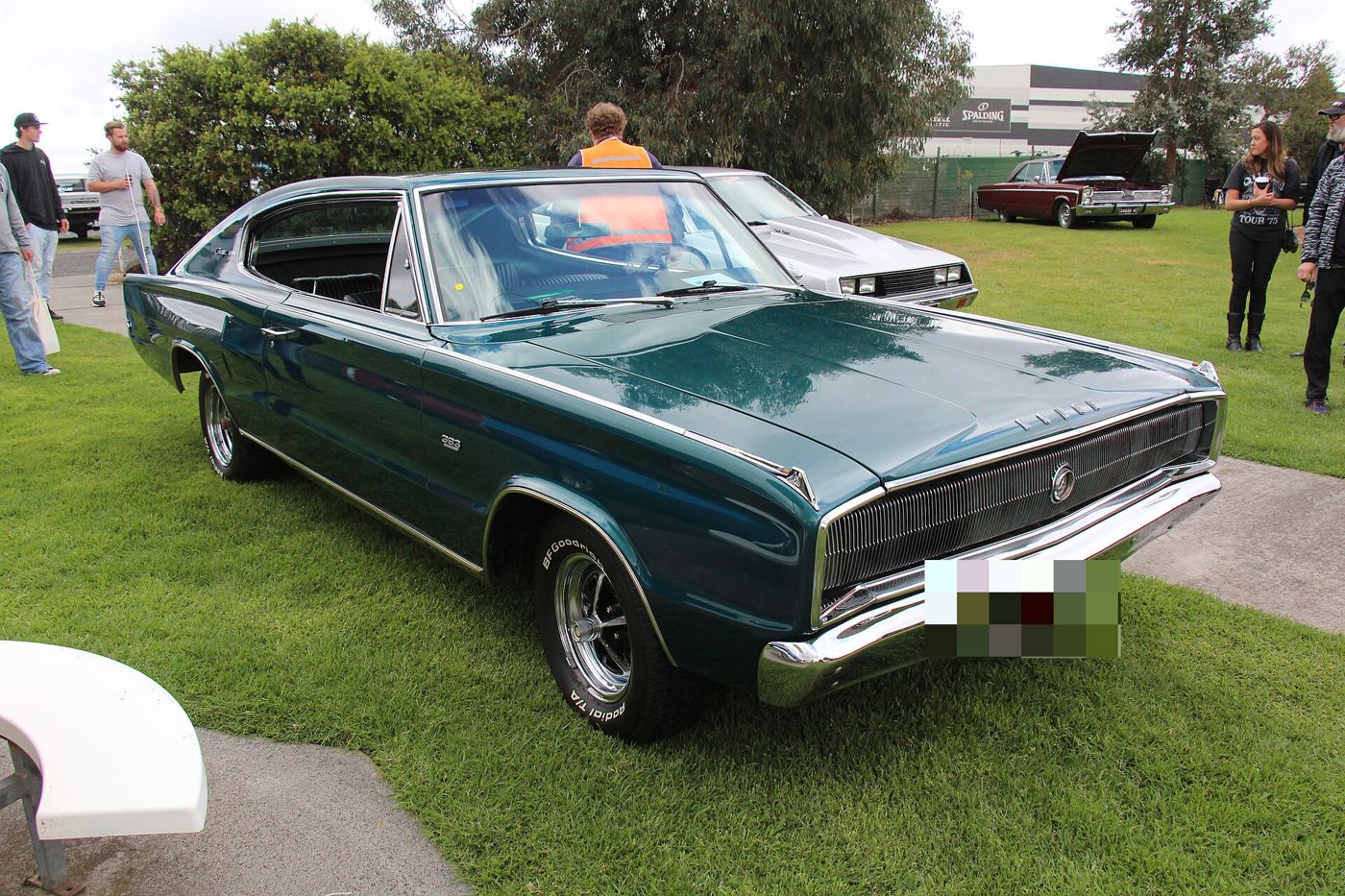
Dodge's 1967 Charger brochure picked a fight on its third page. Under the headline "Stay ahead of the herd," it asked: "Why play around with pony-sized fastbacks?" The answer was to "saddle up" a full-sized Charger with a choice of five V8s from 318 to 440 cubic inches, and elsewhere the brochure called the car "America's only full-sized fastback." It was confident copy for a car whose first year Ate Up With Motor calls an underwhelming debut, and it was written for a body whose replacement had already been approved. The 1967 Charger was a second season for a first idea.1
Ate Up With Motor's history lays out how early that decision came. The design that became the 1968 Charger was mainly the work of stylist Richard Sias, a former GM designer hired by Dodge styling manager Charles Mitchell in 1964. Before leaving on a European trip in mid-1965, Bill Brownlie ordered the clay model destroyed; while he was away, Elwood Engel saw it and backed it, and Brownlie could not stop the project when he returned. Sias later credited Engel with the flip-up gas filler. The design went to Chrysler's Corporate Product Planning Committee in the summer of 1965, before the original Charger had even gone on sale.1
That original Charger had been introduced on January 1, 1966, in Stellantis's heritage account, as Dodge's first production fastback: a Coronet chassis under its own body, with a fastback roof and full-width taillamps drawn from the Charger II show car, four bucket seats and a full-length console. For 1967 Dodge changed little. Over-Drive and the Stellantis history agree on small turn indicators on the front fenders, a few new pieces of chrome and a new vinyl-roof option, while a collapsible steering column and a dual-circuit master cylinder became standard.2,3
The brochure sold the Charger as a car of many moods. Its opening spread, "Lash out at lazy luxury cars," promised that the fastback carried four in stride and hauled wagon-sized loads with the rear seats folded. A detail page showed the concealed headlamps that rotated into view, the full-width band of rear lighting across the tail, and optional wheel covers styled like mag wheels. Over-Drive lists the standard equipment beyond the Coronet 500's: paint stripes, map and courtesy lights, front and rear bucket seats, rear center armrests, a tinted rear window, a tachometer, an oil-pressure gauge and the 318 V8. The brochure offered a three- or four-speed manual or TorqueFlite.3
Under the hood, the new story was the 440. Over-Drive's engine list for the Charger runs from the 318, rated at 230 horsepower and 340 lb-ft, through a two-barrel 383 at 270 horsepower and a four-barrel 383 at 325, to the 440 at 375 horsepower at 4,600 rpm and 480 lb-ft at 3,200, and finally the 426 Street Hemi at 425 horsepower at 5,000 rpm and 490 lb-ft at 4,000. Those are the advertised ratings of the day. The option prices tell the real story: $97 for the four-barrel 383, $133 for the 440 and $712 for the Hemi, more than five times the price of the big wedge.3,4
Buyers were scarce all the same. Kelly Flory's table puts 1967 Charger production at 15,788, down 57.67 percent from 1966, and the same total appears in Mike Mueller's source book, in Richard Langworth's collectible-car guide and in a 1969 Automotive Industries statistical table. Mueller and Tom Glatch count 14,666 of those cars as domestic. The base price in Flory's table was $3,128. Ate Up With Motor calls the car's two-year run of 53,132 sales an underwhelming debut that accounted for a little less than 5 percent of Dodge's volume.5,6,7,8,4,1
Within that small total, the big engines were rarer still. Mueller and Glatch give 660 Chargers with the new 440 Magnum, about 4 percent of 15,788. For the Hemi the specialists disagree by one car: Mueller and Glatch count 117, John Gunnell's Standard Guide counts 118, and neither names the record behind its figure. Either way the Street Hemi went into fewer than one Charger in a hundred and thirty. The 440, at $133, found more than five buyers for every Hemi.4,9
Part of the 440's problem was in the same showroom. Over-Drive describes the Coronet R/T as new for 1967, created to book-end the Charger at the top of Dodge's intermediate line, and it came with the 440 Magnum, dual exhausts, TorqueFlite, Red Streak tires, heavy-duty shocks, torsion bars and brakes, and a scooped hood as standard. John Gunnell's field guide counts 10,181 Coronet R/Ts for 1967, and Clay Fees counts 238 of them with the Hemi. The notchback R/T therefore put more 440s and more Hemis on the road than the fastback Charger did, and on those numbers the notchback, not the fastback, was where Dodge's 1967 big-engine buyers went. The Charger's case rested on its shape, its four buckets and its fold-down rear seats.3,10,11,4
On the racetrack, the fastback had already shown its limits. Ate Up With Motor recounts that the Charger's sleek roof hid excessive lift that made it hard to control at high speed, and that a last-minute rear-deck spoiler helped keep the tail down without giving it much advantage over notchback rivals. David Pearson drove a Charger to the 1966 NASCAR Grand National championship, but Ford won the manufacturers' title that year. The same history goes on to trace how aerodynamics drove the Charger's next chapters, from the redesigned 1968 body to the Charger 500 and the winged Daytona.1
The replacement arrived for 1968 with what Stellantis calls all-new styling, meant to create a performance coupe that looked ready to race on Daytona's high banks. The market's reply was immediate. The same Automotive Industries table that records 15,788 Chargers for 1967 records 96,108 for 1968, roughly six times as many. That comparison makes the 1967 car easy to overlook, but it also makes it one of the scarcer Chargers of the muscle era: a carry-over fastback, sold against the new pony cars its own brochure mocked, with a new 440 that only 660 buyers ordered and a Hemi that barely more than a hundred did.2,8,4
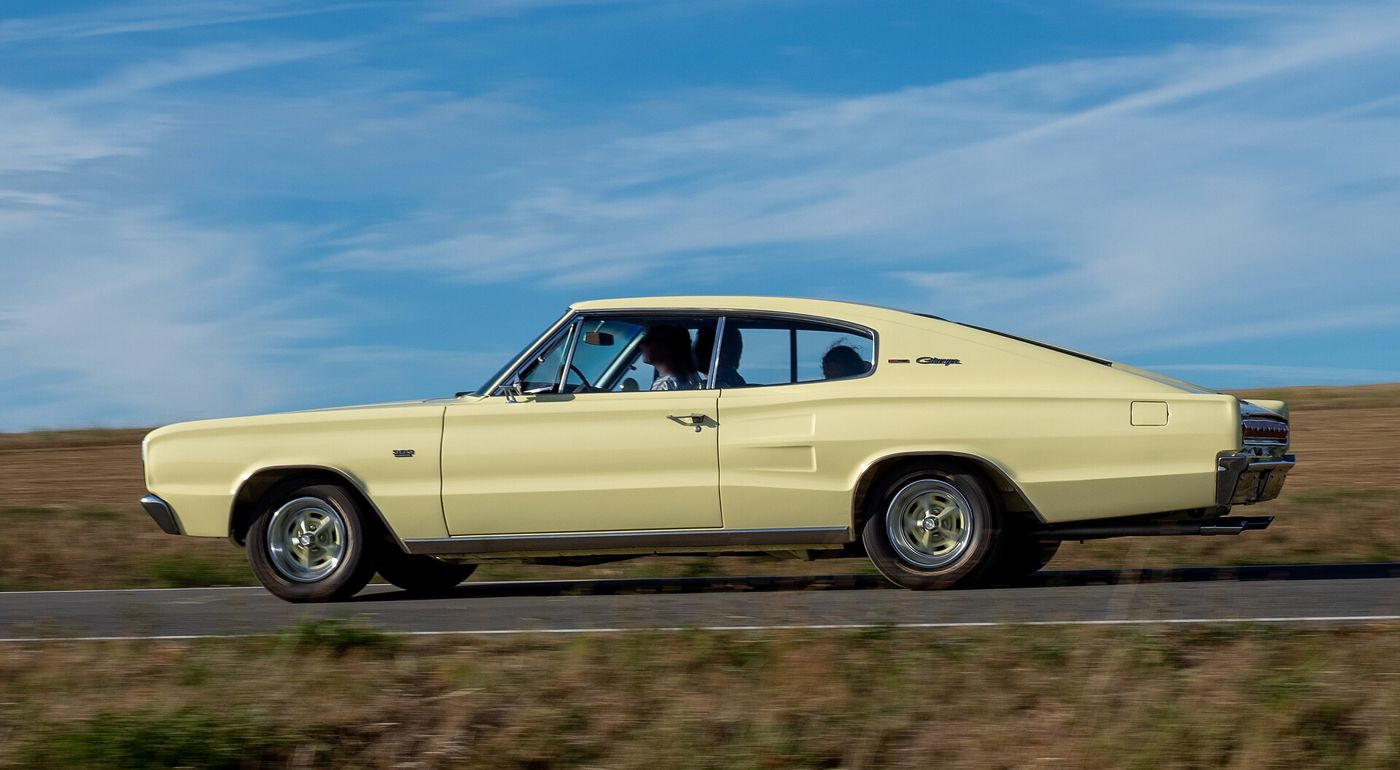
Fact sheet · 1967 · United States
The numbers
1967 Dodge Charger — The first-generation fastback's second and last year: the 440 Magnum joined the options, and production fell to 15,788.
Coverage: Partial — researched sections are shown; missing ones are not yet sourced. Researched through 2026-09-23.
Every figure is labeled with how sure we are. Reported means a manufacturer, registry, or reference figure we cite but have not reconciled against factory records ourselves. Disputed means credible sources disagree and both are shown. Rows are separately scoped; don't add them together unless the note says they make up a total.
Key facts
Production
| What was counted | Count | Basis | Status |
|---|---|---|---|
| Charger fastback, all engines5,6,8,7 Charger · 2-door fastback hardtop · all markets | 15,788 | built, model-year | Reported |
| Charger, domestic4 Charger · 2-door fastback hardtop · US | 14,666 | built, model-year | Reported |
| Charger (Over-Drive production table)3 2-door fastback hardtop · not stated Same figure as the Flory row; lineage not stated by Over-Drive. | 15,788 | built, model-year | Reported |
| What was counted | Count | Basis | Status |
|---|---|---|---|
| Charger, 440 Magnum4 Charger · 2-door fastback hardtop · 440 4-bbl · not stated | 660 | built, model-year | Reported |
| Charger, 426 Hemi4 Charger · 2-door fastback hardtop · 426 Hemi 2x4-bbl · not stated Gunnell gives 118; see conflicts. | 117 | built, model-year | Disputed |
Rows are separately scoped; do not add them.
Over-Drive's 1967 mid-size table totals the Dodge mid-size line (Coronet series, Coronet R/T and Charger) at 199,769; that is not a Charger figure.
Prices when new
| Model | Price | Basis |
|---|---|---|
| Base MSRP, Charger 2-door hardtop (XP29)5 | $3,128 | base manufacturer's suggested retail price as tabulated by Flory, 1967 model year |
| Base price, Charger 2-door fastback hardtop (CWP-29), V-83 | $3,128 | base price as tabulated by Over-Drive (manufacturer's suggested retail), 1967 model year |
Prices are the nominal dollars of the day, not adjusted for inflation.
Engines
| Engine | Factory rating | Availability | Built |
|---|---|---|---|
| 440 Magnum V-84,12 440 cu in · 4-barrel | 375 hp @ 4,600, 480 lb-ft @ 3,200 (SAE gross (AMA 'publishing max bhp', corrected to 60 F and 29.92 in Hg)) | optional (new for 1967) | 6604 Reported |
| 426 Hemi V-84,12 426 cu in · two 4-barrel | 425 hp @ 5,000, 490 lb-ft @ 4,000 (SAE gross (AMA 'publishing max bhp')) | optional | 1174 Disputed |
| 318 2-bbl V-812 318 cu in · 2-barrel | 230 hp @ 4,400, 340 lb-ft @ 2,400 (SAE gross (AMA 'publishing max bhp')) | standard on Charger (P-29) | Not yet sourced |
| 383 2-bbl V-812 383 cu in · 2-barrel | 270 hp @ 4,400, 390 lb-ft @ 2,800 (SAE gross (AMA 'publishing max bhp')) | optional | Not yet sourced |
| 383 4-bbl V-812 383 cu in · 4-barrel | 325 hp @ 4,800, 425 lb-ft @ 2,800 (SAE gross (AMA 'publishing max bhp')) | optional | Not yet sourced |
Ratings are the manufacturer's advertised figures under the standard shown (SAE gross before 1972, SAE net after). They are not dyno results, and gross and net ratings can't be compared directly.
Transmissions
| Transmission | Availability | Built |
|---|---|---|
| 3-speed manual12 | standard on Charger | Not yet sourced |
| 4-speed manual12 | optional with the 383, 426 and 440 only | Not yet sourced |
| TorqueFlite 3-speed automatic12 | optional on Charger | Not yet sourced |
Options and packages
| Code | Option | Price | Installed |
|---|---|---|---|
|
Vinyl roof (new option for 1967)2 | — | Not yet sourced |
|
383 cu in 2-bbl V-8 (270 hp), in Charger3 | $56 | Not yet sourced |
|
383 cu in 4-bbl V-8 (325 hp), in Charger3 | $97 | Not yet sourced |
|
440 cu in 4-bbl V-8 (375 hp)3 | $133 | Not yet sourced |
|
426 Street Hemi V-8, in Charger3 | $712 | Not yet sourced |
|
4-speed manual transmission (not with 225, 273 or 318)3 | — | Not yet sourced |
|
TorqueFlite automatic, with V-8s3 | — | Not yet sourced |
|
Heavy-duty Sure-Grip differential, 440 and 426 Hemi only3 | $107 | Not yet sourced |
|
Air conditioning (Coronet and Charger)3 | $274 | Not yet sourced |
|
Wood-grained steering wheel, on Charger3 | $16 | Not yet sourced |
|
AM radio (Coronet and Charger)3 | $44 | Not yet sourced |
|
Power front disc brakes3 | $54 | Not yet sourced |
|
Power steering3 | $73 | Not yet sourced |
|
Auto Pilot cruise control3 | $64 | Not yet sourced |
|
Simulated 'mag' wheel covers3 | — | Not yet sourced |
|
Vinyl top, hardtops3 | $70 | Not yet sourced |
Paint
| Code | Color | Built |
|---|---|---|
6 |
Mauve3 | Not yet sourced |
8 |
Bright Blue3 | Not yet sourced |
A |
Silver3 | Not yet sourced |
B |
Black3 | Not yet sourced |
C |
Medium Blue3 | Not yet sourced |
D |
Light Blue3 | Not yet sourced |
E |
Dark Blue3 | Not yet sourced |
F |
Light Green3 | Not yet sourced |
G |
Dark Green3 | Not yet sourced |
H |
Dark Copper3 | Not yet sourced |
J |
Chestnut3 | Not yet sourced |
K |
Medium Turquoise3 | Not yet sourced |
L |
Dark Turquoise3 | Not yet sourced |
M |
Bronze3 | Not yet sourced |
P |
Bright Red3 | Not yet sourced |
Q |
Dark Red3 | Not yet sourced |
R |
Yellow3 | Not yet sourced |
S |
Cream3 | Not yet sourced |
T |
Medium Copper3 | Not yet sourced |
W |
White3 | Not yet sourced |
X |
Light Tan3 | Not yet sourced |
Y |
Medium Tan3 | Not yet sourced |
Z |
Gold3 | Not yet sourced |
Color names are the factory's. We don't show color swatches, because a screen color is no guide for a restoration.
Specifications
| Measure | Value | Applies to |
|---|---|---|
| Wheelbase12 | 117 in | Charger CW2-P-29 |
| Overall length12 | 203.6 in | Charger |
| Overall width12 | 75.3 in | Charger |
| Overall height12 | 54.5 in | Charger |
| Track, front / rear12 | 59.5 / 58.5 in | all Coronet and Charger models |
| Curb weight, 318 V-812 | 3,625 lb | Charger special 2-door hardtop |
| Shipping weight12 | 3,475 lb | Charger special 2-door hardtop |
| Shipping weight (Over-Drive table)3 | 3,480 lb | Charger CWP-29 |
| Standard tyres12 | 7.35 x 14 | Charger |
| Standard axle ratio, 3-speed manual / automatic12 | 2.94 / 2.94 :1 | Charger with 318; 4-speed 3.23 (3.54 with Hemi) |
Identification
- 1967 identifiers
- Small turn indicators on the front fenders distinguish the 1967 car from the 1966.2
- Style number
- Flory lists the 1967 Charger hardtop as XP29.5
- AMA style code
- The AMA specification heads the 1967 Charger column as CW2 series, style 29 (V-8 only); Over-Drive's table prints CWP-29.12
Where the sources disagree
Identification
Read a 1967 Dodge VIN
The VIN decoder runs in your browser and never sends the VIN anywhere. How the factory numbered this year's cars:
Same model year
Also in 1967
- AMC Rebel and Rebel Machine The Rebel name returned on AMC's new intermediate, offered with a 280-hp 343 four-barrel V8. This is host-car context for the later Machine.
- Buick Riviera A new 430 V-8 (360 hp, 475 lb-ft) replaced the Nailhead; 4,837 cars had the GS handling option.
- Buick Skylark Gran Sport, GS and GSX A new 400 cu in V-8 made the Gran Sport the GS 400, joined by a 340 cu in GS 340 and a California GS coupe.
- Buick Wildcat The new 430 V-8 (360 hp, 475 lb-ft) replaced the Nailhead.
- Chevrolet Chevelle and Malibu SS Second year of the SS 396 series: 59,685 sport coupes and 3,321 convertibles, front disc brakes newly listed, and a late, barely documented L78.
- Chevrolet Chevy II and Nova Super Sport production fell to 10,069 in the source table. Enthusiast-compiled production: 106,430 cars; Super Sport 10,069.
- Chevrolet El Camino SS No factory Super Sport El Camino is documented for this year; the record carries the host El Camino production as context.
- Chevrolet Impala SS The SS427 (RPO Z24) arrives: 2,124 of about 76,000 Impala Super Sports.
- Dodge Coronet R/T and Super Bee Dodge's first R/T: a Coronet hardtop or convertible with the 440 Magnum standard and the 426 Hemi as a special-order option; its production total is published two ways.
- Dodge Dart GTS, Swinger and Demon The restyled 1967 Dart GT offered a 235 hp 273 four-barrel and, for the first time, a 280 hp 383; Over-Drive counts 437 383-engined cars within 38,200 GT hardtops and convertibles.
- Ford Fairlane A facelifted second year for the big-block Fairlane: GT and GTA continued as Fairlane 500 hardtops and convertibles, and a 427 was offered in small numbers for drag racing.
- Ford Galaxie The last year of the approved Galaxie performance range: the 7-Litre quietly disappeared, while the 428 and a 425-hp 427 remained on the order form.
- Ford Thunderbird A new, larger fifth-generation Thunderbird added a four-door Landau; the 428 was the performance option.
- Mercury Comet and Cyclone The Cyclone and Cyclone GT continued as hardtop and convertible, and a handful of Comets were built with the 427 side-oiler.
- Mercury Cougar Mercury's first pony car arrived as a single hardtop body, added the XR-7 at mid-year, and built 150,893 in its first season.
- Mercury Marauder and S-55 The S-55's last year: 570 hardtops and 145 convertibles with the 428 four-barrel, per Wikipedia's table.
- Oldsmobile Cutlass, 4-4-2 and Hurst/Olds Multiple carburetors were gone, the 4-4-2 was trimmed as a Cutlass Supreme, and the W-30 cold-air package became a regular factory option on about 500 cars.
- Plymouth Barracuda and 'Cuda The redesigned second-generation Barracuda added a notchback hardtop and a convertible to the fastback, and the Formula S could now carry a 383.
- Plymouth GTX, Belvedere and Satellite Plymouth's first GTX put a 375-hp 440 Super Commando in a dressed-up Belvedere hardtop and convertible, with the 426 Hemi as the only engine option.
- Pontiac Catalina 2+2 and Super Duty The 2+2 returned to option status with a standard 360 hp 428, and only 1,768 were built.
- Pontiac Firebird and Trans Am Pontiac's late entry into the pony-car field: a Camaro body with a Pontiac nose, five engine-defined models, and 82,560 built in a short first season.
- Pontiac GTO Tri-Power gone, the 389 grown to 400, and a Ram Air option that Car Life ran to a 14.5-second quarter mile.
- Pontiac Grand Prix Concealed headlamps, a standard 350 hp 400, and the only Grand Prix convertible: 5,856 built.
- Pontiac Tempest and LeMans The Sprint six grows to 215 hp and the 326 HO continues; 109,413 LeMans built.
- Rambler and AMC Marlin The last Marlin moved to a 118-inch wheelbase with 290 and 343 V8s listed, the top one a 280-hp 343. Only 2,545 were built.