1964 · Plymouth · United States
1964 Plymouth Max Wedge: Two Names for the Same Engine, and a Daytona Sweep
Plymouth's last Max Wedge year offered the Super Stock 426-III beside a 365 hp street 426 Commando, while a competition-only 426 Hemi went into lightened Savoy/Belvedere drag cars and swept the Daytona 500.
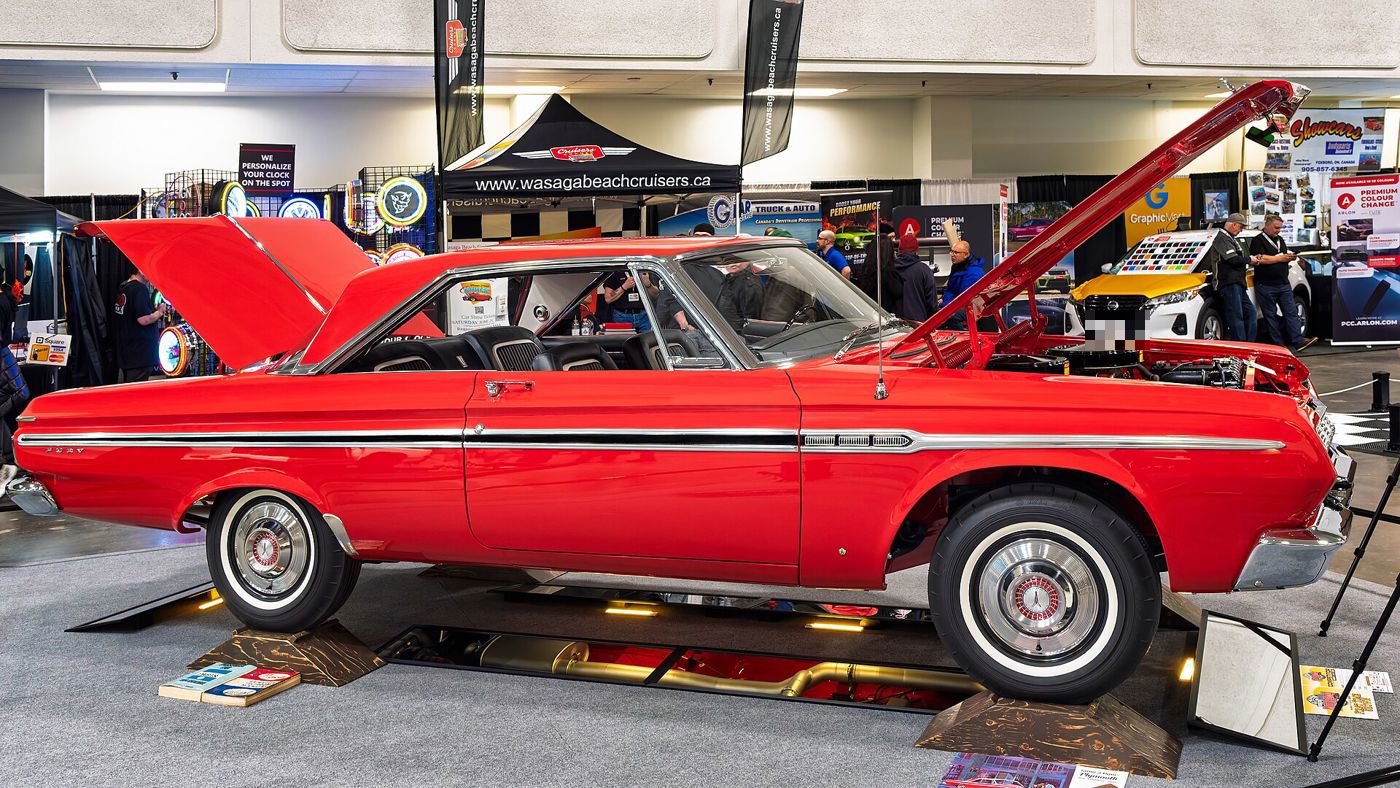

Plymouth's 1964 brochure let a Sport Fury buyer step up from the 383 to a 426 "Commando" street V8 paired with a Hurst-shifted four-speed, advertised at 365 horsepower at 4,800 rpm and 470 lb-ft at 3,200 rpm. The two factory documents disagree on that engine's own compression ratio: the period brochure states 10.3:1, while Over-Drive's fact sheet prints 11.00:1 for the same 365-horsepower engine. The brochure gives the Commando a 4.25-inch bore and 3.75-inch stroke under a Carter four-barrel, and the fact sheet prices it at $483.1
Above the street Commando sat the dual-four-barrel Super Stock 426, priced at $515 for 415 horsepower and $545 for 425, both labeled "Super Stock III" on the fact sheet's own price list despite covering two different power levels. The fact sheet's engine table compounds the confusion by naming the 425-horsepower version two different ways in two different rows, "Super Stock 426 II" at 13.5:1 in one place and "Super Stock 426 Stage III" at 11.0:1 in another, so the same 425-horsepower rating carries two names and two compression ratios in one table.1
Chrysler released a genuinely race-only engine on February 9, 1964: the competition 426 Hemi, rated 400 horsepower in single-four-barrel NASCAR form or 425 horsepower at 6,000 rpm as a dual-four-barrel "Acceleration" version, not sold to the general public and costing roughly $1,800 over the counter. The drag-oriented version came as part of the A864 package, built on Dodge 330/440 and Plymouth Savoy/Belvedere bodies with aluminum panels, lightweight seats, and the rear seat deleted. That same Hemi-powered effort paid off on the track: Richard Petty led a Plymouth sweep of the top three finishing positions at the 1964 Daytona 500, on his way to his first championship, a competition result that gave the otherwise unavailable street name real marketing weight even though ordinary buyers could never put the winning engine under their own hood.1,2,3
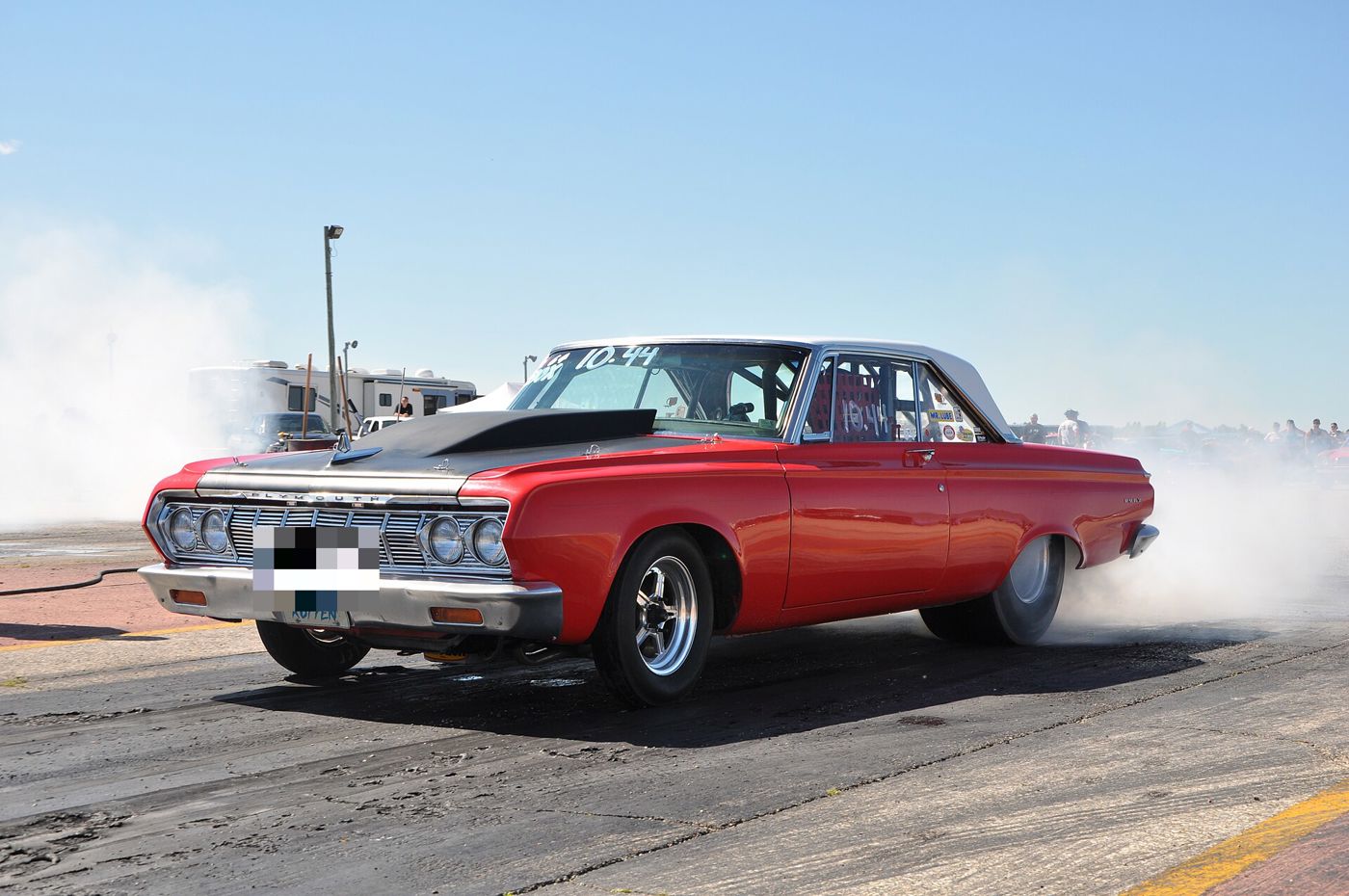

Plymouth's Super Stock and race-Hemi cars came out of the same bodies as everyday Savoys, Belvederes, Furys and Sport Furys, and those bodies sold in large numbers. Body counts, every engine included, ran from 5,364 Belvedere two-door sedans up to 57,307 Belvedere four-door sedans. The Savoy two-door sedan, a host body for Super Stock and A864 cars, sold 21,326, and Sport Fury buyers took 23,695 hardtops and 3,858 convertibles. A separately compiled Over-Drive table puts the full 1964 Plymouth standard line at 295,999 units. In that table a Savoy two-door sedan with a V8 started at $2,332 and a Sport Fury convertible at $3,095, before any Super Stock engine was added.1,4
The fact sheet's price list also carries a "Street" 426 rated 400 horsepower at $514, an entry that matches none of its engine rows. Buyers who wanted to shift for themselves paid $188 for the Hurst four-speed, while the TorqueFlite automatic ran $191 to $210. Underneath all of these engine choices, the 1964 full-size Plymouth kept its 116-inch wheelbase and grew slightly to 206.5 inches overall, riding on 7.00x14 tires except for station wagons, which used the larger 7.50x14 size.1
Fact sheet · 1964 · United States
The numbers
1964 Plymouth: Super Stock III, the 426 Commando and the race Hemi: Plymouth's last Max Wedge year offered the Super Stock 426-III beside a 365 hp street 426 Commando, while a competition-only 426 Hemi went into lightened Savoy/Belvedere drag cars and swept the Daytona 500.
Figures may describe different groups of cars. Add rows together only when the note says they make up a total.
Key facts
Production
| What was counted | Count | Counted as |
|---|---|---|
| Savoy two-door sedan (all engines)1 Savoy · 2-door sedan A host body for Super Stock and A864 cars; not a Max Wedge count. | 21,326 | sold |
| Savoy four-door sedan (all engines)1 Savoy · 4-door sedan | 51,024 | built |
| Savoy station wagon (all engines)1 Savoy · station wagon | 15,643 | built |
| Belvedere two-door sedan (all engines)1 Belvedere · 2-door sedan | 5,364 | sold |
| Belvedere two-door hardtop (all engines)1 Belvedere · 2-door hardtop | 16,334 | built |
| Belvedere four-door sedan (all engines)1 Belvedere · 4-door sedan | 57,307 | built |
| Belvedere station wagon (all engines)1 Belvedere · station wagon | 14,524 | built |
| Fury two-door hardtop (all engines)1 Fury · 2-door hardtop | 26,303 | built |
| Fury four-door hardtop (all engines)1 Fury · 4-door hardtop | 13,713 | built |
| Fury four-door sedan (all engines)1 Fury · 4-door sedan | 34,901 | built |
| Fury convertible (all engines)1 Fury · convertible | 5,173 | built |
| Fury station wagon (all engines)1 Fury · station wagon | 6,834 | built |
| Sport Fury two-door hardtop (all engines)1 Sport Fury · 2-door hardtop | 23,695 | sold |
| Sport Fury convertible (all engines)1 Sport Fury · convertible | 3,858 | sold |
| What was counted | Built |
|---|---|
| 1964 Plymouth standard line, all models (Over-Drive table total)4 | 295,999 |
Prices when new
| Model | Price | Price type |
|---|---|---|
| Savoy 2-door sedan, V8 (VP2-L 311)4 | $2,332 | factory / base price, 1964 model year |
| Belvedere 2-door sedan, V8 (VP2-M 321)4 | $2,466 | factory / base price, 1964 model year |
| Belvedere 2-door hardtop, V8 (VP2-M 322)4 | $2,551 | factory / base price, 1964 model year |
| Fury 2-door hardtop, V8 (VP2-H 332)4 | $2,706 | factory / base price, 1964 model year |
| Fury convertible, V8 (VP2-H 335)4 | $2,937 | factory / base price, 1964 model year |
| Sport Fury 2-door hardtop (VP2-P 342)4 | $2,864 | factory / base price, 1964 model year |
| Sport Fury convertible (VP2-P 345)4 | $3,095 | factory / base price, 1964 model year |
Prices are the nominal dollars of the day, not adjusted for inflation.
Engines
| Engine | Factory rating | Availability |
|---|---|---|
| 426 Commando street V8, 4-bbl, 365 hp1 426 cu in · 4-barrel (Carter AFB-3704S) | 365 hp @ 4,800, 470 lb-ft @ 3,200 (manufacturer published) | optional (street) |
| Super Stock 426 (III), dual 4-bbl short ram, 415 hp1 426 cu in · 2 x 4-barrel (Carter AFB-3705S) | 415 hp @ 5,600, 470 lb-ft @ 4,400 (manufacturer published) | optional |
| Super Stock 426 (Stage III), dual 4-bbl short ram, 425 hp1 426 cu in · 2 x 4-barrel (Carter AFB-3705S) | 425 hp @ 5,600, 480 lb-ft @ 4,400 (manufacturer published) | optional |
| 426 Hemi, NASCAR, 4-bbl, 400 hp (competition only)1 426 cu in · 4-barrel | 400 hp @ 5,600, 465 lb-ft @ 3,800 (manufacturer published) | not available to the general public |
| 426 Hemi, 'Acceleration', dual 4-bbl, 425 hp (competition only)1,2 426 cu in · 2 x 4-barrel | 425 hp @ 6,000, 480 lb-ft @ 4,600 (manufacturer published) | not available to the general public; A864 drag package |
Ratings are published figures, not dyno results. Gross and net ratings aren't directly comparable.
Transmissions
| Transmission | Availability |
|---|---|
| Four-speed manual, Hurst floor shift1 | optional ($188) |
| TorqueFlite automatic1 | optional ($191-$210) |
Options and packages
| Option | Price |
|---|---|
| 'Commando' 426 V8, 365 hp1 | $483 |
| 'Super Stock III' 426 V8, 415 hp1 | $515 |
| 'Super Stock III' 426 V8, 425 hp1 | $545 |
| 426 Hemi competition engine1 | $1,800 |
| Hurst four-speed manual1 | $188 |
| Sure-Grip differential1 | $50 |
| Automatic transmission (stated as a $191-$210 range; lower bound shown)1 | $191 |
| 'Commando' 361 265 hp 2-bbl V81 | $59 |
| 'Commando' 383 305 hp 2-bbl V81 | $71 |
| Four-barrel carburetor on Commando 3831 | $51 |
| 'Commando' 383 330 hp 4-bbl V81 | $122 |
| 'Street' 426 400 hp V8 (as listed by the fact sheet)1 | $514 |
Paint
| Code | Color |
|---|---|
A |
Barracuda Gold1 |
B |
Ebony1 |
C/D/E |
Light / Medium / Dark Blue1 |
H |
Sandalwood1 |
J/K/L |
Light / Medium / Dark Turquoise1 |
M |
Medium Gray1 |
P |
Ruby1 |
T |
Signet Royal Red1 |
V |
Chestnut1 |
W |
White1 |
X/Y |
Light Tan / Medium Tan1 |
Color names are the factory's. We don't show color swatches, because a screen color is no guide for a restoration.
Specifications
| Measure | Value | Applies to |
|---|---|---|
| Wheelbase1 | 116 in | passenger cars |
| Overall length1 | 206.5 in | sedans and hardtops |
| Overall width | 75.6 in | except wagons |
| Tires1 | 7.00 x 14 (7.50 x 14 wagons) |
Identification
- Serial number car line
- In 1964 Chrysler serial numbers, car-line digit 3 is Plymouth V8.5
Where the sources disagree
Compression ratio of the 1964 426 Commando street engine
- 10.3:1
- 11.00:11
Identification
Read a 1964 Plymouth VIN
The VIN decoder runs in your browser and never sends the VIN anywhere. How the factory numbered this year's cars:
Same model year
Also in 1964
- Buick Riviera The 425 became standard, the dual-quad Super Wildcat 360 arrived as an option, and the Super Turbine 400 replaced the twin-turbine automatic.
- Buick Wildcat The best Wildcat year at 84,245, with a 425 in 340- or 360-hp form and an available four-speed.
- Chevrolet Chevelle and Malibu SS The first Chevelle; the Malibu SS was a series, and its strongest released engine was the midyear 300 hp L74 327.
- Chevrolet Chevy II and Nova First V8 (283) year in the source engine table. Enthusiast-compiled production: 191,691 cars; Super Sport 10,576.
- Chevrolet El Camino SS The Chevelle-bodied pickup in 300 and Malibu trim, before any Super Sport version: 32,548 built, 20,576 of them Malibu V8s.
- Chevrolet Impala SS Super Sport becomes its own series: 185,325 built.
- Chrysler 300 letter series Cheaper by about $1,000, with a single-four-barrel 360 hp 413 standard, leather made optional and the convertible restored, the 300K became the best-selling letter car: 3,022 hardtops and 625 convertibles.
- Dodge Dart 330/440, Polara and Max Wedge The Max Wedge's last year brought the Ramcharger 426-III, a 365 hp street 426 for Polara buyers, and in midyear a competition-only 426 Hemi in lightened 330/440 bodies; Roger Lindamood's Dodge won Top Stock at the Nationals.
- Ford Fairlane The year of the Thunderbolt: a midsize Fairlane with a 427 installed for NHRA Super Stock, which carried Gas Ronda to the national Stock title.
- Ford Falcon Sprint The restyled Falcon kept the Sprint hardtop and convertible with the 164 hp 260 V8 standard; the club counts 18,108 built, many with a bench seat.
- Ford Galaxie Ford sold its 427 in the restyled full-size range in two advertised versions, 410 hp with one four-barrel and 425 hp with two, and the Galaxie 500 XL hardtop was the bucket-seat flagship.
- Ford Thunderbird The redesigned fourth-generation car offered one drivetrain, a 300-hp 390 with Cruise-O-Matic, and output rose to 92,465.
- Mercury Comet and Cyclone The Cyclone name first appeared on a 1964 Comet hardtop; the only production figure found is a single secondary total.
- Mercury Marauder and S-55 Marauder now meant the fastback roof on any full-size Mercury series, two-door or four-door, with the 390 standard and the 427 optional.
- Oldsmobile Cutlass, 4-4-2 and Hurst/Olds Oldsmobile's first 4-4-2 was a mid-year option package, B09 Police Apprehender Pursuit, with a 310 hp 330, a four-speed and dual exhausts; 2,999 are tabulated.
- Oldsmobile Starfire Production fell to 16,163 as the cheaper Jetstar I took the same body; Motor Trend timed a convertible at 9.7 s to 60.
- Plymouth Barracuda and 'Cuda Plymouth's glassback Valiant-based fastback launched in a short first season and sold 23,443 cars.
- Pontiac Catalina 2+2 and Super Duty The 2+2 arrived as a $291 Catalina option and the 370 hp 421 HO replaced the Super Duty at the top.
- Pontiac GTO A $295 option on the Tempest LeMans that put Pontiac's 389 in the intermediate body; 32,450 were built.
- Pontiac Grand Prix A carryover year: 63,810 built, with the 370 hp 421 HO at the top of the option list.
- Pontiac Tempest and LeMans The Tempest becomes a 115-inch intermediate with a 326 V8, and the LeMans carries the new GTO option.
- Studebaker Avanti The last Studebaker Avanti, cut short when South Bend stopped building cars on 20 December 1963. It got rectangular headlamp bezels and a level stance, and 809 were built, including the nine production R3s.
- Studebaker Hawk The final Hawk, with a new deck lid and an optional vinyl 'Sports Roof', ended when South Bend closed on 20 December 1963. 1,767 were built, 1,484 of them domestic.
- Studebaker Lark and Super Lark Brooks Stevens restyled the Lark-type line and the Daytona became its top series. Of the V8 Daytonas, 111 got the R1 and 48 the supercharged R2, and one got the only production R4, before South Bend closed in December 1963.