1968 · Buick · United States
1968 Buick GS: Stage 1 between the dealer and the drag strip
On the new 112 in two-door body the GS 400 was joined by a GS 350 hardtop, and a dealer-installed Stage 1 package arrived for the 400.
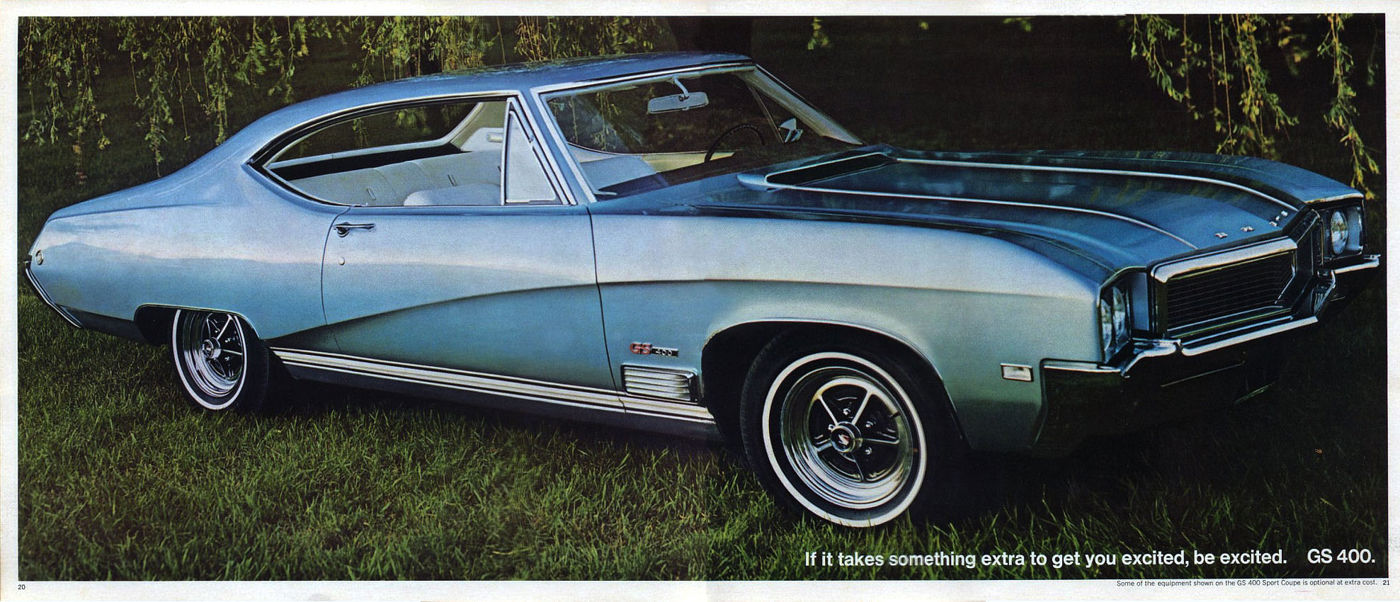
At Irwindale, the Buick in Car Life’s March 1968 report ran a 13.50-second quarter mile at 104.68 mph. It was a GS 400 hardtop with the Stage 1 Special Package, but it also had Mickey Thompson headers and cheater slicks. Those two details made it the magazine’s modified run, not its stock-condition result. Earlier in the same test, the automatic-equipped car recorded 14.4 seconds at 93.3 mph. The two performances describe different states of the same test car. Between them lay dealer preparation, tires and later changes, and the Stage 1 story needs all of them, not just a badge or a single quickest time.1
Buick’s showroom had changed around that experiment. The 1968 intermediates adopted General Motors’ split-wheelbase A-body arrangement, with the two-door cars on a 112-inch wheelbase. Within that family, the GS 350 was offered as a hardtop, while the GS 400 could be bought as a hardtop or convertible. The names described an engine choice as well as a place in the lineup. A buyer did not have to order a 400 to enter the Gran Sport range; the smaller-engine hardtop was a separate offering. Nor did choosing a GS 400 automatically mean choosing the Stage 1 preparation tested by Car Life. Body, engine and package are three different parts of the purchase.2
Car Life described Stage 1 as a dealer-installed Special Package for the GS 400. Its account names a special camshaft, forged pistons giving 11:1 compression, stronger valve springs, and carburetor and spark-timing changes. The ordinary 400’s listed compression ratio was 10.25:1. These were changes inside the engine and to its calibration, not just extra exterior identification. On a surviving car, the hardtop body and a GS emblem show neither those internal parts nor when they were installed. The magazine tested the preparation it described on one car. Not every 1968 GS 400 was an equivalent Stage 1 car.1,2
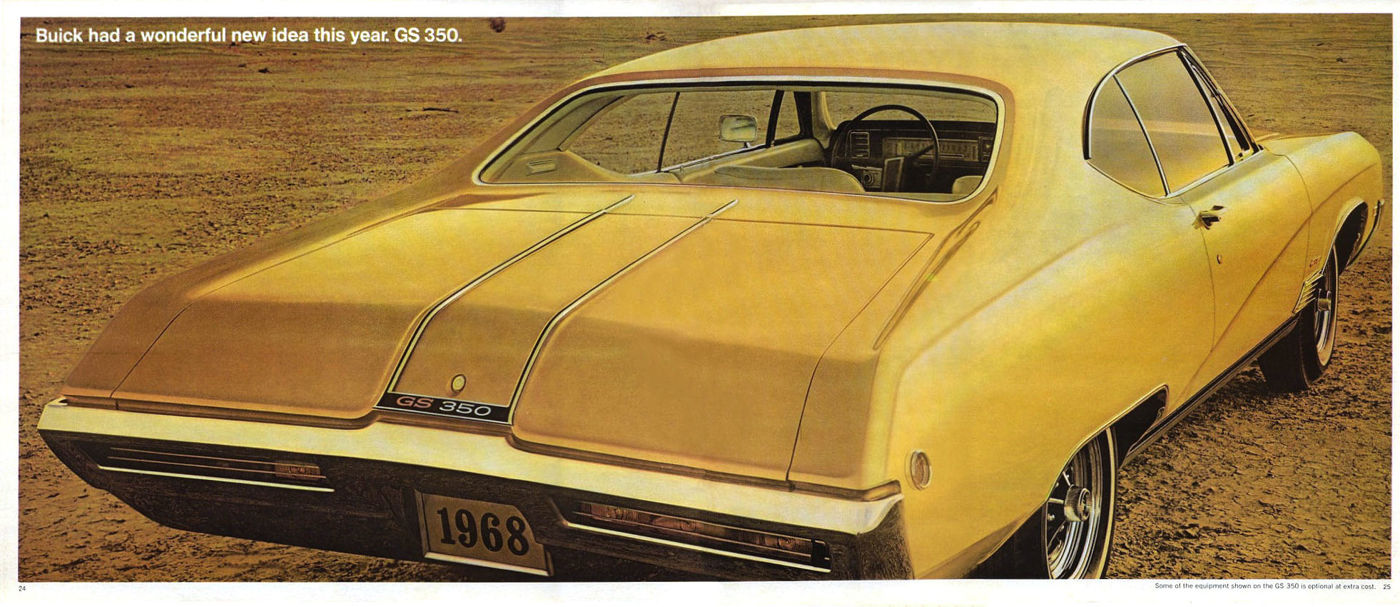
The horsepower figures do not tell one tidy story. Car Life printed a stated 345 bhp at 4,800 rpm for Stage 1, with 440 lb-ft at 3,200 rpm. Over-Drive’s later compilation instead lists the Stage 1 400 at 340 hp at 5,000 rpm, also with 440 lb-ft at 3,200 rpm; that horsepower figure matches its standard GS 400 listing. The two ratings stand side by side. They are published nominal ratings under period conventions, not measurements at the rear wheels and not a modern dynamometer comparison. A five-horsepower difference on paper cannot explain the modified quarter-mile result by itself. The parts the magazine described and its separately reported runs say more about the car than either rating does.1,2
The GS 350 supplied another route through the same showroom. Its four-barrel 350-cu-in V-8 was listed at 280 hp at 4,600 rpm and 375 lb-ft at 3,200 rpm, and the same rating appears for the California GS engine. Those figures belong to the 350, not to the 400’s specification. Transmission choices also differed by model. A floor-shift three-speed manual was standard on the GS 400, a four-speed manual was optional for the California GS, GS 350 and GS 400, and the Turbo Hydra-Matic 400 automatic was optional on the GS 400. The automatic in the road test was therefore one of several GS power teams, not the only GS arrangement.2
Car Life’s test configuration gives the acceleration numbers their meaning. The Stage 1 hardtop had a three-speed automatic, a 3.91 limited-slip axle and UniRoyal Laredo 7.75-14 tires. The stock-condition measurements included 0–60 mph in 6.1 seconds and the 14.4-second quarter mile. Its data panels also list a 3,648-lb curb weight and a separate 4,030-lb test weight. These are two different weights, each with its own label, not competing answers to be averaged. They go with the test configuration just as the axle and tires do. Without those details, or with the later headers-and-slicks time in place of the stock one, the numbers would give a misleading picture of what this particular Buick did in the magazine’s ordinary test.1
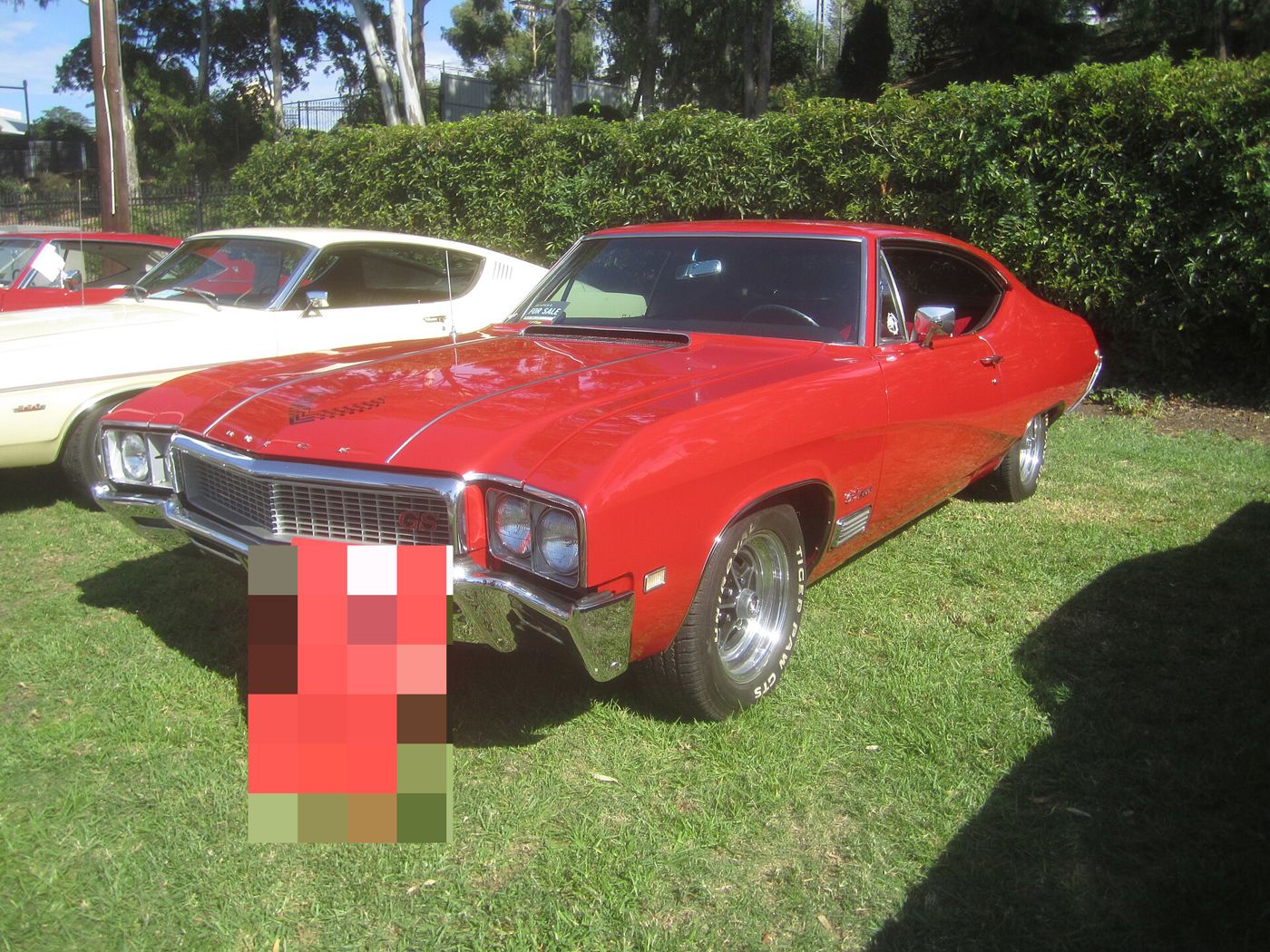

The bill for that test car also needs its labels. Car Life gave a $3,104 list price FOB factory and $3,839 as tested. Over-Drive’s production-and-price compilation lists the GS 400 hardtop at $3,528, its convertible at $3,672 and the GS 350 hardtop at $3,295. The magazine’s list and equipped figures are not the same kind of price, and its hardtop list figure differs from the later compilation. Nothing known about the equipment settles that difference. Each nominal US-dollar amount keeps its own basis and source. The as-tested figure is not a base price, and no known option bundle brings the two sources into agreement.1,2
The two GS branches came to 8,317 GS 350 hardtops, 10,743 GS 400 hardtops and 2,454 GS 400 convertibles. The latter two give 13,197 GS 400s. Across all of the Buick intermediate series, the total was 204,549; that much larger figure is not a Gran Sport count. No separate Stage 1 installation total or California GS breakout is known. A further trap lies in some published 1968 image captions, which repeat figures found in the same compiler’s 1969 table, including 1,176 convertibles and 4,933 GS 350s. Those captioned figures do not match the 1968 production rows and cannot support a rarity claim.2
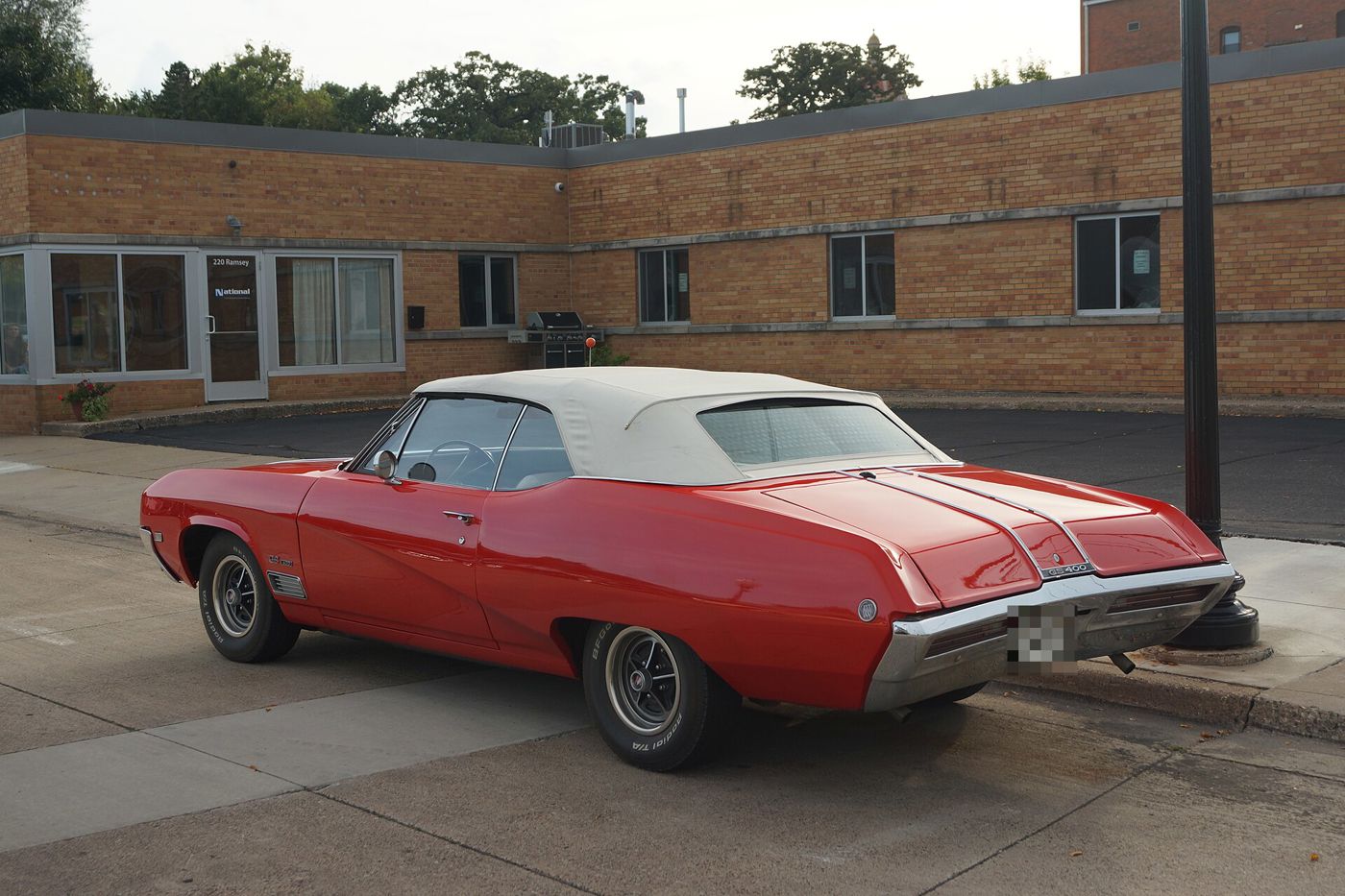

The remaining choices made two otherwise similar hardtops less alike. The factory options spread lists a full-length console for GS 350 and GS 400 only with bucket seats and an automatic, while power front disc brakes were broadly available beyond the LeSabre and Wildcat manual-transmission exceptions. Cruise Control was limited to V-8s with automatics; power windows excluded only the Special DeLuxe coupe and sedan, and a four-way power seat was listed across models. These are advertised ordering possibilities, not evidence that any surviving car was built with them. The 1968 paint chart ran to nineteen exterior codes, including Regal Black, Midnight Teal, Cameo Cream and Inca Silver Mist. Trim ran to six GS 350 entries and five GS 400 entries, with black, blue, green, buckskin, parchment and white vinyl combinations across the two groups.2,3
For a buyer examining a surviving Buick, the basic identifiers are a starting point. The body-model numbers were 43437 for the GS 350 hardtop, 44637 for the GS 400 hardtop and 44667 for the GS 400 convertible. Engine code PP identified the 350-cu-in, 280-hp engine and PR the 400-cu-in, 340-hp engine. Neither code shows a dealer-installed Stage 1 package or later modifications. Car Life’s Irwindale car is the lasting example: what a Buick was, how it had been prepared and how fast it went are related questions, each answered by different evidence. The 1968 GS is clearest when all three stay attached to the particular Buick being described.2,3,1
Fact sheet · 1968 · United States
The numbers
1968 Buick GS 350, GS 400 and Stage 1: On the new 112 in two-door body the GS 400 was joined by a GS 350 hardtop, and a dealer-installed Stage 1 package arrived for the 400.
Figures may describe different groups of cars. Add rows together only when the note says they make up a total.
Key facts
Production
| What was counted | Built |
|---|---|
| GS 400 (Skylark Gran Sport V-8)2 GS 400 · hardtop and convertible · 400 | 13,197 |
| All Buick intermediates in table2 Special DeLuxe, Skylark, Skylark Custom, GS 350, GS 400 | 204,549 |
| What was counted | Built |
|---|---|
| GS 400 hardtop coupe (44637)2 GS 400 · 2-door hardtop coupe · 400 | 10,743 |
| GS 400 convertible (44667)2 GS 400 · 2-door convertible · 400 | 2,454 |
| GS 350 hardtop coupe (43437)2 GS 350 · 2-door hardtop coupe · 350 4-barrel 280 hp | 8,317 |
Prices when new
| Model | Price | Price type |
|---|---|---|
| GS 400 hardtop (44637)2 | $3,528 | factory price, 1968 |
| GS 400 hardtop, list FOB factory (Car Life test car)1 | $3,104 | list FOB factory, 1968-03 |
| GS 400 convertible (44667)2 | $3,672 | factory price, 1968 |
| GS 350 hardtop (43437)2 | $3,295 | factory price, 1968 |
| Car Life Stage 1 test car, as tested1 | $3,839 | equipped, 1968-03 |
Prices are the nominal dollars of the day, not adjusted for inflation.
Engines
| Engine | Factory rating | Availability |
|---|---|---|
| 400 V-8, GS 4001,2 400 cu in · one 4-barrel | 340 hp @ 5,000, 440 lb-ft @ 3,200 (SAE gross) | standard, GS 400 |
| Stage 1 · 400 V-8 Stage 1 Special Package1 400 cu in · Rochester 4-barrel, recalibrated | 345 hp @ 4,800, 440 lb-ft @ 3,200 (SAE gross (stated rating, per Car Life)) | dealer-installed option, GS 400 (per Car Life) |
| 350 V-8 4-barrel, GS 3502 350 cu in · one 4-barrel | 280 hp @ 4,600, 375 lb-ft @ 3,200 (SAE gross (as listed by secondary source)) | standard, GS 350 and California GS |
Ratings are published figures, not dyno results. Gross and net ratings aren't directly comparable.
Transmissions
| Transmission | Availability |
|---|---|
| 3-speed manual, floor shift2 | standard, GS 400 |
| 4-speed manual2 | optional, California GS, GS 350, GS 400 |
| Turbo Hydra-Matic 4002,1 | optional, GS 400 |
Options and packages
| Option |
|---|
| Full-length floor console |
| Power front disc brakes |
| Cruise Control |
| Power windows |
| 4-way power seat |
Paint
| Code | Color |
|---|---|
A |
Regal Black2 |
B |
Midnight Teal2 |
C |
Arctic White2 |
D |
Blue Mist2 |
E |
Deep Fathom2 |
F |
Teal Blue Mist2 |
G |
Ivory Gold Mist2 |
K |
Aqua Mist2 |
L |
Medium Teal Blue Mist2 |
M |
Burnished Saddle2 |
N |
Maroon2 |
P |
Tarpon Mist Green2 |
R |
Scarlet Red2 |
S |
Olive Gold2 |
T |
Desert Beige2 |
V |
Charcoal2 |
W |
Silver Beige Mist2 |
X |
Buckskin2 |
Y |
Cameo Cream2 |
Z |
Inca Silver Mist2 |
Color names are the factory's. We don't show color swatches, because a screen color is no guide for a restoration.
Interiors
| Code | Trim |
|---|---|
118, 178 |
Gs350: Black, vinyl3 |
111, 171 |
Gs350: Blue, vinyl3 |
170 |
Gs350: Green, vinyl3 |
173 |
Gs350: Buckskin, vinyl3 |
114 |
Gs350: Parchment, vinyl3 |
172 |
Gs350: White, vinyl3 |
158, 178 |
GS 400: Black, vinyl3 |
171 |
GS 400: Blue, vinyl3 |
170 |
GS 400: Green, vinyl3 |
173 |
GS 400: Buckskin, vinyl3 |
152, 172 |
GS 400: White, vinyl3 |
Specifications
| Measure | Value | Applies to |
|---|---|---|
| Wheelbase1 | 112 in | two-door bodies |
| Overall length1 | 200.7 in | GS 400 hardtop |
| Curb weight, GS 400 Stage 1 test car1 | 3,648 lb | Car Life test car |
Period road tests
| Test | Car tested | Result |
|---|---|---|
| Car Life, 1968-0310-60 mph | GS 400 2-door hardtop, Stage 1 (345 bhp), 3-speed automatic, 3.91 limited-slip axle, 7.75-14 tires, test weight 4,030 lb | 6.1 s |
| Car Life, 1968-031standing quarter mile | GS 400 Stage 1, automatic, 3.91 axle93.3 mph | 14.4 s |
| Car Life, 1968-031standing quarter mile | GS 400 Stage 1, automatic, 3.91 axle, with Mickey Thompson headers and cheater slicks (modified)104.68 mph; tuned and modified, Irwindale | 13.5 s |
A road test result belongs to the one car that was tested, with its engine, gearing, tires, and conditions. It is not a figure for every car of the year.
Identification
- Body numbers
- GS 350 43437 hardtop; GS 400 44637 hardtop and 44667 convertible.2
- VIN
- E.g. 444377H101555: 4 = Buick; 2-3 = series (34 = GS 350, 46 = GS 400); 4-5 = body (37 GS 350 hardtop, 37 GS 400 hardtop, 67 convertible; TeamBuick lists 37 as hardtop coupe); 6 = year (8); 7 = plant (H, C, Z, X, Y, D, B, K, V, I); last six = production number.3
- Engine codes
- PP: 350 cu in, 280 hp, 10.25:1, 4-barrel (GS 350); PR: 400 cu in, 340 hp, 10.25:1, 4-barrel (GS 400).3
Where the sources disagree
Identification
Read a 1968 Buick VIN
The VIN decoder runs in your browser and never sends the VIN anywhere. How the factory numbered this year's cars:
Same model year
Also in 1968
- AMC AMX AMC's two-seat AMX arrived mid-year on a 97-inch wheelbase. The enthusiast production table counts 6,725 cars, two-thirds of them with the 390.
- AMC Javelin AMC's first pony car, launched in September 1967 as base and SST hardtops. Production of the two combined was about 55,000.
- AMC Rebel and Rebel Machine Now badged AMC, the Rebel came in 550, 770 and SST trims and could be ordered with the 315-hp 390. It is host-car context for the 1970 Machine.
- Buick Riviera Record Riviera sales of 49,284, including 5,337 with the GS handling option.
- Buick Wildcat 73,561 Wildcats with the 430 V-8.
- Chevrolet Chevelle and Malibu SS The restyled Chevelle kept SS 396 as its own series and added an SS 396 El Camino: 62,785 SS 396s in three bodies.
- Chevrolet Chevy II and Nova SS engines per the source: L48 350, L34 396 and L78 396. Enthusiast-compiled production: 183,552 cars; Super Sport 5,571.
- Chevrolet El Camino SS The first factory Super Sport El Camino: a separate SS 396 model, 13880, built 5,190 times.
- Chevrolet Impala SS Super Sport becomes an option again (RPO Z03): 36,432, plus 1,778 SS427 (RPO Z24).
- Dodge Charger The redesigned 'Coke bottle' Charger and the new R/T multiplied sales roughly sixfold over 1967.
- Dodge Coronet R/T and Super Bee The redesigned Coronet kept the 440-powered R/T and added the budget Super Bee coupe, a 383 car with an optional Hemi.
- Dodge Dart GTS, Swinger and Demon The new Dart GTS brought a 275 hp 340 or a 300 hp 383, and in February Dodge released 80 Hurst-completed LO23 Hemi Darts for Super Stock drag racing; GTS production was not reported separately.
- Ford Fairlane The restyled intermediate split into Fairlane, Fairlane 500 and the new Torino series; the Fairlane 500 fastback shared the Torino GT body and the 428 Cobra Jet arrived on April 1, 1968.
- Ford Ranchero GT The Ranchero GT carried Torino GT trim; 1,669 GTs were built among 16,712 Rancheros.
- Ford Thunderbird The new 429 Thunder Jet V-8 arrived as the Thunderbird's optional engine at 360 hp.
- Ford Torino Torino arrived as the new top series of the restyled Fairlane line, the Torino GT fastback became its volume performance car, and the 428 Cobra Jet was added on April 1, 1968.
- Mercury Comet and Cyclone The Cyclone moved to the new Montego-based intermediate; the fastback outsold the notchback hardtop by about ten to one, and the 428 Cobra Jet arrived mid-year.
- Mercury Cougar The year of the 427 GT-E, the mid-year 428 Cobra Jet, and the XR7-G, with production down to 113,741.
- Mercury Marauder and S-55 The year between Mercury's big performance cars: the S-55 ended with 1967 and the next Marauder arrived for 1969.
- Oldsmobile Cutlass, 4-4-2 and Hurst/Olds The restyled 4-4-2 became its own series, the W-31 small-block arrived, and Hurst built the first 455 Hurst/Olds: 515 cars in the tabulation.
- Plymouth Barracuda and 'Cuda The new 340 arrived in the Formula S alongside the 383, and Plymouth issued a competition-only Hemi Barracuda under order code BO29.
- Plymouth GTX, Belvedere and Satellite The GTX became its own model on the restyled 1968 intermediate body, still with the 375-hp 440 standard and the Hemi at $605, and outsold its first year.
- Plymouth Road Runner Plymouth added a stripped Belvedere-based coupe and hardtop with a special 335-hp 383 as standard and the 426 Hemi as the only engine option, and sold 44,599 of them.
- Pontiac Firebird and Trans Am The first full season: the six grew to 250 cu in, the 326 gave way to a 350, and output rose to 107,112.
- Pontiac GTO A new 112-inch-wheelbase body with an Endura nose, the sport coupe dropped, and 87,684 built.
- Pontiac Grand Prix The last full-size Grand Prix: 31,711 hardtops, with a 390 hp 428 HO at the top.
- Pontiac Tempest and LeMans The new two-door body arrives, and a 350 HO replaces the 326 HO.