1968 · AMC · United States
1968 AMC Javelin: American Motors Picks a Fight With the Pony Cars
AMC's first pony car, launched in September 1967 as base and SST hardtops. Production of the two combined was about 55,000.
United States · researched through 2026-09-22
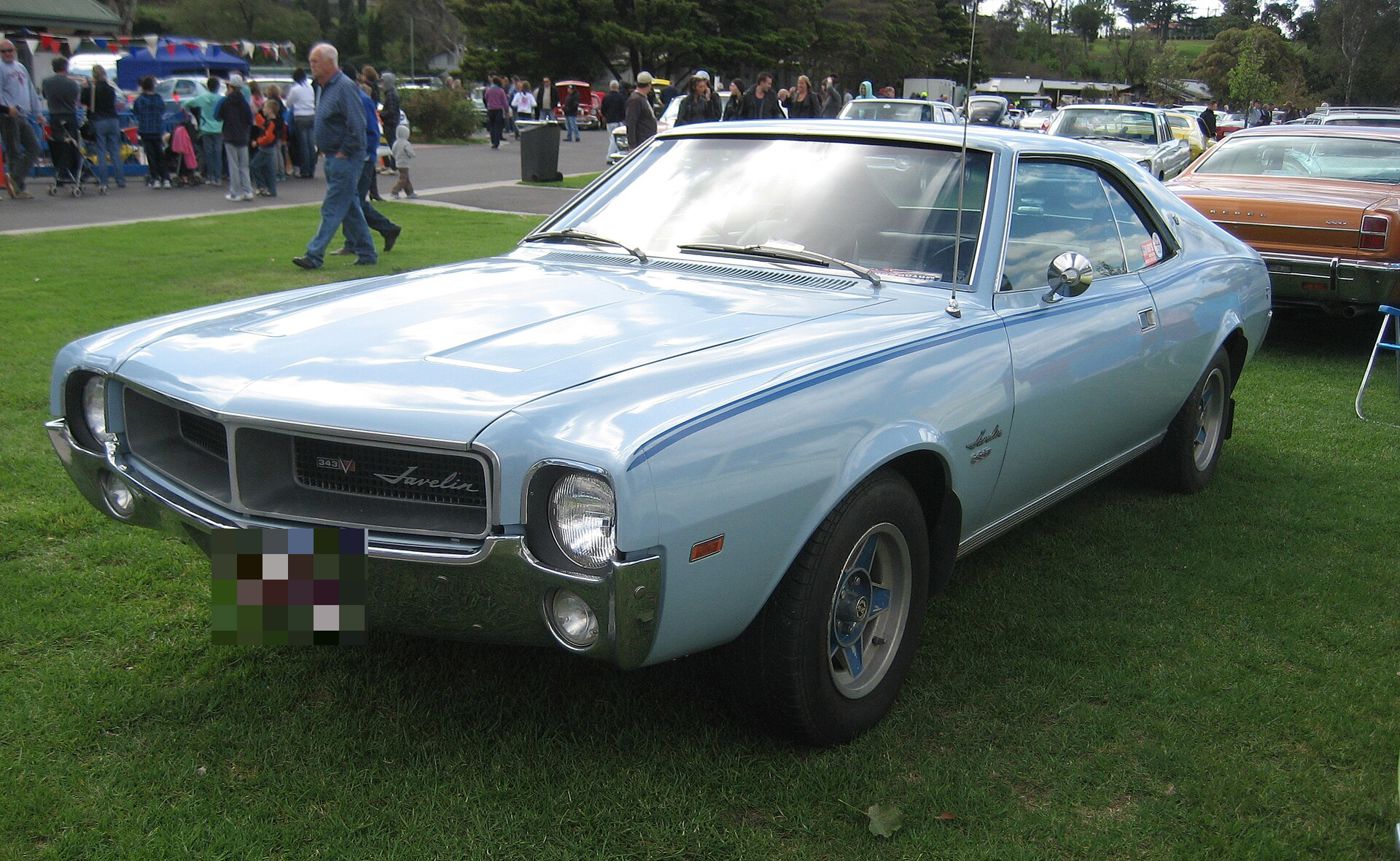
The Javelin's first race was the 12 Hours of Sebring on 23 March 1968. Two cars started. The one driven by George Follmer and Jerry Grant did not finish, and the one driven by Peter Revson and Skip Scott finished fifth. That account comes from Ate Up With Motor's history of the car. Before the season began, AMC engineering chief Victor Raviolo had told reporters that the company did not really expect to win and was hoping for a “solid third-place finish.” It was an unusually modest target for a Detroit racing program. It also fit a company that had spent a decade selling economy and was now entering the pony-car market that Ford and Chevrolet dominated.1
That modesty had a history. Robert B. Evans became American Motors' largest shareholder and then its chairman in 1966, and Ate Up With Motor says he shared the press's view that the company's main failing was its “staid, fusty image.” AMC's earlier sporty car had shown how hard that image was to change. The fastback Marlin sold 10,327 in 1965, 4,547 in 1966 and 2,545 in its restyled 1967 form. The 1966 Project IV show, which toured 10 North American cities, put AMX concept cars in front of the public. Behind the scenes, AMC was working on a four-seat car aimed squarely at the Mustang. Special events manager Guy Hadsall Jr. proposed the name that stuck: Javelin.1
The people who launched the car were not the ones who started it. At a board meeting on 9 January 1967, Evans stepped down as chairman. Roy D. Chapin Jr. became chairman and chief executive, and William Luneburg replaced Roy Abernethy as president. In September 1967 AMC hired Victor Raviolo, a former Ford engineer associated with Ford of England's Lotus Cortina race cars, as group vice president for engineering and styling. The advertising went to Wells, Rich, Greene. Ate Up With Motor says the agency broke an unwritten Detroit rule by comparing the Javelin directly with its competitors. The new management was willing to name its rivals in public.1
AMC showed the Javelin to its dealers by closed-circuit television on 31 August 1967, and the public saw it on 26 September. Chapin set a sales target of 35,000 to 40,000 cars, a small fraction of what Mustang and Camaro sold. The car rode a 109-inch wheelbase and measured 189.2 inches overall. It came as a base Javelin and a better-trimmed SST, both two-door hardtops. Ate Up With Motor says a basic Javelin started under $2,500, more than $100 below the six-cylinder Camaro and Mustang. Planet Houston AMX lists factory prices of $2,482 for the base car and $2,587 for the SST, without stating what those prices include.1,2,3
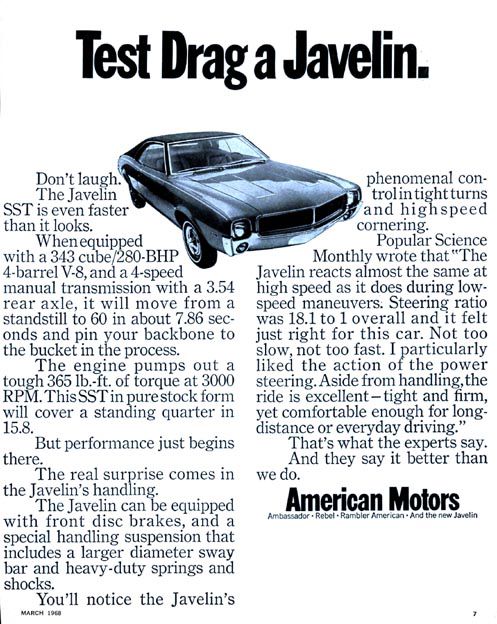
The engine list ran from mild to serious. AMC's 1968 VIN key encodes a 232 six at 145 or 155 horsepower, a 290 V8 at 200 or 225, a 343 at 235 or 280 and a 390 at 315. These are period gross-era ratings, and the key covers the whole AMC line rather than the Javelin alone. The Go Package cost $266 with the 343 or $320 with the 390. It added a four-barrel, dual exhaust, power front disc brakes, red-line tires, six-inch wheels, a handling package and stripes. Planet Houston AMX rates the Go Package 343 at 285 horsepower. The factory key's 280 is the figure used here, and the other is noted as a conflict.4,5
Inside, the two trims looked different. According to Planet Houston AMX's trim codes, the base car had Tahiti basket-weave vinyl on fixed-back seats, in black or black and white. The SST offered black, tan or red, in Strata Stripe fabric with reclining seats or in all-vinyl reclining seats. On the outside, the brochure presented the Javelin and the two-seat AMX as separate models. That matters for the production record, because the AMX, introduced in February 1968 on a wheelbase 12 inches shorter, has its own count of 6,725 and is not part of the Javelin figures. The Javelin was the four-seat car meant to sell in volume. The AMX was built to draw attention.3,1
It did sell. The body-number table at Planet Houston AMX, which JavelinAMX.com repeats, gives 29,097 base Javelins and 26,027 SSTs, so the SST made up about 47 percent. Those two rows add up to 55,124. Wikipedia, citing Gunnell's Standard Catalog, gives 55,125, and the one-car difference is unexplained. Ate Up With Motor calls it more than 55,000 sales, about 40 percent above Chapin's target, yet still less than 6 percent of pony-car sales that year. No engine, transmission or option counts for the 1968 Javelin were found, so the number of Go Package or 390 cars is unknown. That is a gap in the record, not evidence that there were none.3,2,6,1
On the track, AMC put its program in outside hands. Jim Jeffords and Ronnie Kaplan ran the team, hired Revson and Follmer, and used John Martin as co-driver and crew chief. The engines started as 290 blocks bored to 304.3 cubic inches, which kept them under the 305-cubic-inch limit. By Ate Up With Motor's count the Javelins won no races but finished second in six of the 12 rounds and ended third overall, the result Raviolo had forecast. The same history says Raviolo was fired not long afterward and Carl Chakmakian took over AMC's performance work. These results have not yet been checked against the 1968 SCCA result sheets, so they are given as that history's account.1
The team that won the 1968 contest was Chevrolet's. The Trans Am series' own history credits Mark Donohue, driving Roger Penske's Camaro, with ten wins that year and says the title went to the manufacturer. The series did not award a drivers' championship in the period. For AMC, third behind that kind of program was a respectable first year. The early seasons also left lessons. Ford hired Revson and Follmer away for 1969, and Ate Up With Motor says their replacements' best finish that season was fourth. Javelin sales slipped to 40,675. For 1970 AMC went to the team that had beaten it. Roger Penske moved his Trans-Am operation from Chevrolet to AMC and signed a three-year contract.7,1,8
The 1968 Javelin was the car that made that move possible. It gave AMC a four-seat performance car to race, sold well enough to beat the company's own forecast, and shared a body with the AMX two-seater. Its numbers are modest beside Detroit's best sellers: 55,124 cars by the body table, split almost evenly between base and SST, in a segment where it held less than 6 percent. But the Javelin proved that American Motors could build a car buyers wanted for style and speed rather than thrift. Three seasons later, a Penske Javelin would bring AMC the manufacturers' title that the 1968 team had never been expected to win.3,1,9
Fact sheet · 1968 · United States
The numbers
1968 AMC Javelin — AMC's first pony car, launched in September 1967 as base and SST hardtops. Production of the two combined was about 55,000.
Coverage: Partial — researched sections are shown; missing ones are not yet sourced. Researched through 2026-09-22.
Every figure is labeled with how sure we are. Reported means a manufacturer, registry, or reference figure we cite but have not reconciled against factory records ourselves. Disputed means credible sources disagree and both are shown. Rows are separately scoped; don't add them together unless the note says they make up a total.
Key facts
Production
| What was counted | Count | Basis | Status |
|---|---|---|---|
| Javelin (base), body 6879-53,2 Javelin · 2-door hardtop · US production | 29,097 | built, model-year | Reported |
| Javelin SST, body 6879-73,2 Javelin SST · 2-door hardtop · US production | 26,027 | built, model-year | Reported |
| What was counted | Count | Basis | Status |
|---|---|---|---|
| Javelin, all trims6 2-door hardtop · US The base and SST rows sum to 55,124. The one-car difference is unexplained. | 55,125 | built, model-year | Reported |
| Javelin, base and SST (AMC tally sheet)10 Javelin, all trims · 2-door hardtop · US, Canada and export market; built at Kenosha Equals 29,097 + 26,027. Conflicts by one with the 55,125 attributed elsewhere; see conflicts. | 55,124 | built, model-year | Reported |
| What was counted | Count | Basis | Status |
|---|---|---|---|
| Base, 232 six10 Javelin (base) · 2-door hardtop (6879-5) · 232 six · US, Canada and export market; built at Kenosha | 14,750 | built, model-year | Reported |
| Base, 290 V810 Javelin (base) · 2-door hardtop (6879-5) · 290 V8 · US, Canada and export market; built at Kenosha | 11,811 | built, model-year | Reported |
| Base, 343 V810 Javelin (base) · 2-door hardtop (6879-5) · 343 V8 · US, Canada and export market; built at Kenosha | 2,524 | built, model-year | Reported |
| Base, 390 V810 Javelin (base) · 2-door hardtop (6879-5) · 390 V8 · US, Canada and export market; built at Kenosha As written on the sheet; the row sums to its printed total of 29,097. | 12 | built, model-year | Reported |
| SST, 232 six10 Javelin SST · 2-door hardtop (6879-7) · 232 six · US, Canada and export market; built at Kenosha | 2,548 | built, model-year | Reported |
| SST, 290 V810 Javelin SST · 2-door hardtop (6879-7) · 290 V8 · US, Canada and export market; built at Kenosha | 13,654 | built, model-year | Reported |
| SST, 343 V810 Javelin SST · 2-door hardtop (6879-7) · 343 V8 · US, Canada and export market; built at Kenosha | 8,954 | built, model-year | Reported |
| SST, 390 V810 Javelin SST · 2-door hardtop (6879-7) · 390 V8 · US, Canada and export market; built at Kenosha | 871 | built, model-year | Reported |
No 1968 Javelin option or transmission counts were found. Big Bad colors were not offered until 1969.
The eight engine rows from the AMC tally sheet partition the base (29,097) and SST (26,027) body rows exactly.
Prices when new
| Model | Price | Basis |
|---|---|---|
| Javelin (base)3 | $2,482 | 'factory price' as tabulated (basis not stated), 1967-09 |
| Javelin SST3 | $2,587 | 'factory price' as tabulated (basis not stated), 1967-09 |
| Go Package with 3435 | $266 | option price as reported, 1968 model year |
| Go Package with 3905 | $320 | option price as reported, 1968 model year |
Prices are the nominal dollars of the day, not adjusted for inflation.
Engines
| Engine | Factory rating | Availability | Built |
|---|---|---|---|
| B / C · 232 six (145 or 155 hp)4 232 cu in | 145 hp @ 4,300, 215 lb-ft @ 1,600 (period factory rating (gross era)); 155 hp (period factory rating (gross era)) | standard | 17,29810 Reported |
| M / N · 290 V8 (200 or 225 hp)4 290 cu in · 2-barrel / 4-barrel | 200 hp @ 4,600, 285 lb-ft @ 2,800 (period factory rating (gross era)); 225 hp @ 4,700, 300 lb-ft @ 3,200 (period factory rating (gross era)) | optional | 25,46510 Reported |
| S / T · 343 V8 (235 or 280 hp)4,5 343 cu in · 2-barrel / 4-barrel | 235 hp (period factory rating (gross era)); 280 hp @ 4,800, 365 lb-ft @ 3,000 (period factory rating (gross era)) | optional | 11,47810 Reported |
| X · 390 V8 4-bbl4,5 390 cu in · 4-barrel | 315 hp (period factory rating (gross era)) | optional (Go Package) | 88310 Reported |
Ratings are the manufacturer's advertised figures under the standard shown (SAE gross before 1972, SAE net after). They are not dyno results, and gross and net ratings can't be compared directly.
Options and packages
| Code | Option | Price | Installed |
|---|---|---|---|
|
Go Package: 343 or 390 four-barrel, dual exhaust, power front disc brakes, red-line Polyglas tires, 6-in rims, handling package, stripes5 | $266 | Not yet sourced |
|
Black or off-white vinyl-covered roof | — | Not yet sourced |
|
Ventilated vinyl or fabric upholstery in red, black or tan (no-cost option, SST); off-white vinyl upholstery for base Javelin (black vinyl standard) | — | Not yet sourced |
|
Dual exhaust for 4-barrel V-8s | — | Not yet sourced |
|
Headrests; shoulder belts | — | Not yet sourced |
|
All-Season air conditioning (60-amp battery, 40-amp alternator, heavy-duty cooling) | — | Not yet sourced |
|
Quick-ratio manual steering; power steering; power brakes; power disc brakes (V-8) | — | Not yet sourced |
|
Automatic transmission oil cooler for sixes (standard on V-8s); Twin-Grip differential; Adjust-O-Tilt steering wheel | — | Not yet sourced |
|
Solex glass (all or windshield only) | — | Not yet sourced |
|
Wheel discs (standard SST); Turbo-Cast wheel covers; wire wheel covers | — | Not yet sourced |
|
Visibility Group (remote left mirror, clock, visor vanity mirror, electric washers and wipers); Light Group | — | Not yet sourced |
|
AM or AM/FM push-button radio; rear speaker; 8-track stereo tape player with AM manual radio | — | Not yet sourced |
|
Rear bumper guards; Insulation Group (undercoating and hood insulation) | — | Not yet sourced |
|
Heavy-duty engine cooling; 70-amp battery; engine block heater; handling package (6-cyl. or V-8); heavy-duty clutch for 3-speed (200-hp V-8) | — | Not yet sourced |
|
Tires: 7.35x14 (optional six, standard V-8), E70x14 wide-profile red-line on 5.5-in rims (V-8) | — | Not yet sourced |
|
Tachometer (V-8s) | — | Not yet sourced |
|
Dealer accessory rally-pak for V-8s without air conditioning: oil pressure and ammeter gauges, clock or tachometer | — | Not yet sourced |
Interiors
| Code | Trim | Built |
|---|---|---|
831J |
Base: black, Tahiti basket-weave vinyl, non-reclining seats3 | Not yet sourced |
838J |
Base: black/white, Tahiti vinyl3 | Not yet sourced |
831 / 832 / 835 (D or E) |
SST: black, tan or red; D Strata Stripe fabric with reclining seats or E all-vinyl reclining seats3 | Not yet sourced |
Specifications
| Measure | Value | Applies to |
|---|---|---|
| Shipping weight, base3 | 2,826 lb | 6879-5 |
| Shipping weight, SST3 | 2,836 lb | 6879-7 |
| Wheelbase | 109 in | all 1968 Javelins |
| Overall length | 189.2 in | all 1968 Javelins |
| Trunk luggage space | 10.2 cu ft | all 1968 Javelins |
| Standard tires | 6.95x14 (sixes), 7.35x14 (V-8s) | all 1968 Javelins |
Identification
- VIN
- 1968 key: series digit 7 = Javelin; model digit 5 covers 440, Javelin, 770 or DPL, and 7 covers Rogue, AMX, Javelin SST, Rebel SST or Ambassador SST; body 9 = 2-door hardtop.4
- Door tag
- The door-tag model number is 6879-5 for the base car and 6879-7 for the SST.3
Where the sources disagree
Go Package 343 rating
Lead with the factory VIN key's 280 hp. Note the enthusiast page's 285.
Identification
Read a 1968 AMC VIN
The VIN decoder runs in your browser and never sends the VIN anywhere. How the factory numbered this year's cars:
Same model year
Also in 1968
- AMC AMX AMC's two-seat AMX arrived mid-year on a 97-inch wheelbase. The enthusiast production table counts 6,725 cars, two-thirds of them with the 390.
- AMC Rebel and Rebel Machine Now badged AMC, the Rebel came in 550, 770 and SST trims and could be ordered with the 315-hp 390. It is host-car context for the 1970 Machine.
- Buick Riviera Record Riviera sales of 49,284, including 5,337 with the GS handling option.
- Buick Skylark Gran Sport, GS and GSX On the new 112 in two-door body the GS 400 was joined by a GS 350 hardtop, and a dealer-installed Stage 1 package arrived for the 400.
- Buick Wildcat 73,561 Wildcats with the 430 V-8.
- Chevrolet Chevelle and Malibu SS The restyled Chevelle kept SS 396 as its own series and added an SS 396 El Camino: 62,785 SS 396s in three bodies.
- Chevrolet Chevy II and Nova SS engines per the source: L48 350, L34 396 and L78 396. Enthusiast-compiled production: 183,552 cars; Super Sport 5,571.
- Chevrolet El Camino SS The first factory Super Sport El Camino: a separate SS 396 model, 13880, built 5,190 times.
- Chevrolet Impala SS Super Sport becomes an option again (RPO Z03): 36,432, plus 1,778 SS427 (RPO Z24).
- Dodge Charger The redesigned 'Coke bottle' Charger and the new R/T multiplied sales roughly sixfold over 1967.
- Dodge Coronet R/T and Super Bee The redesigned Coronet kept the 440-powered R/T and added the budget Super Bee coupe, a 383 car with an optional Hemi.
- Dodge Dart GTS, Swinger and Demon The new Dart GTS brought a 275 hp 340 or a 300 hp 383, and in February Dodge released 80 Hurst-completed LO23 Hemi Darts for Super Stock drag racing; GTS production was not reported separately.
- Ford Fairlane The restyled intermediate split into Fairlane, Fairlane 500 and the new Torino series; the Fairlane 500 fastback shared the Torino GT body and the 428 Cobra Jet arrived on April 1, 1968.
- Ford Ranchero GT The Ranchero GT carried Torino GT trim; 1,669 GTs were built, per reference-site counts in the Standard Catalog lineage.
- Ford Thunderbird The new 429 Thunder Jet V-8 arrived as the Thunderbird's optional engine at 360 hp.
- Ford Torino Torino arrived as the new top series of the restyled Fairlane line, the Torino GT fastback became its volume performance car, and the 428 Cobra Jet was added on April 1, 1968.
- Mercury Comet and Cyclone The Cyclone moved to the new Montego-based intermediate; the fastback outsold the notchback hardtop by about ten to one, and the 428 Cobra Jet arrived mid-year.
- Mercury Cougar The year of the 427 GT-E, the mid-year 428 Cobra Jet, and the XR7-G, with production down to 113,741.
- Mercury Marauder and S-55 Neither the S-55 nor the Marauder model appears in the sources for 1968; no performance full-size Mercury production figure was found.
- Oldsmobile Cutlass, 4-4-2 and Hurst/Olds The restyled 4-4-2 became its own series, the W-31 small-block arrived, and Hurst built the first 455 Hurst/Olds: 515 cars in the tabulation.
- Plymouth Barracuda and 'Cuda The new 340 arrived in the Formula S alongside the 383, and Plymouth issued a competition-only Hemi Barracuda under order code BO29.
- Plymouth GTX, Belvedere and Satellite The GTX became its own model on the restyled 1968 intermediate body, still with the 375-hp 440 standard and the Hemi at $605, and outsold its first year.
- Plymouth Road Runner Plymouth added a stripped Belvedere-based coupe and hardtop with a special 335-hp 383 as standard and the 426 Hemi as the only engine option, and sold 44,599 of them.
- Pontiac Firebird and Trans Am The first full season: the six grew to 250 cu in, the 326 gave way to a 350, and output rose to 107,112.
- Pontiac GTO A new 112-inch-wheelbase body with an Endura nose, the sport coupe dropped, and 87,684 built.
- Pontiac Grand Prix The last full-size Grand Prix: 31,711 hardtops, with a 390 hp 428 HO at the top.
- Pontiac Tempest and LeMans The new two-door body arrives, and a 350 HO replaces the 326 HO.