1968 · Dodge · United States
1968 Dodge Charger: The Coke-Bottle Body and the R/T That Turned a Slow Seller into a Hit
The redesigned 'Coke bottle' Charger and the new R/T multiplied sales roughly sixfold over 1967.
United States · researched through 2026-09-23
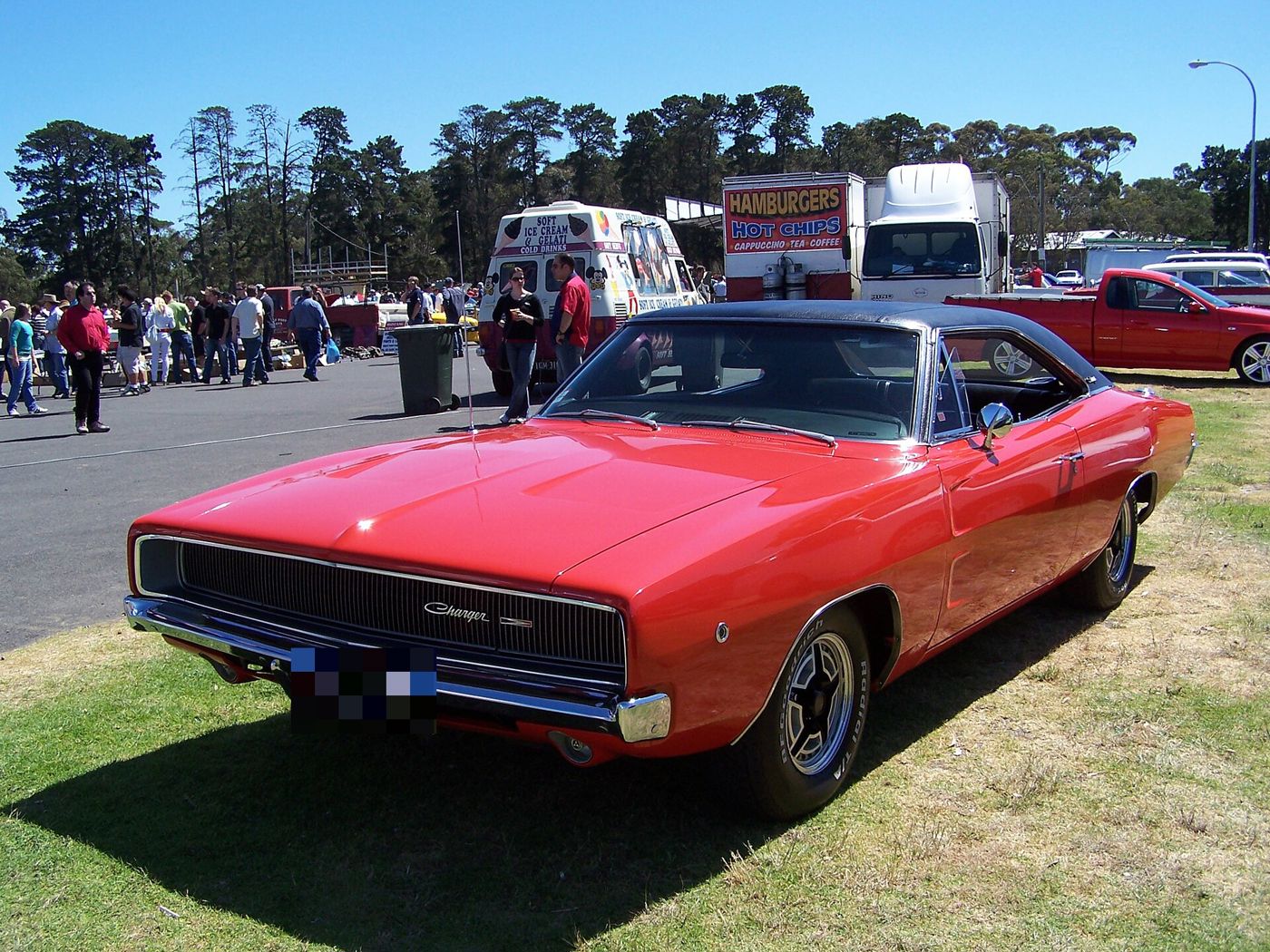
Dodge built 15,788 Chargers for 1967. For 1968 it built 96,108. Those two figures, from Mike Mueller's history of the first car and the Automotive Industries statistical issue for the second, measure a remarkable turnaround. Dodge's own heritage history puts the change as a 343 percent increase in sales over 1967. The corporate percentage and the production figures do not describe the same thing, since sales and model-year production are counted differently, and the production ratio is actually steeper, about six to one. Either way the verdict is the same. A car that had struggled to find buyers for two seasons became, with one redesign and one new performance model, one of the volume cars of Dodge's lineup.1,2,3
The first Charger's problem was plain arithmetic. Ate Up With Motor counts 53,132 Chargers sold across the 1966 and 1967 model years, a little under 5 percent of Dodge's volume, while Pontiac moved nearly 180,000 GTOs and Ford more than a million Mustangs over the same span. The production tables agree: 37,344 for 1966 and 15,788 for 1967 add up to 53,132, so the site's sales figure matches the production count to the car. The fall from the first year to the second was 58 percent. The 1966-67 car was built on the Coronet chassis with a fastback roof and a four-bucket-seat interior. Flory's figures for the new car make the reset visible: 96,100 Chargers and Charger R/Ts combined, rounded, against a base price of $3,040 for the hardtop. For 1968 the Charger stopped being a specialty fastback and became a sporting hardtop.4,5,1,6
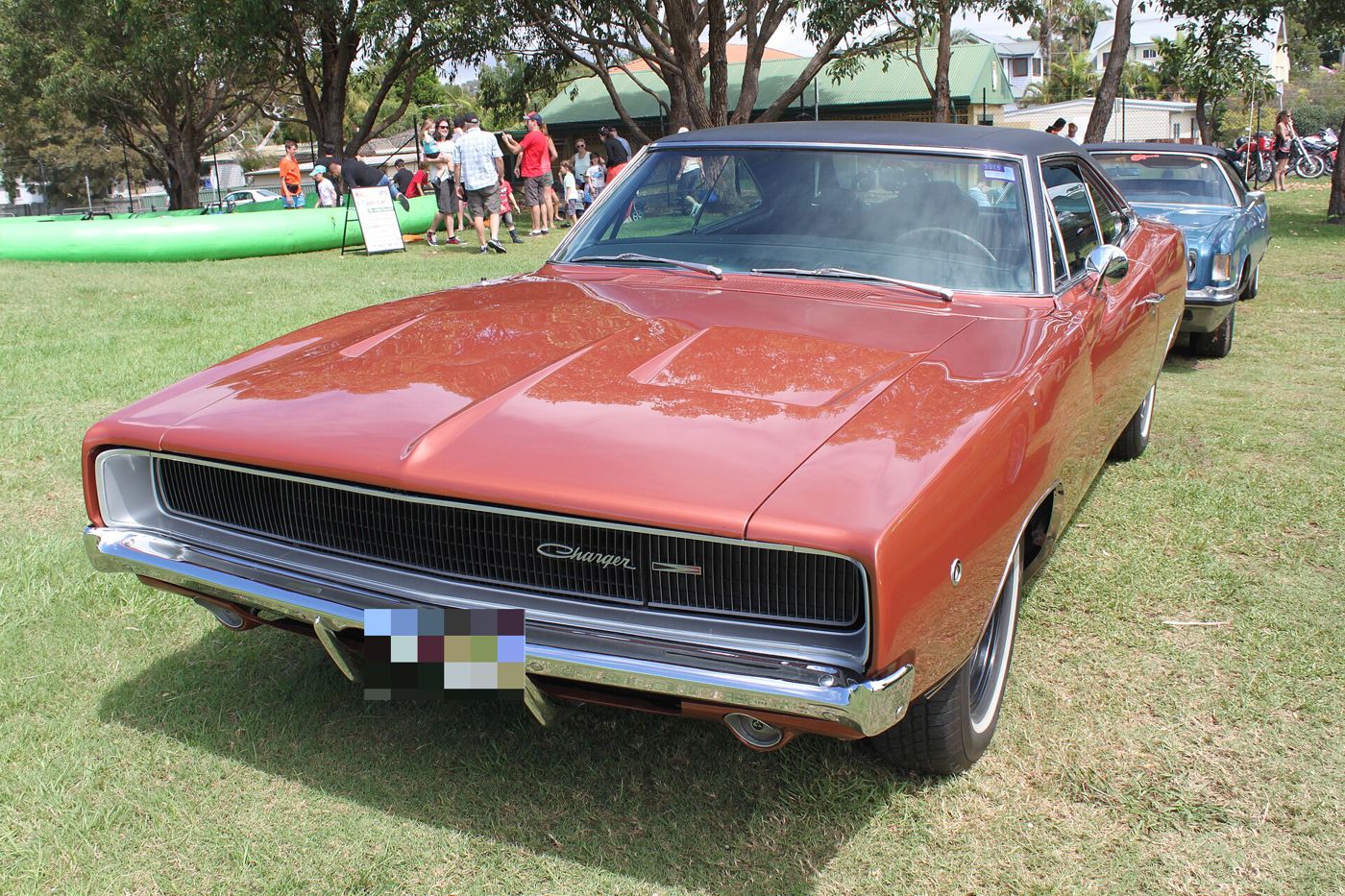
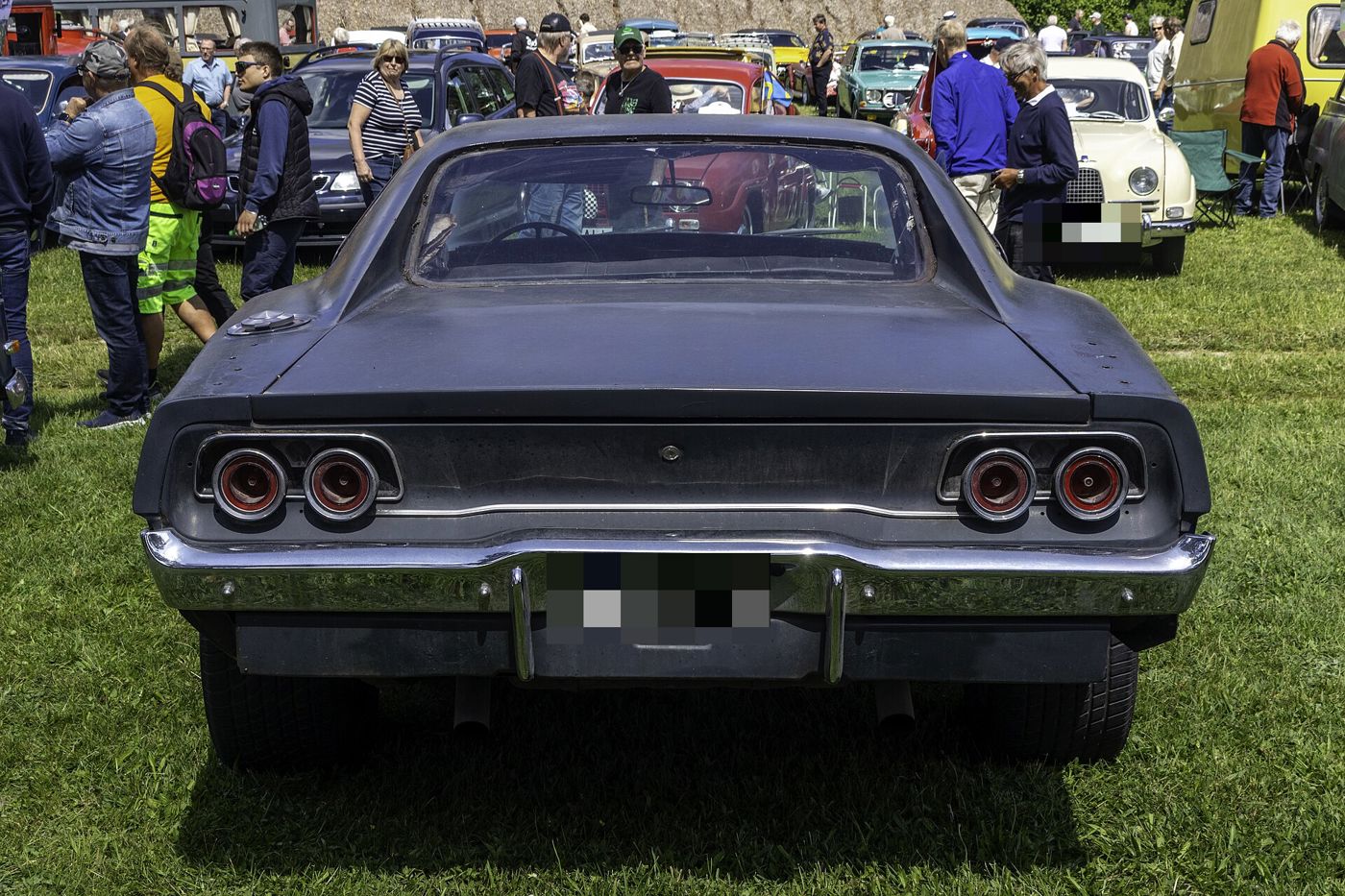
The shape came from the styling studio rather than the wind tunnel. Ate Up With Motor credits stylist Richard Sias, who had come from General Motors, with the double-diamond profile, and reports that Dodge chief stylist Bill Brownlie initially opposed it before styling vice president Elwood Engel backed the concept. That account is the site's, and it is presented as such. Dodge's heritage history uses the designers' own vocabulary: a double-diamond or Coke-bottle silhouette and a flying-buttress roofline. The finished car added twin scallops on the hood and doors, a recessed grille and round tail lamps, the last of which Dodge would replace with rectangular units a year later. It became the Charger's defining shape, and it would soon cause trouble on the superspeedways.4,3
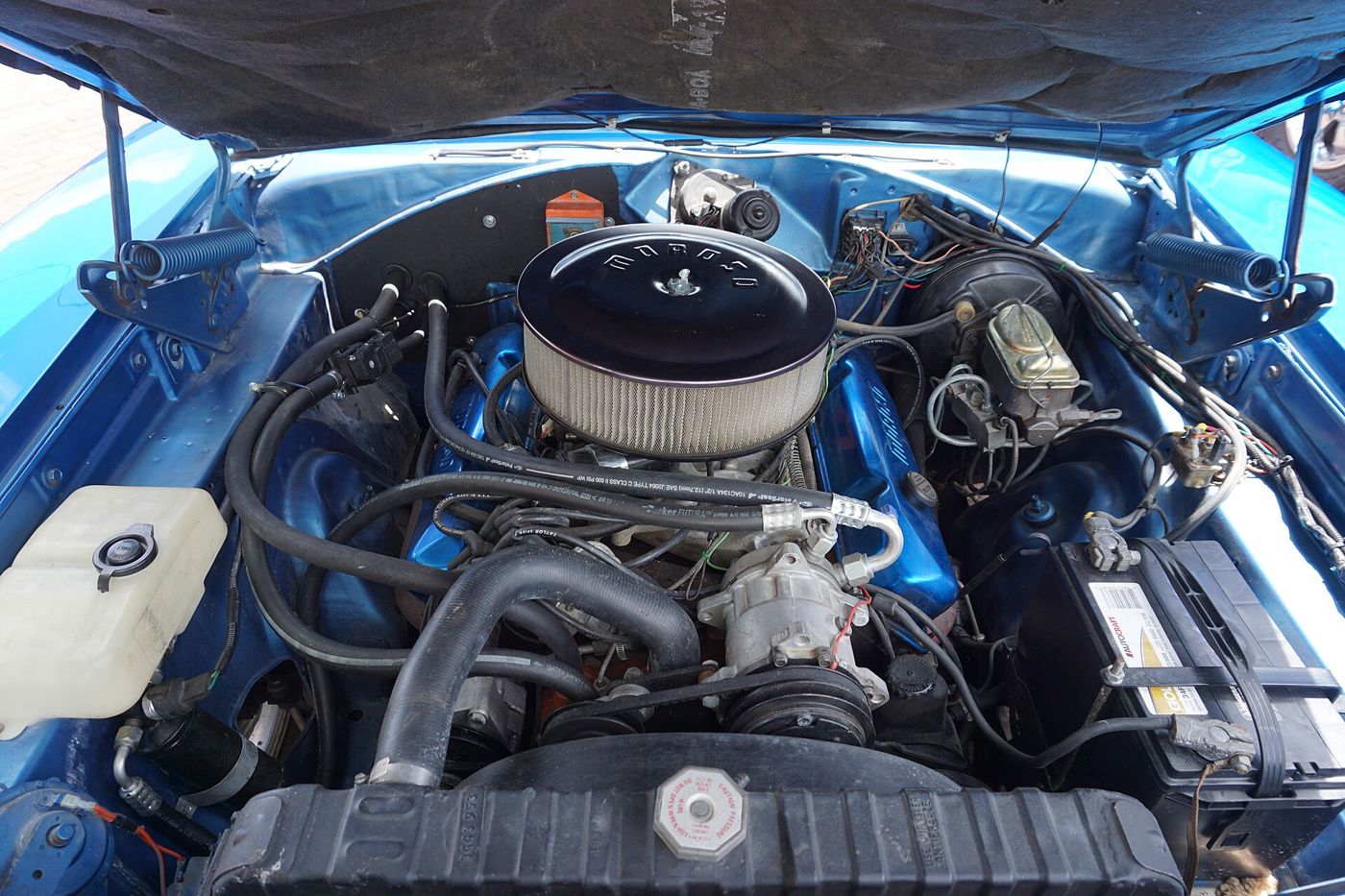
The second half of the recipe was the R/T. Ate Up With Motor describes it as the new model that added a standard TorqueFlite automatic and Chrysler's big 440 with 375 gross horsepower, with the 426 Hemi as the costly option above it. Flory lists the R/T hardtop, style XS29, as new for 1968 at $3,506, which is $466 above the $3,040 base Charger (XP29). Its shipping weight of 3,575 lb was 270 lb more than the base car's 3,305 lb. The R/T did not ask its buyer to understand option codes: it put the big engine, the automatic and the badge on one line of the price list, and left the four-speed and the Hemi as the choices above it.4,6
Buyers took the offer mostly as Dodge wrote it. Mueller's production tables give 17,584 R/Ts, with Gunnell printing 17,582 in passing. Of Mueller's total, 17,109 had the 440, and 14,366 of those came with the standard TorqueFlite against 2,743 with the four-speed, so only about 16 percent of 440 buyers chose to shift for themselves. Set against the industry's 96,108, the R/T figure works out to roughly 18 percent of all 1968 Chargers, though the two numbers come from different compilers and should be read as an approximation. What the sources do not supply is just as telling: no documented count exists for the 318 and 383 base cars that made up the other four-fifths of the year.5,2
At the top sat the Hemi. Mueller counts 475 Hemi R/Ts for 1968, 211 with the four-speed and 264 with TorqueFlite, which is 2.7 percent of his R/T total. The ratio is worth noticing. Among 440 buyers, fewer than one in six took the manual; among Hemi buyers, 44 percent did. The small group of people willing to pay for Chrysler's racing engine were far more likely to want the clutch pedal that went with it. That is as close as the production tables come to a portrait of the customer. Even so, 264 Hemi buyers chose the automatic, a reminder that the Street Hemi went into road cars that were driven on the street, not only into cars built for the drag strip.5
The new Charger also found an audience that never read an order form. Dodge's heritage history notes that 1968 was the year the Charger made its film debut, in Bullitt, starring Steve McQueen, as a black R/T with the 440 Magnum, cast as the getaway car. The film cannot be turned into a sales figure, and its effect on showroom traffic is unmeasured. What it did was fix the shape of the 1968 Charger in the public imagination at exactly the moment the production numbers show Dodge selling it in volume for the first time.3
On the superspeedways the same body was a liability. Ate Up With Motor reports that the recessed grille and the tunnelled rear window between the buttresses produced alarming front-end lift at 180 mph, and counts only five Dodge victories from 49 starts in the 1968 Grand National season. Dodge's heritage account says wind-tunnel testing and research, including rear spoilers and front air dams, gave its engineers an edge in NASCAR. The people who would carry the next chapter were already in place: NASCAR identifies Bobby Isaac as driver of Nord Krauskopf's K&K Insurance Dodges, with Harry Hyde as crew chief, from 1968. The showroom hit and the racing disappointment were the same car.4,3,7
Dodge's response shaped the next two years. For 1969 it kept the body, split the grille with a centre divider, fitted rectangular tail lamps and added an SE package; it also built the Charger 500, with a flush grille and flush rear window meant solely for NASCAR, and then the winged Charger Daytona. The redesigned car still sold. Industry statistics put 1969 production at 89,199, and Mueller counts 20,057 R/Ts including export cars, against his 17,584 for 1968. The 1968 body would carry the Charger through 1970. It had rescued the nameplate in the showroom, given it a film career, and handed Dodge's racing engineers an aerodynamic problem that produced the most extreme Chargers ever sold.3,8,5
Fact sheet · 1968 · United States
The numbers
1968 Dodge Charger — The redesigned 'Coke bottle' Charger and the new R/T multiplied sales roughly sixfold over 1967.
Coverage: Partial — researched sections are shown; missing ones are not yet sourced. Researched through 2026-09-23.
Every figure is labeled with how sure we are. Reported means a manufacturer, registry, or reference figure we cite but have not reconciled against factory records ourselves. Disputed means credible sources disagree and both are shown. Rows are separately scoped; don't add them together unless the note says they make up a total.
Key facts
Production
| What was counted | Count | Basis | Status |
|---|---|---|---|
| Charger, all series2 2-door hardtop · US production statistics Flory prints 96,100 for Charger plus Charger R/T combined (asterisked, rounded). | 96,108 | built, model-year | Reported |
| Charger and Charger R/T combined (Over-Drive, rounded)9 Charger + Charger R/T · 2-door hardtop · not stated Rounded; the table prints the figure on its 'Charger R/T Production Total' row, but its note 5 says it covers all Chargers. Agrees with Flory's rounded 96,100. | 96,100 | built, model-year | Reported |
| What was counted | Count | Basis | Status |
|---|---|---|---|
| Charger R/T5 R/T · 2-door hardtop · not stated Gunnell's Standard Guide prints 17,582 for 1968 R/T production in passing. | 17,584 | built, model-year | Reported |
| What was counted | Count | Basis | Status |
|---|---|---|---|
| Charger R/T, 440 Magnum5 R/T · 2-door hardtop · 440 4-bbl · not stated | 17,109 | built, model-year | Reported |
| Charger R/T, 426 Hemi5 R/T · 2-door hardtop · 426 Hemi 2x4-bbl · not stated | 475 | built, model-year | Reported |
| What was counted | Count | Basis | Status |
|---|---|---|---|
| Charger R/T, 440 Magnum, 4-speed5 R/T · 2-door hardtop · 440 4-bbl · 4-speed manual · not stated | 2,743 | built, model-year | Reported |
| Charger R/T, 440 Magnum, TorqueFlite5 R/T · 2-door hardtop · 440 4-bbl · 3-speed automatic · not stated | 14,366 | built, model-year | Reported |
| Charger R/T, 426 Hemi, 4-speed5 R/T · 2-door hardtop · 426 Hemi 2x4-bbl · 4-speed manual · not stated | 211 | built, model-year | Reported |
| Charger R/T, 426 Hemi, TorqueFlite5 R/T · 2-door hardtop · 426 Hemi 2x4-bbl · 3-speed automatic · not stated | 264 | built, model-year | Reported |
Rows are separately scoped; do not add them. Mueller's 440 and Hemi rows sum to his R/T total, which he presents as the R/T breakdown.
No source consulted gives 1968 base-Charger production by engine (318, 383) with a documented lineage.
Over-Drive's 1968 table prints a Charger six (XP-29 I-6) price and weight, and the revised AMA sheet lists a six-cylinder Charger; no source consulted gives a six-cylinder Charger count.
Prices when new
| Model | Price | Basis |
|---|---|---|
| Base MSRP, Charger 2-door hardtop (XP29)6 | $3,040 | base manufacturer's suggested retail price as tabulated by Flory, 1968 model year |
| Base MSRP, Charger R/T 2-door hardtop (XS29)6 | $3,506 | base manufacturer's suggested retail price as tabulated by Flory, 1968 model year |
| Base price, Charger XP29 V-8 (Over-Drive table)9 | $3,095 | base price as tabulated by Over-Drive, 1968 model year |
| Base price, Charger XP29 six (Over-Drive table)9 | $3,014 | base price as tabulated by Over-Drive, 1968 model year |
| Base price, Charger R/T XS29 (Over-Drive table)9 | $3,480 | base price as tabulated by Over-Drive, 1968 model year |
Prices are the nominal dollars of the day, not adjusted for inflation.
Engines
| Engine | Factory rating | Availability | Built |
|---|---|---|---|
| 440 Magnum 4-bbl V-85,10 440 cu in · 4-barrel | 375 hp @ 4,600, 480 lb-ft @ 3,200 (SAE gross (AMA 'publishing max bhp', corrected to 60 F and 29.92 in Hg)) | standard on R/T | 17,1095 Reported |
| 426 Hemi 2x4-bbl V-85,10 426 cu in · two 4-barrel | 425 hp @ 5,000, 490 lb-ft @ 4,000 (SAE gross (AMA 'publishing max bhp')) | optional on R/T | 4755 Reported |
| 318 2-bbl V-810 318 cu in · 2-barrel | 230 hp @ 4,400, 340 lb-ft @ 2,400 (SAE gross (AMA 'publishing max bhp')) | standard on Charger | Not yet sourced |
| 383 2-bbl V-810 383 cu in · 2-barrel | 290 hp @ 4,400, 390 lb-ft @ 2,800 (SAE gross (AMA 'publishing max bhp')) | optional on Charger | Not yet sourced |
| 383 4-bbl V-810 383 cu in · 4-barrel | 330 hp @ 5,000, 425 lb-ft @ 3,200 (SAE gross (AMA 'publishing max bhp')) | optional on Charger | Not yet sourced |
| 225 Slant Six10 225 cu in · 1-barrel | 145 hp @ 4,000, 215 lb-ft @ 2,400 (SAE gross (AMA 'publishing max bhp')) | listed for the Charger XP29 in the revised AMA sheet ('6-cylinder also'); the catalogue lists only V-8s | Not yet sourced |
Ratings are the manufacturer's advertised figures under the standard shown (SAE gross before 1972, SAE net after). They are not dyno results, and gross and net ratings can't be compared directly.
Transmissions
| Transmission | Availability | Built |
|---|---|---|
| 3-speed manual, column shift | standard with the 318 on Charger only | Not yet sourced |
| TorqueFlite 3-speed automatic | standard on Charger R/T with the Magnum; optional with the 318 and 383 | Not yet sourced |
| 4-speed manual, floor shift | optional with the 383, Magnum and Hemi | Not yet sourced |
Options and packages
| Code | Option | Price | Installed |
|---|---|---|---|
|
R/T Handling Package: special torsion bars, heavy-duty shock absorbers, extra-heavy-duty rear springs and sway bar | — | Not yet sourced |
|
Bumblebee racing stripes | — | Not yet sourced |
|
4-speed manual, floor shift (383 V-8s, Magnum and Hemi) | — | Not yet sourced |
Paint
| Code | Color | Built |
|---|---|---|
A |
Silver9 | Not yet sourced |
B |
Black9 | Not yet sourced |
C |
Medium Blue9 | Not yet sourced |
D |
Pale Blue9 | Not yet sourced |
E |
Dark Blue9 | Not yet sourced |
F |
Light Green9 | Not yet sourced |
G |
Racing Green9 | Not yet sourced |
H |
Light Gold9 | Not yet sourced |
J |
Medium Gold9 | Not yet sourced |
K |
Light Turquoise9 | Not yet sourced |
L |
Medium Dark Turquoise9 | Not yet sourced |
M |
Bronze9 | Not yet sourced |
P |
Red9 | Not yet sourced |
Q |
Bright Blue9 | Not yet sourced |
R |
Burgundy9 | Not yet sourced |
S |
Yellow9 | Not yet sourced |
T |
Medium Green9 | Not yet sourced |
U |
Light Blue9 | Not yet sourced |
W |
White9 | Not yet sourced |
X |
Beige9 | Not yet sourced |
Y |
Medium Tan9 | Not yet sourced |
33 |
Charger Red9 | Not yet sourced |
66 |
Dark Green9 | Not yet sourced |
Color names are the factory's. We don't show color swatches, because a screen color is no guide for a restoration.
Interiors
| Code | Trim | Built |
|---|---|---|
|
All-vinyl front bucket seats (standard on Charger and Charger R/T); optional center console with console-mounted automatic selector | Not yet sourced |
Specifications
| Measure | Value | Applies to |
|---|---|---|
| Shipping weight, Charger XP296 | 3,305 lb | base Charger hardtop |
| Shipping weight, Charger R/T XS296 | 3,575 lb | R/T |
| Overall length10 | 207.9 in | Charger XP29 and Charger R/T XS29 |
| Overall width10 | 76.6 in | Charger XP29 and XS29 |
| Overall height10 | 53.2 in | Charger XP29 (R/T XS29: 53.0) |
| Wheelbase10 | 117 in | all Coronet and Charger |
| Track, front / rear10 | 59.5 / 59.2 in | V-8 Charger |
| Curb weight, 318 V-810 | 3,415 lb | Charger special 2-door hardtop |
| Shipping weight, 318 V-810 | 3,255 lb | Charger special 2-door hardtop (Flory tabulates 3,305) |
| Curb weight, Charger R/T with automatic10 | 3,675 lb | Charger R/T (440 Magnum, TorqueFlite) |
| Shipping weight, Charger R/T with automatic10 | 3,520 lb | Charger R/T (Flory tabulates 3,575) |
| Curb-weight addition, 426 Hemi versus 440 with automatic10 | 128 lb | Charger R/T |
| Overall length (catalogue) | 208 in | Charger |
| Standard tyres | 7.35 x 14 (Charger); F70 x 14 Red Streak (Charger R/T) | Charger and Charger R/T |
Identification
- Style numbers
- Flory lists the Charger as XP29 and the Charger R/T as XS29 for 1968.6
Where the sources disagree
1968 Charger total production
Treat 96,100 as a rounded presentation of the same figure; lead with 96,108.
Identification
Read a 1968 Dodge VIN
The VIN decoder runs in your browser and never sends the VIN anywhere. How the factory numbered this year's cars:
Same model year
Also in 1968
- AMC AMX AMC's two-seat AMX arrived mid-year on a 97-inch wheelbase. The enthusiast production table counts 6,725 cars, two-thirds of them with the 390.
- AMC Javelin AMC's first pony car, launched in September 1967 as base and SST hardtops. Production of the two combined was about 55,000.
- AMC Rebel and Rebel Machine Now badged AMC, the Rebel came in 550, 770 and SST trims and could be ordered with the 315-hp 390. It is host-car context for the 1970 Machine.
- Buick Riviera Record Riviera sales of 49,284, including 5,337 with the GS handling option.
- Buick Skylark Gran Sport, GS and GSX On the new 112 in two-door body the GS 400 was joined by a GS 350 hardtop, and a dealer-installed Stage 1 package arrived for the 400.
- Buick Wildcat 73,561 Wildcats with the 430 V-8.
- Chevrolet Chevelle and Malibu SS The restyled Chevelle kept SS 396 as its own series and added an SS 396 El Camino: 62,785 SS 396s in three bodies.
- Chevrolet Chevy II and Nova SS engines per the source: L48 350, L34 396 and L78 396. Enthusiast-compiled production: 183,552 cars; Super Sport 5,571.
- Chevrolet El Camino SS The first factory Super Sport El Camino: a separate SS 396 model, 13880, built 5,190 times.
- Chevrolet Impala SS Super Sport becomes an option again (RPO Z03): 36,432, plus 1,778 SS427 (RPO Z24).
- Dodge Coronet R/T and Super Bee The redesigned Coronet kept the 440-powered R/T and added the budget Super Bee coupe, a 383 car with an optional Hemi.
- Dodge Dart GTS, Swinger and Demon The new Dart GTS brought a 275 hp 340 or a 300 hp 383, and in February Dodge released 80 Hurst-completed LO23 Hemi Darts for Super Stock drag racing; GTS production was not reported separately.
- Ford Fairlane The restyled intermediate split into Fairlane, Fairlane 500 and the new Torino series; the Fairlane 500 fastback shared the Torino GT body and the 428 Cobra Jet arrived on April 1, 1968.
- Ford Ranchero GT The Ranchero GT carried Torino GT trim; 1,669 GTs were built, per reference-site counts in the Standard Catalog lineage.
- Ford Thunderbird The new 429 Thunder Jet V-8 arrived as the Thunderbird's optional engine at 360 hp.
- Ford Torino Torino arrived as the new top series of the restyled Fairlane line, the Torino GT fastback became its volume performance car, and the 428 Cobra Jet was added on April 1, 1968.
- Mercury Comet and Cyclone The Cyclone moved to the new Montego-based intermediate; the fastback outsold the notchback hardtop by about ten to one, and the 428 Cobra Jet arrived mid-year.
- Mercury Cougar The year of the 427 GT-E, the mid-year 428 Cobra Jet, and the XR7-G, with production down to 113,741.
- Mercury Marauder and S-55 Neither the S-55 nor the Marauder model appears in the sources for 1968; no performance full-size Mercury production figure was found.
- Oldsmobile Cutlass, 4-4-2 and Hurst/Olds The restyled 4-4-2 became its own series, the W-31 small-block arrived, and Hurst built the first 455 Hurst/Olds: 515 cars in the tabulation.
- Plymouth Barracuda and 'Cuda The new 340 arrived in the Formula S alongside the 383, and Plymouth issued a competition-only Hemi Barracuda under order code BO29.
- Plymouth GTX, Belvedere and Satellite The GTX became its own model on the restyled 1968 intermediate body, still with the 375-hp 440 standard and the Hemi at $605, and outsold its first year.
- Plymouth Road Runner Plymouth added a stripped Belvedere-based coupe and hardtop with a special 335-hp 383 as standard and the 426 Hemi as the only engine option, and sold 44,599 of them.
- Pontiac Firebird and Trans Am The first full season: the six grew to 250 cu in, the 326 gave way to a 350, and output rose to 107,112.
- Pontiac GTO A new 112-inch-wheelbase body with an Endura nose, the sport coupe dropped, and 87,684 built.
- Pontiac Grand Prix The last full-size Grand Prix: 31,711 hardtops, with a 390 hp 428 HO at the top.
- Pontiac Tempest and LeMans The new two-door body arrives, and a 350 HO replaces the 326 HO.