1967 · Pontiac · United States
1967 Pontiac GTO: Three Carburetors Out, 400 Cubic Inches In
Tri-Power gone, the 389 grown to 400, and a Ram Air option that Car Life ran to a 14.5-second quarter mile.
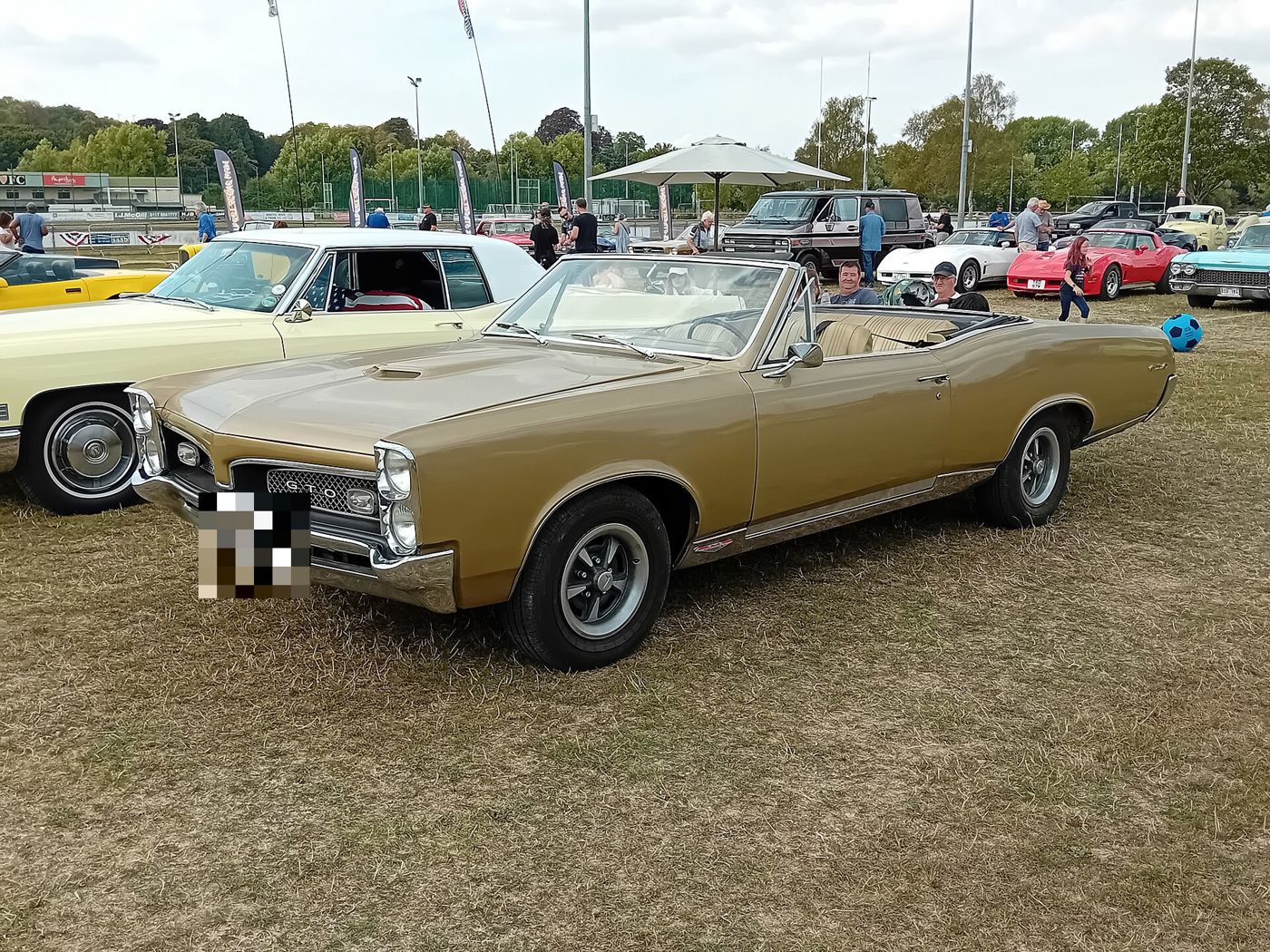

The decision that shaped the 1967 GTO was made above Pontiac. A General Motors management ruling reserved multiple carburetors for a favored few Chevrolets, and Tri-Power, the three two-barrel setup that had been the GTO's signature option since 1964, was gone. The sources differ slightly on the exemption. Over-Drive Magazine's fact sheet says only the Corvette kept multiple carburetors; Ate Up With Motor names Chevrolet's Corvair and Corvette. Either way the rule reached across divisions: Oldsmobile's Tri-Carb 4-4-2 option was dropped under the same edict. Pontiac had to find its performance somewhere else.1,2,3
It found it in displacement. The 389 was bored to 4.12 inches, which with the 3.75-inch stroke made 400 cubic inches, and new cylinder heads moved the combustion centers over the bores and cut the valve-stem angle to 14 degrees. A single Rochester Quadrajet four-barrel replaced the triple carburetors. The GTO offered four 400s, all rated SAE gross: a 255 hp two-barrel economy engine sold only with the automatic, the standard 335 hp four-barrel, a 360 hp HO, and a 360 hp Ram Air engine that reached its peak at 5,400 rpm rather than the HO's 5,100.1,4
The rest of the car changed in ways a driver felt more than a spectator saw. The two-speed automatic gave way to the three-speed Turbo Hydra-Matic, which could be ordered with a Hurst dual-gate shifter, the 'his and hers' lever that let the driver leave it in Drive or pick the gears by hand. For the first time a GTO could have front disc brakes, alongside a new dual master cylinder, and a tachometer could be mounted on the hood for $54. A collapsible steering column, energy-absorbing wheel and padded instrument panel became standard. Outside, the grille trim was reworked, the taillight louvers gave way to eight lamps, and the badges moved down to the sill moldings. The paint chart kept the advertising theme alive: among its 18 colors was code O, Gee-To Tiger Gold.1,2
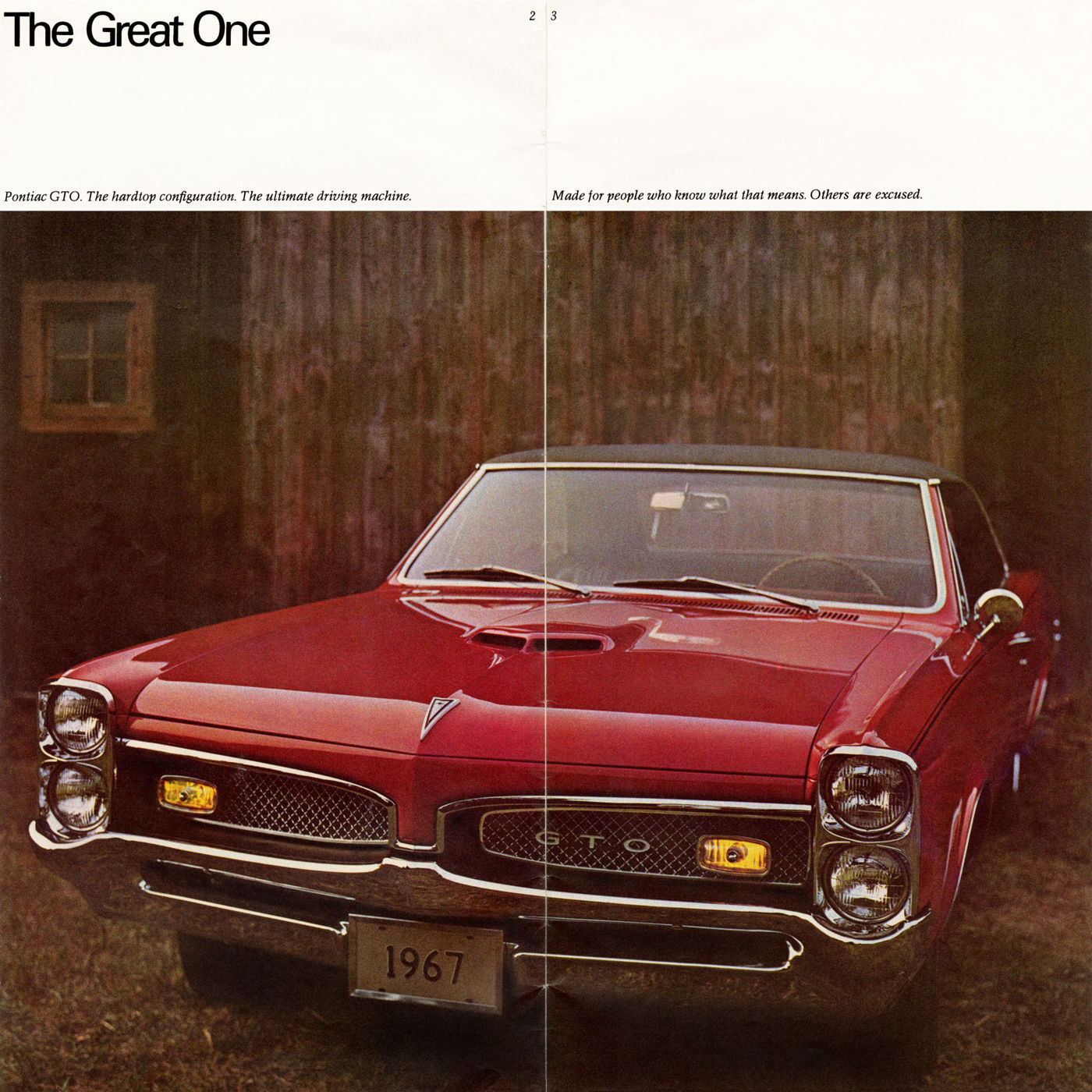
Over-Drive gives the reason the sheet metal barely moved: the introduction of the Firebird and the new body coming for 1968 held the GTO to minor styling and unseen improvements. Pontiac's own pony car was the year's big news. The first-season Firebird came to 82,560 cars, 67,032 hardtops and 15,528 convertibles, and one of its five engine-defined models was the Firebird 400. The GTO now shared the showroom with a smaller, sportier Pontiac that could also be ordered with a 400, and the newcomer's first-season total came out slightly larger than the GTO's 81,722.1,5,6
The order form still started low. Factory prices were $2,871 for the sport coupe, $2,935 for the hardtop and $3,165 for the convertible, the same hardtop list price Car Life printed. The four-speed was listed at $184 and the Turbo Hydra-Matic at $226. The Ram Air engine cost $263.30 over the standard 400, and power front disc brakes $104.79. The smaller items read like a catalog of the era: a $37 Safe-T-Track limited-slip, an $84 Rally gauge cluster, a $68 console, and $343 air conditioning.6,4,1
Pontiac built 81,722 GTOs for 1967: 65,176 hardtops, 9,517 convertibles and 7,029 sport coupes. That was 15,224 fewer than the record 96,946 of 1966, a drop of about 16 percent in the year the Firebird arrived. The hardtop took an even larger share than before, nearly 80 percent, while the convertible slipped to about 12 percent and the pillared sport coupe to under 9 percent.6,7
The field around it kept filling. Chevrolet's SS 396, in its second year as a separate series, came to 59,685 sport coupes and 3,321 convertibles. Oldsmobile's 4-4-2, now without Tri-Carb, came to 25,333. Chrysler answered with a new rival: Plymouth's first GTX, a Belvedere hardtop or convertible with a 375 hp 440 as standard and the 426 Hemi as its only option. Its production table lists 12,690, a figure estimated from dealer sales. At almost 82,000, the GTO stayed well clear of each of them.8,3,9,2
Car Life answered the question the missing carburetors raised. Its October 1967 test, headlined 'Hail to the King! The Super/Supercar,' used a Ram Air hardtop with the Turbo Hydra-Matic and a 4.33 limited-slip axle, which the magazine said came standard with Ram Air. Loaded to a 4,180-pound test weight, the car ran 0-60 mph in 6.1 seconds, 0-100 in 14.0 seconds, and the quarter mile in 14.5 seconds at 102.0 mph with driver and passenger aboard. In one pass with only the driver, it ran 13.9 seconds at 102.8 mph. The figures belong to that one car, gearing and all, but Car Life's headline did not read like a eulogy for Tri-Power.4
The same test showed what that speed came wrapped in. The 4.33 gears limited the car to 107 mph, reached at 5,600 rpm where the valves began to float, and it returned 8.9 mpg under test conditions and 8 to 12 in normal driving. The car carried California emission equipment. It listed at $2,935 and was delivered for testing at $4,422, with Ram Air, Turbo Hydra-Matic, power disc brakes and steering, power windows and antenna, AM-FM radio, vinyl top, tachometer and instrument cluster, styled steel wheels and limited-slip. The options added almost $1,500, about half again the list price, to a car whose appeal had begun with a cheap base.4
The 1967 car closed the first chapter. It was the last GTO on the 115-inch wheelbase, and the 7,029 sport coupes were the last of that body in the first-generation run. The following year brought the new 112-inch-wheelbase body with an Endura nose, the pillared sport coupe was dropped, and production recovered to 87,684. The new car offered five 400 families, topped by a 366 hp Ram Air II. The ruling that ended Tri-Power did not end the GTO's climb; it moved the argument from the number of carburetors to cubic inches and cold air. For 1967, 81,722 buyers accepted the trade.10,11,6,7
Fact sheet · 1967 · United States
The numbers
1967 Pontiac GTO: Tri-Power gone, the 389 grown to 400, and a Ram Air option that Car Life ran to a 14.5-second quarter mile.
Figures may describe different groups of cars. Add rows together only when the note says they make up a total.
Key facts
Production
| What was counted | Built |
|---|---|
| GTO total, all bodies6,12 GTO | 81,722 |
| What was counted | Built |
|---|---|
| GTO two-door sport coupe6 GTO · 2-door sport coupe | 7,029 |
| GTO two-door hardtop6 GTO · 2-door hardtop | 65,176 |
| GTO convertible6 GTO · convertible | 9,517 |
| What was counted | Built |
|---|---|
| GTO, synchromesh (manual) transmission13 GTO · 400 · manual (synchromesh) | 39,128 |
| GTO, automatic transmission13 GTO · 400 · automatic | 42,594 |
Prices when new
| Model | Price | Price type |
|---|---|---|
| GTO sport coupe6 | $2,871 | factory price, 1967 model year |
| GTO hardtop6,4 | $2,935 | factory price, 1967 model year |
| GTO convertible6 | $3,165 | factory price, 1967 model year |
| Price as tested, Car Life Ram Air hardtop (Ram Air, Turbo Hydra-Matic, power disc brakes, power steering, windows and antenna, AM-FM, vinyl top, tachometer and instrument cluster, styled steel wheels, air injector and emission controls, limited-slip)4 | $4,422 | equipped, 1967-10 |
Prices are the nominal dollars of the day, not adjusted for inflation.
Engines
| Engine | Factory rating | Availability |
|---|---|---|
| 400 2-bbl economy1 400 cu in · Rochester two-barrel | 255 hp @ 4,400, 397 lb-ft @ 2,400 (SAE gross) | GTO with automatic only |
| 400 4-bbl (standard)1 400 cu in · Rochester four-barrel | 335 hp @ 5,000, 441 lb-ft @ 3,400 (SAE gross) | standard |
| 400 HO1 400 cu in · Rochester four-barrel | 360 hp @ 5,100, 438 lb-ft @ 3,600 (SAE gross) | optional |
| 400 Ram Air4,1 400 cu in · Rochester four-barrel, functional hood scoop | 360 hp @ 5,400, 438 lb-ft @ 3,800 (SAE gross) | optional; $263.30 over the standard 400 per Car Life |
Ratings are published figures, not dyno results. Gross and net ratings aren't directly comparable.
Transmissions
| Transmission | Availability |
|---|---|
| Three-speed manual1 | standard |
| Four-speed manual, wide or close ratio1 | optional, $184 as listed by secondary fact sheet |
| Turbo Hydra-Matic three-speed automatic (Pontiac-Hurst console shifter on the Car Life car)1,4 | optional, $226 as listed by secondary fact sheet |
Options and packages
| Option | Price |
|---|---|
| Ram Air 400 engine4 | $263.30 |
| Power front disc brakes4 | $104.79 |
| GTO console1 | $68 |
| Rally gauge cluster1 | $84 |
| Safe-T-Track limited-slip differential1 | $37 |
| Air conditioning1 | $343 |
Paint
| Code | Color |
|---|---|
A |
Starlight Black1 |
C |
Cameo Ivory1 |
D |
Montreux Blue1 |
E |
Fathom Blue1 |
F |
Tyrol Blue1 |
G |
Signet Gold1 |
H |
Linden Green1 |
K |
Gulf Turquoise1 |
L |
Mariner Turquoise1 |
M |
Plum Mist1 |
N |
Burgundy1 |
O |
Gee-To Tiger Gold1 |
P |
Silverglaze1 |
Q |
Verdoro Green1 |
R |
Regimental Red1 |
S |
Champagne1 |
T |
Montego Cream1 |
Y |
Mayfair Maize1 |
Color names are the factory's. We don't show color swatches, because a screen color is no guide for a restoration.
Interiors
| Code | Trim |
|---|---|
219 |
Blue (vinyl, per the page's key) [GTO trim list]14 |
220 |
Turquoise (vinyl, per the page's key) [GTO trim list]14 |
221 |
Gold (vinyl, per the page's key) [GTO trim list]14 |
223,235 |
Black (vinyl, per the page's key) [GTO trim list]14 |
224,236 |
Parchment (vinyl, per the page's key) [GTO trim list]14 |
225 |
Red (vinyl, per the page's key) [GTO trim list]14 |
Specifications
| Measure | Value | Applies to |
|---|---|---|
| Wheelbase6,4 | 115 in | all GTO bodies |
| Overall length4 | 206.6 in | hardtop by Car Life |
| Shipping weight, sport coupe6 | 3,425 lb | sport coupe |
| Shipping weight, hardtop6 | 3,430 lb | hardtop |
| Shipping weight, convertible6 | 3,515 lb | convertible |
| Bore x stroke4 | 4.12 x 3.75 in | 400 V8 |
| Standard axle with Ram Air4 | 4.33 ratio | Ram Air GTO, per Car Life |
Period road tests
| Test | Car tested | Result |
|---|---|---|
| Car Life, 1967-1040-60 mph | GTO hardtop, 400 Ram Air (360 hp gross), Turbo Hydra-Matic, 4.33 limited-slip, F70-14 Firestone Wide Ovaltest weight 4,180 lb; California emission equipment fitted | 6.1 s |
| Car Life, 1967-1040-100 mph | GTO hardtop, 400 Ram Air (360 hp gross), Turbo Hydra-Matic, 4.33 limited-slip, F70-14test weight 4,180 lb | 14 s |
| Car Life, 1967-104standing quarter mile | GTO hardtop, 400 Ram Air (360 hp gross), Turbo Hydra-Matic, 4.33 limited-slip, F70-14102.0 mph; driver and passenger plus test gear | 14.5 s |
| Car Life, 1967-104standing quarter mile, driver only | GTO hardtop, 400 Ram Air, Turbo Hydra-Matic, 4.33102.8 mph; single pass | 13.9 s |
| Car Life, 1967-104top speed | GTO hardtop, 400 Ram Air, Turbo Hydra-Matic, 4.33at 5,600 rpm valve-float limit | 107 mph |
| Car Life, 1967-104curb weight | GTO hardtop, 400 Ram Air, Turbo Hydra-Matic, 4.33as reported | 3,780 lb |
| Car Life, 1967-104fuel consumption, normal conditions | GTO hardtop, 400 Ram Air, Turbo Hydra-Matic, 4.338.9 mpg under test conditions | 8-12 mpg |
A road test result belongs to the one car that was tested, with its engine, gearing, tires, and conditions. It is not a figure for every car of the year.
Identification
- Body (cowl) plate
- Body (cowl) plate riveted to the top left cowl under the hood. It carries the build date (month 01-12 and week A-E), the style number (year, series and body style), the body number (assembly-plant prefix and production sequence), the trim code, the lower and upper paint codes, and factory accessory codes. The page's example plate reads: Build Date 03B; Style 67-24217; Body PON 15XXX; Trim 223-B; Paint R-F.14
- Body-plate assembly-plant codes
- BAL = Baltimore, MD; PON = Pontiac, MI; BC = Southgate, CA; BT = Arlington, TX; E = Linden, NJ; LOR = Lordstown, OH; FRA = Framingham, MA; X = Kansas City, KS; KAN = Kansas City, MO; BF = Fremont, CA.14
Identification
Read a 1967 Pontiac VIN
The VIN decoder runs in your browser and never sends the VIN anywhere. How the factory numbered this year's cars:
Same model year
Also in 1967
- AMC Rebel and Rebel Machine The Rebel name returned on AMC's new intermediate, offered with a 280-hp 343 four-barrel V8. This is host-car context for the later Machine.
- Buick Riviera A new 430 V-8 (360 hp, 475 lb-ft) replaced the Nailhead; 4,837 cars had the GS handling option.
- Buick Skylark Gran Sport, GS and GSX A new 400 cu in V-8 made the Gran Sport the GS 400, joined by a 340 cu in GS 340 and a California GS coupe.
- Buick Wildcat The new 430 V-8 (360 hp, 475 lb-ft) replaced the Nailhead.
- Chevrolet Chevelle and Malibu SS Second year of the SS 396 series: 59,685 sport coupes and 3,321 convertibles, front disc brakes newly listed, and a late, barely documented L78.
- Chevrolet Chevy II and Nova Super Sport production fell to 10,069 in the source table. Enthusiast-compiled production: 106,430 cars; Super Sport 10,069.
- Chevrolet El Camino SS The Chevelle pickup with 396s at 325 and 350 hp on its option list; 34,830 built, 25,382 of them Malibu V8s.
- Chevrolet Impala SS The SS427 (RPO Z24) arrives: 2,124 of about 76,000 Impala Super Sports.
- Dodge Charger The first-generation fastback's second and last year: the 440 Magnum joined the options, and production fell to 15,788.
- Dodge Coronet R/T and Super Bee Dodge's first R/T: a Coronet hardtop or convertible with the 440 Magnum standard and the 426 Hemi as a special-order option; its production total is published two ways.
- Dodge Dart GTS, Swinger and Demon The restyled 1967 Dart GT offered a 235 hp 273 four-barrel and, for the first time, a 280 hp 383; Over-Drive counts 437 383-engined cars within 38,200 GT hardtops and convertibles.
- Ford Fairlane A facelifted second year for the big-block Fairlane: GT and GTA continued as Fairlane 500 hardtops and convertibles, and a 427 was offered in small numbers for drag racing.
- Ford Galaxie The last year of the approved Galaxie performance range: the 7-Litre quietly disappeared, while the 428 and a 425-hp 427 remained on the order form.
- Ford Thunderbird A new, larger fifth-generation Thunderbird added a four-door Landau; the 428 was the performance option.
- Mercury Comet and Cyclone The Cyclone and Cyclone GT continued as hardtop and convertible, and a handful of Comets were built with the 427 side-oiler.
- Mercury Cougar Mercury's first pony car arrived as a single hardtop body, added the XR-7 at mid-year, and built 150,893 in its first season.
- Mercury Marauder and S-55 The S-55's last year: 570 hardtops and 145 convertibles with the 428 four-barrel, per Wikipedia's table.
- Oldsmobile Cutlass, 4-4-2 and Hurst/Olds Multiple carburetors were gone, the 4-4-2 was trimmed as a Cutlass Supreme, and the W-30 cold-air package became a regular factory option on about 500 cars.
- Plymouth Barracuda and 'Cuda The redesigned second-generation Barracuda added a notchback hardtop and a convertible to the fastback, and the Formula S could now carry a 383.
- Plymouth GTX, Belvedere and Satellite Plymouth's first GTX put a 375-hp 440 Super Commando in a dressed-up Belvedere hardtop and convertible, with the 426 Hemi as the only engine option.
- Pontiac Catalina 2+2 and Super Duty The 2+2 returned to option status with a standard 360 hp 428, and only 1,768 were built.
- Pontiac Firebird and Trans Am Pontiac's late entry into the pony-car field: a Camaro body with a Pontiac nose, five engine-defined models, and 82,560 built in a short first season.
- Pontiac Grand Prix Concealed headlamps, a standard 350 hp 400, and the only Grand Prix convertible: 5,856 built.
- Pontiac Tempest and LeMans The Sprint six grows to 215 hp and the 326 HO continues; 109,413 LeMans built.
- Rambler and AMC Marlin The last Marlin moved to a 118-inch wheelbase with 290 and 343 V8s listed, the top one a 280-hp 343. Only 2,545 were built.