1971 · AMC · United States
1971 AMC Javelin: Flared Fenders, a 401 and the Trans-Am Championship
A new, flared-fender Javelin, with the AMX name as its top model. Javelin won AMC the 1971 Trans-Am manufacturers' championship.
United States · researched through 2026-09-22
At Road America on 17 July 1971, Mark Donohue started the Penske Javelin from pole. Vic Elford put Roy Woods's Javelin alongside him, and George Follmer's Bud Moore Mustang started third. The series' own retrospective says Follmer cut a tire just past the pit entrance on lap four and had to drive the whole four-mile lap before his crew could help him. He recovered to finish second. The SCCA result sheet records Donohue the winner by two minutes ten seconds after 50 laps. It lists Elford as retired after 30 laps with a “mechanical” failure. It was Donohue's fourth win of the season and the third of six in a row.1,2
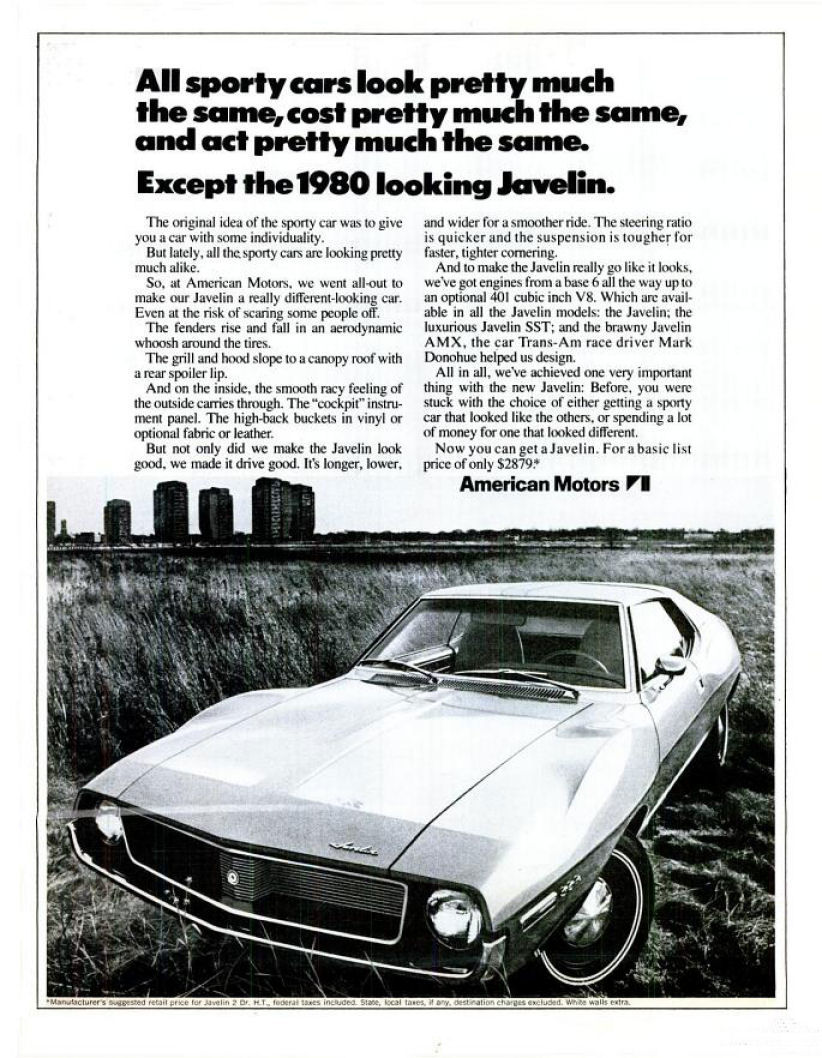
The car in the showrooms had changed as much as the one at the track. For 1971 AMC redesigned the Javelin with bulging fender flares and a spoiler along the roof edge. Ate Up With Motor credits the styling to Jack Kenitz and Keith Goodnough. It adds that the flush grille was included at Donohue's request, because he wanted better aerodynamics for racing. The car grew to a 110-inch wheelbase and a 192.3-inch overall length. It came in three models: the base Javelin, body 7179-5, the SST, 7179-7, and a new Javelin AMX, 7179-8. The AMX name no longer meant a short two-seater. It now meant the top Javelin.3,4,5
The order form ran from economy to real performance. The 232 six was standard, followed by the 258 six and the 304 two-barrel V8. Wikipedia rates them at 135, 150 and 210 gross horsepower, figures not yet checked against AMC literature. AMC's 1971 brochure rates the 360 four-barrel at 285 horsepower and 390 lb-ft and the new 401 at 330 horsepower and 430 lb-ft. The Go Package cost $410 with the 360 or $499 with the 401. It included Rally Pak gauges, dual exhaust, 15x7 Rally wheels, E60x15 raised-white-letter tires, a handling package, heavy-duty cooling, a space-saver spare and Twin-Grip. The factory prices were $2,879 for the base Javelin and $2,999 for the SST.6,7,4
Most buyers did not choose the car's racing image. Planet Houston AMX, followed by JavelinAMX.com, counts 7,105 base Javelins and 17,707 SSTs, and breaks each down by engine. Among the 17,707 SSTs, the 304 went into 10,907, about 62 percent, and the 360 into 5,324. Only 582 had the 401, about 3 percent, and 894 had one of the sixes. The base car leaned even further toward economy. Of its 7,105 buyers, 3,338 took the 304, 2,283 took the 232 six and only 97 took the 401. The two tables give 679 401-powered base and SST Javelins in the year the Javelin won the manufacturers' championship. The 2,054 Javelin AMXs are counted separately.4,5
One small group of 401 Javelins went to work for the state. The Alabama State Police bought Javelins with the big engine, but the size of the order is disputed. JavelinAMX.com estimates about 3 to 20 cars for 1971. Wikipedia gives 132 over 1971 and 1972 together. Neither figure is backed by a published purchase record, so both are reported with their sources and neither is used as a count. The police cars cannot be separated from the 401 totals in the production table, and the table's 679 figure should not be read as civilian buyers only. Even the 401, the rarest engine choice, has an unsettled story behind its numbers.5,6
The racing program on those 1971 weekends had begun two seasons earlier. After 1969, Team Penske moved from Chevrolet's Camaro to AMC's Javelin, and its own history says the small crew had to adapt to a different car. Don Cox, who joined in November 1969 as the team's first dedicated engineer, later recalled AMC's proposal as financially attractive. He said it kept Penske and Donohue together and offered a new challenge. That is his recollection, not the contract. Team Penske names Karl Kainhofer, Woody Woodard, Earl McMullen, Chuck Cantwell and Cox among the early crew. Development of the Javelin was a team effort, not the work of one or two famous names.8,9
The first season did not bring the title. Ate Up With Motor says Donohue won the Javelin's first Trans-Am race at Bridgehampton on 21 June 1970. The final 1970 SCCA sheet shows Ford ahead on manufacturer points, 72 to AMC's 59, with Chevrolet at 40, Dodge at 18 and Plymouth at 15. In 1971 the result reversed. Across the ten over-2.5-liter rounds, Donohue won Lime Rock, Edmonton, Donnybrooke, Road America, St. Jovite, Watkins Glen and Michigan: seven wins, six of them in a row. Follmer won the other three, at Bryar, Mid-Ohio and Riverside. Ate Up With Motor's “seven of the 12” wording does not match the ten dated SCCA sheets, and the sheets lead.3,10,2
The final 1971 sheet gives Javelin 82½ points to Mustang's 61, Camaro's 17 and Pontiac's 7, and states that Javelin had clinched the championship. That was a manufacturers' title, the only kind the series awarded then. A later Trans Am reconstruction applied driver points to the early seasons and credits Donohue as the 1971 driver champion. That recognition is retrospective and is labeled that way. The opposition was also thinner than before. Ate Up With Motor notes that the other manufacturers had withdrawn factory support. Follmer's three wins and his recovery at Road America show that the Javelin still had serious competition, and AMC won the title anyway.2,11,1,3
The showroom car and the race car shared a name, a shape and a purpose in AMC's advertising, but the brochure is not a Penske specification sheet. It cannot prove the race engine's build, output or weight, and a street 401 did not win at Road America. The link between them is the grille that Ate Up With Motor says Donohue asked for. After 1971, according to the same history, Penske and Donohue left the Trans-Am while Roy Woods continued with Javelins in 1972. The Javelin itself lasted through 1974, when AMC needed the plant capacity for the Pacer. In 1971 the Javelin brought AMC its first Trans-Am manufacturers' title, after third place in 1968 and second in 1970. On the street, that same season's buyers mostly chose a 304 SST, and only 97 of them ordered a base car with the 401.3,4,10,2
Fact sheet · 1971 · United States
The numbers
1971 AMC Javelin — A new, flared-fender Javelin, with the AMX name as its top model. Javelin won AMC the 1971 Trans-Am manufacturers' championship.
Coverage: Partial — researched sections are shown; missing ones are not yet sourced. Researched through 2026-09-22.
Every figure is labeled with how sure we are. Reported means a manufacturer, registry, or reference figure we cite but have not reconciled against factory records ourselves. Disputed means credible sources disagree and both are shown. Rows are separately scoped; don't add them together unless the note says they make up a total.
Key facts
- Base Javelin 7,105: 232 six 2,283, 258 six 922, 304 V8 3,338, 360 V8 465, 401 V8 97.4
- Javelin SST 17,707: 232 six 433, 258 six 461, 304 V8 10,907, 360 V8 5,324, 401 V8 582.4
- Alabama State Police bought 401-powered Javelins. JavelinAMX.com estimates about 3–20 in 1971, and Wikipedia gives 132 across 1971–72.5,6
Production
| What was counted | Count | Basis | Status |
|---|---|---|---|
| Javelin (base), body 7179-54,5 Javelin · 2-door hardtop · US production | 7,105 | built, model-year | Reported |
| Javelin SST, body 7179-74,5 Javelin SST · 2-door hardtop · US production | 17,707 | built, model-year | Reported |
| What was counted | Count | Basis | Status |
|---|---|---|---|
| Base, 232 six4 Javelin · 2-door hardtop · 232 six · US | 2,283 | built, model-year | Reported |
| Base, 258 six4 Javelin · 2-door hardtop · 258 six · US | 922 | built, model-year | Reported |
| Base, 304 V84 Javelin · 2-door hardtop · 304 V8 · US | 3,338 | built, model-year | Reported |
| Base, 360 V84 Javelin · 2-door hardtop · 360 V8 · US | 465 | built, model-year | Reported |
| Base, 401 V84 Javelin · 2-door hardtop · 401 V8 · US | 97 | built, model-year | Reported |
| SST, 232 six4 Javelin SST · 2-door hardtop · 232 six · US | 433 | built, model-year | Reported |
| SST, 258 six4 Javelin SST · 2-door hardtop · 258 six · US | 461 | built, model-year | Reported |
| SST, 304 V84 Javelin SST · 2-door hardtop · 304 V8 · US | 10,907 | built, model-year | Reported |
| SST, 360 V84 Javelin SST · 2-door hardtop · 360 V8 · US | 5,324 | built, model-year | Reported |
| SST, 401 V84 Javelin SST · 2-door hardtop · 401 V8 · US | 582 | built, model-year | Reported |
| What was counted | Count | Basis | Status |
|---|---|---|---|
| Javelin line including AMX12 Javelin, SST and AMX · 2-door hardtop · US Equals 7,105 (base) + 17,707 (SST) + 2,054 (AMX, recorded under the AMX subject). Conceptcarz's own body-style breakdown reproduces these three figures exactly, so this row restates the same lineage as a stated combined total rather than an independent count. | 26,866 | built, model-year | Reported |
Engine rows partition each trim's total in the source (base 7,105; SST 17,707).
The 2,054 1971 AMXs (7179-8) are recorded under the AMX subject and are not included in the base/SST rows, but are included in the Javelin-line total row above.
Prices when new
| Model | Price | Basis |
|---|---|---|
| Javelin (base)4 | $2,879 | 'factory price' as tabulated (basis not stated), 1970-09 |
| Javelin SST4 | $2,999 | 'factory price' as tabulated (basis not stated), 1970-09 |
| Go Package with 3607 | $410 | option price as reported for 1971–74, 1971–74 |
| Go Package with 4017 | $499 | option price as reported for 1971–74, 1971–74 |
Prices are the nominal dollars of the day, not adjusted for inflation.
Engines
| Engine | Factory rating | Availability | Built |
|---|---|---|---|
| 232 six6 232 cu in | 135 hp @ 4,000, 210 lb-ft @ 1,600 (gross (per Wikipedia)) | standard | Not yet sourced |
| 258 six6 258 cu in | 150 hp @ 3,800, 240 lb-ft @ 1,800 (gross (per Wikipedia)) | optional | Not yet sourced |
| 304 V86 304 cu in · 2-barrel | 210 hp @ 4,400, 300 lb-ft @ 2,600 (gross (per Wikipedia)) | optional | Not yet sourced |
| 360 V8 4-bbl 360 cu in · 4-barrel | 285 hp @ 4,800, 390 lb-ft @ 3,200 (period advertised factory (gross)) | optional (Go Package) | Not yet sourced |
| 401 V8 4-bbl 401 cu in · 4-barrel | 330 hp @ 5,000, 430 lb-ft @ 3,400 (period advertised factory (gross)) | optional (Go Package) | Not yet sourced |
| 360 V8 2-bbl 360 cu in · 2-barrel | 245 hp @ 4,400, 365 lb-ft @ 2,600 (period factory advertised (gross)) | optional (standard on AMX) | Not yet sourced |
Ratings are the manufacturer's advertised figures under the standard shown (SAE gross before 1972, SAE net after). They are not dyno results, and gross and net ratings can't be compared directly.
Transmissions
| Transmission | Availability | Built |
|---|---|---|
| Three-speed manual, floor shift (standard) | standard | Not yet sourced |
| Shift-Command automatic, column or console | optional | Not yet sourced |
| Four-speed manual, floor (360 4-bbl and 401) | optional | Not yet sourced |
Options and packages
| Code | Option | Price | Installed |
|---|---|---|---|
|
Go Package: 360 or 401 four-barrel, Rally Pak gauges, dual exhaust, 15x7 Rally wheels, E60x15 raised-white-letter tires, handling package, heavy-duty cooling, space-saver spare, Twin-Grip7 | $410 | Not yet sourced |
|
Vinyl-covered roof: black, white, green or blue | — | Not yet sourced |
|
Nylon corduroy upholstery (SST and AMX); genuine leather front seats (SST and AMX) | — | Not yet sourced |
|
Dual exhaust for 360 4-bbl (standard on 401) | — | Not yet sourced |
|
V-8 Rally-Pac: oil pressure gauge, ammeter, tachometer, clock, 140-mph speedometer | — | Not yet sourced |
|
Twin-Grip differential (required with 3.91 axle) | — | Not yet sourced |
|
Quick-ratio manual steering | — | Not yet sourced |
|
Power steering; power brakes; power front disc brakes (V-8); manual front disc brakes (V-8) | — | Not yet sourced |
|
AM push-button radio; AM/FM multiplex stereo with 2 rear speakers; rear speaker with radio; 8-track stereo with manual AM radio | — | Not yet sourced |
|
Console; armrest for console; armrest and center cushion (except AMX) | — | Not yet sourced |
|
Air conditioning; tinted glass; trunk lid rack (except AMX); Adjust-O-Tilt wheel; electric clock; electric wipers and washers; headlights-off delay; electric rear window defogger; space-saver spare | — | Not yet sourced |
|
Light group; visibility group | — | Not yet sourced |
|
Wheel covers (standard SST); custom wheel covers; Turbo-Cast or wire wheel covers; 14x6 spoke-style wheels; 15x7 slot-style wheels; rally stripes | — | Not yet sourced |
|
Bumper guards; insulation group; anti-scuff side molding; clear vinyl floor mats | — | Not yet sourced |
|
Handling package (6-cyl. or V-8); trailer towing package No. 1; heavy-duty cooling; 70-amp battery; cold-start package; engine block heater | — | Not yet sourced |
|
NITROX-TCS emission system (required in California) | — | Not yet sourced |
|
Optional tires: D78x14, E78x14 black (white-twin-line optional), E70x14 white-letter, E60x15 white-letter | — | Not yet sourced |
Interiors
| Code | Trim | Built |
|---|---|---|
61 / 63 / 64 / 65 (J) |
Base: black, blue, green, red; Tampico embossed vinyl4 | Not yet sourced |
61 / 63 / 64 / 65 / 068 (S, L or R) |
SST: black, blue, green, red, white; S Wellington vinyl, L leather (black or red only), R corduroy4 | Not yet sourced |
Specifications
| Measure | Value | Applies to |
|---|---|---|
| Shipping weight, base4 | 2,887 lb | 7179-5 |
| Shipping weight, SST4 | 2,890 lb | 7179-7 |
| Wheelbase | 110 in | all 1971 Javelins |
| Overall length | 191.8 in | all 1971 Javelins |
| Overall width | 75.2 in | all 1971 Javelins |
| Tread, front (six / V-8) / rear | 59.3 / 59.7 / 60.0 in | all 1971 Javelins |
| Trunk space | 10.2 cu ft | all 1971 Javelins |
| Fuel tank | 16 US gal | all 1971 Javelins |
| Standard tires | C78x14 (sixes), D78x14 (V-8s), E70x14 white-letter (AMX) | by engine/trim |
Identification
- Base vs SST
- The 1971 base car has no bright trim around the wheel wells, hood and fender edges, door tops, drip rails and rockers, and has brushed-aluminum-look interior trim. The SST has that bright trim, an 'SST' emblem and burled-wood-look trim.5
Same model year
Also in 1971
- AMC AMX The AMX name moves onto the redesigned Javelin as its top model. It is a derivative badge, not a continuation of the two-seater. 2,054 were built, all with the 360 or 401.
- AMC Hornet SC/360 AMC's one-year compact muscle car pitched as an insurance-friendly alternative. AMC reportedly planned 10,000, but 784 were built.
- AMC Matador Machine The Rebel Machine's unadvertised successor, a 'Machine Go' option package for the Matador hardtop. Production is unknown; published guesses run from 43 to 68.
- Buick Riviera The boattail Riviera: 455 rated 315 gross / 255 net, GS 330 / 265; 3,175 of 33,810 were GS.
- Buick Skylark Gran Sport, GS and GSX Compression fell to 8.5:1, the GS 350 and GS 455 were merged into one GS series of 9,170 cars, and the GSX became an appearance package on any GS.
- Chevrolet Chevelle and Malibu SS A single RPO Z15 SS package now spanned small- and big-block V8s; 9,502 of 19,293 SS cars carried the LS5 454, and Chevrolet began printing net ratings beside gross.
- Chevrolet Chevy II and Nova SS limited to the L48 350 per the source; Rally Nova (RPO YF1) offered. Enthusiast-compiled production: 194,878 cars; Super Sport 7,015.
- Chevrolet El Camino SS A single RPO Z15 SS package on the Malibu/Custom El Camino; the El Camino share of 19,293 SS cars is not separately published.
- Chevrolet Monte Carlo SS The last SS 454 year: RPO Z20 on 1,919 of 128,600 Monte Carlos.
- Dodge Challenger Challenger's second year lost the SE, the R/T convertible, and the T/A; a new pillared coupe joined the hardtop and convertible, and production fell to roughly a third of 1970's.
- Dodge Charger A new, shorter third-generation body absorbed the Coronet two-doors and the Super Bee; it was the last year for the R/T and for a factory Hemi Charger.
- Dodge Coronet R/T and Super Bee The end of the line for Coronet performance: the two-door Coronets were replaced by the Charger, taking the Super Bee with them.
- Dodge Dart GTS, Swinger and Demon Dodge's version of the Duster fastback arrived as the Demon, and the Demon 340 became the performance Dart: 10,098 built, plus 85 Canadian Swinger 340 Specials.
- Ford Maverick Grabber The Grabber became its own model with a dual-scoop hood, and the 210 hp 302 V8 arrived; Classic Industries counts 38,963 Grabbers.
- Ford Ranchero GT The second Torino-based Ranchero year; reference counts give 3,632 GTs, while Barn Finds rounds the GT figure to about 3,900 of 24,946 Rancheros.
- Ford Thunderbird The last fifth-generation year kept the 360-hp 429 as standard; production fell to 36,055.
- Ford Torino A carryover year for the 1970 body; the Torino Cobra now came standard with a 351 four-barrel and offered the 429 Cobra Jet-R, but only 3,054 Cobras were built.
- Mercury Comet and Cyclone The final Cyclone year: production fell to a few thousand across Cyclone, Cyclone GT and Cyclone Spoiler.
- Mercury Cougar A larger second-generation Cougar, new body codes, and the one-year 429 Cobra Jet option, fitted to 448 cars.
- Oldsmobile Cutlass, 4-4-2 and Hurst/Olds Compression fell to 8.5:1 for regular fuel, the W-31 was dropped, the sports coupe was gone, and 4-4-2 production fell to 7,589.
- Plymouth Barracuda and 'Cuda Four headlamps and a new grille marked the second E-body year; the Hemi and 440 Six Barrel stayed on the 'Cuda order form, but Barracuda-line production fell to about a third of 1970's.
- Plymouth Duster 340 and 360 The Duster 340's second year brought a new grille, a Thermo-Quad 340 rated 275 gross and 235 net hp, and a $2,703 list price, while output fell to about 12,900.
- Plymouth GTX, Belvedere and Satellite On the redesigned 1971 Satellite body the GTX fell to 2,942 cars, only 30 of them with the Hemi.
- Plymouth Road Runner Redesigned on the new Satellite body as a hardtop only, the Road Runner fell to 14,218 cars, and a 340 joined the 383, 440, and Hemi.
- Pontiac Firebird and Trans Am The 455 HO year: the Trans Am's biggest engine, 2,116 cars, and a Formula line split across three V-8s.
- Pontiac GTO Lower compression, dual gross and net ratings, the 455 HO as the top engine, and production down to 10,532.
- Pontiac Grand Prix Boat-tail styling, lower compression, and the manual transmission gone by March: 116 of 58,325 had one.
- Pontiac Tempest and LeMans The Tempest name gives way to T-37; the GT-37 option carries on and the 455 HO is available in two-door LeMans models.