1971 · AMC · United States
1971 Javelin AMX: the badge moves to a four-seat platform
The AMX name moves onto the redesigned Javelin as its top model. It is a derivative badge, not a continuation of the two-seater. 2,054 were built, all with the 360 or 401.
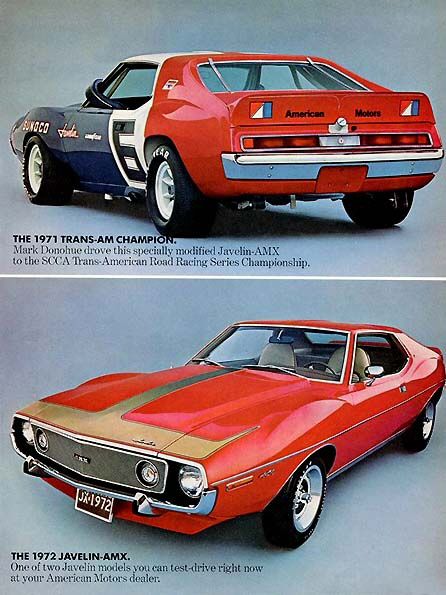
For 1971, AMC dropped the two-seat AMX and moved the name to the top Javelin model. The new four-seat car, body 7179-8, shared the redesigned Javelin's shape but carried its own performance package. It was a real change in what the AMX name meant: the original two-seater ended, while the badge continued on a larger car with a back seat. AMC's catalog described the new model through engine and equipment choices rather than as a continuation of the old car's body.
The reported 1971 production of the Javelin AMX was 2,054 cars, 1,309 of them with the 360 V-8 and 745 with the 401; there were no six-cylinder or 304 V-8 cars, and AMC's own factory tally sheet gives the same engine split. On those figures, about 36 percent of 1971 Javelin AMX buyers chose the 401.1,2,3
The AMX listed for $3,432 and weighed 3,244 pounds shipping. Buyers could add the Go Package for $410 with the 360 or $499 with the 401. It brought Rally Pak gauges, E60-by-15 raised-white-letter tires and handling equipment, plus dual exhaust, 15-by-7 Rally wheels, heavy-duty cooling, a space-saver spare and a Twin-Grip differential; the AMX version also included a fiberglass cowl-induction hood, a hood T-stripe and a blacked-out tail panel. Functional cowl induction was a separate option. Neither the VIN nor the door tag records the Go Package, so original paperwork is what identifies one.4,1,4
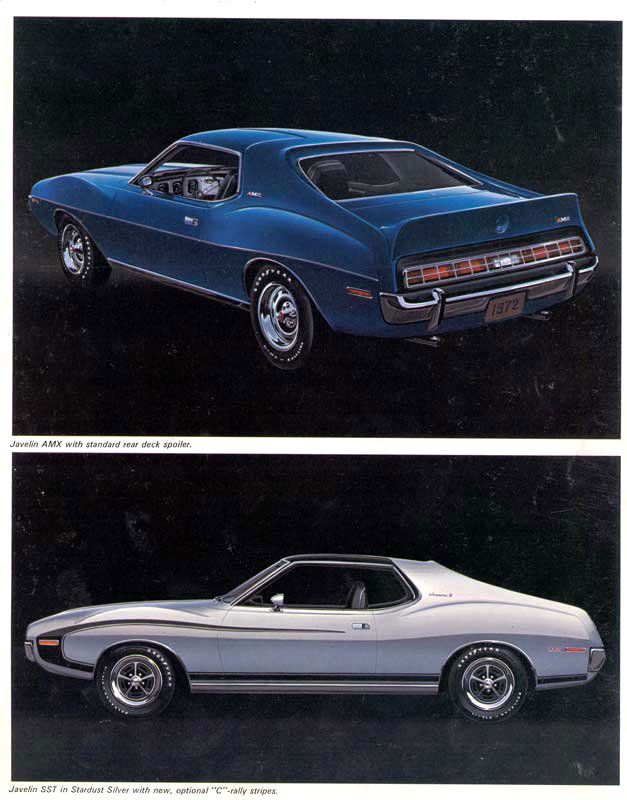
AMC offered three V-8 combinations. The standard 360 used a two-barrel carburetor and was advertised at 245 horsepower and 365 pound-feet. The Go Package's 360 four-barrel was rated at 285 horsepower and 390 pound-feet; the optional 401 four-barrel was rated at 330 horsepower and 430 pound-feet. These are factory gross ratings from the period, before AMC changed to net ratings the following year. The 401 was tied to the Go Package, while the base 360 gave the Javelin AMX its standard power.
A three-speed floor-shift manual came standard with the 360. Buyers could order a four-speed manual or Borg-Warner automatic, and AMC listed a long options menu: upholstery in corduroy or leather, Rally-Pac gauges, power steering and brakes, radios, air conditioning and heavy-duty towing equipment. A vinyl roof came in black, white, green or blue. Interiors came in black, blue, green, red or white under codes 61, 63, 64, 65 and 068, with Wellington vinyl, corduroy, or leather in black or red only.1
The Javelin AMX rode a 110-inch wheelbase and measured 191.8 inches long and 75.2 inches wide. The AMX also came with a 16-gallon tank, V-8 brakes and E70-by-14 white-letter tires. The sixth VIN character identifies the AMX series, while door-tag body number 7179-8 is specific to 1971. Taken together, the equipment and the reported production breakdown show how AMC carried the AMX name into a new kind of car: a four-seat Javelin with a performance package and a range of V-8 choices. V-8 cars rode on a 59.7-inch front and 60.0-inch rear tread. Among the catalog options was the V-8 Rally-Pac, which added an oil pressure gauge, ammeter, tachometer, clock and 140-mph speedometer.1
Fact sheet · 1971 · United States
The numbers
1971 AMC Javelin AMX: The AMX name moves onto the redesigned Javelin as its top model. It is a derivative badge, not a continuation of the two-seater. 2,054 were built, all with the 360 or 401.
Figures may describe different groups of cars. Add rows together only when the note says they make up a total.
Key facts
- 1971 AMX production 2,054: 360 V8 1,309, 401 V8 745.1
- Factory price $3,432; shipping weight 3,244 lb.1,3
- The 1971–74 Go Package cost $410 with the 360 or $499 with the 401 and included the Rally Pak gauges, E60x15 raised-white-letter tires, handling package and, on the AMX, a fiberglass cowl-induction hood.4
- A 1971–74 AMX carries '8' in the sixth VIN position.1
Production
| What was counted | Built |
|---|---|
| Javelin AMX (body 7179-8)1,2,3 AMX · 2-door hardtop · US production | 2,054 |
| What was counted | Built |
|---|---|
| 360 V81 AMX · 2-door hardtop · 360 V8 · US | 1,309 |
| 401 V81 AMX · 2-door hardtop · 401 V8 · US | 745 |
Prices when new
| Model | Price | Price type |
|---|---|---|
| Javelin AMX1,3 | $3,432 | factory price, 1970-09 |
| Go Package with 3604 | $410 | option price, 1971–74 |
| Go Package with 4014 | $499 | option price, 1971–74 |
Prices are the nominal dollars of the day, not adjusted for inflation.
Engines
| Engine | Factory rating | Availability | Built |
|---|---|---|---|
| 360 V8 2-bbl3 360 cu in · 2-barrel | 245 hp @ 4,400, 365 lb-ft @ 2,600 (period factory advertised (gross)) | standard | |
| 360 V8 4-bbl (Go Package) 360 cu in · 4-barrel | 285 hp @ 4,800, 390 lb-ft @ 3,200 (period advertised factory (gross)) | Go Package | |
| 401 V8 4-bbl (Go Package) 401 cu in · 4-barrel | 330 hp @ 5,000, 430 lb-ft @ 3,400 (period advertised factory (gross)) | Go Package | 7451 |
Ratings are published figures, not dyno results. Gross and net ratings aren't directly comparable.
Transmissions
| Transmission | Availability |
|---|---|
| Four-speed manual | optional |
| Borg-Warner automatic3 | optional |
| Three-speed manual, floor shift (standard on AMX with 360) | standard |
Options and packages
| Option | Price |
|---|---|
| Go Package: 360 or 401 four-barrel, Rally Pak gauges, dual exhaust, 15x7 Rally wheels, E60x15 Polyglas raised-white-letter tires, handling package, fiberglass cowl-induction hood (AMX), heavy-duty cooling, space-saver spare, hood T-stripe (AMX), tail-panel blackout (AMX), Twin-Grip. Functional cowl induction was a separate option.4 | $410 |
| Nylon corduroy upholstery (SST and AMX) | |
| Genuine leather front seats (SST and AMX) | |
| Vinyl-covered roof: black, white, green or blue | |
| V-8 Rally-Pac: oil pressure gauge, ammeter, tachometer, clock, 140-mph speedometer | |
| Twin-Grip differential (required with 3.91 axle) | |
| Quick-ratio manual steering | |
| Front lower spoiler (rear spoiler standard on AMX) | |
| Dual exhaust for 360 4-barrel (standard on 401) | |
| Power steering | |
| Power brakes | |
| Power front disc brakes (V-8) | |
| Manual front disc brakes (V-8) | |
| AM push-button radio | |
| AM/FM multiplex stereo radio and 2 rear speakers | |
| 8-track stereo tape player with manual AM radio and 2 rear speakers | |
| Air conditioning (with heavy-duty cooling and 55-amp alternator) | |
| Tinted glass, all windows or windshield only | |
| Adjust-O-Tilt steering wheel | |
| Visibility group: convenience group plus electric wipers and washers | |
| Headlights-off delay system | |
| Electric rear window defogger (with 55-amp alternator and tinted rear glass) | |
| Bumper guards, front and rear | |
| Handling package, V-8 (heavy-duty springs and shocks) | |
| Trailer towing package No. 1 (up to 2,000 lb) | |
| 70-amp battery (60-amp standard on 360 and 401) | |
| Cold-start package | |
| Engine block heater | |
| NITROX-TCS emission system (required in California) | |
| E60 x 15 black tires with white letters | |
| Standard on AMX: console, electric clock, insulation group, space-saver spare, E70 x 14 white-letter tires on 14 x 6 slot-style wheels, right-side mirror, rear spoiler |
Interiors
| Code | Trim |
|---|---|
61 |
Black; trims S (Wellington vinyl), L (leather, black or red only) or R (corduroy)1 |
63 |
Blue1 |
64 |
Green1 |
65 |
Red1 |
068 |
White1 |
Specifications
| Measure | Value | Applies to |
|---|---|---|
| Shipping weight1 | 3,244 lb | body 7179-8 |
| Wheelbase | 110 in | all 1971 Javelins |
| Overall length | 191.8 in | all 1971 Javelins |
| Overall width | 75.2 in | all 1971 Javelins |
| Tread, front / rear (V-8) | 59.7 / 60.0 in | V-8 Javelins |
| Fuel tank capacity | 16 US gal | all 1971 Javelins |
| Brake diameter (V-8) | 10 in | V-8 Javelins |
| Standard tires, AMX | E70 x 14 black with white letters | Javelin AMX |
| Axle ratios, AMX (standard; optional) | 360 2-bbl: 3-speed floor 3.15 (3.54), console automatic 2.87 (3.15); 360 4-bbl: 3-speed 3.15 (3.54), 4-speed 3.54 (3.15, 3.91), automatic 2.87 (3.15); 401: 4-speed 3.54 (3.15, 3.91), automatic 2.87 (3.15, 3.54); with Go Package and automatic 360 3.15 std (2.87 opt), 401 3.15 std (2.87, 3.54 opt) :1 | Javelin AMX |
Identification
- VIN / door tag
- All 1971–74 AMXs have '8' in the sixth VIN digit. The door-tag model number is 7179-8.1
- Go Package
- Neither the VIN nor the door tag indicates the Go Package. Original paperwork is required.4
Read next
The people and races behind the 1971 AMC AMX
- Mark Donohue, Roger Penske, and the 1971 Season AMC Did Not Retreat Racing program
- 1971: Two Horsepower Languages on One Factory Page Cross-marque story
- Every AMC AMX year 1968–1980
Same model year
Also in 1971
- AMC Hornet SC/360 AMC's one-year compact muscle car pitched as an insurance-friendly alternative. AMC reportedly planned 10,000, but 784 were built.
- AMC Javelin A new, flared-fender Javelin, with the AMX name as its top model. Javelin won AMC the 1971 Trans-Am manufacturers' championship.
- AMC Matador Machine The Rebel Machine's unadvertised successor: a 'Machine Go' package for the Matador hardtop, with reported counts from 43 to 68.
- Buick Riviera The boattail Riviera: 455 rated 315 gross / 255 net, GS 330 / 265; 3,175 of 33,810 were GS.
- Buick Skylark Gran Sport, GS and GSX Buick’s revised factory form lists gross and net ratings for the GS engines; the early Stage 1 test used a pre-production car, and GSX appearance did not identify an engine.
- Chevrolet Chevelle and Malibu SS A single RPO Z15 SS package now spanned small- and big-block V8s; 9,502 of 19,293 SS cars carried the LS5 454, and Chevrolet began printing net ratings beside gross.
- Chevrolet Chevy II and Nova SS limited to the L48 350 per the source; Rally Nova (RPO YF1) offered. Enthusiast-compiled production: 194,878 cars; Super Sport 7,015.
- Chevrolet El Camino SS A single RPO Z15 SS package on the Malibu/Custom El Camino, up to the 425 hp LS6; 19,293 SS cars across Malibu models.
- Chevrolet Monte Carlo SS The last SS 454 year: RPO Z20 on 1,919 of 128,600 Monte Carlos.
- Dodge Challenger Challenger's second year lost the SE, the R/T convertible, and the T/A; a new pillared coupe joined the hardtop and convertible, and production fell to roughly a third of 1970's.
- Dodge Charger A new, shorter third-generation body absorbed the Coronet two-doors and the Super Bee; it was the last year for the R/T and for a factory Hemi Charger.
- Dodge Coronet R/T and Super Bee The end of the line for Coronet performance: the two-door Coronets were replaced by the Charger, taking the Super Bee with them.
- Dodge Dart GTS, Swinger and Demon Dodge's version of the Duster fastback arrived as the Demon, and the Demon 340 became the performance Dart: 10,098 built, plus 85 Canadian Swinger 340 Specials.
- Ford Maverick Grabber The Grabber became its own model with a dual-scoop hood, and the 210 hp 302 V8 arrived; Classic Industries counts 38,963 Grabbers.
- Ford Ranchero GT The second Torino-based Ranchero year; reference counts give 3,632 GTs, while Barn Finds rounds the GT figure to about 3,900 of 24,946 Rancheros.
- Ford Thunderbird The last fifth-generation year kept the 360-hp 429 as standard; production fell to 36,055.
- Ford Torino A carryover year for the 1970 body; the Torino Cobra now came standard with a 351 four-barrel and offered the 429 Cobra Jet-R, but only 3,054 Cobras were built.
- Mercury Comet and Cyclone The final Cyclone year: production fell to a few thousand across Cyclone, Cyclone GT and Cyclone Spoiler.
- Mercury Cougar A larger second-generation Cougar, new body codes, and the one-year 429 Cobra Jet option, fitted to 448 cars.
- Oldsmobile Cutlass, 4-4-2 and Hurst/Olds Compression fell to 8.5:1 for regular fuel, the W-31 was dropped, the sports coupe was gone, and 4-4-2 production fell to 7,589.
- Plymouth Barracuda and 'Cuda Four headlamps and a new grille marked the second E-body year; the Hemi and 440 Six Barrel stayed on the 'Cuda order form, but Barracuda-line production fell to about a third of 1970's.
- Plymouth Duster 340 and 360 The Duster 340's second year brought a new grille, a Thermo-Quad 340 rated 275 gross and 235 net hp, and a $2,703 list price, while output fell to about 12,900.
- Plymouth GTX, Belvedere and Satellite On the redesigned 1971 Satellite body the GTX fell to 2,942 cars, only 30 of them with the Hemi.
- Plymouth Road Runner Redesigned on the new Satellite body as a hardtop only, the Road Runner fell to 14,218 cars, and a 340 joined the 383, 440, and Hemi.
- Pontiac Firebird and Trans Am The 455 HO year: the Trans Am's biggest engine, 2,116 cars, and a Formula line split across three V-8s.
- Pontiac GTO Lower compression, dual gross and net ratings, the 455 HO as the top engine, and production down to 10,532.
- Pontiac Grand Prix Boat-tail styling, lower compression, and the manual transmission gone by March: 116 of 58,325 had one.
- Pontiac Tempest and LeMans The Tempest name gives way to T-37; the GT-37 option carries on and the 455 HO is available in two-door LeMans models.