1971 · Dodge · United States
1971 Dodge Challenger: A Pace Car in the Photographers' Stand and a T/A That Never Came
Challenger's second year lost the SE, the R/T convertible, and the T/A; a new pillared coupe joined the hardtop and convertible, and production fell to roughly a third of 1970's.
United States · researched through 2026-09-23
The most famous 1971 Challenger never turned a racing lap. At the start of the 1971 Indianapolis 500, local Dodge dealer Eldon Palmer drove the Challenger convertible pace car down pit lane, by WISH-TV's account at more than 125 mph, with astronaut John Glenn, Speedway owner Tony Hulman and a broadcaster aboard. He lost control and the car plowed into a stand full of photographers. The station reports that 29 people were injured and no one was killed. For a pony car in its second season, already selling at a fraction of its first year's pace, it was an unforgettable and deeply unwelcome kind of publicity.1,2
The explanations have never been tidy. WISH-TV's retrospective says Palmer's braking marker had been removed before the race, and that Palmer said he thought he needed to stay ahead of the race cars and misjudged how much track he needed to stop. The same report says the car had been delivered with drum brakes rather than the better disc brakes, and it identifies the pace car as a 383 four-barrel Challenger. Palmer was not held liable, and the station notes that race organizers afterward chose pace-car drivers with racing backgrounds. Dodge, meanwhile, had built 50 Hemi Orange convertible replicas of the car, according to its own heritage history.1,2,3
The Challenger had arrived with a bang only a year earlier. Dodge's heritage history describes the 1970 car as an E-body sharing its platform with the Barracuda on a wheelbase two inches longer, offered in base, SE, R/T and T/A form with what Dodge called the greatest range of powertrains in the industry, from the Slant Six to the 426 Hemi. The T/A existed to meet SCCA homologation for Sam Posey's Trans-Am entry, and Hemi Challengers, the same history says, dominated Pro Stock drag racing in 1970 and 1971. Period trade tables in Chilton's Automotive Industries count 83,032 Challengers for 1970; Dodge's own history says just over 83,000.2,4
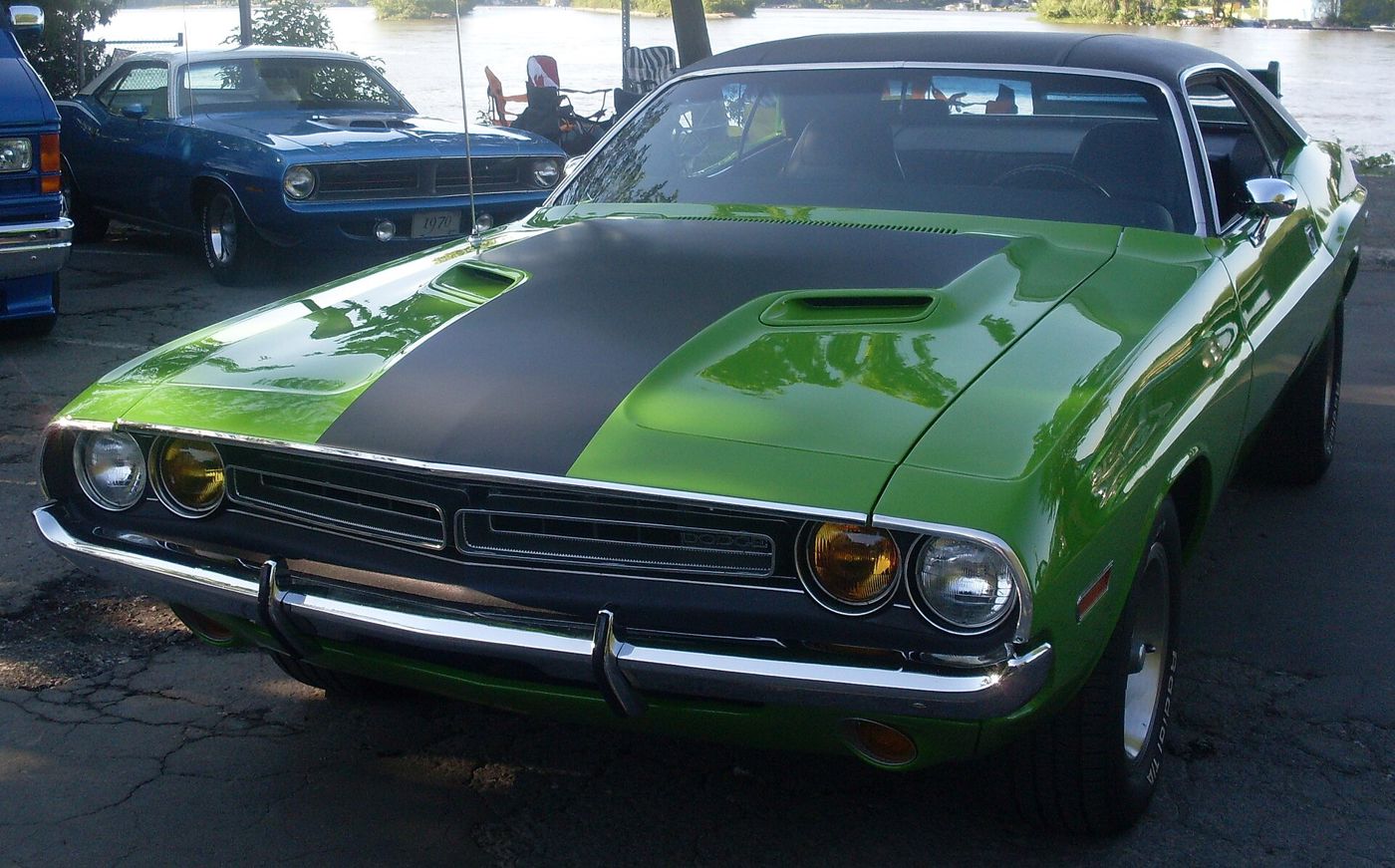
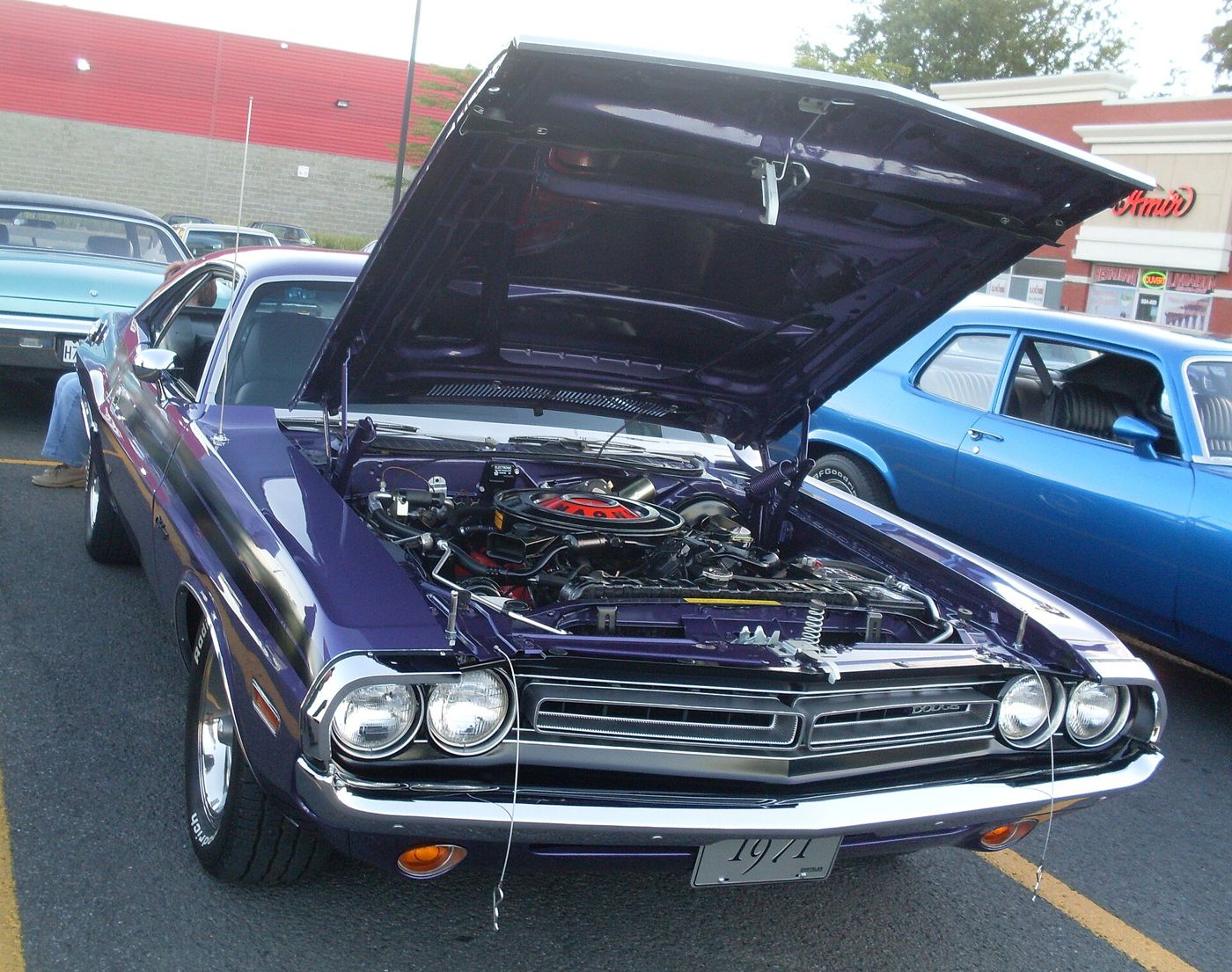
For 1971 the Challenger narrowed. Dodge restyled the grille and taillamps, and its heritage release says EPA emission standards led to some powertrain changes, though the Hemi stayed on the list. The SE, the R/T convertible and the T/A were all gone. The R/T continued only as a hardtop, and the base line added a pillared two-door coupe, model JH21, below the hardtop and convertible. Over-Drive's production table lists base prices of $2,853 for the V8 coupe, $2,950 for the V8 hardtop, $3,207 for the V8 convertible and $3,273 for the R/T hardtop, a spread of only $420 from the cheapest V8 Challenger to the performance model.2,5
The T/A's disappearance left a trace in Dodge's own advertising. The 1971 Scat Pack booklet still carried a full page for a Challenger T/A, and DodgeGarage's heritage retelling describes the pictured car as a Citron Yella example apparently photographed at the Chelsea Proving Grounds. It was not built for 1971. Over-Drive lists a revised set of 1971 specification sheets issued without the T/A and says the 340 Six Pack survived only as a separately sold engine assembly. The advertised car is therefore evidence of what Dodge planned and promoted, not of anything a dealer could deliver. The real T/A remained a 1970 car, of which DodgeGarage says 2,399 were sold.6,5
The R/T itself kept its big-block menu. Over-Drive's engine table rates the standard 383 four-barrel at 300 horsepower at 4,800 rpm and 410 lb-ft at 3,400, the optional 440 Six Pack at 385 horsepower at 4,700 rpm and 490 lb-ft at 3,200, and the optional Hemi at 425 horsepower at 5,000 rpm and 490 lb-ft at 4,000; the table does not say whether those are gross or net figures. Below them sat the 340 four-barrel at 275 horsepower and a two-barrel 383 at 275. A four-speed was available with the 340, 383, 440 and Hemi. The R/T rode on F70-14 tires, and the paint list still included Plum Crazy, Green Go, Hemi Orange and Citron Yella.5
Production fell hard. The same Chilton tables that count 83,032 Challengers for 1970 count 29,883 for 1971, and the 1973 Americana Annual agrees, so on the same accounting Dodge built about 36 percent as many Challengers in the second year as in the first. Over-Drive's table divides the 29,883 into 23,088 coupes and hardtops combined, 2,165 convertibles and 4,630 R/T hardtops. Peter Sessler's production table, however, prints a total of 26,299 and an R/T figure of 3,814, while Mike Mueller and Tom Glatch describe 4,630 as total R/T production including 3,907 domestic deliveries. Sessler's R/T number does not match that domestic count either, so the lower lineage remains unexplained.4,7,5,8,9
What those totals cannot yet say is how many 1971 Challengers carried each engine. None of the production tables divides the 1971 cars by engine or transmission, so the number of Hemi, Six Pack and 340 cars stays unknown rather than estimated. The convertible count raises its own question: Dodge says it built 50 pace-car replica convertibles, but no source states whether they sit inside Over-Drive's 2,165 convertible figure. Sessler's split of the convertibles into 83 sixes and 1,774 V8s belongs to his lower lineage and cannot simply be subtracted from the higher one. Even the rarest 1971 Challengers have to wait for a better ledger.5,3,8
On the drag strip, 1971 was the Hemi's last season on equal terms in Pro Stock. NHRA's retrospective records that Ronnie Sox won six of the eight events and still lost the championship: Rod Shop Dodge team driver Mike Fons beat the Sox & Martin team car of Herb McCandless in the World Finals, 10.05 seconds to 10.40, to take the title. NHRA then adopted a weight-break policy for 1972 that made Hemi-headed cars carry 7.25 pounds per cubic inch, against 6.75 for inline-valve wedges. In NHRA's words, the Mopars lost their performance advantage, and in 1972 Chevrolet won seven of the eight events.10
The 1971 Challenger is therefore a car of subtractions. It lost the SE, the R/T convertible and the T/A; it lost more than 53,000 units of annual volume; and it lost the Trans-Am homologation reason that had produced its most specialized version. What remained was an honest menu, from a Slant Six coupe to a Hemi R/T, sold for a year in which a Dodge dealer put the most visible Challenger of all into a photographers' stand at Indianapolis. The car's reputation today rests largely on its first season, but the 1971 production figures make the second one the scarcer and in some ways the more revealing year.2,4,5,1
Fact sheet · 1971 · United States
The numbers
1971 Dodge Challenger — Challenger's second year lost the SE, the R/T convertible, and the T/A; a new pillared coupe joined the hardtop and convertible, and production fell to roughly a third of 1970's.
Coverage: Partial — researched sections are shown; missing ones are not yet sourced. Researched through 2026-09-23.
Every figure is labeled with how sure we are. Reported means a manufacturer, registry, or reference figure we cite but have not reconciled against factory records ourselves. Disputed means credible sources disagree and both are shown. Rows are separately scoped; don't add them together unless the note says they make up a total.
Key facts
- Dodge produced 50 Challenger convertible pace-car replicas for the 1971 Indianapolis 500.3,2
- The T/A, SE, and R/T convertible were not continued for 1971.2
- A Challenger T/A appeared in Dodge's 1971 Scat Pack advertising but was not produced as a 1971 model; the 340 Six Pack remained available only as a separate engine assembly, according to Over-Drive.5,6
Production
| What was counted | Count | Basis | Status |
|---|---|---|---|
| All 1971 Challengers (table total)4,7,11,5 Challenger and R/T · coupe, hardtop, convertible · not stated Period trade tables agree. The Sessler lineage prints 26,299; see conflicts. The Standard Catalog (via snippet) splits the 29,883 as about 2,000 sixes and 27,900 V8s. | 29,883 | built, model-year | Disputed |
| All 1971 Challengers (Sessler lineage)8 not stated | 26,299 | built, model-year | Disputed |
| What was counted | Count | Basis | Status |
|---|---|---|---|
| Challenger hardtop, six (Sessler)8 Challenger · 2-door hardtop · 6-cyl · not stated | 1,672 | built, model-year | Reported |
| Challenger hardtop, V8 (Sessler)8 Challenger · 2-door hardtop · 8-cyl · not stated | 18,956 | built, model-year | Reported |
| Challenger convertible, six (Sessler)8 Challenger · convertible · 6-cyl · not stated | 83 | built, model-year | Reported |
| Challenger convertible, V8 (Sessler)8 Challenger · convertible · 8-cyl · not stated | 1,774 | built, model-year | Reported |
| Challenger R/T hardtop (Sessler)8 R/T · 2-door hardtop · 8-cyl · not stated Mueller and Glatch give 3,907 domestic R/Ts; see conflicts. | 3,814 | built, model-year | Disputed |
| Challenger R/T hardtop, domestic deliveries9 R/T · 2-door hardtop · V8 · domestic (US) | 3,907 | delivered, model-year | Disputed |
| Challenger coupe and hardtop (combined in source)5 Challenger · 2-door coupe (JH21) and hardtop (JH23) · six and V8 · not stated The source does not split coupe from hardtop. | 23,088 | built, model-year | Reported |
| Challenger convertible5 Challenger · convertible (JH27) · six and V8 · not stated | 2,165 | built, model-year | Reported |
| Challenger R/T hardtop5 R/T · 2-door hardtop (JS23) · V8 · not stated | 4,630 | built, model-year | Reported |
| What was counted | Count | Basis | Status |
|---|---|---|---|
| Challenger (non-R/T) series total5 Challenger · not stated | 25,253 | built, model-year | Reported |
| What was counted | Count | Basis | Status |
|---|---|---|---|
| Indianapolis 500 pace-car replica convertibles3,2 Challenger pace-car replica · convertible · not stated Scope relative to the 2,165 convertible row is not stated. | 50 | built, model-year | Reported |
| What was counted | Count | Basis | Status |
|---|---|---|---|
| R/T hardtop, 383 Magnum11 R/T · 2-door hardtop · 383 4-bbl · not stated | 2,450 | built, model-year | Reported |
| R/T hardtop, 440 Six Pack11 R/T · 2-door hardtop · 440 Six Pack · not stated The printed transmission split (129 + 12 = 141) does not equal the printed 250; shown as printed. | 250 | built, model-year | Disputed |
| R/T hardtop, 426 Hemi11 R/T · 2-door hardtop · 426 Hemi · not stated | 71 | built, model-year | Reported |
| What was counted | Count | Basis | Status |
|---|---|---|---|
| R/T hardtop, 383 Magnum, TorqueFlite11 R/T · 2-door hardtop · 383 4-bbl · TorqueFlite 3-speed automatic · not stated | 1,985 | built, model-year | Reported |
| R/T hardtop, 383 Magnum, 4-speed11 R/T · 2-door hardtop · 383 4-bbl · 4-speed manual · not stated | 465 | built, model-year | Reported |
| R/T hardtop, 440 Six Pack, 4-speed11 R/T · 2-door hardtop · 440 Six Pack · 4-speed manual · not stated | 129 | built, model-year | Disputed |
| R/T hardtop, 440 Six Pack, TorqueFlite (as printed)11 R/T · 2-door hardtop · 440 Six Pack · TorqueFlite 3-speed automatic · not stated Likely a transcription problem in the snippet or the book, since the Hemi line also reads 12 TorqueFlites; shown as printed. | 12 | built, model-year | Disputed |
| R/T hardtop, 426 Hemi, 4-speed11 R/T · 2-door hardtop · 426 Hemi · 4-speed manual · not stated | 59 | built, model-year | Reported |
| R/T hardtop, 426 Hemi, TorqueFlite11 R/T · 2-door hardtop · 426 Hemi · TorqueFlite 3-speed automatic · not stated The revised AMA power-team page lists the 1971 Hemi with the 4-speed only; see conflicts. | 12 | built, model-year | Reported |
| Base Challenger, 383 4-bbl, TorqueFlite (all bodies)11 Challenger (non-R/T) · coupe, hardtop, convertible · 383 4-bbl · TorqueFlite 3-speed automatic · not stated | 547 | built, model-year | Reported |
| Base Challenger coupe, 383 4-bbl, TorqueFlite11 Challenger (non-R/T) · 2-door coupe · 383 4-bbl · TorqueFlite 3-speed automatic · not stated | 9 | built, model-year | Reported |
| Base Challenger hardtop, 383 4-bbl, TorqueFlite11 Challenger (non-R/T) · 2-door hardtop · 383 4-bbl · TorqueFlite 3-speed automatic · not stated | 412 | built, model-year | Reported |
| Base Challenger convertible, 383 4-bbl, TorqueFlite11 Challenger (non-R/T) · convertible · 383 4-bbl · TorqueFlite 3-speed automatic · not stated | 126 | built, model-year | Reported |
| Base Challenger, 383 4-bbl, 4-speed (all bodies)11 Challenger (non-R/T) · coupe, hardtop, convertible · 383 4-bbl · 4-speed manual · not stated | 156 | built, model-year | Reported |
| Base Challenger coupe, 383 4-bbl, 4-speed11 Challenger (non-R/T) · 2-door coupe · 383 4-bbl · 4-speed manual · not stated | 8 | built, model-year | Reported |
| Base Challenger hardtop, 383 4-bbl, 4-speed11 Challenger (non-R/T) · 2-door hardtop · 383 4-bbl · 4-speed manual · not stated | 107 | built, model-year | Reported |
| Base Challenger convertible, 383 4-bbl, 4-speed11 Challenger (non-R/T) · convertible · 383 4-bbl · 4-speed manual · not stated | 41 | built, model-year | Reported |
Rows are separately scoped; do not add them.
Ross's 1971 engine and transmission lines (R/T 383, 440 Six Pack and Hemi; base-Challenger 383 four-barrel) were later exposed by further Google Books snippet searches and are listed above; other 1971 engine lines remain unknown.
Ross's R/T 383 + 440 Six Pack + Hemi rows (2,450 + 250 + 71 = 2,771) do not reach the 4,630 R/T hardtops he also cites; the snippet did not expose the remaining R/T engine lines (e.g. 340 or 440 four-barrel), so the difference is unknown, not zero. Ross says his engine figures are cited from another work whose name was cut off in the snippet.
Prices when new
| Model | Price | Basis |
|---|---|---|
| Challenger coupe, six5 | $2,727 | base price as reported, 1971 model year |
| Challenger coupe, V85 | $2,853 | base price as reported, 1971 model year |
| Challenger hardtop, six5 | $2,848 | base price as reported, 1971 model year |
| Challenger hardtop, V85 | $2,950 | base price as reported, 1971 model year |
| Challenger convertible, six5 | $3,105 | base price as reported, 1971 model year |
| Challenger convertible, V85 | $3,207 | base price as reported, 1971 model year |
| Challenger R/T hardtop5 | $3,273 | base price as reported, 1971 model year |
Prices are the nominal dollars of the day, not adjusted for inflation.
Engines
| Engine | Factory rating | Availability | Built |
|---|---|---|---|
| 198 Six5,12 198 cu in · 1-barrel | 125 hp @ 4,400, 180 lb-ft @ 2,000 (period advertised (standard not stated by source)) | listed in the source's engine table; model applicability not stated | Not yet sourced |
| 225 Six5 225 cu in · 1-barrel | 145 hp @ 4,000, 215 lb-ft @ 2,400 (period advertised (standard not stated by source)) | Challenger | Not yet sourced |
| 318 V8 2-bbl5 318 cu in · 2-barrel | 230 hp @ 4,400, 320 lb-ft @ 2,000 (period advertised (standard not stated by source)) | Challenger | Not yet sourced |
| 340 V8 4-bbl5 340 cu in · 4-barrel | 275 hp @ 5,000, 340 lb-ft @ 3,200 (period advertised (standard not stated by source)) | optional | Not yet sourced |
| 383 V8 2-bbl5 383 cu in · 2-barrel | 275 hp @ 4,400, 375 lb-ft @ 2,800 (period advertised (standard not stated by source)) | optional | Not yet sourced |
| 383 V8 4-bbl (R/T standard)5 383 cu in · 4-barrel | 300 hp @ 4,800, 410 lb-ft @ 3,400 (period advertised (standard not stated by source)) | standard, R/T | Not yet sourced |
| 440 Six Pack V85,12 440 cu in · three 2-barrel | 385 hp @ 4,700, 490 lb-ft @ 3,200 (period advertised (standard not stated by source)) | optional, R/T | Not yet sourced |
| 426 Hemi V85,12 426 cu in · two 4-barrel | 425 hp @ 5,000, 490 lb-ft @ 4,000 (period advertised (standard not stated by source)) | optional, R/T | 7111 Reported |
Ratings are the manufacturer's advertised figures under the standard shown (SAE gross before 1972, SAE net after). They are not dyno results, and gross and net ratings can't be compared directly.
Transmissions
| Transmission | Availability | Built |
|---|---|---|
| 3-speed manual5 | standard | Not yet sourced |
| TorqueFlite 3-speed automatic5 | optional ($176 with six) | Not yet sourced |
| 4-speed manual5 | optional with 340, 383, 440, and Hemi (ratio sets listed by engine) | Not yet sourced |
Options and packages
| Code | Option | Price | Installed |
|---|---|---|---|
E65sales code |
383 4-bbl V-8 (base Challenger)11 | — | 70311 Reported |
D21sales code |
4-speed manual11 | — | Not yet sourced |
Paint
| Code | Color | Built |
|---|---|---|
A4 |
Light Gunmetal5 | Not yet sourced |
B2 |
Light Blue5 | Not yet sourced |
B5 |
Bright Blue5 | Not yet sourced |
B7 |
Dark Blue5 | Not yet sourced |
C7 |
Plum Crazy5 | Not yet sourced |
E5 |
Bright Red5 | Not yet sourced |
F3 |
Medium Green5 | Not yet sourced |
F7 |
Dark Green5 | Not yet sourced |
F8 |
Dark Green5 | Not yet sourced |
J3 |
Light Green5 | Not yet sourced |
J6 |
Green Go5 | Not yet sourced |
K5 |
Dark Burnt Orange5 | Not yet sourced |
K6 |
Dark Bronze5 | Not yet sourced |
L5 |
Butterscotch5 | Not yet sourced |
T2 |
Tan5 | Not yet sourced |
V2 |
Hemi Orange5 | Not yet sourced |
W3 |
Bright White5 | Not yet sourced |
X9 |
Black5 | Not yet sourced |
Y1 |
Bright Yellow5 | Not yet sourced |
Y3 |
Citron Yella5 | Not yet sourced |
Y8 |
Gold5 | Not yet sourced |
Y9 |
Dark Gold5 | Not yet sourced |
Color names are the factory's. We don't show color swatches, because a screen color is no guide for a restoration.
Specifications
| Measure | Value | Applies to |
|---|---|---|
| Wheelbase5 | 110 in | all bodies |
| Overall length5 | 191.3 in | all bodies |
| Overall width5 | 76.1 in | standard (other widths listed for some models) |
| Tires, R/T5 | F70 x 14 | R/T |
Identification
- Model numbers
- Production table lists JH21 (coupe), JH23 (hardtop), JH27 (convertible), and JS23 (R/T hardtop).5
Where the sources disagree
Total 1971 production
Lead with the period trade figure. Mueller and Glatch describe the 4,630 R/T figure of the 29,883 lineage as total production including 3,907 domestic deliveries, which suggests the lower lineage counts domestic cars; Sessler's own R/T figure (3,814) does not match that domestic count, so the explanation is not settled.
Identification
Read a 1971 Dodge VIN
The VIN decoder runs in your browser and never sends the VIN anywhere. How the factory numbered this year's cars:
Same model year
Also in 1971
- AMC AMX The AMX name moves onto the redesigned Javelin as its top model. It is a derivative badge, not a continuation of the two-seater. 2,054 were built, all with the 360 or 401.
- AMC Hornet SC/360 AMC's one-year compact muscle car pitched as an insurance-friendly alternative. AMC reportedly planned 10,000, but 784 were built.
- AMC Javelin A new, flared-fender Javelin, with the AMX name as its top model. Javelin won AMC the 1971 Trans-Am manufacturers' championship.
- AMC Matador Machine The Rebel Machine's unadvertised successor, a 'Machine Go' option package for the Matador hardtop. Production is unknown; published guesses run from 43 to 68.
- Buick Riviera The boattail Riviera: 455 rated 315 gross / 255 net, GS 330 / 265; 3,175 of 33,810 were GS.
- Buick Skylark Gran Sport, GS and GSX Compression fell to 8.5:1, the GS 350 and GS 455 were merged into one GS series of 9,170 cars, and the GSX became an appearance package on any GS.
- Chevrolet Chevelle and Malibu SS A single RPO Z15 SS package now spanned small- and big-block V8s; 9,502 of 19,293 SS cars carried the LS5 454, and Chevrolet began printing net ratings beside gross.
- Chevrolet Chevy II and Nova SS limited to the L48 350 per the source; Rally Nova (RPO YF1) offered. Enthusiast-compiled production: 194,878 cars; Super Sport 7,015.
- Chevrolet El Camino SS A single RPO Z15 SS package on the Malibu/Custom El Camino; the El Camino share of 19,293 SS cars is not separately published.
- Chevrolet Monte Carlo SS The last SS 454 year: RPO Z20 on 1,919 of 128,600 Monte Carlos.
- Dodge Charger A new, shorter third-generation body absorbed the Coronet two-doors and the Super Bee; it was the last year for the R/T and for a factory Hemi Charger.
- Dodge Coronet R/T and Super Bee The end of the line for Coronet performance: the two-door Coronets were replaced by the Charger, taking the Super Bee with them.
- Dodge Dart GTS, Swinger and Demon Dodge's version of the Duster fastback arrived as the Demon, and the Demon 340 became the performance Dart: 10,098 built, plus 85 Canadian Swinger 340 Specials.
- Ford Maverick Grabber The Grabber became its own model with a dual-scoop hood, and the 210 hp 302 V8 arrived; Classic Industries counts 38,963 Grabbers.
- Ford Ranchero GT The second Torino-based Ranchero year; reference counts give 3,632 GTs, while Barn Finds rounds the GT figure to about 3,900 of 24,946 Rancheros.
- Ford Thunderbird The last fifth-generation year kept the 360-hp 429 as standard; production fell to 36,055.
- Ford Torino A carryover year for the 1970 body; the Torino Cobra now came standard with a 351 four-barrel and offered the 429 Cobra Jet-R, but only 3,054 Cobras were built.
- Mercury Comet and Cyclone The final Cyclone year: production fell to a few thousand across Cyclone, Cyclone GT and Cyclone Spoiler.
- Mercury Cougar A larger second-generation Cougar, new body codes, and the one-year 429 Cobra Jet option, fitted to 448 cars.
- Oldsmobile Cutlass, 4-4-2 and Hurst/Olds Compression fell to 8.5:1 for regular fuel, the W-31 was dropped, the sports coupe was gone, and 4-4-2 production fell to 7,589.
- Plymouth Barracuda and 'Cuda Four headlamps and a new grille marked the second E-body year; the Hemi and 440 Six Barrel stayed on the 'Cuda order form, but Barracuda-line production fell to about a third of 1970's.
- Plymouth Duster 340 and 360 The Duster 340's second year brought a new grille, a Thermo-Quad 340 rated 275 gross and 235 net hp, and a $2,703 list price, while output fell to about 12,900.
- Plymouth GTX, Belvedere and Satellite On the redesigned 1971 Satellite body the GTX fell to 2,942 cars, only 30 of them with the Hemi.
- Plymouth Road Runner Redesigned on the new Satellite body as a hardtop only, the Road Runner fell to 14,218 cars, and a 340 joined the 383, 440, and Hemi.
- Pontiac Firebird and Trans Am The 455 HO year: the Trans Am's biggest engine, 2,116 cars, and a Formula line split across three V-8s.
- Pontiac GTO Lower compression, dual gross and net ratings, the 455 HO as the top engine, and production down to 10,532.
- Pontiac Grand Prix Boat-tail styling, lower compression, and the manual transmission gone by March: 116 of 58,325 had one.
- Pontiac Tempest and LeMans The Tempest name gives way to T-37; the GT-37 option carries on and the 455 HO is available in two-door LeMans models.