1971 · Dodge · United States
1971 Dodge Coronet: The Year There Was No Performance Coronet
The end of the line for Coronet performance: the two-door Coronets were replaced by the Charger, taking the Super Bee with them.
United States · researched through 2026-09-22
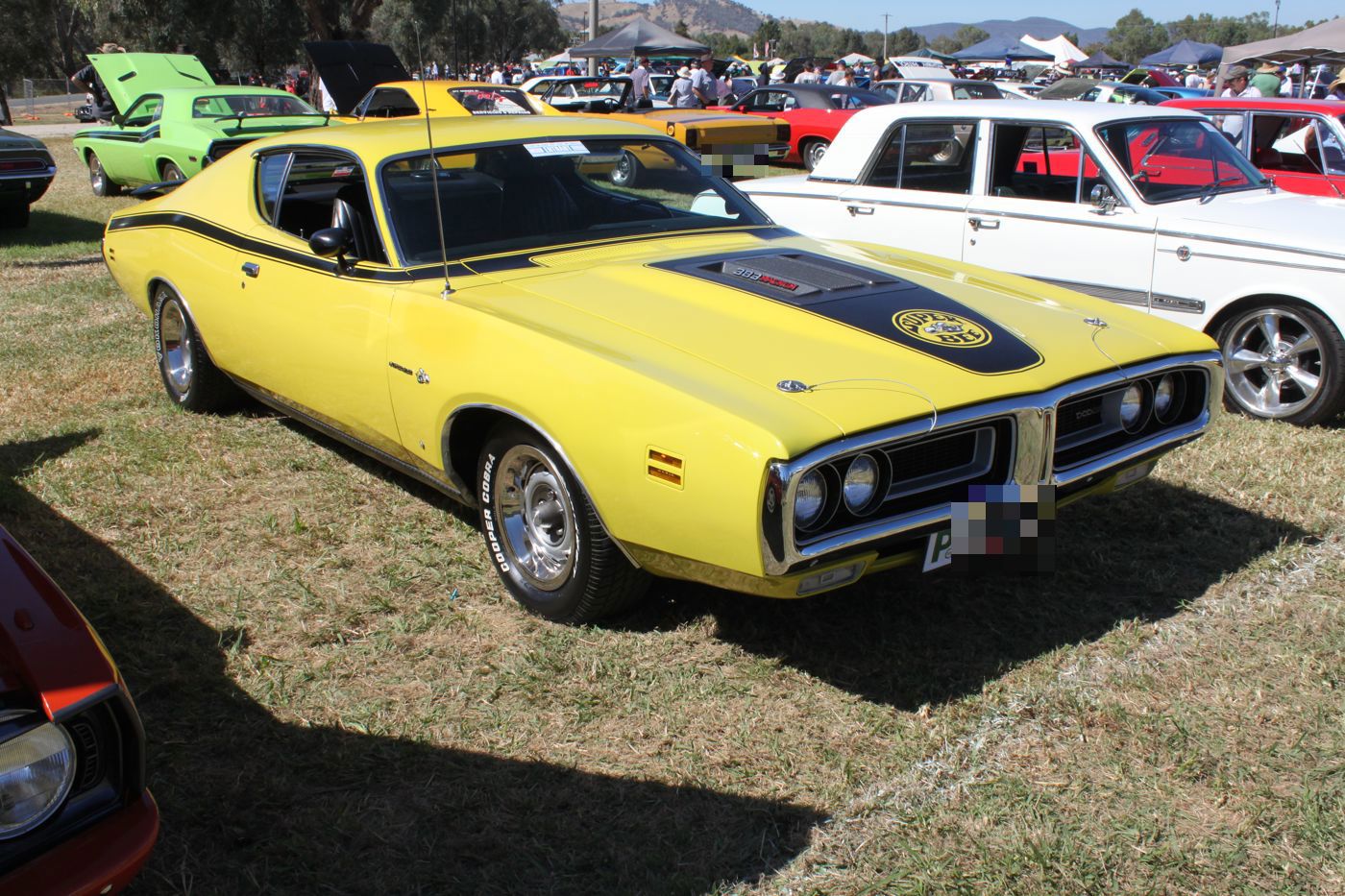
For 1971 there was no performance Coronet to record. Dodge restructured its mid-size lineup that year so that the Charger coupe and hardtop replaced the Coronet's two-door body styles entirely, and the Super Bee name continued for 1971 as a Charger Super Bee rather than a Coronet Super Bee. With no Coronet two-door body left to carry it, no Coronet R/T was listed in the 1971 lineup either, a genuine gap in this record's own year-by-year series where a performance Coronet had stood in prior years. Dodge's own 1971 sales literature reflects the merger directly: the same eight-page U.S. brochure covered both the Charger and the Coronet together, treating what had recently been two distinct performance stories as one combined document split by body type rather than by nameplate.1,2
What remained under the Coronet name was strictly practical: four-door sedans and station wagons on a 118-inch wheelbase, split across the Coronet, Coronet Custom, and Brougham sedan/Crestwood wagon series, with the 225-cubic-inch Slant Six or the 318 V8 as the standard engines. The Standard Catalog of Chrysler describes the whole 1971 Dodge mid-size range as split cleanly between the two-door sport models, now Chargers, and the Coronet sedans and wagons, a division that left no overlap between the two nameplates the way earlier years had, when the Coronet name covered both family cars and performance models under one roof. The three remaining 1971 Coronet series, plain Coronet, Coronet Custom, and the Brougham sedan paired with the Crestwood wagon, formed a conventional trim ladder from base to well-equipped, the same kind of step-up structure the Coronet line had always used, just without a performance rung anywhere on it that year.3
The performance cars that had once worn a Coronet badge moved to a genuinely different chassis in 1971: the Charger, including the new Charger Super Bee, rode a 115-inch wheelbase, three inches shorter than the four-door Coronet's 118 inches, underlining that this was a real platform split rather than a badge change on the same car. Super Bee production for the year, 5,054 units, along with its engine and transmission breakdown, is recorded under the 1971 Dodge Charger subject rather than here, since the Super Bee was a Charger model that year in every sense that matters for this record's scope, from its badge and body down to the wheelbase it actually sat on.1,4,3
This record's own dataset reflects that reorganization directly: every substantive section for 1971, production, prices, engines, options, and specifications, sits empty here because there is genuinely nothing Coronet-specific and performance-related to report for the year, not because the research was left incomplete. The Standard Catalog of Chrysler's own framing of the 1971 Dodge mid-size range, describing it as split cleanly between the Charger two-door sport models and the Coronet sedans and station wagons, is the clearest single statement of why that is: the Coronet name and the performance two-door body simply stopped overlapping that year, after years in which they had shared the same badge and, in earlier seasons, the very same body shell.3
Fact sheet · 1971 · United States
The numbers
1971 Dodge Coronet — The end of the line for Coronet performance: the two-door Coronets were replaced by the Charger, taking the Super Bee with them.
Coverage: Partial — researched sections are shown; missing ones are not yet sourced. Researched through 2026-09-22.
Every figure is labeled with how sure we are. Reported means a manufacturer, registry, or reference figure we cite but have not reconciled against factory records ourselves. Disputed means credible sources disagree and both are shown. Rows are separately scoped; don't add them together unless the note says they make up a total.
Key facts
- No Coronet performance model was produced for 1971 according to the sources consulted; the performance two-doors moved to the Charger line.1
- The Standard Catalog of Chrysler confirms it: for 1971 the Coronet was offered only as four-door sedans and station wagons on a 118-inch wheelbase (Coronet, Coronet Custom, and Brougham sedan / Crestwood wagon), with the 225 Slant Six or 318 V-8 standard, while the two-door sport models, including a Super Bee patterned after the Coronet Super Bee, became Chargers on a 115-inch wheelbase.3
Identification
Read a 1971 Dodge VIN
The VIN decoder runs in your browser and never sends the VIN anywhere. How the factory numbered this year's cars:
Same model year
Also in 1971
- AMC AMX The AMX name moves onto the redesigned Javelin as its top model. It is a derivative badge, not a continuation of the two-seater. 2,054 were built, all with the 360 or 401.
- AMC Hornet SC/360 AMC's one-year compact muscle car pitched as an insurance-friendly alternative. AMC reportedly planned 10,000, but 784 were built.
- AMC Javelin A new, flared-fender Javelin, with the AMX name as its top model. Javelin won AMC the 1971 Trans-Am manufacturers' championship.
- AMC Matador Machine The Rebel Machine's unadvertised successor, a 'Machine Go' option package for the Matador hardtop. Production is unknown; published guesses run from 43 to 68.
- Buick Riviera The boattail Riviera: 455 rated 315 gross / 255 net, GS 330 / 265; 3,175 of 33,810 were GS.
- Buick Skylark Gran Sport, GS and GSX Compression fell to 8.5:1, the GS 350 and GS 455 were merged into one GS series of 9,170 cars, and the GSX became an appearance package on any GS.
- Chevrolet Chevelle and Malibu SS A single RPO Z15 SS package now spanned small- and big-block V8s; 9,502 of 19,293 SS cars carried the LS5 454, and Chevrolet began printing net ratings beside gross.
- Chevrolet Chevy II and Nova SS limited to the L48 350 per the source; Rally Nova (RPO YF1) offered. Enthusiast-compiled production: 194,878 cars; Super Sport 7,015.
- Chevrolet El Camino SS A single RPO Z15 SS package on the Malibu/Custom El Camino; the El Camino share of 19,293 SS cars is not separately published.
- Chevrolet Monte Carlo SS The last SS 454 year: RPO Z20 on 1,919 of 128,600 Monte Carlos.
- Dodge Challenger Challenger's second year lost the SE, the R/T convertible, and the T/A; a new pillared coupe joined the hardtop and convertible, and production fell to roughly a third of 1970's.
- Dodge Charger A new, shorter third-generation body absorbed the Coronet two-doors and the Super Bee; it was the last year for the R/T and for a factory Hemi Charger.
- Dodge Dart GTS, Swinger and Demon Dodge's version of the Duster fastback arrived as the Demon, and the Demon 340 became the performance Dart: 10,098 built, plus 85 Canadian Swinger 340 Specials.
- Ford Maverick Grabber The Grabber became its own model with a dual-scoop hood, and the 210 hp 302 V8 arrived; Classic Industries counts 38,963 Grabbers.
- Ford Ranchero GT The second Torino-based Ranchero year; reference counts give 3,632 GTs, while Barn Finds rounds the GT figure to about 3,900 of 24,946 Rancheros.
- Ford Thunderbird The last fifth-generation year kept the 360-hp 429 as standard; production fell to 36,055.
- Ford Torino A carryover year for the 1970 body; the Torino Cobra now came standard with a 351 four-barrel and offered the 429 Cobra Jet-R, but only 3,054 Cobras were built.
- Mercury Comet and Cyclone The final Cyclone year: production fell to a few thousand across Cyclone, Cyclone GT and Cyclone Spoiler.
- Mercury Cougar A larger second-generation Cougar, new body codes, and the one-year 429 Cobra Jet option, fitted to 448 cars.
- Oldsmobile Cutlass, 4-4-2 and Hurst/Olds Compression fell to 8.5:1 for regular fuel, the W-31 was dropped, the sports coupe was gone, and 4-4-2 production fell to 7,589.
- Plymouth Barracuda and 'Cuda Four headlamps and a new grille marked the second E-body year; the Hemi and 440 Six Barrel stayed on the 'Cuda order form, but Barracuda-line production fell to about a third of 1970's.
- Plymouth Duster 340 and 360 The Duster 340's second year brought a new grille, a Thermo-Quad 340 rated 275 gross and 235 net hp, and a $2,703 list price, while output fell to about 12,900.
- Plymouth GTX, Belvedere and Satellite On the redesigned 1971 Satellite body the GTX fell to 2,942 cars, only 30 of them with the Hemi.
- Plymouth Road Runner Redesigned on the new Satellite body as a hardtop only, the Road Runner fell to 14,218 cars, and a 340 joined the 383, 440, and Hemi.
- Pontiac Firebird and Trans Am The 455 HO year: the Trans Am's biggest engine, 2,116 cars, and a Formula line split across three V-8s.
- Pontiac GTO Lower compression, dual gross and net ratings, the 455 HO as the top engine, and production down to 10,532.
- Pontiac Grand Prix Boat-tail styling, lower compression, and the manual transmission gone by March: 116 of 58,325 had one.
- Pontiac Tempest and LeMans The Tempest name gives way to T-37; the GT-37 option carries on and the 455 HO is available in two-door LeMans models.