1971 · Dodge · United States
1971 Dodge Charger: One Body for Every Buyer, and the Last Factory Hemi
A new, shorter third-generation body absorbed the Coronet two-doors and the Super Bee; it was the last year for the R/T and for a factory Hemi Charger.
United States · researched through 2026-09-23
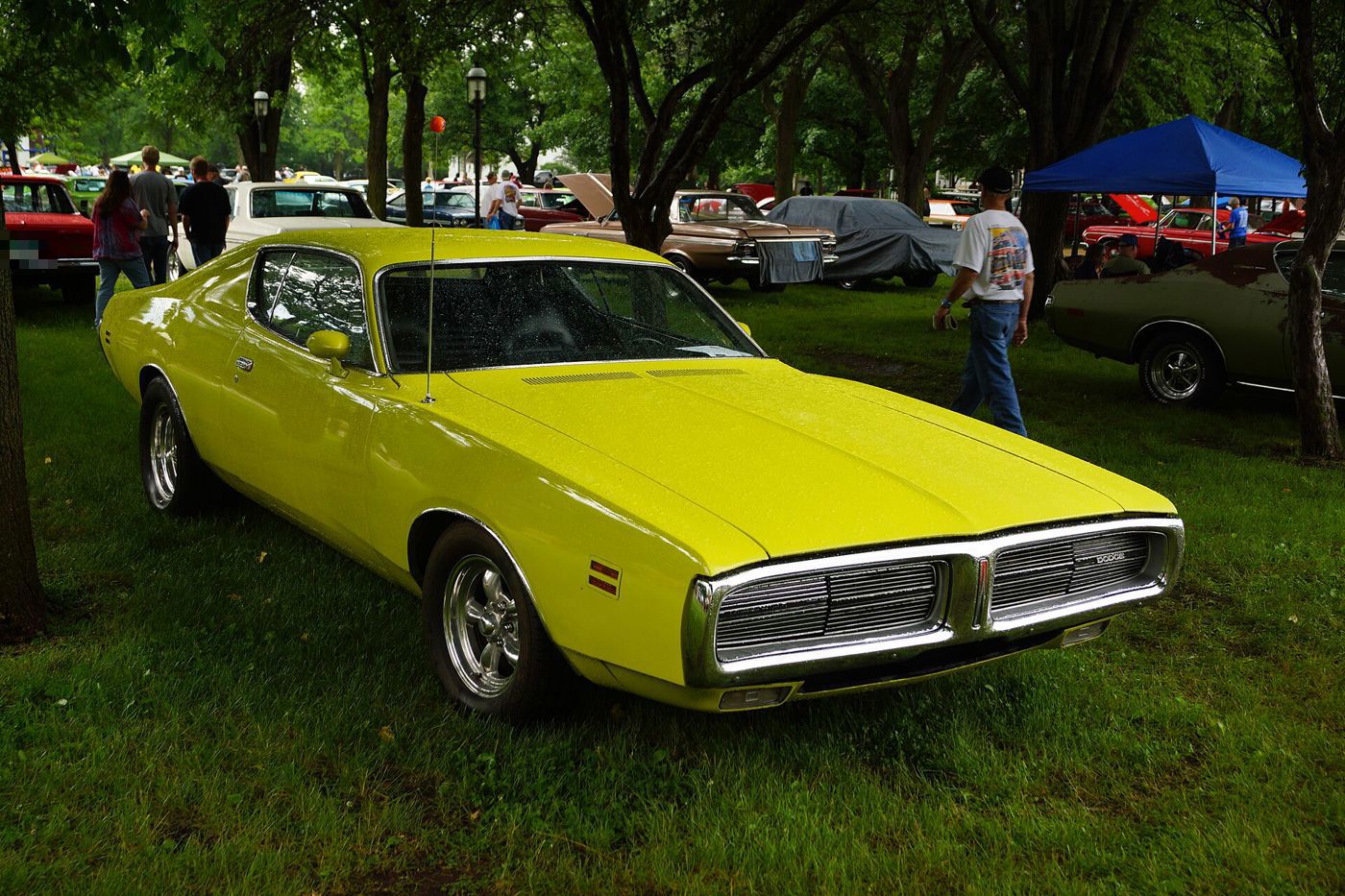
For 1971 Dodge stopped selling two different mid-size two-doors. Flory's history of the year records the decision in one line: the Charger coupe and hardtop replaced the Coronet two-door models. The Coronet name was left without a two-door, and every two-door intermediate Dodge sold, from a $2,707 coupe to a $3,777 R/T, now wore the Charger name. The Super Bee, born as a budget Coronet in 1968, moved with it. It was a consolidation, and the production figures show what it meant: the Charger became a volume car for ordinary buyers in the same year Dodge's heritage history calls the last of the hardcore performance Charger.1,2
The body was new and smaller. Dodge's heritage history gives the third-generation Charger a wheelbase two inches shorter and an overall length three inches shorter than the 1970 car, with a semi-fastback roof, and body-colour wrap-around bumpers on the R/T and Super Bee. The double-diamond flanks and flying-buttress roof of 1968-70 were gone. So was any aerodynamic pretension. The 1971 Charger was designed for the showroom in a year when, according to Ate Up With Motor, NASCAR's Bill France had ruled that winged cars like the Daytona would be limited to engines of no more than 305 cu in.2,3
The price list ran the whole width of the market. Flory lists the base Charger coupe (WL21) at $2,707 and the hardtop (WH23) at $2,975, the Charger 500 (WP23) at $3,223, the Super Bee (WM23) at $3,271, the SE (WP29) at $3,422 and the R/T (WS23) at $3,777. Shipping weights climbed from 3,215 lb for the coupe to 3,685 lb for the R/T. The Super Bee cost $506 less than the R/T and $48 more than a Charger 500. The engine list, per Dodge's heritage history, ran from the 225 slant six through the 318, 340 and 383 to the 440 and, for one last year, the 426 Hemi.1,2
Buyers voted for the plain cars. Flory's model table records 46,183 base hardtops, with the coupes counted in the same figure, 15,811 SEs, 11,948 Charger 500s, 5,054 Super Bees and just 3,118 R/Ts. The base line alone came close to the entire 1970 Charger total, 46,315 by the 1970 registry's count and 49,768 by Flory's, which is what absorbing the Coronet two-door customers looked like. Dodge's heritage history calls the SE the best-selling 1971 Charger; in Flory's figures it trails only the combined base coupe and hardtop, which may be how the claim should be read. No legible source gives a 1971 grand total.1,2,4
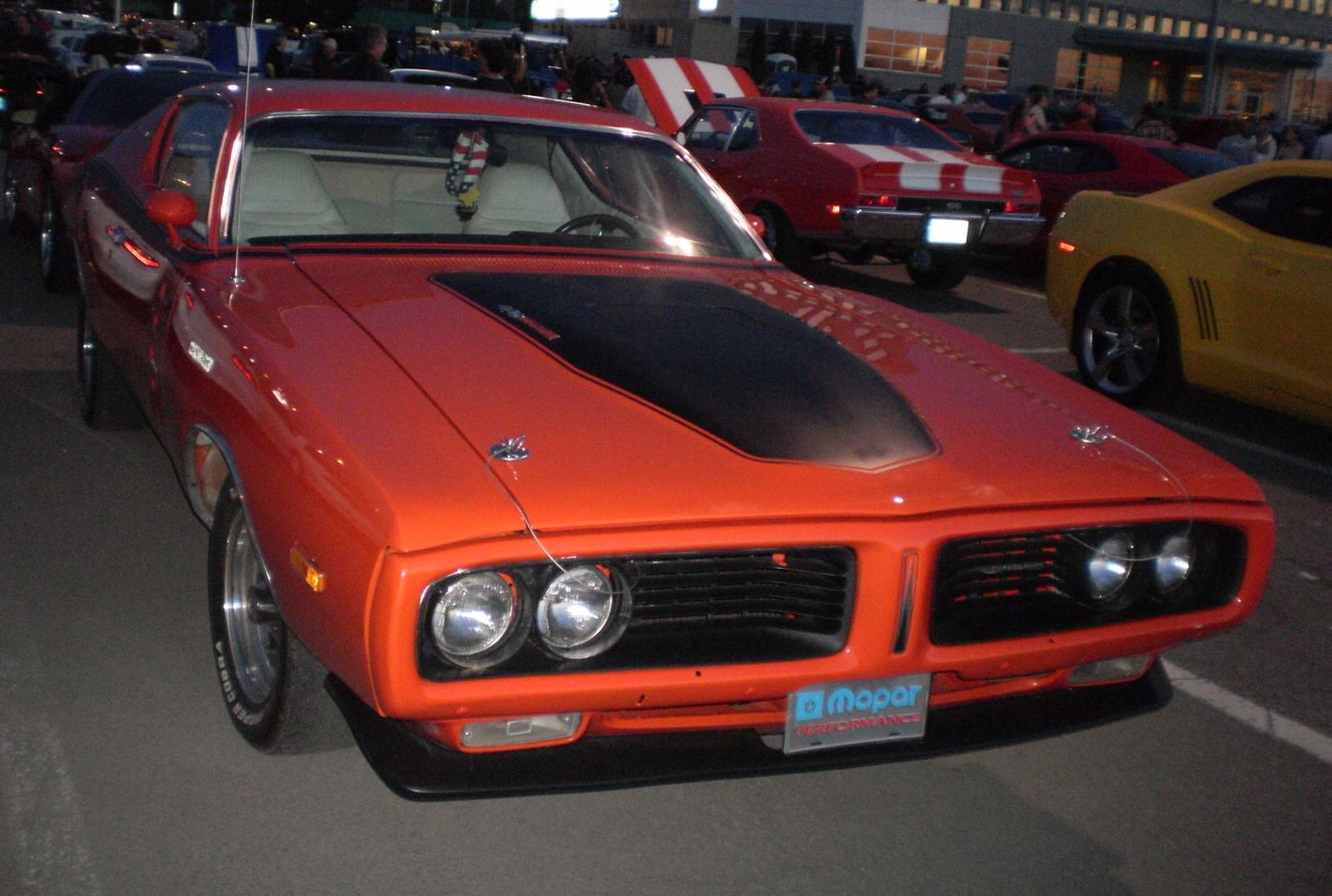
The R/T shrank faster than the car. Mueller and Glatch count 3,118 R/Ts, 2,743 of them delivered in the United States, against 9,370 domestic R/Ts for 1970, a fall of more than 70 percent. The equipment was still serious: Dodge's heritage history lists a louvred dome hood with a flat-black accent, bold horizontal body-side stripes, heavy-duty suspension and the 440 Magnum as standard. Mueller's 1993 book describes that engine as a 370 hp 440, five fewer than the 375 hp quoted in 1970; he does not state the rating basis. The 440 Six Pack and the Hemi remained optional, and at 3,685 lb in Flory's table the R/T was the heaviest Charger of the year. Newhardt counts 63 Hemi R/Ts, which is about 2 percent of all 1971 R/Ts.5,2,6,7,1
The Super Bee did better than the R/T and still sold modestly. Flory, Langworth and Norbye, and the Super Bee Registry all give 5,054, of which the registry says 4,325 were shipped to the United States. Its engine rows show a car bought overwhelmingly with its standard 383: 2,889 automatics, 766 four-speeds and 203 three-speed manuals. The registry also lists 307 Super Bees with the 340, 26 with the 440 four-barrel, 99 with the 440 Six Pack (69 automatic, 30 four-speed) and 22 with the Hemi (13 automatic, 9 four-speed), plus 9 Hemi cars of unknown transmission. The rows add to 4,321, four short of the registry's own US line, a gap the registry does not explain.1,8,9
Dodge's heritage history explains the Hemi's exit plainly: increasing emissions and insurance regulations phased the engine out, and 1971 was the last year a customer could order a factory-built Charger with a Hemi. The final count is small and comes from two compilers. Newhardt's 63 Hemi R/Ts and the Super Bee Registry's 22 Hemi Super Bees with known transmissions, plus 9 whose transmissions are not recorded, come to 94 cars between them. That is barely a fifth of either the 432 Hemi R/Ts Mueller counts for 1969 alone or the 468 Hemi Chargers of the engine's first street year in 1966. The Charger had carried the Street Hemi since that first year, and it saw it out.2,7,9,10,11
The SE pointed the other way. Dodge's heritage history says the SE could not be ordered with the 440 Six Pack or the Hemi; its engines ran from the 318 to the 440 Magnum. It was the Charger as a personal-luxury coupe, and by Flory's figures its 15,811 buyers outnumbered the R/T and Super Bee combined, 8,172, by nearly two to one. For a nameplate that had spent three years as Dodge's racing flagship, that ratio is the real news of 1971. The customers had not left the Charger; most of them were buying it for something other than speed, and the price list put the $3,422 SE $355 below the $3,777 R/T.2,1
The consequences arrived quickly. Dodge's heritage history treats 1971 as the end of the hardcore performance Charger and the last year of the factory Hemi, and for 1972 it dropped both the R/T and the Super Bee, making a Rallye package the performance Charger. The body introduced for 1971 carried on, and the Charger kept selling, but as a mid-size personal coupe rather than as the car that had fought Ford and Plymouth on the superspeedways. The 1971 model is best read as a hinge. The engines, the badges and the stripes of the performance era were all still on the order form. The buyers, as the production table shows, had already moved on to the cars without them.2,1
Fact sheet · 1971 · United States
The numbers
1971 Dodge Charger — A new, shorter third-generation body absorbed the Coronet two-doors and the Super Bee; it was the last year for the R/T and for a factory Hemi Charger.
Coverage: Partial — researched sections are shown; missing ones are not yet sourced. Researched through 2026-09-23.
Every figure is labeled with how sure we are. Reported means a manufacturer, registry, or reference figure we cite but have not reconciled against factory records ourselves. Disputed means credible sources disagree and both are shown. Rows are separately scoped; don't add them together unless the note says they make up a total.
Key facts
- Charger R/T: 3,118 (2,743 delivered in the US).5,1,8
- Charger Super Bee: 5,054.1,8,9
- Hemi Charger R/Ts: 63.7
- The SE did not offer the 440 Six Pack or Hemi; its engines ran from the 318 to the 440 Magnum.2
- The 1971 catalogue lists the Charger R/T's standard equipment as the 440 Magnum with TorqueFlite (column shift), all-vinyl buckets, performance hood with blackout treatment, longitudinal performance stripes, extra-heavy-duty suspension, heavy-duty brakes, G70 x 14 raised-white-letter tyres and dual exhausts.
Production
| What was counted | Count | Basis | Status |
|---|---|---|---|
| Charger 2-door hardtop (WH23), with coupe (WL21) counted together1 Charger · 2-door hardtop and coupe · not stated Flory asterisks the coupe line; the Standard Catalog notes that WL21 and WH23 production was recorded as a single figure. | 46,183 | built, model-year | Reported |
| What was counted | Count | Basis | Status |
|---|---|---|---|
| Charger 500 (WP23)1 Charger 500 · 2-door hardtop · not stated | 11,948 | built, model-year | Reported |
| Charger SE (WP29)1 SE · 2-door hardtop · not stated | 15,811 | built, model-year | Reported |
| Charger Super Bee (WM23)1,8,9 Super Bee · 2-door hardtop · all markets The registry gives 4,325 shipped to the US. | 5,054 | built, model-year | Reported |
| Charger Super Bee, shipped to US9 Super Bee · 2-door hardtop · US | 4,325 | delivered, model-year | Reported |
| Charger R/T (WS23)1,5,6 R/T · 2-door hardtop · all markets | 3,118 | built, model-year | Reported |
| Charger R/T, delivered in the US5 R/T · 2-door hardtop · US | 2,743 | delivered, model-year | Reported |
| Charger R/T, total production (registry)12 R/T · 2-door hardtop (WS23) · all markets Agrees with Flory's WS23 row. | 3,118 | built, model-year | Reported |
| What was counted | Count | Basis | Status |
|---|---|---|---|
| Super Bee, 340, automatic9 Super Bee · 2-door hardtop · 340 4-bbl · 3-speed automatic · not labelled (rows sum near the 4,325 shipped-to-US line) | 268 | built, model-year | Reported |
| Super Bee, 340, 4-speed9 Super Bee · 2-door hardtop · 340 4-bbl · 4-speed manual · not labelled (rows sum near the 4,325 shipped-to-US line) | 39 | built, model-year | Reported |
| Super Bee, 383, automatic9 Super Bee · 2-door hardtop · 383 4-bbl · 3-speed automatic · not labelled (rows sum near the 4,325 shipped-to-US line) | 2,889 | built, model-year | Reported |
| Super Bee, 383, 4-speed9 Super Bee · 2-door hardtop · 383 4-bbl · 4-speed manual · not labelled (rows sum near the 4,325 shipped-to-US line) | 766 | built, model-year | Reported |
| Super Bee, 383, 3-speed manual9 Super Bee · 2-door hardtop · 383 4-bbl · 3-speed manual · not labelled (rows sum near the 4,325 shipped-to-US line) | 203 | built, model-year | Reported |
| Super Bee, 440 Six Pack, automatic9 Super Bee · 2-door hardtop · 440 3x2-bbl · 3-speed automatic · not labelled (rows sum near the 4,325 shipped-to-US line) | 69 | built, model-year | Reported |
| Super Bee, 440 Six Pack, 4-speed9 Super Bee · 2-door hardtop · 440 3x2-bbl · 4-speed manual · not labelled (rows sum near the 4,325 shipped-to-US line) | 30 | built, model-year | Reported |
| Super Bee, 426 Hemi, automatic9 Super Bee · 2-door hardtop · 426 Hemi 2x4-bbl · 3-speed automatic · not labelled (rows sum near the 4,325 shipped-to-US line) | 13 | built, model-year | Reported |
| Super Bee, 426 Hemi, 4-speed9 Super Bee · 2-door hardtop · 426 Hemi 2x4-bbl · 4-speed manual · not labelled (rows sum near the 4,325 shipped-to-US line) | 9 | built, model-year | Reported |
| Charger R/T, 440 4-bbl, automatic12 R/T · 2-door hardtop (WS23) · 440 4-bbl · 3-speed automatic · US dealers unless noted | 2,172 | built, model-year | Reported |
| Charger R/T, 440 4-bbl, 4-speed12 R/T · 2-door hardtop (WS23) · 440 4-bbl · 4-speed manual · US dealers unless noted | 332 | built, model-year | Reported |
| Charger R/T, 440 Six Pack, automatic12 R/T · 2-door hardtop (WS23) · 440 3x2-bbl · 3-speed automatic · US dealers unless noted | 98 | built, model-year | Reported |
| Charger R/T, 440 Six Pack, 4-speed12 R/T · 2-door hardtop (WS23) · 440 3x2-bbl · 4-speed manual · US dealers unless noted | 80 | built, model-year | Reported |
| Charger R/T, 426 Hemi, automatic12 R/T · 2-door hardtop (WS23) · 426 Hemi 2x4-bbl · 3-speed automatic · US dealers unless noted | 33 | built, model-year | Reported |
| Charger R/T, 426 Hemi, 4-speed12 R/T · 2-door hardtop (WS23) · 426 Hemi 2x4-bbl · 4-speed manual · US dealers unless noted | 30 | built, model-year | Reported |
| What was counted | Count | Basis | Status |
|---|---|---|---|
| Super Bee, 440 4-bbl (transmission unknown)9 Super Bee · 2-door hardtop · 440 4-bbl · unknown · not labelled (rows sum near the 4,325 shipped-to-US line) | 26 | built, model-year | Reported |
| Super Bee, 426 Hemi, transmission unknown9 Super Bee · 2-door hardtop · 426 Hemi 2x4-bbl · unknown · not stated | 9 | built, model-year | Reported |
| Charger R/T, 426 Hemi7 R/T · 2-door hardtop · 426 Hemi 2x4-bbl · not stated | 63 | built, model-year | Reported |
| What was counted | Count | Basis | Status |
|---|---|---|---|
| Charger R/T, shipped to US dealers (registry)12 R/T · 2-door hardtop (WS23) · US Agrees with Mueller and Glatch. | 2,743 | shipped, model-year | Reported |
| Charger R/T, 426 Hemi, exported to Canada (transmission unknown)12 R/T · 2-door hardtop (WS23) · 426 Hemi 2x4-bbl · Canada | 12 | built, model-year | Reported |
| What was counted | Count | Basis | Status |
|---|---|---|---|
| 1971 Dodge Charger, all series (base coupe/hardtop, 500, SE, Super Bee and R/T combined)1 all 1971 Charger · not stated No source consulted prints this as a single line; it is the sum of this record's own five Flory-sourced body-style rows, kept as 'estimated' rather than 'reported' for that reason. The identical figure, 82,114, is repeated without its own citation by several enthusiast/reference sites (e.g. autoevolution, conceptcarz-style specification pages), consistent with a shared Flory/AMA lineage rather than independent confirmation of a different total. | 82,114 | built, model-year | Estimate |
Rows are separately scoped; do not add them.
The Super Bee Registry's US engine rows sum to 4,321, four fewer than its 4,325 'shipped to US' line; the registry does not reconcile them.
No 1971 Charger grand total was found printed as a single line in any inspected source; the total row above is computed from this record's own body-style rows and marked 'estimated'. Several secondary sites repeat 82,114 without their own citation, matching this sum.
The R/T Registry's US engine-by-transmission rows sum to 2,745, two more than its 2,743 'shipped to US' line. Its Six Pack rows (98 + 80 = 178) match the figure previously held only as an unpublished lead.
Prices when new
| Model | Price | Basis |
|---|---|---|
| Base MSRP, Charger 2-door coupe (WL21)1 | $2,707 | base MSRP as tabulated by Flory, 1971 model year |
| Base MSRP, Charger 2-door hardtop (WH23)1 | $2,975 | base MSRP as tabulated by Flory, 1971 model year |
| Base MSRP, Charger 500 (WP23)1 | $3,223 | base MSRP as tabulated by Flory, 1971 model year |
| Base MSRP, Charger Super Bee (WM23)1 | $3,271 | base MSRP as tabulated by Flory, 1971 model year |
| Base MSRP, Charger SE (WP29)1 | $3,422 | base MSRP as tabulated by Flory, 1971 model year |
| Base MSRP, Charger R/T (WS23)1 | $3,777 | base MSRP as tabulated by Flory, 1971 model year |
Prices are the nominal dollars of the day, not adjusted for inflation.
Engines
| Engine | Factory rating | Availability | Built |
|---|---|---|---|
| 440 Magnum 4-bbl V-86,2 440 cu in · 4-barrel | 370 hp (not stated in source) | standard on R/T | Not yet sourced |
| 440 Six Pack V-86,9 440 cu in · three 2-barrel | optional on R/T and Super Bee | Not yet sourced | |
| 426 Hemi V-82 426 cu in · two 4-barrel | optional on R/T and Super Bee; final year | 637 Reported | |
| 383 V-8 (2-bbl or 4-bbl)2,9 383 cu in · 2-barrel or 4-barrel | optional; 4-bbl standard on Super Bee | Not yet sourced | |
| 340 V-82 340 cu in · 4-barrel | optional | Not yet sourced | |
| 318 V-82 318 cu in · 2-barrel | optional | Not yet sourced | |
| 225 Slant Six2 225 cu in · 1-barrel | base | Not yet sourced |
Ratings are the manufacturer's advertised figures under the standard shown (SAE gross before 1972, SAE net after). They are not dyno results, and gross and net ratings can't be compared directly.
Options and packages
| Code | Option | Price | Installed |
|---|---|---|---|
|
R/T equipment: louvered dome hood with flat-black accent, bold horizontal body-side stripes, heavy-duty suspension, 440 Magnum2 | — | Not yet sourced |
|
Power sunroof (Charger R/T)12 | — | 3012 Reported |
|
Front and rear aerodynamic spoilers (Charger R/T) | — | Not yet sourced |
|
Colour-keyed racing mirrors and colour-keyed bumpers (Charger R/T) | — | Not yet sourced |
|
Performance-stripe delete (Charger R/T) | — | Not yet sourced |
|
Landau vinyl roof in four colours (standard on SE) | — | Not yet sourced |
Interiors
| Code | Trim | Built |
|---|---|---|
|
Charger R/T: all-vinyl bucket seats with integral head restraints; simulated wood-grained instrument-panel appliqué with hooded circular instruments (150-mph speedometer, clock, oil, fuel, temperature, alternator gauges) | Not yet sourced |
|
Charger SE: split-back cloth-and-vinyl bench seat with center armrest; carpeted trunk | Not yet sourced |
Specifications
| Measure | Value | Applies to |
|---|---|---|
| Shipping weight, Charger hardtop WH231 | 3,240 lb | base hardtop |
| Shipping weight, Charger coupe WL211 | 3,215 lb | base coupe |
| Shipping weight, Charger 500 WP231 | 3,350 lb | Charger 500 |
| Shipping weight, Charger SE WP291 | 3,375 lb | SE |
| Shipping weight, Super Bee WM231 | 3,640 lb | Super Bee |
| Shipping weight, Charger R/T WS231 | 3,685 lb | R/T |
| Standard tyres, Charger R/T | G70 x 14 wide-tread raised-white-letter bias-belted | Charger R/T |
| Brakes, Charger R/T (heavy-duty) | 11 x 3 in front; 11 x 2.5 in rear | Charger R/T |
Identification
- Style numbers
- Flory lists 1971 style numbers WL21 (coupe), WH23 (hardtop), WP23 (Charger 500), WM23 (Super Bee), WP29 (SE) and WS23 (R/T).1
Where the sources disagree
Identification
Read a 1971 Dodge VIN
The VIN decoder runs in your browser and never sends the VIN anywhere. How the factory numbered this year's cars:
Same model year
Also in 1971
- AMC AMX The AMX name moves onto the redesigned Javelin as its top model. It is a derivative badge, not a continuation of the two-seater. 2,054 were built, all with the 360 or 401.
- AMC Hornet SC/360 AMC's one-year compact muscle car pitched as an insurance-friendly alternative. AMC reportedly planned 10,000, but 784 were built.
- AMC Javelin A new, flared-fender Javelin, with the AMX name as its top model. Javelin won AMC the 1971 Trans-Am manufacturers' championship.
- AMC Matador Machine The Rebel Machine's unadvertised successor, a 'Machine Go' option package for the Matador hardtop. Production is unknown; published guesses run from 43 to 68.
- Buick Riviera The boattail Riviera: 455 rated 315 gross / 255 net, GS 330 / 265; 3,175 of 33,810 were GS.
- Buick Skylark Gran Sport, GS and GSX Compression fell to 8.5:1, the GS 350 and GS 455 were merged into one GS series of 9,170 cars, and the GSX became an appearance package on any GS.
- Chevrolet Chevelle and Malibu SS A single RPO Z15 SS package now spanned small- and big-block V8s; 9,502 of 19,293 SS cars carried the LS5 454, and Chevrolet began printing net ratings beside gross.
- Chevrolet Chevy II and Nova SS limited to the L48 350 per the source; Rally Nova (RPO YF1) offered. Enthusiast-compiled production: 194,878 cars; Super Sport 7,015.
- Chevrolet El Camino SS A single RPO Z15 SS package on the Malibu/Custom El Camino; the El Camino share of 19,293 SS cars is not separately published.
- Chevrolet Monte Carlo SS The last SS 454 year: RPO Z20 on 1,919 of 128,600 Monte Carlos.
- Dodge Challenger Challenger's second year lost the SE, the R/T convertible, and the T/A; a new pillared coupe joined the hardtop and convertible, and production fell to roughly a third of 1970's.
- Dodge Coronet R/T and Super Bee The end of the line for Coronet performance: the two-door Coronets were replaced by the Charger, taking the Super Bee with them.
- Dodge Dart GTS, Swinger and Demon Dodge's version of the Duster fastback arrived as the Demon, and the Demon 340 became the performance Dart: 10,098 built, plus 85 Canadian Swinger 340 Specials.
- Ford Maverick Grabber The Grabber became its own model with a dual-scoop hood, and the 210 hp 302 V8 arrived; Classic Industries counts 38,963 Grabbers.
- Ford Ranchero GT The second Torino-based Ranchero year; reference counts give 3,632 GTs, while Barn Finds rounds the GT figure to about 3,900 of 24,946 Rancheros.
- Ford Thunderbird The last fifth-generation year kept the 360-hp 429 as standard; production fell to 36,055.
- Ford Torino A carryover year for the 1970 body; the Torino Cobra now came standard with a 351 four-barrel and offered the 429 Cobra Jet-R, but only 3,054 Cobras were built.
- Mercury Comet and Cyclone The final Cyclone year: production fell to a few thousand across Cyclone, Cyclone GT and Cyclone Spoiler.
- Mercury Cougar A larger second-generation Cougar, new body codes, and the one-year 429 Cobra Jet option, fitted to 448 cars.
- Oldsmobile Cutlass, 4-4-2 and Hurst/Olds Compression fell to 8.5:1 for regular fuel, the W-31 was dropped, the sports coupe was gone, and 4-4-2 production fell to 7,589.
- Plymouth Barracuda and 'Cuda Four headlamps and a new grille marked the second E-body year; the Hemi and 440 Six Barrel stayed on the 'Cuda order form, but Barracuda-line production fell to about a third of 1970's.
- Plymouth Duster 340 and 360 The Duster 340's second year brought a new grille, a Thermo-Quad 340 rated 275 gross and 235 net hp, and a $2,703 list price, while output fell to about 12,900.
- Plymouth GTX, Belvedere and Satellite On the redesigned 1971 Satellite body the GTX fell to 2,942 cars, only 30 of them with the Hemi.
- Plymouth Road Runner Redesigned on the new Satellite body as a hardtop only, the Road Runner fell to 14,218 cars, and a 340 joined the 383, 440, and Hemi.
- Pontiac Firebird and Trans Am The 455 HO year: the Trans Am's biggest engine, 2,116 cars, and a Formula line split across three V-8s.
- Pontiac GTO Lower compression, dual gross and net ratings, the 455 HO as the top engine, and production down to 10,532.
- Pontiac Grand Prix Boat-tail styling, lower compression, and the manual transmission gone by March: 116 of 58,325 had one.
- Pontiac Tempest and LeMans The Tempest name gives way to T-37; the GT-37 option carries on and the 455 HO is available in two-door LeMans models.