1969 · AMC · United States
1969 AMC Javelin: The Year of Big Bad Paint
Production fell to 40,675, but the 1969 Javelin added the Big Bad colors, with 2,282 cars painted blue, green or orange, plus the Mod package.
United States · researched through 2026-09-22
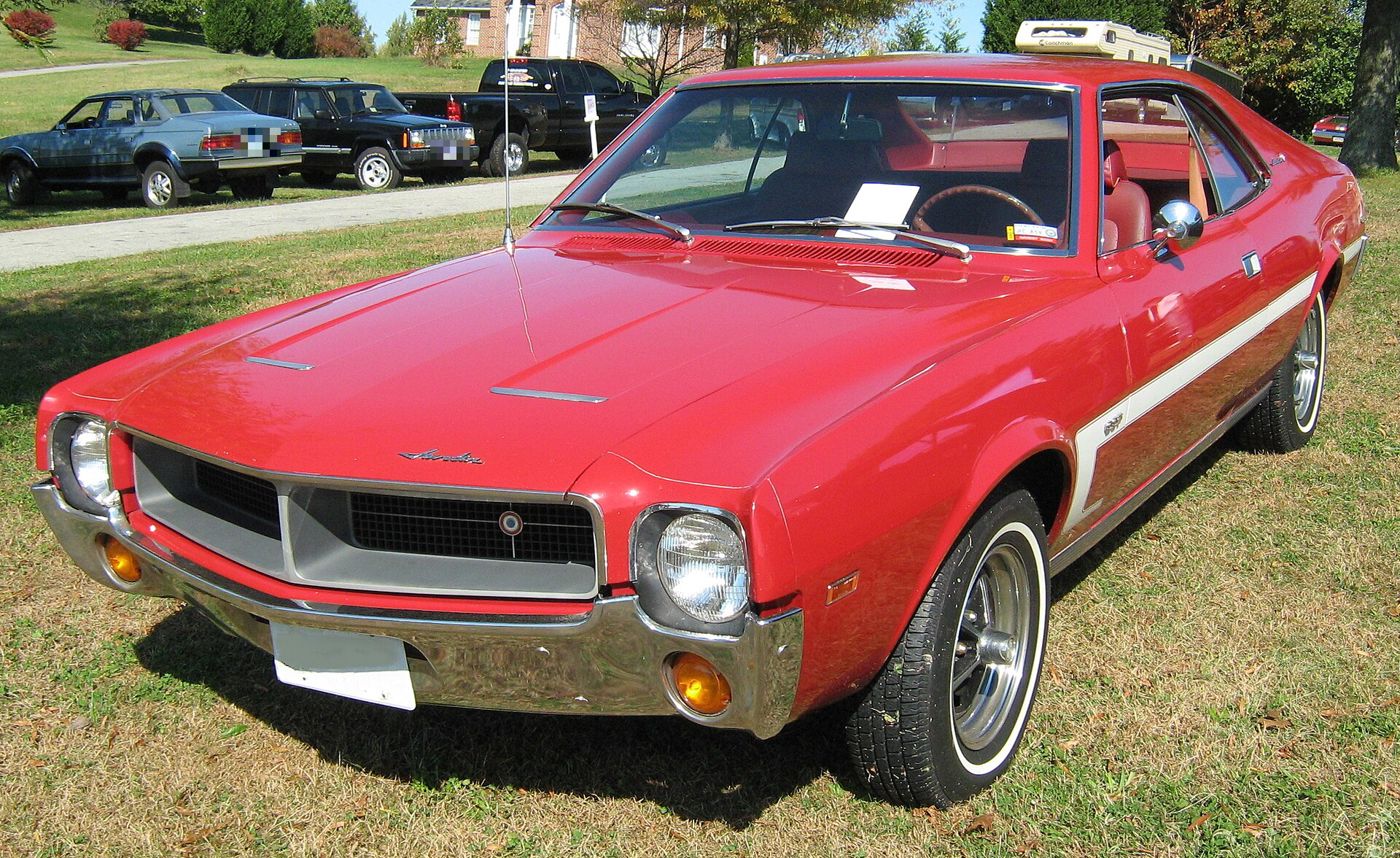
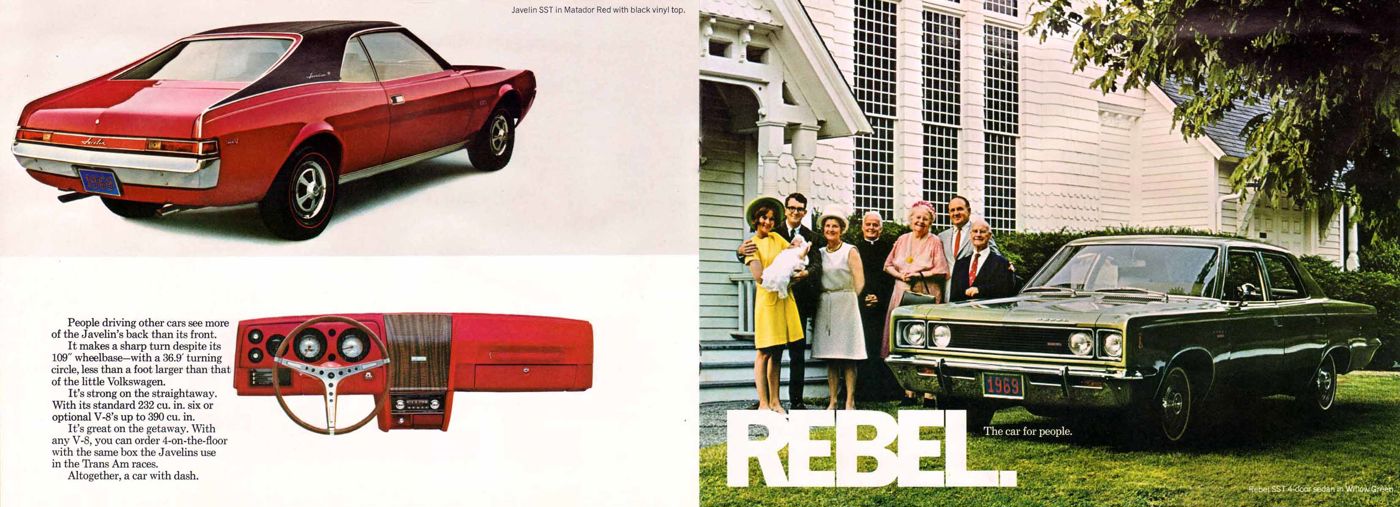
AMC changed the 1969 Javelin only lightly outside, keeping the same two-model structure it had launched with in 1968: a base car and the better-equipped SST, both built as a single body style, the 2-door hardtop. The enthusiast production tally puts 17,389 base Javelins against 23,286 SSTs, a total of 40,675 that Wikipedia's routing entry attributes to Gunnell's Standard Catalog and that AMC's own 1969 full-line literature documented alongside its four-speed SST power teams for the 343 and 390.1,2,3
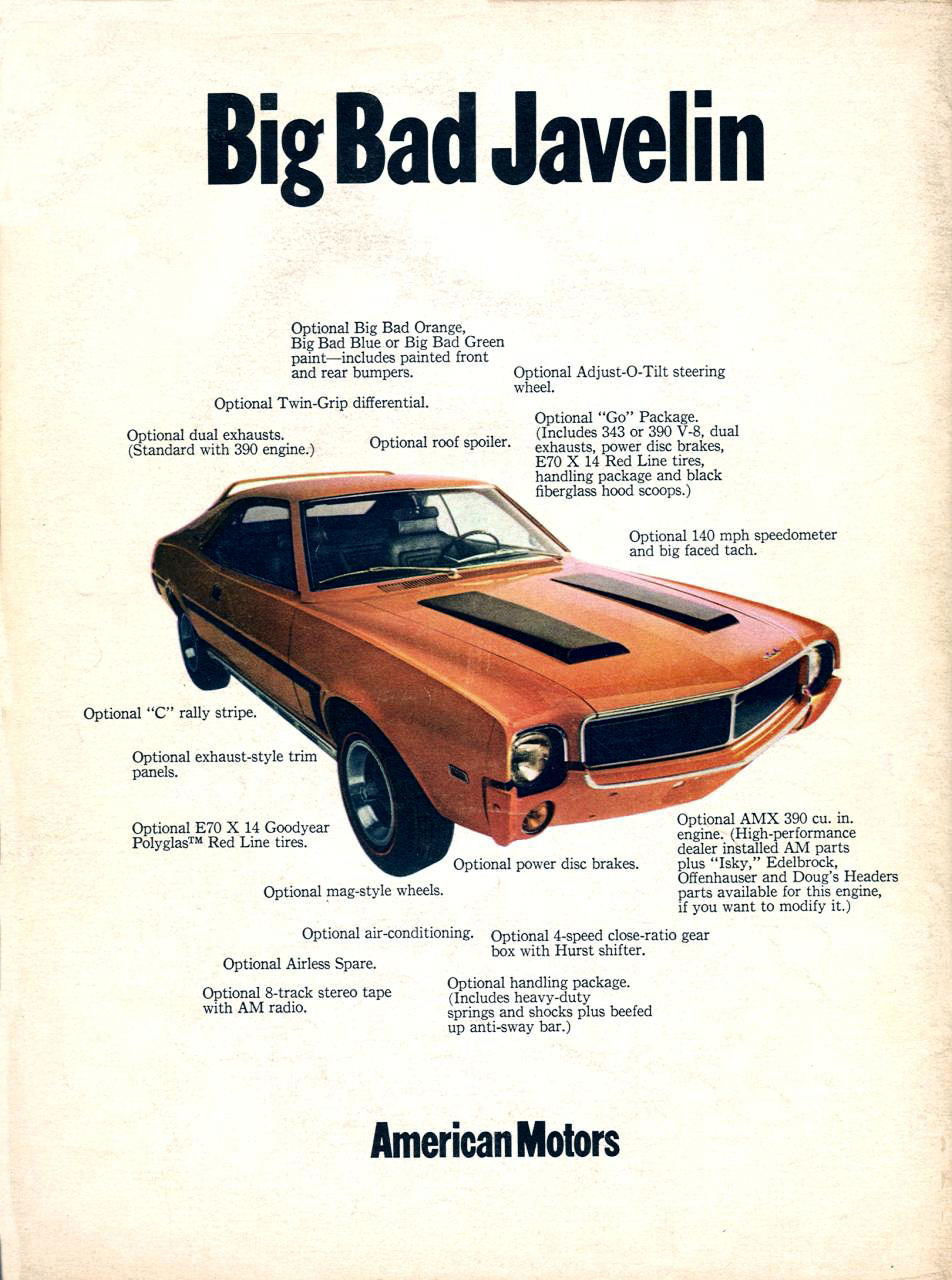
What made 1969 memorable was color, not sheet metal. Planet Houston AMX's history dates the change to January 31, 1969, when the Big Bad palette became orderable across AMC's line except the Ambassador. On the Javelin the counts were small and specific: 465 in Big Bad Blue, 876 in Big Bad Green and 941 in Big Bad Orange, a reported total of 2,282 cars, spread across both the base Javelin and the SST rather than reserved for one trim.1,2
A detail that separates a real 1969 Big Bad car from a repaint: JavelinAMX.com's spotter's guide notes that only the 1969 Big Bad cars carried painted front and rear bumpers to match the body color, while the 1970 Big Bad cars reverted to chrome. The colors were also tied to the 'Mod' Javelin package, which the Planet Houston AMX Go Pack page describes as non-functional twin fiberglass hood scoops, simulated side exhaust moldings and a roof-mounted spoiler credited to land-speed racer Craig Breedlove, sold separately at $32 on an SST (more on the base car) for the exhaust moldings and $33 for the spoiler.2,4
Under the hood, AMC's advertised gross ratings ran from a 145-horsepower 232 six up through a 315-horsepower 390 four-barrel V8. Between them sat two versions of the 290 (200 horsepower with a two-barrel, 225 with a four-barrel) and the 343 four-barrel at 280 horsepower and 365 lb-ft of torque, all figures AMC's own 1969 full-line engine chart printed alongside their compression ratios and fuel requirements.
AMC's factory production tally sheet for the model year adds a layer the sales brochure does not: how those engines actually split between the two trims. Of the base Javelin's 17,389 cars, the tally records 8,234 with the 232 six, 8,145 with the 290, 957 with the 343 and just 53 with the 390. The SST, built in greater numbers, leaned harder toward V8 power: 1,770 sixes against 12,937 290s, 4,480 343s and 4,099 390s. The sheet groups both 290 versions together and gives no transmission split, so the two-barrel-versus-four-barrel divide and the manual-versus-automatic count both stay unresolved for this model year.5
Across the whole line the 343 and 390 four-barrels together reached 5,437 and 4,152 cars respectively, and the base six-cylinder found 10,004 buyers, according to the same tally sheet's line-wide TOTAL row. Measured against the 40,675-car total, sixes and mid-size V8s together still heavily outnumbered the two biggest engines, a reminder that the Javelin's everyday market was wider than its performance reputation implies.5
Factory prices, as the same enthusiast production table lists them, opened at $2,512 for the base Javelin and $2,633 for the SST, both effective from the September 1968 introduction; the table does not state whether that figure is a base list price or includes standard equipment, so it is presented as tabulated rather than reconciled against a separate price list. Performance options layered on top of that base figure included a 140-mph speedometer and 8,000-rpm tachometer package at $51 and a Twin-Grip limited-slip differential at $42, both drawn from Planet Houston AMX's Go Pack performance-equipment page.1,4
AMC's own full-line literature lists a wider options catalog beyond those performance parts: quick-ratio manual steering, dual exhaust standard with the 390 and optional with the 290 and 343 four-barrels, power front disc brakes on V8 cars, and a console available with either a column-mounted or floor-shifted automatic. Reclining bucket seats came standard on the SST and optional on the base car, and radio choices ran from a basic AM set up to an 8-track stereo player paired with two rear speakers.
Axle gearing followed AMC's usual pattern of a workable standard ratio and extra-cost alternatives: 3.08 (or a no-cost-optional 3.31) behind the six-cylinder three-speed, 2.87 (3.15 optional) behind a V8 automatic, and 3.54 (3.15 optional) behind the four-speed manual, with 3.15 standard on cars ordered with a Go Package. Buyers who wanted more could special-order 3.73, 3.91, 4.10, 4.44 or even a 5.00 dealer-installed ratio, according to AMC's own transmission-and-axle chart, though none of those extreme ratios were common enough to appear in the production tally's own totals.
Shipping weight moved only slightly between trims, 2,826 pounds for the base Javelin against 2,836 for the SST, and the door tag distinguished them by model number: 6979-5 for the base car, 6979-7 for the SST. Neither the production tally nor the enthusiast identification pages record a documented case of a 1969 Javelin built outside that base-and-SST structure; the wider Javelin range that would later include an R/T-badged performance model and, in 1971, a factory-backed Trans-Am program under Penske and Donohue, still lay ahead of this second model year.1,2
Inside, the two trims were kept just as distinct as their engine mix suggests. The base Javelin's interior codes covered a charcoal or parchment cabin finished in Tahiti basket-weave vinyl, with non-reclining seats. The SST offered five color choices instead of two, in charcoal, beige, platinum, blue or red, and a genuine material choice as well as a color one: Ventilaire vinyl in reclining seats, or a cloth-and-vinyl combination AMC called Glengarry fabric. Reclining seats being standard on the SST and optional on the base car reinforces the same pattern visible in the engine split, that the SST was where AMC expected buyers to spend on comfort as well as power.1
Paint options ran well beyond the three Big Bad colors that gave the model year its name. AMC's full-line literature also lists a broader special-application color program, an exterior pin stripe, and a five-color rally stripe kit as separate options from the Big Bad program, meaning a 1969 Javelin buyer who wanted a loud paint job did not need to specifically order Big Bad Blue, Green or Orange to get one. The narrower Big Bad palette remains the one the model year is remembered for, but it was one avenue among several toward the same basic idea: a Javelin that looked as quick as its options sheet allowed, whatever engine sat beneath the hood.
Fact sheet · 1969 · United States
The numbers
1969 AMC Javelin — Production fell to 40,675, but the 1969 Javelin added the Big Bad colors, with 2,282 cars painted blue, green or orange, plus the Mod package.
Coverage: Partial — researched sections are shown; missing ones are not yet sourced. Researched through 2026-09-22.
Every figure is labeled with how sure we are. Reported means a manufacturer, registry, or reference figure we cite but have not reconciled against factory records ourselves. Disputed means credible sources disagree and both are shown. Rows are separately scoped; don't add them together unless the note says they make up a total.
Key facts
Production
| What was counted | Count | Basis | Status |
|---|---|---|---|
| Javelin (base), body 6979-51,2 Javelin · 2-door hardtop · US production | 17,389 | built, model-year | Reported |
| Javelin SST, body 6979-71,2 Javelin SST · 2-door hardtop · US production | 23,286 | built, model-year | Reported |
| What was counted | Count | Basis | Status |
|---|---|---|---|
| Javelin, all trims3 2-door hardtop · US Equals the sum of the base and SST rows. | 40,675 | built, model-year | Reported |
| What was counted | Count | Basis | Status |
|---|---|---|---|
| Big Bad Blue1,2 Javelin and SST · 2-door hardtop · US | 465 | built, model-year | Reported |
| Big Bad Green1,2 Javelin and SST · 2-door hardtop · US | 876 | built, model-year | Reported |
| Big Bad Orange1,2 Javelin and SST · 2-door hardtop · US | 941 | built, model-year | Reported |
| Big Bad colors, all three1 Javelin and SST · 2-door hardtop · US The source states this total. It equals the sum of the three color rows. JavelinAMX.com says the color counts include Mod Javelins. | 2,282 | built, model-year | Reported |
| What was counted | Count | Basis | Status |
|---|---|---|---|
| Base, 232 six5 Javelin (base) · 2-door hardtop (6979-5) · 232 six · US, Canada and export market; built at Kenosha | 8,234 | built, model-year | Reported |
| Base, 290 V85 Javelin (base) · 2-door hardtop (6979-5) · 290 V8 · US, Canada and export market; built at Kenosha | 8,145 | built, model-year | Reported |
| Base, 343 V85 Javelin (base) · 2-door hardtop (6979-5) · 343 V8 · US, Canada and export market; built at Kenosha | 957 | built, model-year | Reported |
| Base, 390 V85 Javelin (base) · 2-door hardtop (6979-5) · 390 V8 · US, Canada and export market; built at Kenosha | 53 | built, model-year | Reported |
| SST, 232 six5 Javelin SST · 2-door hardtop (6979-7) · 232 six · US, Canada and export market; built at Kenosha | 1,770 | built, model-year | Reported |
| SST, 290 V85 Javelin SST · 2-door hardtop (6979-7) · 290 V8 · US, Canada and export market; built at Kenosha | 12,937 | built, model-year | Reported |
| SST, 343 V85 Javelin SST · 2-door hardtop (6979-7) · 343 V8 · US, Canada and export market; built at Kenosha | 4,480 | built, model-year | Reported |
| SST, 390 V85 Javelin SST · 2-door hardtop (6979-7) · 390 V8 · US, Canada and export market; built at Kenosha | 4,099 | built, model-year | Reported |
The eight engine rows from the AMC tally sheet partition the base (17,389) and SST (23,286) rows; the sheet total for 6970 is 40,675. No transmission split is on the sheet.
Both 290 versions together: 21,082 (1969 sheet, row 6970 TOTAL, Kenosha 290 column); the sheet does not split them by carburettor.
Prices when new
| Model | Price | Basis |
|---|---|---|
| Javelin (base)1 | $2,512 | 'factory price' as tabulated (basis not stated), 1968-09 |
| Javelin SST1 | $2,633 | 'factory price' as tabulated (basis not stated), 1968-09 |
Prices are the nominal dollars of the day, not adjusted for inflation.
Engines
| Engine | Factory rating | Availability | Built |
|---|---|---|---|
| 343 V8 4-bbl 343 cu in · 4-barrel | 280 hp @ 4,800, 365 lb-ft @ 3,000 (period factory advertised) | optional | 5,4375 Reported |
| 390 V8 4-bbl 390 cu in · 4-barrel | 315 hp @ 4,600, 425 lb-ft @ 3,200 (period factory advertised) | optional | 4,1525 Reported |
| 232 six 1-bbl 232 cu in · 1-barrel | 145 hp @ 4,300, 215 lb-ft @ 1,600 (period factory advertised (gross)) | standard (basic and SST) | 10,0045 Reported |
| 290 V8 2-bbl 290 cu in · 2-barrel | 200 hp @ 4,600, 285 lb-ft @ 2,800 (period factory advertised (gross)) | optional | Not yet sourced |
| 290 V8 4-bbl 290 cu in · 4-barrel | 225 hp @ 4,700, 300 lb-ft @ 3,200 (period factory advertised (gross)) | optional | Not yet sourced |
Ratings are the manufacturer's advertised figures under the standard shown (SAE gross before 1972, SAE net after). They are not dyno results, and gross and net ratings can't be compared directly.
Transmissions
| Transmission | Availability | Built |
|---|---|---|
| Four-speed manual (with 343 and 390 in SST) | optional | Not yet sourced |
Options and packages
| Code | Option | Price | Installed |
|---|---|---|---|
|
Go Package (343): as 1968, plus optional Mod hood scoops4 | — | Not yet sourced |
|
Mod package: twin fiberglass non-functional hood scoops, simulated side exhausts, Craig Breedlove roof spoiler (contents varied)4 | — | Not yet sourced |
|
Simulated exhaust rocker moldings4 | $32 | Not yet sourced |
|
Breedlove roof spoiler4 | $33 | Not yet sourced |
|
140-mph speedometer and 8,000-rpm tachometer (1969–70)4 | $51 | Not yet sourced |
|
Twin-Grip differential4 | $42 | Not yet sourced |
|
Javelin 343 Go Package; Javelin 390 Go Package | — | Not yet sourced |
|
Special application of American Motors colors; exterior pin stripe; rally stripe (five colors) | — | Not yet sourced |
|
Twin-Grip; quick-ratio manual steering; dual exhaust (290 4-bbl, 343 4-bbl; standard with 390); tachometer and 140-mph speedometer (V-8) | — | Not yet sourced |
|
Power steering; power front disc brakes (V-8); power brakes | — | Not yet sourced |
|
Reclining bucket seats (standard SST); armrest and center cushion; console with column-mounted or floor automatic | — | Not yet sourced |
|
AM radio; AM/FM radio; 8-track stereo with manual AM radio and 2 rear speakers | — | Not yet sourced |
|
Solex glass; sports steering wheel (standard SST); Turbo-cast or wire wheel covers; wheel discs; styled steel wheels; rear bumper guards | — | Not yet sourced |
Paint
| Code | Color | Built |
|---|---|---|
|
Big Bad Blue1 | 4651 Reported |
|
Big Bad Green1 | 8761 Reported |
|
Big Bad Orange1 | 9411 Reported |
Color names are the factory's. We don't show color swatches, because a screen color is no guide for a restoration.
Interiors
| Code | Trim | Built |
|---|---|---|
961J / 868J |
Base: charcoal or parchment, Tahiti basket-weave vinyl, non-reclining1 | Not yet sourced |
936 / 961 / 962 / 963 / 965 (F or E) |
SST: beige, charcoal, platinum, blue, red; F Ventilaire vinyl reclining or E Glengarry fabric1 | Not yet sourced |
Specifications
| Measure | Value | Applies to |
|---|---|---|
| Shipping weight, base1 | 2,826 lb | 6979-5 |
| Shipping weight, SST1 | 2,836 lb | 6979-7 |
| Axle ratios (standard; no-cost optional) | 232 3-speed column/floor 3.08 (3.31); V-8 automatic 2.87 (3.15); 4-speed floor 3.54 (3.15); 3.15 standard with Go Packages; dealer ratios 3.73, 3.91, 4.10, 4.44, 5.00 extra cost :1 | Javelin |
Identification
- Door tag
- The door-tag model number is 6979-5 for the base car and 6979-7 for the SST.1
- Big Bad bumpers
- Only the 1969 Big Bad cars had painted bumpers; 1970 cars used chrome.2
Identification
Read a 1969 AMC VIN
The VIN decoder runs in your browser and never sends the VIN anywhere. How the factory numbered this year's cars:
Same model year
Also in 1969
- AMC AMX The two-seat AMX's biggest year: 8,293 cars by the enthusiast production table, with a mid-year run of Big Bad colors and 52 Hurst-built Super Stock AMXs for NHRA drag racing.
- AMC Rebel and Rebel Machine A base and SST Rebel with no convertible. The Big Bad colors were test-marketed through the New York–New Jersey 'Raider' hardtop. This is host-car context for the 1970 Machine.
- Buick Riviera Another record at 52,872 Rivieras; 5,272 had the GS handling option.
- Buick Skylark Gran Sport, GS and GSX GS production fell to 12,465, and the GS 400's Stage 1 package became a factory option while Stage 2 stayed a dealer item.
- Buick Wildcat 67,453 Wildcats; the last year of the 430.
- Chevrolet Chevelle and Malibu SS Super Sport became RPO Z25 option equipment, available for 1969 only on the 300 Deluxe coupes as well as Malibu sport coupe, convertible and El Camino.
- Chevrolet Chevy II and Nova SS is RPO Z26 per the source, with L48, L34 and L78 engines. Enthusiast-compiled production: 251,849 cars; Super Sport 17,564.
- Chevrolet El Camino SS SS 396 became RPO Z25 option equipment, orderable on the V8 Malibu El Camino (13680); the El Camino share of the 86,307 Z25s is not separately published.
- Chevrolet Impala SS Only the SS427 (RPO Z24) remains; the reported count ranges from 2,425 to about 2,455.
- Dodge Charger The second-generation Charger's peak-sales year added the SE package and the aero-bodied Charger 500 and Charger Daytona homologation cars, whose production totals are still disputed.
- Dodge Coronet R/T and Super Bee The Super Bee added a hardtop body and the 440 Six Pack, while the 440-powered Coronet R/T continued as the upscale hardtop and convertible.
- Dodge Dart GTS, Swinger and Demon The low-priced Swinger 340 arrived and outsold the GTS by more than two to one (16,637 against about 6,700), while a 375 hp 440 joined the GTS options.
- Ford Fairlane The Fairlane hardtop was the intermediate line's volume leader, while the Fairlane 500 SportsRoof shared its body with the Torino GT, Cobra and Talladega.
- Ford Ranchero GT The Ranchero GT carried Torino GT trim; 1,658 GTs were built, per reference-site counts in the Standard Catalog lineage.
- Ford Thunderbird Fifth-generation Thunderbird; only the whole-line production total was found.
- Ford Torino The Torino GT carried most of the line's volume, the 428 Cobra Jet was in its first full year, and the Talladega aero fastback was built in a short run at Atlanta to homologate a NASCAR nose.
- Mercury Comet and Cyclone The Cyclone fastback came as Cyclone and Cyclone CJ, mid-year Spoilers carried Dan Gurney and Cale Yarborough graphics, and the extended-nose Cyclone Spoiler II was built at Lorain for NASCAR homologation.
- Mercury Cougar A longer, restyled Cougar added a convertible, the Boss 302 arrived in April, and the Eliminator replaced the GT as the performance Cougar.
- Mercury Marauder and S-55 The Marauder name returned on a full-size hardtop, and the X-100 carried the 360 hp 429 four-barrel as its only engine.
- Oldsmobile Cutlass, 4-4-2 and Hurst/Olds The 4-4-2 kept its 400 while the second Hurst/Olds, in white and gold with a 380 hp 455, went into production at about 900 cars.
- Plymouth Barracuda and 'Cuda The last A-body Barracuda introduced the 'Cuda name as a stripped performance package with a standard 340, alongside Formula S and a midyear 440.
- Plymouth GTX, Belvedere and Satellite The GTX shared the Road Runner's new Air Grabber scoop and Super Track Pack but sold 15,602 cars, fewer than a fifth of the cheaper Road Runner.
- Plymouth Road Runner A convertible joined the coupe and hardtop, the 440 Six Barrel arrived at mid-year, and the Road Runner reached its production peak of 84,420.
- Pontiac Firebird and Trans Am The last first-generation Firebird, and the mid-year debut of the Trans Am package: 697 cars by the commonly published count, eight of them convertibles.
- Pontiac GTO Three four-barrel 400s under one nameplate, and the first year of the Judge package built around Ram Air power.
- Pontiac Grand Prix A new 118-inch Grand Prix with the SJ and a 390 hp 428 HO: production more than tripled to 112,486.
- Pontiac Tempest and LeMans The last year of the OHC Sprint six and the 350 HO.
- Rambler American and SC/Rambler AMC and Hurst put the 315-hp 390 V8 and a close-ratio four-speed into the compact Rambler hardtop for NHRA F/Stock. 1,512 were built, and the split between the two paint schemes is disputed.