1964 · Ford · United States
1964 Ford Fairlane: The Thunderbolt and the Hundred-Car Question
The year of the Thunderbolt: a midsize Fairlane with a 427 installed for NHRA Super Stock, which carried Gas Ronda to the national Stock title.
United States · researched through 2026-09-23
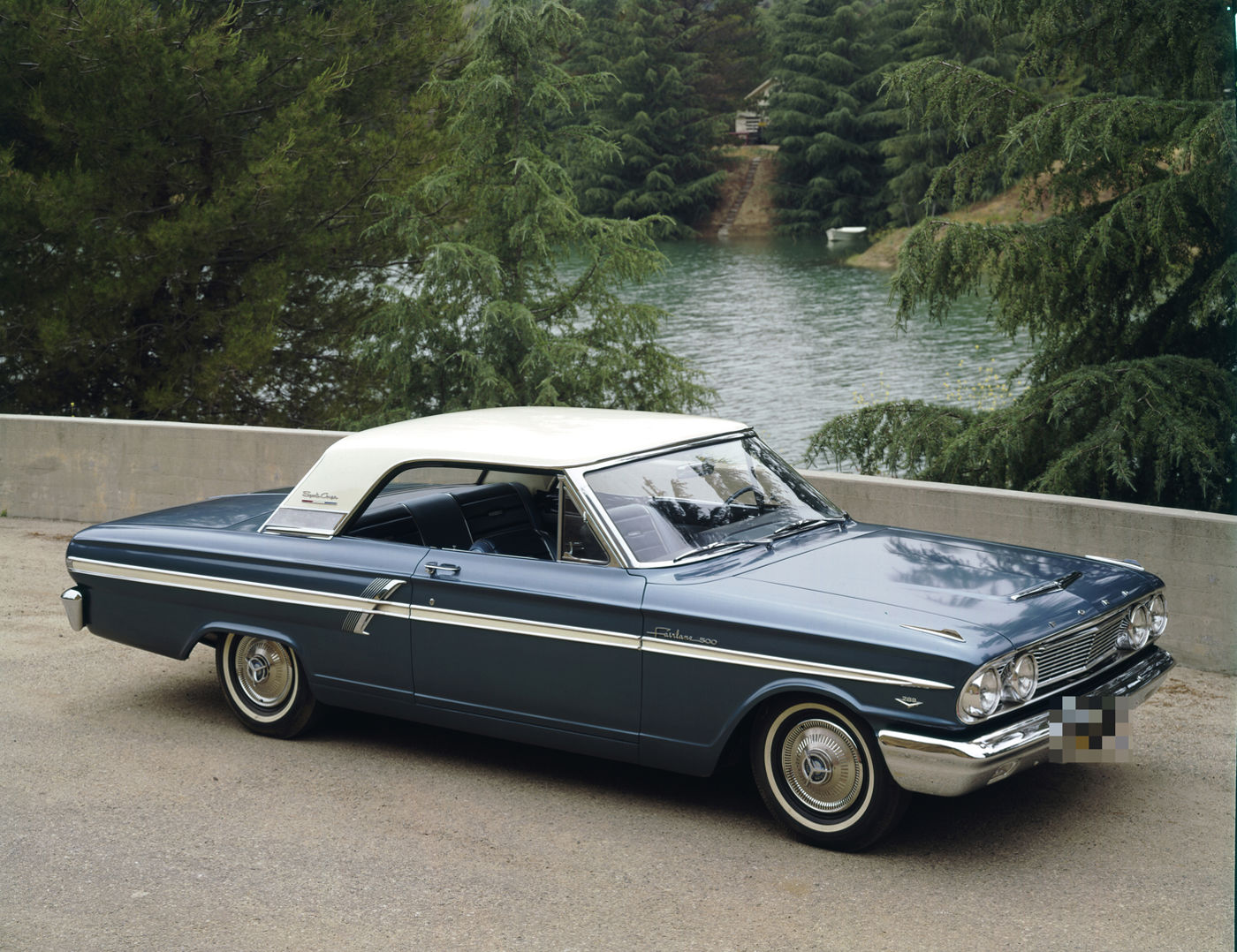
The 1964 NHRA Winternationals final went to a Ford that had not existed a year earlier. Wikipedia's Thunderbolt history records Gas Ronda beating Butch Leal with a run of 11.78 seconds at 123.40 mph, and the NHRA's own remembrance of Ronda says he went on to win the 1964 Hot Rod Magazine Championships on the way to the NHRA Stock world championship. The same NHRA account preserves a small act of showmanship: Ronda had his Fairlane's original factory burgundy repainted in the bright poppy red that Ford's new Mustang had made fashionable that year.1,2
The Thunderbolt existed because Ford's drag racers had a weight problem. The NHRA's account says the full-size Galaxie was too heavy to beat the lighter Chevrolet, Dodge and Plymouth cars in Super Stock, and that Ford solved the problem in 1964 by shoehorning the 427 into the midsize Fairlane. How heavy was too heavy is visible in a 1963 Cars magazine feature on a dealer-raced lightweight 427 Galaxie, which, even with fiberglass panels and aluminum bumpers, still weighed just under 3,600 pounds. The Fairlane offered a smaller shell around the same big engine, and that was the whole of the Thunderbolt idea.2,3
Ronda was not new to Ford when the Thunderbolt arrived. In October 1963, Martyn L. Schorr's Cars feature on a dealer-raced lightweight Galaxie named Bob Tasca, Gas Ronda and Les Ritchey as big Ford boosters who had been running the quarter mile in the very low 12-second range, and reported that Tasca's 'Go Getter II' had just run 12.0 seconds at a Rhode Island strip. Those were full-size cars, fiberglass-panelled Galaxie hardtops with aluminum bumpers. The Thunderbolt took the same engine and some of the same racers and moved them into a smaller car; at the Winternationals, Ronda's elapsed time was 11.78 seconds. The two figures come from different cars, strips and conditions, so they show a direction, not a measured gain.3,1
Ford did not build the cars on its own assembly line. Wikipedia and Old Cars Weekly both say Dearborn Steel Tubing did the conversions, Wikipedia naming Andy Hotton, and Old Cars Weekly says the starting point was 100 Fairlane 500 two-door sedans built with the 271-horsepower 289. Colin Comer's Sports Car Market profile places the program inside Ford's Total Performance push and says Dick Brannan got the first car, with racers including Mickey Thompson and Phil Bonner following. Old Cars Weekly describes the work in batches: a first batch of eleven, then the remaining 89 cars in seven further batches.1,4,5
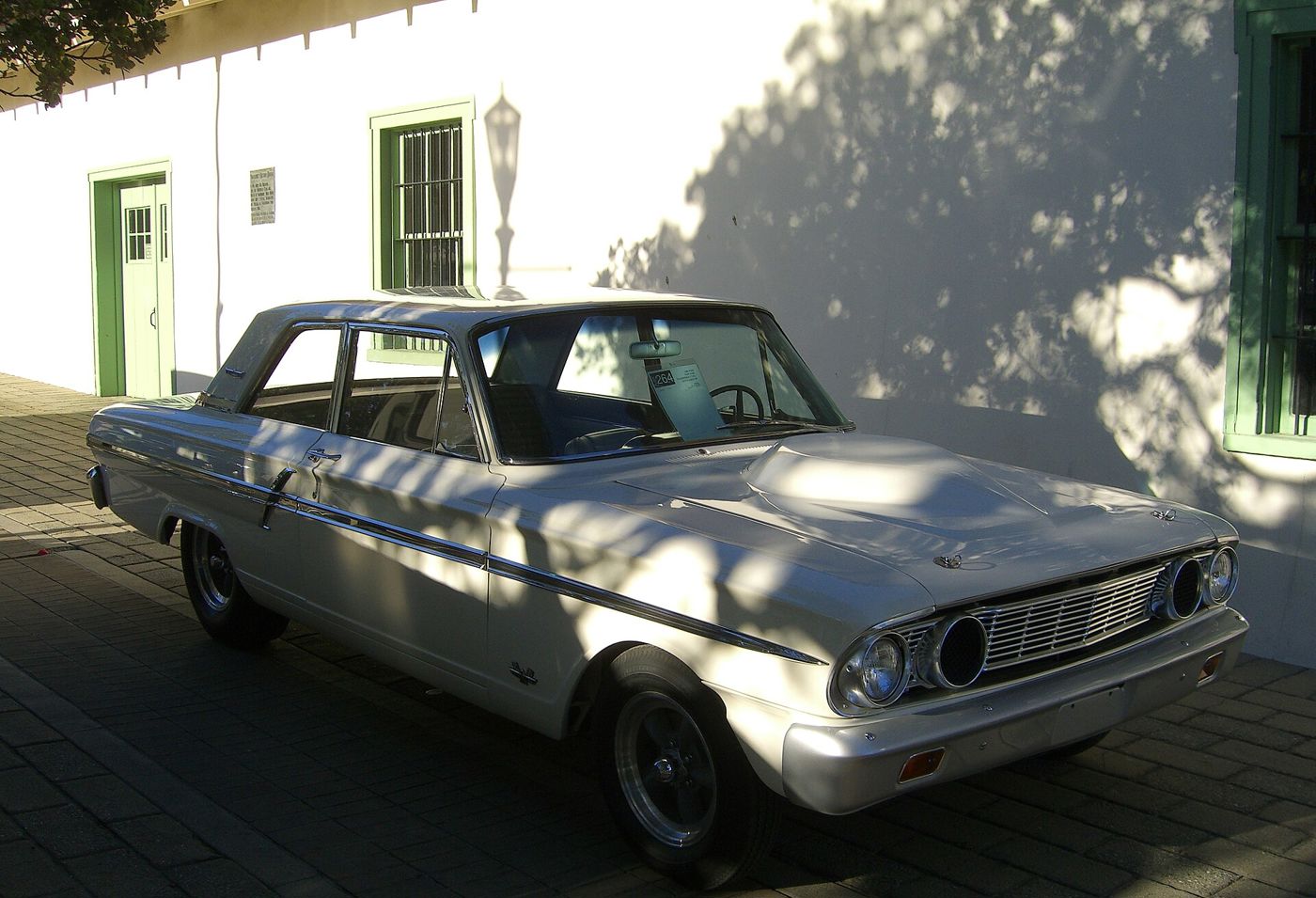
The conversion was a catalogue of subtraction. Wikipedia lists fiberglass doors, hood and front fenders and, on early cars, a fiberglass front bumper; Plexiglas windows; and the removal of the sun visors, radio, heater, wheel covers, passenger-side windshield wiper, arm rests, rear window cranks, mirrors, sound-deadening material, carpet, trunk mat, lug wrench, jack and spare tire. The hood was pinned rather than hinged, and the high-beam headlamps gave way to mesh-covered air intakes. What remained was a two-door Fairlane body carrying Ford's biggest racing engine and very little else, a car that made sense only at a drag strip.1
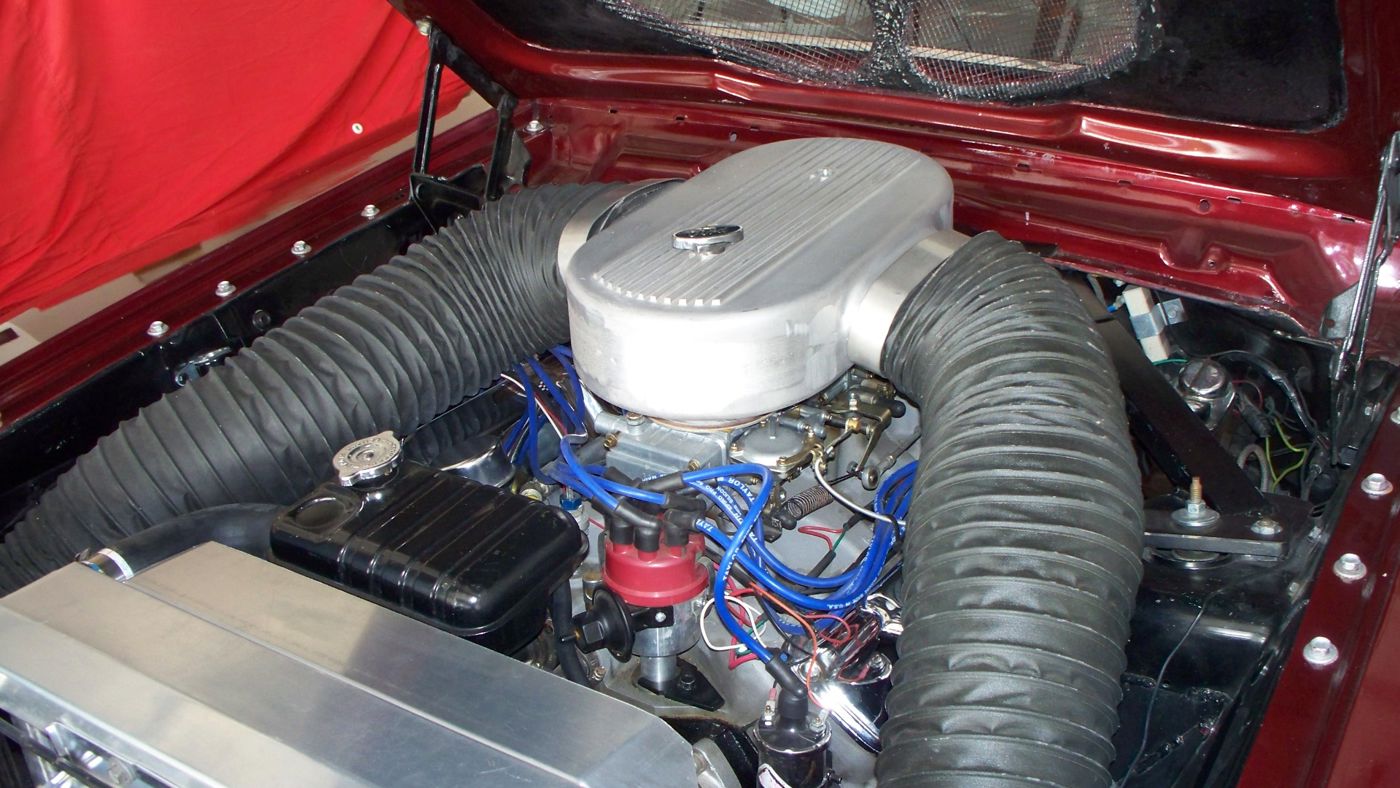
That engine was the 427 with two Holley four-barrel carburetors. Wikipedia's Thunderbolt article gives an advertised rating of 425 horsepower at 6,000 rpm and 480 lb-ft at 3,700 rpm with 13.5:1 compression, and calls the rating conservative; its broader Fairlane article gives the same 425 horsepower at 7,500 rpm, and the two articles do not reconcile the difference. Wikipedia also repeats later estimates of about 540 flywheel horsepower. Those are estimates rather than ratings, so they sit beside the advertised figure and never replace it, and the rating's own basis is not stated in the sources found.1,6
The production figure is the Thunderbolt's own argument. Wikipedia's Thunderbolt article says 100 were built, 49 with four-speeds and 51 with automatics, the first eleven painted Vintage Burgundy and the other 89 Wimbledon White. Sports Car Market also counts 100 but splits them 41 four-speed and 59 automatic, and says all but one of the first eleven were four-speeds. Old Cars Weekly agrees on 100 and on eleven early dark cars, calling the colour Vintage Red. Wikipedia's broader Fairlane article, without a citation, gives a range of 111 to 127. No Ford or Dearborn Steel Tubing record was found, so the total stays disputed and the transmission split stays two-sided.1,5,4,6
The price is just as slippery. Old Cars Weekly says the cars were 'priced' at about $3,800 but that Ford is said to have handed them to drivers for a dollar, and Sports Car Market calls them 'Dollar Cars' sold to important drag racers. Neither cites a Ford invoice, so the dollar remains racing lore with a paper trail still to be found. The same Old Cars Weekly report shows how closely the hobby now tracks individual cars: the Thunderbolt that Phil Bonner identified as his own carries VIN 4F41K229249 and is recorded as number 55 in build sequence and number 64 in delivery sequence.4,5
The ordinary 1964 Fairlane, by contrast, has no production breakdown in the sources used for this year, so the Thunderbolt cannot be expressed honestly as a share of Fairlane output. What can be said is narrower and firmer. Whether the true total is 100 or as many as 127, the Thunderbolt was a batch of hand-converted racing cars supplied to a list of drag racers, not an option a showroom customer could tick, and it did its job: Sports Car Market credits the Thunderbolts with the 1964 NHRA Super Stock title for Ford, and NHRA credits Ronda with the Stock world championship.6,5,2
The Thunderbolt's line ran straight into the next era of Ford drag racing. NHRA's remembrance says Ford followed Ronda's Thunderbolt season by giving him a 1965 Mustang powered by the single-overhead-cam 427, which ran in the mid-10-second range in A/FX form, and that this led to his 1966 factory Funny Car and a pioneering role in that new category. The 1964 Fairlane's racing story therefore begins in a stripped two-door sedan converted outside Ford's plants and ends, two years later, in a class built around cars that were no longer stock at all.2
Fact sheet · 1964 · United States
The numbers
1964 Ford Fairlane — The year of the Thunderbolt: a midsize Fairlane with a 427 installed for NHRA Super Stock, which carried Gas Ronda to the national Stock title.
Coverage: Partial — researched sections are shown; missing ones are not yet sourced. Researched through 2026-09-23.
Every figure is labeled with how sure we are. Reported means a manufacturer, registry, or reference figure we cite but have not reconciled against factory records ourselves. Disputed means credible sources disagree and both are shown. Rows are separately scoped; don't add them together unless the note says they make up a total.
Key facts
Production
| What was counted | Count | Basis | Status |
|---|---|---|---|
| All 1964 Fairlanes (conceptcarz total)7 all series · as published Disputed. The page states this total, but its listing repeats two rows (V8 Club Sedan 23,477 and V8 Town Sedan 86,919) with the same values as the Six-series 500 Club Sedan and Town Sedan rows, and the total equals the sum of all ten rows including those two. The eight distinct rows add to 268,616. OldRide's stated series totals (78,094 and 199,522) are held as rows below. See conflicts. | 379,012 | built, model-year | Disputed |
| What was counted | Count | Basis | Status |
|---|---|---|---|
| Fairlane Thunderbolt1 Thunderbolt · 427 dual 4-barrel · as published Competing uncited range 111 to 127; see conflicts. | 100 | built, model-year | Disputed |
| What was counted | Count | Basis | Status |
|---|---|---|---|
| Thunderbolt with 4-speed manual1 Thunderbolt · 427 · 4-speed manual · as published | 49 | built, model-year | Reported |
| Thunderbolt with automatic1 Thunderbolt · 427 · automatic · as published | 51 | built, model-year | Reported |
| What was counted | Count | Basis | Status |
|---|---|---|---|
| Thunderbolt in Vintage Burgundy1 Thunderbolt · 427 · as published The first eleven cars. | 11 | built, model-year | Reported |
| Thunderbolt in Wimbledon White1 Thunderbolt · 427 · as published | 89 | built, model-year | Reported |
| What was counted | Count | Basis | Status |
|---|---|---|---|
| Fairlane series total (six and V8)8 Fairlane · as published | 78,094 | built, model-year | Reported |
| Fairlane 500 series total (as stated)8 Fairlane 500 · as published | 199,522 | built, model-year | Reported |
| What was counted | Count | Basis | Status |
|---|---|---|---|
| Fairlane 4-door sedan (32)8 Fairlane · 4-door sedan, 32 · as published | 36,693 | built, model-year | Reported |
| Fairlane 2-door sedan (31)8 Fairlane · 2-door sedan, 31 · as published | 20,421 | built, model-year | Reported |
| Fairlane Ranch Wagon (38)8 Fairlane · station wagon, 38 · as published | 20,980 | built, model-year | Reported |
| Fairlane 500 4-door sedan (42)8 Fairlane 500 · 4-door sedan, 42 · as published | 86,919 | built, model-year | Reported |
| Fairlane 500 2-door sedan (41)8 Fairlane 500 · 2-door sedan, 41 · as published | 23,477 | built, model-year | Reported |
| Fairlane 500 2-door hardtop coupe (43)8 Fairlane 500 · 2-door hardtop, 43 · as published | 42,733 | built, model-year | Reported |
| Fairlane 500 Sport Coupe (47), as printed8 Fairlane 500 Sport Coupe · 2-door hardtop, 47 · as published | 12,431 | built, model-year | Reported |
| Fairlane 500 station wagon (48)8 Fairlane 500 · station wagon, 48 · as published | 24,962 | built, model-year | Reported |
The transmission and paint rows partition the 100-car figure according to the same article; they inherit its dispute.
No ordinary 1964 Fairlane series or body counts were found.
Rows prefixed or- come from OldRide.com's production table (Standard Catalog lineage, not stated). Production was counted by body style only, sixes and V8s together. The Fairlane rows add to 78,094; the Fairlane 500 rows add to 190,522, 9,000 short of the stated 199,522, which points to a misprint in one row (possibly the Sport Coupe, 12,431).
Whole-year total 379,012 from conceptcarz is recorded as disputed because its listing appears to include two duplicated rows. Searched 2026-09-29: conceptcarz year pages (read), the OldRide table already cited, Wikipedia.
Prices when new
| Model | Price | Basis |
|---|---|---|
| Fairlane 500 2-door hardtop coupe (43), six8 | $2,330 | factory price as compiled (base list, by engine), 1964 model year |
| Fairlane 500 2-door hardtop coupe (43), V88 | $2,430 | factory price as compiled (base list, by engine), 1964 model year |
| Fairlane 500 Sport Coupe (47), six8 | $2,491 | factory price as compiled (base list, by engine), 1964 model year |
| Fairlane 500 Sport Coupe (47), V88 | $2,591 | factory price as compiled (base list, by engine), 1964 model year |
| Fairlane 4-door sedan (32), six8 | $2,224 | factory price as compiled (base list, by engine), 1964 model year |
| Fairlane 4-door sedan (32), V88 | $2,324 | factory price as compiled (base list, by engine), 1964 model year |
| Fairlane 2-door sedan (31), six8 | $2,183 | factory price as compiled (base list, by engine), 1964 model year |
| Fairlane 2-door sedan (31), V88 | $2,283 | factory price as compiled (base list, by engine), 1964 model year |
| Fairlane 500 4-door sedan (42), six8 | $2,306 | factory price as compiled (base list, by engine), 1964 model year |
| Fairlane 500 4-door sedan (42), V88 | $2,406 | factory price as compiled (base list, by engine), 1964 model year |
| Fairlane 500 2-door sedan (41), six8 | $2,265 | factory price as compiled (base list, by engine), 1964 model year |
| Fairlane 500 2-door sedan (41), V88 | $2,365 | factory price as compiled (base list, by engine), 1964 model year |
| Fairlane Ranch Wagon (38), V88 | $2,620 | factory price as compiled (base list, by engine), 1964 model year |
| Fairlane 500 station wagon (48), V88 | $2,701 | factory price as compiled (base list, by engine), 1964 model year |
Prices are the nominal dollars of the day, not adjusted for inflation.
Engines
| Engine | Factory rating | Availability | Built |
|---|---|---|---|
| 427 Thunderbolt, dual 4-bbl1 427 cu in · 2 x 4-barrel (Holley) | 425 hp @ 6,000, 480 lb-ft @ 3,700 (advertised (basis not stated)) | Thunderbolt only | Not yet sourced |
Ratings are the manufacturer's advertised figures under the standard shown (SAE gross before 1972, SAE net after). They are not dyno results, and gross and net ratings can't be compared directly.
Specifications
| Measure | Value | Applies to |
|---|---|---|
| Shipping weight, Sport Coupe (47) V88 | 3,012 lb | 47, V8 |
| Shipping weight, Fairlane 500 hardtop (43) V88 | 2,992 lb | 43, V8 |
| Shipping weight, Fairlane 2-door sedan (31) V88 | 2,922 lb | 31, V8 |
| Wheelbase8 | 115.4 in | all |
| Overall length8 | 197.6 in | sedans (wagons 201.8) |
Where the sources disagree
Thunderbolt production total
Both shown; neither is supported by a Ford record in this pass, so the total is disputed.
Thunderbolt 427 rating rpm
Engine row carries the 6,000 rpm figure from the dedicated article; the alternative is shown here.
1964 whole-year Fairlane production
- 379,012 (stated total; equals its ten listed rows, two of which repeat other rows)7
- Series totals 78,094 (Fairlane) and 199,522 (Fairlane 500), the latter 9,000 above its own body rows; no whole-year total stated8
Show the conceptcarz total as disputed and the OldRide series totals as rows; no whole-year figure is asserted and the series totals are not added into one. A Ford production summary or the Standard Catalog of American Cars 1946-1975 would settle it.
Identification
Read a 1964 Ford VIN
The VIN decoder runs in your browser and never sends the VIN anywhere. How the factory numbered this year's cars:
Same model year
Also in 1964
- Buick Riviera The 425 became standard, the dual-quad Super Wildcat 360 arrived as an option, and the Super Turbine 400 replaced the twin-turbine automatic.
- Buick Wildcat The best Wildcat year at 84,245, with a 425 in 340- or 360-hp form and an available four-speed.
- Chevrolet Chevelle and Malibu SS The first Chevelle; the Malibu SS was a series, and its strongest released engine was the midyear 300 hp L74 327.
- Chevrolet Chevy II and Nova First V8 (283) year in the source engine table. Enthusiast-compiled production: 191,691 cars; Super Sport 10,576.
- Chevrolet El Camino SS No factory Super Sport El Camino is documented for this year; the record carries the host El Camino production as context.
- Chevrolet Impala SS Super Sport becomes its own series: 185,325 built.
- Chrysler 300 letter series Cheaper by about $1,000, with a single-four-barrel 360 hp 413 standard, leather made optional and the convertible restored, the 300K became the best-selling letter car: 3,022 hardtops and 625 convertibles.
- Dodge Dart 330/440, Polara and Max Wedge The Max Wedge's last year brought the Ramcharger 426-III, a 365 hp street 426 for Polara buyers, and in midyear a competition-only 426 Hemi in lightened 330/440 bodies; Roger Lindamood's Dodge won Top Stock at the Nationals.
- Ford Falcon Sprint The restyled Falcon kept the Sprint hardtop and convertible with the 164 hp 260 V8 standard; the club counts 18,108 built, many with a bench seat.
- Ford Galaxie Ford sold its 427 in the restyled full-size range in two advertised versions, 410 hp with one four-barrel and 425 hp with two, and the Galaxie 500 XL hardtop was the bucket-seat flagship.
- Ford Thunderbird The redesigned fourth-generation car offered one drivetrain, a 300-hp 390 with Cruise-O-Matic, and output rose to 92,465.
- Mercury Comet and Cyclone The Cyclone name first appeared on a 1964 Comet hardtop; the only production figure found is a single secondary total.
- Mercury Marauder and S-55 Marauder now meant the fastback roof on any full-size Mercury series, two-door or four-door, with the 390 standard and the 427 optional.
- Oldsmobile Cutlass, 4-4-2 and Hurst/Olds Oldsmobile's first 4-4-2 was a mid-year option package, B09 Police Apprehender Pursuit, with a 310 hp 330, a four-speed and dual exhausts; 2,999 are tabulated.
- Oldsmobile Starfire Production fell to 16,163 as the cheaper Jetstar I took the same body; Motor Trend timed a convertible at 9.7 s to 60.
- Plymouth Barracuda and 'Cuda Plymouth's glassback Valiant-based fastback launched in a short first season and sold 23,443 cars.
- Plymouth Savoy, Fury and Max Wedge Plymouth's last Max Wedge year offered the Super Stock 426-III beside a 365 hp street 426 Commando, while a competition-only 426 Hemi went into lightened Savoy/Belvedere drag cars and swept the Daytona 500.
- Pontiac Catalina 2+2 and Super Duty The 2+2 arrived as a $291 Catalina option and the 370 hp 421 HO replaced the Super Duty at the top.
- Pontiac GTO A $295 option on the Tempest LeMans that put Pontiac's 389 in the intermediate body; 32,450 were built.
- Pontiac Grand Prix A carryover year: 63,810 built, with the 370 hp 421 HO at the top of the option list.
- Pontiac Tempest and LeMans The Tempest becomes a 115-inch intermediate with a 326 V8, and the LeMans carries the new GTO option.
- Studebaker Avanti The last Studebaker Avanti, cut short when South Bend stopped building cars on 20 December 1963. It got rectangular headlamp bezels and a level stance, and 809 were built, including the nine production R3s.
- Studebaker Hawk The final Hawk, with a new deck lid and an optional vinyl 'Sports Roof', ended when South Bend closed on 20 December 1963. 1,767 were built, 1,484 of them domestic.
- Studebaker Lark and Super Lark Brooks Stevens restyled the Lark-type line and the Daytona became its top series. Of the V8 Daytonas, 111 got the R1 and 48 the supercharged R2, and one got the only production R4, before South Bend closed in December 1963.