1964 · Plymouth · United States
1964 Plymouth Barracuda: The Glass Fastback That Beat the Mustang to Showrooms by 16 Days
Plymouth's glassback Valiant-based fastback launched in a short first season and sold 23,443 cars.
United States · researched through 2026-09-23
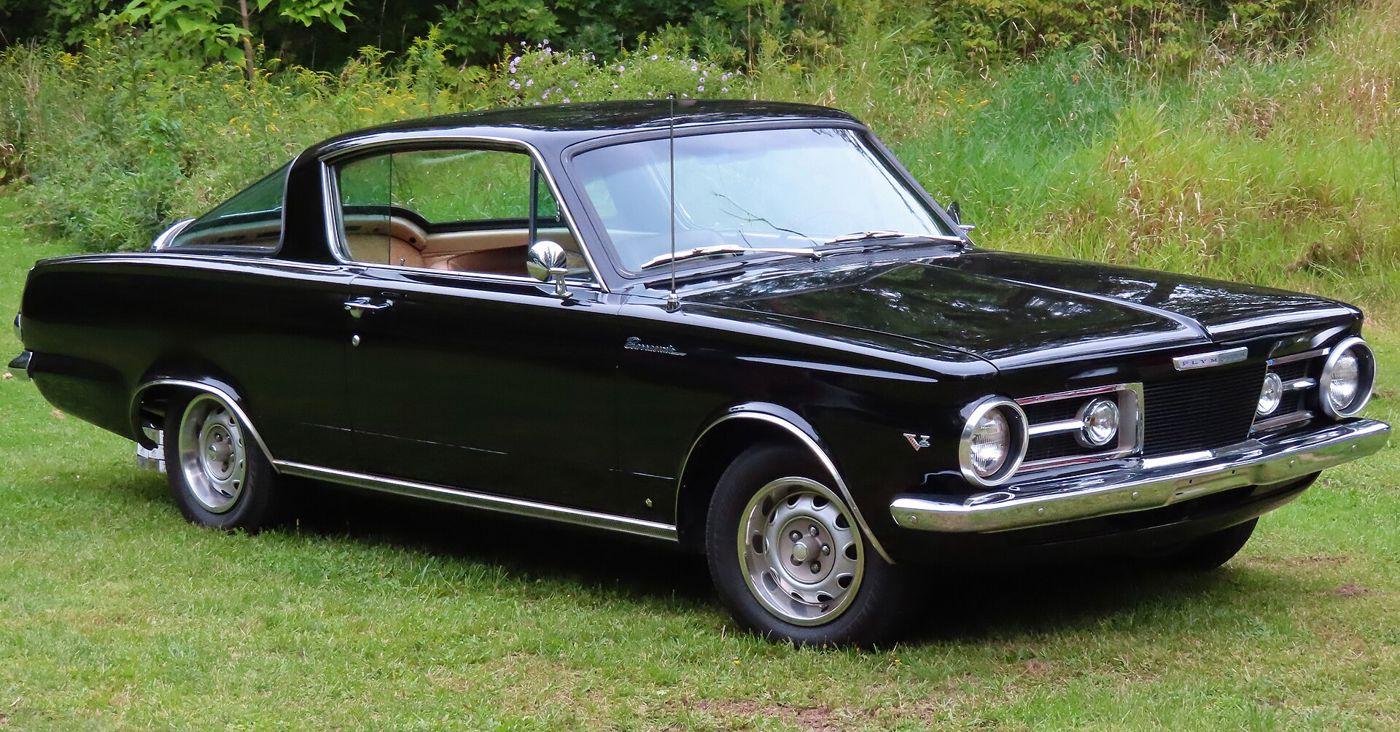
Plymouth introduced the Barracuda on April 1, 1964, April Fool's Day, and the date has followed the car ever since. Ate Up With Motor's history puts the debut 16 days ahead of Ford's Mustang; Over-Drive's fact sheet calls it two weeks. Either way, Plymouth reached showrooms first with a sporty compact, and then watched Ford sell roughly five cars for every one of its own in the same short season. The 1964 Barracuda is the story of a clever answer delivered on time and on a tight budget, into a market that turned out to belong to the other company's car.1,2
The idea came out of the compact wars. According to Ate Up With Motor, compact buyers were drifting toward sportier cars such as Chevrolet's Corvair Monza, and even before the 1963 Valiant launched, Chrysler-Plymouth product planner Joe Strum wondered whether it was too conservative. The design work that followed was collective. Stylist Milt Antonick refined the final shape, designers Dave Cummins and Irv Ritchie developed the fastback roof, and designer John Samsen suggested the Barracuda name. No single figure invented the car in these accounts, and the history keeps each contribution attached to the person it credits.1
Money set the shape of the program. Ate Up With Motor says funds were still tight and that extensive changes to the Valiant's unitized body would have been prohibitively expensive, which is why the car was first called the Plymouth Valiant Barracuda. Over-Drive lists what it borrowed: the Valiant's 106-inch wheelbase, hood, headlamp bezels, windshield, vent windows, quarter panels, doors, A-pillar, bumpers and trunk. The production table files it in the Valiant line as series VV1-P, body 149, a two-door sports hardtop. Below the beltline, in other words, a Barracuda was a Valiant wearing a new roof and a new name.1,2
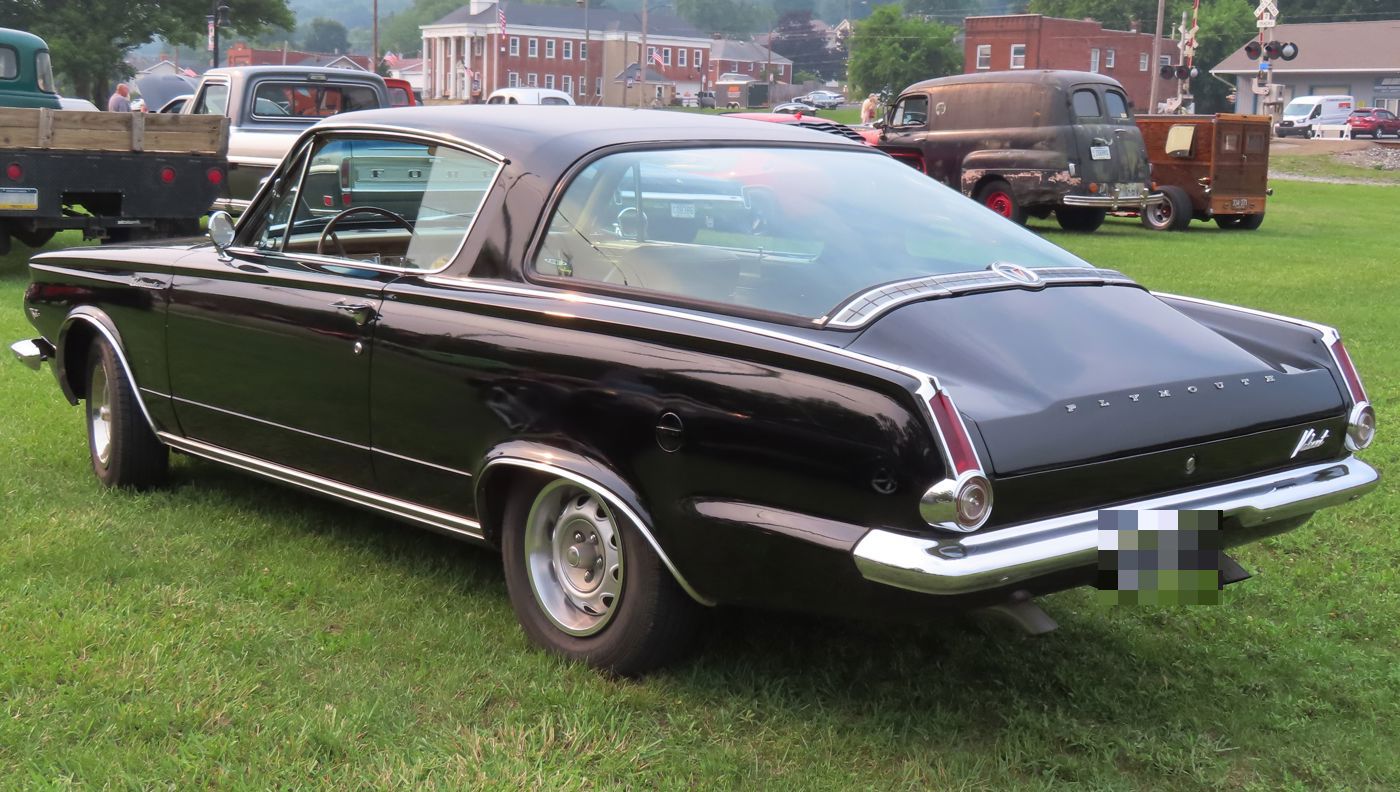
That roof was the whole point. Pittsburgh Plate Glass, the supplier, worked jointly with Chrysler's own designers on a wraparound backlight that Over-Drive describes as the largest single glass window installed on a standard production car up to that time. Ate Up With Motor gives its area as 2,070 square inches and says it was tinted to cut solar heat. The glass and the other body and equipment changes, by the same account, made the Barracuda about 100 pounds heavier than the car it came from. The production table gives a shipping weight of 2,740 pounds for the sports hardtop, a factory figure rather than a scale reading.2,1
Behind the glass sat the feature that made the shape useful. Ate Up With Motor says the Barracuda came standard with a fold-down rear seat and a removable package shelf, producing a flat load floor about seven feet long from the front seatbacks into the trunk. The same history notes an awkward reminder of the budget: an exposed fuel filler that complicated the cargo area. The case for the car was a sporting roofline with something close to station-wagon usefulness, on the same 106-inch wheelbase as the Valiant it came from.1
Under the hood, the order form was modest by later standards. The 170-cubic-inch Slant Six, rated 101 horsepower, was standard. The 225 six at 145 horsepower was listed at $47, and the new lightweight LA-series 273 V8, rated 180 horsepower at 4,200 rpm with 260 lb-ft at 1,600, at $131. Ate Up With Motor labels those ratings gross; Over-Drive's table does not state the standard. A three-speed manual was standard, a Warner T-10 four-speed was listed at $180, and the TorqueFlite automatic was optional, 1964 being the last year it was controlled by push buttons.2,1
The price was the sharpest part of the pitch. The Barracuda sports hardtop listed at $2,365, and Ate Up With Motor notes that this was $3 below a six-cylinder Mustang. The option list stayed short: a Sure-Grip axle at about $39, power steering at about $82, and the engine and transmission upgrades. Over-Drive's color chart runs to sixteen paints, from Ebony and Signet Royal Red to a Barracuda Gold that carried the car's own name, with Sandalwood, Chestnut, Ruby and three shades each of blue and turquoise in between. For a buyer who wanted a sporty compact with a real trunk, Plymouth had put the offer on the lot a little earlier and a few dollars cheaper.2,1
Being first did not make it the winner. Reference books agree that Plymouth built 23,443 Barracudas in the abbreviated 1964 season; Peter Sessler's production table and Charles Hyde's Chrysler history both print that figure. Sessler's table also prints a six-and-V8 split of 2,647 and 20,796, but the snippet does not show which number belongs to which engine, so the split stays unrecorded. For scale, Over-Drive sets the Barracuda total against 126,538 Mustangs sold in the same short season, and Ate Up With Motor puts the Barracuda at about one-fifth of Mustang sales.3,4,2,1
The numbers explain the Barracuda's later arc better than any design argument. Plymouth had built a sporty car by rearranging a Valiant, and the Barracuda's later answers came in stages. For 1965 Plymouth added the Formula S, which Ate Up With Motor describes as carrying a hotter 273 rated 235 gross horsepower, the first step toward the performance Barracudas that followed. The first-year car, with its six-cylinder base engine and 180-horsepower V8, was never meant to be a muscle car, and its records never pretend otherwise. Its appeal in 1964 was shape, space and price rather than power: the V8 added $131 to the bill and 180 advertised horsepower to the car.1,2
What the 1964 car left behind is a set of firsts that still hold up without exaggeration. It reached showrooms ahead of the Mustang, it carried a backlight that Over-Drive calls the largest on a standard production car of its time, and it gave a compact coupe a seven-foot load floor. It also left an honest ledger: 23,443 cars, one body style, three engines, one price of $2,365, and a six-and-V8 split that nobody can yet read cleanly off the page. The Barracuda was the right idea delivered at the right moment, and it took later model years to find its full voice.2,1,3
Fact sheet · 1964 · United States
The numbers
1964 Plymouth Barracuda — Plymouth's glassback Valiant-based fastback launched in a short first season and sold 23,443 cars.
Coverage: Partial — researched sections are shown; missing ones are not yet sourced. Researched through 2026-09-23.
Every figure is labeled with how sure we are. Reported means a manufacturer, registry, or reference figure we cite but have not reconciled against factory records ourselves. Disputed means credible sources disagree and both are shown. Rows are separately scoped; don't add them together unless the note says they make up a total.
Key facts
Production
| What was counted | Count | Basis | Status |
|---|---|---|---|
| All 1964 Barracudas3,4,2 Barracuda · 2-door sports hardtop (fastback), body 149 · not stated Langworth prints 23,433, apparently a transposition. The Sessler and Zazarine snippets also show 2,647 and 20,796 as a six/V8 split, but which figure is which is not legible, so the split is not recorded. | 23,443 | built, model-year | Reported |
Only the total is recorded.
Prices when new
| Model | Price | Basis |
|---|---|---|
| Barracuda sports hardtop2 | $2,365 | factory price as reported, 1964 model year |
| Barracuda sports hardtop with 273 V85,6 | $2,496 | list / base price as printed by the road-test magazines (V8 car), 1964 model year (tests of July and August 1964) |
| Road-test car as tested (Car Life: V8, TorqueFlite, A/C, power steering and other options)5 | $3,324 | price as tested, per Car Life, 1964-07 |
| Road-test car as tested (Motor Trend: V8, 4-speed, radio and other options)6 | $3,025.90 | price as tested, plus tax and license, per Motor Trend, 1964-08 |
Prices are the nominal dollars of the day, not adjusted for inflation.
Engines
| Engine | Factory rating | Availability | Built |
|---|---|---|---|
| 170 Six2 170 cu in · 1-barrel | 101 hp @ 4,400, 155 lb-ft @ 2,400 (as listed by Over-Drive (standard not stated)) | standard | Not yet sourced |
| 225 Six2 225 cu in · 1-barrel | 145 hp @ 4,000, 215 lb-ft @ 2,400 (as listed by Over-Drive (standard not stated)) | optional ($47 as listed) | Not yet sourced |
| 273 V82 273 cu in · 2-barrel | 180 hp @ 4,200, 260 lb-ft @ 1,600 (as listed by Over-Drive (standard not stated)) | optional ($131 as listed) | Not yet sourced |
Ratings are the manufacturer's advertised figures under the standard shown (SAE gross before 1972, SAE net after). They are not dyno results, and gross and net ratings can't be compared directly.
Transmissions
| Transmission | Availability | Built |
|---|---|---|
| 4-speed manual, floor shift2 | optional ($180 as listed) | Not yet sourced |
| 3-speed manual2 | standard | Not yet sourced |
| TorqueFlite 3-speed automatic (push-button control)5 | optional (price not stated in the sources read) | Not yet sourced |
Options and packages
| Code | Option | Price | Installed |
|---|---|---|---|
|
Sure-Grip rear axle2 | $39 | Not yet sourced |
|
Power steering2 | $82 | Not yet sourced |
|
Heavy-duty 48-amp battery2 | $8 | Not yet sourced |
|
Buffed paint2 | $17 | Not yet sourced |
|
Heavy-duty shock absorbers and suspension package2 | $17 | Not yet sourced |
|
Power brakes2 | $43 | Not yet sourced |
|
AM radio (Transaudio), push-button2 | $59 | Not yet sourced |
|
Remote-control outside rear-view mirror2 | $12 | Not yet sourced |
|
Safety padded instrument panel2 | $16 | Not yet sourced |
|
Tinted glass, all windows2 | $29 | Not yet sourced |
|
Tinted glass, windshield only2 | $14 | Not yet sourced |
|
Variable-speed wipers and washers2 | $17 | Not yet sourced |
|
Air conditioning | — | Not yet sourced |
|
Undercoating | — | Not yet sourced |
|
Day/nite inside rear-view mirror | — | Not yet sourced |
|
Back-up lights | — | Not yet sourced |
|
Magnesium-type sport wheel covers with exposed chrome-plated lugs6 | $34.15 | Not yet sourced |
|
Rear-window defogger | — | Not yet sourced |
Paint
| Code | Color | Built |
|---|---|---|
A |
Barracuda Gold2 | Not yet sourced |
B |
Ebony2 | Not yet sourced |
C |
Light Blue2 | Not yet sourced |
D |
Medium Blue2 | Not yet sourced |
E |
Dark Blue2 | Not yet sourced |
H |
Sandalwood2 | Not yet sourced |
J |
Light Turquoise2 | Not yet sourced |
K |
Medium Turquoise2 | Not yet sourced |
L |
Dark Turquoise2 | Not yet sourced |
M |
Medium Gray2 | Not yet sourced |
P |
Ruby2 | Not yet sourced |
T |
Signet Royal Red2 | Not yet sourced |
V |
Chestnut2 | Not yet sourced |
W |
White2 | Not yet sourced |
X |
Light Tan2 | Not yet sourced |
Y |
Medium Tan2 | Not yet sourced |
Color names are the factory's. We don't show color swatches, because a screen color is no guide for a restoration.
Interiors
| Code | Trim | Built |
|---|---|---|
|
Vinyl bucket-seat interior, gold | Not yet sourced |
|
Vinyl bucket-seat interior, red | Not yet sourced |
|
Vinyl bucket-seat interior, blue | Not yet sourced |
|
Vinyl bucket-seat interior, black | Not yet sourced |
Specifications
| Measure | Value | Applies to |
|---|---|---|
| Wheelbase2 | 106 in | all |
| Shipping weight2 | 2,740 lb | sports hardtop |
| Overall length2 | 188.2 in | all |
| Overall width | 70.1 in | all |
| Tread, front / rear | 55.9 / 55.6 in | all |
| Fuel tank | 18 US gal | all |
| Headroom, front / rear | 38.3 / 36.8 in | all (includes cushion deflection per AMA) |
| Legroom, front / rear | 39.9 / 30.7 in | all |
| Curb weight, V8 TorqueFlite test car5 | 3,150 lb | Car Life test car |
| Front/rear weight distribution, test car5 | 57.5 / 42.5 % | Car Life test car, test weight |
Period road tests
| Test | Car tested | Result |
|---|---|---|
| Car Life, 1964-0750-60 mph | Valiant Barracuda V-8: 273 2-bbl (180 bhp), TorqueFlite, 2.93:1 axle, 7.00-13 tires; air conditioning, power steering; 3,450 lb test weightTest weight 3,450 lb | 12.9 s |
| Car Life, 1964-075standing quarter-mile | Valiant Barracuda V-8, 273 2-bbl, TorqueFlite, 2.93:172 mph at end | 17.8 s |
| Car Life, 1964-075top speed | Valiant Barracuda V-8, 273 2-bbl, TorqueFlite, 2.93:1at 4,300 rpm | 105 mph |
| Car Life, 1964-075fuel consumption, normal range | Valiant Barracuda V-8, 273 2-bbl, TorqueFlite, 2.93:1 | 16-19 mpg |
| Motor Trend, 1964-0860-60 mph | Barracuda fastback: 273 2-bbl (180 hp), 4-speed manual with Hurst linkage, 3.55:1 axle, 7.00x13 whitewalls; radio, custom steering wheel, wheel coversTwo aboard | 11 s |
| Motor Trend, 1964-086standing quarter-mile | Barracuda fastback, 273 2-bbl, 4-speed, 3.55:179 mph | 18.2 s |
| Motor Trend, 1964-086top speed | Barracuda fastback, 273 2-bbl, 4-speed, 3.55:14th gear at 5,000 rpm, stated as actual top speed | 102 mph |
| Motor Trend, 1964-086stopping distance from 60 mph | Barracuda fastback, 273 2-bbl, 4-speed, 3.55:131 ft from 30 mph | 156 ft |
A road test result belongs to the one car that was tested, with its engine, gearing, tires, and conditions. It is not a figure for every car of the year.
Identification
- Series and body (as reported)
- Series VV1-P, body number 149, two-door sports hardtop, within the Valiant line.2
Identification
Read a 1964 Plymouth VIN
The VIN decoder runs in your browser and never sends the VIN anywhere. How the factory numbered this year's cars:
Same model year
Also in 1964
- Buick Riviera The 425 became standard, the dual-quad Super Wildcat 360 arrived as an option, and the Super Turbine 400 replaced the twin-turbine automatic.
- Buick Wildcat The best Wildcat year at 84,245, with a 425 in 340- or 360-hp form and an available four-speed.
- Chevrolet Chevelle and Malibu SS The first Chevelle; the Malibu SS was a series, and its strongest released engine was the midyear 300 hp L74 327.
- Chevrolet Chevy II and Nova First V8 (283) year in the source engine table. Enthusiast-compiled production: 191,691 cars; Super Sport 10,576.
- Chevrolet El Camino SS No factory Super Sport El Camino is documented for this year; the record carries the host El Camino production as context.
- Chevrolet Impala SS Super Sport becomes its own series: 185,325 built.
- Chrysler 300 letter series Cheaper by about $1,000, with a single-four-barrel 360 hp 413 standard, leather made optional and the convertible restored, the 300K became the best-selling letter car: 3,022 hardtops and 625 convertibles.
- Dodge Dart 330/440, Polara and Max Wedge The Max Wedge's last year brought the Ramcharger 426-III, a 365 hp street 426 for Polara buyers, and in midyear a competition-only 426 Hemi in lightened 330/440 bodies; Roger Lindamood's Dodge won Top Stock at the Nationals.
- Ford Fairlane The year of the Thunderbolt: a midsize Fairlane with a 427 installed for NHRA Super Stock, which carried Gas Ronda to the national Stock title.
- Ford Falcon Sprint The restyled Falcon kept the Sprint hardtop and convertible with the 164 hp 260 V8 standard; the club counts 18,108 built, many with a bench seat.
- Ford Galaxie Ford sold its 427 in the restyled full-size range in two advertised versions, 410 hp with one four-barrel and 425 hp with two, and the Galaxie 500 XL hardtop was the bucket-seat flagship.
- Ford Thunderbird The redesigned fourth-generation car offered one drivetrain, a 300-hp 390 with Cruise-O-Matic, and output rose to 92,465.
- Mercury Comet and Cyclone The Cyclone name first appeared on a 1964 Comet hardtop; the only production figure found is a single secondary total.
- Mercury Marauder and S-55 Marauder now meant the fastback roof on any full-size Mercury series, two-door or four-door, with the 390 standard and the 427 optional.
- Oldsmobile Cutlass, 4-4-2 and Hurst/Olds Oldsmobile's first 4-4-2 was a mid-year option package, B09 Police Apprehender Pursuit, with a 310 hp 330, a four-speed and dual exhausts; 2,999 are tabulated.
- Oldsmobile Starfire Production fell to 16,163 as the cheaper Jetstar I took the same body; Motor Trend timed a convertible at 9.7 s to 60.
- Plymouth Savoy, Fury and Max Wedge Plymouth's last Max Wedge year offered the Super Stock 426-III beside a 365 hp street 426 Commando, while a competition-only 426 Hemi went into lightened Savoy/Belvedere drag cars and swept the Daytona 500.
- Pontiac Catalina 2+2 and Super Duty The 2+2 arrived as a $291 Catalina option and the 370 hp 421 HO replaced the Super Duty at the top.
- Pontiac GTO A $295 option on the Tempest LeMans that put Pontiac's 389 in the intermediate body; 32,450 were built.
- Pontiac Grand Prix A carryover year: 63,810 built, with the 370 hp 421 HO at the top of the option list.
- Pontiac Tempest and LeMans The Tempest becomes a 115-inch intermediate with a 326 V8, and the LeMans carries the new GTO option.
- Studebaker Avanti The last Studebaker Avanti, cut short when South Bend stopped building cars on 20 December 1963. It got rectangular headlamp bezels and a level stance, and 809 were built, including the nine production R3s.
- Studebaker Hawk The final Hawk, with a new deck lid and an optional vinyl 'Sports Roof', ended when South Bend closed on 20 December 1963. 1,767 were built, 1,484 of them domestic.
- Studebaker Lark and Super Lark Brooks Stevens restyled the Lark-type line and the Daytona became its top series. Of the V8 Daytonas, 111 got the R1 and 48 the supercharged R2, and one got the only production R4, before South Bend closed in December 1963.