1964 · Mercury · United States
1964 Mercury Comet Cyclone
The Cyclone name first appeared on a 1964 Comet hardtop; the only production figure found is a single secondary total.
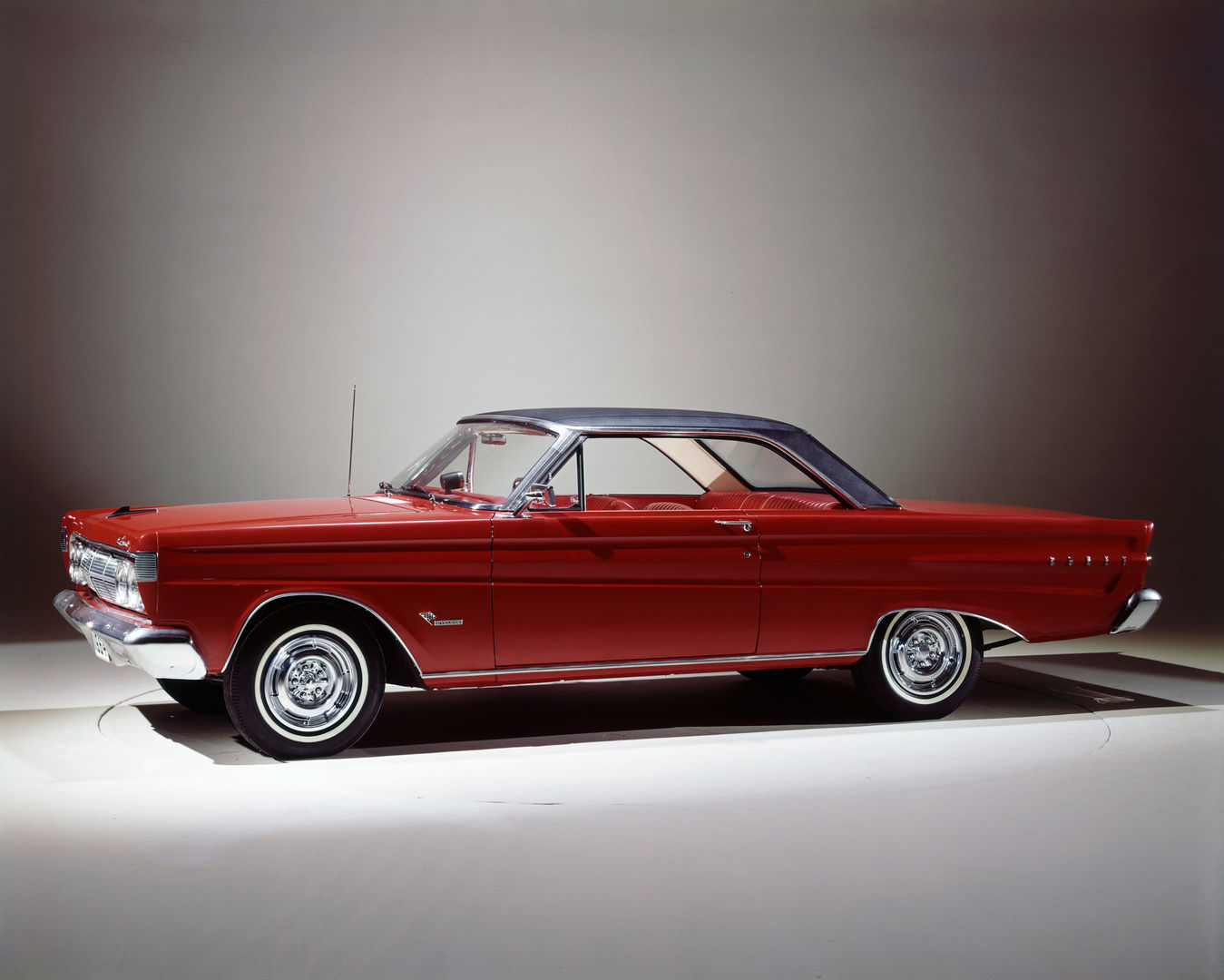
The Cyclone name debuted for 1964 on a Comet hardtop. Mercury built 7,454 Cyclones that year, the figure given on pages 83 to 90 of Holder and Kunz's Ford Muscle and repeated on conceptcarz's 1964 Comet spec page. The ten body and series rows for the whole 1964 Comet line sum to 187,956, so the Cyclone accounted for about one Comet in every 25 built. The Comet Caliente two-door hardtop, sharing the Cyclone's body, totals 31,204 on its own, more than four times the Cyclone's count.1,2
Mercury's own Cyclone folder advertises the "Super 289" V8 at 210 hp at 4,400 rpm and 300 lb-ft at 2,800 rpm, an advertised-gross figure with chrome engine dress-up, an argent air cleaner, and chrome rocker covers and caps, as standard equipment. The engine itself measured 4.00 x 2.87 in bore and stroke, ran a single four-barrel carburetor at a 9.0:1 compression ratio on regular fuel, and used hydraulic lifters, and it was the Cyclone's only engine for the year. With a 4.00-inch bore against a 2.87-inch stroke, the Super 289 was a short-stroke design. That 210-hp rating was the only one the Cyclone carried in 1964. Torque peaked 1,600 rpm below the horsepower peak. Mercury's folder, form C-115, titled the car the Comet Cyclone with Super 289 V-8, putting the engine in the name.1
Mac's Motor City Garage, in a 2026 article titled Muy Caliente, reports a $2,655 list price for the Cyclone two-door hardtop, $280, or about 12 percent, above the $2,375 it gives for the Caliente hardtop. A 3-speed manual, geared 2.79, 1.70 and 1.00, was standard; a Multi-Drive Merc-O-Matic automatic, geared 2.46, 1.46 and 1.00, and a floor-mounted 4-speed manual, geared 2.78, 1.93, 1.36 and 1.00, were both optional at extra cost. The four-speed's first gear was almost the same as the three-speed's, with two closer steps in between, and the automatic had the tallest first gear of the three at 2.46. All three finished in a direct 1.00 top gear.3
NHRA's own history separately identifies Jack Chrisman's Sachs and Sons Comet at the 1964 Nationals as considered by many the original Funny Car, running a supercharged, nitromethane-fueled engine in B/Fuel Dragster trim and recording 10.25 seconds at 156.31 mph before losing in eliminations. It was a purpose-built race car rather than a showroom Cyclone, but it carried the Comet name into drag-racing history in the Cyclone's first year.4
The Cyclone measured 195.1 in overall on a 114.0-inch wheelbase, 71.4 in wide and 53.6 in tall, with a 55.6-inch front tread and a slightly wider 56.0-inch rear. Self-adjusting 10-inch drum brakes with 154.2 sq in of lining were standard, with power assist optional; tires were 6.50x14 standard (7.00x14 optional) on 14x5-inch rims, and the fuel tank held 20 gallons. The optional 7.00x14 tires were one size up from the standard 6.50x14s. Mercury printed all of these figures on the back panel of its Cyclone folder, alongside the power-assisted brakes and the two extra-cost transmissions. The 14x5-inch rims carried either tire size.
Fact sheet · 1964 · United States
The numbers
1964 Mercury Comet Cyclone: The Cyclone name first appeared on a 1964 Comet hardtop; the only production figure found is a single secondary total.
Figures may describe different groups of cars. Add rows together only when the note says they make up a total.
Key facts
- Cyclone 1964: 7,454 (secondary, Holder and Kunz via Wikipedia).1
- Mercury's 1964 Comet Cyclone folder advertises the "Super 289" V8 at 210 hp at 4,400 rpm and 300 lb-ft at 2,800 rpm (advertised gross), with chrome engine dress-up as standard.
Production
| What was counted | Built |
|---|---|
| Comet Cyclone1,2 Cyclone · 289 · as published | 7,454 |
| What was counted | Built |
|---|---|
| All 1964 Comets (host line, context)2 all series of the host line · as published | 187,956 |
| Comet Caliente 2-door hardtop (context)2 Caliente · 2-door hardtop · as published The Caliente hardtop shared the Cyclone's body. | 31,204 |
Prices when new
| Model | Price | Price type |
|---|---|---|
| Comet Cyclone 2-door hardtop3 | $2,655 | list price, 1964 model year |
Prices are the nominal dollars of the day, not adjusted for inflation.
Engines
| Engine | Factory rating | Availability |
|---|---|---|
| 289 V81 289 cu in | 210 hp (SAE gross) | Cyclone |
Ratings are published figures, not dyno results. Gross and net ratings aren't directly comparable.
Transmissions
| Transmission | Availability |
|---|---|
| 3-speed manual (2.79, 1.70, 1.00) | standard |
| Multi-Drive Merc-O-Matic automatic (2.46, 1.46, 1.00) | optional at extra cost |
| 4-speed manual, floor-mounted (2.78, 1.93, 1.36, 1.00) | optional at extra cost |
Specifications
| Measure | Value | Applies to |
|---|---|---|
| Wheelbase | 114 in | Comet Cyclone |
| Tread, front / rear | 55.6 / 56.0 in | Comet Cyclone |
| Overall length | 195.1 in | Comet Cyclone |
| Overall width | 71.4 in | Comet Cyclone |
| Overall height | 53.6 in | Comet Cyclone |
| Brakes | self-adjusting 10-in drums, 154.2 sq in lining; power assist optional text | Comet Cyclone |
| Tires | 6.50 x 14 (7.00 x 14 optional), 14 x 5-in rims size | Comet Cyclone |
| Fuel tank | 20 gal | Comet Cyclone |
| Engine detail, 289 V8 | bore x stroke 4.00 x 2.87 in; 300 lb-ft @ 2,800 rpm advertised; 4-barrel; 9.0:1; regular fuel; hydraulic lifters; chrome dress-up (argent air cleaner, chrome rocker covers and caps) text | Comet Cyclone |
Identification
Read a 1964 Mercury VIN
The VIN decoder runs in your browser and never sends the VIN anywhere. How the factory numbered this year's cars:
Read next
The people and races behind the 1964 Mercury Comet and Cyclone
- 1964 Factory Racing in Public Racing program
- Every Mercury Comet and Cyclone year 1964–1971
Same model year
Also in 1964
- Buick Riviera The 425 became standard, the dual-quad Super Wildcat 360 arrived as an option, and the Super Turbine 400 replaced the twin-turbine automatic.
- Buick Wildcat The best Wildcat year at 84,245, with a 425 in 340- or 360-hp form and an available four-speed.
- Chevrolet Chevelle and Malibu SS The first Chevelle; the Malibu SS was a series, and its strongest released engine was the midyear 300 hp L74 327.
- Chevrolet Chevy II and Nova First V8 (283) year in the source engine table. Enthusiast-compiled production: 191,691 cars; Super Sport 10,576.
- Chevrolet El Camino SS The Chevelle-bodied pickup in 300 and Malibu trim, before any Super Sport version: 32,548 built, 20,576 of them Malibu V8s.
- Chevrolet Impala SS Super Sport becomes its own series: 185,325 built.
- Chrysler 300 letter series Cheaper by about $1,000, with a single-four-barrel 360 hp 413 standard, leather made optional and the convertible restored, the 300K became the best-selling letter car: 3,022 hardtops and 625 convertibles.
- Dodge Dart 330/440, Polara and Max Wedge The Max Wedge's last year brought the Ramcharger 426-III, a 365 hp street 426 for Polara buyers, and in midyear a competition-only 426 Hemi in lightened 330/440 bodies; Roger Lindamood's Dodge won Top Stock at the Nationals.
- Ford Fairlane The year of the Thunderbolt: a midsize Fairlane with a 427 installed for NHRA Super Stock, which carried Gas Ronda to the national Stock title.
- Ford Falcon Sprint The restyled Falcon kept the Sprint hardtop and convertible with the 164 hp 260 V8 standard; the club counts 18,108 built, many with a bench seat.
- Ford Galaxie Ford sold its 427 in the restyled full-size range in two advertised versions, 410 hp with one four-barrel and 425 hp with two, and the Galaxie 500 XL hardtop was the bucket-seat flagship.
- Ford Thunderbird The redesigned fourth-generation car offered one drivetrain, a 300-hp 390 with Cruise-O-Matic, and output rose to 92,465.
- Mercury Marauder and S-55 Marauder now meant the fastback roof on any full-size Mercury series, two-door or four-door, with the 390 standard and the 427 optional.
- Oldsmobile Cutlass, 4-4-2 and Hurst/Olds Oldsmobile's first 4-4-2 was a mid-year option package, B09 Police Apprehender Pursuit, with a 310 hp 330, a four-speed and dual exhausts; 2,999 are tabulated.
- Oldsmobile Starfire Production fell to 16,163 as the cheaper Jetstar I took the same body; Motor Trend timed a convertible at 9.7 s to 60.
- Plymouth Barracuda and 'Cuda Plymouth's glassback Valiant-based fastback launched in a short first season and sold 23,443 cars.
- Plymouth Savoy, Fury and Max Wedge Plymouth's last Max Wedge year offered the Super Stock 426-III beside a 365 hp street 426 Commando, while a competition-only 426 Hemi went into lightened Savoy/Belvedere drag cars and swept the Daytona 500.
- Pontiac Catalina 2+2 and Super Duty The 2+2 arrived as a $291 Catalina option and the 370 hp 421 HO replaced the Super Duty at the top.
- Pontiac GTO A $295 option on the Tempest LeMans that put Pontiac's 389 in the intermediate body; 32,450 were built.
- Pontiac Grand Prix A carryover year: 63,810 built, with the 370 hp 421 HO at the top of the option list.
- Pontiac Tempest and LeMans The Tempest becomes a 115-inch intermediate with a 326 V8, and the LeMans carries the new GTO option.
- Studebaker Avanti The last Studebaker Avanti, cut short when South Bend stopped building cars on 20 December 1963. It got rectangular headlamp bezels and a level stance, and 809 were built, including the nine production R3s.
- Studebaker Hawk The final Hawk, with a new deck lid and an optional vinyl 'Sports Roof', ended when South Bend closed on 20 December 1963. 1,767 were built, 1,484 of them domestic.
- Studebaker Lark and Super Lark Brooks Stevens restyled the Lark-type line and the Daytona became its top series. Of the V8 Daytonas, 111 got the R1 and 48 the supercharged R2, and one got the only production R4, before South Bend closed in December 1963.