1964 · Dodge · United States
1964 Dodge Max Wedge: A Street 426, a Race-Only Hemi, and No Count of Either
The Max Wedge's last year brought the Ramcharger 426-III, a 365 hp street 426 for Polara buyers, and in midyear a competition-only 426 Hemi in lightened 330/440 bodies; Roger Lindamood's Dodge won Top Stock at the Nationals.
United States · researched through 2026-09-23
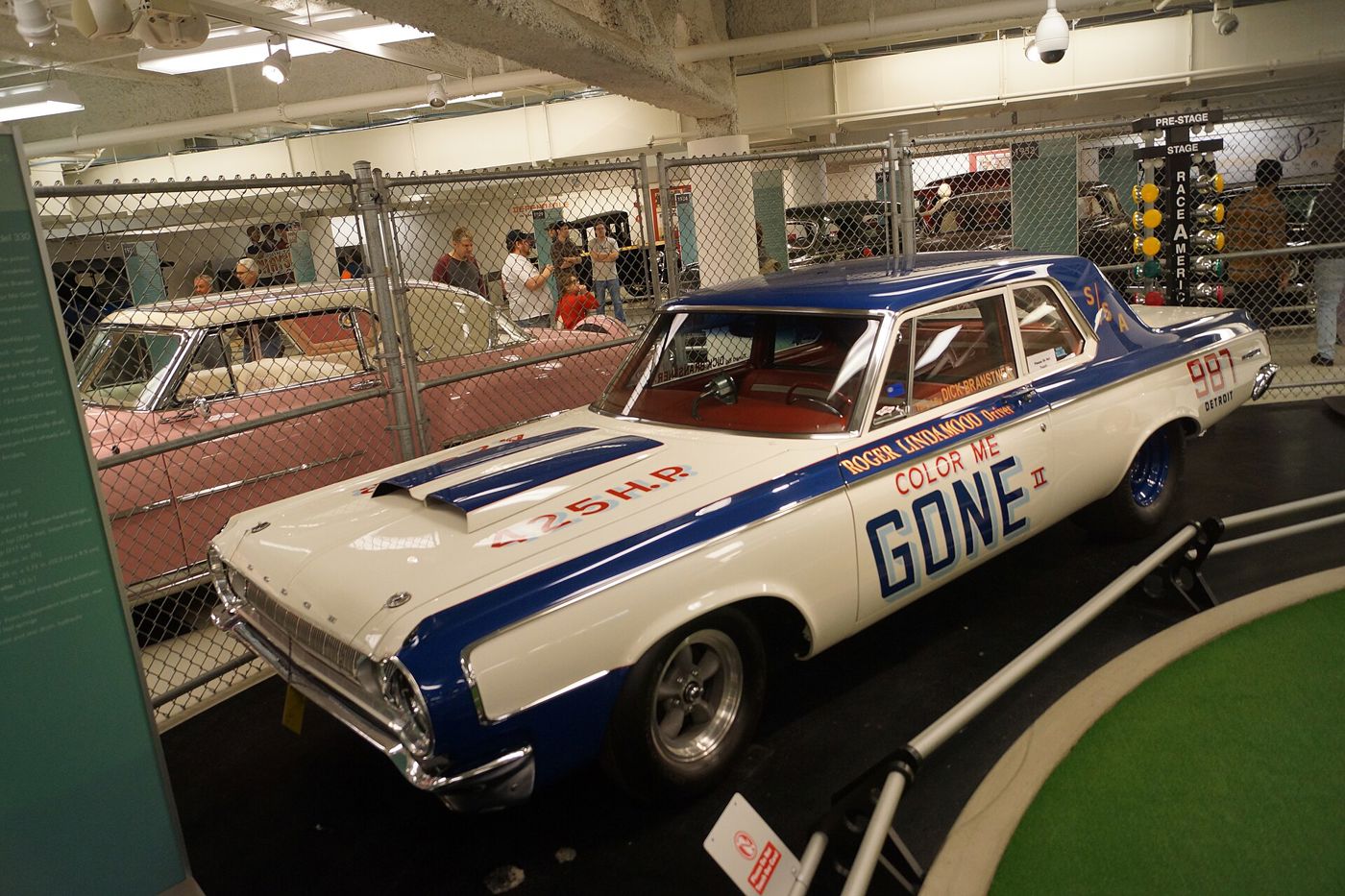
The Max Wedge's last year brought a genuinely layered performance offer from Dodge. A Polara 500 hardtop buyer could order the street-legal 426, a single four-barrel engine rated 365 horsepower at 4,800 rpm that came with a floor-shift four-speed as standard equipment, for $483. Above that sat the dual-four-barrel Ramcharger, restricted to recognized competition participants and sold in two states of tune, the 426-II at 415 horsepower for $515 and the 426-III at 425 horsepower for $545, Over-Drive's fact sheet labeling both the "Super Stock III" option despite the different engine names, a labeling quirk the record notes rather than resolves.1
Beyond even the Ramcharger sat a genuine race-only engine: the 426 Hemi, offered as a single-four-barrel NASCAR version at 400 horsepower and a dual-four-barrel drag version at 425 horsepower at 6,000 rpm, both on 12.5:1 compression, not available to the general public and costing roughly $1,800 over the counter according to the period fact sheet. The drag version came as part of the A864 package, built on Dodge 330/440 and Plymouth Savoy/Belvedere bodies stripped for competition with aluminum panels, lightweight seats, the rear seat deleted, and the battery relocated to the trunk, a purpose-built drag car rather than anything a buyer could option onto a street car.1,2
On the track, NHRA credits Roger Lindamood with the Top Stock title at the 1964 Nationals, a win that came at the expense of factory teams fielded by Al Eckstrand, Hayden Profitt, Bill Lawton, and Gas Ronda, though NHRA's own account does not specify which of Dodge's 1964 engine options powered Lindamood's winning car. A separate Dodge "Ramcharger" performance brochure, advertising nine engines across the 1964 line from a 101-horsepower 170 six up to the two 426 Ramchargers, also credits a Ramcharger Dodge Dart with a 191.89 mph Bonneville speed record, a claim this record carries from the brochure itself rather than an independent timing authority.3
A small compression-ratio disagreement runs through the street 426's own paperwork: the period Polara brochure states 10.3:1, while Over-Drive's fact sheet prints 11.00:1 for the same 365-horsepower engine. The record leads with the period brochure's figure and shows the fact sheet's value alongside it rather than discarding either. As with 1963, no sourced production count survives for any 1964 Max Wedge or race-Hemi Dodge specifically; what is documented is the much larger host-series context, a full-size Dodge line that built roughly 76,400 330s, 58,700 440s, 64,900 Polaras, and 18,400 Polara 500s for a rounded 248,700-car total, within which a base 330 two-door sedan V8 started at $2,372 and a Polara 500 convertible topped the range at $3,196.1
Underneath the performance ladder, the 1964 full-size Dodge kept the same 119-inch wheelbase as the year before, stretching to 209.8 inches overall and 75.0 inches wide as a Polara. The Polara 500 added all-vinyl bucket seats, a padded dash, and a center console as standard fittings, and shipping weights climbed with the equipment: a base 330 two-door sedan V8 weighed 3,270 pounds against 3,426 pounds for a Polara 500 two-door hardtop, a roughly 156-pound gap between the plainest and most dressed-up trims the 426 street engine could be ordered into.1
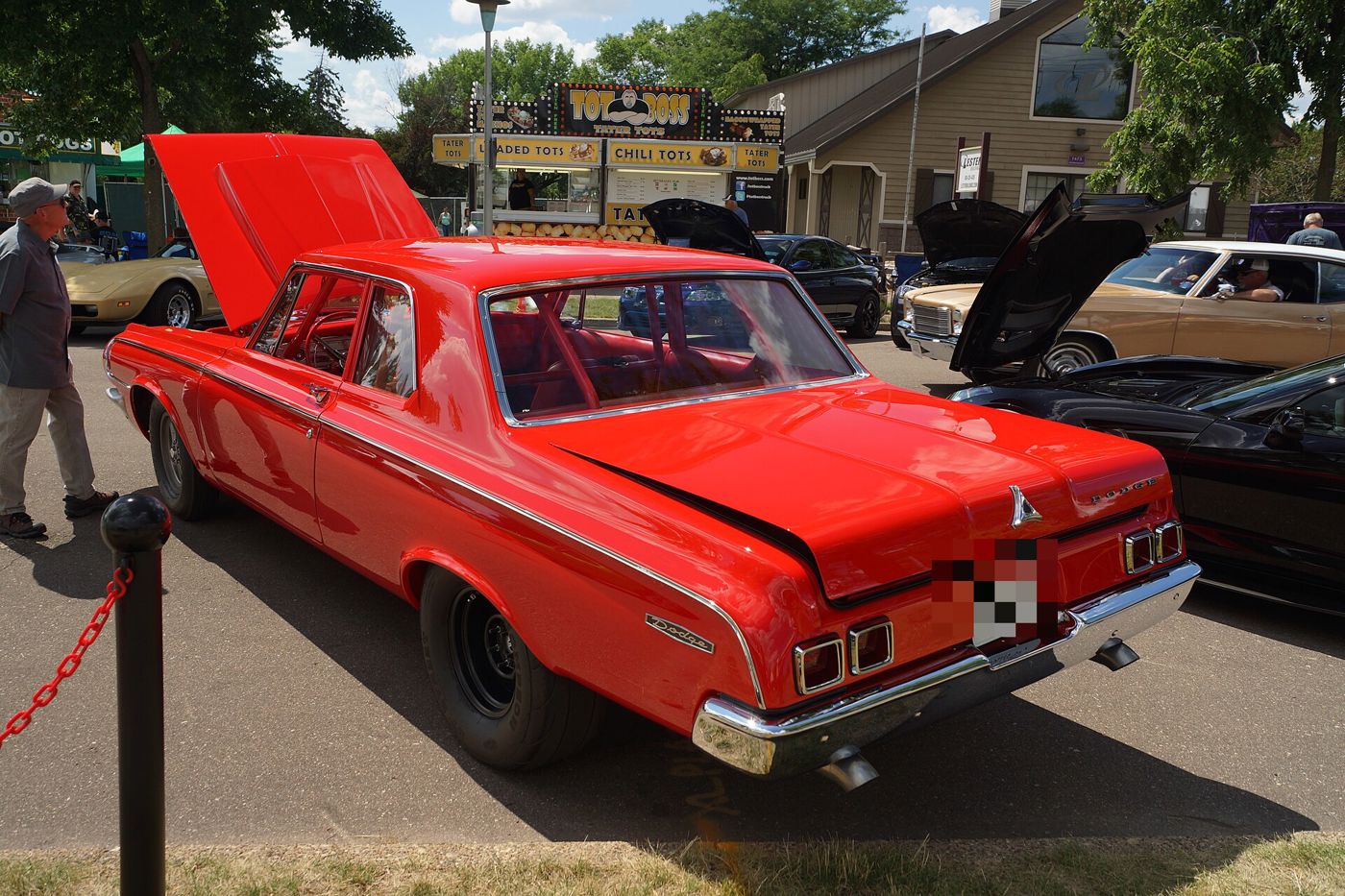
Fact sheet · 1964 · United States
The numbers
1964 Dodge 330, 440 and Polara: Ramcharger 426-III and the race Hemi — The Max Wedge's last year brought the Ramcharger 426-III, a 365 hp street 426 for Polara buyers, and in midyear a competition-only 426 Hemi in lightened 330/440 bodies; Roger Lindamood's Dodge won Top Stock at the Nationals.
Coverage: Partial — researched sections are shown; missing ones are not yet sourced. Researched through 2026-09-23.
Every figure is labeled with how sure we are. Reported means a manufacturer, registry, or reference figure we cite but have not reconciled against factory records ourselves. Disputed means credible sources disagree and both are shown. Rows are separately scoped; don't add them together unless the note says they make up a total.
Key facts
- 426 street wedge: 365 hp at 4,800 rpm, 470 lb-ft at 3,200 rpm; $483 option.1
- Competition 426 Hemi: about $1,800 over the counter; not available to the general public.1
- No sourced production count exists here for Max Wedge or race-Hemi Dodges.1
- Dodge's 1964 'Ramcharger' brochure advertised nine engines, from the 101 hp 170 Six to two 426 Ramcharger V-8s rated at 415 and 425 hp, and credited a Ramcharger Dodge Dart with a 191.89 mph Bonneville speed record.
Production
| What was counted | Count | Basis | Status |
|---|---|---|---|
| Dodge 330 passenger cars, rounded1 330 · sedans · not stated Host-series context (the race-Hemi and Max Wedge lightweights were 330-based); not a performance-engine count. | 76,400 | built, model-year | Reported |
| Dodge 440 passenger cars, rounded1 440 · sedans and hardtop · not stated Host-series context. The note says 'built during model year 1963', apparently a typo. | 58,700 | built, model-year | Reported |
| Dodge Polara, rounded1 Polara · sedans, hardtops, convertible · not stated Host-series context. | 64,900 | built, model-year | Reported |
| Dodge Polara 500, rounded1 Polara 500 · hardtop and convertible · not stated Host-series context for the 426 street wedge. | 18,400 | built, model-year | Reported |
| Dodge Wagons (330/440), rounded1 330 and 440 station wagons · 4-door wagon · not stated Host-series context; the wagon line was not offered with the Ramcharger 426-III or race Hemi. Read directly from the linked production table on 2026-09-25. | 30,300 | built, model-year | Reported |
| What was counted | Count | Basis | Status |
|---|---|---|---|
| 1964 Dodge full-size line, all series (330, 440, wagons, Polara, Polara 500)1 all 119-in Dodges · not stated Whole-line context, all engines; not a Ramcharger 426-III or race-Hemi count, which remain unpublished. Equals the sum of the 330, 440, wagon, Polara and Polara 500 rows above. Read directly from the linked production table on 2026-09-25. | 248,700 | built, model-year | Reported |
No sourced production figure was found for 1964 Ramcharger 426-III cars, A864 race-Hemi cars, or 330/440/Polara body styles.
The linked '1964 Dodge Mid-Size Car Production Figures' PDF was read directly on 2026-09-25; it adds a wagon row and a printed 'Total Mid-Size Production' line, but still gives no Ramcharger- or race-Hemi-specific count.
Prices when new
| Model | Price | Basis |
|---|---|---|
| Base price, Dodge 330 2-door sedan V-8 (VD2-L 611)1 | $2,372 | base price as tabulated by Over-Drive, 1964 model year |
| Base price, Polara 500 2-door hardtop (VD2-P 642)1 | $2,965 | base price as tabulated by Over-Drive, 1964 model year |
| Base price, Polara 500 convertible (VD2-P 645)1 | $3,196 | base price as tabulated by Over-Drive, 1964 model year |
Prices are the nominal dollars of the day, not adjusted for inflation.
Engines
| Engine | Factory rating | Availability | Built |
|---|---|---|---|
| 426 street wedge, 4-bbl, 365 hp1 426 cu in · 4-barrel (Carter AFB-3611S) | 365 hp @ 4,800, 470 lb-ft @ 3,200 (manufacturer published (basis not stated)) | optional (street) | Not yet sourced |
| Ramcharger 426-II, dual 4-bbl, 415 hp1 426 cu in · 2 x 4-barrel (Carter AFB-2903S standard, AFB-3447S optional) | 415 hp @ 5,600, 470 lb-ft @ 4,400 (manufacturer published (basis not stated)) | competition-restricted option | Not yet sourced |
| Ramcharger 426-III, dual 4-bbl, 425 hp1 426 cu in · 2 x 4-barrel (Carter 3705S) | 425 hp @ 5,600, 480 lb-ft @ 4,400 (manufacturer published (basis not stated)) | competition-restricted option | Not yet sourced |
| 426 Hemi, NASCAR, 4-bbl, 400 hp (competition only)1 426 cu in · 4-barrel (Carter AFB-3559S or Holley R-2814A) | 400 hp @ 5,600, 465 lb-ft @ 3,800 (manufacturer published (basis not stated)) | not available to the general public | Not yet sourced |
| 426 Hemi, acceleration (drag), dual 4-bbl, 425 hp (competition only)1,2 426 cu in · 2 x 4-barrel (Carter AFB-3559S or Holley R-2814A) | 425 hp @ 6,000, 480 lb-ft @ 4,600 (manufacturer published (basis not stated)) | not available to the general public; A864 package | Not yet sourced |
Ratings are the manufacturer's advertised figures under the standard shown (SAE gross before 1972, SAE net after). They are not dyno results, and gross and net ratings can't be compared directly.
Transmissions
| Transmission | Availability | Built |
|---|---|---|
| Four-speed manual, floor shift | standard with the single-4-bbl 426 in the Polara 500; optional with the 383 | Not yet sourced |
Options and packages
| Code | Option | Price | Installed |
|---|---|---|---|
|
426 CID street V8, 365 hp1 | $483 | Not yet sourced |
|
426 CID Stage III, 415 hp1 | $515 | Not yet sourced |
|
426 CID Stage III, 425 hp1 | $545 | Not yet sourced |
|
426 Hemi competition engine1 | $1,800 | Not yet sourced |
|
Four-speed manual, Hurst1 | $188 | Not yet sourced |
Paint
| Code | Color | Built |
|---|---|---|
B |
Black1 | Not yet sourced |
C |
Light Blue / Wedgewood1 | Not yet sourced |
D |
Medium Blue / Nassau Blue1 | Not yet sourced |
E |
Dark Blue / Monarch Blue1 | Not yet sourced |
J |
Aqua1 | Not yet sourced |
K |
Light Turquoise / Medium Turquoise1 | Not yet sourced |
L |
Dark Green1 | Not yet sourced |
M |
Gray / Madison Gray1 | Not yet sourced |
P |
Red1 | Not yet sourced |
S |
Ivory1 | Not yet sourced |
T |
Roman Dark Red1 | Not yet sourced |
W |
White / Persian White1 | Not yet sourced |
X |
Beige / Dune Beige1 | Not yet sourced |
Y |
Tan / Sable Tan1 | Not yet sourced |
Z |
Anniversary Gold1 | Not yet sourced |
Color names are the factory's. We don't show color swatches, because a screen color is no guide for a restoration.
Interiors
| Code | Trim | Built |
|---|---|---|
|
Polara 500 (hardtop and convertible): all-vinyl bucket seats, padded dash, center console1 | Not yet sourced |
Specifications
| Measure | Value | Applies to |
|---|---|---|
| Wheelbase | 119 in | Polara |
| Overall length | 209.8 in | Polara |
| Overall width | 75 in | Polara |
| Shipping weight, Dodge 330 2-door sedan V-81 | 3,270 lb | VD2-L 611 |
| Shipping weight, Polara 500 2-door hardtop1 | 3,426 lb | VD2-P 642 |
Identification
- Serial number model digit
- In the 1964 serial-number model digit, 4 covers Polara 500 among other top-line models.4
Where the sources disagree
Compression ratio of the 1964 426 street engine
- 10.3:1
- 11.00:11
The period brochure leads; the fact sheet value is shown.
Identification
Read a 1964 Dodge VIN
The VIN decoder runs in your browser and never sends the VIN anywhere. How the factory numbered this year's cars:
Same model year
Also in 1964
- Buick Riviera The 425 became standard, the dual-quad Super Wildcat 360 arrived as an option, and the Super Turbine 400 replaced the twin-turbine automatic.
- Buick Wildcat The best Wildcat year at 84,245, with a 425 in 340- or 360-hp form and an available four-speed.
- Chevrolet Chevelle and Malibu SS The first Chevelle; the Malibu SS was a series, and its strongest released engine was the midyear 300 hp L74 327.
- Chevrolet Chevy II and Nova First V8 (283) year in the source engine table. Enthusiast-compiled production: 191,691 cars; Super Sport 10,576.
- Chevrolet El Camino SS No factory Super Sport El Camino is documented for this year; the record carries the host El Camino production as context.
- Chevrolet Impala SS Super Sport becomes its own series: 185,325 built.
- Chrysler 300 letter series Cheaper by about $1,000, with a single-four-barrel 360 hp 413 standard, leather made optional and the convertible restored, the 300K became the best-selling letter car: 3,022 hardtops and 625 convertibles.
- Ford Fairlane The year of the Thunderbolt: a midsize Fairlane with a 427 installed for NHRA Super Stock, which carried Gas Ronda to the national Stock title.
- Ford Falcon Sprint The restyled Falcon kept the Sprint hardtop and convertible with the 164 hp 260 V8 standard; the club counts 18,108 built, many with a bench seat.
- Ford Galaxie Ford sold its 427 in the restyled full-size range in two advertised versions, 410 hp with one four-barrel and 425 hp with two, and the Galaxie 500 XL hardtop was the bucket-seat flagship.
- Ford Thunderbird The redesigned fourth-generation car offered one drivetrain, a 300-hp 390 with Cruise-O-Matic, and output rose to 92,465.
- Mercury Comet and Cyclone The Cyclone name first appeared on a 1964 Comet hardtop; the only production figure found is a single secondary total.
- Mercury Marauder and S-55 Marauder now meant the fastback roof on any full-size Mercury series, two-door or four-door, with the 390 standard and the 427 optional.
- Oldsmobile Cutlass, 4-4-2 and Hurst/Olds Oldsmobile's first 4-4-2 was a mid-year option package, B09 Police Apprehender Pursuit, with a 310 hp 330, a four-speed and dual exhausts; 2,999 are tabulated.
- Oldsmobile Starfire Production fell to 16,163 as the cheaper Jetstar I took the same body; Motor Trend timed a convertible at 9.7 s to 60.
- Plymouth Barracuda and 'Cuda Plymouth's glassback Valiant-based fastback launched in a short first season and sold 23,443 cars.
- Plymouth Savoy, Fury and Max Wedge Plymouth's last Max Wedge year offered the Super Stock 426-III beside a 365 hp street 426 Commando, while a competition-only 426 Hemi went into lightened Savoy/Belvedere drag cars and swept the Daytona 500.
- Pontiac Catalina 2+2 and Super Duty The 2+2 arrived as a $291 Catalina option and the 370 hp 421 HO replaced the Super Duty at the top.
- Pontiac GTO A $295 option on the Tempest LeMans that put Pontiac's 389 in the intermediate body; 32,450 were built.
- Pontiac Grand Prix A carryover year: 63,810 built, with the 370 hp 421 HO at the top of the option list.
- Pontiac Tempest and LeMans The Tempest becomes a 115-inch intermediate with a 326 V8, and the LeMans carries the new GTO option.
- Studebaker Avanti The last Studebaker Avanti, cut short when South Bend stopped building cars on 20 December 1963. It got rectangular headlamp bezels and a level stance, and 809 were built, including the nine production R3s.
- Studebaker Hawk The final Hawk, with a new deck lid and an optional vinyl 'Sports Roof', ended when South Bend closed on 20 December 1963. 1,767 were built, 1,484 of them domestic.
- Studebaker Lark and Super Lark Brooks Stevens restyled the Lark-type line and the Daytona became its top series. Of the V8 Daytonas, 111 got the R1 and 48 the supercharged R2, and one got the only production R4, before South Bend closed in December 1963.