1970 · Dodge · United States
1970 Dodge Coronet R/T and Super Bee: The Last Two-Door Coronets and the Bee That Flew On
The final Coronet-based R/T and Super Bee: the R/T fell to 2,615 cars, while the Super Bee added a 3-speed manual and kept its Six Pack and Hemi options.
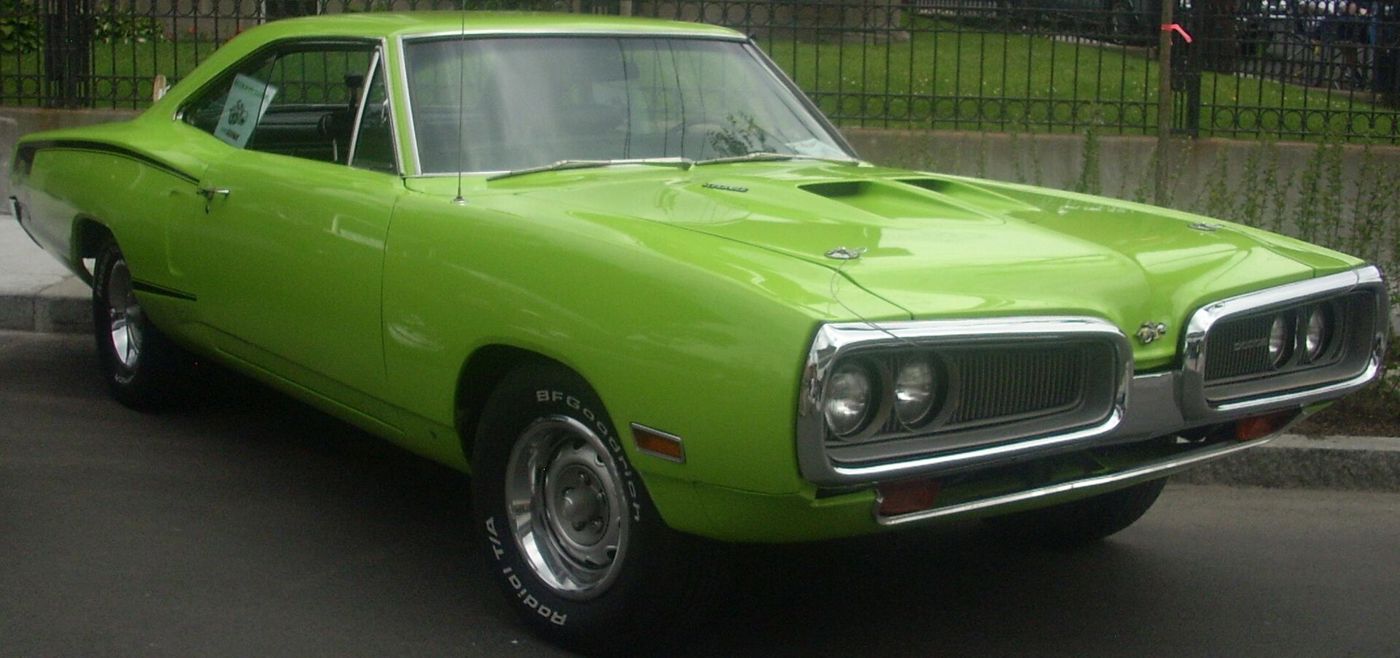

Dodge photographed the 1970 Coronet R/T for its brochure on the grass beside a drag strip. Behind the lime-green hardtop, a Dick Landy race Dodge sits with its hood up, and the circular headline advises: "if you pay more money... make sure you get more car." The copy promises scoops on the hood and rear quarters, bucket seats and carpet, "an uneasy 440 Magnum," TorqueFlite or a Hurst-shifted four-speed at no extra cost, and the Rallye suspension. Then it signs off with a wink: "Tell your mother it's a nice old man's car." It was the R/T's last brochure. The two-door Coronet itself would not return for 1971.1
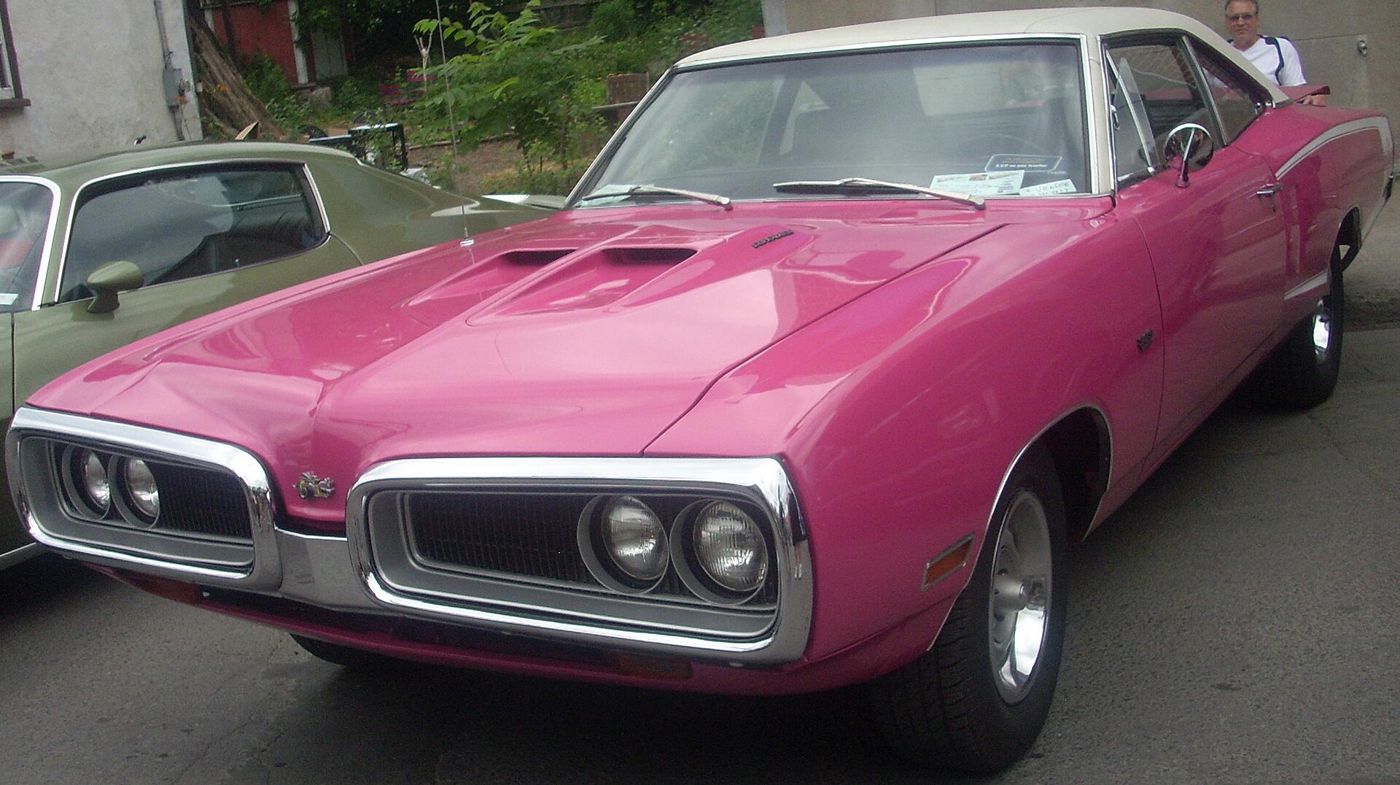
The 1970 Coronet wore a new face. A completely new front fascia had the bumper forming part of the grille, and Dodge's brochure pictures show it as two chrome loops, each framing a pair of headlamps. The R/T remained the high-performance version of the Coronet 500 series, offered only as a two-door hardtop or convertible, with all-vinyl front buckets and bumblebee stripes across the trunk lid. 1970 would also be the last year for any Dodge convertible until the mid-1980s. That makes the rare R/T convertible the end of a longer line than its own nameplate.2
The cheaper car got the livelier sales pitch. Dodge's Super Bee spread was shot on a beach with surfboards and a fire, under the line "it drives you right out of the high-rent district." Standard equipment was the 383 Magnum, the Rallye suspension, the Charger instrument panel and, new for 1970, a full-synchro three-speed manual with a floor shift; the four-speed and the TorqueFlite were at extra cost "if you insist." The copy called out the optional Six Pack 440 "with the nasty hood" and urged buyers to order one of the new high-impact colors: Plum Crazy, Sublime, Banana, Go-Mango and Hemi Orange, each optional at extra cost.2

Dodge's advertised ratings stack up in a neat ladder. The Super Bee's 383 was rated at 335 horsepower at 5,200 rpm and 425 lb-ft at 3,400. The R/T's standard 440 Magnum was rated at 375 horsepower at 4,600 rpm and 480 lb-ft at 3,200. The 440 Six Pack, three two-barrels on the same big block, was listed at 390 horsepower at 4,700 rpm and 490 lb-ft at 3,200, and it cost $375 on the Coronet and Super Bee. The 426 Hemi topped the chart at 425 horsepower at 5,000 rpm and 490 lb-ft at 4,000.2
The brochure's promises did not translate into R/T sales. Coronet R/T production ran from 10,849 cars in 1968 to 7,238 in 1969 and just 2,615 in 1970, so the final year sold roughly a quarter of the 1968 total. Those 2,615 split into 2,319 hardtops at $3,569 and 296 convertibles at $3,785. Only 13 of the 1970 cars had the Hemi, a $718 option in the R/T. Charger R/T production reached 18,400 for the same year, a hint of where the buyer who wanted a 440 and some posh was signing.3,4,2
The Super Bee fell too, though from a much greater height. The Super Bee Registry records 10,507 hardtops and 3,630 coupes for 1970, 14,137 cars counting its Canada-export Hemi rows. Its 1969 tables had shown 18,361 US hardtops and 8,202 US coupes, so the Bee lost nearly half its volume in a year. Over-Drive's production summary prints a different figure, 11,540 two-door Super Bees, and neither source says where its number comes from. On either count, the Super Bee outsold the R/T by more than four to one.5,2,3
The registry's engine and transmission rows show how most Bees were actually bought. Among hardtops, 5,737 had the 383 and an automatic, 3,383 the 383 and a four-speed, and 284 the new three-speed; among coupes the same three rows read 1,710, 1,336 and 385. The advertised three-speed therefore went into 669 of 14,137 cars, under 5 percent. The Six Pack found 1,072 hardtop buyers, 599 of them with four-speeds, and 196 coupe buyers, about 9 percent of the total. US Hemi Super Bees numbered 36, 32 hardtops and four coupes, with six more exported to Canada. The registry lists no automatic Hemi coupe at all.5
The brochure also called the Six Pack new, which was only half true. The Super Bee Registry's 1969 tables already count 1,487 Six Pack hardtops, 661 automatics and 826 four-speeds, so the three-carburetor 440 had arrived the year before; for 1970 it was simply part of the regular option list at $375. Its count shrank with the car, to 1,072 hardtops in 1970. The same registry shows US Hemi hardtops falling from 165 in 1969, 73 automatics and 92 four-speeds, to 32 in 1970. Fewer buyers were paying for the most extreme versions of Dodge's cheapest muscle car, even as the Six Pack held roughly one hardtop in ten.5,2
The Landy car in the R/T photograph pointed toward where Dodge's drag-racing energy was going. The first Pro Stock race, run at the 1970 Winternationals, drew a field of five Hemi Plymouths, five big-block Camaros, three overhead-cam Ford Mavericks and three Hemi Dodges. "Dandy Dick" Landy, the 1969 Winternationals Street champion, drove a Challenger whose 426 Hemi fired through two distributors and 16 spark plugs. He won a round at 10.21 seconds, then red-lighted against Bill Jenkins, whose Camaro went on to beat Ronnie Sox's Barracuda in the final. Dodge's new pony car, not the Coronet, carried the flag.6
The consequence arrived with the 1971 catalog. The Charger coupe and hardtop replaced the Coronet two-door models for 1971, and the Super Bee moved with them onto the Charger body. The R/T badge already lived on the Charger, which had built 18,400 R/Ts in 1970; on the Coronet it ended with those 2,615 cars. What 1970 leaves behind is a pair of very different last chapters: a posh R/T that 2,615 people bought, and a stripped Super Bee whose buyers, overwhelmingly, took the 383 and ordered the color. By Dodge's own brochure, that was precisely the car built to leave the high-rent district.1,5,3
Fact sheet · 1970 · United States
The numbers
1970 Dodge Coronet R/T and Super Bee: The final Coronet-based R/T and Super Bee: the R/T fell to 2,615 cars, while the Super Bee added a 3-speed manual and kept its Six Pack and Hemi options.
Figures may describe different groups of cars. Add rows together only when the note says they make up a total.
Key facts
- Coronet R/T: 2,615 (13 with the Hemi, per Cheetham).3,4
- Super Bee: 10,507 hardtops and 3,630 coupes (registry totals, including Canada-export Hemi rows).5
- The 1970 Coronet brochure prints 18 exterior colours with full codes, five of them extra-cost (Plum Crazy FC7, Sublime FJ5, Go-Mango EK2, Hemi Orange EV2, Banana FY1); the 383 Magnum is standard on Super Bee and the 440 Magnum on Coronet R/T.
Production
| What was counted | Built |
|---|---|
| Coronet R/T, all bodies3,4 Coronet R/T · hardtop and convertible | 2,615 |
| Super Bee, all bodies (Over-Drive)2 Super Bee · coupe and hardtop | 15,506 |
| Coronet (base series), rounded2 Coronet · 2-door and 4-door sedan, 4-door station wagon | 14,566 |
| Coronet 440 (all bodies), rounded2 Coronet 440 · 2-door and 4-door sedan, 2-door hardtop, 4-door station wagon | 66,571 |
| Coronet 500 (all bodies), rounded2 Coronet 500 · 2-door hardtop, convertible, 4-door sedan, 4-door station wagon | 15,497 |
| What was counted | Built |
|---|---|
| Coronet R/T, 426 Hemi4 Coronet R/T · hardtop and convertible · 426 Hemi 2x4-bbl | 13 |
| What was counted | Count | Counted as |
|---|---|---|
| Super Bee hardtop (WM23), total5 Super Bee · 2-door hardtop · US and Canada export | 10,507 | delivered |
| Super Bee coupe (WM21), total5 Super Bee · 2-door coupe · US and Canada export | 3,630 | delivered |
| Coronet R/T 2-door hardtop (WS-23)2 R/T · 2-door hardtop | 2,319 | built |
| Coronet R/T convertible (WS-27)2 R/T · convertible | 296 | built |
| Super Bee 2-door coupe (WM-21), Over-Drive2 Super Bee · 2-door coupe | 3,966 | built |
| Super Bee 2-door hardtop (WM-23), Over-Drive2 Super Bee · 2-door hardtop | 11,540 | built |
| What was counted | Count | Counted as |
|---|---|---|
| Super Bee hardtop, 383, automatic5 Super Bee · 2-door hardtop · 383 4-bbl · 3-speed automatic · US | 5,737 | delivered |
| Super Bee hardtop, 383, 4-speed5 Super Bee · 2-door hardtop · 383 4-bbl · 4-speed manual · US | 3,383 | delivered |
| Super Bee hardtop, 383, 3-speed manual5 Super Bee · 2-door hardtop · 383 4-bbl · 3-speed manual · US | 284 | delivered |
| Super Bee hardtop, 440 Six Pack, automatic5 Super Bee · 2-door hardtop · 440 3x2-bbl · 3-speed automatic · US | 473 | delivered |
| Super Bee hardtop, 440 Six Pack, 4-speed5 Super Bee · 2-door hardtop · 440 3x2-bbl · 4-speed manual · US | 599 | delivered |
| Super Bee hardtop, 426 Hemi, automatic5 Super Bee · 2-door hardtop · 426 Hemi 2x4-bbl · 3-speed automatic · US | 11 | delivered |
| Super Bee hardtop, 426 Hemi, 4-speed5 Super Bee · 2-door hardtop · 426 Hemi 2x4-bbl · 4-speed manual · US | 21 | delivered |
| Super Bee coupe, 383, automatic5 Super Bee · 2-door coupe · 383 4-bbl · 3-speed automatic · US | 1,710 | delivered |
| Super Bee coupe, 383, 4-speed5 Super Bee · 2-door coupe · 383 4-bbl · 4-speed manual · US | 1,336 | delivered |
| Super Bee coupe, 383, 3-speed manual5 Super Bee · 2-door coupe · 383 4-bbl · 3-speed manual · US | 385 | delivered |
| Super Bee coupe, 440 Six Pack, automatic5 Super Bee · 2-door coupe · 440 3x2-bbl · 3-speed automatic · US | 87 | delivered |
| Super Bee coupe, 440 Six Pack, 4-speed5 Super Bee · 2-door coupe · 440 3x2-bbl · 4-speed manual · US | 109 | delivered |
| Super Bee coupe, 426 Hemi, 4-speed5 Super Bee · 2-door coupe · 426 Hemi 2x4-bbl · 4-speed manual · US | 4 | delivered |
| What was counted | Count | Counted as |
|---|---|---|
| Super Bee hardtop, 426 Hemi, Canada export5 Super Bee · 2-door hardtop · 426 Hemi 2x4-bbl · Canada | 2 | delivered |
| Super Bee coupe, 426 Hemi, Canada export5 Super Bee · 2-door coupe · 426 Hemi 2x4-bbl · Canada | 4 | delivered |
| What was counted | Built |
|---|---|
| 1970 Dodge mid-size line, all series (Coronet, 440, 500, R/T, Super Bee and Charger combined)2 all 1970 Dodge Coronet and Charger | 172,586 |
Prices when new
| Model | Price | Price type |
|---|---|---|
| Base price, Coronet R/T 2-door hardtop (WS-23)2 | $3,569 | base price, 1970 model year |
| Base price, Coronet R/T convertible (WS-27)2 | $3,785 | base price, 1970 model year |
| Base price, Super Bee 2-door coupe (WM-21)2 | $3,012 | base price, 1970 model year |
| Base price, Super Bee 2-door hardtop (WM-23)2 | $3,074 | base price, 1970 model year |
Prices are the nominal dollars of the day, not adjusted for inflation.
Engines
| Engine | Factory rating | Availability |
|---|---|---|
| 383 V-85,7 383 cu in · 4-barrel | 335 hp @ 5,200, 425 lb-ft @ 3,400 (SAE gross (AMA 'publishing max bhp', 383 Hi-Perf)) | standard on Super Bee |
| 440 Six Pack V-85,7 440 cu in · three 2-barrel | 390 hp @ 4,700, 490 lb-ft @ 3,200 (SAE gross (AMA 'publishing max bhp')) | Super Bee option |
| 426 Hemi V-85,4,7 426 cu in · two 4-barrel | 425 hp @ 5,000, 490 lb-ft @ 4,000 (SAE gross (AMA 'publishing max bhp')) | optional on R/T and Super Bee |
| 440 Magnum 4-bbl V-87,2 440 cu in · 4-barrel | 375 hp @ 4,600, 480 lb-ft @ 3,200 (SAE gross (AMA 'publishing max bhp', 440 Hi-Perf)) | standard on Coronet R/T; optional on Super Bee |
Ratings are published figures, not dyno results. Gross and net ratings aren't directly comparable.
Transmissions
| Transmission | Availability |
|---|---|
| 3-speed manual5 | Super Bee with 383 (first listed for 1970 in the registry tables) |
Options and packages
| Option | Price |
|---|---|
| 426 Street Hemi V-8, in Coronet Super Bee2 | $848 |
| 426 Street Hemi V-8, in Coronet R/T2 | $718 |
| 440 cu in 390 hp Six Pack V-8, in Coronet R/T and Super Bee2 | $375 |
| 440 cu in 375 hp Magnum V-8, in Super Bee2 | $250 |
| 4-speed manual with Hurst shifter (383 4-bbl, 440, 440 Six Pack and 426 Hemi only)2 | |
| Air conditioning2 | $361 |
| AM radio with 8-track tape2 | $196 |
| White sidewall tyres2 | $34 |
Paint
| Code | Color |
|---|---|
A4 |
Silver2 |
A9 |
Dark Gray2 |
J6 |
Green Go2 |
M3 |
Panther Pink2 |
Q3 |
Light Turquoise2 |
R6 |
Red2 |
R8 |
Burgundy2 |
T3 |
Tan2 |
Y1 |
Bright Yellow2 |
Y6 |
Gold2 |
FC7 |
Plum Crazy (extra cost) |
FJ5 |
Sublime (extra cost) |
EK2 |
Go-Mango (extra cost) |
EV2 |
Hemi Orange (extra cost) |
FY1 |
Banana (extra cost) |
EB3 |
Light Blue Metallic |
EB5 |
Bright Blue Metallic |
EB7 |
Dark Blue Metallic |
FE5 |
Bright Red |
FF4 |
Light Green Metallic |
EF8 |
Dark Green Metallic |
FK5 |
Dark Burnt Orange Metallic |
BL1 |
Beige |
FT6 |
Dark Tan Metallic |
EW1 |
White |
TX9 |
Black |
DY3 |
Cream |
FY4 |
Light Gold Metallic |
Color names are the factory's. We don't show color swatches, because a screen color is no guide for a restoration.
Interiors
| Trim |
|---|
| All-vinyl front bucket seats (standard on Coronet 500 and R/T hardtops and R/T convertibles) |
| All-vinyl full-width front bench seat (standard on most models, including Super Bee) |
Specifications
| Measure | Value | Applies to |
|---|---|---|
| Curb weight, Super Bee 2-door sedan (coupe), with automatic7 | 3,665 lb | Super Bee WM21 |
| Curb weight, Super Bee 2-door hardtop, with automatic7 | 3,700 lb | Super Bee WM23 |
| Curb weight, Coronet R/T 2-door hardtop, with automatic7 | 3,710 lb | Coronet R/T WS23 |
| Curb weight, Coronet R/T convertible, with automatic7 | 3,855 lb | Coronet R/T WS27 |
| Curb-weight addition, 4-speed manual7 | 37 (Super Bee) / 103 (R/T) lb | versus automatic |
| Shipping weight, Super Bee coupe / hardtop (Over-Drive table)2 | 3,425 / 3,390 lb | WM-21 / WM-23 |
| Shipping weight, Coronet R/T hardtop / convertible (Over-Drive table)2 | 3,573 / 3,638 lb | WS-23 / WS-27 |
Identification
- Style codes
- The AMA specification lists the 1970 Super Bee as WM21 (coupe) and WM23 (hardtop) and the Coronet R/T as WS23 (hardtop) and WS27 (convertible).7
Where the sources disagree
Identification
Read a 1970 Dodge VIN
The VIN decoder runs in your browser and never sends the VIN anywhere. How the factory numbered this year's cars:
Same model year
Also in 1970
- AMC AMX The last two-seat AMX: a restyled nose, a 360 base V8 and a 325-hp 390. At 4,116 cars it was the rarest of the three two-seat years.
- AMC Javelin Penske and Donohue brought the Javelin to Trans-Am, and the showroom answered with 2,501 Mark Donohue Javelins and 100 red-white-blue Trans Am Javelins, while total production fell to 28,210.
- AMC Rebel and Rebel Machine AMC's intermediate supercar: a 340-hp 390, four-speed and Hurst shifter in the Rebel hardtop, first in white with red-white-blue stripes. Totals reported for the one-year run range from about 1,200 to 2,326.
- Buick Riviera The 455 (370 hp gross) arrived with a restyle; production fell to about 37,300 with some 3,505 GS cars.
- Buick Skylark Gran Sport, GS and GSX Buick's GS went to a 455 rated at 510 lb-ft, the Stage 1 option added 10 advertised hp, and a mid-year GSX package was built 678 times in two colors.
- Buick Wildcat The final Wildcat, Custom trim only, with the 370-hp 455; 23,645 built.
- Chevrolet Chevelle and Malibu SS The year the Chevelle Super Sport split into RPO Z25 SS 396 and RPO Z15 SS 454, with the LS6 454 rated at 450 gross horsepower.
- Chevrolet Chevy II and Nova Last year the source engine table lists the big-block (as 402) in the Nova. Enthusiast-compiled production: 307,280 cars; Super Sport 19,558.
- Chevrolet El Camino SS The Malibu/Custom El Camino could carry RPO Z25 SS 396 or RPO Z15 SS 454, including the 450 hp LS6; 8,773 Z15s across Malibu models.
- Chevrolet Monte Carlo SS The first Monte Carlo, with the SS 454 as RPO Z20: 3,823 of 145,976 Monte Carlos per Chevrolet-report-derived tables.
- Dodge Challenger Dodge's first pony car arrived as a 1970 model with nine advertised engines, base, SE, R/T, and R/T SE hardtops, two convertibles, and a one-year Trans-Am homologation special, the T/A.
- Dodge Charger The last year of the second-generation body: a new full-width grille, three series (Charger, 500, R/T), the 440 Six Pack added to the R/T, and production roughly half of 1969's.
- Dodge Dart GTS, Swinger and Demon With the GTS gone, the Swinger 340 was the only performance Dart; it kept front discs, Rallye suspension and a twin-scoop hood and sold about 13,800 beside the new Challenger.
- Ford Fairlane The last Fairlane year: the name survived only on the Fairlane 500 beneath the new Torino, with a mid-year Falcon sharing the body at the bottom of the range.
- Ford Maverick Grabber The $179 Grabber package of stripes, a spoiler and a blacked-out grille arrived mid-1970 on the new two-door Maverick.
- Ford Ranchero GT The Torino-based Ranchero GT could take the 429 Cobra Jet and Super Cobra Jet; reference counts give 3,905 GTs, while Barn Finds rounds the GT figure to about 3,600 of 21,640 Rancheros.
- Ford Thunderbird The 429 at 360 hp was the standard and only engine listed in the 1970 catalog.
- Ford Torino A new, longer body on a 117-inch wheelbase; the Torino Cobra became its own model with the 429, offered in 360, 370 (Cobra Jet) and 375 (Super Cobra Jet) horsepower forms.
- Mercury Comet and Cyclone A new, longer Montego-based Cyclone in three versions: the 429 Cyclone, the small-block Cyclone GT that outsold both others, and the Ram Air 429 Cobra Jet Cyclone Spoiler.
- Mercury Cougar The last first-generation Cougar moved to the 351 Cleveland, kept the Boss 302 as an Eliminator-only engine, and built 2,268 Eliminators.
- Mercury Marauder and S-55 The second and last year of the 1969-70 Marauder: production fell to about a third of 1969's, with the X-100 near half of it.
- Oldsmobile Cutlass, 4-4-2 and Hurst/Olds The 4-4-2 got a standard 455 rated at 365 hp, the W-30 went to 370 hp, and the small-block W-31 moved to the Cutlass and F-85 coupes.
- Plymouth Barracuda and 'Cuda The E-body redesign split the line into Barracuda, Gran Coupe, and 'Cuda hardtops and convertibles, put every Chrysler performance engine through the 426 Hemi on the order form, and added the one-year AAR 'Cuda for Trans-Am homologation.
- Plymouth Duster 340 and 360 Plymouth's new Valiant-based fastback coupe arrived with a 275 hp 340 performance model at $2,547; 24,817 Duster 340s among 217,192 Dusters.
- Plymouth GTX, Belvedere and Satellite Now hardtop-only, the GTX fell to 7,748 cars while its 440 Six Barrel option cost just $119.
- Plymouth Road Runner Production halved from 1969, the 440 Six Barrel became a regular option, and the winged Superbird was built as a Road Runner hardtop to put Plymouth back on NASCAR superspeedways.
- Pontiac Firebird and Trans Am A late-arriving, coupe-only second generation: 48,739 Firebirds, 3,196 of them Trans Ams, and 88 Ram Air IVs.
- Pontiac GTO A new Endura nose, a 455 added beside the three 400s, and GTO production falling to 40,149.
- Pontiac Grand Prix The SJ took a 370 hp 455, Hurst built the SSJ, and production fell to 65,750.
- Pontiac Tempest and LeMans The T-37 and GT-37 bring budget performance to the Tempest.