1970 · Chevrolet · United States
1970 Chevrolet Monte Carlo SS 454: A Big Block in a Tailored Suit
The first Monte Carlo, with the SS 454 as RPO Z20: 3,823 of 145,976 Monte Carlos per Chevrolet-report-derived tables.
United States · researched through 2026-09-22
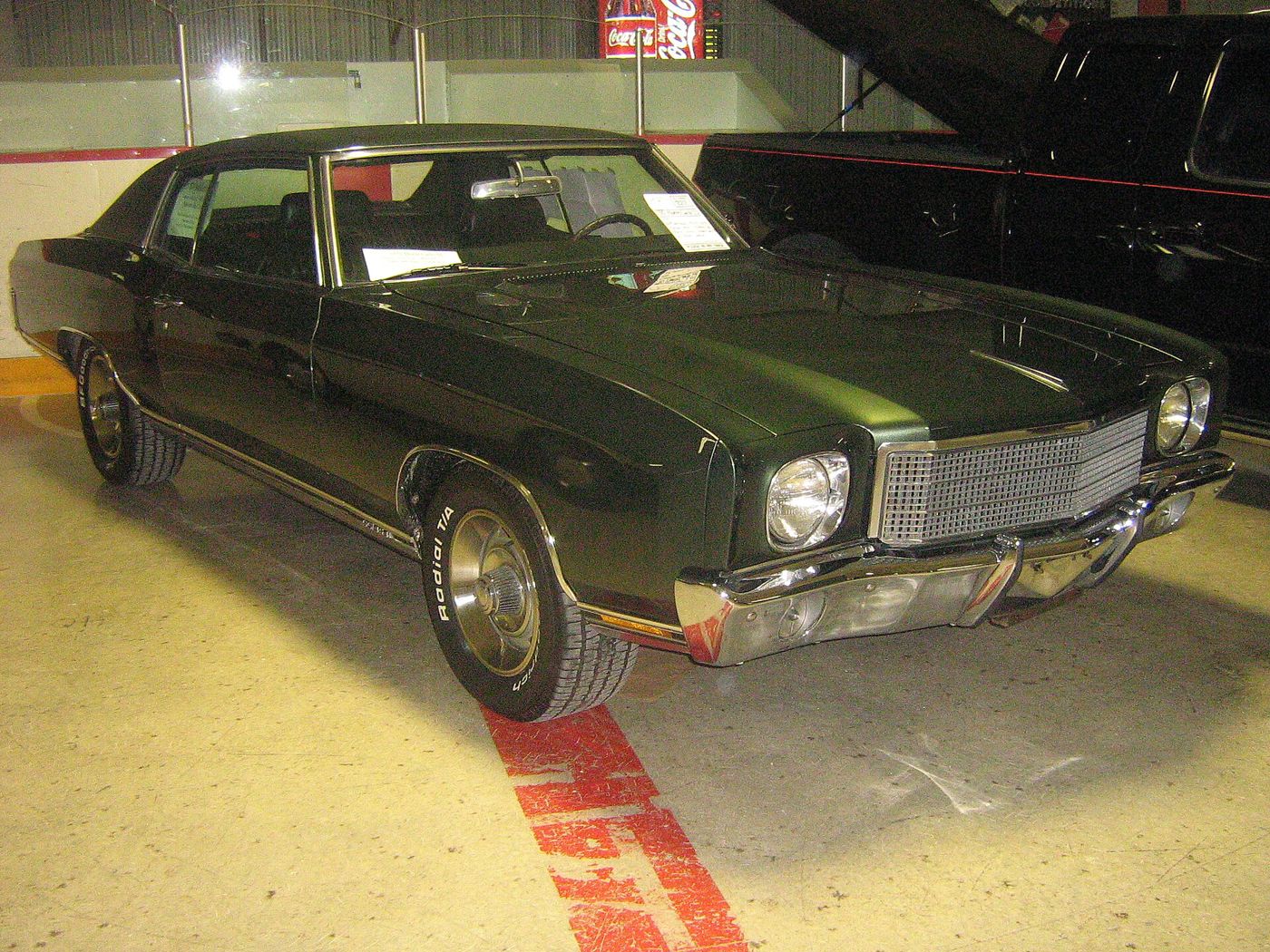
When Chevrolet put the Monte Carlo on sale on September 18, 1969, the man running the division had not built it. John Z. DeLorean had been promoted from Pontiac to Chevrolet the previous February, and Mac's Motor City Garage notes that the new personal-luxury coupe was already finished by the time he arrived. The irony runs deeper than timing. At Pontiac, DeLorean had directed the development of the Grand Prix, the Monte Carlo's corporate sibling. His first new car at Chevrolet was therefore a cheaper cousin of the car he had just left behind, sharing its long-hood proportions and, as the next year's figures would show, competing for the same buyers.1,2
The idea was older than DeLorean's tenure. Ate Up With Motor traces it to Pete Estes, who came over from Pontiac to replace Bunkie Knudsen as Chevrolet general manager in July 1965 and pushed for a personal Chevrolet to take on Ford's Thunderbird. Dave Holls, then group chief designer for Chevrolet, and designer Terry Henline, a Fisher Body Craftsman's Guild finalist, produced the shape, with Henline using the Cadillac Eldorado as what the history calls a loose conceptual starting point. Inside General Motors the program was known as the C-Bird, a name Mac's Motor City Garage reads as an obvious nod to the Thunderbird, and it credits the final design to Bill Mitchell's organization with Holls as advanced studio chief.3,1
The engineering trick was a stretch in exactly the right place. Instead of the 112-inch A-body coupe chassis, Chevrolet started from the 116-inch sedan and wagon platform, and the Monte Carlo rode a special version of the four-door frame with the extra four inches of wheelbase inserted ahead of the firewall. All of it went into hood. At 205.8 inches overall, the car was 8.6 inches longer than a Chevelle or Malibu coupe. Wikipedia describes a grille of 720 small chromed squares under a thin hood spear. There was one body, a two-door hardtop sport coupe, style 13857; Mac's reports that a convertible was considered but never approved.3,1,2,4
Price was the weapon. The base car listed at $3,123 with a 250-horsepower 350 two-barrel V8 and power front disc brakes. Wikipedia puts that $218 above a comparable Chevelle Malibu; Ate Up With Motor, comparing a similarly equipped Malibu hardtop, says about $200, and points out that the discs still cost extra on most Chevelles. The rivals lived in another bracket. The same history says the Thunderbird started around $5,000 and seldom left a showroom for less than $6,000, while the Grand Prix started just under $4,000; Pontiac's compiled 1969 table lists the Grand Prix hardtop at $3,866. Automatic, power steering and a radio, almost always ordered, took most Monte Carlos to at least $3,600.1,2,3,5
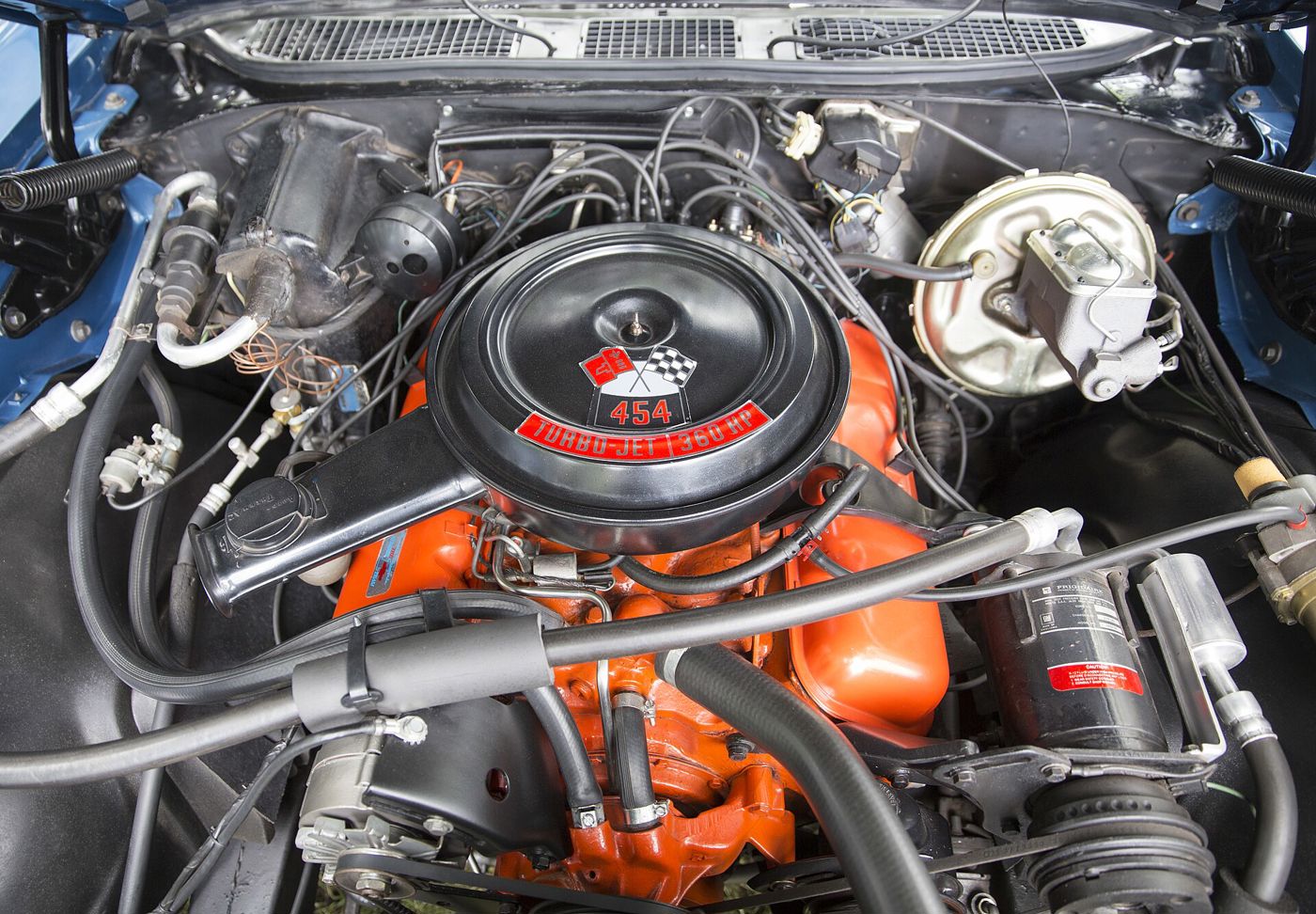
Above the base engine the ladder had four more rungs, all gross ratings: a 300-horsepower 350 four-barrel, a 265-horsepower 400 two-barrel, a 330-horsepower 402 four-barrel, and at the top RPO Z20, the Monte Carlo SS, at $420.25. The SS could not be ordered without the 454, rated at 360 horsepower and 500 lb-ft. ChevelleStuff's engine table puts the power peak at 4,400 rpm and Wikipedia's Monte Carlo account at 4,800, and neither lineage settles it. Wikipedia lists the package as the 454 with heavy-duty suspension, wider wheels and tires, SS 454 badging and automatic load-leveling rear suspension: a luxury-car feature bolted to a big-block option.4,2,3
The order books show how few buyers took the invitation. ChevelleStuff.net, which attributes its quantities to Chevrolet's accumulative production and final model-year reports, lists 145,976 Monte Carlos built for 1970 and 3,823 with RPO Z20. That is about 2.6 percent of the year's Monte Carlos, roughly one in 38. Ate Up With Motor's explanation is the mandatory engine: about half of all Monte Carlo buyers were content with the mild base V8, and the SS option, in its words, 'was not particularly successful.' The Chevelle's own SS 454 package, RPO Z15 at $503.45, went into 8,773 cars in the same reports, 4,475 of them with the 450-horsepower LS6.4,3
The numbers also explain why the SS 454 was a different animal from the Chevelle that shared its engine. Ate Up With Motor says the Monte Carlo SS weighed about 150 pounds more than a comparably equipped Chevelle, which left it with ample performance but no match for the hottest supercars of the day. It cost less to order, though: Z20's $420.25 undercut the Chevelle's Z15 by $83.20, and the Monte Carlo already carried front discs as standard. What the buyer got for the money was the 454 in the longest-hooded Chevrolet intermediate, with self-leveling at the rear and a list price that stayed within reach of a Malibu buyer.3,4,2
Labor trouble cut into the first year. Wikipedia says a strike at Flint, Michigan held first-year sales to 159,341 against a projected 185,000, while Mac's Motor City Garage gives first-year sales of more than 130,000. Those are sales figures, and sources disagree on them; neither should be mistaken for production. ChevelleStuff's 145,976 is a build count, and it comes from three plants only, Baltimore, Flint and Van Nuys, with no Monte Carlos listed as built at Atlanta, at Kansas City or in Canada for 1970. The build count sits between the two sales claims, and all three are kept with their basis.2,1,4
Pontiac felt the Monte Carlo at once. The compiled Pontiac tables record 112,486 Grand Prix hardtops for 1969 and 65,750 for 1970, a fall of about 42 percent, which matches Mac's report that Grand Prix sales dropped nearly 42 percent. Ate Up With Motor concludes that Chevrolet appears to have poached a fair number of Grand Prix sales. Build counts and sales are different measures, so the match is suggestive rather than exact. Either way, the car DeLorean had championed at Pontiac lost more than 46,000 units in the first year of the Chevrolet he inherited.5,6,1,3,1
The long hood mattered beyond the showroom. Wikipedia notes that the 116-inch wheelbase sat one inch above NASCAR's minimum at the time, and that from 1972 the Monte Carlo became Chevrolet's NASCAR standard-bearer through 1989, chosen for that wheelbase and a long hood that helped weight distribution. Ate Up With Motor counts seven NASCAR manufacturers' championships won for Chevrolet by Monte Carlos between 1972 and 1979. The 1970 SS 454 was not a race car and never pretended to be one, but the proportions its designers stretched for style were the ones the stock-car builders later wanted.2,3
The SS 454 got one more year. ChevelleStuff's 1971 tables record 1,919 Z20 cars among 128,600 Monte Carlos, after which the package was dropped; the two years together come to 5,742, consistent with Ate Up With Motor's 'fewer than 6,000 buyers.' The Monte Carlo itself went on to close to half a million first-generation sales by that history's count. In 1970 the big block was the rarest way to buy Chevrolet's new coupe, fitted to about one car in 38, and it remains the version that best shows what the C-Bird was: a Grand Prix idea at a Chevrolet price, with a Chevelle engine under the longest hood the division could justify.7,3,4
Fact sheet · 1970 · United States
The numbers
1970 Chevrolet Monte Carlo SS 454 — The first Monte Carlo, with the SS 454 as RPO Z20: 3,823 of 145,976 Monte Carlos per Chevrolet-report-derived tables.
Coverage: Partial — researched sections are shown; missing ones are not yet sourced. Researched through 2026-09-22.
Every figure is labeled with how sure we are. Reported means a manufacturer, registry, or reference figure we cite but have not reconciled against factory records ourselves. Disputed means credible sources disagree and both are shown. Rows are separately scoped; don't add them together unless the note says they make up a total.
Key facts
Production
| What was counted | Count | Basis | Status |
|---|---|---|---|
| Monte Carlo 2-door coupe, style 138574 2-door sport coupe · US plants (Baltimore, Flint, Van Nuys) | 145,976 | built, model-year | Reported |
| What was counted | Count | Basis | Status |
|---|---|---|---|
| RPO Z20 Monte Carlo SS (SS 454)4,4,2 SS 454 · 2-door sport coupe · 454 V8 · US plants ChevelleStuff and Wikipedia agree; their lineages are not shown to be independent. | 3,823 | built, model-year | Reported |
| What was counted | Count | Basis | Status |
|---|---|---|---|
| RPO L65 350/250 2-bbl (Monte Carlo 13857 applicability)4 L65 · US plants Source applicability text reads "13857 - 06/12"; the quantity may not be Monte Carlo-only. | 112,686 | built, model-year | Reported |
| RPO LF6 400/265 2-bbl (Monte Carlo 13857 applicability)4 LF6 · US plants Applicability text "13857 - 01/70". | 16,595 | built, model-year | Reported |
Chevelle-wide option quantities on the same page (e.g., M40, G80) are not restated here because they are not Monte Carlo-scoped.
The GM Heritage 1970 Monte Carlo vehicle information kit is the best missing primary source (gm.com returned 403).
Paint codes are those the reference marks as available on the Monte Carlo; its paint counts cover the whole Chevelle line and are not shown here as Monte Carlo counts.
Prices when new
| Model | Price | Basis |
|---|---|---|
| Base price, Monte Carlo 2-door coupe (13857)4,2 | $3,123 | manufacturer suggested retail, 1970 |
| RPO Z20 Monte Carlo SS option4 | $420.25 | retail option price (Options and Accessories price sheet, April 1, 1970, per source), 1970-04-01 |
Prices are the nominal dollars of the day, not adjusted for inflation.
Engines
| Engine | Factory rating | Availability | Built |
|---|---|---|---|
| LS5 · 454 V8 (Z20 SS 454)4,2 454 cu in · 4-barrel | 360 hp @ 4,400, 500 lb-ft @ 3,200 (SAE gross) | standard with Z20 | Not yet sourced |
| L65 · 350 V8 2-bbl4 350 cu in · 2-barrel | 250 hp @ 4,800, 345 lb-ft @ 2,800 (SAE gross) | optional | Not yet sourced |
| L48 · 350 V8 4-bbl4,2 350 cu in · 4-barrel | 300 hp @ 4,800, 380 lb-ft @ 3,200 (SAE gross) | optional | Not yet sourced |
| LF6 · 400 V8 2-bbl2 400 cu in · 2-barrel | 265 hp @ 4,800, 400 lb-ft @ 3,800 (SAE gross) | optional | Not yet sourced |
| LS3 · 402 V8 4-bbl4,2 402 cu in · 4-barrel | 330 hp @ 4,800, 410 lb-ft @ 3,200 (SAE gross) | optional | Not yet sourced |
Ratings are the manufacturer's advertised figures under the standard shown (SAE gross before 1972, SAE net after). They are not dyno results, and gross and net ratings can't be compared directly.
Options and packages
| Code | Option | Price | Installed |
|---|---|---|---|
Z20RPO |
Monte Carlo SS (SS 454)4 | $420.25 | 3,8234 Reported |
LF6RPO |
400 V8 2-bbl 265 hp4 | $63.20 | 16,5954 Reported |
L65RPO |
350 V8 2-bbl 250 hp4 | $47.40 | 112,6864 Reported |
ZJ7RPO |
Special wheel, hub cap and trim ring (13857 - 06/70)4 | $35.85 | 90,0174 Reported |
Paint
| Code | Color | Built |
|---|---|---|
10 (930) |
Classic White4 | Not yet sourced |
14 (931) |
Cortez Silver4 | Not yet sourced |
17 (932) |
Shadow Gray4 | Not yet sourced |
19 (933) |
Tuxedo Black4 | Not yet sourced |
25 (935) |
Astro Blue4 | Not yet sourced |
28 (937) |
Fathom Blue4 | Not yet sourced |
34 (938) |
Misty Turquoise4 | Not yet sourced |
45 (941) |
Green Mist4 | Not yet sourced |
48 (942) |
Forest Green4 | Not yet sourced |
50 (943) |
Gobi Beige4 | Not yet sourced |
55 (946) |
Champagne Gold4 | Not yet sourced |
58 (947) |
Autumn Gold4 | Not yet sourced |
63 (949) |
Desert Sand4 | Not yet sourced |
75 (952) |
Cranberry Red4 | Not yet sourced |
78 (953) |
Black Cherry4 | Not yet sourced |
25-10 |
Two-tone Astro Blue lower / Classic White upper | Not yet sourced |
34-10 |
Two-tone Misty Turquoise lower / Classic White upper | Not yet sourced |
25-28 |
Two-tone Astro Blue lower / Fathom Blue upper | Not yet sourced |
28-25 |
Two-tone Fathom Blue lower / Astro Blue upper | Not yet sourced |
55-10 |
Two-tone Champagne Gold lower / Classic White upper | Not yet sourced |
58-10 |
Two-tone Autumn Gold lower / Classic White upper | Not yet sourced |
63-10 |
Two-tone Desert Sand lower / Classic White upper | Not yet sourced |
vinyl black |
Vinyl roof, black (all colours) | Not yet sourced |
vinyl white |
Vinyl roof, white (all colours) | Not yet sourced |
vinyl dark blue |
Vinyl roof, dark blue (10, 14, 25, 28) | Not yet sourced |
vinyl dark green |
Vinyl roof, dark green (10, 45, 48) | Not yet sourced |
vinyl dark gold |
Vinyl roof, dark gold (55, 58, 50) | Not yet sourced |
Color names are the factory's. We don't show color swatches, because a screen color is no guide for a restoration.
Interiors
| Code | Trim | Built |
|---|---|---|
748 |
Black Prima Cloth4 | Not yet sourced |
757 |
Black Coated Fabric4 | Not yet sourced |
767 |
Dark Blue Prima4 | Not yet sourced |
769 |
Antique Medium Saddle Coated Fabric4 | Not yet sourced |
774 |
Medium Gold Riano Cloth4 | Not yet sourced |
778 |
Antique Medium Saddle Pattern Coated Fabric4 | Not yet sourced |
780 |
Dark Green Prima Cloth4 | Not yet sourced |
784 |
Metallic Dark Green Coated Fabric4 | Not yet sourced |
785 |
Metallic Dark Green Pattern Coated Fabric4 | Not yet sourced |
792 |
Medium Sandalwood Riano Cloth4 | Not yet sourced |
748 |
Bench seat, knitcloth, black | Not yet sourced |
780 (kit) |
Bench seat, knitcloth, dark green | Not yet sourced |
767 (kit) |
Bench seat, knitcloth, dark blue | Not yet sourced |
758 (kit) |
Bench seat, cloth, blue | Not yet sourced |
774 (kit) |
Bench seat, cloth, gold | Not yet sourced |
792 (kit) |
Bench seat, cloth, sandalwood | Not yet sourced |
749 (kit) |
Bucket seats, knitcloth, black | Not yet sourced |
757 (kit) |
Bucket seats, vinyl, black | Not yet sourced |
769 (kit) |
Bucket seats, vinyl, saddle | Not yet sourced |
784 (kit) |
Bucket seats, vinyl, dark green | Not yet sourced |
Identification
- Style number
- 13857 = Monte Carlo 2-door coupe (V8 only).4
Where the sources disagree
LS5 454 peak-power rpm
Both shown; the ChevelleStuff table is the Chevelle LS5 row, Wikipedia is Monte Carlo-specific but its citation was not visible.
Identification
Read a 1970 Chevrolet VIN
The VIN decoder runs in your browser and never sends the VIN anywhere. How the factory numbered this year's cars:
Same model year
Also in 1970
- AMC AMX The last two-seat AMX: a restyled nose, a 360 base V8 and a 325-hp 390. At 4,116 cars it was the rarest of the three two-seat years.
- AMC Javelin Penske and Donohue brought the Javelin to Trans-Am, and the showroom answered with 2,501 Mark Donohue Javelins and 100 red-white-blue Trans Am Javelins, while total production fell to 28,210.
- AMC Rebel and Rebel Machine AMC's intermediate supercar: a 340-hp 390, four-speed and Hurst shifter in the Rebel hardtop, first in white with red-white-blue stripes. Totals reported for the one-year run range from about 1,200 to 2,326.
- Buick Riviera The 455 (370 hp gross) arrived with a restyle; production fell to about 37,300 with some 3,505 GS cars.
- Buick Skylark Gran Sport, GS and GSX Buick's GS went to a 455 rated at 510 lb-ft, the Stage 1 option added 10 advertised hp, and a mid-year GSX package was built 678 times in two colors.
- Buick Wildcat The final Wildcat, Custom trim only, with the 370-hp 455; 23,645 built.
- Chevrolet Chevelle and Malibu SS The year the Chevelle Super Sport split into RPO Z25 SS 396 and RPO Z15 SS 454, with the LS6 454 rated at 450 gross horsepower.
- Chevrolet Chevy II and Nova Last year the source engine table lists the big-block (as 402) in the Nova. Enthusiast-compiled production: 307,280 cars; Super Sport 19,558.
- Chevrolet El Camino SS The Malibu/Custom El Camino could carry either RPO Z25 SS 396 or RPO Z15 SS 454, including the 450 hp LS6; the El Camino share is not separately published.
- Dodge Challenger Dodge's first pony car arrived as a 1970 model with nine advertised engines, base, SE, R/T, and R/T SE hardtops, two convertibles, and a one-year Trans-Am homologation special, the T/A.
- Dodge Charger The last year of the second-generation body: a new full-width grille, three series (Charger, 500, R/T), the 440 Six Pack added to the R/T, and production roughly half of 1969's.
- Dodge Coronet R/T and Super Bee The final Coronet-based R/T and Super Bee: the R/T fell to 2,615 cars, while the Super Bee added a 3-speed manual and kept its Six Pack and Hemi options.
- Dodge Dart GTS, Swinger and Demon With the GTS gone, the Swinger 340 was the only performance Dart; it kept front discs, Rallye suspension and a twin-scoop hood and sold about 13,800 beside the new Challenger.
- Ford Fairlane The last Fairlane year: the name survived only on the Fairlane 500 beneath the new Torino, with a mid-year Falcon sharing the body at the bottom of the range.
- Ford Maverick Grabber The Grabber appearance and tire package arrived in mid-1970 on the new two-door Maverick; no Grabber count for 1970 was found.
- Ford Ranchero GT The Torino-based Ranchero GT could take the 429 Cobra Jet and Super Cobra Jet; reference counts give 3,905 GTs, while Barn Finds rounds the GT figure to about 3,600 of 21,640 Rancheros.
- Ford Thunderbird The 429 at 360 hp was the standard and only engine listed in the 1970 catalog.
- Ford Torino A new, longer body on a 117-inch wheelbase; the Torino Cobra became its own model with the 429, offered in 360, 370 (Cobra Jet) and 375 (Super Cobra Jet) horsepower forms.
- Mercury Comet and Cyclone A new, longer Montego-based Cyclone in three versions: the 429 Cyclone, the small-block Cyclone GT that outsold both others, and the Ram Air 429 Cobra Jet Cyclone Spoiler.
- Mercury Cougar The last first-generation Cougar moved to the 351 Cleveland, kept the Boss 302 as an Eliminator-only engine, and built 2,268 Eliminators.
- Mercury Marauder and S-55 The second and last year of the 1969-70 Marauder: production fell to about a third of 1969's, with the X-100 near half of it.
- Oldsmobile Cutlass, 4-4-2 and Hurst/Olds The 4-4-2 got a standard 455 rated at 365 hp, the W-30 went to 370 hp, and the small-block W-31 moved to the Cutlass and F-85 coupes.
- Plymouth Barracuda and 'Cuda The E-body redesign split the line into Barracuda, Gran Coupe, and 'Cuda hardtops and convertibles, put every Chrysler performance engine through the 426 Hemi on the order form, and added the one-year AAR 'Cuda for Trans-Am homologation.
- Plymouth Duster 340 and 360 Plymouth's new Valiant-based fastback coupe arrived with a 275 hp 340 performance model priced at $2,547; the Standard Catalog lineage counts 24,817 Duster 340s among 217,192 Dusters.
- Plymouth GTX, Belvedere and Satellite Now hardtop-only, the GTX fell to 7,748 cars while its 440 Six Barrel option cost just $119.
- Plymouth Road Runner Production halved from 1969, the 440 Six Barrel became a regular option, and the winged Superbird was built as a Road Runner hardtop to put Plymouth back on NASCAR superspeedways.
- Pontiac Firebird and Trans Am A late-arriving, coupe-only second generation: 48,739 Firebirds, 3,196 of them Trans Ams, and 88 Ram Air IVs.
- Pontiac GTO A new Endura nose, a 455 added beside the three 400s, and GTO production falling to 40,149.
- Pontiac Grand Prix The SJ took a 370 hp 455, Hurst built the SSJ, and production fell to 65,750.
- Pontiac Tempest and LeMans The T-37 and GT-37 bring budget performance to the Tempest.