1970 · AMC · United States
1970 AMC Rebel 'The Machine': Faster Than Your Old Man's Cadillac, and Counted Four Ways
AMC's intermediate supercar: a 340-hp 390, four-speed and Hurst shifter in the Rebel hardtop, first in white with red-white-blue stripes. Totals reported for the one-year run range from about 1,200 to 2,326.
United States · researched through 2026-09-22
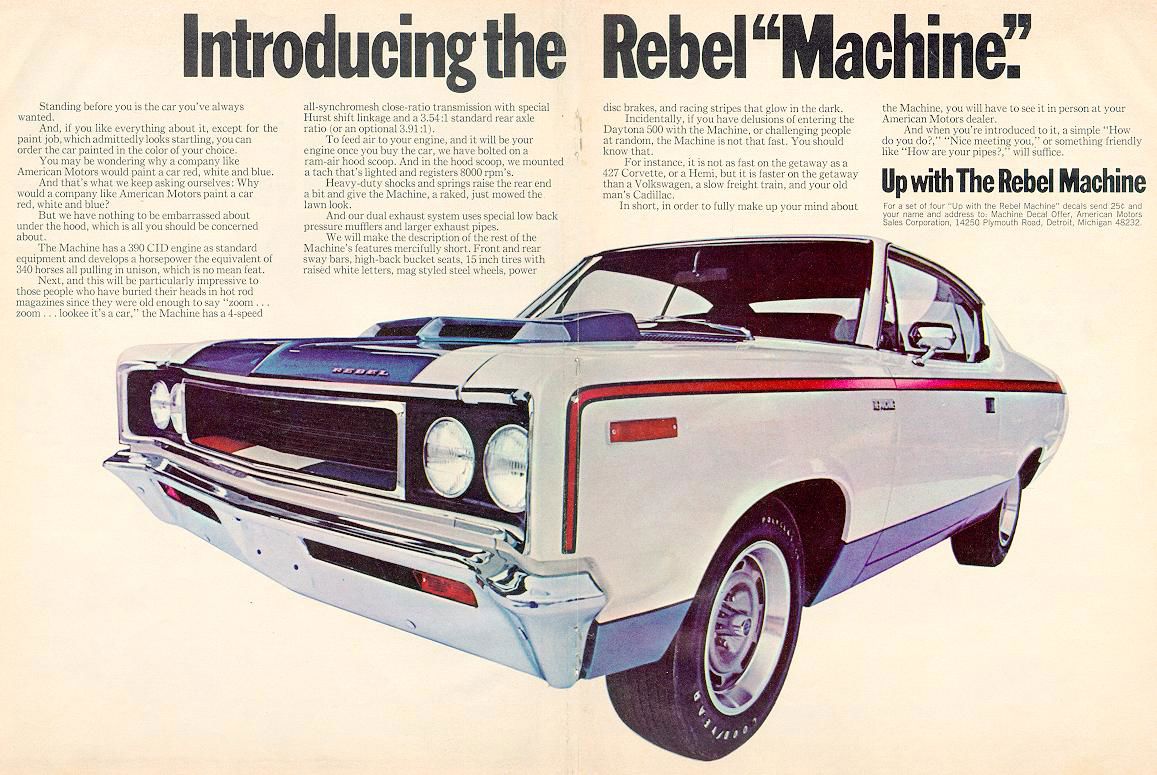
American Motors' December 1969 magazine ad for the Rebel Machine opened with a boast: “Standing before you is the car you've always wanted.” Then it admitted the car's limits, which few muscle-car ads did. According to Old Cars Weekly, the copy conceded that the Machine was not as quick off the line as a 427 Corvette or a Hemi. It also claimed the car was faster than “a Volkswagen, a slow freight train, and your old man's Cadillac.” Few performance ads of the period ranked their own car below the competition in print. This one did, and then ranked it above everything most readers actually drove.1
The ad arrived after the car. Old Cars Weekly says the Machine had debuted two months earlier at the National Hot Rod Association's World Championship drag races. That was a fitting place for AMC, which had spent 1969 selling performance through the drag strip. That year AMC and Hurst had put a 315-horsepower 390 into the compact SC/Rambler and aimed it at NHRA F/Stock. Ate Up With Motor describes the Machine as the same treatment applied to the midsize Rebel. Here that meant the Rebel two-door hardtop on a 114-inch wheelbase, a bigger and heavier car than the Rambler American it followed.1,2
The Machine got the strongest version of the engine. AMC's 1970 full-line brochure rates its 390 at 340 horsepower and 430 lb-ft, gross-era advertised figures. The same year's AMX 390 was rated at 325 horsepower. Old Cars Weekly lists the rest of the package: a close-ratio four-speed with a Hurst shifter, a lighted 8,000-rpm tachometer on the hood, Ram Air, a choice of 3.54:1 or 3.91:1 rear axles, heavy-duty shocks and springs, a low-back-pressure dual exhaust, front and rear sway bars, 15-inch raised-white-letter tires on styled wheels, high-back buckets and power disc brakes. An automatic was optional. Old Cars Weekly gives the curb weight as 3,640 pounds.1
The rating put the Machine at the top of AMC's 390 family. AMC's foldout for the 1969 SC/Rambler rated its 390 at 315 horsepower. The 1970 brochure gives the AMX's 390 325 horsepower and the Machine's 340. All three figures are factory-advertised gross ratings from sales literature, not dynamometer measurements. The brochure does not explain the 15-horsepower gap between the two 1970 ratings. Old Cars Weekly's equipment list includes Ram Air and a low-back-pressure exhaust on the Machine, but that list is not a factory explanation of the rating. What the paperwork shows is that AMC gave its heaviest performance car its highest advertised rating.1
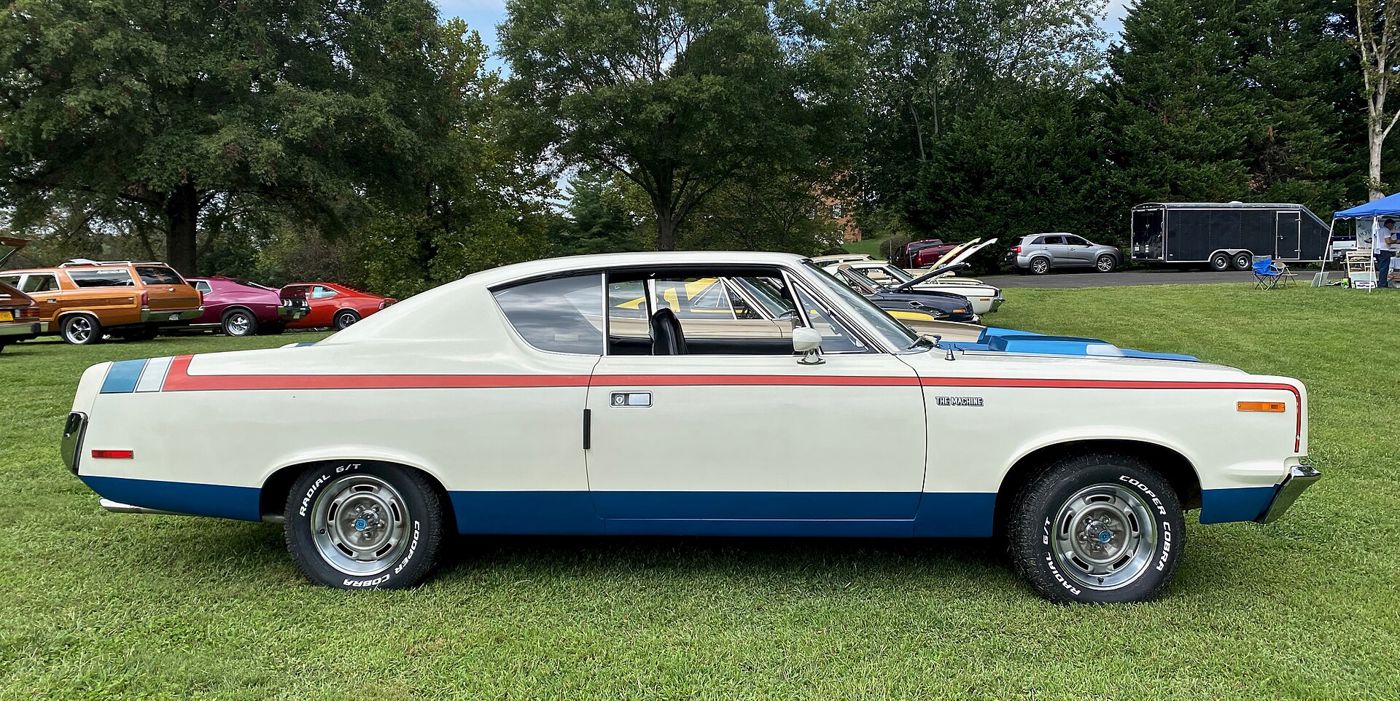
Old Cars Weekly reports a price of $3,475, and Wikipedia gives the same figure as the MSRP. The first cars wore the scheme that people remember. Planet Houston AMX describes them as white with a red, white and blue stripe kit. After that first run the Machine could be ordered in any regular production color, and the original scheme became a $75 option. Planet Houston AMX adds that the Big Bad colors reached the Rebel Machine after 1 January 1970. So a Machine in green or orange is not automatically a later car, and a white one is not automatically an early car. The stripe scheme alone does not date a Machine.1,3,4,5
How large was the first run? Planet Houston AMX says the first 1,000 Machines were built in white with the stripe kit, and Wikipedia repeats that number. Old Cars Weekly says instead that “the first 100 'Machines' delivered from the AMC factory in Kenosha” were finished in white. One figure is ten times the other. A dropped zero is a tempting explanation, but nobody has shown that it happened. The two counts may also describe different things: cars built in the full scheme, or cars delivered in white. Until a build record or registry tally settles it, both figures stand with their sources, and neither can be used to call a car rare.4,3,1
The production total is even less settled. Old Cars Weekly gives 2,326 and calls the Machine a one-year wonder. Wikipedia gives the same number but credits it to a collector website. Planet Houston AMX writes 1,936, “or 2306, depends on who you talk to,” and an uncited Wikipedia body list also shows 1,936 for the 7019-7 hardtop. JavelinAMX.com, in an aside, says about 1,200. Ate Up With Motor says only that fewer than 2,400 were built, which is a limit, not a count. That makes four reported figures and one upper bound, with nearly a thousand cars between the lowest and highest. No AMC production report has been found to settle it.1,3,4,6,2
Because both the total and the first run are uncertain, no rarity claim about a white, striped Machine holds up. The two disputes affect each other. If the first run was 1,000 cars and the total about 1,200, the later any-color cars would be only a small group. If the first run was 100 and the total 2,326, the later cars would be the great majority. The reported figures allow both readings, so neither is stated as fact. The one fixed point is the price: $3,475, with the scheme included on the first cars and offered for $75 on later ones.1,4,6
The street performance record is also thin. Old Cars Weekly prints a 14.4-second quarter-mile at 98 mph, but it names neither the magazine nor the tested car. Without a test date, axle ratio or transmission, that figure cannot be attached to a configuration and is left out here. A period test does exist. Ate Up With Motor's bibliography lists a May 1970 Road Test article headlined “Track Burner from AMC,” but that issue was not read for this story. What can be said is what AMC advertised. The ad itself set the car below a 427 Corvette or a Hemi and above an ordinary family car.1,2
For 1971 the Rebel became the Matador, and the Machine became a much quieter package. Planet Houston AMX says the Go-Machine package cost $373 with the 360 or $461 with the 401. It cites counts of 68, 50 and 43 and notes that AMC's production records show only 43 two-door 1971 Matadors built with a 401. JavelinAMX.com says fewer than 50 were built and fewer than half of them had four-speeds. That leaves the 1970 Machine as the loudest intermediate AMC built, with a 340-horsepower rating, a hood-mounted tachometer and an advertisement that admitted its limits, sold in numbers that still cannot be pinned down.4,6
Fact sheet · 1970 · United States
The numbers
1970 AMC Rebel 'The Machine' — AMC's intermediate supercar: a 340-hp 390, four-speed and Hurst shifter in the Rebel hardtop, first in white with red-white-blue stripes. Totals reported for the one-year run range from about 1,200 to 2,326.
Coverage: Partial — researched sections are shown; missing ones are not yet sourced. Researched through 2026-09-22.
Every figure is labeled with how sure we are. Reported means a manufacturer, registry, or reference figure we cite but have not reconciled against factory records ourselves. Disputed means credible sources disagree and both are shown. Rows are separately scoped; don't add them together unless the note says they make up a total.
Key facts
Production
| What was counted | Count | Basis | Status |
|---|---|---|---|
| Rebel Machine, all colors1,3 The Machine · 2-door hardtop · 390 V8 (340 hp) · US The most repeated figure. It is not traced to an AMC document. | 2,326 | built, model-year | Disputed |
| Rebel Machine, body 7019-7 hardtop (alternative figure)4 The Machine · 2-door hardtop · US An uncited Wikipedia list also shows 'Rebel Machine 7019-7 two-door hardtop: 1,936'. | 1,936 | built, model-year | Disputed |
| Rebel Machine, row 7019-MACHINE (AMC tally sheet)7 Rebel Machine · 2-door hardtop · 390 V8 · US, Canada and export market; built at Kenosha Same figure as the alternative 1,936 count shown above, now traced to AMC's own final 1970 tally. It remains disputed against 2,326 until the source of that figure is found. | 1,936 | built, model-year | Disputed |
| What was counted | Count | Basis | Status |
|---|---|---|---|
| Initial run in white with red-white-blue stripe scheme4,3 The Machine · 2-door hardtop · US Old Cars Weekly says the first 100. See conflicts. | 1,000 | built, model-year | Disputed |
| What was counted | Count | Basis | Status |
|---|---|---|---|
| Rebel SST hardtop (7019-7) with the 390, non-Machine7 Rebel SST · 2-door hardtop · 390 V8 · US, Canada and export market; built at Kenosha Context: 390-engined SST hardtops tallied separately from the Machine row. Row 7019-7 total 6,573 (232 = 1,533, 304 = 2,758, 360 = 2,138). | 144 | built, model-year | Reported |
| What was counted | Count | Basis | Status |
|---|---|---|---|
| Rebel hardtop (7019-0), all engines7 Rebel · 2-door hardtop · US, Canada and export market; built at Kenosha 232 = 1,173, 304 = 561, 360 = 57; no 390. | 1,791 | built, model-year | Reported |
The two total rows are competing claims, not components. Never add them.
Prices when new
| Model | Price | Basis |
|---|---|---|
| Rebel Machine1,3 | $3,475 | MSRP as reported, 1969-10 |
| Original stripe scheme (after the initial run)1 | $75 | option price as reported, 1970 |
Prices are the nominal dollars of the day, not adjusted for inflation.
Engines
| Engine | Factory rating | Availability | Built |
|---|---|---|---|
| 390 V8 4-bbl (Machine)1 390 cu in · 4-barrel, ram-air hood scoop | 340 hp @ 5,100, 430 lb-ft @ 3,600 (period factory advertised (gross era)) | standard (only engine) | Not yet sourced |
Ratings are the manufacturer's advertised figures under the standard shown (SAE gross before 1972, SAE net after). They are not dyno results, and gross and net ratings can't be compared directly.
Transmissions
| Transmission | Availability | Built |
|---|---|---|
| Four-speed manual with Hurst shifter1 | standard | Not yet sourced |
| Automatic1 | optional | Not yet sourced |
Options and packages
| Code | Option | Price | Installed |
|---|---|---|---|
|
'Machine' package for Rebel hardtop (footnote 4): special 340-hp 390 V-8, ram-air hood scoop, Shadow Black paint on hood and scoop, hood-scoop-mounted tachometer, rear sway bar, carpeting, plus other items in the Options chart | — | Not yet sourced |
|
'Machine' red/white/blue color and trim theme (includes center cushion and armrest) | — | Not yet sourced |
|
Vinyl-covered roof: black, white or blue | — | Not yet sourced |
|
Twin-Grip differential (required with 3.91 axle) | — | Not yet sourced |
|
Power steering | — | Not yet sourced |
|
AM radio; AM/FM radio; rear speaker with radio | — | Not yet sourced |
|
Air conditioning; A/C package; Command-Air ventilation; tinted glass; Cruise-Command speed control; Adjust-O-Tilt wheel | — | Not yet sourced |
|
Convenience group (6); electric wipers and washers; visibility group; light group (8) | — | Not yet sourced |
|
Bumper guards front and rear; insulation group; sports steering wheel with rim-blow | — | Not yet sourced |
|
70-amp battery; cold-start package; engine block heater; fuel-tank vapor emission control (California) | — | Not yet sourced |
|
Standard on the Machine: vinyl bucket seats, dual exhaust, power front disc brakes, custom steering wheel, mag-styled wheels with space-saver spare, handling package, heavy-duty engine cooling, E60x15 white-lettered tires | — | Not yet sourced |
Paint
| Code | Color | Built |
|---|---|---|
|
Frost White with blue hood and red-white-blue stripes (initial run)3 | 1,0004 Disputed |
|
Any regular production color, including Big Bad colors after 1 January 19705,4 | Not yet sourced |
Color names are the factory's. We don't show color swatches, because a screen color is no guide for a restoration.
Specifications
| Measure | Value | Applies to |
|---|---|---|
| Wheelbase1 | 114 in | Rebel two-door |
| Curb weight1 | 3,640 lb | Machine, as reported |
| Rear axle ratios1 | 3.54:1 or 3.91:1 | Machine |
| Axle ratios, 390 (340 hp) (standard; optional) | Shift-Command automatic on console 3.54 (3.15); 4-speed manual floor (standard) 3.54 (3.91) :1 | Rebel Machine |
| Standard tires | E60 x 15 white lettered | Rebel Machine |
Where the sources disagree
1970 Rebel Machine total
Show the range with attributions. Lead with no single number until an AMC production report or the Rebel Machine registry is consulted.
Size of the initial stripe-scheme run
Present both. 100 may be a transcription error, but that is not established.
Identification
Read a 1970 AMC VIN
The VIN decoder runs in your browser and never sends the VIN anywhere. How the factory numbered this year's cars:
Same model year
Also in 1970
- AMC AMX The last two-seat AMX: a restyled nose, a 360 base V8 and a 325-hp 390. At 4,116 cars it was the rarest of the three two-seat years.
- AMC Javelin Penske and Donohue brought the Javelin to Trans-Am, and the showroom answered with 2,501 Mark Donohue Javelins and 100 red-white-blue Trans Am Javelins, while total production fell to 28,210.
- Buick Riviera The 455 (370 hp gross) arrived with a restyle; production fell to about 37,300 with some 3,505 GS cars.
- Buick Skylark Gran Sport, GS and GSX Buick's GS went to a 455 rated at 510 lb-ft, the Stage 1 option added 10 advertised hp, and a mid-year GSX package was built 678 times in two colors.
- Buick Wildcat The final Wildcat, Custom trim only, with the 370-hp 455; 23,645 built.
- Chevrolet Chevelle and Malibu SS The year the Chevelle Super Sport split into RPO Z25 SS 396 and RPO Z15 SS 454, with the LS6 454 rated at 450 gross horsepower.
- Chevrolet Chevy II and Nova Last year the source engine table lists the big-block (as 402) in the Nova. Enthusiast-compiled production: 307,280 cars; Super Sport 19,558.
- Chevrolet El Camino SS The Malibu/Custom El Camino could carry either RPO Z25 SS 396 or RPO Z15 SS 454, including the 450 hp LS6; the El Camino share is not separately published.
- Chevrolet Monte Carlo SS The first Monte Carlo, with the SS 454 as RPO Z20: 3,823 of 145,976 Monte Carlos per Chevrolet-report-derived tables.
- Dodge Challenger Dodge's first pony car arrived as a 1970 model with nine advertised engines, base, SE, R/T, and R/T SE hardtops, two convertibles, and a one-year Trans-Am homologation special, the T/A.
- Dodge Charger The last year of the second-generation body: a new full-width grille, three series (Charger, 500, R/T), the 440 Six Pack added to the R/T, and production roughly half of 1969's.
- Dodge Coronet R/T and Super Bee The final Coronet-based R/T and Super Bee: the R/T fell to 2,615 cars, while the Super Bee added a 3-speed manual and kept its Six Pack and Hemi options.
- Dodge Dart GTS, Swinger and Demon With the GTS gone, the Swinger 340 was the only performance Dart; it kept front discs, Rallye suspension and a twin-scoop hood and sold about 13,800 beside the new Challenger.
- Ford Fairlane The last Fairlane year: the name survived only on the Fairlane 500 beneath the new Torino, with a mid-year Falcon sharing the body at the bottom of the range.
- Ford Maverick Grabber The Grabber appearance and tire package arrived in mid-1970 on the new two-door Maverick; no Grabber count for 1970 was found.
- Ford Ranchero GT The Torino-based Ranchero GT could take the 429 Cobra Jet and Super Cobra Jet; reference counts give 3,905 GTs, while Barn Finds rounds the GT figure to about 3,600 of 21,640 Rancheros.
- Ford Thunderbird The 429 at 360 hp was the standard and only engine listed in the 1970 catalog.
- Ford Torino A new, longer body on a 117-inch wheelbase; the Torino Cobra became its own model with the 429, offered in 360, 370 (Cobra Jet) and 375 (Super Cobra Jet) horsepower forms.
- Mercury Comet and Cyclone A new, longer Montego-based Cyclone in three versions: the 429 Cyclone, the small-block Cyclone GT that outsold both others, and the Ram Air 429 Cobra Jet Cyclone Spoiler.
- Mercury Cougar The last first-generation Cougar moved to the 351 Cleveland, kept the Boss 302 as an Eliminator-only engine, and built 2,268 Eliminators.
- Mercury Marauder and S-55 The second and last year of the 1969-70 Marauder: production fell to about a third of 1969's, with the X-100 near half of it.
- Oldsmobile Cutlass, 4-4-2 and Hurst/Olds The 4-4-2 got a standard 455 rated at 365 hp, the W-30 went to 370 hp, and the small-block W-31 moved to the Cutlass and F-85 coupes.
- Plymouth Barracuda and 'Cuda The E-body redesign split the line into Barracuda, Gran Coupe, and 'Cuda hardtops and convertibles, put every Chrysler performance engine through the 426 Hemi on the order form, and added the one-year AAR 'Cuda for Trans-Am homologation.
- Plymouth Duster 340 and 360 Plymouth's new Valiant-based fastback coupe arrived with a 275 hp 340 performance model priced at $2,547; the Standard Catalog lineage counts 24,817 Duster 340s among 217,192 Dusters.
- Plymouth GTX, Belvedere and Satellite Now hardtop-only, the GTX fell to 7,748 cars while its 440 Six Barrel option cost just $119.
- Plymouth Road Runner Production halved from 1969, the 440 Six Barrel became a regular option, and the winged Superbird was built as a Road Runner hardtop to put Plymouth back on NASCAR superspeedways.
- Pontiac Firebird and Trans Am A late-arriving, coupe-only second generation: 48,739 Firebirds, 3,196 of them Trans Ams, and 88 Ram Air IVs.
- Pontiac GTO A new Endura nose, a 455 added beside the three 400s, and GTO production falling to 40,149.
- Pontiac Grand Prix The SJ took a 370 hp 455, Hurst built the SSJ, and production fell to 65,750.
- Pontiac Tempest and LeMans The T-37 and GT-37 bring budget performance to the Tempest.