1970 · AMC · United States
1970 AMC AMX: The Last Two-Seater Got Its Best Engine and Its Smallest Audience
The last two-seat AMX: a restyled nose, a 360 base V8 and a 325-hp 390. At 4,116 cars it was the rarest of the three two-seat years.
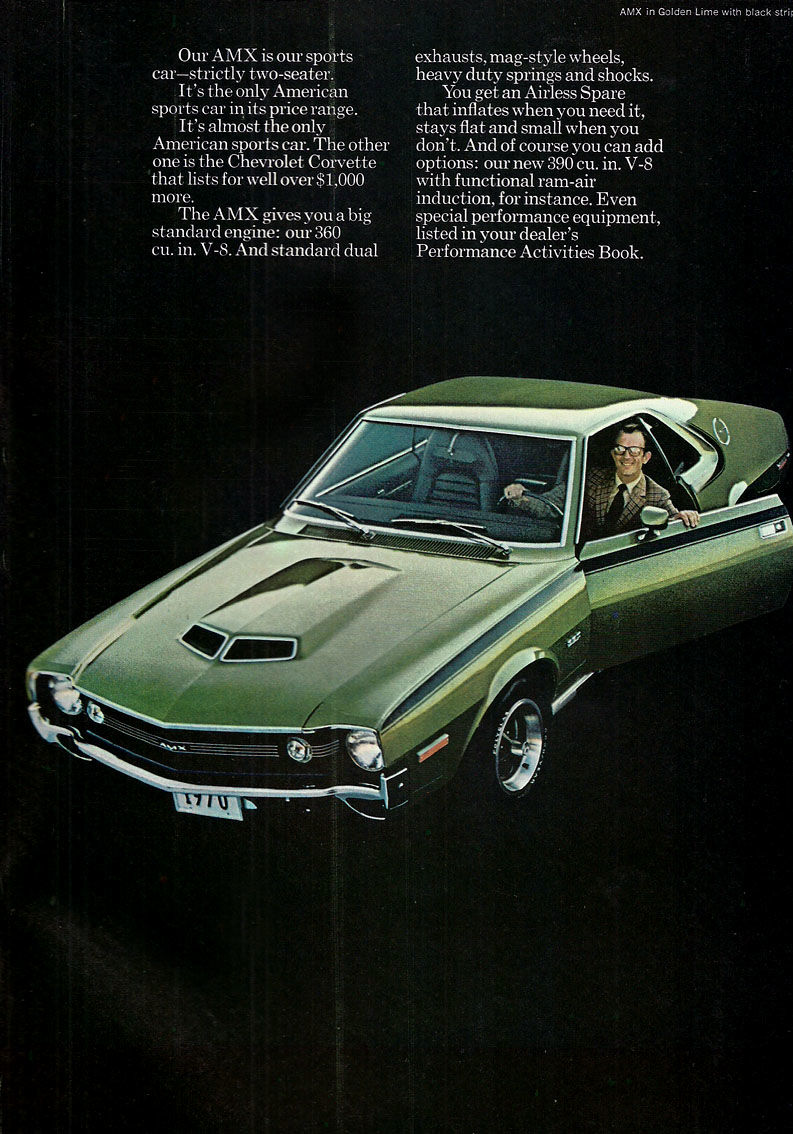
Motor Trend's Eric Dahlquist ran the 1970 AMX in the magazine's December 1969 issue. His test car had the optional 390 V8, a Borg-Warner four-speed and a 3.54:1 rear axle. It reached 60 mph in 6.56 seconds, covered the quarter-mile in 14.68 seconds at 92 mph and topped out at 109 mph in fourth gear. Dahlquist called it “one of the better constructed cars around.” That was a strong review for a car in its third and final season as a two-seater, after 1968 and 1969. It was also the best-developed version of the idea, and it was about to become the rarest.1
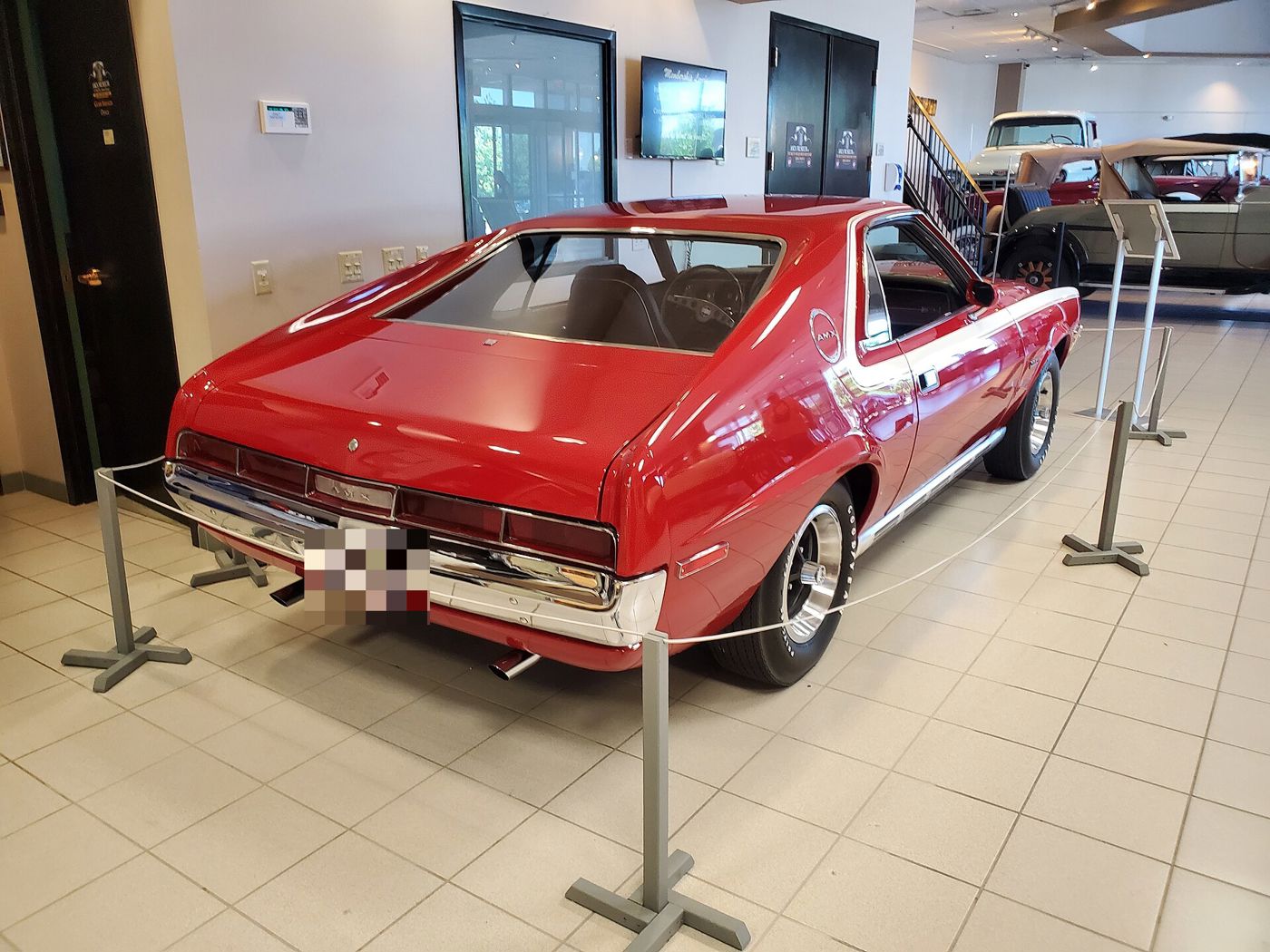
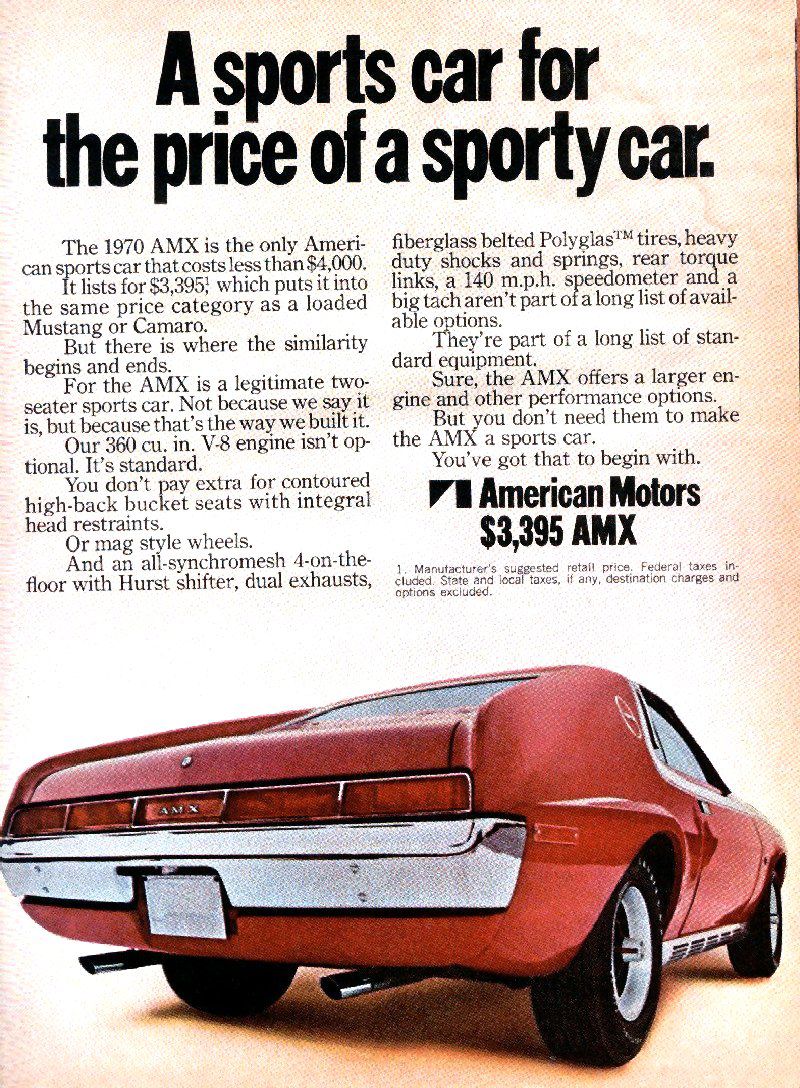
American Motors changed a great deal for the last year. The car got a completely restyled front end shared with the Javelin's performance models. The grille now sat flush with the hood, and a large ram-induction scoop fed cold air to the engine. The car was about an inch lower and about two inches longer, at 179 inches, but kept the 97-inch wheelbase. Inside were new contoured high-back buckets with built-in head restraints and a redesigned instrument panel. The weight rose to 3,126 pounds, only 29 pounds more than 1969. AMC's 1970 full-line brochure documented the AMX's four-speed power teams with both of the year's V8s.1
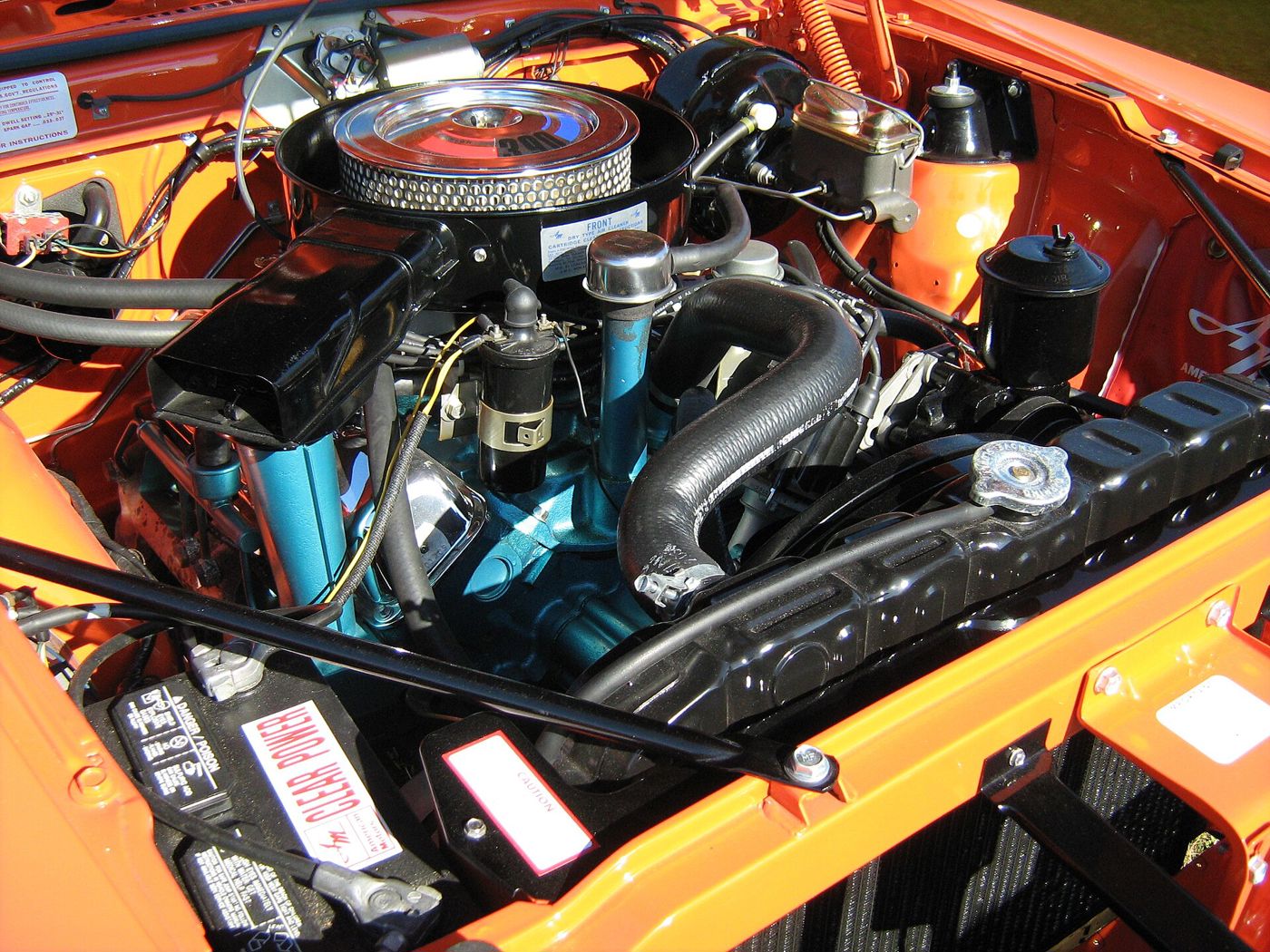
The engines changed too. The 290 and 343 were gone, and the new 360 four-barrel became standard at 290 horsepower at 4,800 rpm, a period gross-era rating. Its torque carries two published values. AMC's brochure prints 390 lb-ft, and Old Cars Weekly gives 395 lb-ft at 3,200 rpm, and the factory figure is the better guide. The optional 390 was rerated to 325 horsepower at 5,000 rpm and 420 lb-ft at 3,200, ten horsepower more than the 1968–69 rating. Both engines ran 10.0:1 compression. A Hurst-shifted four-speed was standard and the Shift-Command automatic was optional.1
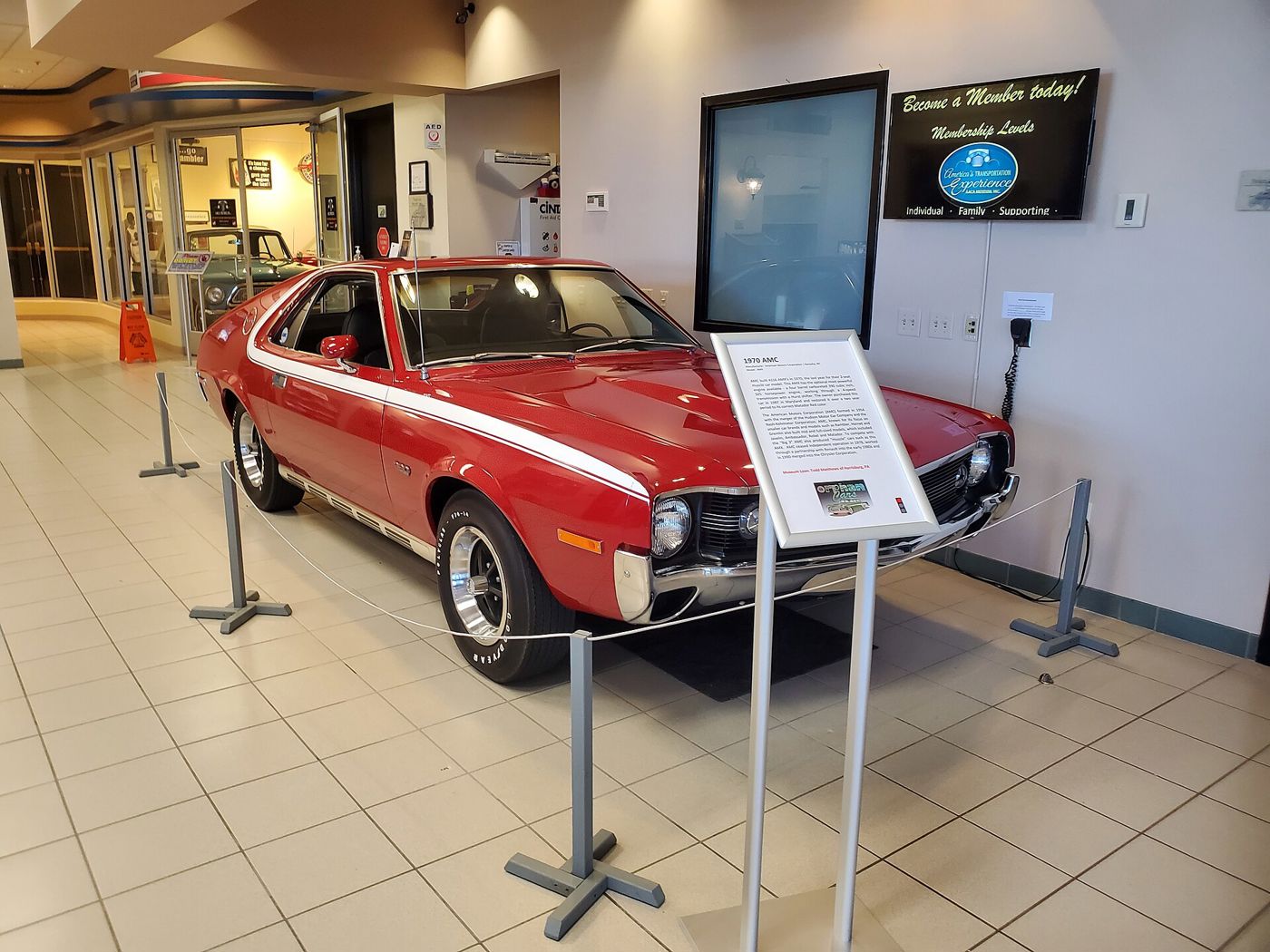

The base price was $3,395, $150 more than the $3,245 of 1968, though neither figure states its basis. The Go Package now cost $298.85 with the 360 or $383.90 with the 390, prices often rounded to $299 and $384. It bundled power front disc brakes, F70x14 raised-white-letter tires, Twin-Grip, the handling package, heavy-duty cooling, a space-saver spare and the functional Ram Air power-blister hood. Among the other options were air conditioning at $380, power steering at $102 and a $52 Shadow Mask treatment. The Shadow Mask was an extra-cost paint option.1,2
Unlike 1969, the total is not in dispute. Every count, from the engine-and-transmission table to the weekly production series credited to Linn Barton, gives 4,116. The cars split into 836 360 four-speeds, 747 360 automatics, 1,632 390 four-speeds and 901 390 automatics. With 4,116 as the denominator, the 390 went into 2,533 cars, about 62 percent, and four-speeds into 2,468, about 60 percent. The single largest combination was again the 390 with a four-speed. Buyers of the last two-seater mostly ordered the strongest engine and the stick.3,4,1
The option-installation table for 1970 is more useful for showing trends than for giving exact counts. It reports Ram Air on 2,875 cars, about 70 percent, power front disc brakes on 3,383 and the Shadow Mask on 982. Air conditioning went on 1,056 cars, and all 4,116 are listed with Rally wheels, 628 of them with machined rims. But the table's own transmission rows, 2,468 four-speeds and 1,464 automatics, add up to 3,932, not 4,116. Its automatic count does not match the engine table's 1,648. It also prints Twin-Grip at 340 even though Twin-Grip was part of the Go Package.3,2

Comfort options show that not every 1970 buyer wanted a stripped performance car. Air conditioning cost $380 and power steering $102, and the option table counts 1,056 air-conditioned cars and 2,869 with power steering out of 4,116, roughly a quarter of the cars and seven in ten. The table also lists 823 tilt columns, 1,139 center armrests, 728 luggage racks and 56 heated rear windows. Radios split among 2,568 AM sets, 482 AM/FM units and 556 AM/8-track units. The two-seater was still a sports car, but many of its last buyers ordered it as a comfortable, well-equipped one.1,3
The color story shrank with the car. The Big Bad colors carried over, and there were 114 blue, 74 green and 122 orange 1970 AMXs, 310 cars in all. That is fewer than half of 1969's Big Bad total. In the interior, leather still commanded attention. There were 98 black-leather, 181 red-leather and 487 saddle-leather cars, and blue came only in Ventilaire vinyl. Black vinyl, at 1,701 cars, was the common choice. The 1970 dash plates ran from 014469 to 18584.3,5,1

Better equipment did not bring in more buyers. From 8,293 in 1969 by the engine table's count, production fell to 4,116 in 1970, a drop of about half, even with more power and a stronger review. An internal argument followed. Styling chief Dick Teague pushed hard to keep the two-seater as an image builder. President William Luneburg decided that the cut-down car's sales did not justify the production complications it created. The 1970 car was therefore the last AMX built on the 97-inch wheelbase. It was the rarest of the three two-seat editions: 4,116 against 6,725 and 8,293.3,6,1
The name survived the car. For 1971 AMX became the top model of the redesigned Javelin, which had a 110-inch wheelbase and a 192.3-inch overall length. It was a four-seat pony car, not a short two-seater, and that first Javelin AMX numbered 2,054 cars. The three two-seat years, 1968, 1969 and 1970, add up to 19,134 cars. The 1970 car accounts for just over a fifth of them, and it was the one Motor Trend praised for its construction. AMC had built its best two-seater in the year it decided to stop building two-seaters.6,1,3
Fact sheet · 1970 · United States
The numbers
1970 AMC AMX: The last two-seat AMX: a restyled nose, a 360 base V8 and a 325-hp 390. At 4,116 cars it was the rarest of the three two-seat years.
Figures may describe different groups of cars. Add rows together only when the note says they make up a total.
Key facts
- 1970 AMX production 4,116: 360 four-speed 836, 360 automatic 747, 390 four-speed 1,632, 390 automatic 901.3,4,1
- Big Bad colors on the 1970 AMX: blue 114, green 74, orange 122.3,5
- Go Package price: $298.85 with the 360, $383.90 with the 390.1,2
- All 4,116 cars are listed with Rally wheels. Machine rims appear on 628.3
Production
| What was counted | Built |
|---|---|
| AMX, all engines3,4,1 AMX · 2-seat fastback coupe · US production (Kenosha) Treated as one reported figure. | 4,116 |
| What was counted | Built |
|---|---|
| 360 V8, four-speed3 AMX · 2-seat coupe · 360 V8 · 4-speed manual · US | 836 |
| 360 V8, automatic3 AMX · 2-seat coupe · 360 V8 · automatic · US | 747 |
| 390 V8, four-speed3 AMX · 2-seat coupe · 390 V8 · 4-speed manual · US | 1,632 |
| 390 V8, automatic3 AMX · 2-seat coupe · 390 V8 · automatic · US | 901 |
| What was counted | Built |
|---|---|
| Big Bad Blue3,5 AMX · 2-seat coupe · US | 114 |
| Big Bad Green3,5 AMX · 2-seat coupe · US | 74 |
| Big Bad Orange3,5 AMX · 2-seat coupe · US | 122 |
| What was counted | Count | Counted as |
|---|---|---|
| Shadow Mask paint option3 AMX · 2-seat coupe · US | 982 | installed |
| Ram Air3 AMX · 2-seat coupe · US | 2,875 | installed |
| What was counted | Built |
|---|---|
| 360 V8, all transmissions (AMC tally sheet)7 AMX · 2-seat coupe · 360 V8 · US, Canada and export market; built at Kenosha | 1,583 |
| 390 V8, all transmissions (AMC tally sheet)7 AMX · 2-seat coupe · 390 V8 · US, Canada and export market; built at Kenosha | 2,533 |
Prices when new
| Model | Price | Price type |
|---|---|---|
| Base price, AMX1 | $3,395 | base price, 1969-09 |
| Go Package with 3601 | $298.85 | option price, 1970 model year |
| Go Package with 3901 | $383.90 | option price, 1970 model year |
| Shadow Mask paint2 | $52 | option price, 1970 model year |
| Power steering1 | $102 | option price, 1970 model year |
| Air conditioning1 | $380 | option price, 1970 model year |
Prices are the nominal dollars of the day, not adjusted for inflation.
Engines
| Engine | Factory rating | Availability | Built |
|---|---|---|---|
| 360 V8 4-bbl1 360 cu in · 4-barrel | 290 hp @ 4,800, 395 lb-ft @ 3,200 (period factory advertised (gross era), as reported by Old Cars Weekly) | standard | 1,5837 |
| 390 V8 4-bbl1 390 cu in · 4-barrel | 325 hp @ 5,000, 420 lb-ft @ 3,200 (period factory advertised (gross era)) | optional | 2,5337 |
Ratings are published figures, not dyno results. Gross and net ratings aren't directly comparable.
Transmissions
| Transmission | Availability | Built |
|---|---|---|
| Four-speed all-synchromesh manual, Hurst shifter1 | standard | 2,4683 |
| Shift-Command automatic1 | optional | 1,4643 |
Options and packages
| Option | Price | Installed |
|---|---|---|
| Go Package: 360 or 390, power disc brakes, F70x14 white-letter tires, Twin-Grip, handling package, heavy-duty cooling, space-saver spare, Ram Air with power-blister hood2,1 | $298.85 | |
| AM radio3 | 2,5683 | |
| AM/FM radio3 | 4823 | |
| AM/8-track radio3 | 5563 | |
| Clock3 | 2,2583 | |
| Air conditioning3,1 | $380 | 1,0563 |
| Power steering3 | $102 | 2,8693 |
| Power front disc brakes3 | 3,3833 | |
| Twin-Grip differential3 | 3403 | |
| Machine rims3 | 6283 | |
| Tilt steering column3 | 8233 | |
| Heated rear glass3 | 563 | |
| Luggage rack3 | 7283 | |
| Stripes3 | 2,5663 | |
| Ram Air3 | 2,8753 | |
| Center armrest3 | 1,1393 | |
| Shadow Mask paint2 | $52 | 9823 |
| Command-Air ventilation3 | 5973 | |
| Quick-ratio manual steering3 | 3193 | |
| Standard (manual) steering3 | 9283 | |
| Standard manual drum brakes3 | 5563 | |
| Power drum brakes3 | 1173 | |
| Tinted glass, all windows3 | 1,6963 | |
| Tinted windshield only3 | 8893 | |
| Clear glass, all windows3 | 1,5313 | |
| Rally wheels3 | 4,1163 | |
| Remote-control driver mirror3 | 2,4043 | |
| Right-side passenger mirror3 | 1,1083 | |
| Electric windshield wipers3 | 3,4283 | |
| No radio3 | 5103 | |
| Bucket seats, genuine leather | ||
| Power brakes | ||
| Rear speaker, with radio | ||
| Convenience Group (6): remote-control left mirror, visor vanity mirror, electric clock, glove box lock | ||
| Visibility Group (includes Convenience Group, electric wipers and washers) | ||
| Light Group (7): glove box light, parking brake warning light, lights-on buzzer, low-fuel warning light, map light, front door switches (trunk and courtesy lights standard on AMX) | ||
| Bumper guards, rear | ||
| Undercoating | ||
| Handling package, V-8 (heavy-duty springs and shock absorbers) | ||
| Heavy-duty engine cooling system (included with air conditioning) | ||
| 70-amp battery (60-amp standard on 360 and 390) | ||
| Cold-start package: 70-amp battery and 55-amp alternator (cars without A/C) | ||
| Engine-block heater | ||
| Fuel tank vapor emission control system (required in California) | ||
| E70 x 14 Red Line tires | ||
| F70 x 14 white-lettered tires | ||
| Standard on AMX: vinyl bucket seats, dual exhaust, tachometer and 140-mph speedometer, sports steering wheel with rim-blow, mag-styled wheels with space-saver spare, simulated-exhaust rocker panel molding, E78 x 14 black fiberglass-belted tires |
Paint
| Color | Built |
|---|---|
| Big Bad Blue3 | 1143 |
| Big Bad Green3 | 743 |
| Big Bad Orange3 | 1223 |
Color names are the factory's. We don't show color swatches, because a screen color is no guide for a restoration.
Interiors
| Code | Trim | Built |
|---|---|---|
031F |
Black, Ventilaire vinyl3 | 1,7013 |
031L |
Black leather3 | 983 |
033F |
Blue, Ventilaire vinyl (no leather offered in blue)3 | 2633 |
035F |
Red, Ventilaire vinyl3 | 1413 |
035L |
Red leather3 | 1813 |
036F |
Brown, Ventilaire vinyl3 | 3573 |
036L |
Saddle/brown leather3 | 4873 |
Specifications
| Measure | Value | Applies to |
|---|---|---|
| Shipping weight8 | 3,126 lb | body 7039-7, as tabulated |
| Wheelbase1 | 97 in | all 1970 AMX |
| Overall length1 | 179 in | all 1970 AMX |
| Weight1 | 3,126 lb | |
| Axle ratio, 360 or 390 with four-speed floor (standard; optional) | 3.54 (3.15 and 3.91) :1 | AMX |
| Axle ratio, 360 or 390 with Shift-Command automatic on console (standard; optional) | 2.87 (3.15 and 3.54); 3.15 standard with Go Package and automatic :1 | AMX |
| Dealer-kit axle ratios | 3.73, 3.91 (also factory option), 4.10, 4.44, 5.00 :1 | AMX and Javelin |
| Engine compression ratio and bore x stroke | 360 4-bbl: 10.0:1, 4.08 x 3.44 in; 390 4-bbl: 10.0:1, 4.17 x 3.57 in (premium fuel) | by engine |
Period road tests
| Test | Car tested | Result |
|---|---|---|
| Motor Trend, 1969-1210-60 mph | 1970 AMX, 390 V8as reported by Old Cars Weekly; original issue not read | 6.56 s |
| Motor Trend, 1969-121quarter-mile | 1970 AMX, 390 V8trap speed 92 mph; as reported by Old Cars Weekly | 14.68 s |
| Motor Trend, 1969-121top speed | 1970 AMX, 390 V8in fourth gear, as reported by Old Cars Weekly | 109 mph |
A road test result belongs to the one car that was tested, with its engine, gearing, tires, and conditions. It is not a figure for every car of the year.
Identification
- Dash plate numbers
- Old Cars Weekly gives 1970 AMX dash plate numbers 014469 to 18584.1
- Interior trim code
- Codes 031 black, 033 blue, 035 red, 036 brown. Trim F Ventilaire vinyl or L leather (no leather in 033).3
Where the sources disagree
1970 360 four-barrel torque rating
- 390 lb-ft
- 395 lb-ft @ 3,200 rpm1
Identification
Read a 1970 AMC VIN
The VIN decoder runs in your browser and never sends the VIN anywhere. How the factory numbered this year's cars:
Read next
The people and races behind the 1970 AMC AMX
- 1970 Showroom Argument Cross-marque story
- Every AMC AMX year 1968–1980
Same model year
Also in 1970
- AMC Javelin Penske and Donohue brought the Javelin to Trans-Am, and the showroom answered with 2,501 Mark Donohue Javelins and 100 red-white-blue Trans Am Javelins, while total production fell to 28,210.
- AMC Rebel and Rebel Machine AMC's intermediate supercar: a 340-hp 390, four-speed and Hurst shifter in the Rebel hardtop, first in white with red-white-blue stripes. Totals reported for the one-year run range from about 1,200 to 2,326.
- Buick Riviera The 455 (370 hp gross) arrived with a restyle; production fell to about 37,300 with some 3,505 GS cars.
- Buick Skylark Gran Sport, GS and GSX Buick's GS went to a 455 rated at 510 lb-ft, the Stage 1 option added 10 advertised hp, and a mid-year GSX package was built 678 times in two colors.
- Buick Wildcat The final Wildcat, Custom trim only, with the 370-hp 455; 23,645 built.
- Chevrolet Chevelle and Malibu SS The year the Chevelle Super Sport split into RPO Z25 SS 396 and RPO Z15 SS 454, with the LS6 454 rated at 450 gross horsepower.
- Chevrolet Chevy II and Nova Last year the source engine table lists the big-block (as 402) in the Nova. Enthusiast-compiled production: 307,280 cars; Super Sport 19,558.
- Chevrolet El Camino SS The Malibu/Custom El Camino could carry RPO Z25 SS 396 or RPO Z15 SS 454, including the 450 hp LS6; 8,773 Z15s across Malibu models.
- Chevrolet Monte Carlo SS The first Monte Carlo, with the SS 454 as RPO Z20: 3,823 of 145,976 Monte Carlos per Chevrolet-report-derived tables.
- Dodge Challenger Dodge's first pony car arrived as a 1970 model with nine advertised engines, base, SE, R/T, and R/T SE hardtops, two convertibles, and a one-year Trans-Am homologation special, the T/A.
- Dodge Charger The last year of the second-generation body: a new full-width grille, three series (Charger, 500, R/T), the 440 Six Pack added to the R/T, and production roughly half of 1969's.
- Dodge Coronet R/T and Super Bee The final Coronet-based R/T and Super Bee: the R/T fell to 2,615 cars, while the Super Bee added a 3-speed manual and kept its Six Pack and Hemi options.
- Dodge Dart GTS, Swinger and Demon With the GTS gone, the Swinger 340 was the only performance Dart; it kept front discs, Rallye suspension and a twin-scoop hood and sold about 13,800 beside the new Challenger.
- Ford Fairlane The last Fairlane year: the name survived only on the Fairlane 500 beneath the new Torino, with a mid-year Falcon sharing the body at the bottom of the range.
- Ford Maverick Grabber The $179 Grabber package of stripes, a spoiler and a blacked-out grille arrived mid-1970 on the new two-door Maverick.
- Ford Ranchero GT The Torino-based Ranchero GT could take the 429 Cobra Jet and Super Cobra Jet; reference counts give 3,905 GTs, while Barn Finds rounds the GT figure to about 3,600 of 21,640 Rancheros.
- Ford Thunderbird The 429 at 360 hp was the standard and only engine listed in the 1970 catalog.
- Ford Torino A new, longer body on a 117-inch wheelbase; the Torino Cobra became its own model with the 429, offered in 360, 370 (Cobra Jet) and 375 (Super Cobra Jet) horsepower forms.
- Mercury Comet and Cyclone A new, longer Montego-based Cyclone in three versions: the 429 Cyclone, the small-block Cyclone GT that outsold both others, and the Ram Air 429 Cobra Jet Cyclone Spoiler.
- Mercury Cougar The last first-generation Cougar moved to the 351 Cleveland, kept the Boss 302 as an Eliminator-only engine, and built 2,268 Eliminators.
- Mercury Marauder and S-55 The second and last year of the 1969-70 Marauder: production fell to about a third of 1969's, with the X-100 near half of it.
- Oldsmobile Cutlass, 4-4-2 and Hurst/Olds The 4-4-2 got a standard 455 rated at 365 hp, the W-30 went to 370 hp, and the small-block W-31 moved to the Cutlass and F-85 coupes.
- Plymouth Barracuda and 'Cuda The E-body redesign split the line into Barracuda, Gran Coupe, and 'Cuda hardtops and convertibles, put every Chrysler performance engine through the 426 Hemi on the order form, and added the one-year AAR 'Cuda for Trans-Am homologation.
- Plymouth Duster 340 and 360 Plymouth's new Valiant-based fastback coupe arrived with a 275 hp 340 performance model at $2,547; 24,817 Duster 340s among 217,192 Dusters.
- Plymouth GTX, Belvedere and Satellite Now hardtop-only, the GTX fell to 7,748 cars while its 440 Six Barrel option cost just $119.
- Plymouth Road Runner Production halved from 1969, the 440 Six Barrel became a regular option, and the winged Superbird was built as a Road Runner hardtop to put Plymouth back on NASCAR superspeedways.
- Pontiac Firebird and Trans Am A late-arriving, coupe-only second generation: 48,739 Firebirds, 3,196 of them Trans Ams, and 88 Ram Air IVs.
- Pontiac GTO A new Endura nose, a 455 added beside the three 400s, and GTO production falling to 40,149.
- Pontiac Grand Prix The SJ took a 370 hp 455, Hurst built the SSJ, and production fell to 65,750.
- Pontiac Tempest and LeMans The T-37 and GT-37 bring budget performance to the Tempest.