1970 · Plymouth · United States
1970 Plymouth GTX: The Executive Branch Loses Half Its Members
Now hardtop-only, the GTX fell to 7,748 cars while its 440 Six Barrel option cost just $119.
United States · researched through 2026-09-22
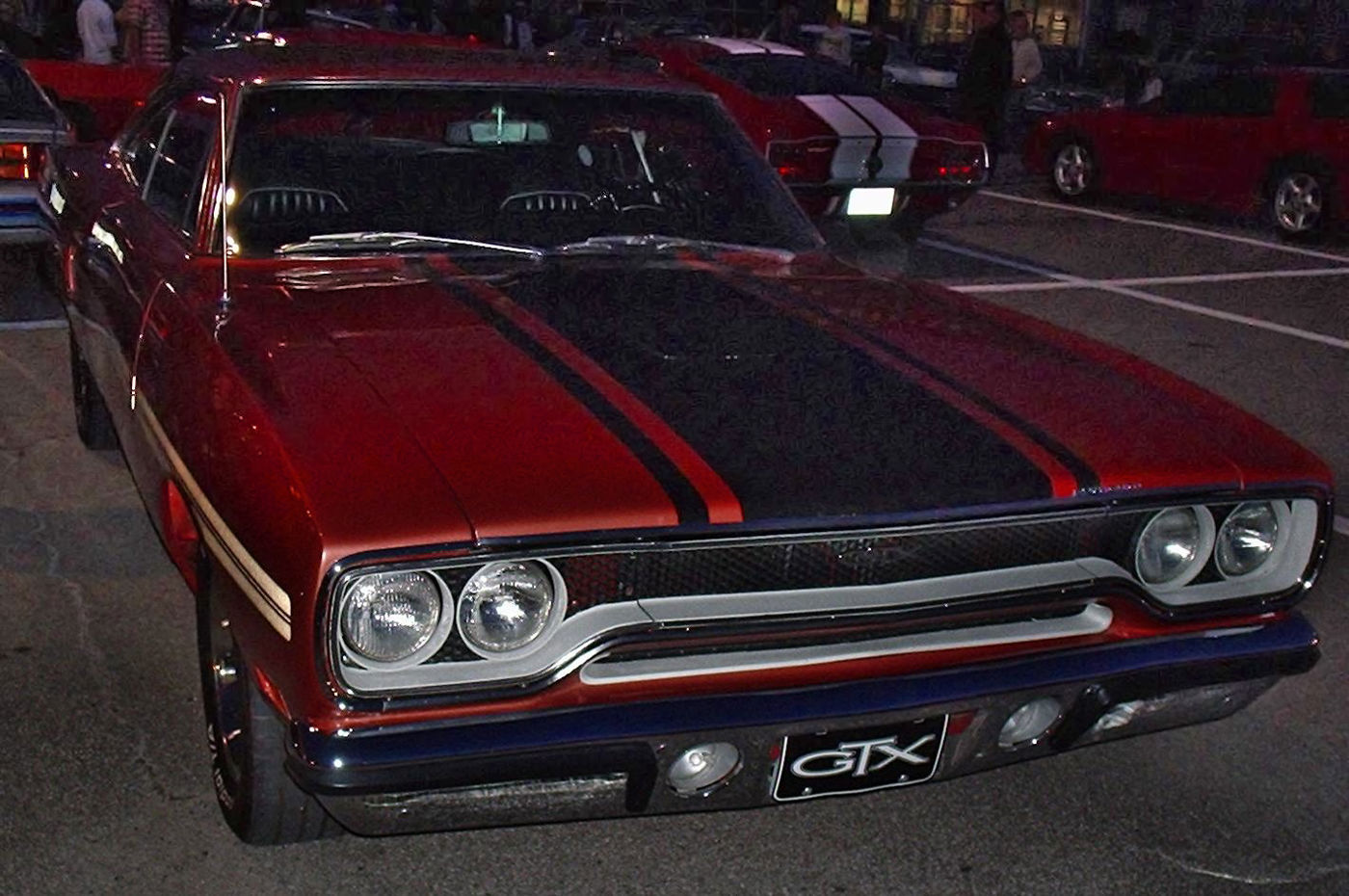
Plymouth's 1970 Rapid Transit System catalog gave the GTX a page headed "Plymouth GTX and Sport Fury GT. Our Executive Branch," and its first line picked the audience without subtlety: "Men, 25 and over, take note." The copy imagines a buyer who had spent years putting off hot machinery for school, the service, marriage and children, and who was now tempted by the family sedan. Its prescription was the GTX, described as a true supercar from its 440 and hot camshaft to its fat tires and bulging hood, but with high-back buckets, deep carpeting, simulated woodgrain and full instrumentation inside. Plymouth was selling the GTX as the grown-up's muscle car.
The reason for that pitch was parked on the facing pages. The same catalog boasts that the Road Runner, Plymouth's no-frills car for young buyers, sold well over 100,000 units in its first two years and was Motor Trend's Car of the Year for 1969; those are Plymouth's advertising claims, not a production ledger. The ledger that does exist tells the same story. Over-Drive's 1969 production table shows 84,420 Road Runners against 15,602 GTXs, and its 1969 fact sheet says GTX sales dropped once the Road Runner was also offered as a convertible. The cheaper car had taken the young buyer, so the GTX went looking for an older one.1
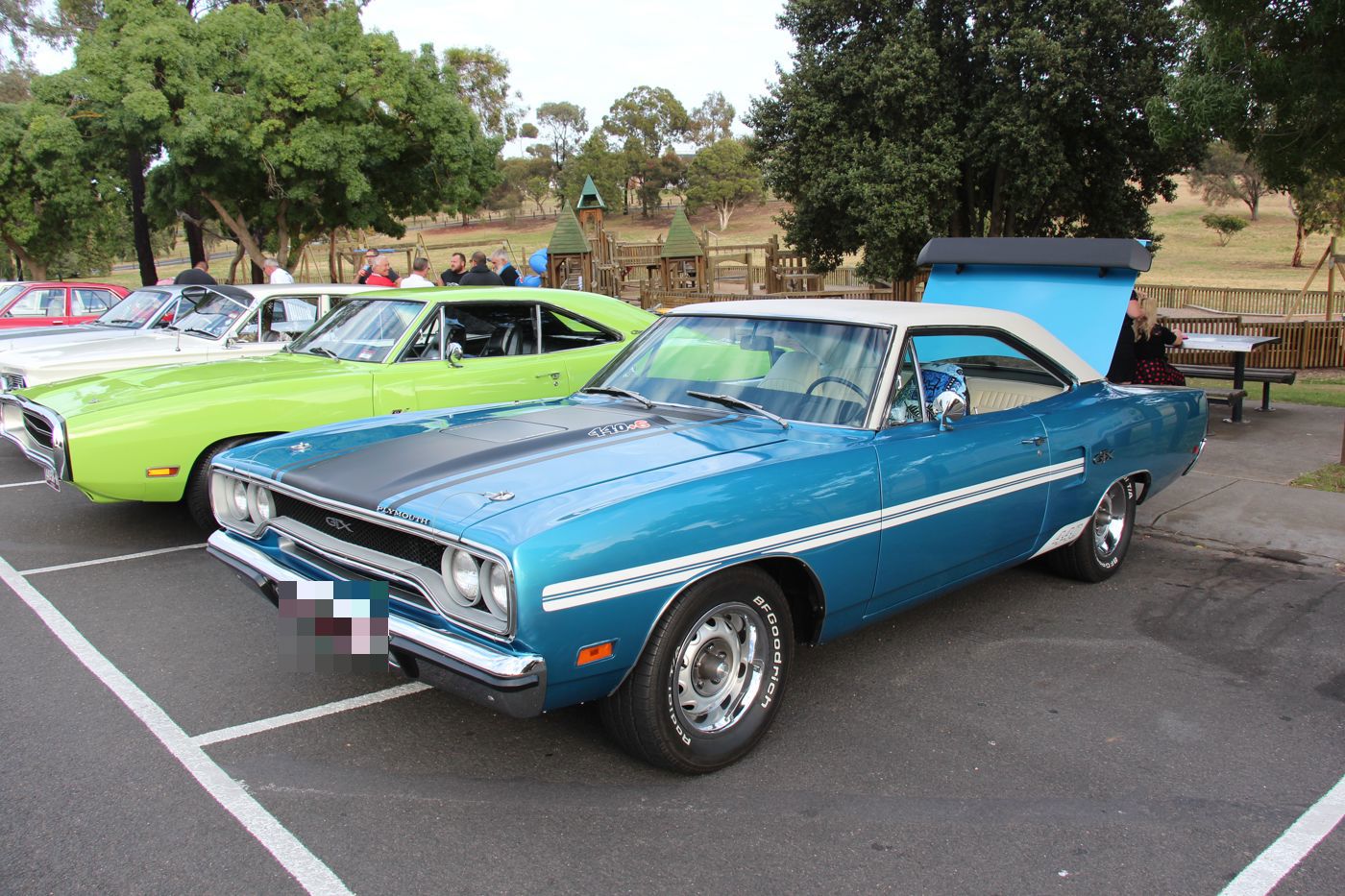
The 1970 car looked new from both ends. Over-Drive lists new front and rear styling for Plymouth's intermediates, with a new grille, hood, front fenders and quarter panels. The GTX lost its convertible and was built only as the RS23 two-door hardtop in series FR2, at a factory price of $3,535 and a shipping weight of 3,515 pounds. The standard-equipment list reads like the catalog's promise put into parts: a heavy-duty TorqueFlite automatic, deluxe vinyl foam-cushioned bucket seats, reflective body-side tape, dual horns, a 70-ampere battery, bright exhaust trumpets and the big-block 440 Super Commando V8. Over-Drive lists the four-speed manual as an extra-cost option priced from $188 to $197 across the line.2
Under the hood the GTX gave its owner three choices. The standard 440 Super Commando with one four-barrel was rated at 375 horsepower at 4,600 rpm and 480 lb-ft at 3,200. The 440 Six Barrel, three two-barrel carburetors on the same engine, was rated at 390 horsepower at 4,700 rpm and 490 lb-ft at 3,200, and on a GTX it cost $119. The 426 Hemi, rated at 425 horsepower at 5,000 rpm and 490 lb-ft at 4,000, cost $711, roughly six times as much. All three are SAE gross ratings. Plymouth's catalog argued the arithmetic itself, claiming the Six Barrel nearly equaled the Street Hemi at a price many skins less.2
The Air Grabber changed character too. In 1969 it had been a set of flush vents; for 1970, Over-Drive explains, a switch below the dash worked a vacuum servo that slowly raised a forward-facing scoop, exposing shark-teeth decals on either side. The catalog preferred a Cold War image, saying the scoop rose out of the hood like a Nike launcher. It was a $66 option on the Road Runner and GTX and standard with the Hemi. Hood hold-down pins cost $15 and a performance hood treatment $18. The paint chart gave the buyer somewhere to put all that attitude, with colors named In Violet, Vitamin C, Tor Red, Lemon Twist and Moulin Rouge among its 27 listings.2
No period road test of a 1970 GTX has been located, but Motor Trend's December 1969 comparison of three budget supercars measured the Six Barrel in the Road Runner that shared the GTX's body and option list. That car, a hardtop with the 440 Six Barrel, four-speed, 4.10 axle, Super Track Pak and Air Grabber, weighed 3,935 pounds as tested, reached 60 mph in 6.6 seconds and ran the quarter-mile in 14.4 seconds at 99.0 mph. After a Chrysler drag-racing specialist tuned it, it ran 14.06 seconds at 101.69 mph. It stickered from $3,034 and came to $4,417 delivered. Those figures belong to that prepared Road Runner, not to any GTX.3
The Executive Branch pitch did not find enough executives. Over-Drive's production table lists 7,748 GTX hardtops for 1970, about half of the 15,602 built in 1969 when the convertible was still offered. How those 7,748 divided among the standard 440, the Six Barrel and the Hemi has not been documented from a named record, so those shares stay unknown rather than guessed. The Road Runner fell too: Over-Drive's text gives 24,944 hardtops, 15,716 coupes and only 834 convertibles, and Ate Up With Motor, putting 1970 Road Runner sales at 41,484, blames skyrocketing insurance premiums for performance cars. Even the cheap bird was losing buyers.2,1,4
Plymouth's racing effort in 1970 ran through the rest of the system. The catalog lists Daytona, Indianapolis, Riverside, Irwindale and Cecil County among the places its race cars ran, and it steered readers to Sox & Martin and Don Grotheer supercar clinics. On the superspeedways the new car was the winged Road Runner Superbird. Motor Trend's January 1970 feature put its build at 1,920 and described a GTX-type 440 four-barrel as standard, with the Six Barrel or Hemi optional. The count is disputed: an independent researcher's compilation lists 1,935 from Chrysler Historical, including 135 Hemis, against 1,850 on a US shipping list, and concludes fewer than 2,000 were built.5,6
The Superbird brought Plymouth's biggest name home. NASCAR's catalog of Richard Petty's wins records his first victory in the winged car at the Carolina 500 on March 8, 1970, after his season in a Ford, and NASCAR's account of Pete Hamilton describes Plymouth pairing Hamilton with Petty Enterprises in a second Superbird run by Maurice Petty. Hamilton won the 1970 Daytona 500 in that car. None of that racing happened in a GTX, but it happened in the same Plymouth intermediate family, and it gave the Rapid Transit System the thing a performance catalog most needs: proof that the badge on the hood had won somewhere that mattered.7,8,9
The 1970 GTX was the last of its shape and nearly the last of its kind. Chrysler's intermediates took on a swoopy fuselage-style body for 1971, and punitive insurance rates kept eating into sales. The 1971 Plymouth B Body Registry counts 2,942 GTXs for that year, and Mopar Connection's retrospective puts 1971 Hemi GTX production at 30 cars. Set against those figures, the 7,748 cars of 1970 look less like a collapse than a last good year for Plymouth's gentleman's supercar: a new face, a pop-up scoop, a $119 route to 390 horsepower, and a catalog that asked grown men to stop kidding themselves about the family sedan.4,10,11
Fact sheet · 1970 · United States
The numbers
1970 Plymouth GTX — Now hardtop-only, the GTX fell to 7,748 cars while its 440 Six Barrel option cost just $119.
Coverage: Partial — researched sections are shown; missing ones are not yet sourced. Researched through 2026-09-22.
Every figure is labeled with how sure we are. Reported means a manufacturer, registry, or reference figure we cite but have not reconciled against factory records ourselves. Disputed means credible sources disagree and both are shown. Rows are separately scoped; don't add them together unless the note says they make up a total.
Key facts
- Bright exhaust trumpets and three-speed wipers were standard on the GTX, and the Air Grabber scoop was standard with the Hemi.2
- Plymouth's 1970 code guide lists the GTX only as body RS23, a two-door hardtop, with the 440 four-barrel (E86) and TorqueFlite (D34) standard, the 440 Six Barrel (E87) and 426 Hemi (E74) optional, and the four-speed (D21) optional; a dual-tape sport stripe was standard unless deleted (V68).12
Production
| What was counted | Count | Basis | Status |
|---|---|---|---|
| GTX 2-door hardtop (RS23)2 GTX · 2-door hardtop · not stated Only GTX body style listed; this is also the model total. | 7,748 | not stated (production table), model-year | Reported |
| What was counted | Count | Basis | Status |
|---|---|---|---|
| GTX with 426 Hemi13 GTX · 426 Hemi · not stated Single secondary lineage (Chrysler/Govier figures as repeated by UltimateMuscleCar); scope not stated. | 72 | not stated, model-year | Reported |
The 7,748 total is the source table's only GTX line. No documented engine or transmission breakdown was found (searched 2026-09-29 for a Chrysler or Govier-derived split beyond the 72 Hemi cars); the 678 Six Barrel claim stays an unpublished lead. A Chrysler build-record count would close it.
Prices when new
| Model | Price | Basis |
|---|---|---|
| GTX 2-door hardtop2 | $3,535 | factory price (list, per production table), 1970 model year |
Prices are the nominal dollars of the day, not adjusted for inflation.
Engines
| Engine | Factory rating | Availability | Built |
|---|---|---|---|
| 440 Super Commando 4-bbl2 440 cu in · single 4-barrel | 375 hp @ 4,600, 480 lb-ft @ 3,200 (SAE gross) | standard in GTX | Not yet sourced |
| 440 Six Barrel (three 2-bbl)2 440 cu in · three 2-barrels | 390 hp @ 4,700, 490 lb-ft @ 3,200 (SAE gross) | optional; $119 in GTX | Not yet sourced |
| 426 Hemi2 426 cu in · two 4-barrels | 425 hp @ 5,000, 490 lb-ft @ 4,000 (SAE gross) | optional; $711 in GTX | Not yet sourced |
Ratings are the manufacturer's advertised figures under the standard shown (SAE gross before 1972, SAE net after). They are not dyno results, and gross and net ratings can't be compared directly.
Transmissions
| Transmission | Availability | Built |
|---|---|---|
| Four-speed manual2 | available; $188-$197 (range price) | Not yet sourced |
| TorqueFlite automatic2 | available; $191-$227 with V-8s (range price) | Not yet sourced |
Options and packages
| Code | Option | Price | Installed |
|---|---|---|---|
|
440 Six Pack 390-hp V-8 (GTX)2 | $119 | Not yet sourced |
|
426 Street Hemi (GTX)2 | $711 | Not yet sourced |
|
Air Grabber hood scoop (Road Runner, GTX; standard with Hemi)2 | $66 | Not yet sourced |
|
Hood hold-down pins (Road Runner, GTX)2 | $15 | Not yet sourced |
|
Performance hood (Road Runner, GTX)2 | $18 | Not yet sourced |
A36package |
Performance Axle Package, heavy-duty 3.55 (Hemi, 440 with TorqueFlite)12 | — | Not yet sourced |
A32package |
Performance Axle Package, heavy-duty 4.10 (Hemi and 440 4-bbl with TorqueFlite)12 | — | Not yet sourced |
A33package |
Track Pak, heavy-duty 3.54 (Hemi, 440 4-bbl and 440 6-bbl with 4-speed)12 | — | Not yet sourced |
A34package |
Super Track Pak, heavy-duty 4.10 (Hemi, 440 4-bbl and 440 6-bbl with 4-speed)12 | — | Not yet sourced |
A35package |
Trailer Towing Package (440 4-bbl only among GTX engines; TorqueFlite only)12 | — | Not yet sourced |
A04sales code |
Basic Group12 | — | Not yet sourced |
A01sales code |
Light Package12 | — | Not yet sourced |
T87 / U84sales code |
Tires: F70x14 raised white letter; F60x15 raised white letter12 | — | Not yet sourced |
Paint
| Code | Color | Built |
|---|---|---|
A4 |
Platinum2 | Not yet sourced |
B3 |
Ice Blue2 | Not yet sourced |
B5 |
Blue Fire2 | Not yet sourced |
B7 |
Jamaica Blue2 | Not yet sourced |
C7 |
In Violet2 | Not yet sourced |
E5 |
Rally Red2 | Not yet sourced |
F4 |
Lime Green2 | Not yet sourced |
F8 |
Ivy Green2 | Not yet sourced |
J5 |
Lime Light2 | Not yet sourced |
K2 |
Vitamin C2 | Not yet sourced |
K3 |
Burnt Orange2 | Not yet sourced |
K5 |
Deep Burnt Orange2 | Not yet sourced |
L1 |
Sand Pebble Beige2 | Not yet sourced |
M3 |
Moulin Rouge2 | Not yet sourced |
P6 |
Frosted Teal2 | Not yet sourced |
R6 |
Scorch Red2 | Not yet sourced |
T3 |
Sahara Tan2 | Not yet sourced |
T6 |
Burnt Tan2 | Not yet sourced |
T8 |
Walnut2 | Not yet sourced |
V2 |
Tor Red2 | Not yet sourced |
W1 |
Alpine White2 | Not yet sourced |
X9 |
Black Velvet2 | Not yet sourced |
Y1 |
Lemon Twist2 | Not yet sourced |
Y2 |
Sunfire Yellow2 | Not yet sourced |
Y3 |
Yellow Gold2 | Not yet sourced |
Y4 |
Citron Mist2 | Not yet sourced |
Y6 |
Citron Gold2 | Not yet sourced |
V6W / V6X / V6Y / V68 |
GTX sport stripe (standard, dual tape): white / black / gold / delete12 | Not yet sourced |
V1F / V1W / V1X / V1G |
Vinyl roof (extra cost): green / white / black / gator grain12 | Not yet sourced |
Color names are the factory's. We don't show color swatches, because a screen color is no guide for a restoration.
Interiors
| Code | Trim | Built |
|---|---|---|
P3B5 / P3K4 / P3X9 |
Cloth-and-vinyl bench seat with center armrest, GTX: blue, burnt orange, black12,12 | Not yet sourced |
P6B5 / P6F8 / P6K4 / P6T5 / P6BW / P6KW / P6XA / P6XW / P6XY |
Vinyl bucket seats, GTX: blue, green, burnt orange, tan, white and blue, white and burnt orange, charcoal and black, white and black, gold and black12,12 | Not yet sourced |
Specifications
| Measure | Value | Applies to |
|---|---|---|
| Wheelbase2 | 116 in | non-wagon bodies |
| Overall length2 | 204 in | non-wagon bodies |
| Standard tire, 440/4262 | F70x14 | 440 and 426 cars |
| Shipping weight, GTX hardtop2 | 3,515 lb | RS23 |
Identification
- Series and body number
- Series FR2; GTX body RS23 = hardtop.2
- Body code
- RS23 = GTX two-door hardtop.12
Identification
Read a 1970 Plymouth VIN
The VIN decoder runs in your browser and never sends the VIN anywhere. How the factory numbered this year's cars:
Same model year
Also in 1970
- AMC AMX The last two-seat AMX: a restyled nose, a 360 base V8 and a 325-hp 390. At 4,116 cars it was the rarest of the three two-seat years.
- AMC Javelin Penske and Donohue brought the Javelin to Trans-Am, and the showroom answered with 2,501 Mark Donohue Javelins and 100 red-white-blue Trans Am Javelins, while total production fell to 28,210.
- AMC Rebel and Rebel Machine AMC's intermediate supercar: a 340-hp 390, four-speed and Hurst shifter in the Rebel hardtop, first in white with red-white-blue stripes. Totals reported for the one-year run range from about 1,200 to 2,326.
- Buick Riviera The 455 (370 hp gross) arrived with a restyle; production fell to about 37,300 with some 3,505 GS cars.
- Buick Skylark Gran Sport, GS and GSX Buick's GS went to a 455 rated at 510 lb-ft, the Stage 1 option added 10 advertised hp, and a mid-year GSX package was built 678 times in two colors.
- Buick Wildcat The final Wildcat, Custom trim only, with the 370-hp 455; 23,645 built.
- Chevrolet Chevelle and Malibu SS The year the Chevelle Super Sport split into RPO Z25 SS 396 and RPO Z15 SS 454, with the LS6 454 rated at 450 gross horsepower.
- Chevrolet Chevy II and Nova Last year the source engine table lists the big-block (as 402) in the Nova. Enthusiast-compiled production: 307,280 cars; Super Sport 19,558.
- Chevrolet El Camino SS The Malibu/Custom El Camino could carry either RPO Z25 SS 396 or RPO Z15 SS 454, including the 450 hp LS6; the El Camino share is not separately published.
- Chevrolet Monte Carlo SS The first Monte Carlo, with the SS 454 as RPO Z20: 3,823 of 145,976 Monte Carlos per Chevrolet-report-derived tables.
- Dodge Challenger Dodge's first pony car arrived as a 1970 model with nine advertised engines, base, SE, R/T, and R/T SE hardtops, two convertibles, and a one-year Trans-Am homologation special, the T/A.
- Dodge Charger The last year of the second-generation body: a new full-width grille, three series (Charger, 500, R/T), the 440 Six Pack added to the R/T, and production roughly half of 1969's.
- Dodge Coronet R/T and Super Bee The final Coronet-based R/T and Super Bee: the R/T fell to 2,615 cars, while the Super Bee added a 3-speed manual and kept its Six Pack and Hemi options.
- Dodge Dart GTS, Swinger and Demon With the GTS gone, the Swinger 340 was the only performance Dart; it kept front discs, Rallye suspension and a twin-scoop hood and sold about 13,800 beside the new Challenger.
- Ford Fairlane The last Fairlane year: the name survived only on the Fairlane 500 beneath the new Torino, with a mid-year Falcon sharing the body at the bottom of the range.
- Ford Maverick Grabber The Grabber appearance and tire package arrived in mid-1970 on the new two-door Maverick; no Grabber count for 1970 was found.
- Ford Ranchero GT The Torino-based Ranchero GT could take the 429 Cobra Jet and Super Cobra Jet; reference counts give 3,905 GTs, while Barn Finds rounds the GT figure to about 3,600 of 21,640 Rancheros.
- Ford Thunderbird The 429 at 360 hp was the standard and only engine listed in the 1970 catalog.
- Ford Torino A new, longer body on a 117-inch wheelbase; the Torino Cobra became its own model with the 429, offered in 360, 370 (Cobra Jet) and 375 (Super Cobra Jet) horsepower forms.
- Mercury Comet and Cyclone A new, longer Montego-based Cyclone in three versions: the 429 Cyclone, the small-block Cyclone GT that outsold both others, and the Ram Air 429 Cobra Jet Cyclone Spoiler.
- Mercury Cougar The last first-generation Cougar moved to the 351 Cleveland, kept the Boss 302 as an Eliminator-only engine, and built 2,268 Eliminators.
- Mercury Marauder and S-55 The second and last year of the 1969-70 Marauder: production fell to about a third of 1969's, with the X-100 near half of it.
- Oldsmobile Cutlass, 4-4-2 and Hurst/Olds The 4-4-2 got a standard 455 rated at 365 hp, the W-30 went to 370 hp, and the small-block W-31 moved to the Cutlass and F-85 coupes.
- Plymouth Barracuda and 'Cuda The E-body redesign split the line into Barracuda, Gran Coupe, and 'Cuda hardtops and convertibles, put every Chrysler performance engine through the 426 Hemi on the order form, and added the one-year AAR 'Cuda for Trans-Am homologation.
- Plymouth Duster 340 and 360 Plymouth's new Valiant-based fastback coupe arrived with a 275 hp 340 performance model priced at $2,547; the Standard Catalog lineage counts 24,817 Duster 340s among 217,192 Dusters.
- Plymouth Road Runner Production halved from 1969, the 440 Six Barrel became a regular option, and the winged Superbird was built as a Road Runner hardtop to put Plymouth back on NASCAR superspeedways.
- Pontiac Firebird and Trans Am A late-arriving, coupe-only second generation: 48,739 Firebirds, 3,196 of them Trans Ams, and 88 Ram Air IVs.
- Pontiac GTO A new Endura nose, a 455 added beside the three 400s, and GTO production falling to 40,149.
- Pontiac Grand Prix The SJ took a 370 hp 455, Hurst built the SSJ, and production fell to 65,750.
- Pontiac Tempest and LeMans The T-37 and GT-37 bring budget performance to the Tempest.