1970 · Ford · United States
1970 Ford Ranchero GT: Cobra Jet Power in Ford's Car-Based Pickup
The Torino-based Ranchero GT could take the 429 Cobra Jet and Super Cobra Jet; reference counts give 3,905 GTs, while Barn Finds rounds the GT figure to about 3,600 of 21,640 Rancheros.
United States · researched through 2026-09-25
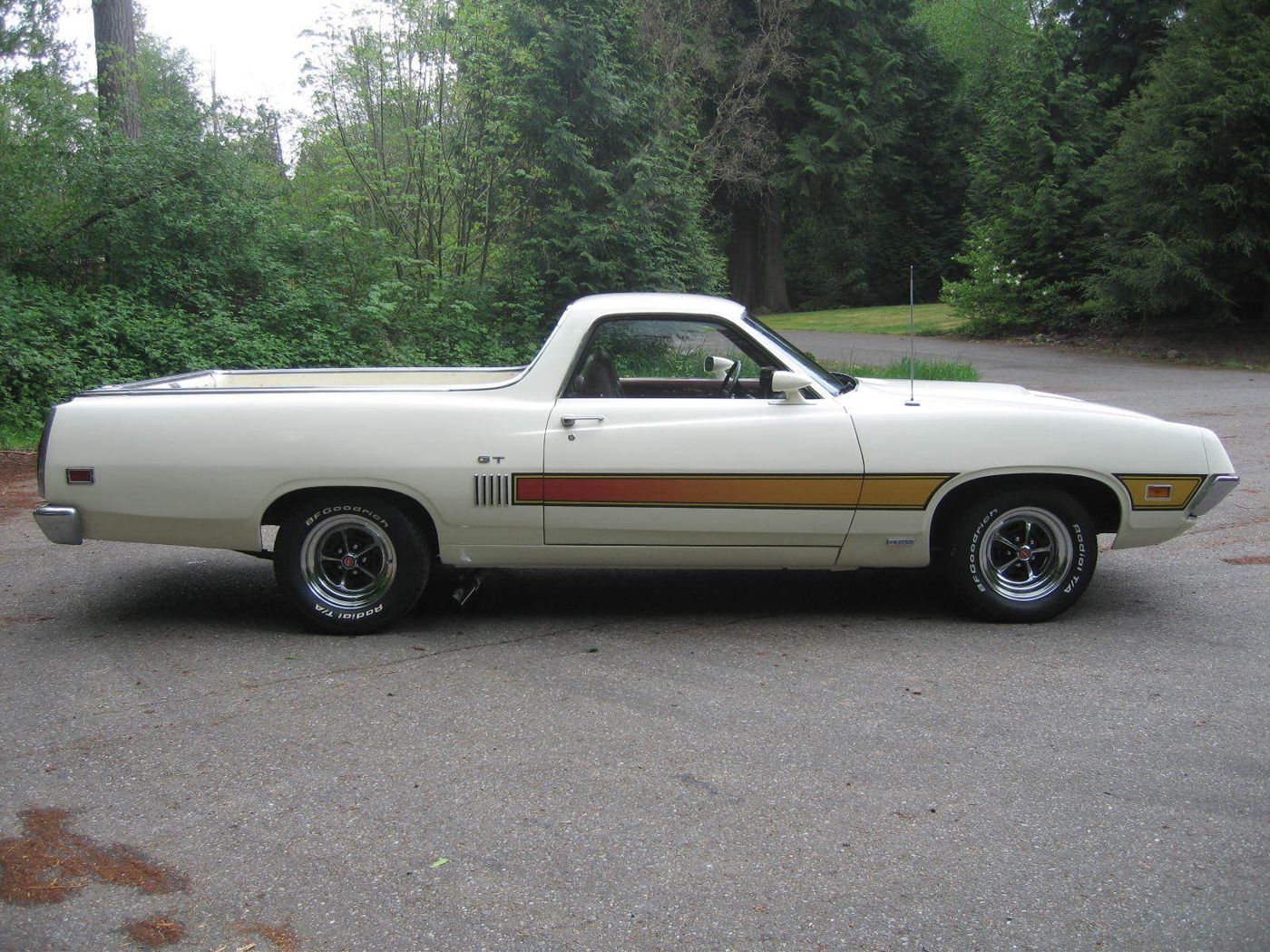
Ford showed the first Ranchero at the New York Auto Show on December 8, 1956, according to Classic Industries, and Wikipedia calls it the first postwar American vehicle of its type adapted at the factory from a popular sedan. By 1970 the idea had moved through three families of Fords. Autoevolution traces it from the full-size 1957 line, which ended after 1959 on poor sales, to the compact Falcon from 1960 to 1965, the intermediate Fairlane for 1966 and 1967, and the Torino from 1968. That last move gave the 1970 Ranchero GT access to the biggest engines Ford put in an intermediate.1,2,3,3
The 1970 Ranchero was restyled with the new Torino. Wikipedia describes smoother, more curvaceous lines influenced by coke-bottle styling, and Classic Industries says Ford's designers gave the fifth-generation Ranchero the Torino's grille and front end. The line had four trims for the first time: base, 500, GT, and a new Squire with woodgrain applique like the Country Squire wagon's. Buyers could order hide-away headlamps in the grille, and Classic Industries notes that a large hood scoop, standard on the Torino GT, could also be had on the Ranchero.2,1
The GT name was not new. Wikipedia says the larger 1968 Ranchero came in three trims, base, 500 and a top-of-the-line GT, with engines up to the 428 Cobra Jet. For 1970 the GT remained the performance Ranchero. Autoevolution lists hidden headlamps, laser-stripe graphics and the shaker hood among its features. Its standard engine was a 220-horsepower two-barrel 302 Windsor, and the 351 was offered at 250 and 300 horsepower. Barn Finds writer Russ Dixon describes the GT as the performance version of the pickup, available with Ram Air on the 429 and a shaker hood. Those equipment lists come from secondary histories rather than a Ford order guide, so exactly which items were standard on the GT and which were extra-cost options is not settled.3,4,2
At the top of the list were the same 429s that powered the Torino Cobra. Autoevolution lists three: the 360-horsepower Thunder Jet, offered in 1970 only; the 370-horsepower Cobra Jet with optional Ram Air; and the 375-horsepower Super Cobra Jet that came with the Drag Pack, including four-bolt main bearings and forged aluminum pistons. Over-Drive Magazine's 1970 Torino fact sheet gives the same three ratings for the Torino's 429s. All are SAE gross factory ratings. No period road test of a 1970 Ranchero GT with any 429 was found.3,2,5
Barn Finds gives 21,640 Rancheros built for 1970, and two of its writers agree on that total. They disagree about the GT. Russ Dixon writes that 3,905 of the 21,640 were GTs; Jim O'Donnell puts the 1970 GT count at 3,600. Neither names a source. Taken at either figure, the GT was about 17 or 18 percent of Ranchero output. Both are reported figures from the same publisher, and neither can be preferred on the evidence available; the 3,600 is expressly rounded, while the 3,905 is stated as an exact count.4,6
The 429 cars were a small fraction of those GTs. Autoevolution reports that Ford sold nearly 8,000 Ranchero GTs across 1970 and 1971 and that fewer than 5 percent had a 429. That is a two-year figure with a ceiling, not a count, and it cannot be split into 1970 and 1971 from the sources read. O'Donnell's 3,900 for 1971, added to either 1970 figure, gives between 7,500 and roughly 7,800 GTs over the two years, which is consistent with autoevolution's nearly 8,000.3,6,4
Inside Ford's own intermediate line the Ranchero GT was a specialty item. Over-Drive Magazine's fact sheet lists 56,819 Torino GT SportsRoofs and 7,675 Torino Cobras for 1970, and Wikipedia's Torino history gives 230,411 Torinos in all. Against those figures a few thousand Ranchero GTs, and a few hundred 429 Rancheros at most, were a narrow slice of Torino-based production. The Ranchero shared the Torino's front-end styling and engine range, but it was sold to a much smaller group of buyers.5,7,3
Across town, Chevrolet's car-based pickup sold in much larger numbers. Autoevolution says the Ranchero had always struggled to outsell the El Camino, and that the El Camino SS 454, with the 450-horsepower LS6 available, proved more popular. ChevelleStuff's 1970 style-number table shows 40,728 Malibu El Camino V8s, 539 Malibu El Camino sixes, 5,137 base El Camino V8s and 1,303 base sixes, 47,707 in all. That is more than twice the Ranchero's 21,640 for the same model year. How many El Caminos had the SS 454 is not separately published.3,8
The comparison shows the Ranchero's position in 1970. It offered every performance engine the Torino had, including the Super Cobra Jet with the Drag Pack, in a market where Chevrolet was selling more than twice as many car-based pickups. The GT gave Ford a rival to the El Camino SS on paper. Most Ranchero buyers chose something else: the base, 500 and Squire models accounted for more than four-fifths of 1970 output under either GT figure.3,8,4,6
The Ranchero line grew in 1971. O'Donnell's Barn Finds article gives 24,946 Rancheros for 1971, up from 21,640, with about 3,900 GTs. His 1970 example had the 220-horsepower 302 and a standard bench seat. His 1971 example carried a 351 Cleveland that he suggests may originally have been the 285-horsepower version, and bucket seats with a horizontal band tachometer. Wikipedia places 1970 and 1971 together as the fifth generation, so the 1970 car was the first of a two-year design. Autoevolution lists the Thunder Jet 429 as a 1970-only engine.6,2,3
Across its whole run the Ranchero was never a large seller. Wikipedia and Classic Industries both give 508,355 built from 1957 to 1979. The 1970 GT with a 429 is among the rarest parts of that total, though no source gives an exact count for it. The known figures are a 21,640-car year, a GT count between 3,600 and 3,905 depending on the writer, and a two-year 429 share under 5 percent. Pinning the 1970 figure down will require Ford production records rather than retold totals.2,1,4,6,3
Fact sheet · 1970 · United States
The numbers
1970 Ford Ranchero GT — The Torino-based Ranchero GT could take the 429 Cobra Jet and Super Cobra Jet; reference counts give 3,905 GTs, while Barn Finds rounds the GT figure to about 3,600 of 21,640 Rancheros.
Coverage: Partial — researched sections are shown; missing ones are not yet sourced. Researched through 2026-09-25.
Every figure is labeled with how sure we are. Reported means a manufacturer, registry, or reference figure we cite but have not reconciled against factory records ourselves. Disputed means credible sources disagree and both are shown. Rows are separately scoped; don't add them together unless the note says they make up a total.
Production
| What was counted | Count | Basis | Status |
|---|---|---|---|
| All 1970 Rancheros6 all trims · coupe utility · as published | 21,640 | sold, model-year | Reported |
| What was counted | Count | Basis | Status |
|---|---|---|---|
| Ranchero GT (rounded)6 GT · coupe utility · as published Rounded; other secondary material gives 3,905 for 1970. See unpublished leads. | 3,600 | sold, model-year | Reported |
| Ranchero GT9,10 GT · sedan pickup · as published | 3,905 | built, model-year | Reported |
| What was counted | Count | Basis | Status |
|---|---|---|---|
| Ranchero (base)9 Ranchero (base) · sedan pickup · as published Not a GT; context for the GT share. | 4,816 | built, model-year | Reported |
| Ranchero 5009,10 Ranchero 500 · sedan pickup · as published Not a GT; context for the GT share. | 8,976 | built, model-year | Reported |
| Ranchero Squire9,10 Squire · sedan pickup · as published Not a GT; context for the GT share. | 3,943 | built, model-year | Reported |
The GT, 500 and Squire counts each now match a second, named lineage: The Production Figure Book for U.S. Cars (Jerry Heasley, 1977), read via search-inside snippets, gives the identical 3,905 / 8,976 / 3,943 figures (alongside the separate, rounded 3,600 sales figure from Barn Finds). This does not confirm either compilation against a Ford record, but it is no longer a single-source figure.
Rows are separately scoped; do not add them.
Ranchero counts above come from Ford-Torino.de's production overview, an enthusiast reference site in the Standard Catalog lineage; the forum list in the unpublished leads gives the same figures.
Prices when new *
| Model | Price | Basis |
|---|---|---|
| Ranchero, base (not GT; context) | $2,643.89 | manufacturer's suggested retail, as printed in a 'Ford Recreation Vehicles' price panel alongside Bronco and F-Series prices, not broken out by Ranchero trim, 1970 model year (form revised 1969-12-19) |
Prices are the nominal dollars of the day, not adjusted for inflation.
This page used to also show a price sourced to J.D. Power's live valuation pages, pulled from every page on this site on 2026-09-24 because those pages can change without our knowing and we have no way to check them independently. A price for this car elsewhere that looks suspiciously exact to what J.D. Power showed may be quoting that same figure rather than confirming it — several sites we checked turned out to be doing exactly that, without saying so.
Engines
| Engine | Factory rating | Availability | Built |
|---|---|---|---|
| 429 Cobra Jet V8 4-bbl (Ram Air optional)3,2 429 cu in · 4-barrel | 370 hp (SAE gross) | optional | Not yet sourced |
| 429 Super Cobra Jet V8 (Drag Pack)3 429 cu in · 4-barrel | 375 hp (SAE gross) | optional | Not yet sourced |
| 429 Thunder Jet V83 429 cu in · 4-barrel | 360 hp (SAE gross) | optional, 1970 only | Not yet sourced |
Ratings are the manufacturer's advertised figures under the standard shown (SAE gross before 1972, SAE net after). They are not dyno results, and gross and net ratings can't be compared directly.
Paint
| Code | Color | Built |
|---|---|---|
A |
Black11 | Not yet sourced |
B |
Dark Maroon11 | Not yet sourced |
C |
Dark Ivy Green Metallic11 | Not yet sourced |
D |
Bright Yellow11 | Not yet sourced |
E |
Light Blue11 | Not yet sourced |
F |
Dark Aqua Metallic11 | Not yet sourced |
G |
Medium Avocado Metallic11 | Not yet sourced |
H |
Light Green11 | Not yet sourced |
I |
Dark Orchid Metallic11 | Not yet sourced |
J |
Bright Blue Metallic11 | Not yet sourced |
K |
Yellow Metallic11 | Not yet sourced |
L |
Light Gray Metallic11 | Not yet sourced |
M |
White11 | Not yet sourced |
N |
Platinum11 | Not yet sourced |
O |
Burnt Orange Metallic11 | Not yet sourced |
P |
Medium Ivy Green Metallic11 | Not yet sourced |
Q |
Medium Blue Metallic11 | Not yet sourced |
R |
Dark Brown Metallic11 | Not yet sourced |
S |
Nugget Gold Metallic11 | Not yet sourced |
T |
Candyapple Red11 | Not yet sourced |
U |
Medium Aqua Metallic11 | Not yet sourced |
W |
Yellow11 | Not yet sourced |
X |
Dark Blue11 | Not yet sourced |
Y |
Chestnut Metallic11 | Not yet sourced |
Z |
Dark Slate Gray Metallic11 | Not yet sourced |
1 |
Calypso Coral11 | Not yet sourced |
2 |
Light Ivy Yellow11 | Not yet sourced |
5 |
Medium Brown Metallic11 | Not yet sourced |
Color names are the factory's. We don't show color swatches, because a screen color is no guide for a restoration.
Where the sources disagree
Identification
Read a 1970 Ford VIN
The VIN decoder runs in your browser and never sends the VIN anywhere. How the factory numbered this year's cars:
Same model year
Also in 1970
- AMC AMX The last two-seat AMX: a restyled nose, a 360 base V8 and a 325-hp 390. At 4,116 cars it was the rarest of the three two-seat years.
- AMC Javelin Penske and Donohue brought the Javelin to Trans-Am, and the showroom answered with 2,501 Mark Donohue Javelins and 100 red-white-blue Trans Am Javelins, while total production fell to 28,210.
- AMC Rebel and Rebel Machine AMC's intermediate supercar: a 340-hp 390, four-speed and Hurst shifter in the Rebel hardtop, first in white with red-white-blue stripes. Totals reported for the one-year run range from about 1,200 to 2,326.
- Buick Riviera The 455 (370 hp gross) arrived with a restyle; production fell to about 37,300 with some 3,505 GS cars.
- Buick Skylark Gran Sport, GS and GSX Buick's GS went to a 455 rated at 510 lb-ft, the Stage 1 option added 10 advertised hp, and a mid-year GSX package was built 678 times in two colors.
- Buick Wildcat The final Wildcat, Custom trim only, with the 370-hp 455; 23,645 built.
- Chevrolet Chevelle and Malibu SS The year the Chevelle Super Sport split into RPO Z25 SS 396 and RPO Z15 SS 454, with the LS6 454 rated at 450 gross horsepower.
- Chevrolet Chevy II and Nova Last year the source engine table lists the big-block (as 402) in the Nova. Enthusiast-compiled production: 307,280 cars; Super Sport 19,558.
- Chevrolet El Camino SS The Malibu/Custom El Camino could carry either RPO Z25 SS 396 or RPO Z15 SS 454, including the 450 hp LS6; the El Camino share is not separately published.
- Chevrolet Monte Carlo SS The first Monte Carlo, with the SS 454 as RPO Z20: 3,823 of 145,976 Monte Carlos per Chevrolet-report-derived tables.
- Dodge Challenger Dodge's first pony car arrived as a 1970 model with nine advertised engines, base, SE, R/T, and R/T SE hardtops, two convertibles, and a one-year Trans-Am homologation special, the T/A.
- Dodge Charger The last year of the second-generation body: a new full-width grille, three series (Charger, 500, R/T), the 440 Six Pack added to the R/T, and production roughly half of 1969's.
- Dodge Coronet R/T and Super Bee The final Coronet-based R/T and Super Bee: the R/T fell to 2,615 cars, while the Super Bee added a 3-speed manual and kept its Six Pack and Hemi options.
- Dodge Dart GTS, Swinger and Demon With the GTS gone, the Swinger 340 was the only performance Dart; it kept front discs, Rallye suspension and a twin-scoop hood and sold about 13,800 beside the new Challenger.
- Ford Fairlane The last Fairlane year: the name survived only on the Fairlane 500 beneath the new Torino, with a mid-year Falcon sharing the body at the bottom of the range.
- Ford Maverick Grabber The Grabber appearance and tire package arrived in mid-1970 on the new two-door Maverick; no Grabber count for 1970 was found.
- Ford Thunderbird The 429 at 360 hp was the standard and only engine listed in the 1970 catalog.
- Ford Torino A new, longer body on a 117-inch wheelbase; the Torino Cobra became its own model with the 429, offered in 360, 370 (Cobra Jet) and 375 (Super Cobra Jet) horsepower forms.
- Mercury Comet and Cyclone A new, longer Montego-based Cyclone in three versions: the 429 Cyclone, the small-block Cyclone GT that outsold both others, and the Ram Air 429 Cobra Jet Cyclone Spoiler.
- Mercury Cougar The last first-generation Cougar moved to the 351 Cleveland, kept the Boss 302 as an Eliminator-only engine, and built 2,268 Eliminators.
- Mercury Marauder and S-55 The second and last year of the 1969-70 Marauder: production fell to about a third of 1969's, with the X-100 near half of it.
- Oldsmobile Cutlass, 4-4-2 and Hurst/Olds The 4-4-2 got a standard 455 rated at 365 hp, the W-30 went to 370 hp, and the small-block W-31 moved to the Cutlass and F-85 coupes.
- Plymouth Barracuda and 'Cuda The E-body redesign split the line into Barracuda, Gran Coupe, and 'Cuda hardtops and convertibles, put every Chrysler performance engine through the 426 Hemi on the order form, and added the one-year AAR 'Cuda for Trans-Am homologation.
- Plymouth Duster 340 and 360 Plymouth's new Valiant-based fastback coupe arrived with a 275 hp 340 performance model priced at $2,547; the Standard Catalog lineage counts 24,817 Duster 340s among 217,192 Dusters.
- Plymouth GTX, Belvedere and Satellite Now hardtop-only, the GTX fell to 7,748 cars while its 440 Six Barrel option cost just $119.
- Plymouth Road Runner Production halved from 1969, the 440 Six Barrel became a regular option, and the winged Superbird was built as a Road Runner hardtop to put Plymouth back on NASCAR superspeedways.
- Pontiac Firebird and Trans Am A late-arriving, coupe-only second generation: 48,739 Firebirds, 3,196 of them Trans Ams, and 88 Ram Air IVs.
- Pontiac GTO A new Endura nose, a 455 added beside the three 400s, and GTO production falling to 40,149.
- Pontiac Grand Prix The SJ took a 370 hp 455, Hurst built the SSJ, and production fell to 65,750.
- Pontiac Tempest and LeMans The T-37 and GT-37 bring budget performance to the Tempest.