1970 · Pontiac · United States
1970 Pontiac Grand Prix: The 455 SJ and the Hurst SSJ
The SJ took a 370 hp 455, Hurst built the SSJ, and production fell to 65,750.
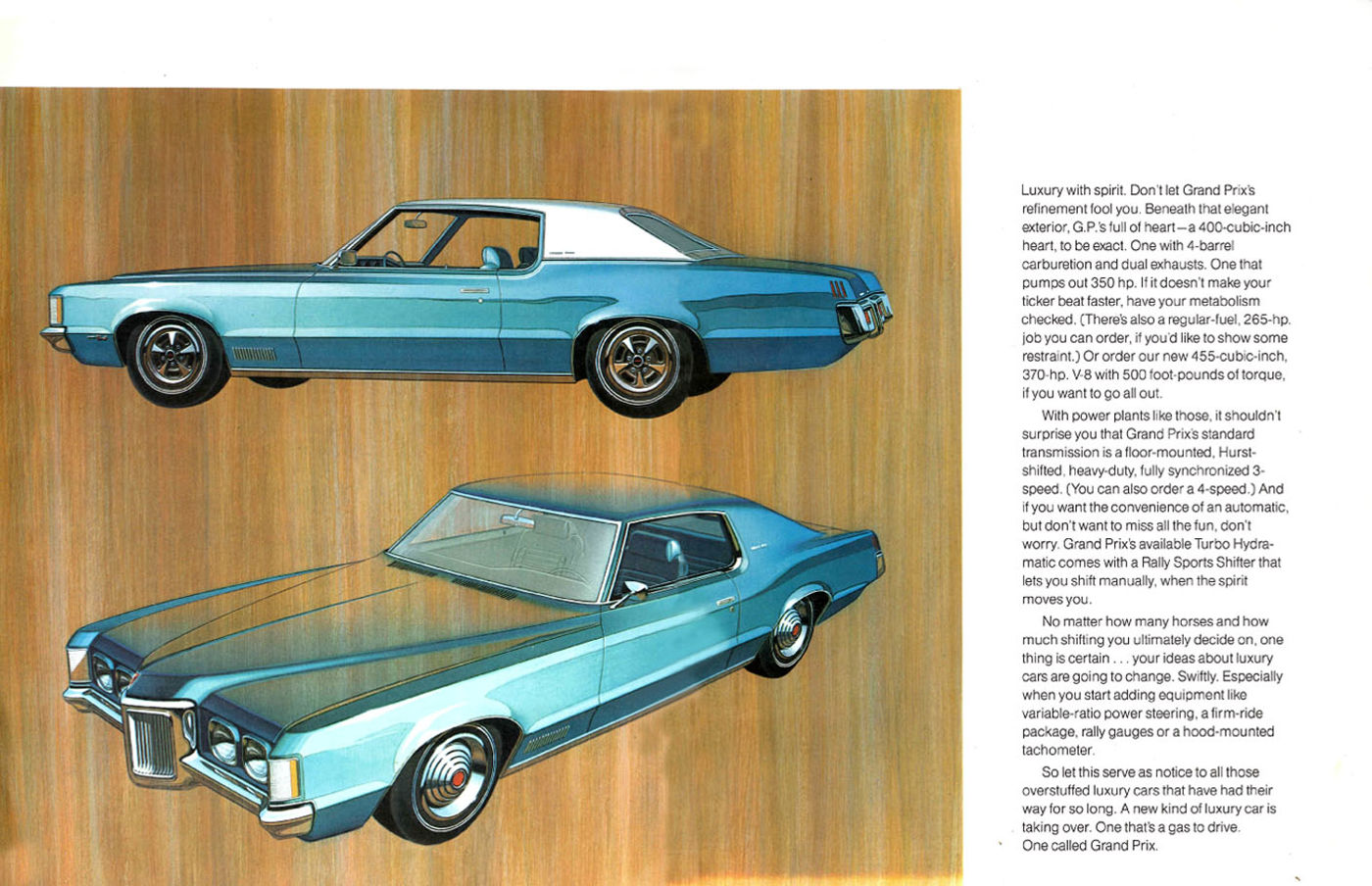
The 1970 SJ replaced the 428 with a 455 rated at 370 hp and 500 lb-ft. Pontiac also made power front disc brakes standard and brought back a no-cost bench-seat option. The Hurst SSJ conversion added Fire Frost Gold accents, Rally wheels, an electric sunroof and vinyl half-top for $1,147.25. Pontiac built 65,750 Grand Prix, listed at $3,985.1,2
The engine menu included a 265-hp two-barrel 400 for regular fuel, automatic only; a 350-hp four-barrel 400; and the SJ's 370-hp 455. A three-speed manual came standard, with four-speed and Turbo-400 automatic options each listed at $226. One article reports 329 four-speed cars across J and SJ trims, a reported figure rather than a factory one. The economy 400 ran 8.6:1 compression and made 397 lb-ft at 2,400 rpm; the four-barrel engines ran 10.25:1, the 400 making 445 lb-ft at 3,000 rpm and the 455 its 500 lb-ft at 3,100.1,3
Pontiac's option list ranged from the $223 SJ package to a leather trim group, Rally gauges, capacitor ignition, air conditioning, cruise control, power seats and windows, and AM/FM stereo. Smaller choices included cornering lamps, an electric clock, a hood tachometer, tinted glass, a rear defogger and a visor vanity mirror. The Hurst SSJ conversion had its own $1,147.25 price. Air conditioning cost $422, the AM/FM stereo $239, Rally gauges $84, capacitor ignition $104 to $115, and the hood tachometer and Rally II wheels $63 each. Power steering cost $105 and the leather trim group $199, giving buyers more than the exterior SSJ package to tailor the Grand Prix.1
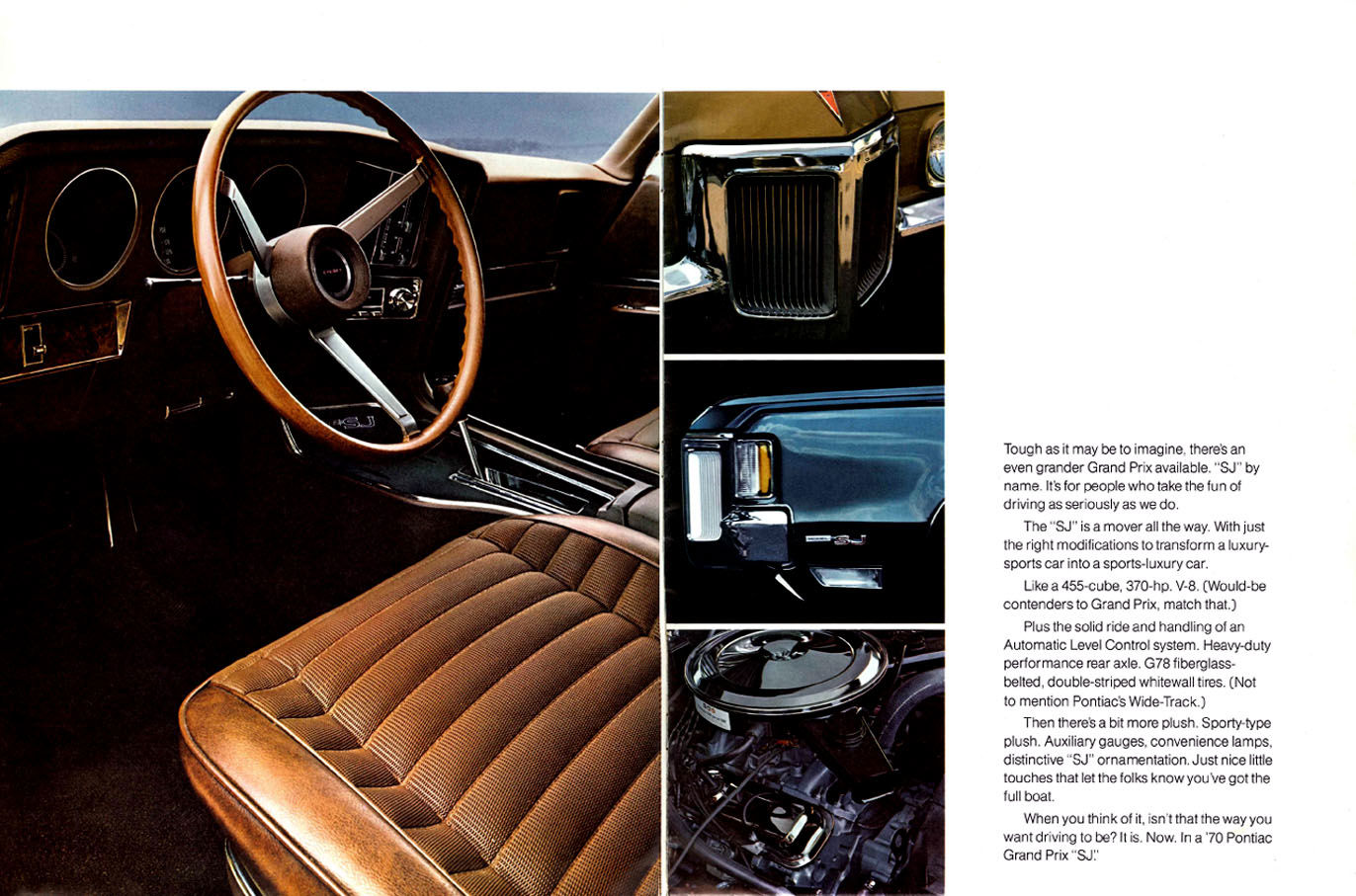
Pontiac offered Strato bucket seats with console and floor shift, or a no-cost bench seat with center armrest on cars using column shift and a three-speed manual or automatic; the bench was not paired with the four-speed. The optional Leather Trim Group added another cabin choice. Hurst's SSJ used a separate interior palette, with black, brown, gold, saddle or sandalwood depending on seat type and surface. The factory sheet differs on the SSJ's base exterior color: one section says Cameo White and another says Polar White; both name Starlight Black as the alternative and Fire Frost Gold accents.1
The 1970 coupe had an 118-inch wheelbase, measured 210.2 inches long and weighed 3,784 pounds shipping. Pontiac listed G78-by-14 tires standard and G70-by-14 optional. Axle ratios depended on engine and transmission: the four-speed 400 used 3.55:1; the 455 automatic used 3.07:1, with 3.31 optional; the 455 three-speed used 3.31; and the four-speed 455 used 3.55. It stood 52 inches high and 75.7 inches wide on a 62-inch front and 60-inch rear track. The three-speed ran 2.42/1.61/1.00, the four-speed 2.52/1.88/1.46/1.00 and the Turbo Hydra-Matic 2.48/1.48/1.00.1,2
The compiled production table identifies the Grand Prix as Series 266, body 26657, and gives a 121-inch wheelbase; Pontiac's fact sheet identifies Series 276 and gives the 118-inch wheelbase of the new body. Pontiac's color chart ran to 21 colors, from Polar White, Palladium Silver and Starlight Black through Bermuda, Lucerne and Atoll Blue, Mint Turquoise, four greens, two yellows and three golds to Palomino Copper, Castilian Bronze, Carousel Red, Cardinal Red and Burgundy.2,1
Fact sheet · 1970 · United States
The numbers
1970 Pontiac Grand Prix and SJ 455: The SJ took a 370 hp 455, Hurst built the SSJ, and production fell to 65,750.
Figures may describe different groups of cars. Add rows together only when the note says they make up a total.
Key facts
Production
| What was counted | Built |
|---|---|
| Grand Prix 2-door sport coupe2,1,4 Grand Prix · 2-door sport coupe | 65,750 |
| What was counted | Built |
|---|---|
| Grand Prix with four-speed manual3 Grand Prix (J and SJ) · 2-door sport coupe · four-speed manual A subset of the total. | 329 |
Prices when new
| Model | Price | Price type |
|---|---|---|
| Grand Prix 2-door sport coupe2 | $3,985 | factory price, 1970 model year |
Prices are the nominal dollars of the day, not adjusted for inflation.
Engines
| Engine | Factory rating | Availability |
|---|---|---|
| 400 2-bbl economy1 400 cu in · 2-barrel, 8.6:1 | 265 hp @ 4,600, 397 lb-ft @ 2,400 (SAE gross (period advertised rating)) | automatic only |
| 400 4-bbl1 400 cu in · 4-barrel, 10.25:1 | 350 hp @ 5,000, 445 lb-ft @ 3,000 (SAE gross (period advertised rating)) | standard |
| 455 4-bbl1 455 cu in · 4-barrel, 10.25:1 | 370 hp @ 4,600, 500 lb-ft @ 3,100 (SAE gross (period advertised rating)) | SJ |
Ratings are published figures, not dyno results. Gross and net ratings aren't directly comparable.
Transmissions
| Transmission | Availability |
|---|---|
| Three-speed manual1 | standard |
| Four-speed manual1 | optional, $226 |
| Turbo-400 Hydra-Matic1 | optional, $226 |
Options and packages
| Option | Price |
|---|---|
| SJ package (price range as listed)1 | $223 |
| Hurst SSJ package1 | $1,147.25 |
| Leather Trim Group1 | $199 |
| Rally gauge cluster1 | $84 |
| Capacitor ignition (price range)1 | $104 |
| Air conditioner1 | $422 |
| Automatic level control1 | $79 |
| Cordova top1 | $105 |
| Cornering lamps1 | $34 |
| Cruise control1 | $63 |
| Door edge guards1 | $6 |
| Electric clock1 | $16 |
| Hood-mounted tachometer1 | $63 |
| Mirror, rear view glare-proof tilt1 | $4 |
| Mirror, remote control outside rear view1 | $12 |
| Power brakes1 | $42 |
| Power bucket seat, left-hand1 | $69 |
| Power steering1 | $105 |
| Power windows1 | $104 |
| Radio, AM/FM stereo1 | $239 |
| Radio, push-button AM1 | $89 |
| Radio, push-button AM/FM1 | $151 |
| Rally II wheels1 | $63 |
| Rear window defogger1 | $41 |
| Remote control deck lid release1 | $14 |
| Ride and Handling package1 | $9 |
| Safeguard speedometer1 | $16 |
| Tinted glass1 | $43 |
| Tinted windshield1 | $29 |
| Under-hood utility lamp1 | $7 |
| Visor vanity mirror1 | $4 |
Paint
| Code | Color |
|---|---|
10 |
Polar White1 |
14 |
Palladium Silver1 |
19 |
Starlight Black1 |
25 |
Bermuda Blue1 |
26 |
Lucerne Blue1 |
28 |
Atoll Blue1 |
34 |
Mint Turquoise1 |
43 |
Keylime Green1 |
45 |
Palisade Green1 |
47 |
Verdoro Green1 |
48 |
Pepper Green1 |
50 |
Sierra Yellow1 |
51 |
Goldenrod Yellow1 |
53 |
Coronado Gold1 |
55 |
Baja Gold1 |
58 |
Granada Gold1 |
63 |
Palomino Copper1 |
65 |
Carousel Red1 |
67 |
Castilian Bronze1 |
75 |
Cardinal Red1 |
78 |
Burgundy1 |
Color names are the factory's. We don't show color swatches, because a screen color is no guide for a restoration.
Interiors
| Trim |
|---|
| Strato bucket seats standard; bench seat with armrest a no-cost option; Leather Trim Group optional1 |
| Strato bucket seats with integral console and floor shift standard; bench seat with center armrest a no-cost option (column shift, three-speed manual or automatic only, four-speed not available with the bench). Carpeted lower door panels and special upholstery trims.1 |
| Hurst SSJ conversion: interior colors limited to black, brown, gold, saddle or sandalwood, depending on seat type and surface.1 |
Specifications
| Measure | Value | Applies to |
|---|---|---|
| Wheelbase1 | 118 in | Grand Prix |
| Overall length1 | 210.2 in | Grand Prix |
| Overall height1 | 52 in | Grand Prix |
| Overall width1 | 75.7 in | Grand Prix |
| Front track1 | 62 in | Grand Prix |
| Rear track1 | 60 in | Grand Prix |
| Tires1 | G78 x 14 standard; G70 x 14 optional | Grand Prix |
| Shipping weight2 | 3,784 lb | Grand Prix sport coupe |
| Transmission ratios1 | 3-speed 2.42/1.61/1.00; 4-speed 2.52/1.88/1.46/1.00 (special order 2.20/1.64/1.28/1.00); Turbo Hydra-Matic 400 2.48/1.48/1.00 :1 | Grand Prix |
| Rear axle ratios1 | 400 350 hp four-speed 3.55; 455 370 hp automatic 3.07 (3.31 optional), three-speed 3.31, four-speed 3.55 :1 | Grand Prix |
| Brakes1 | Power front disc brakes standard (new for 1970) | Grand Prix |
| Hurst SSJ base colors1 | Ordered in Cameo White or Starlight Black (the fact sheet also says Polar White or Starlight Black) with Fire Frost Gold accents | Hurst SSJ conversion (not Pontiac factory production) |
Identification
- Series and body
- Series 266, body 26657.2
- Series (fact sheet)
- The Over-Drive fact sheet identifies the 1970 Grand Prix as Series 276; the compiled production table shows series 266, body 26657 and a 121-inch wheelbase (see Where the sources disagree, below).1
Where the sources disagree
Identification
Read a 1970 Pontiac VIN
The VIN decoder runs in your browser and never sends the VIN anywhere. How the factory numbered this year's cars:
Same model year
Also in 1970
- AMC AMX The last two-seat AMX: a restyled nose, a 360 base V8 and a 325-hp 390. At 4,116 cars it was the rarest of the three two-seat years.
- AMC Javelin Penske and Donohue brought the Javelin to Trans-Am, and the showroom answered with 2,501 Mark Donohue Javelins and 100 red-white-blue Trans Am Javelins, while total production fell to 28,210.
- AMC Rebel and Rebel Machine AMC's intermediate supercar: a 340-hp 390, four-speed and Hurst shifter in the Rebel hardtop, first in white with red-white-blue stripes. Totals reported for the one-year run range from about 1,200 to 2,326.
- Buick Riviera The 455 (370 hp gross) arrived with a restyle; production fell to about 37,300 with some 3,505 GS cars.
- Buick Skylark Gran Sport, GS and GSX Buick's GS went to a 455 rated at 510 lb-ft, the Stage 1 option added 10 advertised hp, and a mid-year GSX package was built 678 times in two colors.
- Buick Wildcat The final Wildcat, Custom trim only, with the 370-hp 455; 23,645 built.
- Chevrolet Chevelle and Malibu SS The year the Chevelle Super Sport split into RPO Z25 SS 396 and RPO Z15 SS 454, with the LS6 454 rated at 450 gross horsepower.
- Chevrolet Chevy II and Nova Last year the source engine table lists the big-block (as 402) in the Nova. Enthusiast-compiled production: 307,280 cars; Super Sport 19,558.
- Chevrolet El Camino SS The Malibu/Custom El Camino could carry RPO Z25 SS 396 or RPO Z15 SS 454, including the 450 hp LS6; 8,773 Z15s across Malibu models.
- Chevrolet Monte Carlo SS The first Monte Carlo, with the SS 454 as RPO Z20: 3,823 of 145,976 Monte Carlos per Chevrolet-report-derived tables.
- Dodge Challenger Dodge's first pony car arrived as a 1970 model with nine advertised engines, base, SE, R/T, and R/T SE hardtops, two convertibles, and a one-year Trans-Am homologation special, the T/A.
- Dodge Charger The last year of the second-generation body: a new full-width grille, three series (Charger, 500, R/T), the 440 Six Pack added to the R/T, and production roughly half of 1969's.
- Dodge Coronet R/T and Super Bee The final Coronet-based R/T and Super Bee: the R/T fell to 2,615 cars, while the Super Bee added a 3-speed manual and kept its Six Pack and Hemi options.
- Dodge Dart GTS, Swinger and Demon With the GTS gone, the Swinger 340 was the only performance Dart; it kept front discs, Rallye suspension and a twin-scoop hood and sold about 13,800 beside the new Challenger.
- Ford Fairlane The last Fairlane year: the name survived only on the Fairlane 500 beneath the new Torino, with a mid-year Falcon sharing the body at the bottom of the range.
- Ford Maverick Grabber The $179 Grabber package of stripes, a spoiler and a blacked-out grille arrived mid-1970 on the new two-door Maverick.
- Ford Ranchero GT The Torino-based Ranchero GT could take the 429 Cobra Jet and Super Cobra Jet; reference counts give 3,905 GTs, while Barn Finds rounds the GT figure to about 3,600 of 21,640 Rancheros.
- Ford Thunderbird The 429 at 360 hp was the standard and only engine listed in the 1970 catalog.
- Ford Torino A new, longer body on a 117-inch wheelbase; the Torino Cobra became its own model with the 429, offered in 360, 370 (Cobra Jet) and 375 (Super Cobra Jet) horsepower forms.
- Mercury Comet and Cyclone A new, longer Montego-based Cyclone in three versions: the 429 Cyclone, the small-block Cyclone GT that outsold both others, and the Ram Air 429 Cobra Jet Cyclone Spoiler.
- Mercury Cougar The last first-generation Cougar moved to the 351 Cleveland, kept the Boss 302 as an Eliminator-only engine, and built 2,268 Eliminators.
- Mercury Marauder and S-55 The second and last year of the 1969-70 Marauder: production fell to about a third of 1969's, with the X-100 near half of it.
- Oldsmobile Cutlass, 4-4-2 and Hurst/Olds The 4-4-2 got a standard 455 rated at 365 hp, the W-30 went to 370 hp, and the small-block W-31 moved to the Cutlass and F-85 coupes.
- Plymouth Barracuda and 'Cuda The E-body redesign split the line into Barracuda, Gran Coupe, and 'Cuda hardtops and convertibles, put every Chrysler performance engine through the 426 Hemi on the order form, and added the one-year AAR 'Cuda for Trans-Am homologation.
- Plymouth Duster 340 and 360 Plymouth's new Valiant-based fastback coupe arrived with a 275 hp 340 performance model at $2,547; 24,817 Duster 340s among 217,192 Dusters.
- Plymouth GTX, Belvedere and Satellite Now hardtop-only, the GTX fell to 7,748 cars while its 440 Six Barrel option cost just $119.
- Plymouth Road Runner Production halved from 1969, the 440 Six Barrel became a regular option, and the winged Superbird was built as a Road Runner hardtop to put Plymouth back on NASCAR superspeedways.
- Pontiac Firebird and Trans Am A late-arriving, coupe-only second generation: 48,739 Firebirds, 3,196 of them Trans Ams, and 88 Ram Air IVs.
- Pontiac GTO A new Endura nose, a 455 added beside the three 400s, and GTO production falling to 40,149.
- Pontiac Tempest and LeMans The T-37 and GT-37 bring budget performance to the Tempest.