1969 · Dodge · United States
1969 Dodge Super Bee and Coronet R/T: The Six Pack Year, and the A12 That Came Without Hubcaps
The Super Bee added a hardtop body and the 440 Six Pack, while the 440-powered Coronet R/T continued as the upscale hardtop and convertible.
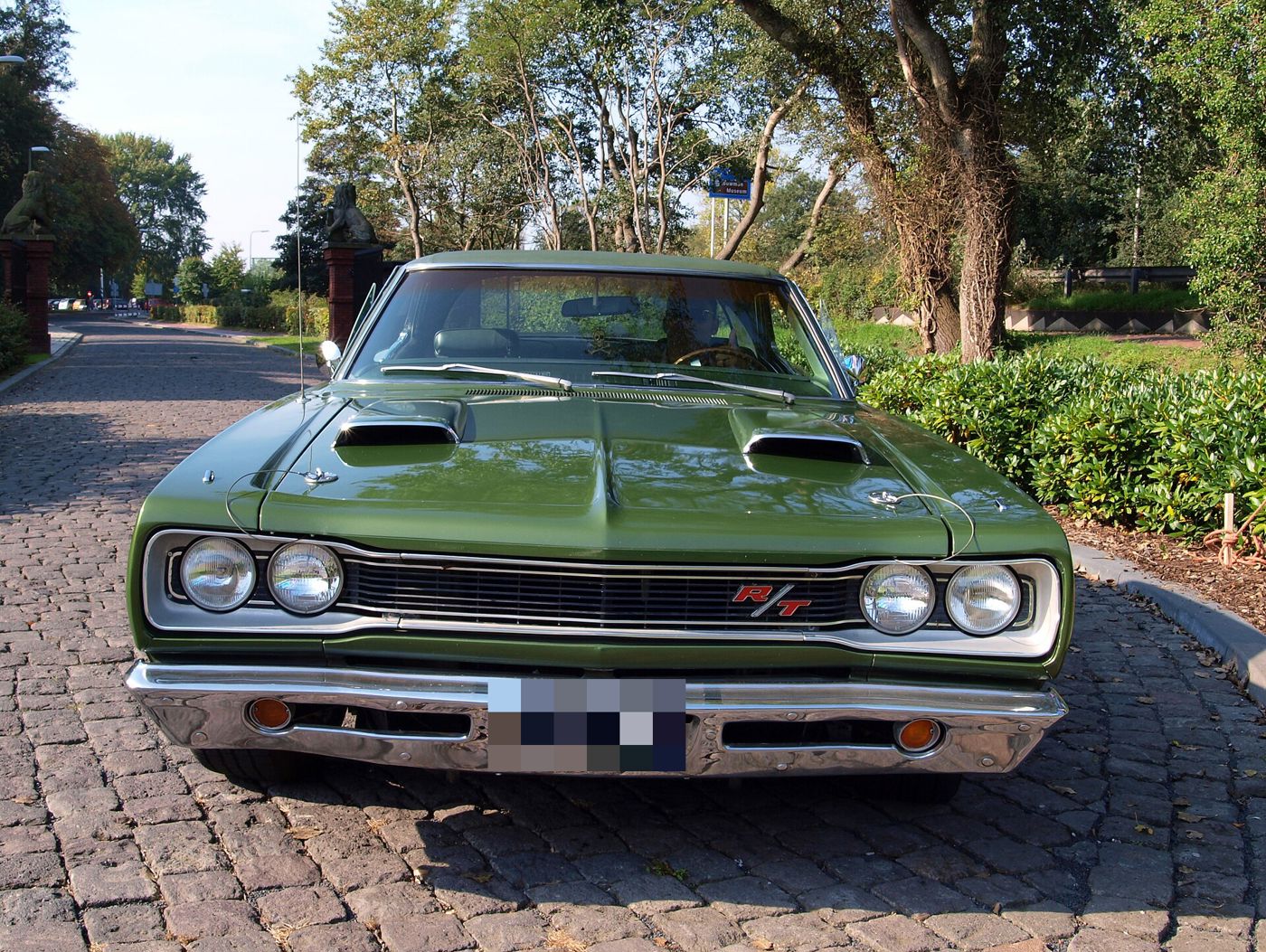

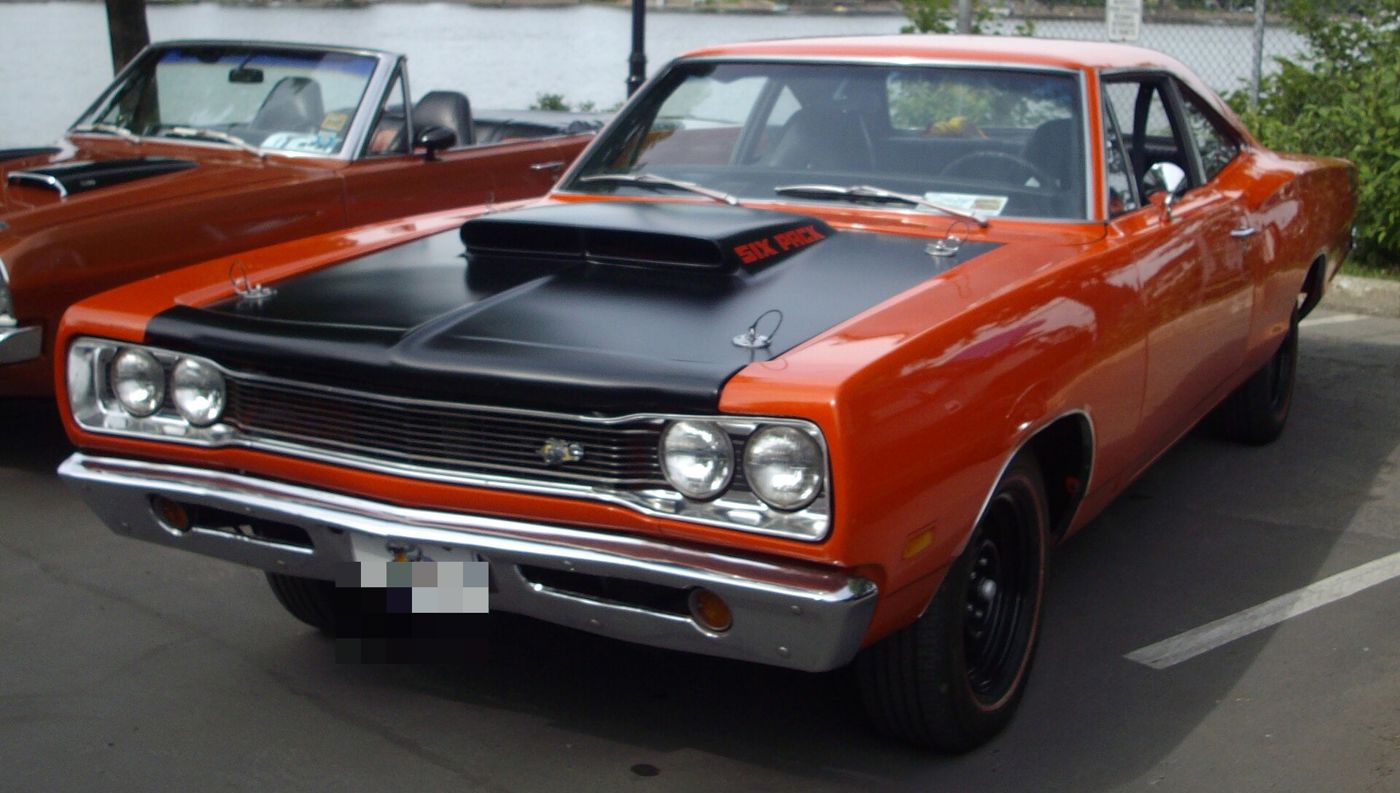
Partway through 1969, Dodge offered a Super Bee that looked unfinished on purpose. The A12 package was a 440 with a special camshaft, 10.5:1 pistons, magnafluxed connecting rods and a dual-point distributor; an Edelbrock aluminum intake carrying three Holley two-barrel carburettors; a Dana 60 Sure Grip axle; a matte-black, lift-off fibreglass hood with a large scoop; heavy-duty 11-inch drum brakes; and plain black 15x6 steel wheels on G70-15 Polyglas redline tyres, with no hubcaps. Power steering and power brakes were not part of it. The buyer chose a heavy-duty TorqueFlite or a Hurst-shifted four-speed. It was a package built around the drivetrain and very little else.1
The A12's 440 Six Pack was rated at 390 hp and 490 lb-ft. Its price is disputed: the Super Bee Registry's history puts it at around $460, while Over-Drive's options list prices the 440 Six Pack at $395 in the base Coronet, Coronet R/T and Super Bee. Dodge built 1,907 A12 Super Bees as mid-1969 special orders, and the Super Bee Registry's four US Six Pack rows add to exactly the same figure. That is 7.2 percent of the 26,563 Super Bees the registry counts for US dealers that year.1,2,3,4
The Six Pack arrived in a Super Bee line that had already grown. For 1969 Dodge added a two-door hardtop, style WM23, to the pillared coupe (WM21) that had launched the car the previous spring. The new hardtop listed at $3,138 and weighed 3,470 lb. The 383 remained standard. A Ramcharger fresh-air hood with two large scoops was among the year's additions, along with a fibreglass hood with four NASCAR-style tie-down pins, which matches the lift-off A12 hood described above. Buyers now had three distinct Super Bees to choose from, the 383, the Six Pack and the Hemi, in two bodies, and the production tables record every combination by transmission.5,3,2

The hardtop immediately became the main Super Bee. The registry counts 18,361 US hardtops and 8,202 US coupes. With the 383, the hardtop went 9,346 automatic and 7,363 four-speed, and the coupe 3,695 automatic and 3,427 four-speed, the coupe figures matching Mueller's source book exactly. Across both bodies, about 45 percent of 383 Super Bees had the four-speed, up from 38 percent in the 1968 coupe. The Six Pack cars leaned harder toward the manual: 826 four-speed and 661 automatic hardtops, 267 four-speed and 153 automatic coupes, so 57 percent of A12 buyers chose to shift for themselves.3,6
The Hemi was still available and still rare. The registry records 165 US Hemi hardtops, 73 automatic and 92 four-speed, and 91 US Hemi coupes, 53 automatic and 38 four-speed, plus 12 of each body exported to Canada. Its 256 US Hemi Super Bees are under 1 percent of the US total, and fewer than one Hemi was sold for every seven Six Packs. Hemi buyers split almost evenly between four-speed and automatic, 130 to 126. The comparison is the point of 1969. The A12 did not replace the Hemi, but it gave Super Bee buyers a big-inch, triple-carburettor alternative that the registry's own counts show they preferred by a wide margin. For most performance buyers in a Dodge showroom that year, the Six Pack was the top of the realistic range.3
Beside the Super Bee, the Coronet R/T continued as the more expensive big-block Coronet, a hardtop or convertible with the 440 Magnum and TorqueFlite standard. The R/T hardtop (WS23) listed at $3,442 and weighed 3,601 lb, and the convertible (WS27) cost $3,660, so the R/T hardtop cost $304 more than a Super Bee hardtop. Gunnell and Langworth give 7,238 Coronet R/Ts for the year, hardtops and convertibles combined, and Over-Drive's table gives some 7,200. Gunnell counts 97 Hemi hardtops, 58 of them four-speeds, and 10 Hemi convertibles. The Street Hemi cost $718 in the Coronet R/T and $848 in the Super Bee.5,7,8,4
The two cars' fortunes had already crossed. In 1968 the Coronet R/T had the bigger number, 10,849 against the Super Bee's 7,841 US cars from a spring launch. In 1969 the R/T fell to 7,238 while the Super Bee grew to 26,563 US cars in the registry's count; Over-Drive's rounded table puts the Super Bee at 27,800 for coupe and hardtop together. The registry counts US dealer shipments, and Gunnell and Langworth the model year, but every count points one way. Offered a more expensive Coronet with a 440 and an automatic, or a cheaper Coronet with a 383 or a Six Pack, Dodge buyers overwhelmingly chose the cheaper car.8,3,7,4
The A12's appeal was that it put the cost into the drivetrain and left it out of everything else. The list of what the package deleted, the hubcaps, the power steering and power brakes, reads as the other half of its specification. What it kept was hardware: the Dana 60 axle, the strengthened engine internals, the triple carburettors and the fibreglass hood. None of it made the car more comfortable. The production counts show that 1,907 buyers took that trade in a single partial model year, which is more than seven times the number who ordered a Hemi Super Bee in the whole year.1,3
The Six Pack outlived the A12's bare-steel-wheel moment. For 1970 the registry's Super Bee tables still list Six Pack hardtops and coupes, 599 four-speed and 473 automatic hardtops and 109 four-speed and 87 automatic coupes, while Langworth gives the Coronet R/T just 2,615 cars in its final year. For 1971, when the Charger coupe and hardtop replaced the Coronet two-doors, the Super Bee moved into the Charger line, and the registry counts 99 Six Pack cars among its US Super Bees. The formula that 1969 established, a cheap intermediate with the biggest engine bolted into it and the frills left off, stayed in Dodge's lineup for as long as the Super Bee did.3,8,5
Fact sheet · 1969 · United States
The numbers
1969 Dodge Coronet R/T and Super Bee: The Super Bee added a hardtop body and the 440 Six Pack, while the 440-powered Coronet R/T continued as the upscale hardtop and convertible.
Figures may describe different groups of cars. Add rows together only when the note says they make up a total.
Key facts
Production
| What was counted | Built |
|---|---|
| Coronet R/T, hardtop and convertible7,8 Coronet R/T · hardtop and convertible | 7,238 |
| Super Bee, coupe and hardtop (Over-Drive, rounded)4 Super Bee · 2-door coupe and hardtop Rounded; note 1 says there was 'no breakout of Super Bees by type'. | 27,800 |
| Coronet R/T, hardtop and convertible (Over-Drive, rounded)4 R/T · hardtop and convertible Rounded; consistent with Gunnell's 7,238. | 7,200 |
| Coronet (base series), rounded4 Coronet · 2-door and 4-door sedan, 4-door station wagon | 30,400 |
| Coronet 440 (all bodies), rounded4 Coronet 440 · 2-door and 4-door sedan, 2-door hardtop, 4-door station wagon | 105,900 |
| Coronet 500 (all bodies), rounded4 Coronet 500 · 4-door sedan, 2-door hardtop, convertible, 4-door station wagon | 32,100 |
| What was counted | Count | Counted as |
|---|---|---|
| Coronet R/T hardtop, 426 Hemi7 Coronet R/T · 2-door hardtop · 426 Hemi 2x4-bbl | 97 | built |
| Coronet R/T convertible, 426 Hemi7 Coronet R/T · convertible · 426 Hemi 2x4-bbl | 10 | built |
| Super Bee hardtop, 426 Hemi, Canada export3 Super Bee · 2-door hardtop · 426 Hemi 2x4-bbl · Canada | 12 | delivered |
| Super Bee coupe, 426 Hemi, Canada export3 Super Bee · 2-door coupe · 426 Hemi 2x4-bbl · Canada | 12 | delivered |
| What was counted | Count | Counted as |
|---|---|---|
| Coronet R/T hardtop, 426 Hemi, 4-speed7 Coronet R/T · 2-door hardtop · 426 Hemi 2x4-bbl · 4-speed manual | 58 | built |
| Super Bee hardtop, 383, automatic3 Super Bee · 2-door hardtop · 383 4-bbl · 3-speed automatic · US | 9,346 | delivered |
| Super Bee hardtop, 383, 4-speed3 Super Bee · 2-door hardtop · 383 4-bbl · 4-speed manual · US | 7,363 | delivered |
| Super Bee hardtop, 440 Six Pack, automatic3 Super Bee · 2-door hardtop · 440 3x2-bbl · 3-speed automatic · US | 661 | delivered |
| Super Bee hardtop, 440 Six Pack, 4-speed3 Super Bee · 2-door hardtop · 440 3x2-bbl · 4-speed manual · US | 826 | delivered |
| Super Bee hardtop, 426 Hemi, automatic3 Super Bee · 2-door hardtop · 426 Hemi 2x4-bbl · 3-speed automatic · US | 73 | delivered |
| Super Bee hardtop, 426 Hemi, 4-speed3 Super Bee · 2-door hardtop · 426 Hemi 2x4-bbl · 4-speed manual · US | 92 | delivered |
| Super Bee coupe, 383, automatic3,6 Super Bee · 2-door coupe · 383 4-bbl · 3-speed automatic · US | 3,695 | delivered |
| Super Bee coupe, 383, 4-speed3,6 Super Bee · 2-door coupe · 383 4-bbl · 4-speed manual · US | 3,427 | delivered |
| Super Bee coupe, 440 Six Pack, automatic3 Super Bee · 2-door coupe · 440 3x2-bbl · 3-speed automatic · US | 153 | delivered |
| Super Bee coupe, 440 Six Pack, 4-speed3 Super Bee · 2-door coupe · 440 3x2-bbl · 4-speed manual · US | 267 | delivered |
| Super Bee coupe, 426 Hemi, automatic3 Super Bee · 2-door coupe · 426 Hemi 2x4-bbl · 3-speed automatic · US | 53 | delivered |
| Super Bee coupe, 426 Hemi, 4-speed3 Super Bee · 2-door coupe · 426 Hemi 2x4-bbl · 4-speed manual · US | 38 | delivered |
| What was counted | Count | Counted as |
|---|---|---|
| Super Bee hardtop (WM23), US dealers3 Super Bee · 2-door hardtop · US | 18,361 | delivered |
| Super Bee coupe (WM21), US dealers3 Super Bee · 2-door coupe · US | 8,202 | delivered |
| What was counted | Built |
|---|---|
| 1969 Dodge mid-size line, all series (Coronet, 440, 500, R/T, Super Bee and Charger combined)4 all 1969 Dodge Coronet and Charger | 292,600 |
Prices when new
| Model | Price | Price type |
|---|---|---|
| Base MSRP, Super Bee 2-door hardtop (WM23)5 | $3,138 | base MSRP, 1969 model year |
| Base MSRP, Coronet R/T 2-door hardtop (WS23)5 | $3,442 | base MSRP, 1969 model year |
| Base MSRP, Coronet R/T convertible (WS27)5 | $3,660 | base MSRP, 1969 model year |
| Base price, Super Bee 2-door coupe (WM-21)4 | $3,076 | base price, 1969 model year |
Prices are the nominal dollars of the day, not adjusted for inflation.
Engines
| Engine | Factory rating | Availability |
|---|---|---|
| 440 Six Pack (3x2-bbl) V-83,4 440 cu in · three 2-barrel | 390 hp @ 4,700, 490 lb-ft @ 3,200 (gross, as Over-Drive transcribes it) | Super Bee option |
| 383 V-83,4 383 cu in · 4-barrel | 335 hp @ 5,200, 425 lb-ft @ 3,400 (gross, as Over-Drive transcribes it (383 HiPo)) | standard on Super Bee |
| 440 Magnum V-87,4 440 cu in · 4-barrel | 375 hp @ 4,600, 480 lb-ft @ 3,200 (gross, as Over-Drive transcribes it) | standard on Coronet R/T |
| 426 Hemi V-87,3,4 426 cu in · two 4-barrel | 425 hp @ 5,000, 490 lb-ft @ 4,000 (gross, as Over-Drive transcribes it) | optional on R/T and Super Bee |
Ratings are published figures, not dyno results. Gross and net ratings aren't directly comparable.
Transmissions
| Transmission | Availability |
|---|---|
| 4-speed manual with Hurst shifter4 | standard on Super Bee; available with the 383 4-bbl, 440 Magnum, 440 Six Pack and 426 Hemi only |
| TorqueFlite 3-speed automatic4 | standard on R/T models |
Options and packages
| Code | Option | Price |
|---|---|---|
| 426 Street Hemi V-8, in Super Bee4 | $848 | |
| 426 Street Hemi V-8, in Coronet R/T4 | $718 | |
| 440 cu in 390 hp Six Pack V-8, in Coronet R/T and Super Bee4 | $395 | |
| 440 cu in 375 hp Magnum V-8, in Super Bee4 | $268 | |
| Air conditioning4 | $361 | |
| Power steering4 | $85 | |
| Power brakes4 | $43 | |
| AM radio with 8-track tape4 | $196 | |
A12sales code |
Engine Conversion Package (1969 440 Six Pack)9 | |
A31sales code |
Hi-Performance axle package (3.91, Hemi suspension and cooling; 340 and 383 only)9 | |
A32sales code |
Super Performance axle package (4.10 Dana; 426 and 440 with automatic only)9 | |
A33sales code |
Trak Pak axle package (3.54 Dana; 426 and 440 with 4-speed only)9 | |
A34sales code |
Super Trak Pak axle package (4.10 Dana; 426 and 440 with 4-speed)9 | |
A36sales code |
Performance axle package (3.55)9 | |
N96sales code |
Fresh-air hood9 | |
J45sales code |
Hood tie-down pins9 | |
V8*sales code |
Bumble-Bee stripes (tape; third character is the colour: B, F, R, W, X; 8 = stripe delete)9 | |
V21sales code |
Performance hood treatment9 | |
A62sales code |
Rallye instrument cluster9 | |
N85sales code |
Tachometer9 | |
| Trailer-Towing Package (not available with 225 Six or Hemi V8) |
Paint
| Code | Color |
|---|---|
A4 |
Silver4 |
B3 |
Light Blue4 |
B5 |
Bright Blue4 |
B7 |
Medium Blue4 |
B9 |
Dark Blue4 |
E7 |
Cordovan4 |
F3 |
Light Green4 |
F5 |
Medium Green4 |
F6 |
Bright Green4 |
F8 |
Dark Green4 |
L1 |
Beige4 |
Q4 |
Light Turquoise4 |
Q5 |
Bright Turquoise4 |
R4 |
Charger Red4 |
R6 |
Red4 |
T3 |
Light Bronze4 |
T5 |
Copper4 |
T7 |
Dark Bronze4 |
W1 |
White4 |
X9 |
Black4 |
Y2 |
Yellow4 |
Y3 |
Cream4 |
Y4 |
Gold4 |
Y6 |
Citron Gold4 |
999 |
Bahama Yellow (special order)4 |
999 |
Orange (special order)4 |
999 |
Rallye Green (special order)4 |
Color names are the factory's. We don't show color swatches, because a screen color is no guide for a restoration.
Specifications
| Measure | Value | Applies to |
|---|---|---|
| Shipping weight, Super Bee hardtop WM235 | 3,470 lb | Super Bee hardtop |
| Shipping weight, Coronet R/T hardtop WS235 | 3,601 lb | Coronet R/T hardtop |
| Shipping weight, Super Bee coupe WM-214 | 3,440 lb | Super Bee coupe |
| Shipping weight, Coronet R/T convertible WS-274 | 3,721 lb | Coronet R/T convertible |
| Standard tyres4 | F70 x 14 Red Line wide-oval | Super Bee |
| Standard tyres, Coronet R/T and Super Bee | F70 x 14 wide-tread on 5.5 JK wheels | Coronet R/T and Super Bee |
| Standard tyres, Hemi V8 cars | F70 x 15 wide-tread on 6.0 JJ wheels | 426 Hemi cars |
| Rallye Suspension (standard, R/T and Super Bee) | HD torsion bars, Firm Ride shocks, sway bar, XHD rear springs | Coronet R/T and Super Bee |
| Battery, 440 Magnum and Hemi | 70 amp-hr | 440 Magnum and Hemi cars |
| Wheelbase / overall length / width | 117 / 206.6 / 76.7 in | 1969 Coronet 4-door sedan (other bodies may vary) |
Identification
- Style numbers
- Flory lists the Super Bee hardtop as WM23 (new for 1969), the Coronet R/T hardtop as WS23 and the R/T convertible as WS27; the registry lists the Super Bee coupe as WM21.5,3
- Engine sales codes (fender tag)
- E63 383 4-bbl high performance; E74 426 Hemi; E86 440 4-bbl high performance; E87 440 three two-barrel (Six Pack).9
- Transmission codes (fender tag)
- D21 4-speed manual; D32 3-speed automatic (other D-codes listed for 3-speed manuals and automatics).9
- VIN
- Super Bee VINs begin WM (Coronet line, medium price class) followed by body type (21 coupe, 23 hardtop), engine letter (H 383 4-bbl HP, J 426 Hemi, M special order including the 440 Six Pack), model-year digit 9, assembly plant (A Lynch Road, B Hamtramck, E Los Angeles, G St. Louis, R Windsor) and a six-digit sequence starting at 100001.9
- Interior trim code
- The fender-tag trim code gives price class, seat type (for example 5 cloth/vinyl buckets, 6 vinyl buckets, 2 vinyl bench) and interior colour (for example X black, B light blue, G green, R red, T tan).9
Identification
Read a 1969 Dodge VIN
The VIN decoder runs in your browser and never sends the VIN anywhere. How the factory numbered this year's cars:
Read next
The people and races behind the 1969 Dodge Coronet R/T and Super Bee
- 1969 Showroom War Cross-marque story
- Every Dodge Coronet R/T and Super Bee year 1965–1971
Same model year
Also in 1969
- AMC AMX The two-seat AMX's biggest year: 8,293 cars by the enthusiast production table, with a mid-year run of Big Bad colors and 52 Hurst-built Super Stock AMXs for NHRA drag racing.
- AMC Javelin Production fell to 40,675, but the 1969 Javelin added the Big Bad colors, with 2,282 cars painted blue, green or orange, plus the Mod package.
- AMC Rebel and Rebel Machine A base and SST Rebel with no convertible. The Big Bad colors were test-marketed through the New York–New Jersey 'Raider' hardtop. This is host-car context for the 1970 Machine.
- Buick Riviera Another record at 52,872 Rivieras; 5,272 had the GS handling option.
- Buick Skylark Gran Sport, GS and GSX Stage 1 became a factory GS 400 option, alongside distinct GS 350 and California GS choices; output, base-price and convertible-count disputes remain visible.
- Buick Wildcat 67,453 Wildcats; the last year of the 430.
- Chevrolet Chevelle and Malibu SS Super Sport became RPO Z25 option equipment, available for 1969 only on the 300 Deluxe coupes as well as Malibu sport coupe, convertible and El Camino.
- Chevrolet Chevy II and Nova SS is RPO Z26 per the source, with L48, L34 and L78 engines. Enthusiast-compiled production: 251,849 cars; Super Sport 17,564.
- Chevrolet El Camino SS SS 396 became RPO Z25 option equipment on the V8 Malibu El Camino, with 396s up to 375 hp; 86,307 Z25s across eligible models.
- Chevrolet Impala SS Only the SS427 (RPO Z24) remains; the reported count ranges from 2,425 to about 2,455.
- Dodge Charger The second-generation Charger's peak-sales year added the SE package and the aero-bodied Charger 500 and Charger Daytona homologation cars, whose production totals are still disputed.
- Dodge Dart GTS, Swinger and Demon The low-priced Swinger 340 arrived and outsold the GTS by more than two to one (16,637 against about 6,700), while a 375 hp 440 joined the GTS options.
- Ford Fairlane The Fairlane hardtop was the intermediate line's volume leader, while the Fairlane 500 SportsRoof shared its body with the Torino GT, Cobra and Talladega.
- Ford Ranchero GT A second year of Torino GT trim on the Ranchero: 1,658 GTs, with a separate line of 727 listed with bucket seats.
- Ford Thunderbird Fifth-generation Thunderbird; only the whole-line production total was found.
- Ford Torino The Torino GT carried most of the line's volume, the 428 Cobra Jet was in its first full year, and the Talladega aero fastback was built in a short run at Atlanta to homologate a NASCAR nose.
- Mercury Comet and Cyclone The Cyclone fastback came as Cyclone and Cyclone CJ, mid-year Spoilers carried Dan Gurney and Cale Yarborough graphics, and the extended-nose Cyclone Spoiler II was built at Lorain for NASCAR homologation.
- Mercury Cougar A longer, restyled Cougar added a convertible, the Boss 302 arrived in April, and the Eliminator replaced the GT as the performance Cougar.
- Mercury Marauder and S-55 The Marauder name returned on a full-size hardtop, and the X-100 carried the 360 hp 429 four-barrel as its only engine.
- Oldsmobile Cutlass, 4-4-2 and Hurst/Olds The 4-4-2 kept its 400 while the second Hurst/Olds, in white and gold with a 380 hp 455, went into production at about 900 cars.
- Plymouth Barracuda and 'Cuda The last A-body Barracuda introduced the 'Cuda name as a stripped performance package with a standard 340, alongside Formula S and a midyear 440.
- Plymouth GTX, Belvedere and Satellite The GTX shared the Road Runner's new Air Grabber scoop and Super Track Pack but sold 15,602 cars, fewer than a fifth of the cheaper Road Runner.
- Plymouth Road Runner A convertible joined the coupe and hardtop, the 440 Six Barrel arrived at mid-year, and the Road Runner reached its production peak of 84,420.
- Pontiac Firebird and Trans Am The last first-generation Firebird, and the mid-year debut of the Trans Am package: 697 cars by the commonly published count, eight of them convertibles.
- Pontiac GTO Three four-barrel 400s under one nameplate, and the first year of the Judge package built around Ram Air power.
- Pontiac Grand Prix A new 118-inch Grand Prix with the SJ and a 390 hp 428 HO: production more than tripled to 112,486.
- Pontiac Tempest and LeMans The last year of the OHC Sprint six and the 350 HO.
- Rambler American and SC/Rambler AMC and Hurst put the 315-hp 390 V8 and a close-ratio four-speed into the compact Rambler hardtop for NHRA F/Stock. 1,512 were built, and the split between the two paint schemes is disputed.