1964 · Dodge · United States
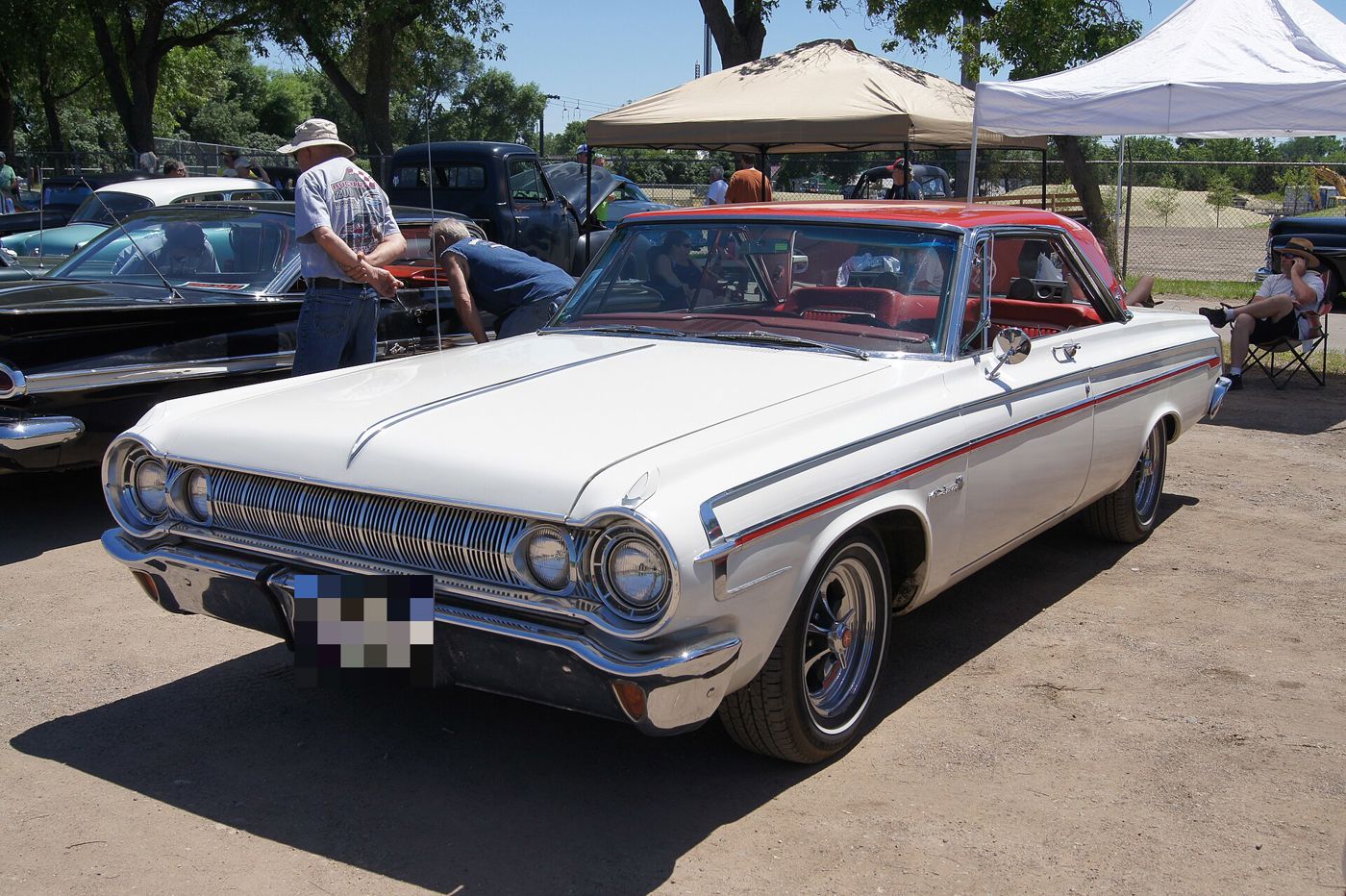
1964 Dodge Polara 500: Two Street Wedges Beside a Competition Hemi
Dodge sold the Polara 500 with a 383 or a single-four-barrel 426, closely mirroring Plymouth's catalog — which is itself evidence about how 1964 street performance was marketed.
United States · researched through July 26, 2026
Power-team selector
Choose the exact Polara
Dodge’s 1964 Polara brochure offered performance in layers. The Polara 500 two-door hardtop could carry a 383 four-barrel or a single-four-barrel 426 High Performance engine, each with a floor-shift four-speed configuration. Elsewhere the same brochure discussed a dual-four-barrel Ramcharger maximum-performance engine restricted to recognized competition participants. The page’s first job is to keep those audiences separate. Two street combinations enter the selector; the competition-only engine does not.
The 383 used a 4.25-inch bore, 3.38-inch stroke, and 10.0:1 compression. Dodge advertised 330 horsepower at 4,600 rpm and 425 lb-ft at 2,800 rpm. The selected Polara 500 pairs it with the optional four-speed floor shift. Those figures are preserved as period advertising, not treated as measured wheel output. The configuration establishes what a buyer could select without implying a particular surviving hardtop was built that way.
The 426 High Performance street engine retained the 4.25-inch bore and used a 3.75-inch stroke. Dodge listed 10.3:1 compression, 365 horsepower at 4,800 rpm, and 470 lb-ft at 3,200 rpm. For the single-four-barrel 426, the brochure identifies the four-speed floor shift as standard. That detail creates a particularly coherent power team and a clean comparison with the 383/four-speed branch.
The Polara’s full-size dimensions frame both choices: a 119-inch wheelbase, 209.8-inch overall length, and 75-inch width. It was longer than Plymouth Sport Fury and substantially larger than GTO or Chevelle. A comparison that shows only advertised horsepower would hide the different product idea. Dodge was offering high output inside a large, styled hardtop whose space, ride, and presence were part of the purchase.
Transmission applicability is part of that product idea rather than a generic footnote. The brochure’s wording supports an optional floor-shift four-speed with the 383 and identifies it as standard with the selected single-four-barrel 426. That means the two branches do not merely swap displacement: they carry different relationships between engine choice and transmission equipment. The selector preserves the relationship without inferring how often customers selected either combination.
The competition-only Ramcharger description is not a secret upgrade to the street configuration. Dodge’s own wording limits the maximum-performance dual-four-barrel engine to recognized and qualified participants. It therefore belongs with factory race specials, where eligibility, body preparation, distribution, and intended use can be explained. The public selector does not reward an exotic claim by stripping away the restriction printed beside it.
Stellantis’s later history makes the A864 distinction even clearer. The 426 Race Hemi drag package used lighter Dodge 330/440 and Plymouth Savoy/Belvedere bodies and deleted or relocated equipment in pursuit of elapsed time. It was described as non-street. Those features cannot be combined with Polara 500 trim to create a fictional showroom supercar. Race-special identity is its own provenance, not a higher point on the Polara options ladder.
Roger Lindamood’s “Color Me Gone” Dodge supplies the decisive competition story. NHRA confirms his Top Stock victory over factory teams at the 1964 Nationals, while Dodge history describes an all-Dodge final against the Ramchargers. The result belongs on the racing page with participant and sanctioning-body scope. It does not prove how a customer Polara accelerated, but it shows the corporate performance culture surrounding Dodge’s street offerings.
The Ramchargers add engineering detail with source labels attached. Dodge’s retrospective says the 426 Hemi replaced the Stage IV Max Wedge during 1964 and credits Gary Congdon with recommending a carburetor change. A claimed 130.06-mph class run remains participant-company history until the official event sheet is acquired. Tom Hoover may be described as the engineering leader in Stellantis’s account, but a full person page awaits a direct oral history, personnel record, SAE paper, or archived interview.
These boundaries let the Polara page tell a quieter but important story. Not every Dodge performance buyer was a qualified competition participant. The 383 and single-four-barrel 426 were strong street choices documented in the regular brochure, and the four-speed made each a distinct driver-controlled configuration. The race packages sat beyond them, visible enough to lend prestige but materially different in access and construction.
Exact production totals and matched road tests remain absent. A specialist count cannot become a factory total merely because it is repeated, and a drag package result cannot substitute for a Polara test. Future period journalism can supply measured observations if it identifies the body, engine, transmission, axle, tires, weight, weather, preparation, and method. Until then, the selector presents the source-backed catalog and leaves the stopwatch blank.
Survivor authentication follows the same hierarchy. A brochure can establish the appearance and factory availability of a Polara 500 combination, but badges, carburetors, and a floor shifter can be added during sixty years of ownership. A featured car will need its own serial and body records, period paperwork, ownership chain, and physical inspection. The publication describes a configuration class; it does not certify a vehicle offered for sale.
The comparison with Plymouth is especially revealing. Both divisions offered 383 and 426 street engines with similar advertised ratings, yet their bodies, wheelbases, trim identities, and transmission wording were not identical. Keeping separate configurations prevents Chrysler Corporation’s shared hardware from erasing divisional products. It also creates room to trace how marketing language and option applicability differed even where core engine dimensions converged.
Dodge in 1964 therefore occupied both the showroom and the starting line, but through different cars and rules. The Polara 500 offered two documented four-speed street power teams. The A864 and Ramcharger machinery pursued sanctioned competition under restricted conditions. Lindamood and the Ramchargers made the race side memorable; the brochure makes the customer side publishable. Treating each on its own terms produces a stronger muscle-car history than combining every Hemi-era fact under one badge.
The missing official event sheets and engineering interviews remain productive leads rather than hidden weaknesses. They can refine the competition branch without changing the ordinary Polara records, because street and race entities were separated from the beginning. That structure is what lets a future Tom Hoover interview, Ramchargers log, or NHRA bracket deepen the story instead of forcing another cleanup of blended claims.
Same model year
Also in 1964
- Buick Riviera The 425 became standard, the dual-quad Super Wildcat 360 arrived as an option, and the Super Turbine 400 replaced the twin-turbine automatic.
- Buick Wildcat The best Wildcat year at 84,245, with a 425 in 340- or 360-hp form and an available four-speed.
- Chevrolet Chevelle and Malibu SS The first Chevelle; the Malibu SS was a series, and its strongest released engine was the midyear 300 hp L74 327.
- Chevrolet Chevy II and Nova First V8 (283) year in the source engine table. Enthusiast-compiled production: 191,691 cars; Super Sport 10,576.
- Chevrolet El Camino SS No factory Super Sport El Camino is documented for this year; the record carries the host El Camino production as context.
- Chevrolet Impala SS Super Sport becomes its own series: 185,325 built.
- Chrysler 300 letter series Cheaper by about $1,000, with a single-four-barrel 360 hp 413 standard, leather made optional and the convertible restored, the 300K became the best-selling letter car: 3,022 hardtops and 625 convertibles.
- Dodge Dart 330/440, Polara and Max Wedge The Max Wedge's last year brought the Ramcharger 426-III, a 365 hp street 426 for Polara buyers, and in midyear a competition-only 426 Hemi in lightened 330/440 bodies; Roger Lindamood's Dodge won Top Stock at the Nationals.
- Ford Fairlane The year of the Thunderbolt: a midsize Fairlane with a 427 installed for NHRA Super Stock, which carried Gas Ronda to the national Stock title.
- Ford Falcon Sprint The restyled Falcon kept the Sprint hardtop and convertible with the 164 hp 260 V8 standard; the club counts 18,108 built, many with a bench seat.
- Ford Galaxie Ford sold its 427 in the restyled full-size range in two advertised versions, 410 hp with one four-barrel and 425 hp with two, and the Galaxie 500 XL hardtop was the bucket-seat flagship.
- Ford Thunderbird The redesigned fourth-generation car offered one drivetrain, a 300-hp 390 with Cruise-O-Matic, and output rose to 92,465.
- Mercury Comet and Cyclone The Cyclone name first appeared on a 1964 Comet hardtop; the only production figure found is a single secondary total.
- Mercury Marauder and S-55 Marauder now meant the fastback roof on any full-size Mercury series, two-door or four-door, with the 390 standard and the 427 optional.
- Oldsmobile Cutlass, 4-4-2 and Hurst/Olds Oldsmobile's first 4-4-2 was a mid-year option package, B09 Police Apprehender Pursuit, with a 310 hp 330, a four-speed and dual exhausts; 2,999 are tabulated.
- Oldsmobile Starfire Production fell to 16,163 as the cheaper Jetstar I took the same body; Motor Trend timed a convertible at 9.7 s to 60.
- Plymouth Barracuda and 'Cuda Plymouth's glassback Valiant-based fastback launched in a short first season and sold 23,443 cars.
- Plymouth Savoy, Fury and Max Wedge Plymouth's last Max Wedge year offered the Super Stock 426-III beside a 365 hp street 426 Commando, while a competition-only 426 Hemi went into lightened Savoy/Belvedere drag cars and swept the Daytona 500.
- Pontiac Catalina 2+2 and Super Duty The 2+2 arrived as a $291 Catalina option and the 370 hp 421 HO replaced the Super Duty at the top.
- Pontiac GTO A $295 option on the Tempest LeMans that put Pontiac's 389 in the intermediate body; 32,450 were built.
- Pontiac Grand Prix A carryover year: 63,810 built, with the 370 hp 421 HO at the top of the option list.
- Pontiac Tempest and LeMans The Tempest becomes a 115-inch intermediate with a 326 V8, and the LeMans carries the new GTO option.
- Studebaker Avanti The last Studebaker Avanti, cut short when South Bend stopped building cars on 20 December 1963. It got rectangular headlamp bezels and a level stance, and 809 were built, including the nine production R3s.
- Studebaker Hawk The final Hawk, with a new deck lid and an optional vinyl 'Sports Roof', ended when South Bend closed on 20 December 1963. 1,767 were built, 1,484 of them domestic.
- Studebaker Lark and Super Lark Brooks Stevens restyled the Lark-type line and the Daytona became its top series. Of the V8 Daytonas, 111 got the R1 and 48 the supercharged R2, and one got the only production R4, before South Bend closed in December 1963.