1969 · Ford · United States
1969 Ford Ranchero GT: a second year of Torino GT trim
A second year of Torino GT trim on the Ranchero: 1,658 GTs, with a separate line of 727 listed with bucket seats.
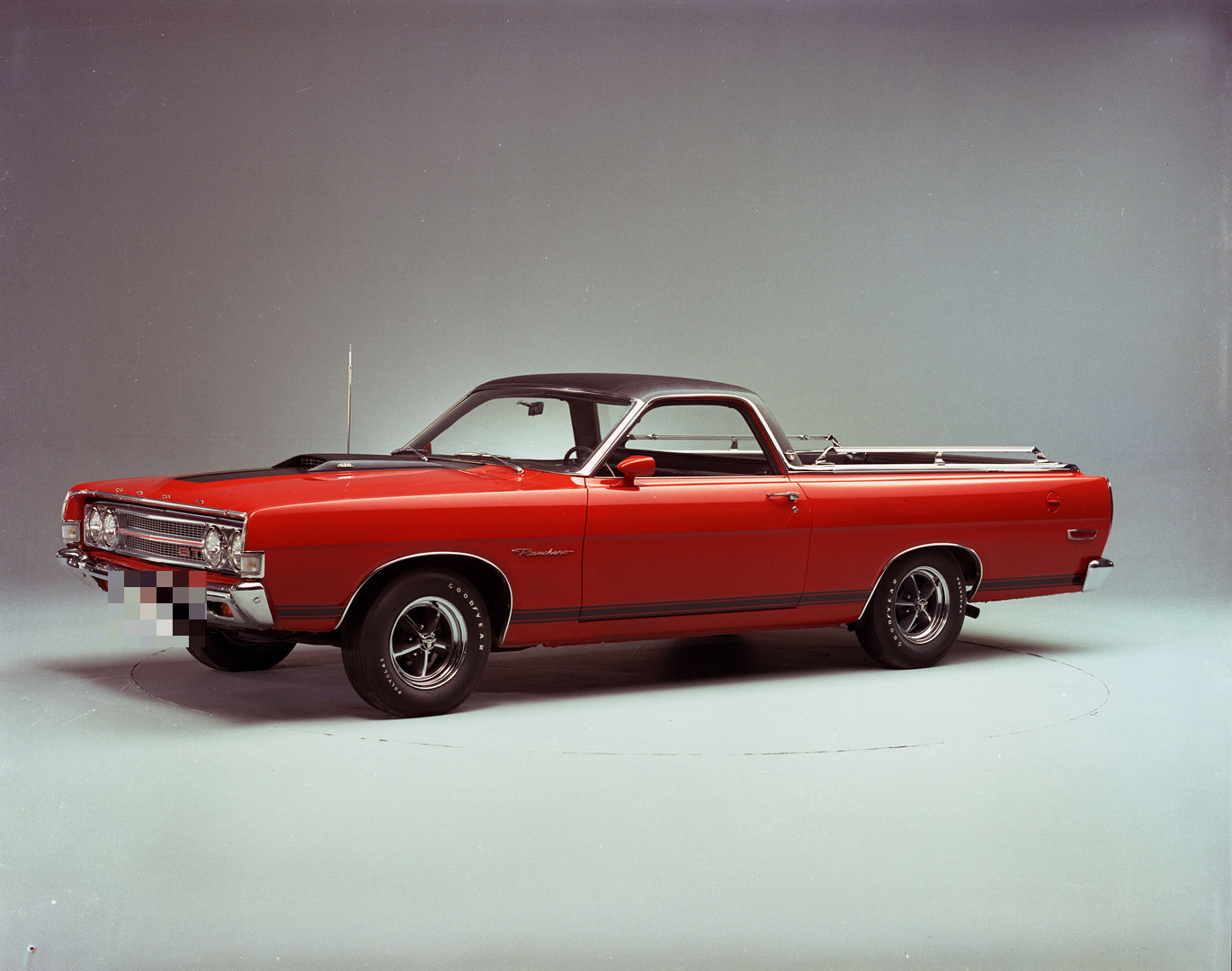
The 1969 Ranchero came in the same three trim levels as the 1968: the base Ranchero, the Ranchero 500 trimmed like the Fairlane 500, and the top Ranchero GT with Torino GT trim. The two years together make up the fourth-generation Ranchero, and in both the GT was the Ranchero dressed as a Torino GT. Ford built 1,658 Ranchero GTs for 1969, a figure usually attributed to the Standard Catalog of American Light-Duty Trucks. That made the GT the rarest of the three trims, against 5,210 base Rancheros and 11,214 Ranchero 500s for the model year. The GT also sat at the very top of the Ranchero price ladder for the year.1,2
A separate production line counts 727 "Ranchero GT with bucket seats" on its own. Ford-Torino.de, which lists it, does not say whether those are GTs counted within the 1,658 that were ordered with bucket seats, or a separate group of cars on top of them, so the two figures stand side by side rather than as a sum. For the Ranchero line as a whole, Jerry Heasley's 1977 Production Figure Book for U.S. Cars prints 19,455 cars for 1969, while conceptcarz gives 17,489; the two totals disagree by 1,966 cars, more than the entire GT output for the year. Ford-Torino.de's own rows come to 18,809 if the bucket-seat line is counted separately, which matches neither. Against any of those figures, the 1,658 GTs were a small part of the year's Ranchero output, with the 11,214 Ranchero 500s the largest single group by a wide margin.2,3,4
J.D. Power's valuation guide lists original prices of $2,623 for the Ford Ranchero Pickup, $2,740 for the Ford Ranchero 500 Pickup and $2,954 for the Ford Ranchero GT Pickup. The ladder was short: the Ranchero 500 sat $117 above the base pickup, and the GT another $214 above the 500, $331 over the cheapest Ranchero in all.5,2
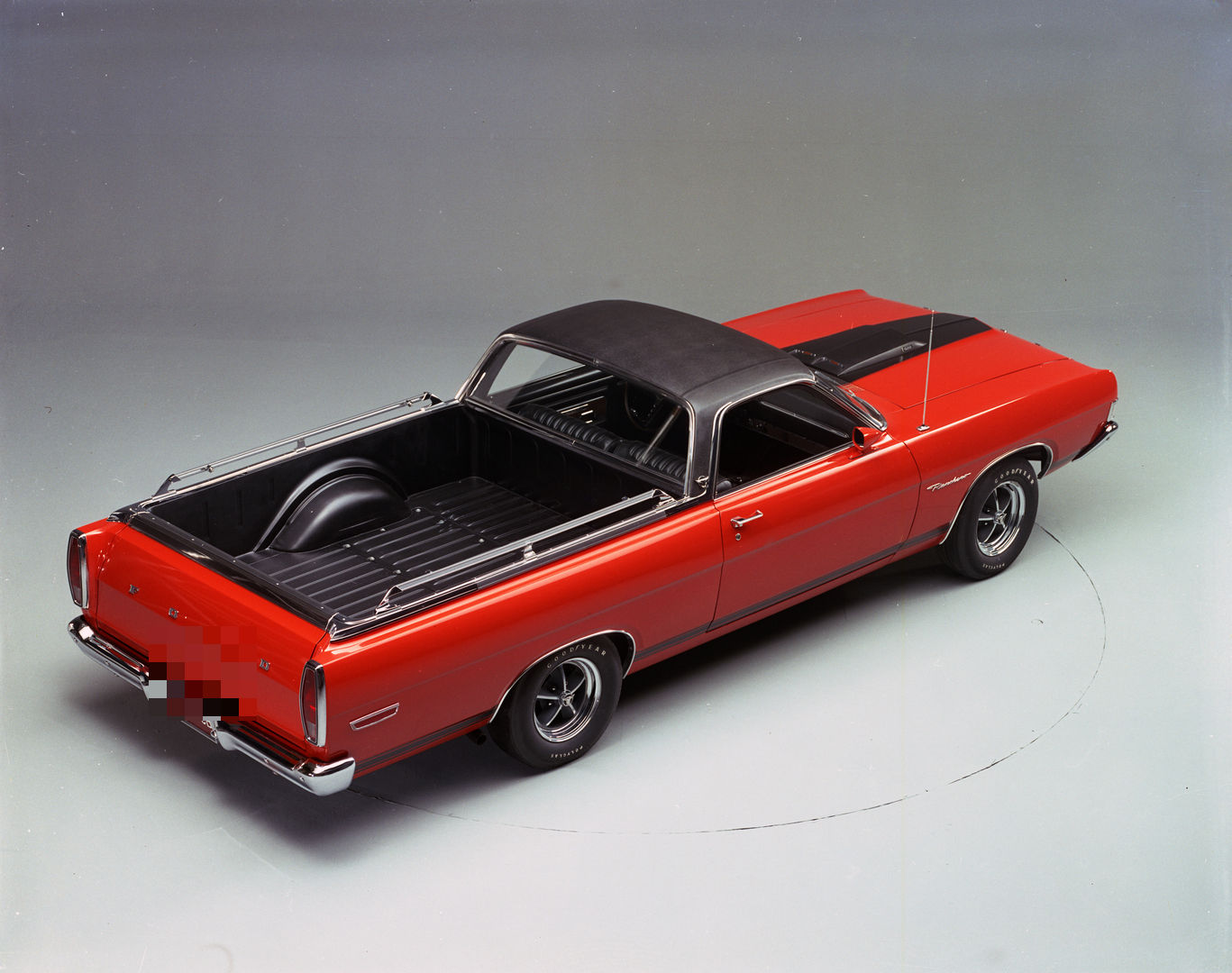
All three trims shared one chassis. Every 1969 Ranchero rode a 113.0-inch wheelbase, the same figure as the rest of the fourth-generation Ranchero built for both 1968 and 1969. On that common wheelbase the trims separated by finish and price: the base Ranchero, the Ranchero 500 in Fairlane 500 trim, and the GT in Torino GT trim at the top. Buyers leaned heavily toward the middle. Against Heasley's 19,455-car total, the 1,658 GTs come to about 8.5 percent of the year's Rancheros, and against conceptcarz's 17,489 about 9.5 percent, while the 11,214 Ranchero 500s alone account for well over half of either total.1,5,3,4,2
The 1,658-car GT figure turns up again and again in other places. A ranchero.us forum post gives the identical 1,658 GT figure alongside the same 727-car bucket-seat line, which it labels "GT Buckets", 5,210 base Rancheros and 11,214 Ranchero 500s, with the usual attribution to the Standard Catalog. A French enthusiast photo site, trombinoscar.com, gives the same 1,658-car GT figure and the same $2,954 GT and $2,623 base prices that J.D. Power's valuation guide lists, but a 5,856-car base-Ranchero line; Ford-Torino.de and the forum post both give 5,210 base Rancheros.2
Fact sheet · 1969 · United States
The numbers
1969 Ford Ranchero GT: A second year of Torino GT trim on the Ranchero: 1,658 GTs, with a separate line of 727 listed with bucket seats.
Figures may describe different groups of cars. Add rows together only when the note says they make up a total.
Production
| What was counted | Built |
|---|---|
| All 1969 Rancheros (Heasley printed total)3 all trims · sedan pickup · as published | 19,455 |
| All 1969 Rancheros (conceptcarz total)4 all trims · sedan pickup · as published | 17,489 |
| What was counted | Built |
|---|---|
| Ranchero GT2 GT · sedan pickup · as published | 1,658 |
| Ranchero GT with bucket seats2 GT with bucket seats · sedan pickup · as published | 727 |
| What was counted | Built |
|---|---|
| Ranchero (base)2 Ranchero (base) · sedan pickup · as published | 5,210 |
| Ranchero 5002 Ranchero 500 · sedan pickup · as published | 11,214 |
Prices when new *
| Model | Price | Price type |
|---|---|---|
| Ford Ranchero Pickup (J.D. Power listing)5 | $2,623 | original MSRP, 1969 model year |
| Ford Ranchero 500 Pickup (J.D. Power listing)5 | $2,740 | original MSRP, 1969 model year |
| Ford Ranchero GT Pickup (J.D. Power listing)5 | $2,954 | original MSRP, 1969 model year |
Prices are the nominal dollars of the day, not adjusted for inflation.
From J.D. Power's valuation guide; we can't verify it against a factory price list.
Specifications
| Measure | Value | Applies to |
|---|---|---|
| Wheelbase1 | 113 in | 1969 Ranchero, all trims |
Where the sources disagree
Identification
Read a 1969 Ford VIN
The VIN decoder runs in your browser and never sends the VIN anywhere. How the factory numbered this year's cars:
Same model year
Also in 1969
- AMC AMX The two-seat AMX's biggest year: 8,293 cars by the enthusiast production table, with a mid-year run of Big Bad colors and 52 Hurst-built Super Stock AMXs for NHRA drag racing.
- AMC Javelin Production fell to 40,675, but the 1969 Javelin added the Big Bad colors, with 2,282 cars painted blue, green or orange, plus the Mod package.
- AMC Rebel and Rebel Machine A base and SST Rebel with no convertible. The Big Bad colors were test-marketed through the New York–New Jersey 'Raider' hardtop. This is host-car context for the 1970 Machine.
- Buick Riviera Another record at 52,872 Rivieras; 5,272 had the GS handling option.
- Buick Skylark Gran Sport, GS and GSX Stage 1 became a factory GS 400 option, alongside distinct GS 350 and California GS choices; output, base-price and convertible-count disputes remain visible.
- Buick Wildcat 67,453 Wildcats; the last year of the 430.
- Chevrolet Chevelle and Malibu SS Super Sport became RPO Z25 option equipment, available for 1969 only on the 300 Deluxe coupes as well as Malibu sport coupe, convertible and El Camino.
- Chevrolet Chevy II and Nova SS is RPO Z26 per the source, with L48, L34 and L78 engines. Enthusiast-compiled production: 251,849 cars; Super Sport 17,564.
- Chevrolet El Camino SS SS 396 became RPO Z25 option equipment on the V8 Malibu El Camino, with 396s up to 375 hp; 86,307 Z25s across eligible models.
- Chevrolet Impala SS Only the SS427 (RPO Z24) remains; the reported count ranges from 2,425 to about 2,455.
- Dodge Charger The second-generation Charger's peak-sales year added the SE package and the aero-bodied Charger 500 and Charger Daytona homologation cars, whose production totals are still disputed.
- Dodge Coronet R/T and Super Bee The Super Bee added a hardtop body and the 440 Six Pack, while the 440-powered Coronet R/T continued as the upscale hardtop and convertible.
- Dodge Dart GTS, Swinger and Demon The low-priced Swinger 340 arrived and outsold the GTS by more than two to one (16,637 against about 6,700), while a 375 hp 440 joined the GTS options.
- Ford Fairlane The Fairlane hardtop was the intermediate line's volume leader, while the Fairlane 500 SportsRoof shared its body with the Torino GT, Cobra and Talladega.
- Ford Thunderbird Fifth-generation Thunderbird; only the whole-line production total was found.
- Ford Torino The Torino GT carried most of the line's volume, the 428 Cobra Jet was in its first full year, and the Talladega aero fastback was built in a short run at Atlanta to homologate a NASCAR nose.
- Mercury Comet and Cyclone The Cyclone fastback came as Cyclone and Cyclone CJ, mid-year Spoilers carried Dan Gurney and Cale Yarborough graphics, and the extended-nose Cyclone Spoiler II was built at Lorain for NASCAR homologation.
- Mercury Cougar A longer, restyled Cougar added a convertible, the Boss 302 arrived in April, and the Eliminator replaced the GT as the performance Cougar.
- Mercury Marauder and S-55 The Marauder name returned on a full-size hardtop, and the X-100 carried the 360 hp 429 four-barrel as its only engine.
- Oldsmobile Cutlass, 4-4-2 and Hurst/Olds The 4-4-2 kept its 400 while the second Hurst/Olds, in white and gold with a 380 hp 455, went into production at about 900 cars.
- Plymouth Barracuda and 'Cuda The last A-body Barracuda introduced the 'Cuda name as a stripped performance package with a standard 340, alongside Formula S and a midyear 440.
- Plymouth GTX, Belvedere and Satellite The GTX shared the Road Runner's new Air Grabber scoop and Super Track Pack but sold 15,602 cars, fewer than a fifth of the cheaper Road Runner.
- Plymouth Road Runner A convertible joined the coupe and hardtop, the 440 Six Barrel arrived at mid-year, and the Road Runner reached its production peak of 84,420.
- Pontiac Firebird and Trans Am The last first-generation Firebird, and the mid-year debut of the Trans Am package: 697 cars by the commonly published count, eight of them convertibles.
- Pontiac GTO Three four-barrel 400s under one nameplate, and the first year of the Judge package built around Ram Air power.
- Pontiac Grand Prix A new 118-inch Grand Prix with the SJ and a 390 hp 428 HO: production more than tripled to 112,486.
- Pontiac Tempest and LeMans The last year of the OHC Sprint six and the 350 HO.
- Rambler American and SC/Rambler AMC and Hurst put the 315-hp 390 V8 and a close-ratio four-speed into the compact Rambler hardtop for NHRA F/Stock. 1,512 were built, and the split between the two paint schemes is disputed.