1969 · Plymouth · United States
1969 Plymouth GTX: The Fastest Car in the Test, Outsold Five to One by Its Little Brother
The GTX shared the Road Runner's new Air Grabber scoop and Super Track Pack but sold 15,602 cars, fewer than a fifth of the cheaper Road Runner.
United States · researched through 2026-09-22
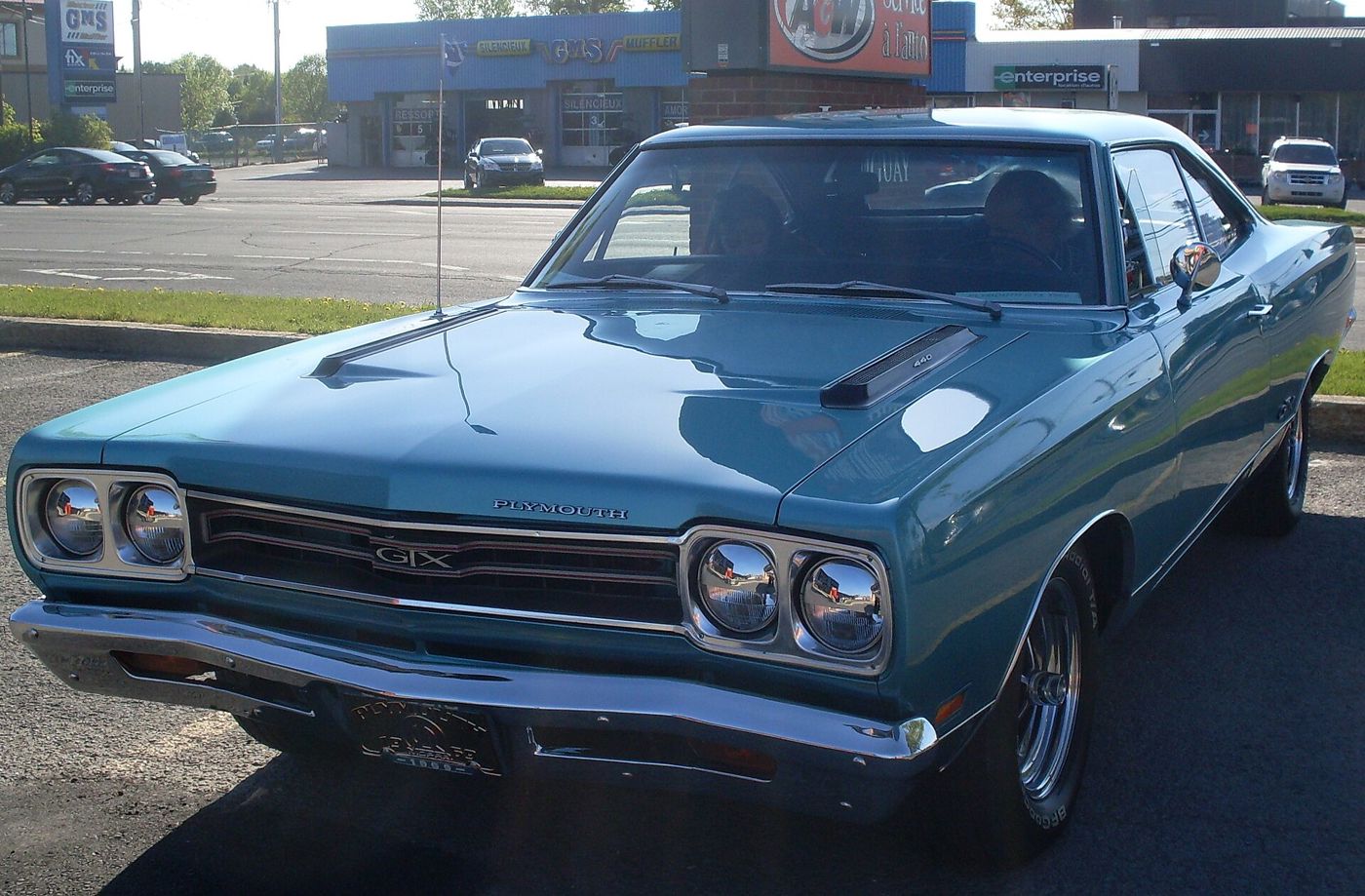
Motor Trend lined up six supercars for its January 1969 issue: a Plymouth GTX 440, a Dodge Charger R/T 440, a Ford Cobra 428 Cobra Jet, a Pontiac GTO 400, a Chevelle SS 396 and a Buick GS 400. Bill Sanders' verdict on the drag strip was not close. The GTX, he wrote, was "the flat out, best qualifier of all," and it posted the best times in every acceleration category the magazine measured: 0 to 60 mph in 5.8 seconds and the standing quarter-mile in 13.7 seconds at 102.8 mph. For a car that Plymouth's own showroom was about to leave behind, that was quite a send-off.1
The magazine was honest about the asterisk. Its test GTX, the text says, "had been romanced by Plymouth's fine tuning experts before we met it," and it ran the standard 440 with a three-speed automatic and a 4.10:1 axle. The Charger R/T carried the same engine and transmission on a 3.55 axle and ran 13.9 seconds at 101.4 mph, although Sanders' scale put the GTX 35 pounds heavier, 3,790 pounds against 3,755. Behind the Chrysler pair came the Cobra at 14.5 seconds, the GTO at 14.9, the SS 396 at 15.4 and the GS 400 at 15.9. Those numbers belong to those six prepared press cars, not to every GTX a dealer sold.1
The GTX had been Plymouth's answer to the Pontiac GTO since 1967: a fancier, big-engine version of the intermediate Satellite, as Ate Up With Motor describes it. For 1969 its standard engine was still the 440 Super Commando with one four-barrel, rated at 375 horsepower at 4,600 rpm and 480 lb-ft at 3,200 rpm on the SAE gross standard. The 426 Street Hemi, rated at 425 horsepower at 5,000 rpm and 490 lb-ft at 4,000, cost $700.90 on a GTX. The same history is blunt about how the formula had sold. Big engine, standard automatic and plush trim pushed the price well above the GTO, and GTX sales, it says, made depressing reading.2,3
The real competition was parked in the same showroom. Plymouth's stripped Road Runner had arrived for 1968 at $2,870, which Ate Up With Motor puts $559 below an equivalent GTX. For 1969 the Road Runner added a convertible, the Air Grabber and a 440 option of its own, and Motor Trend named it Car of the Year. Over-Drive's fact sheet draws the obvious conclusion: GTX sales dropped when the Road Runner was also offered as a convertible. Its production table shows 81,125 Road Runners built for the United States plus 3,295 for Canada and other markets, 84,420 in all, against 15,602 GTXs. Ate Up With Motor gives 82,109 Road Runner sales, on a basis it does not state.2,3
The GTX split its 15,602 cars between two bodies: 14,902 two-door hardtops, body code RS23, and 700 convertibles, RS27, which means convertibles were about one car in twenty-two. Even that small figure is not settled. Over-Drive's production table says 700 convertibles, while the text of the same fact sheet says 701, eleven of them with the Hemi, and the discrepancy sits inside a single compiler's work. Over-Drive also says 1969 was the last year the GTX offered a convertible. For the Hemi across the whole model, MuscleCarFacts reports 209 of its own 15,602-car total, and because the site does not name the record behind the number, it stands as that site's report.3,4
The buyer's list started at $3,416 for the hardtop and $3,635 for the convertible in Over-Drive's production table; Motor Trend's price panel printed a $3,433 base for its test car, a small gap the two sources do not explain. From there the GTX was built by checking boxes. The N96 Air Grabber cost $55, performance hood paint $18, the Track Pack $143 and the Super Track Pack $256, the latter only with the 440 or Hemi and a four-speed. Motor Trend described the Track Pack as a four-speed with Hurst shifter, 3.55 gears, viscous fan, dual-breaker distributor and Sure-Grip, with the Super Track Pack adding disc brakes and 4.10 gears. Its loaded test car came to $4,335.40.3,1
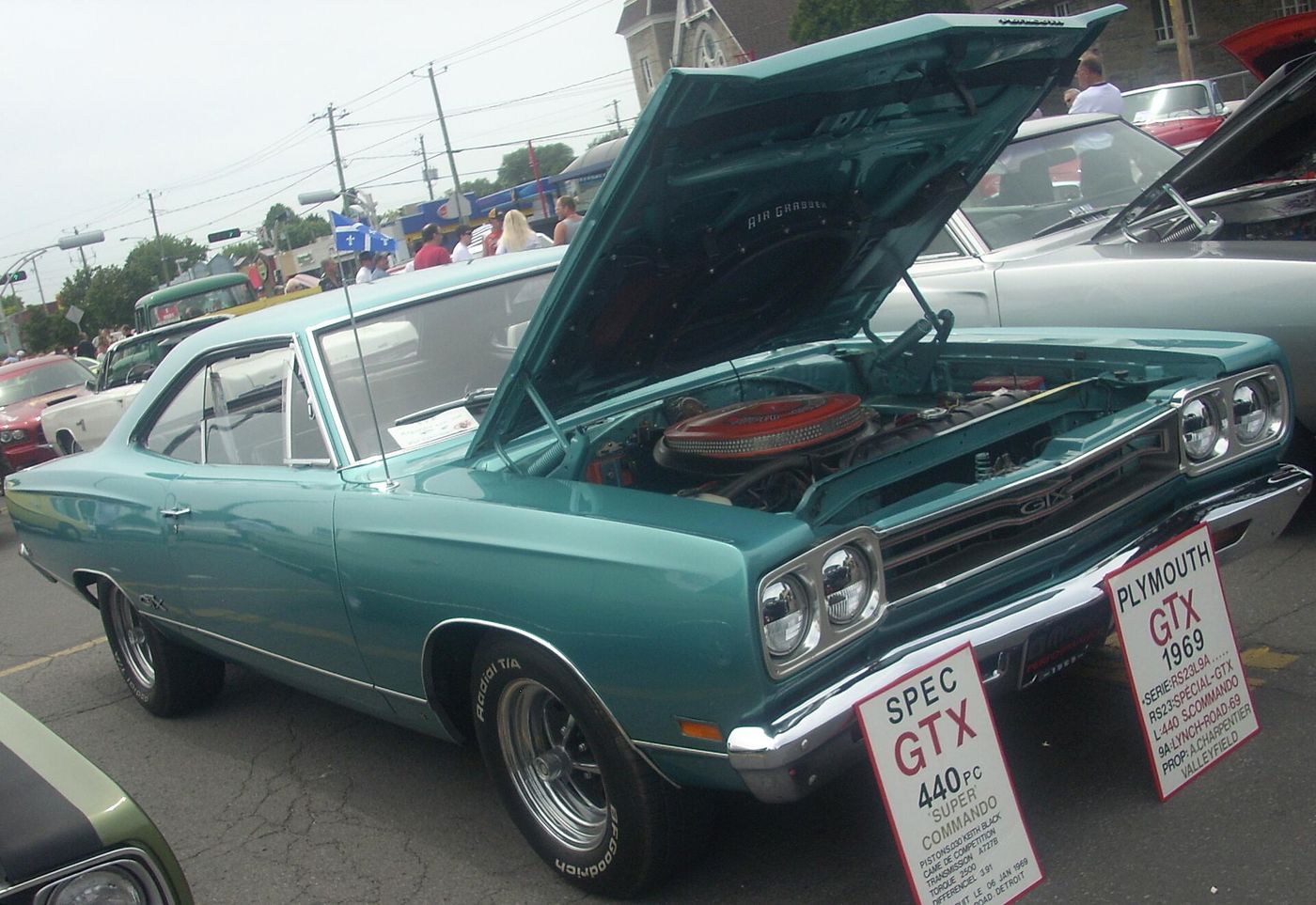
The Air Grabber was the season's new trick, and Motor Trend's description of the first version is worth keeping because Ate Up With Motor, for one, calls it a pop-up scoop. On the 1969 car, the magazine explained, a lever under the dash opened and closed vents that fed either outside or underhood air to the carburetor, and the louvers sat flush in the hood. Sanders liked that it kept the hood low and did not block the view the way the Cobra's scoop did. Over-Drive confirms the N96 Air Grabber was introduced that year. The same option code was offered on the Road Runner, so the cheaper car could breathe the same cold air for the same $55.1,3,2
Away from the drag strip Motor Trend was less generous. The GTX handled tolerably, with understeer that grew pronounced in tight turns, and the Sure-Grip and handling suspension made it hop around corners. The tachometer was too small for precise shifts, the car had no oil-pressure gauge, and the 4.10 axle spun the engine at 4,500 to 5,000 rpm at 65 to 70 mph. The text gives 8.7 to 10.4 mpg while the data table prints 9.9 to 10.8. Its overall-quality box is harsh: "Not too good. Body loose." The magazine did credit the GTX with the lowest trunk liftover of the six, 24 inches against the Charger's 34.1
On the superspeedways, 1969 was the year Plymouth lost its best-known driver. The Talladega and Spoiler Registry notes that 1969 was the only season Richard Petty raced a Ford, and that he won ten races in it. Dodge, meanwhile, had its Charger 500 and then the winged Charger Daytona, while Ford answered with the Torino Talladega and Mercury Cyclone Spoiler, according to Ate Up With Motor's history of the Dodge aero cars. Plymouth's intermediates had nothing comparable that year. The source trail here does not document the negotiations behind Petty's move, so the season is best told by its result: the brand's figurehead spent the year beating Chrysler products in a Ford.5,6
What followed came fast. Plymouth's own aero answer, the Road Runner Superbird, arrived for 1970 as a NASCAR homologation special, and Ate Up With Motor counts only 1,920 sold. The GTX carried on into 1970 as a hardtop only, while Road Runner sales fell to 41,484, which the same history ties to soaring insurance premiums on performance cars. The 1969 GTX is therefore the high-water mark of a car that did its job and still lost the argument: the quickest of six supercars in Motor Trend's January test, built about 15,600 times, while buyers who wanted speed more than carpet signed for more than five Road Runners for every GTX.2,3,1
Fact sheet · 1969 · United States
The numbers
1969 Plymouth GTX — The GTX shared the Road Runner's new Air Grabber scoop and Super Track Pack but sold 15,602 cars, fewer than a fifth of the cheaper Road Runner.
Coverage: Partial — researched sections are shown; missing ones are not yet sourced. Researched through 2026-09-22.
Every figure is labeled with how sure we are. Reported means a manufacturer, registry, or reference figure we cite but have not reconciled against factory records ourselves. Disputed means credible sources disagree and both are shown. Rows are separately scoped; don't add them together unless the note says they make up a total.
Key facts
- The 1969 Belvedere catalogue lists GTX standard equipment as the 440 Super Commando V-8, heavy-duty TorqueFlite (four-speed with Hurst shift optional with Track Pak), heavy-duty suspension and brakes, Red Streak Wide Boot tires, dual exhaust, deluxe all-vinyl bucket-seat interior, black lower-body paint with red or white reflective tape, and simulated hood air scoops.
Production
| What was counted | Count | Basis | Status |
|---|---|---|---|
| GTX 2-door hardtop (RS23)3 GTX · 2-door hardtop · not stated | 14,902 | not stated (production table), model-year | Reported |
| GTX convertible (RS27)3,3 GTX · convertible · not stated The same source gives 700 in its table and 701 in its text; see conflicts. | 700 | not stated, model-year | Disputed |
| What was counted | Count | Basis | Status |
|---|---|---|---|
| GTX model total3 GTX · not stated | 15,602 | not stated (production table), model-year | Reported |
| What was counted | Count | Basis | Status |
|---|---|---|---|
| GTX convertible, 426 Hemi3 GTX · convertible · 426 Hemi · not stated | 11 | not stated, model-year | Reported |
| GTX with 426 Hemi7 GTX · 426 Hemi · not stated Single secondary lineage (Chrysler/Govier figures as repeated by UltimateMuscleCar); scope not stated. | 209 | not stated, model-year | Reported |
Prices when new
| Model | Price | Basis |
|---|---|---|
| GTX 2-door hardtop3 | $3,416 | factory price (list, per production table), 1969 model year |
| GTX convertible3 | $3,635 | factory price (list, per production table), 1969 model year |
Prices are the nominal dollars of the day, not adjusted for inflation.
Engines
| Engine | Factory rating | Availability | Built |
|---|---|---|---|
| 440 Super Commando 4-bbl3 440 cu in · single 4-barrel | 375 hp @ 4,600, 480 lb-ft @ 3,200 (SAE gross) | standard in GTX | Not yet sourced |
| 426 Street Hemi3 426 cu in · two 4-barrels | 425 hp @ 5,000, 490 lb-ft @ 4,000 (SAE gross) | optional; $700.90 in GTX | Not yet sourced |
Ratings are the manufacturer's advertised figures under the standard shown (SAE gross before 1972, SAE net after). They are not dyno results, and gross and net ratings can't be compared directly.
Transmissions
| Transmission | Availability | Built |
|---|---|---|
| Four-speed manual3 | available with 440 and 426; $188-$197 (range price) | Not yet sourced |
| TorqueFlite automatic3 | available; $191-$227 with V-8s (range price) | Not yet sourced |
Options and packages
| Code | Option | Price | Installed |
|---|---|---|---|
|
426 Street Hemi (GTX)3 | $700.90 | Not yet sourced |
N96sales code |
Air Grabber hood scoop (Road Runner, GTX)3 | $55 | Not yet sourced |
|
Track Pack (Road Runner, GTX)3 | $143 | Not yet sourced |
|
Super Track Pack (Road Runner, GTX with 440 or 426 and four-speed)3 | $256 | Not yet sourced |
|
Super performance axle package (GTX with Hemi)3 | $242 | Not yet sourced |
|
Performance hood paint (Road Runner, GTX)3 | $18 | Not yet sourced |
|
Floral roof treatment3 | $96 | Not yet sourced |
|
Floral interior3 | $113 | Not yet sourced |
|
Four-speed manual floor shift (383 Hi-Po, 440, 426; price varies 188-197)3 | $188 | Not yet sourced |
|
Heavy-duty 70-ampere battery3 | $13 | Not yet sourced |
|
Optional rear axle ratio (2.76-4.10 where available)3 | $10 | Not yet sourced |
|
Auto speed control3 | $58 | Not yet sourced |
|
Bumper guards, front and rear3 | $32 | Not yet sourced |
|
Colour-keyed carpet mats3 | $14 | Not yet sourced |
|
Dual head rests (standard after January 1, 1969)3 | $27 | Not yet sourced |
|
Headlights-on signal3 | $7 | Not yet sourced |
|
Power brakes3 | $43 | Not yet sourced |
|
Solid-state AM radio3 | $62 | Not yet sourced |
|
Solid-state AM radio with tape3 | $196 | Not yet sourced |
|
Solid-state AM/FM radio3 | $135 | Not yet sourced |
|
Tinted glass3 | $41 | Not yet sourced |
|
Tinted windshield3 | $26 | Not yet sourced |
|
Air conditioning3 | $358 | Not yet sourced |
|
Chrome styled wheels, 14 inch, except Hemi3 | $100 | Not yet sourced |
|
Disc front brakes3 | $49 | Not yet sourced |
|
Performance gauges, without clock or tachometer3 | $17 | Not yet sourced |
|
Power steering3 | $100 | Not yet sourced |
|
Sure-Grip positive traction rear axle3 | $42 | Not yet sourced |
|
Tachometer, V-8 only3 | $50 | Not yet sourced |
Paint
| Code | Color | Built |
|---|---|---|
A4 |
Silver3 | Not yet sourced |
B3 |
Ice Blue3 | Not yet sourced |
B5 |
Blue Fire3 | Not yet sourced |
B7 |
Jamaica Blue3 | Not yet sourced |
F3 |
Frost Green3 | Not yet sourced |
F5 |
Limelight3 | Not yet sourced |
F8 |
Ivy Green3 | Not yet sourced |
L1 |
Sand Pebble Beige3 | Not yet sourced |
Q5 |
Seafoam Turquoise3 | Not yet sourced |
R4 |
Barracuda Orange3 | Not yet sourced |
R6 |
Scorch Red3 | Not yet sourced |
T3 |
Honey Bronze3 | Not yet sourced |
T5 |
Bronze Fire3 | Not yet sourced |
T7 |
Saddle Bronze3 | Not yet sourced |
W1 |
Alpine White3 | Not yet sourced |
X9 |
Black Velvet3 | Not yet sourced |
Y2 |
Sunfire Yellow3 | Not yet sourced |
Y3 |
Yellow Gold3 | Not yet sourced |
Y4 |
Spanish Gold3 | Not yet sourced |
Y6 |
Citron Gold3 | Not yet sourced |
999 |
Bahama Yellow (special-order 999 color)3 | Not yet sourced |
999 |
Orange (special-order 999 color)3 | Not yet sourced |
999 |
Rallye Green (special-order 999 color)3 | Not yet sourced |
Color names are the factory's. We don't show color swatches, because a screen color is no guide for a restoration.
Interiors
| Code | Trim | Built |
|---|---|---|
|
Deluxe all-vinyl interior with full-volume foam bucket seats and colour-keyed nylon carpeting (standard GTX) | Not yet sourced |
Specifications
| Measure | Value | Applies to |
|---|---|---|
| Wheelbase3 | 116 in | non-wagon bodies |
| Overall length3 | 204 in | non-wagon bodies |
| Shipping weight, GTX hardtop3 | 3,465 lb | RS23 |
| Shipping weight, GTX convertible3 | 3,590 lb | RS27 |
| Front brakes (Road Runner and GTX) | 11 x 3 in | drum; rear 11 x 2-1/2 in. |
Identification
- Series and body numbers
- Series ER2; GTX body RS23 = hardtop, RS27 = convertible.3
Where the sources disagree
Identification
Read a 1969 Plymouth VIN
The VIN decoder runs in your browser and never sends the VIN anywhere. How the factory numbered this year's cars:
Same model year
Also in 1969
- AMC AMX The two-seat AMX's biggest year: 8,293 cars by the enthusiast production table, with a mid-year run of Big Bad colors and 52 Hurst-built Super Stock AMXs for NHRA drag racing.
- AMC Javelin Production fell to 40,675, but the 1969 Javelin added the Big Bad colors, with 2,282 cars painted blue, green or orange, plus the Mod package.
- AMC Rebel and Rebel Machine A base and SST Rebel with no convertible. The Big Bad colors were test-marketed through the New York–New Jersey 'Raider' hardtop. This is host-car context for the 1970 Machine.
- Buick Riviera Another record at 52,872 Rivieras; 5,272 had the GS handling option.
- Buick Skylark Gran Sport, GS and GSX GS production fell to 12,465, and the GS 400's Stage 1 package became a factory option while Stage 2 stayed a dealer item.
- Buick Wildcat 67,453 Wildcats; the last year of the 430.
- Chevrolet Chevelle and Malibu SS Super Sport became RPO Z25 option equipment, available for 1969 only on the 300 Deluxe coupes as well as Malibu sport coupe, convertible and El Camino.
- Chevrolet Chevy II and Nova SS is RPO Z26 per the source, with L48, L34 and L78 engines. Enthusiast-compiled production: 251,849 cars; Super Sport 17,564.
- Chevrolet El Camino SS SS 396 became RPO Z25 option equipment, orderable on the V8 Malibu El Camino (13680); the El Camino share of the 86,307 Z25s is not separately published.
- Chevrolet Impala SS Only the SS427 (RPO Z24) remains; the reported count ranges from 2,425 to about 2,455.
- Dodge Charger The second-generation Charger's peak-sales year added the SE package and the aero-bodied Charger 500 and Charger Daytona homologation cars, whose production totals are still disputed.
- Dodge Coronet R/T and Super Bee The Super Bee added a hardtop body and the 440 Six Pack, while the 440-powered Coronet R/T continued as the upscale hardtop and convertible.
- Dodge Dart GTS, Swinger and Demon The low-priced Swinger 340 arrived and outsold the GTS by more than two to one (16,637 against about 6,700), while a 375 hp 440 joined the GTS options.
- Ford Fairlane The Fairlane hardtop was the intermediate line's volume leader, while the Fairlane 500 SportsRoof shared its body with the Torino GT, Cobra and Talladega.
- Ford Ranchero GT The Ranchero GT carried Torino GT trim; 1,658 GTs were built, per reference-site counts in the Standard Catalog lineage.
- Ford Thunderbird Fifth-generation Thunderbird; only the whole-line production total was found.
- Ford Torino The Torino GT carried most of the line's volume, the 428 Cobra Jet was in its first full year, and the Talladega aero fastback was built in a short run at Atlanta to homologate a NASCAR nose.
- Mercury Comet and Cyclone The Cyclone fastback came as Cyclone and Cyclone CJ, mid-year Spoilers carried Dan Gurney and Cale Yarborough graphics, and the extended-nose Cyclone Spoiler II was built at Lorain for NASCAR homologation.
- Mercury Cougar A longer, restyled Cougar added a convertible, the Boss 302 arrived in April, and the Eliminator replaced the GT as the performance Cougar.
- Mercury Marauder and S-55 The Marauder name returned on a full-size hardtop, and the X-100 carried the 360 hp 429 four-barrel as its only engine.
- Oldsmobile Cutlass, 4-4-2 and Hurst/Olds The 4-4-2 kept its 400 while the second Hurst/Olds, in white and gold with a 380 hp 455, went into production at about 900 cars.
- Plymouth Barracuda and 'Cuda The last A-body Barracuda introduced the 'Cuda name as a stripped performance package with a standard 340, alongside Formula S and a midyear 440.
- Plymouth Road Runner A convertible joined the coupe and hardtop, the 440 Six Barrel arrived at mid-year, and the Road Runner reached its production peak of 84,420.
- Pontiac Firebird and Trans Am The last first-generation Firebird, and the mid-year debut of the Trans Am package: 697 cars by the commonly published count, eight of them convertibles.
- Pontiac GTO Three four-barrel 400s under one nameplate, and the first year of the Judge package built around Ram Air power.
- Pontiac Grand Prix A new 118-inch Grand Prix with the SJ and a 390 hp 428 HO: production more than tripled to 112,486.
- Pontiac Tempest and LeMans The last year of the OHC Sprint six and the 350 HO.
- Rambler American and SC/Rambler AMC and Hurst put the 315-hp 390 V8 and a close-ratio four-speed into the compact Rambler hardtop for NHRA F/Stock. 1,512 were built, and the split between the two paint schemes is disputed.