1969 · AMC · United States
1969 AMC AMX: Hurst Super Stocks, Big Bad Paint and a Total Nobody Can Pin Down
The two-seat AMX's biggest year: 8,293 cars by the enthusiast production table, with a mid-year run of Big Bad colors and 52 Hurst-built Super Stock AMXs for NHRA drag racing.
United States · researched through 2026-09-22
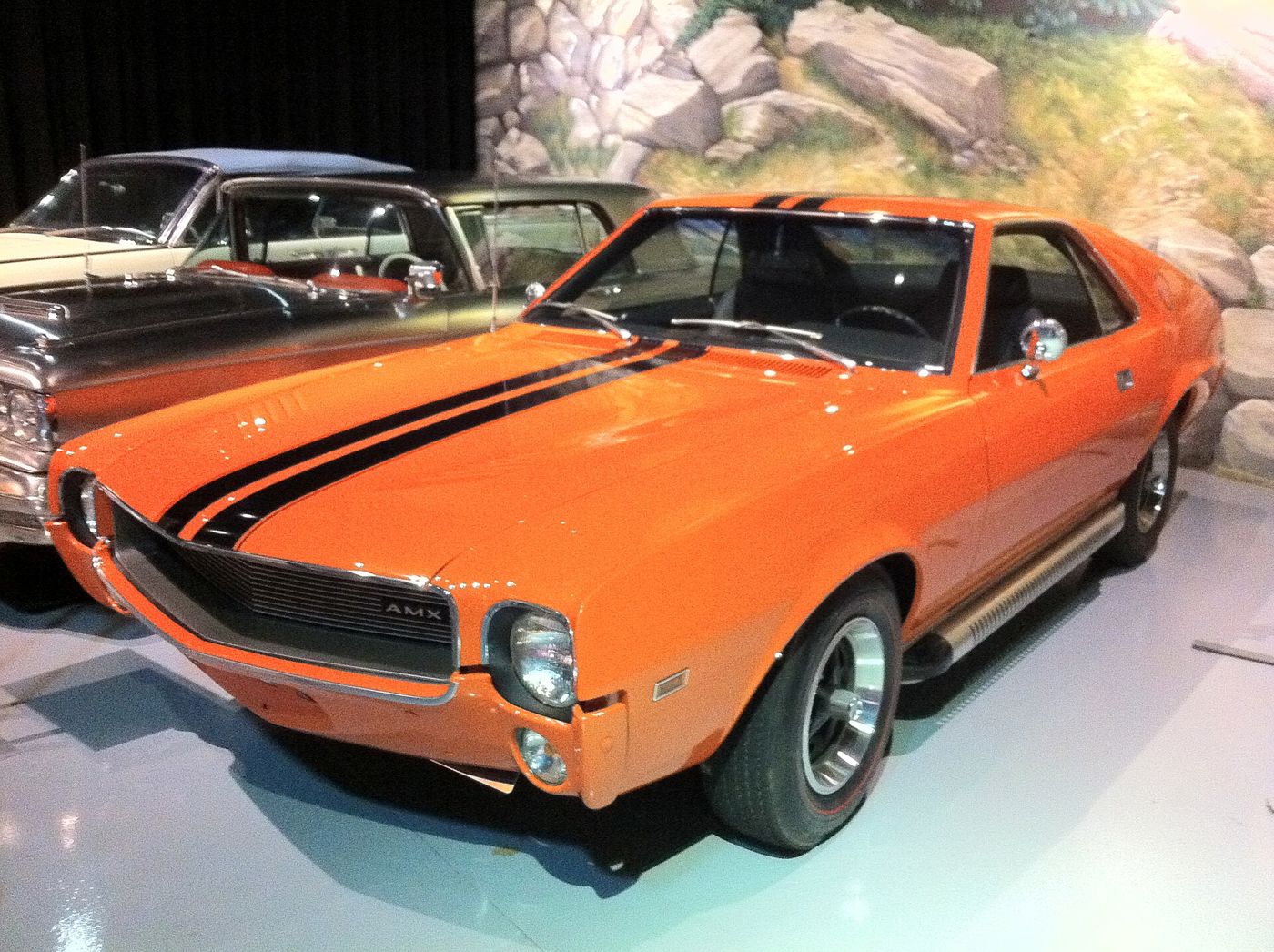
Before Hurst built a single Super Stock AMX, Shirley Shahan and her husband and crew chief, H.L. Shahan, built the prototype themselves. Mac's Motor City Garage reports that their mule ran in the “11-seconds-flat zone” at better than 120 mph. Shahan, known as the Drag-On Lady, then took an AMX to the U.S. Nationals at Indianapolis and won class honors on its first trip there. That was a new kind of result for American Motors, a company whose showroom reputation had been built on sensible Ramblers. The AMX was in its second model year, and 1969 was the year AMC took its short two-seater to the drag strip, painted it in loud colors and sold more of them than it ever would again.1
Mac's Motor City Garage describes the goal as shedding a “granny-car image” and reaching the young performance buyer. The tool was a factory drag car. Hurst Performance had done the same job for Chrysler in 1968 with the Dodge Dart and Plymouth Barracuda super stockers. At its Detroit facility it converted 52 Frost White production AMXs into racers legal for NHRA Super Stock. The SS/AMX registry numbers those Hurst cars #1 through #52 and lists non-Hurst cars separately. Mac's counts 53 when the Shahan-built prototype is included, and JavelinAMX.com prints “53 (?).” Read carefully, 52 and 53 are two scopes, Hurst-built cars and all cars including the prototype, not two competing counts of the same thing.1,2,3
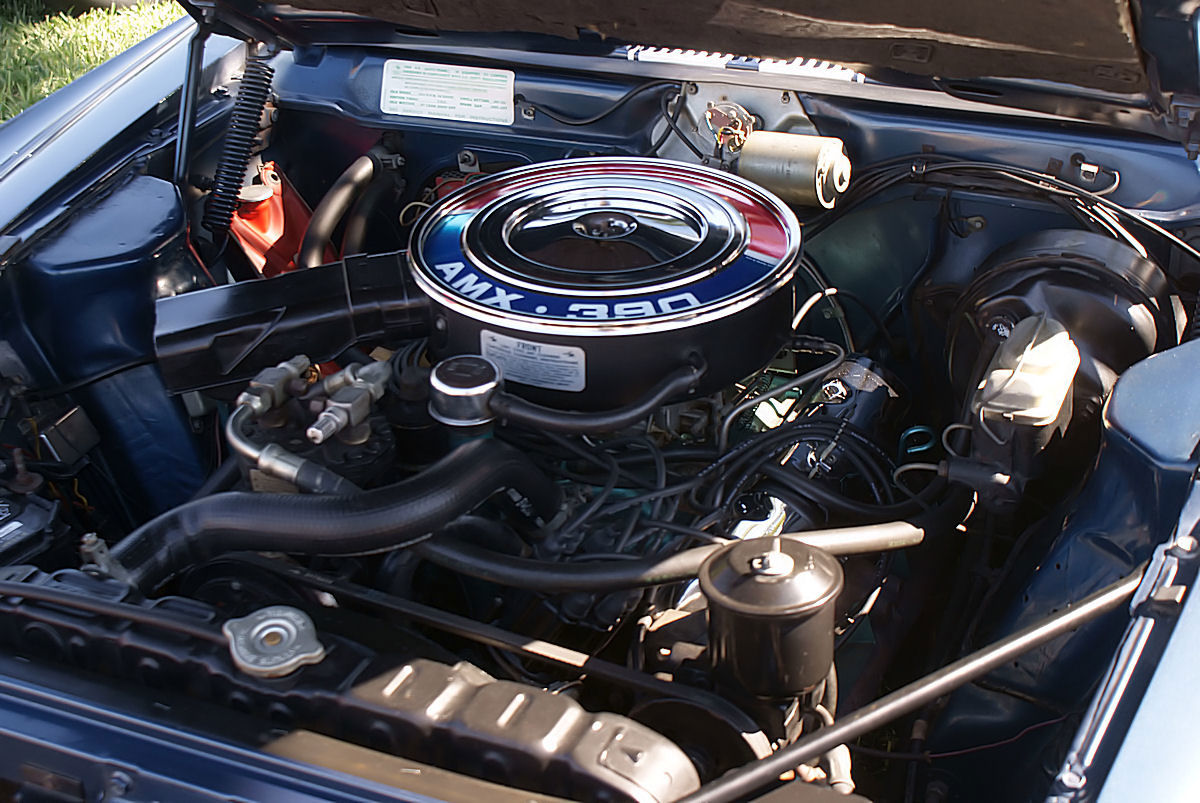
The conversion went far past a hot street car. According to Mac's, the 390 was built with 12.3:1 compression, Crane-modified heads, an Edelbrock cross-ram intake and two Holley 650-cfm four-barrels, behind a Borg-Warner four-speed and a 4.44:1 Twin-Grip axle, at a quoted curb weight of 3,050 pounds. AMC advertised 340 horsepower. NHRA refactored the engine to 420, so the cars were classed first in SS/E and later in SS/D and SS/C, and Mac's says they set and reset SS/E records. The factory price was $5,994, and Street Muscle adds that the car came without a warranty. About 40 survive by both articles' counts, and the registry's index lists 39.1,2
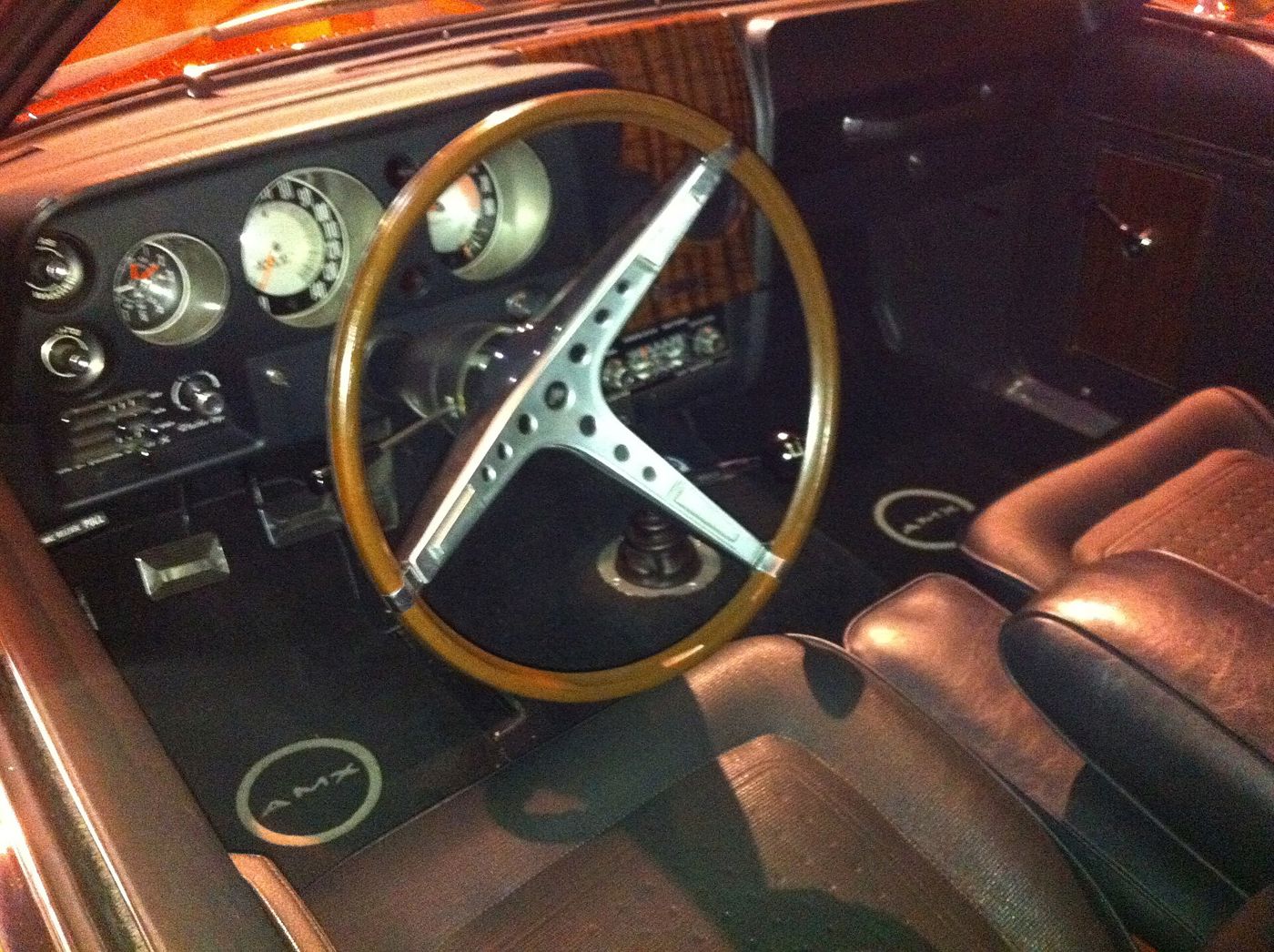
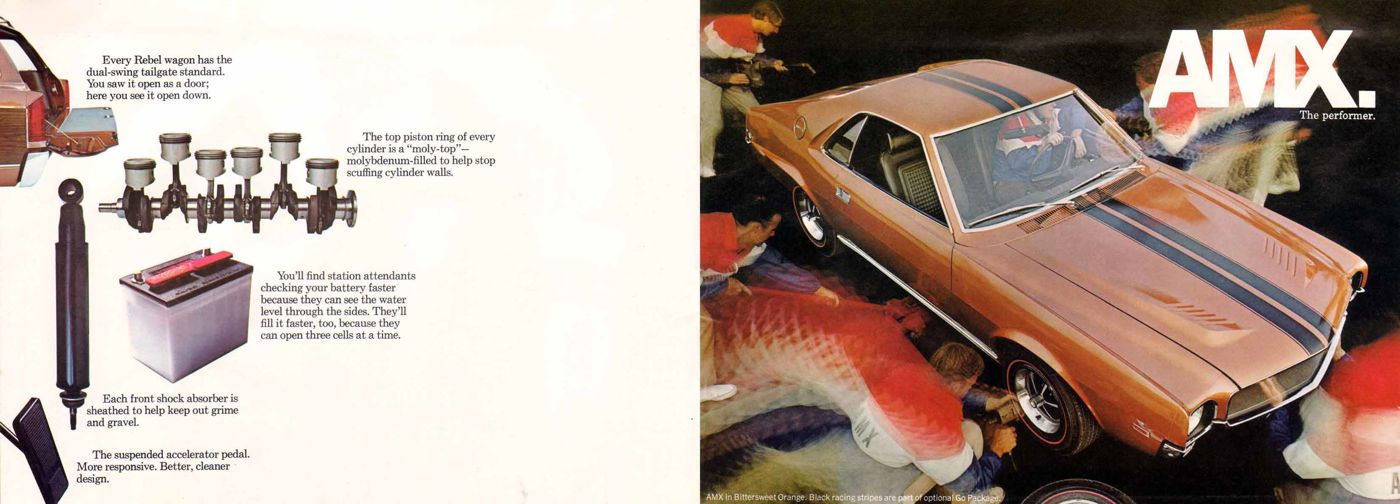
The street AMX changed little. AMC's 1969 full-line brochure presented it as its own two-seat model beside the Javelin and the SC/Rambler, with the 343 at 280 horsepower and 365 lb-ft and the 390 at 315 horsepower and 425 lb-ft, both available with a four-speed. The 290 remained the base V8. OldRide's table gives body 6939-7 a factory price of $3,297, against the $3,245 Old Cars Weekly reports for 1968; neither source states what the price includes. The Go Package carried over for 343 and 390 cars: dual exhaust, power disc brakes, redline tires, Twin-Grip, the handling package, heavy-duty cooling and over-the-top stripes. Its $5,994 price put the Super Stock AMX in a different world from the showroom car.4,5,6,1
How many AMXs did Kenosha build for 1969? The honest answer is two numbers. Planet Houston AMX's engine-and-transmission table, repeated by JavelinAMX.com, gives 8,293. The same site's weekly production series, credited to Linn Barton, ends at 8,317, which is 24 cars more. The two figures do not come from separate investigations, and neither has been traced to an AMC production report. The arithmetic suggests where the gap sits. The option table's transmission rows, 5,082 four-speeds and 3,235 automatics, add up to 8,317, the weekly figure. The engine table's six cells add up to 8,293. The two tables were compiled on different bases, and the source does not reconcile them.7,8,3
A second, smaller dispute sits inside the engine table itself. Planet Houston AMX gives 3,620 390 four-speeds for 1969, while a widely read Wikipedia copy of the table prints 3,690. The 3,620 figure is the one that fits the table's own 1969 total and its three-year 390 four-speed total of 7,364, so it leads here. Taking 8,293 as the denominator, the 390 went into 5,803 cars (3,620 four-speeds and 2,183 automatics), about 70 percent. The 343 accounted for 1,572 and the 290 for just 918. The buyer mix also swung toward the clutch: four-speeds took 5,082 of the 8,293 cars, roughly 61 percent, after automatics had outnumbered them in 1968.7,9
The same compilation shows how the cars were equipped. Power front disc brakes went on 6,276 cars and Twin-Grip on 6,569, both roughly three-quarters or more of an 8,293-car year. Stripes appeared on 6,159 and Rally wheels on 4,941. Air conditioning went on 1,742, and quick-ratio steering on 912. Leather was now offered in charcoal and saddle, and the counts are 1,377 charcoal-leather and 1,525 saddle-leather interiors. The compiler warns that dealers could install many options, and that the Go Package does not appear in the VIN or on the door tag. Only a window sticker, dealer order form or build sheet proves a Go Package car, whatever its hood stripes say.7,6
Mid-year, AMC made the AMX impossible to miss. The Big Bad colors, a vivid blue, green and orange, reached the two-seater, and Planet Houston AMX counts 195 blue, 284 green and 283 orange 1969 AMXs. JavelinAMX.com agrees on green and orange but gives 176 blue, and it says its Big Bad figures include the California 500 cars. Both counts are shown. Planet Houston AMX also states that no factory breakdown of regular-color production exists. The Big Bad numbers are therefore the only color data for the year, and they come from one enthusiast lineage. Even on the most generous reading, fewer than one 1969 AMX in ten wore a Big Bad color.7,3
Other famous 1969 AMX stories are left out because their counts rest on a single encyclopedia article. These include a California dealer special and a group of Pikes Peak pace cars, whose numbers disagree even within that article. What the documented record supports is enough. In 1969 AMC sold an AMX that buyers most often ordered with the 390 and a four-speed, and it put 52 Hurst-converted cars into Super Stock drag racing at $5,994 apiece. Shirley Shahan carried one to class honors at Indianapolis. In little more than a year, the two-seater had gone from a record-breaking image car to a class winner at the U.S. Nationals.9,7,1
It was also the peak. Whether the year's total is 8,293 or 8,317, 1969 is the largest of the three two-seat years. The engine-and-transmission table gives 6,725 for the half-year 1968 run and 4,116 for 1970. The 52 Hurst cars are counted inside the 1969 total, not on top of it. Today the Super Stock AMXs are among the most carefully tracked AMCs, numbered one by one in a registry, while the ordinary cars' paint colors were never broken out at all. That contrast is the lesson of the year's production record: the rarest cars are the best documented, and the most common figure, the model-year total, is the one still in dispute.7,8,2
Fact sheet · 1969 · United States
The numbers
1969 AMC AMX — The two-seat AMX's biggest year: 8,293 cars by the enthusiast production table, with a mid-year run of Big Bad colors and 52 Hurst-built Super Stock AMXs for NHRA drag racing.
Coverage: Partial — researched sections are shown; missing ones are not yet sourced. Researched through 2026-09-22.
Every figure is labeled with how sure we are. Reported means a manufacturer, registry, or reference figure we cite but have not reconciled against factory records ourselves. Disputed means credible sources disagree and both are shown. Rows are separately scoped; don't add them together unless the note says they make up a total.
Key facts
- 1969 AMX production 8,293 (engine/transmission table); 390 with four-speed was the largest single combination at 3,620.7
- Big Bad AMX colors, 1969: blue 195, green 284, orange 283 (Planet Houston AMX); JavelinAMX.com gives blue 176.7,3
- Super Stock AMX: the SS/AMX registry numbers 52 Hurst-built cars; Mac's Motor City Garage counts 53 including the Shahan-built prototype.2,1
- Power front disc brakes were installed on 6,276 1969 AMXs and Twin-Grip on 6,569, per the option-installation table.7
Production
| What was counted | Count | Basis | Status |
|---|---|---|---|
| AMX, all engines7,3 AMX · 2-seat fastback coupe · US production (Kenosha) Both sites are one enthusiast lineage. The weekly series gives 8,317; see conflicts. | 8,293 | built, model-year | Disputed |
| AMX, sum of weekly production series8 AMX · 2-seat fastback coupe · US production (Kenosha) Weekly figures credited to Linn Barton; basis differs from the model-year table. | 8,317 | built (weekly build tally), model-year | Disputed |
| AMX, all engines (AMC tally sheet)10 AMX · 2-seat coupe · US, Canada and export market; built at Kenosha Same figure as the enthusiast table, which appears to be transcribed from this sheet; not an independent lineage. The weekly series total of 8,317 remains a separate claim. | 8,293 | built, model-year | Reported |
| What was counted | Count | Basis | Status |
|---|---|---|---|
| 290 V8, four-speed7 AMX · 2-seat coupe · 290 V8 · 4-speed manual · US | 619 | built, model-year | Reported |
| 290 V8, automatic7 AMX · 2-seat coupe · 290 V8 · automatic · US | 299 | built, model-year | Reported |
| 343 V8, four-speed7 AMX · 2-seat coupe · 343 V8 · 4-speed manual · US | 843 | built, model-year | Reported |
| 343 V8, automatic7 AMX · 2-seat coupe · 343 V8 · automatic · US | 729 | built, model-year | Reported |
| 390 V8, four-speed7 AMX · 2-seat coupe · 390 V8 · 4-speed manual · US Wikipedia's copy of the table prints 3,690; 3,620 is the value consistent with the table's own totals. See conflicts. | 3,620 | built, model-year | Disputed |
| 390 V8, automatic7 AMX · 2-seat coupe · 390 V8 · automatic · US | 2,183 | built, model-year | Reported |
| What was counted | Count | Basis | Status |
|---|---|---|---|
| Automatic transmission (option-installation table)7 AMX · 2-seat coupe · automatic · US The engine/transmission table's automatic cells total 3,211; the option table and the engine table are separately scoped and not reconciled by the source. | 3,235 | installed, model-year | Reported |
| Four-speed transmission (option-installation table)7 AMX · 2-seat coupe · 4-speed manual · US | 5,082 | installed, model-year | Reported |
| What was counted | Count | Basis | Status |
|---|---|---|---|
| Big Bad Blue7 AMX · 2-seat coupe · US JavelinAMX.com gives 176; see conflicts. | 195 | built, model-year | Disputed |
| Big Bad Green7,3 AMX · 2-seat coupe · US JavelinAMX.com says its Big Bad AMX figures include the California 500 cars. | 284 | built, model-year | Reported |
| Big Bad Orange7,3 AMX · 2-seat coupe · US | 283 | built, model-year | Reported |
| What was counted | Count | Basis | Status |
|---|---|---|---|
| Hurst Super Stock AMX (SS/AMX)2,1 SS/AMX · 2-seat coupe · 390 V8, twin four-barrel · 4-speed manual · US; converted by Hurst Mac's Motor City Garage counts 53 including one prototype built by Shirley and H.L. Shahan; JavelinAMX.com gives '53 (?)'. Included in the AMX total. | 52 | converted (registry car numbers), model-year | Reported |
| What was counted | Count | Basis | Status |
|---|---|---|---|
| 290 V8, all transmissions (AMC tally sheet)10 AMX · 2-seat coupe · 290 V8 · US, Canada and export market; built at Kenosha Equals 619 + 299 in the enthusiast engine-transmission table. | 918 | built, model-year | Reported |
| 343 V8, all transmissions (AMC tally sheet)10 AMX · 2-seat coupe · 343 V8 · US, Canada and export market; built at Kenosha Equals 843 + 729 in the enthusiast table. | 1,572 | built, model-year | Reported |
| 390 V8, all transmissions (AMC tally sheet)10 AMX · 2-seat coupe · 390 V8 · US, Canada and export market; built at Kenosha Equals 3,620 + 2,183 in the enthusiast table, which supports 3,620 over the 3,690 printed elsewhere for the 390 four-speed. | 5,803 | built, model-year | Reported |
The six engine-transmission rows are the source's partition of its 8,293 total.
Big Bad color counts come from the same enthusiast lineage. The source states there is no factory breakdown of regular-color production.
Option-installation rows are separately scoped. Do not add them.
The AMC tally-sheet rows (sheet-*) restate the 8,293 by engine; they are not additional cars.
Prices when new
| Model | Price | Basis |
|---|---|---|
| AMX (body 6939-7)4 | $3,297 | 'factory price' as tabulated by OldRide (basis not stated), 1968-09 |
| Hurst Super Stock AMX1 | $5,994 | factory price as reported (no warranty per Street Muscle), 1969 |
Prices are the nominal dollars of the day, not adjusted for inflation.
Engines
| Engine | Factory rating | Availability | Built |
|---|---|---|---|
| 290 V8 4-bbl9 290 cu in · 4-barrel | 225 hp @ 4,700, 300 lb-ft @ 3,200 (period factory advertised (gross era)) | standard | 91810 Reported |
| 343 V8 4-bbl 343 cu in · 4-barrel | 280 hp @ 4,800, 365 lb-ft @ 3,000 (period factory advertised) | optional | 1,57210 Reported |
| 390 V8 4-bbl 390 cu in · 4-barrel | 315 hp @ 4,600, 425 lb-ft @ 3,200 (period factory advertised) | optional | 5,80310 Reported |
| 390 V8, two Holley four-barrels (SS/AMX)1 390 cu in · two 650-cfm Holley 4-barrels | 340 hp (advertised rating as reported); 420 hp (NHRA class factor (not a dyno measurement)) | Hurst SS/AMX only | Not yet sourced |
Ratings are the manufacturer's advertised figures under the standard shown (SAE gross before 1972, SAE net after). They are not dyno results, and gross and net ratings can't be compared directly.
Transmissions
| Transmission | Availability | Built |
|---|---|---|
| Four-speed manual | standard | 5,0827 Reported |
| Automatic7 | optional | 3,2357 Reported |
Options and packages
| Code | Option | Price | Installed |
|---|---|---|---|
|
Go Package (343 or 390): dual exhaust, power disc brakes, E70x14 redline tires, Twin-Grip, handling package, heavy-duty cooling, over-the-top stripes6 | — | Not yet sourced |
|
AM radio7 | — | 5,9197 Reported |
|
AM/FM radio7 | — | 1,2427 Reported |
|
Clock7 | — | 4,2787 Reported |
|
Air conditioning7 | — | 1,7427 Reported |
|
Command Air7 | — | 8937 Reported |
|
Power steering7 | — | 5,5897 Reported |
|
Quick-ratio steering7 | — | 9127 Reported |
|
Power drum brakes7 | — | 4717 Reported |
|
Power front disc brakes7 | — | 6,2767 Reported |
|
Twin-Grip limited-slip differential7 | — | 6,5697 Reported |
|
Full tinted glass7 | — | 2,9857 Reported |
|
Tinted windshield only7 | — | 1,7847 Reported |
|
Optional wheelcovers7 | — | 1,3997 Reported |
|
Rally wheels7 | — | 4,9417 Reported |
|
Tilt steering column7 | — | 1,7587 Reported |
|
Remote driver mirror7 | — | 4,9917 Reported |
|
Electric wipers7 | — | 5,9777 Reported |
|
Stripes7 | — | 6,1597 Reported |
|
Standard (manual) steering7 | — | 1,8167 Reported |
|
Standard manual drum brakes7 | — | 1,5707 Reported |
|
Clear glass, all windows7 | — | 3,5487 Reported |
|
Standard wheelcovers7 | — | 1,9777 Reported |
|
Special application of American Motors colors | — | Not yet sourced |
|
Leather seats | — | Not yet sourced |
|
Rally stripe (five colors) | — | Not yet sourced |
|
AMX 343 Go Package | — | Not yet sourced |
|
AMX 390 Go Package | — | Not yet sourced |
|
Power brakes (drum) | — | Not yet sourced |
|
Console with floor automatic transmission | — | Not yet sourced |
|
8-track stereo tape player with manual AM radio and 2 rear speakers | — | Not yet sourced |
|
Solex glass, windshield only / all windows | — | Not yet sourced |
|
Turbo-cast wheel covers (14-inch wheels) | — | Not yet sourced |
|
Wire wheel covers (14-inch wheels) | — | Not yet sourced |
|
Styled steel wheels (set of four) | — | Not yet sourced |
|
Bumper guards, rear only | — | Not yet sourced |
|
Standard on AMX: all-vinyl upholstery, reclining bucket seats, dual exhaust (290, 343 and 390), tachometer and 140-mph speedometer, sports steering wheel, wheel discs | — | Not yet sourced |
Paint
| Code | Color | Built |
|---|---|---|
|
Big Bad Blue7 | 1957 Disputed |
|
Big Bad Green7 | 2847 Reported |
|
Big Bad Orange7 | 2837 Reported |
Color names are the factory's. We don't show color swatches, because a screen color is no guide for a restoration.
Interiors
| Code | Trim | Built |
|---|---|---|
931 (trim F) |
Charcoal, Ventilaire vinyl, reclining seats7 | 2,8107 Reported |
931L |
Charcoal leather7 | 1,3777 Reported |
932 (trim F) |
Platinum, Ventilaire vinyl7 | 7337 Reported |
935 (trim F) |
Red, Ventilaire vinyl7 | 5957 Reported |
936 (trim F) |
Saddle tan, Ventilaire vinyl7 | 1,2527 Reported |
936L |
Saddle leather7 | 1,5257 Reported |
Specifications
| Measure | Value | Applies to |
|---|---|---|
| Shipping weight4 | 3,097 lb | body 6939-7, as tabulated |
| Wheelbase5 | 97 in | 1968–70 two-seat AMX |
| Curb weight, Super Stock AMX1 | 3,050 lb | Hurst SS/AMX |
| Rear axle ratio, Super Stock AMX1 | 4.44 :1 | Hurst SS/AMX, Twin-Grip |
| Compression ratio, Super Stock AMX 3901 | 12.3 :1 | Hurst SS/AMX |
| Axle ratio, four-speed floor (standard; optional) | 290: 3.54; 343 and 390: 3.54 (3.15) :1 | AMX |
| Axle ratio, Shift-Command automatic on console (standard; optional) | 2.87 (3.15) with 290, 343 and 390; 3.15 standard with Go Packages :1 | AMX |
| Dealer-installed axle ratios | 3.73, 3.91, 4.10, 4.44, 5.00 :1 | any V-8 transmission combination, extra cost |
| Engine compression ratio and bore x stroke | 290 4-bbl: 10.0:1, 3.75 x 3.28 in; 343 4-bbl: 10.2:1, 4.08 x 3.28 in; 390 4-bbl: 10.2:1, 4.17 x 3.57 in (premium fuel) | by engine |
Identification
- Interior trim code
- Door-tag trim code: first digit is the year (9 = 1969), '30' identifies the 1968–70 AMX, the third digit is the color, and the letter is the material (F Ventilaire vinyl, L leather).7
- Go Package and Big Bad cars
- Neither the VIN nor the door tag records the Go Package; only a window sticker, dealer order form or build sheet proves it.6
Where the sources disagree
1969 AMX model-year total
Show 8,293 as the widely published model-year figure and 8,317 as the weekly-tally figure, both attributed. Neither is reconciled to an AMC document.
1969 AMX 390 four-speed count
Lead with 3,620, which is consistent with the table's 1969 total and the three-year 390 four-speed total of 7,364. Note that 3,690 appears in a widely read copy.
Identification
Read a 1969 AMC VIN
The VIN decoder runs in your browser and never sends the VIN anywhere. How the factory numbered this year's cars:
Same model year
Also in 1969
- AMC Javelin Production fell to 40,675, but the 1969 Javelin added the Big Bad colors, with 2,282 cars painted blue, green or orange, plus the Mod package.
- AMC Rebel and Rebel Machine A base and SST Rebel with no convertible. The Big Bad colors were test-marketed through the New York–New Jersey 'Raider' hardtop. This is host-car context for the 1970 Machine.
- Buick Riviera Another record at 52,872 Rivieras; 5,272 had the GS handling option.
- Buick Skylark Gran Sport, GS and GSX GS production fell to 12,465, and the GS 400's Stage 1 package became a factory option while Stage 2 stayed a dealer item.
- Buick Wildcat 67,453 Wildcats; the last year of the 430.
- Chevrolet Chevelle and Malibu SS Super Sport became RPO Z25 option equipment, available for 1969 only on the 300 Deluxe coupes as well as Malibu sport coupe, convertible and El Camino.
- Chevrolet Chevy II and Nova SS is RPO Z26 per the source, with L48, L34 and L78 engines. Enthusiast-compiled production: 251,849 cars; Super Sport 17,564.
- Chevrolet El Camino SS SS 396 became RPO Z25 option equipment, orderable on the V8 Malibu El Camino (13680); the El Camino share of the 86,307 Z25s is not separately published.
- Chevrolet Impala SS Only the SS427 (RPO Z24) remains; the reported count ranges from 2,425 to about 2,455.
- Dodge Charger The second-generation Charger's peak-sales year added the SE package and the aero-bodied Charger 500 and Charger Daytona homologation cars, whose production totals are still disputed.
- Dodge Coronet R/T and Super Bee The Super Bee added a hardtop body and the 440 Six Pack, while the 440-powered Coronet R/T continued as the upscale hardtop and convertible.
- Dodge Dart GTS, Swinger and Demon The low-priced Swinger 340 arrived and outsold the GTS by more than two to one (16,637 against about 6,700), while a 375 hp 440 joined the GTS options.
- Ford Fairlane The Fairlane hardtop was the intermediate line's volume leader, while the Fairlane 500 SportsRoof shared its body with the Torino GT, Cobra and Talladega.
- Ford Ranchero GT The Ranchero GT carried Torino GT trim; 1,658 GTs were built, per reference-site counts in the Standard Catalog lineage.
- Ford Thunderbird Fifth-generation Thunderbird; only the whole-line production total was found.
- Ford Torino The Torino GT carried most of the line's volume, the 428 Cobra Jet was in its first full year, and the Talladega aero fastback was built in a short run at Atlanta to homologate a NASCAR nose.
- Mercury Comet and Cyclone The Cyclone fastback came as Cyclone and Cyclone CJ, mid-year Spoilers carried Dan Gurney and Cale Yarborough graphics, and the extended-nose Cyclone Spoiler II was built at Lorain for NASCAR homologation.
- Mercury Cougar A longer, restyled Cougar added a convertible, the Boss 302 arrived in April, and the Eliminator replaced the GT as the performance Cougar.
- Mercury Marauder and S-55 The Marauder name returned on a full-size hardtop, and the X-100 carried the 360 hp 429 four-barrel as its only engine.
- Oldsmobile Cutlass, 4-4-2 and Hurst/Olds The 4-4-2 kept its 400 while the second Hurst/Olds, in white and gold with a 380 hp 455, went into production at about 900 cars.
- Plymouth Barracuda and 'Cuda The last A-body Barracuda introduced the 'Cuda name as a stripped performance package with a standard 340, alongside Formula S and a midyear 440.
- Plymouth GTX, Belvedere and Satellite The GTX shared the Road Runner's new Air Grabber scoop and Super Track Pack but sold 15,602 cars, fewer than a fifth of the cheaper Road Runner.
- Plymouth Road Runner A convertible joined the coupe and hardtop, the 440 Six Barrel arrived at mid-year, and the Road Runner reached its production peak of 84,420.
- Pontiac Firebird and Trans Am The last first-generation Firebird, and the mid-year debut of the Trans Am package: 697 cars by the commonly published count, eight of them convertibles.
- Pontiac GTO Three four-barrel 400s under one nameplate, and the first year of the Judge package built around Ram Air power.
- Pontiac Grand Prix A new 118-inch Grand Prix with the SJ and a 390 hp 428 HO: production more than tripled to 112,486.
- Pontiac Tempest and LeMans The last year of the OHC Sprint six and the 350 HO.
- Rambler American and SC/Rambler AMC and Hurst put the 315-hp 390 V8 and a close-ratio four-speed into the compact Rambler hardtop for NHRA F/Stock. 1,512 were built, and the split between the two paint schemes is disputed.